
Tag: Canada
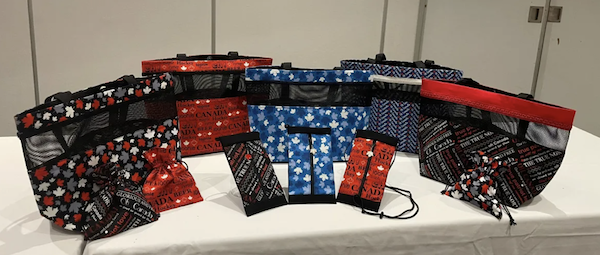
O Canada! tote bag line
Tikun Olam Gogos’ O Canada! bags proclaim dedication to the ethic of improving the world in friendship with other nations, raising much-needed funds for grandmothers in sub-Saharan Africa who are raising their grandchildren due to the HIV & AIDS pandemic. (photo from Tikun Olam Gogos)
As proud Canadians and fundraisers for the Stephen Lewis Foundation Grandmothers to Grandmothers Campaign, Tikun Olam Gogos have launched a special edition line of O Canada! tote bags – determined to respond to the threats American tariffs pose to Canada, and to the suspension of USAID, which is devastating to the Gogos’ partner organizations in Africa.
According to Stephen Lewis, “Lives will be lost. Our best contribution at this perilous moment is to attempt to replace the resources that America has expunged.”
Tikun Olam Gogos’ response to the White House is to raise more funds by intensifying its efforts to handcraft and market its O Canada! line of large tote bags, zippered and drawstring pouches.
Tikun Olam Gogos (TOG) is part of the Greater Vancouver Gogos, which includes about 20 Gogo groups across the Lower Mainland. Gogo is the Zulu word for “grandmother” and tikkun olam is Hebrew for “repair of the world.” TOG is a volunteer group of grandmothers and grand-others (non-members who help out the group periodically) in Vancouver that was founded in May 2011 and is sponsored by the Sisterhood of Temple Sholom. Its mission is to raise awareness, build solidarity and mobilize support in Canada for grandmothers in sub-Saharan Africa who are raising their grandchildren due to the HIV & AIDS pandemic.
In 14 years of operation, Tikun Olam Gogos has raised more than half a million dollars for the SLF Grandmothers to Grandmothers Campaign. With its partners in Africa reeling from the withdrawal of other international programs, TOG is more determined than ever to fulfil its motto: “we will not rest until they can rest.”
Priced at $50, just $5 more than TOG’s original signature totes, the O Canada! bags proclaim dedication to the ethic of improving the world in friendship with other nations. So, wear your maple leaf and your heart proudly on your O Canada! tote. You are telling the world “Canada cares.”
To order your O Canada! tote bags, zippered pouches and drawstring pouches, visit tikunolamgogos.org or call Joyce Cherry at 604-261-5454.
– Courtesy Tikun Olam Gogos
בורחים מטראמפ ועוברים לקנדה
מספר האמריקאים שעוזבים את ארה”ב ועוברים למדינה השכנה מצפון – קנדה – הולך וגדל. זאת, בעיקר עקב בחירתו המחודשת של דונלד טראמפ לנשיא המדינה
קרוב למאה אלף אמריקאים חצו את הגבול בעשר השנים האחרונות והפכו לתושבי קבע או אזרחים, לפי דיווח של ממשלת קנדה. וזאת בעיקר עקב בחירתו של טראמפ בפעם הראשונה לנשיאות (לפני כתשע שנים), לצד הרגשת חוסר הביטחון האישי, שהיו מהגורמים המרכזיים להגירה לקנדה
בעקבות המתיחות הפוליטית הגוברת בארה”ב, בוודאי אחרי בחירתו בחודש נובמבר של טראמפ לנשיא האמריקני בפעם השנייה, והזעזועים החברתיים העמוקים, יותר ויותר אמריקאים בוחנים אפשרות להגר לקנדה. נתוני גוגל טרנדס מראים זינוק משמעותי בחיפושים אחר מעבר לקנדה, שהחלו לאחר העימות הטלוויזיוני בין הנשיא היוצא ג’ו ביידן לטראמפ, כשביידן נראה מבולבל מאוד לאורך השידור, כך לפי דיווחים בעיתונות האמריקנית
מהלנה-רי ג’ונסון, אישה שחורה בת ארבעים ושתיים, מייצגת את גל ההגירה הזה. ג’ונסון, שגדלה בדרום ארה”ב ועברה ללוס אנג’לס, החליטה בשנת אלפיים ושמונה עשרה עבור לקנדה עם בן זוגה. היא רצתה לחיות במקום שבו המדינה לא נמצאת במלחמה מתמדת. לדבריה במדינה כמו קנדה היא מקום בו היא מרגישה בטוחה יותר עם משפחתה
לפי נתוני ממשלת קנדה, בין השנים אלפיים וחמש עשרה ועד הרבעון השלישי של שנה שעברה, קיבלו למעלה מתשעים ושלושה אלף אמריקאים תושבות קבע בקנדה. המספרים עולים בהתמדה כמעט מדי שנה מאז בחירתו של טראמפ לנשיאות בארה”ב בפעם הראשונה
אולם החיים בקנדה אינם חסרי אתגרים ובעיות. יותר ויותר אמריקאים מדווחים על הקשיים הכלכליים במעבר. כך למשל, כריס אולט בן הארבעים, שעבר מפורטלנד לויקטוריה במחוז בריטיש קולומביה, סיפר שהדירה שלו בארה”ב בבניין מגורים עלתה כשלוש מאות אלף דולר. ואילו אותה דירה בקנדה עולה בין חצי מיליון לתשע מאות אלף דולר. ובתים פרטיים הרבה יותר יקרים בקנדה ומחירם נאמד סביב מיליון דולר או אף יותר
האמריקנים שעברו לקנדה מספרים שהשירות הרפואי בקנדה הוא חינם עבור אזרחים ותושבי קבע, או בעלות נמוכה מאוד. וזה יתרון אדיר מול ארה”ב שבה השירות הרפואי עולה הרבה מאוד כסף, ויש משפחות מתקשות להתמודד עם הוצאה חיונית וגדולה זו. מצד שני זמני ההמתנה לטיפולים רפואיים ארוכים במיוחד בקנדה, עם תורים שיכולים להגיע לשנה וחצי עבור ניתוחים לא דחופים. המצב כל כך חמור עד כדי כך שאנשים נאלצים לטוס למדינות אחרות, כולל בחזרה לארה”ב, כדי למשל לעבור ניתוחים מסובכים
למרות בעיות ההגירה הקשורות בקנדה, המהגרים מדווחים על יתרונות משמעותיים. מערכת החינוך נחשבת איכותית יותר, והביטחון האישי גבוה יותר, בעיקר בכל מה שקשור לעניין רישוי הנשק, שהוא פרוץ לגמרי בארה”ב. וזה מעלה חשש גדול אצל הורים ששולחים ילדים למסגרות החינוך נוכח תקריות הירי, שהפכו כבר לדי שכיחות במדינתם
אם כן, אמנם קנדה מהווה פתרון אטרקטיבי לאמריקאים שמחפשים שינוי נוכח התנודות הפוליטיות במדינה והחשש לביטחון האישי שלהם, אבל היא לא אוטופיה. גם במדינה השכנה יש לא מעט מורכבויות ואתגרים כלכליים, חברתיים ותרבותיים. וכידוע חיי מהגרים לא תמיד קלים במיוחד בשנים הראשונות לקליטתם במדינתם החדשה
טראמפ שנכנס שוב הפעם לבית הלבן מדיר שינה מאמריקנים רבים שמבינים היטב עד כמה הוא מסוכן למדינתם, למערב ובעצם לעולם כולו. ועל כן מספר המהגרים מארה”ב לקנדה צפוי לגדול בשנים הקרובות. בקנדה שמתעבים את טראמפ מקבלים את האמריקנים בזרועות פתוחות כבני משפחה לכל דבר ועניין.
Interesting time to live
It is said that a week is a lifetime in politics and – well, would you look at that? – it is almost exactly a week before the Liberal Party of Canada selects its new leader to replace Prime Minister Justin Trudeau.
Conventional wisdom says that leader will be Mark Carney. Of course, if conventional wisdom were dependable, prime ministers John Turner and Kim Campbell would have gone down in history as figures in the biggest landslides in electoral history. Of course, those “fresh faces” were indeed involved in two of Canada’s most decisive electoral sweeps – just not in the ways they had hoped. Both had taken what appeared to be their respective parties’ hopeless chances and revived their fortunes temporarily before being devastated in their parties’ worst showings to date when the votes came in.
Both Campbell and Turner were, to an extent, known quantities, though Turner had been out of the political scene for close to a decade and Campbell was a single-term cabinet minister without the deepest roots in federal politics when she became the country’s first (and, to date, only) female prime minister.
So, while conventional wisdom tells us that Carney will be the next Liberal leader – and, by convention, as leader of the governing party, prime minister – conventional wisdom can be bubkes, as Turner and Campbell learned.
Carney, former head of both the Bank of Canada and the Bank of England, has never held elective office. Many Canadians wouldn’t recognize him in the lineup at Tim Horton’s. In a time of economic anxiety, Carney’s undeniable credibility on that topic is the selling point that has brought members of the Liberal caucus to his campaign by an almost four-to-one margin over presumed second-place candidate Chrystia Freeland, whose shock resignation led to Trudeau’s retirement in the first place.
In any event, surveys suggest that, under Carney, the Conservatives under Pierre Poilievre would go from shoo-ins to a neck-and-neck race. One poll suggests that, given Anyone-But-Trudeau, centre-left voters would rally around Carney to keep the Conservatives out, with New Democratic Party support crashing to half of what it gained in the last election.
Whoever wins the probably-almost-immediate general election after the leadership vote will inherit one of the most unenviable scenarios. With the once and once again US President Donald Trump reprising his role as global disruptor, threatening the Canadian (and global) economy with tariffs, aggression and assorted chaos, the new Canadian leader will walk a tightrope of defending Canadian interests while not unnecessarily rattling the cage of the Most Powerful Man in the World ™. Trump injects variables into politics that can never be accurately predicted – and Canadian leaders will be forced to react.
It is almost inevitable that everything will be seen through a prism of Trumpism, including the flashpoint issue of the Middle East conflict. With the US president repeatedly promising variations on the theme of “all hell” if developments do not go in Israel’s favour, fragile diplomacy, such as it ever has been between Israel and its neighbours, seems to be a thing of the past – particularly with Israel’s Prime Minister Binyamin Netanyahu largely echoing Trump’s sociopathic scheme for some sort of Las Vegas in the Gaza Strip.
Canadian voters tend to make electoral decisions on domestic issues, not foreign policy. Nevertheless, there is another variable that could play a sleeper in the coming election. It’s something few people seem to have on the radar but that may emerge as things unfold.
Anti-Israel activists (call them “pro-Palestinian” if you will, though it is hard to see how stopping traffic, chanting slogans, burning flags, etc., are aiding Palestinians) are no doubt planning to continue disrupting any public event where they can make their case against Israel. While justifying the atrocities of Oct. 7 as “brilliant” and justifiable, for example, is probably a bridge too far even for those most sympathetic to the Palestinian people and those who desire peace, depend on these extremists to nonetheless disrupt political events across the country – and do not expect them to do so in stereotypically polite Canadian style.
There are a lot of external variables facing Canadian politicians in the coming weeks. Responding to harangues from Washington by an unprecedented leader will force our own leaders to respond. Closer to home, expect disruptions and pandemonium from so-called “pro-Palestinian” activists. How politicians react to these unpredictable interventions could change the trajectory of the race. How Canadians, in turn, respond to the politicians’ reactions could prove one of the most volatile variables in the unsettled political firmament.
A profoundly false (we think) assumption says that Canadian politics and history are boring. In this era, a more ancient dictum – the curse “May you live in interesting times” – seems more apt.
מדינה במשבר
אירוע השבעה באוקטובר הנורא גרם לטראומה קשה מאוד אצל ישראלים רבים. ישראל מעולם לא חוותה אירוע כל כך קשה שגרם נזק נפשי גדול לתושבי המדינה שנמצאת במשבר שהולך ומתעצם
חלק מהישראלים מנסה לחזור לשגרת היום יום ויש אחרים המתסכלים החוצה אל מה שקורה בעולם. יש שרוצים לעזוב את ישראל ועל פי נתונים רשמיים כבר למעלה משמונים אלף עבור לגור בחו”ל. בפועל המספר צפוי להיות גדול יותר. אחרים רוצים לתפוס קצת מנוחה בחו”ל למספר ימים וכידוע נסיעה לחו”ל היא אחד התחביבים הידועים של הישראלים. המשבר הנוכחי יצר אף תופעה חדשה של ישראלים המלכלכים על העולם שלא עצר מלכת, או שמחפשים נקודות תורפה במדינות שנות – כדי לטעון שהחיים ישראל טובים יותר. ישראלים אלו שותפים לרגשי התעמולה הלאומנית שתפחו לאור השבעה באוקטובר. לא מפתיע כי בעת שראש ממשלת ישראל מפעיל מכונת רעל כנגד כל מי שמתנגד לו, יש אזרחים שמפעילים מכונת רעל כנגד כל דבר שהוא לא ישראלי בהן מדינות בעולם. כידוע הנשק הטוב ביותר לפתור בעיות מבית הוא להתקיף את האחרים הזרים
לאחרונה מספר ישראלים שלחו לי לינקים על קנדה ונקודות התורפה שלה. כמו הומלסים, מהגרים, פשע ואנטישמיות. אכן האנטישמיות מרימה ראש במדינות רבות בעולם כולל קנדה וזו תופעה חמורה ביותר. אך לא פחות חמור הוא שישראלים ויהודים בעולם מתעלמים לחלוטין מהסיבה לאנטישמיות בגל הנוכחי. הם מציינים כי העלייה באנטישמיות הנוכחית החלה לאור השבעה באוקטובר. אך “שוכחים” את מעובדה לא פשוטה שעדיף להתעלם ממנה, במסגרת מסע הלאומניות השוטף את ישראל ויהודי העולם. והיא: שההרג של עשרות אלפים אזרחים חפים מפשע בעזה, הוא זה שהביא לאנטישמיות הקשה שאנו חווים כיום. אין שום הצדקה לאנטישמיות נגד עם שאיבד כמחציתו בשואה, אך עם שאיבד את מחציתו בשואה, לא יכול לאפשר הרג של אזרחים ברצועת עזה, כולל נשים וילדים רבים
על מנת להסביר עוד יותר עד כמה כיום הישראלים הם לאומניים אזכיר כיצד הם מתייחסים “ודואגים” לילדי עזה המסכנים שאף אחד לא יכול להאשימם במעשי השנאה הבלתי אנושית של החמאס ושאר ארגוני הטרור. סיפרתי לידידה ישראלית שגרה שנים בארה”ב על מופע של זמרת אמריקאית ידועה שהופיעה בחודש שעבר בוונקובר. אמרתי לשמאוד נהנינו בהופעה. ומה היא אמר בתגובה: אני שמחה שנהניתם בהופעה אך אני פחות שמחה שהוצאת כסף על כך, והזמרת תתרום חלק מההכנסות לילדי עזה. נדהמתי מהתגובה הזו והחלטתי שלא להגיב. זאת, למרות שכמעט עניתי לידידתי כי צה”ל ידאג לכך שעוד מעט לא ישארו ילדים חיים בעזה כך שאלה לא יזדקקו עוד לתרומות
מספר ישראלים שלחו לי דברי ביקורת קשים על ראש הממשלה “הנורא” של קנדה, ג’סטין טרודו, שגרם לנזק גדול למדינה. הופתעתי שפתאום הישראלים הפכו למומחים בנושאי קנדה. מכל מקום טרודו סוף סוף הודיע בימים האחרונים על התפטרותו וחבל שלא עשה זאת קודם. לגבי הישראלים: הם האחרונים שיכולים לבקר ראשי הממשלות של מדינות אחרות. ומדוע? כי במשך כשבעה עשרה שנה עומד בראש ממשלת ישראל, בנימין נתניהו הנוכל. הוא הרס כל חלקה טובה במדינה אותה הפך לבובת הסמרטוטים שלו. נתניהו הוא אחראי הראשי והראשון למחדלי השבעה באוקטובר ולרבים רבים מתחלואות מדינת ישראל בעשורים האחרונים. מי שלא הצליח להחליפו שלא יחפש ללכלך על מדינות אחרות בעולם ועל המנהיגים שלהן. הלאומניות הישראלית לא תוביל את הישראל להצלחה
Choose your next PM
By the time Justin Trudeau emerged from the front door of Rideau Cottage last week to announce his intention to end almost a decade as Canada’s prime minister, any element of surprise had evaporated. His future was sealed – and not by his choice.
As is so typical in our polarized times, Trudeau’s reign has been neither as masterful as his PR flaks suggest nor as disastrous as the monster truck crowds with their “[Expletive] Trudeau” stickers would have us believe. The truth lies somewhere in between. Despite the apocalyptic rhetoric of some opposition figures depicting Canada as a failed state in line with Somalia or Haiti, we remain arguably the most fortunate people on the planet and any commentary to the contrary is either self-serving propaganda or the worst example of First World ingratitude.
Among those who are glad to see Trudeau go there is a prevailing crankiness that he waited too long. True, abandoning ship days before our greatest trading partner and rather obtrusive (at the best of times) neighbour is set to (re)inaugurate an unpredictable kook as their head of state does raise some concerns. But let’s get some perspective.
Canadians are sleeping with an elephant, as the current prime minister’s late father, Pierre Trudeau, famously quipped. “No matter how friendly and even-tempered is the beast, if I can call it that, one is affected by every twitch and grunt.” Under the incoming US president, that country seems destined to become twitchier and gruntier.
Trump is proposing an Anschluss in which Canada becomes the 51st state. Why 51st, we have to wonder? Why not the 51st to, at a minimum, the 61st? How do Lilliputian Vermont and Rhode Island and the practically unpeopled Wyoming justify statehood, two senators each and the assorted benefits of statehood but our 3.8 million square miles is mooted to get a single state and a measly two senators? Canada’s 40 million people exceed the combined populations of the 21 smallest US states so excuse us for being a little miffed at the idea that our landmass and people deserve an American presence equivalent to Arkansas or New Mexico. But perhaps we’re getting ahead of negotiations here.
We josh, of course. But this much is deadly serious: were an American president to genuinely promote annexation – either militarily or through the economic bullying Trump suggested last week – Canadians would have little defence but throwing Timbits and snowballs at the invading forces. There is plenty of comedic fodder around this subject but laughing has a tendency to stop abruptly when an underestimated madman gets his hands on the levers of power.
The idea that who occupies 24 Sussex Drive makes a whit of difference in the circumstance is an exercise in national self-delusion. In the event of an American invasion of Canada, Greenland or Panama, who ya gonna call for backup? Perhaps China or Russia might be willing to come to our aid. There’s a cheery idea – although not entirely out of the realm, given evidence that both these countries have already had their fingers in our democratic processes, and geopolitical and economic interests in the Arctic landmass.
The Liberal party is now charged with finding a new leader to pull it back from an apparent electoral abyss. In most instances, we would argue that this is an internal party matter for partisans to decide. The added wrinkle of our constitutional conventions, in which the leader of the party in power effectively automatically becomes PM, adds gravitas to the current situation.
Whether or not one is a Liberal partisan, it may be worth participating in the process. In the last bun toss, in which Trudeau was selected, it was an effective free-for-all in which, without even coughing up a membership fee, anyone was pretty much welcome to cast a vote – sort of like a “no purchase necessary” cereal box contest for a balsa-wood airplane.
We are in a challenging political environment right now, where single-interest groups are flexing their disruptive muscles – anti-Israel activists, for example, are trying to cancel Christmas, they are disrupting public events, have shut down theatre performances and generally are making their small numbers have outsized impacts. While there is not on the horizon, at this point, a standard-bearer for the hate-Israel demographic, count on the myopic activists to inject this issue into the contest, likely to the detriment of the Jewish community’s safety and interests and, we would argue, to Israelis and Palestinians.
Those who believe in a multiculturalism where Jews are welcome, a world where both Israelis and Palestinians are safe, and a body politic where dialogue trumps flag-burning should really pay attention to the process the Liberal party is about to adopt to select their next leader – who will be our next prime minister – and ensure that our views and interests are at least as well represented as the regressive mobs, be they on one side or the other of the issues we care most deeply about.
Surveying Canadian Jews
“Canada’s Jewish community is divided over Israeli and domestic Canadian politics, even though rising antisemitism and war seem to have increased the emotional attachment of Canada’s Jews to Israel,” writes sociologist Robert Brym in the executive summary of Arguments for the Sake of Heaven: A Jewish Community Divided. The report imparts the results of a poll sponsored by the New Israel Fund of Canada, JSpaceCanada, and Canadian Friends of Peace Now.
From Aug. 28 to Sept. 16, 2024, the polling firm Leger surveyed 588 Canadian Jews. The sample “was drawn from a large online panel of Canadian adults. It was weighted by characteristics of the Canadian Jewish population based on the 2021 Census of Canada and the 2018 Survey of Jews in Canada,” which was prepared by Brym, Keith Neuman and Rhonda Lenton for the Environics Institute, University of Toronto, and York University. The composition of the sample “is believed to be broadly representative of Canadian Jewry.”
“We undertook this survey in response to conservative establishment Jewish institutions and anti-Zionist Jewish groups co-creating a polarized, black-and-white public debate that didn’t reflect the diverse, nuanced Jewish community we know and love,” write Maytal Kowalski, JSpaceCanada executive director, Gabriella Goliger, national chair of Canadian Friends of Peace Now, and Ben Murane, executive director of NIF Canada, in the introduction to the report, which was released last month.
“Our research confirms that there is no such thing as ‘the Jewish community’s opinion’ as a monolith, nor can any segment of the community (or any institution) claim to speak for all others. In many cases, we see no majority opinion as well as high levels of uncertainty. Therefore, not only are claims of monolithic support misrepresentations of Canadian Jewish diversity, they also erase the spirited nature of Jewish life in Canada.”
 Explaining the report’s title, they note: “One of the noblest ideals in Judaism is ‘arguments for the sake of heaven’ – that disagreement and debate are in fact coveted and celebrated as long as the disagreement is ‘for the sake of heaven,’ meaning an argument that seeks to uncover truth.”
They call upon “Jewish communal leaders to uphold and support the variety of opinions and ideas held by Canadian Jews – and to foster arguments for the sake of heaven,” and warn that “Canadian political leaders must engage all of Canada’s Jewish communities and not stereotype us based on a false monolith.”
Brym lists the poll’s highlights, which include that “Canadian Jews express stronger emotional attachment to Israel than in four previous surveys dating back to 2018. Specifically, 84% of Canada’s Jews say they are ‘very’ or ‘somewhat’ emotionally attached to Israel [compared to 79% in 2018]. Ninety-four percent support the existence of Israel as a Jewish state.”
Brym notes, “Just 3% say Israel lacks that right, while another 3% say they don’t know or don’t answer the question. Belief in Israel’s right to exist does not vary significantly by gender, educational attainment, income or denomination. It does vary significantly by age and political party support. Ninety-eight percent of those over the age of 34 say Israel has the right to exist as a Jewish state, compared to 81% of those under the age of 35. Ninety-seven percent of Conservative and Liberal party supporters say that Israel has the right to exist as a Jewish state. Some 79% of NDP supporters concur, although the number of NDP supporters in the sample is too small to provide a highly reliable estimate.”
When asked “Do you consider yourself a Zionist?” however, 51% of respondents said yes, 15% claimed ambivalence, 27% said no and 7% said they didn’t know, or didn’t answer the question.
“Given their strong emotional attachment to Israel and their nearly universal belief that Israel has the right to exist as a Jewish state, one might be tempted to speculate that more Canadian Jews do not consider themselves Zionists because they confuse Zionism with certain policies of the Netanyahu government that they find objectionable,” writes Brym. “Future research needs to probe this issue.”
When asked whether continued building of Jewish settlements in the West Bank helped, harmed or didn’t make a difference to the security of Israel, 34% of respondents said it hurts Israel’s security while 27% said it helps, 22% thought it made no difference and 18% didn’t know or didn’t answer.
Half of respondents favoured a two-state solution, while 25% wanted an Israeli state (the annexation of West Bank and Gaza), while 8% believe that “the best resolution to the conflict is a single, secular, binational state that favours equal rights for Jews and Palestinians.”
“When asked whether Canadian politicians should increase pressure on Israel and the Palestinians to engage in a meaningful peace process, 55% of Canadian Jews agree and 23% disagree,” summarizes Brym. “When asked whether politicians should sanction Jewish West Bank settlers who engage in acts of vigilante violence against Palestinian civilians, 35% of Canadian Jews agree and 41% disagree. When asked whether politicians should recognize a Palestinian state in the near future, 21% of Canadian Jews agree and 53% disagree. When asked whether Canadian politicians should impose an embargo on the arms trade with Israel, 69% of Canadian Jews say no and 10% say yes.”
The survey also asked respondents to rank, in view of an upcoming federal election, their priorities among 11 different issues. From most to least important were cost of living, antisemitism, health care, housing, Israel-Palestine conflict, climate change and environment, crime and public safety, immigration, threats posed by China and Russia, discrimination against Indigenous people, and Islamophobia.
The question was asked, “Which political party did you vote for in the last (2021) federal election?” and also “If a Canadian federal election were held tomorrow, which party, if any, would you vote for?”
“Among decided voters, support for the New Democratic Party remained steady at about 9% between 2021 and 2024,” writes Brym. “Support for the Liberal party fell from 39% to 26%. And support for the Conservative party increased from 36% to 55%. These trends are similar to those in the general population, but the decline in Liberal support and increase in Conservative support is more pronounced among Jews.”
The whole report can be found at jspacecanada.ca/arguments_sake_of_heaven. It includes much more data – including more analysis of responses according to age, gender, level of education, household income, denominational identification and political party support – as well as commentary and recommendations from the survey’s three sponsoring organizations.

Human rights, democracy
Left to right: Haleema Sadia, Emily Schrader, Christine Douglass-Williams and Goldie Ghamari formed the panel of the Dec. 4 event in Toronto called The Head of the Snake, the Islamic Republic of Iran. (photo by Dave Gordon)
American-Israeli journalist Emily Schrader believes it took years for Canada to designate the Islamic Revolution Guard Corps a terror group, as it did in June, because of “moral cowardice.”
She said other Western countries have “refuse[d] to stand up for moral values and their countries and civilizations” and that is “all the reason to vote for those who will protect democracies and freedoms in Canada.”
Schrader spoke in Toronto at the Lodzer Centre on Dec. 4. She was part of a panel with cofounder of TAG TV Haleema Sadia, Iranian-born Ottawa-area Member of Provincial Parliament Goldie Ghamari, and journalist Christine Douglass-Williams, in a talk called The Head of the Snake, the Islamic Republic of Iran.
Schrader is an anchor on ILTV in Israel, co-hosts a panel show on Jewish News Syndicate, and is a contributor to ynetnews.com. In her opening remarks, she spoke of growing up “nominally pro-Israel” until her time at the University of Southern California as an undergrad student. “I didn’t realize how much people passionately hate Israel and Jews until I went to university,” she said.
Her first time “really seeing this visceral, irrational obsession with the Jewish state, which really is an obsession with Jews,” was during an Israel Apartheid Week, held by Students for Justice in Palestine. She said she was “irritated” by the “lies they spread across campus.” She joined Students for Israel in response to “this obsessive hatred towards Israel.”
“I always joke that Students for Justice in Palestine – the best thing they ever did was make me the biggest Zionist in the world,” said Schrader. “I would not be Israeli today if it was not for Students for Justice in Palestine. So, I guess I have them to thank for that.”
It was only after making aliyah that Schrader became aware of the historical connection between Iranians and Jews, going back to Cyrus the Great (circa 590 – 529 BCE), who allowed the Jewish exiles to return to the Holy Land. Iranians and Israelis are “really fighting the same evil,” she said.
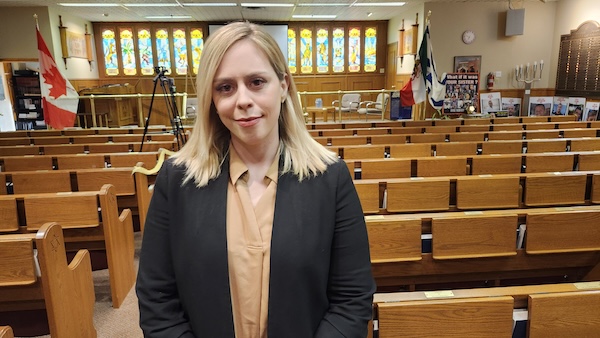
In 2024, Schrader founded the Israeli Iranian Women’s Alliance (IIWA) to promote women’s advancement and democratic values.
She said Iran’s human rights violations have gotten worse. “There are more restrictions and gender apartheid than we have ever seen before.” She added: “The world is not paying attention because of everything else that’s been going on.”
Ghamari said Canada has been “courting the Hamas votes,” meaning immigrants from countries with “fundamentally different values than Canada.”
Schrader added that “the left overestimates the values of these voters” and “they are against the West – whether it’s a right or left government – so courting them is a fundamental mistake.”
“One of the best ways to support Iranians is to support our king,” Ghamari said of exiled Crown Prince Reza Pahlavi – son of the late, deposed shah – who visited Israel in April 2023. “He is the one true voice of the Iranian people. He has 90% support,” she said.
A way to battle the anti-Israel forces is to build connections with like-minded allies, said Douglass-Williams. “They want the outreach just as much as the Jewish community.”
Ghamari seconded that: “All your support gave me the motivation to speak out and speak up.”
Sadia’s advice to win hearts and minds was to “multiply the voices” on social media.
Douglass-Williams alerted the audience that Venezuela has now sold a million hectares of land to the Iranian regime. “The IDF says they are developing weapons there that could reach America and Israel,” she said.
The Dec. 4 talk was organized by the Canadian Antisemitism Education Foundation, OneGlobalVoice, Allied Voices for Israel, Tafsik, and Canadians for Israel.
In an exclusive interview with the Jewish Independent, Schrader said the new Trump administration will be “excellent” on cracking down on Iran. She believes that moral-minded countries need to “de-recognize” the Islamic regime and ramp up sanctions. “It’s going to be a tall order,” she said of countries who have economic ties.
As for the wave of anti-Israel protests, they are primarily concerned with “support for terrorist organizations and an attempt to infiltrate and undermine Western values and the West,” Schrader told the JI.
If they cared about Palestinians, she said, they would protest the estimated 4,000 Palestinians killed in Syria by the Assad regime during that country’s civil war, she said. The Islamic regime’s “vast majority of the victims” are Arab and Muslim, but again, these protesters are silent.
Law enforcement, she believes, is to blame for allowing “multiple antisemitic assaults and attacks,” because “there’s zero accountability for these crimes that are being committed with a racist, hateful, pro-terror agenda.”
“You have to deter it, or it will only grow,” said Schrader. “And we see that happening. It’s a year after Oct. 7 and, I would argue, that it’s worse.”
Dave Gordon is a Toronto-based freelance writer whose work has appeared in more than 100 publications around the world. His website is davegordonwrites.com.
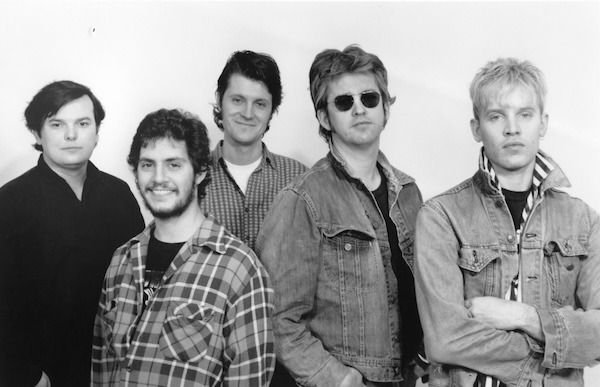
Blue Rodeo is thriving at 40
A 1989 PR photo for Blue Rodeo’s Diamond Mine album. Left to right are Bazil Donovan, Bob Wiseman, Jim Cuddy, Greg Keelor and Mark French. The documentary Blue Rodeo: Lost Together (left) has its world premiere at the Whistler Film Festival. (photo by Andrew MacNaughtan / bluerodeo.com)
The world premiere of Blue Rodeo: Lost Together, which gives viewers a glimpse into the rise of this iconic Canadian band, was so anticipated that the first screening of the documentary at the Whistler Film Festival sold out – a second screening has been added.
The Whistler Film Festival runs Dec. 4-8, offering several programs, including feature-length films, shorts and its “Mountain Culture” series of films, après events and Q&As. The WFF24 Content Summit, which runs Dec. 4-7 in person and Dec. 10-12 online, presents speakers, panel discussions, workshops and other opportunities to learn and connect.
Looking through the festival lineup, I came across Blue Rodeo: Lost Together and requested the screener for a few reasons. First, I grew up with Blue Rodeo’s music and knew many of their songs. Second, given the challenges of being recording and touring musicians – and Canadian to boot – I find it remarkable that the band is as popular as ever 40 years after high school friends Jim Cuddy and Greg Keelor started it. Lastly, founding members included Bazil Donovan (bass), Cleave Anderson (drums) and, most interestingly from my perspective, Bob Wiseman (keyboards). Wiseman is my second cousin and, though I’ve never met him, I have always been proud to let people know that I had a relative in Blue Rodeo. Wiseman was part of the group from 1984 to 1992.
 Blue Rodeo: Lost Together delicately covers the comings and goings of musicians, and the sometimes-difficult friendship and professional collaboration of Cuddy and Keelor. It is frank about the band’s challenges in becoming a commercial success, starting as it did in the era of hard rock, but also dealing with some producers who had a different vision than Cuddy and/or Keelor of what would lead to that success. It is always fascinating to see how creative people balance their very personal drive with taking other people’s feelings and opinions into consideration (or not) and the need to feed and clothe themselves.
Overall, Blue Rodeo seems to have avoided any huge drama, though marriages and partnerships were tested by the rigorous tour schedule once the group broke into the international music scene. Some member partings were clearly amicable, such as when Anderson returned to his postman job after taking a five-year hiatus to play with the band – he had a family to support and wanted to be present for them. Other separations were more fraught: Wiseman wanted to leave a good year at least before he did, his unhappiness seeming to have started – from what I understand from the documentary – with the making of the album Casino, which was released in 1990. To make Blue Rodeo fit a more market-friendly mould, so it could become popular in the United States, Wiseman’s innate energy and expressive performance style was tamped down. “That was really traumatic for me,” he says in the film.
Despite creative differences and some tough times, all the interviewees in the documentary speak of one another and their experiences with great respect and gratitude. It is uplifting to see people treating one another kindly, even as they disagree. Hopefully, it isn’t just for show. Their affection seems genuine. The bonds these musicians have created between themselves and with their listeners seem strong. With all the bad that happens in the world, this is reason enough to watch this documentary – and, if you haven’t already, check out the music of Blue Rodeo.
At press time, there were tickets left for the Dec. 8 screening of Blue Rodeo: Lost Together. Of course, the festival features many other movies during its Dec. 4-8 run, including September 5 on Dec. 5 and 8. The thriller is based on the hostage-taking of Israeli athletes at the 1972 Munich Olympics. The description reads: “At the heart of the story is Geoff, a young producer eager to prove himself to his legendary boss, Roone Arledge. Teaming with Marianne, a German interpreter, Geoff unexpectedly takes the reins of the broadcast. As tensions rise, conflicting reports swirl and the lives of the hostages hang in the balance, Geoff faces difficult decisions that test his skills and moral compass.”
For tickets to the Whistler Film Festival and the full lineup of movies, visit whistlerfilmfestival.com.
The fight for democracy
The following remarks were delivered at the Israel hostages rally at Vancouver Art Gallery on Sept. 15, which is also the International Day of Democracy.
In recognition of the International Day of Democracy, I will talk about how antisemitism is harming and potentially destroying democracy. This talk will be based mainly on a report by Amy Spitalnick, just published in the United States. Fair warning, this talk will be heavy, but, in my view, important to understand.
Antisemitism is a form of religious, racial and ethnic prejudice against Jews. But, unlike other such prejudices, antisemitism also operates as a conspiracy theory that lies about Jewish power and influence. And, because it functions as a conspiracy theory, antisemitism poses a threat far beyond the Jewish community. It fuels other forms of hate and extremism, including against other communities and against democratic institutions that are depicted as pawns of Jewish control.
Antisemitism – like other conspiracy theories – increases at times of social or political anxiety, as people look for a source to blame for what’s wrong with society and with their lives.
Enemies of democracy, such as Iran and Russia, use antisemitism to undermine trust in democracies and make them seem like failed states. The “conspiracy myth” that Jews control certain sectors of society, such as banks, media or elections, is the cornerstone of antisemitism, and anyone who accepts this myth loses faith in democracy. If Jews control elections, judges and finance, people say to themselves, how can I, as a non-Jew, live up to my potential? My failings are caused by evil forces beyond my control.
Casting Jews as all-powerful naturally fuels hatred of Jews. But it also explains what extremists believe – that other communities, like People of Colour, non-Christians, LGBTQ+, are incapable of success except through unfair or illegal ways. And so, belief in this powerful Jewish control group causes distrust in democratic institutions and values.
When neo-Nazis came to Charlottesville, Va., in 2017, they chanted “Jews will not replace us,” showing that they believed in the “Great Replacement” conspiracy theory. Once hidden in the dark corners of the internet, this conspiracy theory says that there is a deliberate Jewish effort to replace the white population with immigrants and People of Colour. This conspiracy theory has directly inspired many mass killings targeting not only Jewish people (Pittsburgh and Poway), but also Hispanic people (El Paso), Black people (Buffalo), Muslims (New Zealand and London, Ont.) and other communities.
Versions of this conspiracy theory have become increasingly mainstreamed, courtesy of influencers, elected officials, candidates and foreign powers in our social media. They use it to advance their own political goals – and, at the same time, they embolden violent extremists. In the Jan. 6, 2021, attack on the US Congress, when many insurrectionists carried white supremacist symbols in their efforts to overturn the 2020 US election results, they included false claims of undocumented immigrants stealing the election. Only recently, we heard in the presidential debate about immigrants eating their neighbours’ pets from a man who wants to be president.
Recent polling shows that belief in conspiracy theories is among the best predictors of antisemitism. And a recent US survey found that highly antisemitic Americans are significantly more likely to support political violence and other forms of anti-democratic extremism. So, what to do?
First of all, we need to fight like hell! We need to call out conspiracy theories against Jews and any other identifiable group every time we encounter them. We need to educate ourselves about what antisemitism means by knowing the International Holocaust Remembrance Alliance definition and its examples, and we must call out antisemitism and other forms or racism when we see it.
We should fight against antisemitism but also against all other forms of racism, including Islamophobia, misogyny, sexual-preference bigotry and other forms of hate and violence; and we should work to advance inclusive, multi-ethnic democracy. The safety and fates of all minority communities and, eventually, all supporters of democracy, are bound together. Jews historically thrive in free, democratic states, and don’t do so well in autocracies, even if autocratic rule might at first seem attractive.
I know this won’t be easy. Many Jews, including me, have felt abandoned and isolated by those who have remained conspicuously silent, or worse, fallen for anti-Israel and antisemitic lies. This crisis since Oct. 7 exposed the lack of understanding of antisemitism in so many parts of society, including how antisemitism is present in conversations related to Israel. Fundamentally, there is a lack of recognition that Jewish safety, including in Israel, is deeply linked to the safety of all communities in all democracies. We need to change that.
But, while we need to work tirelessly to save ourselves and combat antisemitism, we alone, without allies, cannot stop antisemitism. We need to recognize that antisemitism is one part, granted a big part, of the assault on democracy that affects everyone.
If we accept what we need to do as I’ve outlined today, it means having open and difficult conversations with others who think they can save democracy without fighting antisemitism. We need to show them that they are wrong. Let’s start today.
Bernard Pinsky, KC, is chair of the Ronald S. Roadburg Foundation.