Skip to content
  • Home
  • Subscribe / donate
  • Events calendar
  • News
    • Local
    • National
    • Israel
    • World
    • עניין בחדשות
      A roundup of news in Canada and further afield, in Hebrew.
  • Opinion
    • From the JI
    • Op-Ed
  • Arts & Culture
    • Performing Arts
    • Music
    • Books
    • Visual Arts
    • TV & Film
  • Life
    • Celebrating the Holidays
    • Travel
    • The Daily Snooze
      Cartoons by Jacob Samuel
    • Mystery Photo
      Help the JI and JMABC fill in the gaps in our archives.
  • Community Links
    • Organizations, Etc.
    • Other News Sources & Blogs
    • Business Directory
  • FAQ
  • JI Chai Celebration
  • JI@88! video

Recent Posts

  • Story of Israel’s north
  • Sheltering in train stations
  • Teach critical thinking
  • Learning to bridge divides
  • Supporting Iranian community
  • Art dismantles systems
  • Beth Tikvah celebrates 50th
  • What is Jewish music?
  • Celebrate joy of music
  • Women share experiences 
  • Raising funds for Survivors
  • Call for digital literacy
  • The hidden hand of hate
  • Tarot as spiritual ritual
  • Students create fancy meal
  • Encouraging young voices
  • Rose’s Angels delivers
  • Living life to its fullest
  • Drawing on his roots
  • Panama City welcoming
  • Pesach cleaning
  • On the wings of griffon vultures
  • Vast recipe & story collection
  • A word, please …
  • מארק קרני לא ממתין לטראמפ
  • On war and antisemitism
  • Jews shine in Canucks colours
  • Moment of opportunity
  • Shooting response
  • BC budget fails seniors
  • Ritual is what makes life holy
  • Dogs help war veterans live again
  • Remain vital and outspoken
  • An urgent play to see
  • Pop-up exhibit popular
  • An invite to join JWest

Archives

Follow @JewishIndie
image - The CJN - Visit Us Banner - 300x600 - 101625

Month: February 2026

Hateful messages intensify

Hateful messages intensify

The Douglas Park area is being covered with hateful chalk and stickers. (photo by Joshua)

A residential pocket near Vancouver’s Oak Street corridor has become the site of an increasingly bitter battle over political messaging, public space and antisemitism. At the centre of it is one Jewish resident who says his neighbourhood – and his sense of safety – has been upended by a neighbour’s anti-Israel graffiti campaign.

Joshua, who asked that his surname be omitted, said one particular individual began tearing down hostage posters shortly after the Oct. 7, 2023, attacks. The same individual was filmed tearing posters down in front of a group of community members outside Schara Tzedeck before a commemorative event a year after 10/7.

The Vancouver Police Department’s diversity unit initially advised Joshua to stop putting up pro-Israel or hostage posters and allow the city to “neutralize” the space to de-escalate tensions. He complied for several months, he said, but anti-Israel messages only intensified. He has been in discussions with police since last June; he worries that the situation will escalate as the weather improves.
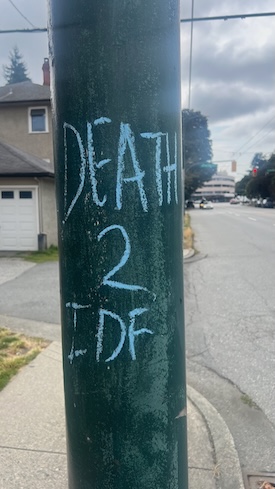
photo - Over the past six to seven months, chalked and adhesive messages have appeared across sidewalks, utility boxes, crosswalk placards and construction signage.
Over the past six to seven months, chalked and adhesive messages have appeared across sidewalks, utility boxes, crosswalk placards and construction signage. (photo by Joshua)

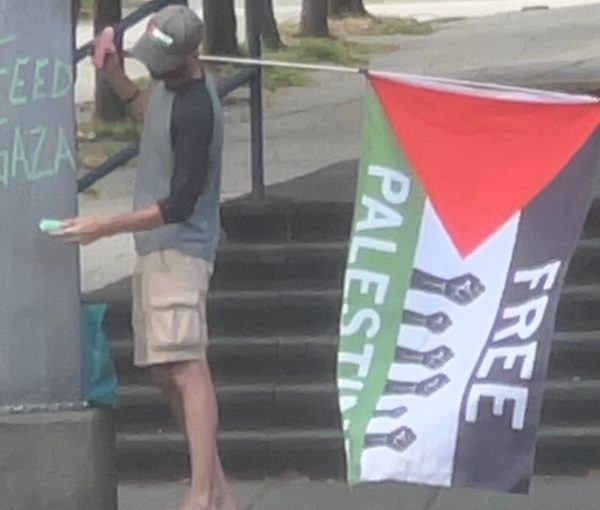
The same individual has become a near-constant presence in the area, waving a Palestinian flag at busy intersections such as Oak and 12th, usually at rush hour and sometimes for hours at a time. According to Joshua, who admits he has done his share of flag-waving as a regular participant at City Hall rallies for Israeli hostages, the anti-Israel activism has gone far beyond flag-waving. 

Over the past six to seven months, chalked and adhesive messages have appeared across sidewalks, utility boxes, crosswalk placards and construction signage. While some read “Gaza” or “Free Gaza,” the messaging has grown more aggressive, including “Zionism is terrorism” and “Death to the IDF,” sometimes accompanied by an inverted triangle associated with Hamas imagery and implying terrorist targets. 

The most recent messaging, Joshua said, is “Stop Israel Sadistic Cult” and equating the US Immigration and Customs Enforcement (ICE) with Israel – “ICErael.”

Joshua said he has documented the activity extensively, as well as the antisemitic rhetoric on the individual’s social media, and filed numerous 311 complaints with the City of Vancouver. If graffiti appears on city property, the city contracts a third-party removal company. But response times range from 48 hours to more than a week – sometimes longer, Joshua said. In one park, spray-painted slogans remained for more than three weeks before being removed.

Because chalk is temporary and easily reapplied, the individual can rewrite messages almost as soon as they are washed away.

Frustrated by what he sees as municipal inaction on targeted harassment and hate speech, Joshua has purchased an 11-litre backpack sprayer and walks the neighbourhood with water and scrub brushes to remove the chalk. 

According to Joshua, the individual leaving the messages has “doxed” at least six area residents, sharing their personal information online, including their images and their licence plates. He posted Joshua’s first and last names and the cross street where he lives, with the comment, “Be sure to say hi and other things if you see him.”

Someone wrote Joshua’s full name on a public sign along with the words “IOF soldier” – IOF meaning “Israeli Occupying Forces” – and he has been accused online and in person of serving in the IDF, which he has not. In one incident, a woman confronted and filmed him at 7 a.m., shouting accusations and telling him, “We know where you live” and calling him an “IOF baby-killer.”

Joshua reported that encounter, as well as the doxing incidents, to police. Officers took a statement but indicated their options were limited, citing freedom of expression, Joshua told the Independent.

Meanwhile, the impact on the neighbourhood is tangible. A local rabbi told him that one Jewish family moved away because their children felt unsafe seeing hostile messages near their home and synagogue.

Joshua has removed his name from his building directory out of concern for his family’s safety. Confrontations and cleanup efforts are framed online as attempts by “Zionists” to silence dissent.

Within the Jewish community, there is debate about how to respond. Some have suggested stopping cleanup efforts in hopes that broader community frustration will grow. Joshua believes a coordinated, multi-block volunteer cleanup effort – involving Jews and non-Jews – is the only way to demonstrate that the issue is about shared civic space, not a private feud. He has set up an online group at facebook.com/groups/cleaningupdouglaspark.
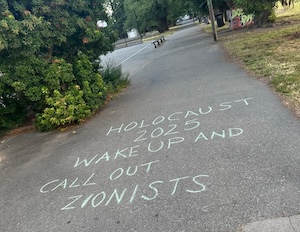
photo - Because chalk is temporary and easily reapplied, the individual can rewrite messages almost as soon as they are washed away
Because chalk is temporary and easily reapplied, the individual can rewrite messages almost as soon as they are washed away. (photo by Joshua)

Residents should not have to navigate obscenities and hostile rhetoric on sidewalks and parks, said Joshua, and he questions whether the city would respond differently if racist or homophobic messages appeared in neighbourhoods with significant populations of the targeted communities.

This sort of conflict, in different permutations, is taking place in cities across Canada and worldwide. In Toronto, anti-Israel protesters have routinely set up demonstrations in areas with concentrations of Jewish residents and even marched through residential areas. Many Jews and their allies have repeatedly asked why there do not seem to be consequences for perpetrators of such deliberate harassment and intimidation. 

That question was the subject of a Feb. 10 webinar with legal and policing experts, organized by the Centre for Israel and Jewish Affairs, titled Why Can’t There Be More Consequences?, which was moderated by Richard Marceau, CIJA’s senior vice-president and general counsel.

Mark Sandler, the chair of the Alliance of Canadians Combatting Antisemitism, and Rochelle Direnfeld, that organization’s senior criminal counsel, have been delivering educational modules to police, making them aware of tools they have to enforce existing laws. Training for prosecutors is also necessary, Sandler noted.

Law enforcement and justice officials need to be able to recognize antisemitism and how it manifests, said Sandler.

Direnfeld provided examples, noting that average police officers cannot, for example, be expected to understand a sign that appeared at one rally: it read “Israel’s only friend is the Gharqad tree.” This is a reference to a Muslim religious verse about the only tree that would protect Jews from Muslims at the end-times.

Even the nuances of more seemingly straightforward messages – “From the river to the sea,” “Globalize the intifada” and “By any means necessary” – may not be immediately evident to those who are not engaged with the narrative, panelists said.

Sandler said police have been asking for sharper tools and the federal government is responding with Bill C-9. (See jewishindependent.ca/new-bill-targets-hate-crimes.) Panelists noted that existing laws against mischief, intimidation and unlawful assembly should suffice in cases where protesters are blocking roads or crowding into shopping malls.

Hank Idsinga, a retired inspector with the Toronto Police Service, said insufficient staffing can be used as an excuse for inaction, but this is not an appropriate response. “Police need to be prepared for various scenarios,” he said.

On the other hand, said Joseph Neuberger, chair of the Canadian Jewish Law Association, Jewish community members need to know what is and is not acceptable within the bounds of the law. Chanting allegations of genocide is protected speech, he said, whether or not the allegations are false.

Neuberger is enthusiastic about components of C-9 that would criminalize intimidation around and obstruction of cultural and religious spaces. The bill is in committee stage.

The full webinar is available at youtube.com/watch?v=kAj_D0gREIM. 

Format ImagePosted on February 27, 2026February 26, 2026Author Pat JohnsonCategories LocalTags antisemitism, antizionism, graffiti, public space, Vancouver

Creating entrepreneurs

Yazamut 360° co-founder and general manager Dana Gavish, left, and Gadi Bahat, an entrepreneur who heads Yazamut’s academic programs. (photos from bgu.ac.il)

Representatives from Ben-Gurion University  of the Negev’s entrepreneurship centre, Yazamut 360°, will be coming to Vancouver in April. 

Yazamut – which means entrepreneurship in Hebrew – aims to provide the BGU community with the skills and mentality to excel in any career. It also promotes innovation. 

Since its establishment in 2018, Yazamut 360° has seen more than 240 startups and ventures created, had more than 2,000 program participants, fostered an entrepreneurial community of 11,000+ members, and had more than $45 million invested in its companies. 

“It was clear to us from the very beginning that, if we’re starting a new entrepreneurship centre at BGU, it needs to be special. We decided to touch very different audiences because entrepreneurship for us is a set of skills, and that set of skills needs to be mastered by everyone,” Dana Gavish, Yazamut’s co-founder and general manager, told the Independent.

“With these different audiences in mind, we went on to develop nine different programs that would match these different audiences and would be the correct ones for entrepreneurship. But the one thing that they all have in common is the idea that you need a learning-by-doing experience.”

Those who enrol in Yazamut are taught such skills as putting together a team, examining problems and solving them, coming up with ideas, conveying messages, presenting in front of a crowd and, on occasion, rejecting a first idea and pursuing another. Yazamut trains participants to move out of their comfort zones towards greater resilience and mental toughness.

“It’s a difficult journey but, when you graduate, you are self-empowered and better educated when you go out to the outer world,” said Gavish, who emphasized that students from across the university are coming to the centre because they see value in what it offers.

“Our graduates really aim high and reach high. We know that they’re hunted today by HR [human resources] specialists from different companies and VCs [venture capitalists]. They’re more daring, and they are employed in wonderful places.”

Among its entrepreneurial offerings, Yazamut features a leaders program that not only teaches entrepreneurship and other skills but forces students to take a fresh look at how they run things, how they manage other people, and how they manage their relationship with failure, said Gadi Bahat, an entrepreneur and venture capitalist with extensive experience in Israel’s tech sector, who heads  Yazamut’s academic programs.

“If you want to be a good entrepreneur, it’s not enough that you know how to build a startup. It’s not enough that you know how to measure the right pricing or how to get penetration into the right market,” he said. “You also need to be a different type of person, and that goes into your ability to talk with people. It goes to your ability to present yourself in the right way. It goes to your ability to survive this roller-coaster period. Because, as an entrepreneur, you get a lot of ‘no.’ You get a lot of problems.”

According to Bahat, participants in the program do not come solely from science, engineering and technology backgrounds. Almost half are from other fields, such as medicine and the social sciences. In total, 18 different BGU departments are represented in Yazamut, and half of the participants are women. The startups created, therefore, have sprung from many fields, including medical technology, agriculture and software development.

On April 12, Gavish and some of the entrepreneurs in Yazamut’s leaders program will be in Vancouver for Spark to Startup: Resilience Ignites Leaders. The event will feature the “RBC Lion’s Den,” which will see BGU student entrepreneurs pitching their ventures to a panel of judges and the audience, with a focus on the Negev. 

“They will be presenting a potential solution, products and potential markets,” Gavish explained.“It will be a taste for the audience of how we teach entrepreneurship at BGU. The kind of experience these guys get is literally priceless. No other university teaches like it.”

The winning team will receive a monetary prize.

The keynote speaker for the Spark to Startup event will be Saul Singer, an advisor to various companies and nonprofits, who, with Dan Senor, wrote Start-Up Nation: The Story of Israel’s Economic Miracle and The Genius of Israel: The Surprising Resilience of a Divided Nation in a Troubled World. Michael Fugman, with PearTree Canada, will be honoured for his entrepreneurship and leadership, both in work and community. Martin Thibodeau, regional president of RBC British Columbia, and his wife Caroline Desrosiers, a community leader and advocate, are the event’s honorary co-chairs.

For more information, visit bengurion.ca/events/vancouver-events/spark-to-start-up. 

Sam Margolis has written for the Globe and Mail, the National Post, UPI and MSNBC.

Format ImagePosted on February 27, 2026February 26, 2026Author Sam MargolisCategories LocalTags Ben-Gurion University, BGU, Dana Gavish, education, entrepreneurship, Gadi Bahat, start-ups, Yazamut

Wrong choice to host Piker

As a political science student at the University of British Columbia, I believe fiercely in free expression, open debate and intellectual diversity. I have defended the idea that universities should be places where ideas are rigorously challenged, interrogated and tested against competing visions of the world. But debating controversial ideas is not the same as giving a platform to only one side. It’s not the same as presenting individuals whose speech crosses the line into hate and dehumanization. 

Universities are not neutral stages without consequence. They are institutions that make choices, and those choices carry weight. The people a university decides to platform is never incidental. It is a statement of values. It shapes the tone of campus discourse. It sends a message about whose voices are elevated and whose concerns are dismissed. And, in moments of deep political tension, it can determine whether students feel genuinely safe, respected and included, or alienated in their own community. 

It is because of these reasons that I am deeply concerned that UBC decided to include Hasan Piker in its America First, America Alone? lecture series. 

The Phil Lind Initiative claims to explore global politics in an age of uncertainty. That is an important and timely goal. But the credibility of such a series depends on the seriousness and integrity of its speakers. When a university invites someone whose public commentary has repeatedly included inflammatory, dehumanizing or violent remarks, it undermines the very academic rigour it claims to promote.

US Democratic Congressman Ritchie Torres warned about the amplification of antisemitism on Twitch and specifically in reference to Piker: “Since October 7th, there has been an explosion of Jew-hatred on social media platforms,” Torres wrote. “Hasan Piker has emerged as the poster child for the post-October 7th outbreak of antisemitism in America.” 

This is not about disagreement. Universities should host controversial thinkers. They should invite people whose views make us uncomfortable. But there is a difference between complex ideological debate and rhetoric that outright promotes violence, questions the suffering of victims and/or uses language that dehumanizes and endangers entire communities, including marginalized groups.

Piker is not merely a “polarizing” internet personality. He has built a brand around extremist commentary, from justifying 9/11 to repeated attacks on Israel and Zionism that go beyond policy criticism to attacking Jewish identity and calling for the destruction of Israel. 

He has compared Zionism to Nazism, a comparison that is as morally distorted as it is historically indefensible. This kind of talk isn’t political critique, it’s erasure. Piker takes Zionism, a movement rooted in Jewish survival and self-determination, and distorts it into the Nazis’ attempt to annihilate us. These are not accidental slips of the tongue. They reflect a consistent pattern of language that crosses from criticism into dehumanization.

Piker has been temporarily suspended from Twitch multiple times for violating community guidelines related to hateful or abusive speech. That matters. Even if someone wants to defend his right to speak, we can’t pretend his public record reflects thoughtful, careful debate. 

His style is built on provocation – on pushing buttons and escalating outrage – because that’s the business model of social media. The louder and more inflammatory the take, the more clicks, the more engagement, the more money. Academic spaces are supposed to prioritize nuance, depth and serious inquiry, not viral moments designed to generate cash and controversy.

For Jewish students on UBC’s campus, this isn’t some abstract political theory debate. Since Oct. 7, 2023, campus has felt different. Heavier. As antisemitism and openly hostile rhetoric have increased, many of us feel more exposed than we did before. I know I do. It has changed how openly we express our identity, how we participate in class discussions and how comfortable we feel in spaces that once felt safe. Friendships have been strained. Conversations are more tense.

So, when the university invites a speaker who has compared Zionism to Nazism, brushes aside concerns about antisemitism and treats Jewish self-determination as inherently illegitimate, it is difficult to believe this is simply about “intellectual curiosity.” It does not feel neutral. It feels dismissive. It feels like our fears and lived experiences are being minimized. More than anything, it feels like no one is listening.

UBC often speaks about inclusion, safety and belonging. Those commitments are not tested when we invite speakers everyone agrees with. They are tested when we decide whether “academic freedom” should be used as a shield for rhetoric that alienates vulnerable students.

To be clear: academic freedom protects speech from censorship, but it does not obligate a university to amplify any individual voice. Universities curate speakers all the time. They reject invitations. They choose who represents them. 

Some will argue that silencing controversial figures sets a dangerous precedent. I agree that censorship is not the answer. But accountability is not censorship. Standards are not censorship. Students have every right to question whether this invitation reflects the kind of discourse a serious institution should highlight. 

At the least, UBC has a responsibility to ensure ideological balance in the series. But where are the scholars who defend liberal democracy from the populist left and right? Where are the voices that articulate the Jewish experience of antisemitism in progressive spaces? Where is the intellectual diversity that the series claims to value?

Universities should be raising the nuance of conversation, not bringing the loudest parts of internet culture into serious academic spaces. Piker already has millions of followers. He did not need UBC to amplify him. The real question is whether our university’s stage should have been used to legitimize Piker’s approach – I don’t think it should have been. 

As students, we deserve better.  

We deserve debate that is rigorous, not reactionary. We deserve speakers who challenge our ideas without dehumanizing entire communities in the process. We deserve administrators who understand that inclusion cannot be selective.

Inclusion cannot mean protecting some students while asking others to tolerate hostility in the name of “dialogue.” If UBC is serious about equity, then protecting Jewish students from being dehumanized should not be controversial. It should be common practice.

If views like Piker’s were directed at almost any other marginalized group, there would have been immediate outrage, with statements, listening sessions and other institutional responses. There would have been no confusion about whether they crossed a line. So why was it different when it came to Jewish students?

UBC’s brand is built on excellence, inclusion and global leadership. Excellence requires discernment. Inclusion requires sensitivity. Leadership requires moral clarity. 

The decision to host Hasan Piker fell short on all three values. 

Avigail Feldman is a fourth-year student at the University of British Columbia, with a bachelor’s in political science and going into a master’s of management. She is also a StandWithUs Canada Emerson Fellow.

Posted on February 27, 2026February 26, 2026Author Avigail FeldmanCategories Op-EdTags antisemitism, antizionism, free speech, Hasan Piker, hate, speakers, StandWithUs Canada, UBC, University of British Columbia

Attack on Jewish kids

Fresh red lines have been crossed by anti-Israel agitators in Canada. These developments should alarm everyone who cares about civil society, diversity and safe spaces for children.

A coalition of antizionist groups is pressuring provincial camping associations to strip accreditation from Jewish summer camps on the basis that the camps integrate Zionism into their programming.

These opponents accuse the camps of politicizing Jewish summer camps, but the irony here is that it is the activists who are doing the politicizing. The land and the state of Israel are integral to Jewish identity. They deserve to be part of a holistic Jewish experience – camping, or any other cultural undertaking – for Jews of any age.

A primary complaint, it seems, is that Jewish camps often employ young Israelis, including (as almost all Israelis are) veterans of the Israel Defence Forces. They take it a step further, though – and this is a lesson about the insidious strategy behind the “genocide” libel. 

The term genocide, we should not need to note, carries a strict definition under international law and no competent international court has made such a finding against Israel. While the term is thrown about with abandon, including by erstwhile legitimate nongovernmental organizations, this is, at best, a contested area of discourse. 

It might have seemed that the widespread use of the term “genocide” was a means to undermine the legitimacy of the Jewish state. It is much more than that.

Having planted the flag of “genocide,” antizionist groups are now moving from this presumed “fact” to employing it as a weapon on new fronts to attack Jewish identity, culture and security worldwide – the first, apparently, being Jewish kids’ summer camp experiences.

The activists targeting Jewish camps are accusing them of endorsing “genocide.” The campaign is part of a broader effort to cast Jewish institutions as unacceptable in public life if they are connected, even tangentially, to anything associated with Israel.

Jewish summer camps have nothing to do with military strategy in Gaza or legislative decisions in Jerusalem. They have everything to do with building community, preserving language and tradition, fostering positive identity and belongingness, and providing childhood experiences that many Canadian Jews cherish and remember fondly for decades. They are also sources of relationships – dating and marriages included – for many in the Jewish world.

And that, of course, may be the point.

The anti-Israel activists know the centrality of Israel to Jewish identity. To undermine Israel, they seem to have concluded, it is necessary to attack the foundations of Jewish identity in Canada and around the world. Starting with kids.

The attempt to weaponize accreditation – a marker of safety, quality and regulatory compliance – threatens to blur the boundary between political disputes and Canada’s multicultural harmony. Provincial camping associations are rightly focused on ensuring that camps meet health, safety and staffing standards. They are not forums for arbitrating geopolitical grievances. 

What is most disturbing about this campaign is not merely its target, but its implications. If any cultural institution can be penalized because it maintains a connection to a nation or narrative that some (rightly or wrongly) find objectionable, then no group is safe from the imposition of political litmus tests in civic life. Imagine if every cultural organization that used Russian, Hausa, Arabic, Urdu or Mandarin were accused of endorsing every foreign government’s actions. The corrosive effect on Canadian pluralism would be profound.

To their credit, camping associations in Ontario and Manitoba have responded appropriately. We await similar expressions from the BC Camps Association.

Jewish camp leaders, Jewish federations and others have rightly pushed back, calling the campaign discriminatory and cautioning that it risks undermining the welfare and safety of Jewish children. Their voices deserve amplification. Protecting our children’s right to participate in enriching experiences free from political and antisemitic harassment is not a partisan concern. It is a foundational element of a just, inclusive society.

In defending Jewish summer camps, we are defending more than campfires and games. We are defending a principle: that identity – religious, cultural or ethnic – must not be a basis for discrimination in Canada. 

To suggest that Jewish camps should lose their accreditation because they use Hebrew words around a campfire, celebrate Jewish holidays or employ staff who have served in the Israeli military is to redefine discrimination as activism. 

Targeting Jewish summer camps for their cultural identity is an assault on the very foundations of multicultural community life. 

Posted on February 27, 2026February 26, 2026Author The Editorial BoardCategories From the JITags antisemitism, antizionism, genocide, Jewish summer camp, language

Multiple benefits of a break

It’s been an incredibly stressful time in our community for more than two years. The relief I felt when Ran Gvili’s body, the last hostage in Gaza, was returned home, was huge. When I saw others at synagogue, all our body language said the same thing. We’re exhausted as a people. It sometimes feels like there is no end in sight to our worry – about the antisemitism, the ongoing violence.

Along with all this, of course, there are the usual life events. For example, we’ve watched the gradual blossoming of independence for our teens. This culminated for me recently when my husband took our twins on a skiing trip with extended family. I got the chance at a staycation – by myself – with our dog. I can almost hear those who would say, “What?! You didn’t join them? You didn’t want to go?”

Reader, I’m not a skier. I’m happiest at home. Staying in a ski house with 15 extended family members isn’t everyone’s idea of bliss. So, for the first time, I wrote the special letter that says I consent to my children traveling outside of Canada without me. I helped everyone pack, drove them to the airport and came home to a quiet house. Once or twice a day, I reminded our worried dog that they weren’t coming home today, while she lingered by the door, waiting.

Friends at synagogue asked what special things I would do. Are you ordering take out? What movies are you watching? What are your plans? At first, I had no answer for them. It’s been 15 years since I was actually by myself for so long. I didn’t even know what I wanted to do.

In the end, what I wanted was small, but it was meaningful. I took walks outdoors every day with my dog, particularly reveling in adventures on the frozen Nestawaya River Trail, right in the middle of the city. I dawdled outside in my crisp winter backyard looking at the stars. I listened to music my household wouldn’t have chosen and ate everyday things that my family doesn’t like. I read a whole book. 

I also made inroads, each day, on routine chores that needed to be done. I vacuumed. Did a load of laundry. Cooked and polished silver. Nothing was crazy or so different. In embracing daily rituals, I kept things feeling normal and predictable. The dog got fed and walked. The lights got turned on and off. The phone got answered. The bed got made. 

To many, this might not seem like a break or a particularly meaningful experience, but I had exchanges with multiple women, moms in mid-life, who absolutely knew what it meant when I said I was going to be staying home – alone. They offered smiles and good wishes. There was a wistful jealousy there, too. I recognized it well. Everyone asked if I was getting the chance to sleep a lot.

Truth is that I had nightmares more than once. There’s a lot to process. It was harder than I thought it would be to relax and rest. Yesterday though, my children, relatively new to downhill skiing, were finally off the mountain and on their way to an airport and back to the prairies, with my husband. They regaled me with what they’d accomplished. Their cross-country skiing experience, learned in Winnipeg public school gym class, had helped them. They joked that the biggest hill they’d ever gone down on a Manitoba school ski trip was small compared to the bunny hill in the Rockies. Their texts and calls showed 14-year-olds alternately nervous and boastful, a normal teen experience. They grew during their trip away, but I did, too.

Lately, I’ve thought about the many pressures parents face as we’re juggling households, kids, work and community. There are frequently calls to volunteer, donate, “get involved” and do more. This is particularly true in a (relatively small) Canadian Jewish community, in which every one of us helps keep things afloat. However, I’d gotten to a place where I kept showing up, feeling completely exhausted. Yes, I’d woken everyone up and dropped them off to volunteer, or I’d helped at another “do something to help others” event myself. The weekend break reminded me viscerally that when your own “cup” is empty, it’s hard to fill everyone else’s.

Everybody needs breaks to rest and restore themselves. Without that space – and, for this introvert, silence – there’s no way to offer our best selves to others. We often quote the famous Pirkei Avot 2:5 passage from Hillel: “In a place where there are no men [people], strive to be a man [person].”  There are many takes on this, including, where there are no leaders, strive to be responsible. Another take is, when people behave as monsters, or aren’t behaving in an upstanding way, try to be a mensch. Yet, when, I woke up after several days by myself, rested and happy, I realized something else.

In a place where there are no other people, self-regulate. Strive to be a good person, one who does the chores and shows up and does her work, even when there’s no one else to hold us accountable. Take responsibility. Make space for recovery, so that we can all “treat others as we wish to be treated.” In the Babylonian Talmud, Tractate Shabbat 31a, Hillel says to the gentile who asks to convert, with the condition that Hillel teach him the whole Torah while he stands on one foot, “That which is hateful to you, do not do to another; that is the entire Torah, the rest is its interpretation. Go study.”

Right in one of our most popular Jewish quotes is a good answer for why a staycation – or a break when you’re tired – matters. Don’t demand something from others that you cannot manage. Instead, give space for others to learn, grow and change. Sometimes, the best restoration and learning happens in the same way we absorb and appreciate music. How do we best appreciate and learn music? In the rests between notes. 

Joanne Seiff has written regularly for the Winnipeg Free Press and various Jewish publications. She is the author of three books, including From the Outside In: Jewish Post Columns 2015-2016, a collection of essays available for digital download or as a paperback from Amazon. Check her out on Instagram @yrnspinner or at joanneseiff.blogspot.com.

Posted on February 27, 2026February 26, 2026Author Joanne SeiffCategories Op-EdTags health care, lifestyle, parenting, self-care, volunteerism
Dialing up the perfect thriller

Dialing up the perfect thriller

Tyrell Crews and Emily Dallas in Dial M For Murder, mounted by Theatre Calgary in 2025. Crews and Dallas reprise their roles in the Arts Club Theatre Company and Theatre Calgary co-production now playing at the Stanley until March 8. (photo by Trudie Lee for Theatre Calgary)

What do a latch key, a handbag, a compromising letter, two blackmail notes and an unexpected telephone call have in common? They are the primary clues in what is supposed to be the perfect murder – you know, the one you get away with. This is the premise for the Arts Club Theatre Company and Theatre Calgary co-production of Dial M for Murder, now playing at the Stanley. 

Frederick Knott’s 1952 play was adapted for cinema early on, with the 1954 thriller starring Grace Kelly and Ray Milland directed by the master of suspense himself, Alfred Hitchcock. About six ago, playwright Jeffrey Hatcher updated the story to add a contemporary and surprising twist. While the 1950s London setting has been preserved, giving it that quintessential British vibe, the cheating wife’s lover is now a woman – definitely a taboo to audiences of that era. Hatcher has also injected comedic moments and witty bon mots into the script, in contrast to the more noirish original.

This is not a murder mystery where the sleuthing detective ultimately exposes the culprit. In this iteration, we know from the beginning what the plan is, how it is to be executed and by whom – the only question is whether the perpetrator will get away with it.

It all starts when Tony Wendice (Tyrell Crews) discovers that his heiress wife, Margot (Emily Dallas), is having an affair with murder mystery writer Maxine Hadley (Olivia Hutt). Since he married Margot for her money, not love, he has no qualms about doing away with her to inherit her fortune. However, he does not want to do the dirty deed himself, so he blackmails a distant acquaintance from his past, Lesgate (Stafford Perry), to carry out the hit. Unfortunately, the plan backfires. Enter Chief Inspector Hubbard (Shekhar Paleja) of Scotland Yard, who, with Maxine’s assistance, attempts to recreate the murder scene to ferret out the mastermind behind the plot. But will they succeed?

Tony is front and centre of the narrative. At the beginning, he is in full control of the situation, callously planning the murder with painstaking attention to the details. He takes the art of manipulation to new heights. As his plan starts to unravel, we see the layers of his confidence peel away. 

Crews commands the role of Tony and Perry ably portrays Lesgate’s nervousness and angst in confronting Margot with the news that he is about to kill her. Dallas, who portrays Margot in a rather subdued fashion initially, is sublime in her portrayal of the hunted housewife, taking the audience on a melodramatic roller-coaster ride of emotions. Flamboyant Hutt infuses the character of Maxine with intelligence, charm and sleek sophistication, and comes across as the smartest person in the room. 

It is a testament to the abilities of these actors that such a small cast can pull off the highs and lows of this psychological thriller. They are assisted in this feat by a talented design team, including Jewish community members Itai Erdal, whose pinpoint lighting directs the audience’s attention to significant clues during scene breaks, and Anton Lipovetsky, whose sound design increases the suspense. 

Then there is set designer Anton deGroot’s revolving turntable stage. All the action takes place in the Wendices’ sparsely furnished drawing room, which slowly and imperceptibly moves back and forth, providing the audience with different perspectives of the action and emphasizing the fluidity of the story. Even the walls and windows move, providing additional layers to the puzzle. 

Jolane Houle’s costumes capture the essence of the stylish 1950s, elegant frocks for the ladies and tailored suits for the gents, all with colour palettes ranging from brown to blue to green that change with Erdal’s lighting. The ladies are perfectly coiffed and made-up à la that glamorous era. Jillian Keily directs her crew well.

This dialogue-dense production requires the audience to pay attention and focus on the various subtle clues that are dropped to determine if indeed Tony gets away with his deception and betrayal. It’s a cat and mouse game at its finest. 

Dial M for Murder runs to March 8. For tickets, go to artsclub.com or call 604 687-1644. 

Tova Kornfeld is a Vancouver freelance writer and lawyer.

Format ImagePosted on February 27, 2026February 26, 2026Author Tova KornfeldCategories Performing ArtsTags Anton Lipovetsky, Arts Club, Dial M for Murder, Itai Erdal, plays, theatre, Theatre Calgary, thrillers

Empowerment & more

CHW’s SHE DAY is a multi-city celebration in honour of International Women’s Day, activating communities across Canada, including in Vancouver on March 8, and elsewhere.

Programming explores themes of women’s empowerment, leadership, health, mental wellness, fashion and beauty. Across the country, participants will experience a lineup of speakers, artists and performers who spark conversation, creativity and change.

SHE DAY Vancouver will feature guest speakers Dr. Tamara Shenkier, Laura Mossey and Ruth M’Rav-Jankelowitz in a panel discussion moderated by Jocelyn Brown.

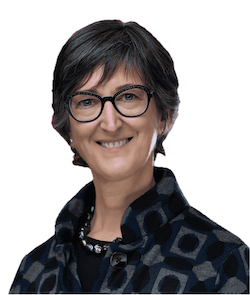
photo - Dr. Tamara Shenkier
Dr. Tamara Shenkier (photo from chw.ca)

Shenkier is a Vancouver-based medical oncologist and educator who retired from BC Cancer in November 2025 after a 31-year clinical career, which was focused on breast cancer care from 2014. She held various leadership roles in medical education and governance, including at the University of British Columbia and the Royal College of Physicians and Surgeons of Canada, and was the inaugural medical director of the After Breast Cancer Service, a BC Cancer-BC Women’s Hospital collaboration supporting survivorship care. More recently, she served as vice-chair of the Provincial Health Services Authority Health Authority Medical Advisory Committee (PHSA HAMAC). She was recognized with the YWCA Women of Distinction Award (education, training and development) in 2024.

Outside of work, Shenkier has raised significant funds through sponsored cycling events for Callanish, a local nonprofit that offers a restorative retreat and healing community for people whose lives have been irrevocably changed by cancer (callanish.org). She also supports the Jewish Federation of Greater Vancouver as a long-time volunteer canvasser and is an inaugural and ongoing board member of the Jewish Medical Association of British Columbia, founded in early 2024 to help create a supportive professional home for Jewish physicians and health professionals, foster mentorship across generations, and strengthen Jewish voice and belonging in health care.

Mossey joins the SHE DAY Vancouver event as an ally.

Raised in Ontario, Mossey earned a bachelor’s in history from the University of Western Ontario, where she was first introduced to Middle Eastern history. She completed her teaching degree at UBC and returned to Ontario for a full-time career as an elementary school teacher and literacy consultant with the Durham District School Board. In 2013, her family relocated to Port Moody.

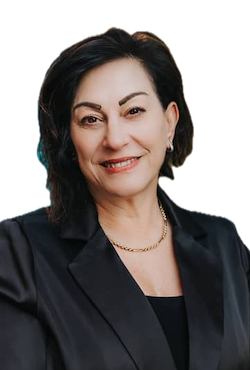
photo - Laura Mossey
Laura Mossey (photo from chw.ca)

Today, Mossey works as a teacher-on-call with SD43 Coquitlam, often teaching history and using the classroom as an opportunity to clarify misconceptions about Israel. She has committed herself to listening and learning so she can speak with factual integrity in defence of Israel and Canada’s Jewish community. Since the Oct. 7, 2023, Hamas attack on Israel, she has read more than 30 books on Islam, Israel and the broader conflict. In March 2025, she traveled to Israel with Jewish National Fund Greater Toronto.

Also in 2025, Mossey received an Allyship Award from the Vancouver Jewish community, presented through the Jewish Federation of Greater Vancouver. She is an outspoken advocate for social justice and Israel on social media.

Raised in the Anglican Church, Mossey has always understood Israel as the homeland of the Jewish people. Her resolve to stand up for Canada’s Jewish community is rooted in a respect for the Canadian Charter of Rights and Freedoms, and for the Jewish values of ethical responsibility, social justice and compassion. She is currently studying the Torah through participation in Israel’s 929 Project (named for the number of chapters in the Hebrew Bible).

photo - Ruth M’Rav-Jankelowitz
Ruth M’Rav-Jankelowitz (photo from janksdesigngroup.com)

Jankelowitz is an interior designer with more than 30 years of experience in commercial and hospitality design. Known for her strategic and practical approach, she brings expertise in translating brand identity, operational needs and customer experience into built environments that perform.

Jankelowitz has worked internationally with leading fashion and lifestyle brands including Timberland, Bebe, Polo, DKNY, Nike, Balle and Nine West. Her portfolio spans retail, restaurant, corporate and hospitality environments. She currently works with restaurant groups and commercial clients, including OEB Breakfast Co., Tap & Barrel, Earnest Ice Cream, Field and Social, and Return-It.

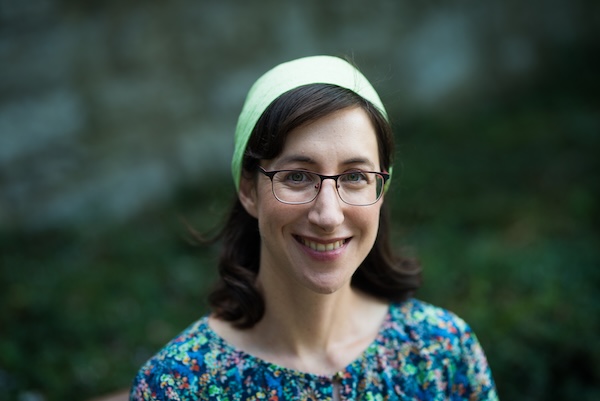
photo - Jocelyn Brown
Jocelyn Brown (photo from chw.ca)

The panel moderator, Brown, is a health and hospital administrator and project manager with more than 25 years’ experience. She has been employed by BC Children’s Hospital, GF Strong Rehabilitation Centre, BC Children’s Hospital Research Institute and the College of Family Physicians of Canada. Currently, she works as a project manager and health-care consultant. 

Born and raised in Winnipeg, Brown has lived in the Lower Mainland since 1997. She and her family currently live in Steveston. She has served the Jewish community as a board member of Hillel BC, CHW, Vancouver Jewish Film Festival, Richmond Jewish Day School, and the Kehila Society of Richmond.

In addition to the speakers, SHE DAY Vancouver will feature a community shuk (market) featuring local, women-led businesses, vendors in beauty, fashion, health and wellness.

Proceeds from SHE DAY events will support the Eden Association Trauma Therapy Centre, which was founded in 1997. The association opened a new treatment centre in the heart of the Gaza Envelope communities following the events of Oct. 7. The centre provides trauma-focused care for girls and women from the northern Negev and Gaza Envelope regions and is strategically located in Kibbutz Dorot, near the city of Sderot.

Since Oct. 7, there has been an urgent need for therapeutic support for women. Untreated trauma worsens over time, affecting mental and physical health, daily life and relationships. For women, the impact extends to their families, communities and Israel’s social resilience. With support from CHW, Eden is expanding its trauma therapy centre to prevent long-term suffering, restore hope and build a healthier future.

To attend SHE DAY Vancouver on March 8, register at chw.ca/she-day. 

– from chw.ca

Posted on February 27, 2026February 26, 2026Author CHWCategories LocalTags CHW, education, fashion, health care, SHE DAY, women
Songs in war of peace

Songs in war of peace

Naomi Cohn Zentner shared how music in the time of war can offer resilience and hope. (photo from Naomi Cohn Zentner)

Earlier this month, ethnomusicologist Naomi Cohn Zentner gave the lecture Music and War: An Optimistic View. Her talk was the fourth in Kolot Mayim Reform Temple’s 2025/26 Many Voices of Jewish Music Zoom series.

Speaking from Israel, Cohn Zentner, a lecturer at Bar-Ilan University, examined how music in the time of war can offer resilience and hope, and is not solely about tragedy and mourning. She started with a photograph of Leonard Cohen and Israeli musician Matti Caspi, who passed away on Feb. 8, the day of her talk. The pair were performing for soldiers during the 1973 Yom Kippur War, Ariel Sharon at their side.

Cohn Zentner then played two songs, composed more than a century apart: “The Battle Hymn of the Republic,” written during the American Civil War, and a 1967 performance by the Nachal Entertainment Troupe called “Hallelujah.”

Contrasting the two, Cohn Zentner argued that the former is a sacralizing, providential song in the war hymn tradition, seeing war very much within a religious way of life and values, while the Israeli song – with lines such as, “If there were no need for rifles anymore, then we would sing ‘Hallelujah’” and “If children could play by the border, then you’d hear their mothers sigh in relief, ‘Hallelujah’” – offers a hope for peace, or a prayer for peace.

“It’s an Israeli war song tradition, which shows just how important peace was in these fighting units,” Cohn Zentner said. “We can see this as two opposing examples of what war songs are about. 

“The religious hymn of the Civil War is ‘Glory, Hallelujah.’ The conflict itself is very religious and violence, while terrifying, is also cleansing and purifying, and death and martyrdom make men free,” she said. In the Israeli song, war is de-romanticized, death is not glorified but used as a reason to end wars, life itself is considered holy, peace is the desired goal, and the music is more national and secular in outlook.

Last year, on the Israeli reality show, Hakokhav Haba (Rising Star), during which a contestant is chosen to represent the country at Eurovision, Daniel Weiss, from Kibbutz Be’eri, selected Cohen’s “Hallelujah” as one of his songs. Weiss, who lost both of his parents during the Oct. 7, 2023, Hamas attacks, performed a duet with Arab singer Valerie Hamaty in both Hebrew and Arabic.

“Of course, this image was so powerful and iconic – of them singing this song together in Hebrew and Arabic after everything that had happened. It was a very emotional moment,” Cohn Zentner said.

Another song Weiss performed, in honour of his parents, was “Ani Guitar” (“I Am a Guitar”) by Naomi Shemer, which contains the lyric “I remember all those who played on me before, and I say thank you.”

“This symbolic issue of a guitar, which used to be a tree, but still has in it the ability to thank all those who [have] played on him … is very, very emotional,” she said.

Weiss lost out to Yuval Raphael in the contest to represent Israel. Raphael, a survivor of the Nova music festival, performed ABBA’s “Dancing Queen” as her final song in the show. She dedicated it to those who died at Nova. 

“I sing about the angels who weren’t fortunate enough to be here now. It hurts because I had this chance not only to come back [from the festival] and to live, but to fulfil my dream. There are those who stayed there, and the shadow behind me is the only thing left of them,” said Raphael, who went on to place second in the 2025 Eurovision with the song “New Day Will Rise.”

At the end of her talk, Cohn Zentner played “Not Alone,” a song penned by Doror Talmon of the band Jane Bordeaux in the weeks following Oct. 7. The song speaks to the feelings of being in the close-knit community of a kibbutz in which everyone has a role and nobody is dispensable; if one person is lost, it affects the entire community.

“The song starts by telling us about all the sad and tragic things that happened, and asks who is going to bring the kibbutz back to what it was,” Cohn Zentner said.

Then, she pointed out, there is a shift in the song to where it answers, “We’ll all extend a hand, we are not alone, and we are partners in fate, in pain and in love, as one people. We will cry and we will overcome, we’re not going to break, we’re going to come together, we have each other, the roots of the trees will go into the earth, and we’re going to be rebuilding.”

The next speaker in Kolot Mayim’s series is Joshua Jacobson, an author, composer and choral director. Jacobson, professor emeritus of music at Northeastern University in Boston, will delve into the history and ongoing evolution of Jewish music in his April 5 talk, Jewish Music: What’s That? For more information, go to kolotmayimreformtemple.com. 

Sam Margolis has written for the Globe and Mail, the National Post, UPI and MSNBC.

Format ImagePosted on February 27, 2026February 26, 2026Author Sam MargolisCategories MusicTags ethnomusicology, Kolot Mayim, music, Naomi Cohn Zentner, peace, songs, war
Successful trip to Cuba 

Successful trip to Cuba 

Cantor Eric Moses led a delegation from his synagogue to Havana, Cuba, this month. (photo from Beth Sholom)

Earlier this month, I traveled to Havana with a delegation from Beth Sholom, the Toronto synagogue where I serve as cantor. Together, we represented the first Canadian Jewish group to visit the island since 2019. Travel to Cuba has been complex and unpredictable for some, but our mission was simple – to support the Jewish community in Cuba and remind them that they are neither forgotten nor alone. 

The island nation continues to face an unprecedented and protracted crisis. There is a shortage of nearly everything, most notably fuel. Gas stations, if open at all, have hours-long lineups. Illicit WhatsApp groups gouge desperate consumers for the little gasoline that remains. Electricity is out for 12 to 14 hours each day. Medical supplies are scarce to nonexistent. Surgeries have been canceled, public transportation suspended and schools closed. Along the highways, people stand with wads of Cuban pesos, hoping someone will stop and offer a ride. And yet, despite these hardships, the small but remarkably resilient Jewish community has not lost hope. 

On Friday evening, we arrived at Beth Shalom Synagogue, locally known as the Patronato, before Shabbat for a briefing with the community’s vice-president. Moments into her remarks, the lights went out. There was no panic, no drama. She calmly pulled out a few flashlights and continued speaking, as though nothing unusual had happened. She then guided us through the synagogue’s modest pharmacy, where scarce medical supplies are distributed not only to Jewish families but to the broader community as well. We were proud to have brought generously donated supplies from pharmaceutical distributor Kohl & Frisch and members of our congregation – though we knew it would not be enough. 

As I entered the sanctuary for services, my contact, William Miller, pulled me aside. “Eric, we have enough generator power for about 20 more minutes.” That meant the Shabbat dinner we had sponsored would likely be served in the dark and with cold food. Again, there was no panic, just another fact of life in today’s Havana. (Our group had helped purchase that very generator during a visit in 2008.) 

Our time on the island was filled with meaningful encounters. We visited all three synagogues – Orthodox, Conservative and Sephardi – participated in hands-on volunteer activities and spent time connecting with community members. We toured the Jewish cemetery, the Holocaust memorial and museum, and visited shut-in seniors during a power outage. We visited the Canadian embassy and heard from the ambassador and her team about Cuba’s precarious future. We found brief moments to experience Havana’s incredible charm, including a ride in a classic car, the taste of a mojito and the sounds of Cuban music. 

By the end of the trip, our group of 16 left Havana feeling enriched, united and deeply humbled. On Friday night, the entire service was led by the youth at the Patronato – a powerful testament to the community’s commitment. I was honoured to address the congregation and shared a simple reflection: in Canada, we have almost everything, while they have almost nothing; yet they possess something we can learn from, a profound sense of pride, spirit and the determination not merely to survive, but to thrive again. One taxi driver summed up the mood of the country when he told me, “We are in a dark tunnel without a way out.” But we were welcomed with open arms and open hearts. 

We departed on Sunday evening on what felt like the last fumes of jet fuel, just hours before Air Canada and WestJet announced the suspension of flights. Those who remain behind do not have the option to leave. They continue to live with constant uncertainty, navigating daily hardships while carrying the weight of more than six decades of a revolution that has failed to deliver on its promises. And yet, the Jews of Havana remain determined, resilient and passionate about their heritage and their future. 

Eric Moses is the cantor at Beth Sholom Synagogue in Toronto.

Format ImagePosted on February 27, 2026February 26, 2026Author Eric MosesCategories WorldTags Beth Shalom Synagogue, Beth Sholom Synagogue, Cuba, Havana, Patronato, tikkun olam

Tackling antizionism head on

Adam Louis-Klein was deep in the Amazon on Oct. 7, 2023 – three months into fieldwork with an Indigenous community, living without any internet or phone contact. Two days later, in a local town, he reconnected with the outside world and saw the news. Then he saw something else: how people in his professional orbit were responding to the atrocities perpetrated against Israelis.

“I spoke up and said I stood in solidarity with Israelis, and spoke up against the bigotry I was already seeing, and I was quickly, basically purged,” he told the Independent.

photo - Adam Louis-Klein
Adam Louis-Klein (photo by Adam Louis-Klein)

Louis-Klein, a McGill University PhD candidate who now lives in New York state, describes a swift loss of “all my social and professional contacts.” But that didn’t stop him from expressing his views. He felt an obligation, he said, to offer a Jewish voice that speaks the same language as the academy and the left, especially in response to antizionism.

“As I wrote more about it, I think my understanding of antizionism got sharper and sharper,” he said. “I got more focused on antizionism itself as an ideology, not just antisemitism.”

That shift – treating antizionism as something that should be named and confronted directly, rather than in the context of its relationship with antisemitism – has become central to his work. In his view, focusing on antisemitism as the lens can become a rhetorical trap, positioning antizionism as a respectable political position.

His ideas went viral. 

“I was posting on Facebook and people kind of liked the little mini-essays I wrote,” he said. He launched a blog at the Times of Israel, then began writing for other outlets. “One thing led to another.”

The visibility has accelerated in recent months, he said. Movement Against Antizionism (MAAZ), the organization he founded and leads, has also caught on rapidly. 

People found his Times of Israel blog and were on the lookout for voices explicitly naming and confronting antizionism, he said. The people he works with have helped refine his language. Looking back at his writing over a short span, he said, “I already see a kind of progression whereby I get sharper at naming antizionism and making that the focus.”

The backlash was instantaneous.

“People tried to shut me down,” he said. “There were fake complaints against me … they would call my advisor, they would call the anthropology department to try and get me expelled.” He said he was removed from WhatsApp groups, a book club he organized collapsed, a presentation he organized on the Soviet roots of antizionist rhetoric was canceled without explanation.

He described a hardened ideological environment.

“I was told that no one would discuss with me whether it’s a genocide,” he said. “The genocide libel was not something that could be discussed.”

While the university environment may be a hotbed of antizionism generally, anthropology is particularly hostile, he said.

Early anthropology was connected to colonial infrastructures and later efforts to reckon with that legacy have put “settler-colonialism” at the centre of the discipline, Louis-Klein said. In his telling, the field has “swallowed wholesale” a narrative in which “Israelis are these evil white settlers.” He no longer sees a future in the discipline. “It’s not a field that Jews who do not profess loyalty to the antizionist movement … can exist in at this point,” he said.

Louis-Klein, who grew up mostly in Seattle and who spent time in Whistler growing up, holds a bachelor’s degree in philosophy from Yale University, a master’s in philosophy from the New School, a master’s in anthropology from the University of Chicago, and is nearing completion of his PhD at McGill.

With academic doors closing in front of him, he sees a new possibility: the creation of a serious intellectual space for the study of antizionism itself. 

“There is now a movement to try and create an academic space for critical studies of antizionism,” he said, adding that he wants to “provide an intellectual framework for treating antizionism as an objective study, as something that we can critically understand, break down, trace its genealogy, understand how it functions in the present as its own phenomenon.”

In his view, the public conversation must change for practical reasons, not just academic ones.

“We cannot fight anti-Jewish violence today without naming and opposing antizionism,” he said. “The vast majority of anti-Jewish violence is directly motivated by antizionism.” 

Even attacks rooted in “more classical” right-wing antisemitism now unfold within “the overall hysteria that has been created by antizionism since Oct. 7 and the genocide libel,” he said. Besides, he argued, as a strategy, equating antizionism and antisemitism is failing.

“Calling antizionism antisemitism is also not working,” he said. “We’re assuming that if we just say it’s antisemitic, a number of institutional levers will set into place Holocaust memory, and it’ll shut it down.”

But that’s not happening, he said, “because antizionism doesn’t look like classical antisemitism.”

Instead, he thinks people need to be taught what antizionism is. 

“You can’t just say it’s antisemitic,” he said. “You have to explain to people what antizionism is as an ideology, and you have to stop treating it as political critique.”

He draws a distinction between debating Zionism and describing antizionism as a social phenomenon. 

“Talking about antizionism also doesn’t mean … explaining how Zionism is actually good. It goes far beyond that. It means explaining how antizionism is a hate movement,” he said.

“It’s a mob movement,” he added. “There are lynch mobs … people who hunt down Zionists and try and shame and humiliate them.… They vandalize buildings, they smash windows.”

MAAZ delivers training in different sectors, including education, business, arts and journalism, designed to help people understand antizionism and “to fight back and to give people a language.”

“We really think naming and labeling is the way to defeat it,” he said.

Louis-Klein described teaching people to “maintain boundaries,” and to label recurring accusations – “colonizer libel, apartheid libel, genocide libel” – as antizionist so that Jews and allies stop feeling obligated to defend their legitimacy and instead “hold antizionism to account.”

The organization also includes legal thinking, with scholar Rona Kaufman developing a legal concept of antizionist discrimination.

Beyond training, MAAZ emphasizes public education. Louis-Klein encourages people to explore the organization’s website (movementagainstantizionism.org), which he describes as “kind of like a museum … a curation where you enter inside of the whole history of antizionism and its different forms and the different libels.” 

He emphasized a point he sees as essential for long-term success: expanding beyond the Jewish community. 

“Having non-Jewish people who can get behind that … will just be the key,” he said. “That will be the thing that catapults it to the next stage.” 

Posted on February 27, 2026March 9, 2026Author Pat JohnsonCategories NationalTags academia, Adam Louis-Klein, antisemitism, antizionism, discrimination, education, MAAZ, Movement Against Antizionism

Posts pagination

Page 1 Page 2 … Page 5 Next page
Proudly powered by WordPress