

Love runs through every word in Voices of Resilience: An Anthology of Stories Written by Children of Holocaust Survivors, edited by Deborah (Devora) Ross-Grayman with Wendy Bancroft and the writers.
This compelling, hopeful and inspiring collection of stories will be launched on May 25, 7 p.m., in the Floral Hall at VanDusen Botanical Garden in an event supported by the Vancouver Holocaust Education Centre (VHEC). Some of the authors will share parts of their stories, and signed books will be available for purchase.
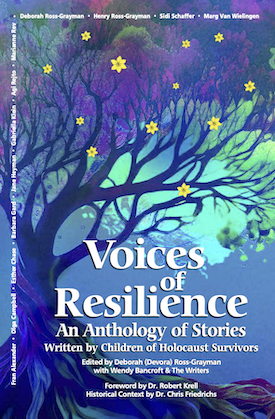 The 12 contributors of stories and poems are children of Holocaust survivors and members of the Vancouver Second-Generation (2G) Group, which Ross-Grayman joined in 1993 and of which she is now a facilitator. Bancroft, a former journalist and researcher, is a trained instructor of guided autobiography.
“After an extensive investigation to better understand the impact of the Shoah’s legacy, Wendy adapted and crafted themes for our group,” writes Ross-Grayman in the book’s preface.
“What began as a six-week course for six of us grew to a two-year writing project for 12 participants,” she explains. “Through laughter and tears, we marveled at the similarity in our felt experiences despite the varied external circumstances. At times it was challenging to face and hold our parents’ pain and loss; at times we were sleepless and anxious, but we supported each other, developed deep bonds, and persevered. Through listening and reflecting on each of the stories, our understanding of ourselves and each other grew as we shared what some of us had never shared and, with understanding, came to a deeper compassion for ourselves and our parents.
“Our narratives so impressed Wendy that she recommended organizing an anthology. We included accounts of our parents’ survival to honour their lives and illustrate examples of post-traumatic growth – the positive psychological changes that can unintentionally arise from a life crisis or traumatic event, even while acknowledging the profound distress such experiences entail.”
The simultaneous holding of grief and contentment, even joy, is remarkable, as is the strength to continue, to grow, to heal – as much as healing is possible. The authors (in order of entries) – Gabriella Klein, Ross-Grayman, Henry Ross-Grayman, Jane Heyman, Marg Van Wielingen, Fran Alexander, Agi Rejto, Marianne Rev, Esther Chase, Barbara Gard, Olga Campbell and Sidi Schaffer – are open, sharing personal, vulnerable experiences on the page. The intergenerational impacts of trauma are clear from their diverse experiences, but so is the capacity for finding peace, for building community, for embracing one’s cultural roots while forging your own individual identity. While specific to the Holocaust, these stories, these remembrances, speak to a universal experience of living through and with historical trauma.
The anthology, put out by Amsterdam Publishers as part of the series Holocaust Survivor True Stories, is dedicated to the writers’ families; “to those who risked everything to save lives; to those who survived; to the millions who perished in the Holocaust; and to all people affected by war, displacement and genocide.” It is published in memory of Rev, who passed away in January.
Dr. Robert Krell, a psychiatrist, author, child survivor and founding president of the VHEC, wrote the book’s foreword, in which he shares some of his own story – he is both a Holocaust survivor and a 2G child – and offers emotional context. Dr. Chris Friedrichs, professor emeritus at the University of British Columbia, provides historical context.
Krell explains that, in general, “the second-generation consists of those born after the war, thousands in the displaced persons (DP) camps, which, for several years, recorded the highest birth rate in the world!” He talks about some of the experiences that 2G have in common, such as the need to sometimes parent their parents, how it feels to live “with the ghosts of the missing.”
“There are moments one cannot forget, must not forget, and these memories linger and reverberate throughout life, reviving the inner rage about the outrage committed against our parents and us,” writes Krell.
“It should therefore be no surprise that this collection of recollections reveals evidence of a surviving rage, problems with trust, confrontations with the meaning of death, and remarkable attempts to reinvigorate a life with meaning, including a meaningful spiritual engagement, whether within the Jewish traditions or not.”
“Mass murders were nothing new in history, but the Holocaust revealed that a once civilized society could orchestrate a program of extermination of human lives on a scale and in a manner that had never been imagined before,” writes Friedrichs. “It was so extensive and so unspeakably brutal that it gave rise to the very concept of genocide.”
Friedrichs writes concisely of the origins of the Holocaust, what happened and about how there are any survivors, as well as about some of the challenges survivors faced after the war.
“This volume reveals not only the enormous variety of what survivors went through but also the tremendous range of emotions and experiences that shaped the lives of their children,” he writes. “Though the Shoah ended 80 years ago, it is a living presence for all members of the Jewish people, and for none more so than those Jews whose own parents had survived this event without comparison in the modern history of humanity.”
In Voices of Resilience, each 2G writer’s chapter includes a brief biography, their parents’ survival stories and a few of their own stories or poems. Maps near the anthology’s beginning shows where all the authors were born and all the survivor parents’ birthplaces. The geography spans continents: Asia, Europe, the Middle East and North America.
Despite vastly different experiences, there are recurring topics: dealing with antisemitism; taking care of their survivor parent; feelings of insufficiency, fear and sadness; being conflicted about religion and feeling like an outsider even inside the Jewish community.
The writers have worked to make their lives and the larger world better, as did their parents. The word “love” is prominent in these stories, as is its expression in the enduring strength of the family relationships, the caring for others, as well as oneself, the compassion shown, the emotional connections forged.
“We offer our stories as a source of hope and the possibility of resilience in the aftermath of trauma,” writes Deborah Ross-Grayman in the afterword.
No one contribution is more quotable than another. The collection does indeed offer hope, as well as thought-provoking explorations of memory, displacement and the generational impacts of genocide.
To attend the launch, RSVP at vhec.org. The anthology is available on Amazon for those who can’t make it on the 25th.



