Skip to content
  • Home
  • Subscribe / donate
  • Events calendar
  • News
    • Local
    • National
    • Israel
    • World
    • עניין בחדשות
      A roundup of news in Canada and further afield, in Hebrew.
  • Opinion
    • From the JI
    • Op-Ed
  • Arts & Culture
    • Performing Arts
    • Music
    • Books
    • Visual Arts
    • TV & Film
  • Life
    • Celebrating the Holidays
    • Travel
    • The Daily Snooze
      Cartoons by Jacob Samuel
    • Mystery Photo
      Help the JI and JMABC fill in the gaps in our archives.
  • Community Links
    • Organizations, Etc.
    • Other News Sources & Blogs
    • Business Directory
  • FAQ
  • JI Chai Celebration
  • JI@88! video

Recent Posts

  • תגובתי לכתבה על ישראלים שרצו להגר לקנדה ולא קיבלו אותם עם שטיח אדום
  • Lessons in Mamdani’s win
  • West Van Story at the York
  • Words hold much power
  • Plenty of hopefulness
  • Lessons from past for today
  • Rebuilding a life after Shoah
  • Raising existential questions
  • Explore Jewish music 
  • Life, beginning to end
  • Give yourself the gift of love
  • From the archives … books
  • היהירות היא אחד האויבים הגדולים ביותר של ישראל
  • Vrba monument is unveiled
  • Music to build bridges
  • A better future possible
  • Anne Frank exhibit on now
  • Human rights in sport
  • Telling the story of an icon
  • Crawl bigger than ever
  • JCC Maccabi in Toronto
  • A way to meet fellow Jews
  • Time to include
  • Add Jewish joy to the mix
  • Reminder of humanity’s light
  • From the archives … editorials
  • Year-round holiday recipes
  • מדוע עזבתי את ישראל ואינני חושב לחזור ארצה
  • OJC hosts Oct. 7 memorial
  • A journey beyond self
  • Antisemitism a problem
  • Young man is missed
  • Orr action sparks complaint
  • Prison sentence for hate
  • Etgar Keret comes to Vancouver
  • New fall lecture series

Archives

Follow @JewishIndie
image - The CJN - Visit Us Banner - 300x600 - 101625

Tag: Vancouver Holocaust Education Centre

Rebuilding a life after Shoah

Rebuilding a life after Shoah

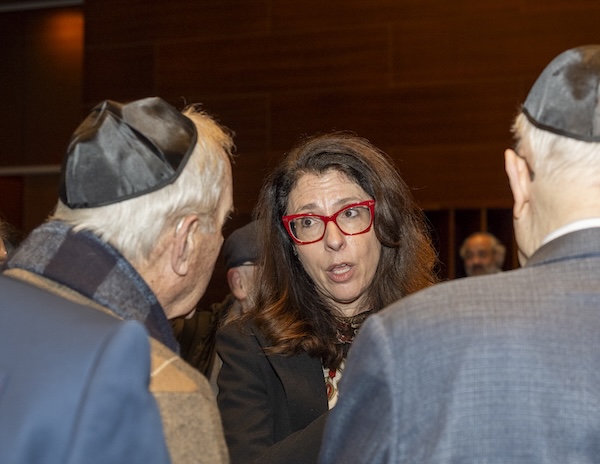
Prof. Robin Judd, author of Between Two Worlds: Jewish War Brides After the Holocaust, speaks with community members at the Kristallnacht commemoration in Vancouver Nov. 9. (photo by Sova Photography)

The history of war brides – generally British or European women who married Allied military men – is widely known and has been explored by historians and social scientists. Between 1944 and 1948, about 65,000 dependents came to Canada as spouses or intended spouses of military personnel. 

Speaking at Vancouver’s annual Kristallnacht commemorative event Nov. 9 at Congregation Beth Israel, Prof. Robin Judd discussed an almost unknown subset of this phenomenon: Holocaust survivors who met Allied soldiers in displaced persons’ camps after the war and went on to marry them.

Judd is associate professor of history at Ohio State University and immediate past president of the Association for Jewish Studies, the largest international society for scholars of Jewish studies. Her award-winning book Between Two Worlds: Jewish War Brides After the Holocaust explores the harrowing task of rebuilding a life in the wake of the Holocaust. 

Many Jewish survivors, as well as community and religious leaders, viewed marriage between Jewish women and military personnel as a way for the survivors to move forward after extraordinary trauma, said Judd, whose academic interest in the subject stems from family history.

“My grandmother was a war bride,” Judd said. “She was a survivor. She and my father survived the war in hiding. My biological grandfather died at liberation, and my grandmother married an American soldier after the war, who then adopted my father.”

Her grandmother spoke little about her experiences during or immediately after the war, though Judd knew the rough outline of her past. Only when Judd began research into the subject did she learn that her grandmother’s experience was not as unique as Judd had assumed.

The individual stories of these war brides, and their efforts to integrate, offer lessons around survival in the aftermath of trauma, as well as larger issues concerning marriage, immigration and citizenship, she said. 

Judd focused on a few couples, including Isaac and Leesha (neé Leisje Bornstijn) Rose, and Sala (neé Solarcz) and Abe Bonder.

Sala survived in the Warsaw Ghetto for more than a year, before deportation to a ghetto outside Lublin, then to Majdanek and a series of other camps. She was liberated during a death march in April 1945.

At Rosh Hashanah services at a DP camp in Hanover, she met Abe, a mechanic in the Royal Canadian Air Force. Until then, Judd said, Sala had avoided the Canadian and British soldiers overseeing the DP camp because she said they made her feel like a monkey in the zoo.

“But Abe came to her and started to speak to her in a very quiet Yiddish,” Judd recounted. “It was his questioning, his real interest in understanding who she was and what she had experienced that made her want to seek a second encounter with him.”

Many of the war brides found themselves at the whims of their new extended families, subsumed into existing structures that were foreign and unfamiliar. Often, they arrived in the new country and did not have homes of their own but lived with their husbands’ families, sometimes with multiple generations in the same home.

Leesha arrived in Ottawa and moved in with fiancé Isaac and her soon-to-be mother-in-law, with whom she had limited language skills to communicate. The groom’s mother took it upon herself to plan the wedding. 

“Leesha and other war brides are often talking about how, in these moments, whether it was the marriage or it was having their first child, or it was their first child’s bar or bat mitzvah, or their first child’s wedding, how they so desperately missed those murdered family members at that time,” Judd said.

Newcomers were sometimes judged unfairly, as if their healthy appearance diminished the perception of their suffering. A newspaper article described Leesha as “a good-natured chubby little girl.”

“There was this notion that these women looked almost too healthy,” said Judd, “That the trauma was almost not written sufficiently enough on her body.”

Associations and networks existed for the newcomers to connect with others from similar backgrounds, including Jewish war bride clubs and synagogue-affiliated groups. 

The war bride experiences Judd studies are diverse and include sad but also happy memories, she said, from the difficulties of reconstruction and recovery to stories of resilience and rebuilding.

Prof. Chris Friedrichs, a scholar of German history who taught at the University of British Columbia from 1973 until his retirement in 2018, contextualized Judd’s presentation, as well as Kristallnacht and the larger history of the Holocaust. 

Kristallnacht sent a message to the world, he said. But the world did not listen.

“This horrific Night of Broken Glass was front page news all over the world, but not for long,” he recounted. “Much else was going on in the world at that time and, within a few days, Kristallnacht was forgotten. In fact, the world learned nothing from Kristallnacht. But the Nazis learned a lot. They realized that whatever they might do to the Jews, there would be no consequences. And thus, once Hitler’s war started in 1939, within Germany itself and in every country the Germans conquered under cover of war, a relentless program to exterminate the Jews began to be carried out by beatings, by shootings, by starvation and by gas.”

Hannah Marazzi, executive director of the Vancouver Holocaust Education Centre (VHEC), which presented the event in partnership with Beth Israel and the Jewish Federation of Greater Vancouver, called Kristallnacht “a defining moment in which the shadow of hatred quite literally burst into flame.” 

Dr. Abby Wener Herlin, associate director of programs and community relations for the VHEC, introduced Holocaust survivors, who lit candles of remembrance. 

“Tonight, as we are about to light candles … we vow never to forget the lives of the women, men and children who are symbolized by these flames,” she said. “May the memory of their lives inspire us to live so that we may help to ensure that their memories live on.”

Beth Israel’s Rabbi Jonathan Infeld thanked the speaker and reflected on his family’s experience.

“My father left the DP camp and moved to Pittsburgh,” Infeld said. At a party at the Jewish community centre specifically to make shidduchim, marriage matches, for Holocaust survivors, he met the woman who would become his wife and the rabbi’s mother.

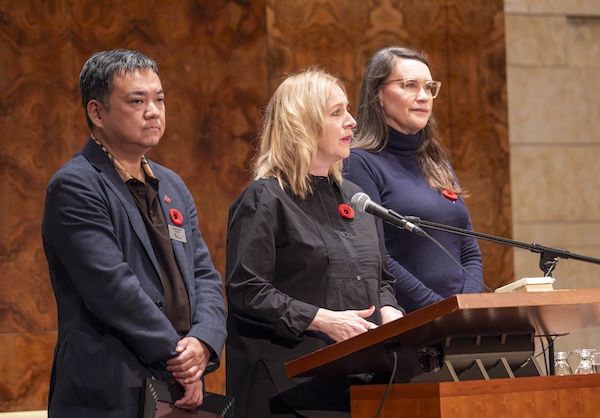
photo - Vancouver Deputy Mayor Sarah Kirby-Yung, centre, and councilors Lenny Zhou and Lucy Maloney at the Nov. 9 Kristallnacht commemoration
Vancouver Deputy Mayor Sarah Kirby-Yung, centre, and councilors Lenny Zhou and Lucy Maloney at the Nov. 9 Kristallnacht commemoration. (photo by Sova Photography)

Cantor Yaakov Orzech chanted El Moleh Rachamim, the memorial prayer.

Taleeb Noormohamed, member of Parliament for Vancouver Granville, warned of the dangers of ignoring the lessons of history.

“If we don’t take the lesson that remembrance requires us to take, we end up with a quiet normalization of what that night represented,” he said. “This is a fight that we all take on. We take on with responsibility, we take on with conviction, and we take it on to honour all of you who survived and all of you that have relatives and friends and loved ones that didn’t. So, we say, may their memory be a blessing and, indeed, may it be, but may it also be a reminder to all of us that the work that is to be done is for all of us.”

Terry Yung, member of the BC Legislature for Vancouver-Yaletown and a retired senior officer with the Vancouver Police Department, told the audience the future depends on education.

“We cannot arrest ourselves out of hate, we cannot,” he said. “We have to educate people in this world of darkness.”

Sarah Kirby-Yung, deputy mayor of Vancouver, and fellow city councilors Lenny Zhou and Lucy Maloney read a proclamation from the city. 

Posted on November 21, 2025November 20, 2025Author Pat JohnsonCategories LocalTags Beth Israel, Chris Friedrichs, Hannah Marazzi, history, Holocaust, Jonathan Infeld, Kristallnacht, Robin Judd, Sarah Kirby-Yung, Shoah, Taleeb Noormohamed, Terry Yung, Vancouver Holocaust Education Centre, VHEC, war brides
Vrba monument is unveiled

Vrba monument is unveiled

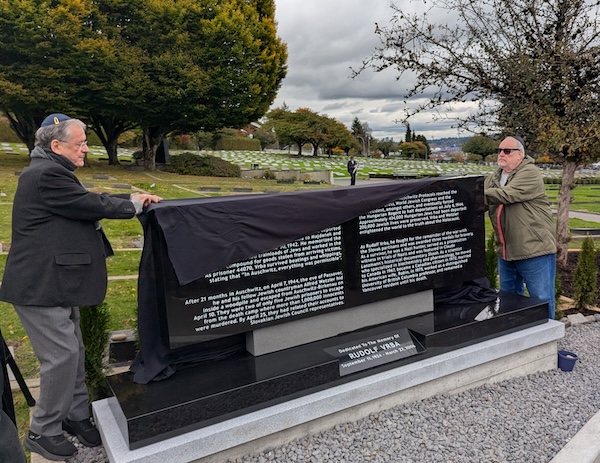
Robert Krell, left, founding president of the Vancouver Holocaust Education Centre, and Al Szajman, the current president, unveil the monument to Rudolf Vrba at Schara Tzedeck Cemetery. (photo by Pat Johnson)

Rudolf Vrba, a scientist who had a significant but comparatively quiet career in the laboratories and lecture halls of the University of British Columbia, enjoyed a comfortable life with his wife Robin in Vancouver before his death in 2006. Unbeknownst to thousands of his students over the years, Vrba may have saved more Jews during the Holocaust than any other individual. Despite this astonishing fact, his name has remained almost unknown not only among scholars of that history but even in his own adopted community of Vancouver.

At Schara Tzedeck Cemetery in New Westminster on Oct. 26, a monument was unveiled that seeks to remedy Vrba’s relative anonymity. 

“Why do so few know his name?” asked Dr. Robert Krell, founding president of the Vancouver Holocaust Education Centre and a member of an ad hoc group that came together to recognize Vrba’s life and bravery. “Sir Martin Gilbert, the British historian, wrote that Vrba was directly responsible for saving at least 100,000 Jewish lives. Others now credit him with the preservation of as many as 200,000 Hungarian Jews.”

Before about 200 people gathered in the cemetery’s chapel prior to the monument’s unveiling, Krell recounted the exploits of Vrba and his co-conspirator, fellow Slovakian Jew Alfréd Wetzler, who were incarcerated in Auschwitz. 

In April 1944, Vrba, just 19 at the time, and Wetzler, 25, contrived to conceal themselves within the Auschwitz compound, while, outside the camp, a massive search was undertaken by dogs and armed guards. After hiding silently in a woodpile for three days, the two men escaped and traveled for days by foot to Slovakia, where they shared all the information they had amassed about operations at the death camp. Vrba has been credited with having had an almost photographic memory and, over 22 months in Auschwitz, with Wetzler and he both having risen to positions of comparative privilege and trust in the camp, they were uniquely equipped to tell the world what was happening. 

Vrba had worked on the arrival platforms at the camp, observing the incoming Jews and, later, in the “Kanada” compound, where the stolen valuables of arriving prisoners were stored. Wetzler was a registrar and clerk in the camp. The pair chose their moment to act because their vantage points alerted them to the imminent deportation of the last remaining large group of surviving Jews in Europe, those of Budapest. 

Their account, which became known as the Auschwitz Protocols, or sometimes the Vrba-Wetzler Report, was the most credible and detailed information received to that moment about the extent of mass murder taking place in Auschwitz. More than 400,000 Hungarian Jews had already been murdered. 

“The Jews of Budapest were next,” said Krell. 

After dictating the report, Vrba joined the Slovakian army as a machine gunner and, later, joined the Slovak partisans, participating in 10 major battles and being awarded multiple medals for bravery. 

After the war, Vrba completed a PhD in biochemistry at Charles University in Prague, then lived in Israel and England before serving as a research fellow at Harvard Medical School. He married Robin, an American, in 1975 and they made a home in Vancouver. Vrba was an associate professor in the department of pharmaceutical sciences at UBC for 30 years and Robin was a realtor.

The explanation for Vrba’s relative anonymity has been explored in books, including a recently released first volume of a two-part biography by Vancouver writer Alan Twigg. (Holocaust Hero: The Life and Times of Rudolf Vrba was reviewed in the Oct. 10 issue of the Independent.)

The unfamiliarity with Vrba’s story in Israel, in particular, has been explored by Ruth Linn, a University of Haifa academic who first heard of Vrba when she was on sabbatical in Vancouver in the late 1990s. She returned to Israel and began asking if others with expertise in the field knew of Vrba, Wetzler and their escape. Her explorations led to her 2004 book Escaping Auschwitz: A Culture of Forgetting, which made the case that there was a deliberate effort in Israel to silence Vrba’s voice and obscure his history.

Vrba bore particular animus toward Rezső Kasztner, a leader of the Budapest Jewish community who went on to become a mid-level bureaucrat affiliated with the Israeli establishment and the Mapai party that led the country. Vrba – and others – viewed Kasztner’s actions as having saved the lives of Kasztner, his family and several hundred of his friends and associates at the possible expense of thousands of other Hungarian Jews. Vrba believed that, had ordinary Hungarian Jews been privy to the Auschwitz Protocols, as Kasztner was, they could have made their own decisions about whether to board the deportation trains.

The new monument and the unveiling ceremony were the culmination of several years of work by a group including Krell, Yosef Wosk, Geoffrey Druker, Joseph Ragaz, Arthur Dodek and Bernie Simpson, who formed a core committee advancing the project. Dodek, who emceed the Oct. 26 event, acknowledged additional contributions from the Kahn family, Ryan Davis, Marie Doduck and Jack Micner. Mayor Patrick Johnstone of New Westminster attended.

Organizers thanked the Schara Tzedeck Cemetery Board, including chairs Arnold Silber and Jack Kowarsky, and executive director Howard Jampolsky, as well as Schara Tzedeck’s Rabbi Andrew Rosenblatt.

Rosenblatt spoke of biblical and modern concepts of righteousness, citing Vrba as the definition of a hero. 

“He did not escape from Auschwitz simply to save his own skin,” said the rabbi. “He escaped from Auschwitz to save Hungarian Jewry. He escaped from Auschwitz to warn the world.”

The monument, located adjacent to an area of the cemetery not yet open to burials, means that future generations who pass through mourning loved ones will have an opportunity to reflect on true heroism.

“I am struck anew by how singular his legacy was, how young he was, how hard he fought to bring the truth to the world,” said Hannah Marazzi, executive director of the Vancouver Holocaust Education Centre, which sponsored the ceremony. “It is a legacy of courage, brilliance, sorrow, resilience and endurance. But perhaps what I have treasured most is learning about his life and legacy from those here who have had the privilege of knowing him.”

Druker noted that the monument reflects an increased awareness of Vrba locally and hoped that the knowledge would expand beyond his hometown.

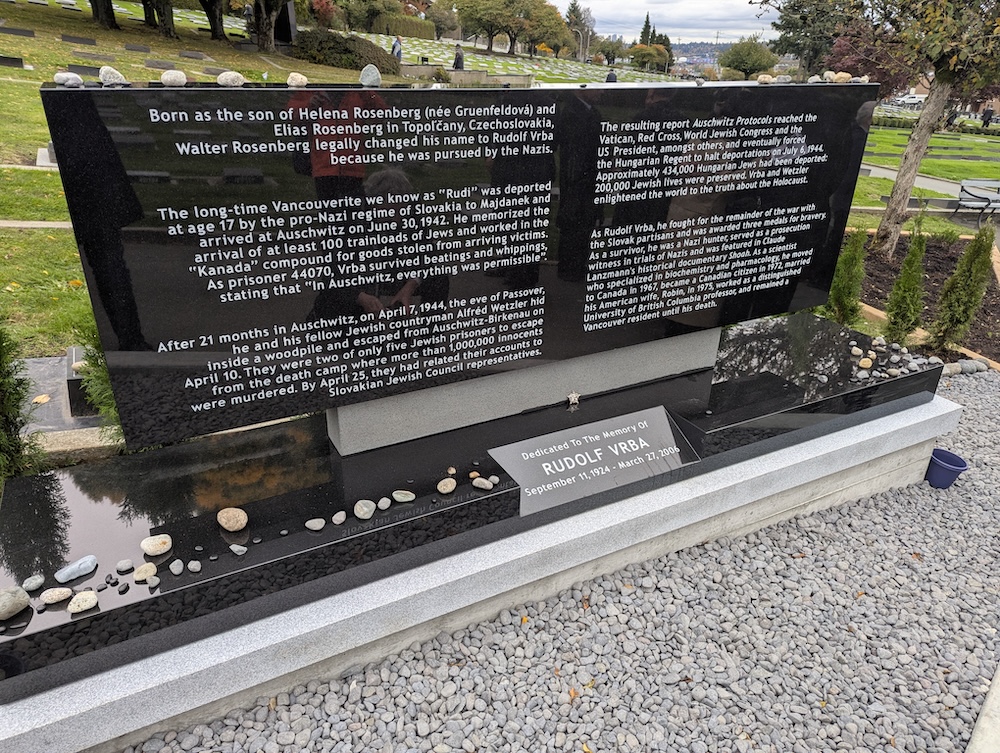
Druker read aloud the inscription, which recounts the details of Vrba’s life: his origins, his deportation to Majdanek and Auschwitz, his escape, his war heroism and his life as an academic. 

“We hope that, in Israel, he will finally be recognized for what he is: a central hero that changed the course of the Holocaust for Hungarian Jews,” Druker said. “We want the world to recognize that too.”

photo - The new monument to Rudolf Vrba at Schara Tzedeck Cemetery
The new monument to Rudolf Vrba at Schara Tzedeck Cemetery. (photo by Pat Johnson)

Chris Friedrichs, professor emeritus of history at UBC, put Vrba in the context of his times.

“The existence of Auschwitz was no secret to those leaders,” he said. “They knew that Auschwitz was the site of a vast industrial complex where German war production was being performed by forced labour. But, as we know, this report for the first time described the actual operations of the camp in terrifying detail, making clear that Auschwitz was not only a location of industrial activity, but also the site of mass extermination of human lives on a scale that nobody had previously fully grasped.

“A huge number of Hungarian Jews had already been sent to Auschwitz, but the approximately 200,000 Jews of Budapest had not yet been deported, and it was largely thanks to this warning that the deportations were halted and the lives of most of those 200,000 Jews were saved.”

The experiences Vbra underwent at a young age, as well as his anger that his escape and the report he helped draft did not save even more lives, affected him through his life. Friedrichs, who knew Rudi and Robin Vrba, said they enjoyed a happy life in Vancouver, but the past haunted Vrba.

“For, although he could escape from Auschwitz, Rudolf Vrba could never really escape from the Shoah,” said Friedrichs. “He knew too much and he cared too much to put what he had seen behind him.… Rudolf Vrba was dedicated to relating the facts, but there was also anger, and that anger was directed not just against the Nazis, but also against Jewish leaders during the war who could not bring themselves to inform their fellow Jews about what was happening in Auschwitz. He was like a biblical prophet who had inveigled against the wilful ignorance or stubborn disbelief of those who should have known better.”

Friedrichs credits Robin, who now lives in the United States and was not able to attend the unveiling, as “not only his cherished companion for over three decades,” but with ensuring that his legacy not be forgotten. 

“In fact,” said Friedrichs, “that task is a challenge for all of us. Even the Jewish community of Vancouver never fully recognized the greatness of this man and the role he had played both in saving Jewish lives and in contributing to knowledge of the Shoah.” 

The monument is a belated recognition, said Friedrichs.

“What we do today is overdue, but it is not too late,” he said. “Future generations will pass by this monument and realize how proud our community should have been that this man lived and worked for 30 years in our midst. As we watch the monument being unveiled, and if we gently lay some stones upon it, we will be paying a debt of gratitude to someone who is not only a hero of the 20th century, but should continue to be an inspiration for the 21st.” 

Format ImagePosted on November 7, 2025November 6, 2025Author Pat JohnsonCategories LocalTags Andrew Rosenblatt, Chris Friedrichs, history, Holocast, memorials, Robert Krell, Rudolf Vrba, Schara Tzedeck Cemetery, Vancouver Holocaust Education Centre

Survival in the forest

The harrowing new memoir by Vancouver’s Evelyn Kahn, They Never Left Me: A Holocaust Memoir of Maternal Courage and Triumph, written with her daughter Hodie Kahn, tells of a family’s survival while hiding in the forests of Eastern Europe.

They Never Left Me includes some of the most debasing inhumanity imaginable. Perhaps most shocking, though, is that human beings can withstand what the author and her family experienced and somehow endure and begin again in a post-Holocaust world, to raise a successful family and find meaning and happiness.

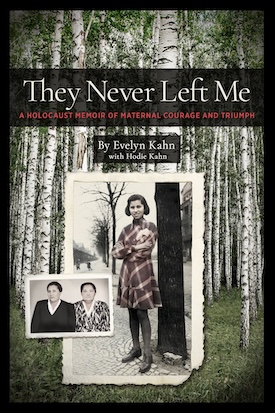
image - They Never Left Me book cover
Evelyn Kahn wrote They Never Left Me: A Holocaust Memoir of Maternal Courage and Triumph with her daughter, Hodie Kahn. On Oct. 19, at Schara Tzedeck Synagogue, Evelyn Kahn will talk about the book with Dr. Robert Krell.

Stories of Chava’s (Evelyn’s) early years, typical of traditional Eastern European Jewish shtetl life – her father’s preparations for morning prayers, her mother baking round challah for Rosh Hashanah, a live fish floating around in preparation for gefilte – read as ominously ordinary, knowing as we do a little of what is to come. 

From their hometown of Eishyshok, a shtetl in Poland that historically had shifted between Lithuania, Poland and then, tragically, between the Nazis and the Soviets, the family moved a few dozen kilometres to Lida, in what is now Belarus. This relocation, an economic move driven by her father’s proficiency in the Russian language, was the least dramatic move of Chava Landsman’s young life. Nonetheless, that move might have been the first of many near-miracles that saved the lives of Chava and the women in her family.

“On the eve of Rosh Hashanah 1941, Eishyshok’s Jews were rounded up and locked in the synagogue and two schools. After three days, they were herded to the horse market.… Over the next two days, the Jews were taken in groups of 250 – first the men and then the women and children – to the old Jewish cemetery. They were ordered to undress and stand at the edge of large open ditches, where they were shot to death by Lithuanian police. Babies were bashed to death against headstones or tossed into the air for sharpshooting practice led by the chief of police, Ostrauskas, before their tiny lifeless or quivering bodies were thrown into the killing pits to join their parents. Everyone was murdered.”

The final victim of the massacre was the town rabbi, “shot after being forced to witness the murder of his entire flock.”

As the Nazis invaded Lida, the family witnessed the aerial bombardment and made the decision to flee. They headed south, and sought refuge in another shtetl, Zhetel. But this was a brief refuge – not an escape. Death was chasing them. 

Chava’s father was rounded up during a cull of intelligentsia on July 23, 1941, barely a month after they arrived. 

“We watched in misery as Papa climbed into the back of a truck and was driven away,” she writes. “I never saw my father again.”

Chava’s Uncle Chaim and Rivke’s husband Shael were conscripted into the Red Army, leaving the women as the only family together in the Zhetel ghetto, which was created in February 1942. Chaim was captured by the Nazis, but incredibly escaped a POW camp and returned to Zhetel, where he became a Partisan in the forest and was killed. On April 30, 1942, the first liquidation began in the Zhetel ghetto.

“My own memory of the procession along the street is of being corralled into a narrow funnel and of feeling smothered by the crush of human bodies around me,” she writes. “I remember telling my mother I could not breathe. I was worried I might pass out and be trampled. People were on top of one another – on top of me – crying and tearing their hair out. I wanted Mama to pick me up, but it was impossible. We were compressed like livestock in a cattle chute. I just held onto Mama’s hand and prayed that mine would not slip out of hers.”

In terror, Chava told her mother she was being suffocated.

“She bent down close to me and I will never forget her tearful words,” Kahn writes. “My child, it is better that you should suffocate here than my eyes should witness you being murdered.

“I took in what she said and then simply asked, ‘Does it hurt to die, Mama?’ She assured me it was a peaceful experience. ‘Neyn mayn kind, es iz vey a feygele, git a brum’ (‘No my child, it is like a chirp of a bird’).

“Her answer quieted my fears and calmed me. I was never afraid of death from that moment on. I never remember feeling despair. On the contrary, I was exceptionally calm and clear throughout the nightmare to come.”

Somehow, the women survived the first liquidation. When the second and what would be the final liquidation of the ghetto began on Aug. 6, 1942, 3,000 Jews were herded to the Jewish cemetery and murdered. Knowing what was to come, Chava’s mother Basia decided to risk going into hiding – a choice between instant death and likely later death for disobedience. Again, it was a lifesaving decision.

Basia, Chava and her grandmother (Bobe) Hoda fled to the forest. Miraculously, with the help of a non-Jewish friend of the family, they were reunited with Chava’s Aunt Rivke, and the three adult women and Chava would endure the horrors of life in the woods for two years. (Shael fought with the Red Army through the war and survived, but he and Rivke did not reunite.)

The women largely fended for themselves with some assistance from Partisans and the occasional righteous non-Jew. Like other Jews in the forests at the time, they formed fluctuating ad hoc survival “family groups” of a dozen or as many as 20 people.

“We had learned the rules of the ghetto and we had survived. Now we would have to learn the rules of the forest. And we would have to learn them very, very well and very, very quickly. We could either adapt and hopefully live or not adapt and definitely die.

“We lived with the constant nervous anticipation of being discovered and killed at any moment. We were careful to speak quietly. We were always alert. We became as hypersensitized and wary as the creatures of the forest.”

In winter, they sheltered in holes in the ground. 

“Needless to say, hygiene and maintaining our health in the forest was hugely challenging,” Kahn writes. “We were malnourished and vitamin deficient. We were unwashed and unkempt. We wore the same clothes day after day with no relief. We were filthy skeletons, bulked up only by the layers of our lice-infested clothing, which we wore 24 hours a day. I often wonder how we managed to survive those two years without bathing.”

Basia’s doggedness saved her family. Even at 40 degrees below zero and with snow to her thighs, she would trudge out of the woods to beg or steal provisions from local farmers. 

“It is true that many (most) farmers were unfeeling or, worse, informers. But it is important to acknowledge that there were those who hung onto their humanity during the war, righteous gentiles who were sympathetic and compassionate and gave us food and other necessities,” Kahn writes.

It is estimated that only one-half to one-third of the Jews who hid in forests survived to liberation. And, when “liberation” did come, and the Nazis were defeated, antisemitism remained. Many ordinary Russians, Poles, Lithuanians and Belarusians thought they had seen the last of the Jews and were not welcoming to the few straggling remnants who found their way back home.

The three generations of women – Bobe Hoda, mother Basia, Aunt Rivke and Chava, as well as Rivke’s baby, Joseph, who was born in and knew life only in the forest – remarkably survived and proceeded through a series of displaced persons camps, with schooling and vocational training for the young survivors. They had no family in the new state of Israel and so America seemed the more logical destination. At age 16-and-a-half, Chaya/Evelyn, her mother, aunt, cousin and grandmother were greeted at New York by the Statue of Liberty and a coterie of cousins. Eventually, Evelyn reconnected with a young man from Eishyshok, Leon (Leibke) Kaganowicz, who would become Leon Kahn and, because of American migration quotas, a Canadian who lived in Vancouver. Together, they became stalwarts of the Vancouver community.

Leon Kahn passed in 2003. His memoir, No Time To Mourn: The True Story of a Jewish Partisan Fighter, was published in 1978 and reissued in 2004. It will be released again this fall.

Evelyn has two sons, Mark and Saul, and daughter Hodie, as well as seven grandchildren and three great-grandchildren.

The idyllic start of Chava’s life, surrounded by a tight and loving family and community, juxtaposes horrifically with the abrupt cataclysm of history that would follow. The survival of three generations of women in the forests of Eastern Europe is a monument to human resolve and resilience. They Never Left Me is a momentous contribution to the literature of the Holocaust.

An event featuring Evelyn Kahn in conversation about the memoir with Dr. Robert Krell will take place on Oct. 19, 2 p.m., at Schara Tzedeck Synagogue, presented by the Vancouver Holocaust Education Centre, Ronsdale Press and Schara Tzedeck. 

Posted on September 26, 2025September 24, 2025Author Pat JohnsonCategories BooksTags book lauch, Evelyn Kahn, history, Hodie Kahn, Holocaust, memoirs, Ronsdale Press, Schara Tzedeck, survivors, They Never Left Me, Vancouver Holocaust Education Centre, VHEC
Ruta’s Closet reissued

Ruta’s Closet reissued

Lady Esther Gilbert speaking at Vancouver City Hall April 8, when Vancouver Mayor Ken Sim proclaimed Ruth Kron Sigal Day in the city. (photo by Keith Morgan)

Ruta’s Closet, the Holocaust narrative of the late Vancouverite Ruth Kron Sigal, is being reissued for a new generation of audiences – and the book’s author is ensuring the survivor’s inspiring story of survival and resilience reaches the widest possible global audience.

Vancouver journalist Keith Morgan, who completed the book shortly before Kron Sigal’s passing, at age 72 in 2008, has updated the publication – and created an extensive range of multimedia projects to expand the impact of the written volume.

image - Ruta’s Closet book coverFirst issued as a fundraising initiative for the Vancouver Holocaust Education Centre, Ruta’s Closet was later published in the United Kingdom, with distribution there reaching new audiences. 

The book recounts the harrowing survival story of the Kron family, imprisoned in the tiny Shavl (Šiauliai) ghetto in Lithuania, through the eyes of the youngest daughter, Ruta (later Ruth). Their survival against Nazi persecution hinged on the courage and resourcefulness of her parents, Meyer and Gita Kron, as well as the bravery of non-Jewish rescuers. Depicted with novel-like narrative power but rooted in rigorous research and eyewitness testimony, the memoir vividly portrays atrocities such as mass murder, a Nazi ban on Jewish births and the deportation of children to Auschwitz, while also shining a light on courage, compassion and human resilience amid the evil.

Kron Sigal didn’t live to see the book in print but she saw the final draft.

“She said to me shortly before she died, ‘You are going to carry on telling my story, Keith, aren’t you?’ And I said, of course I am,” Morgan told the Independent. “So, I took that on as a mission.”

Surveys indicating widespread ignorance of Holocaust history, combined with skyrocketing antisemitism, motivated Morgan to launch a series of Ruta’s Closet-related projects. 

“We updated the book and decided it was time to go basically worldwide with this,” he said. 

In addition to the re-release of the hard-copy, Morgan and his small team of colleagues recorded an audiobook and released an ebook. They revamped the existing Ruta’s Closet website and made it more interactive.

Working with Bill Barnes, a local radio producer, Morgan developed a 25-segment podcast.

“We are doing Zoom interviews with people around the world who are a part of a driving force behind an imaginative, creative initiative in spreading Holocaust awareness and education,” he explained. “I’ve got Ruth’s kids – Michael, Marilee and Elana – each week doing an introduction for book clubs.”

The VHEC has produced a downloadable guide for book clubs, as well as a teacher’s guide to the book, which makes it additionally relevant as British Columbia’s education curriculum mandates Holocaust education this year for the first time as part of the Social Studies 10 coursework. 

“The beauty of it, for British Columbia, is it’s technically a local story,” Morgan said. “It’s about Ruth. It’s about somebody who came here and did a lot for her adopted society.”

photo - Journalist Keith Morgan, author with Ruth Kron Sigal of Kron Sigal’s memoir, Ruta’s Closet, is ensuring that her story of survival and resilience reaches the widest possible audience
Journalist Keith Morgan, author with Ruth Kron Sigal of Kron Sigal’s memoir, Ruta’s Closet, is ensuring that her story of survival and resilience reaches the widest possible audience. (photo from Keith Morgan)

Morgan, who spent many years as the crime reporter at the Province newspaper, met Kron Sigal when his editor asked him to take on a more uplifting assignment and begin a series about people doing good works at home and abroad.

“Somebody said, ‘Oh, you should talk to Ruth Sigal,’” who was sharing her Holocaust story with students. “I went to meet her. I was very impressed. She told her story and it had an amazing impact on me. I just knew this was an important story to tell.”

He found immediate support from Dr. Robert Krell, the founding president of the Vancouver Holocaust Education Centre. 

“Robert Krell kind of took me under his wing – he was a close friend of Ruth – and he said, ‘I’ve got just the guy to introduce to you, who will be really helpful to you for pulling the story together.’” 

The person was renowned historian Sir Martin Gilbert.

“The British schoolboy in me thought, ‘How do I curtsy?’” Morgan joked.

Morgan met Sir Martin in London and got a one-on-one master course in writing about the subject.

“He looked me right in the eye and said, ‘You have to tell the story as though you were writing it for your newspaper and make it accessible to all people,’” Morgan recalled. “Sadly, Martin died [in 2015], but Lady Esther Gilbert took up his mantle and, since then, she’s been an ally and was very important in this edition in terms of going through it, adding bits here and there.”

She spoke at a ceremony at Vancouver City Hall on April 8 this year, when the mayor proclaimed Ruth Kron Sigal Day in the city.

Kron Sigal’s story resonates profoundly with people, according to Morgan.

“We can all relate to what happened to Ruth and her sister Tamara,” he said. “It also tells us compelling stories about how, through their own devices, they basically survived and helped others along the way. We also see what other members of the family did to help the broader community.… We get this family story, which, in itself, is very dramatic, but we also get this wider picture of how a community in the ghetto work with each other, help each other.”

Morgan sees Kron Sigal’s narrative as an inspiration not only because of her survival against the Nazis but in all she did after becoming a Canadian.

“Ruth came here, an adopted country, and spent 25 years at the Women’s Resource Centre and the VHEC Child Survivors Group,” said Morgan. “That’s an example to everybody: come into a new society, an adopted country, and just roll up the sleeves and get working. Isn’t that an example to anybody that comes in?”

No less a triumph, Morgan said, is the family Ruth and her husband, Dr. Cecil Sigal, created. 

“You look at that family and you think, ‘Victory!” he said. “Because they beat Hitler.” 

Format ImagePosted on August 29, 2025August 27, 2025Author Pat JohnsonCategories BooksTags books, ebooks, education, Esther Gilbert, Holocaust, Martin Gilbert, memoir, multimedia, podcasts, Robert Krell, Ruta's Closet, Ruth Kron Sigal, Vancouver Holocaust Education Centre, VHEC
Krieger takes on new roles

Krieger takes on new roles

Nina Krieger, centre, member of the BC Legislative Assembly for Victoria-Swan Lake, connects with community members. Krieger is the new public safety minister and solicitor general. (photo from Nina Krieger)

After a cabinet shuffle last week, Nina Krieger, member of the legislative assembly for Victoria-Swan Lake, is the new public safety minister and solicitor general, replacing Garry Begg, who became parliamentary secretary for Surrey infrastructure. 

Saying she is “humbled and excited” to take on the position, Krieger told the Independent: “Our province faces complex challenges, and I am committed to working with my colleagues, local governments, Indigenous leadership, police services, business and community organizations to build safe, healthy and resilient communities for everyone.

“Public safety is one of the central issues of our time,” she said, “and British Columbians are looking to us to strengthen public safety through effective support of our law enforcement services and working across government to address the root causes of public disorder. 

“I look forward to working with partners around the province to take meaningful action to keep BC a safe place to live, work and enjoy this beautiful province we call home,” she added.

Before being elected to the Legislative Assembly of British Columbia last fall, Krieger was the executive director of the Vancouver Holocaust Education Centre (VHEC). She takes over her new cabinet position after having served as parliamentary secretary for arts and film. Prior to this shift in roles, she spoke with the Independent about her time in office since being sworn in.

“The role of MLA is a unique opportunity and responsibility. I don’t think anything can quite prepare you for the busy, ever-changing schedule, and the range of issues and people that you encounter on any given day,” Krieger said.

“The learning curve is steep but exciting and I’m grateful to be learning alongside other new MLAs, from veteran members of caucus and from the incredible teams behind the scenes at the BC legislature.”

Krieger describes the move from the VHEC as “bittersweet,” saying it was difficult to leave an organization and a community for which she cares deeply. Nonetheless, she said the skills, experience and values she honed during her work at VHEC have proved meaningful and timely in her current role.

“I keep in close touch with former colleagues and the Holocaust survivor community and was honoured to return to the VHEC this spring to emcee a Yom Hashoah commemorative program featuring Premier David Eby, presented in partnership with the Province of BC and the Centre for Israel and Jewish Affairs,” she said.

Her introduction to the legislative side of the MLA job came during the recent spring session that concluded in May. She sat in the house and committee rooms, sometimes late into the night, delivering speeches about her community and constituents’ achievements and needs, as well as debating and voting on proposed legislation. 

“I was proud to deliver several statements in the house, marking days of significance for BC’s Jewish community,” said Krieger.

“This spring, government passed legislation to protect consumers, respond to the threat of tariffs and implement countermeasures, deliver more renewable energy projects and major infrastructure projects, among other work,” she said.

During the summer months, MLAs return to their communities. 

“I visit and meet with local organizations to hear about the work they do and how we can spotlight and support them,” she said. “I also have the chance to attend local events as an MLA over the summer, from graduation ceremonies to festivals, markets and sports games. With so many amazing people putting on great events around town here over the summer, it adds to the fun of this role.”

As the parliamentary secretary for arts and film, Krieger worked closely with the minister of tourism, arts, culture and sport to advance the 

development and growth of British Columbia’s film, television and animation sectors, as well as supporting and growing the arts and culture sectors in the province. One of the perks of that job was attending film-related events and meetings, like local film festivals.

“It has been amazing to see the talent and work coming out of BC, and rewarding to stand strong in support of workers in the face of tariff threats,” she said.

Krieger acknowledges that it is a difficult time for Jews in the province and throughout Canada, with challenges in finding their political “homes.” She is grateful that there were Jewish voters whose values aligned with those of the BC NDP.

“I know that there is work to do to ensure that Jewish people in BC feel safe and supported, and that nobody is targeted because of who they are,” Krieger said. “Combatting antisemitism – which is illiberal, toxic to democracy and dangerous – requires the work of all levels of government and civil society.”

She continues to be in active contact with Jewish constituents and community leaders in Victoria, which, she says, is home to a diverse Jewish community. Constituents from a range of backgrounds have contacted her and expressed deep concern about the toll of the ongoing Israel-Hamas war on the civilian populations of the region. 

“While foreign policy is beyond my scope as a provincial representative, it is vital to discuss ways to ensure that BC is a safe and inclusive place for all people,” Krieger said. “From my work as a Holocaust educator, I know that it is vital to counter misinformation, disinformation and conspiracy theories, which can fan the flames of xenophobia, antisemitism and hate, and keep communities divided. In my work as MLA, I hope to counter this by bringing people together, modeling respectful dialogue and upholding the values of truth and trust in democratic institutions.”

Krieger explained that her experience as an anti-racism educator showed her the importance of listening and continually learning with openness and compassion. It is relevant to her current work, she believes, because she is entrusted with the stories and experiences of many constituents, which are often shared to build a more just and inclusive society.

“The province helps fund anti-racism and anti-hate work done around BC,” said Krieger, “and I have the opportunity to talk to organizers that are the recipients of grant funding and hear about their work, share experiences and learn how we can continue to collaborate to do this vital work effectively.”

Sam Margolis has written for the Globe and Mail, the National Post, UPI and MSNBC.

Format ImagePosted on July 25, 2025July 23, 2025Author Sam MargolisCategories LocalTags antisemitism, British Columbia, governance, MLAs, Nina Krieger, politics, Vancouver Holocaust Education Centre, VHEC
Marazzi at VHEC helm

Marazzi at VHEC helm

Hannah Marazzi is the new executive director of the Vancouver Holocaust Education Centre. (photo by Alina Ilyasova)

The Vancouver Holocaust Education Centre, which is marking three decades of educating about and commemorating the Shoah, has a new executive director: Hannah Marazzi. She is the first person of non-Jewish background to hold the role.

Barry Dunner was the first executive director of the Vancouver Holocaust Centre Society for Education and Remembrance, the not-for-profit organization that operates the VHEC. Ronnie Tessler then helmed the centre, followed by the late Dr. Roberta Kremer, then Frieda Miller. Nina Krieger served more than a decade as head of the institution before successfully running for the British Columbia legislature last fall. (See story, jewishindependent.ca/krieger-takes-on-new-roles.)

Marazzi had been the VHEC’s director of communications and special projects for about 10 months before being appointed interim executive director. Her permanent appointment was announced on June 17, at the annual general meeting of the society.

The organization’s president, Al Szajman, credited Marazzi’s background as a good fit.

Formally announcing Marazzi’s appointment, Szajman noted her role as “Irwin Cotler’s right-hand person” and her existing relationships with partner groups like the International Holocaust Remembrance Alliance, and with various foundations, government leaders and influencers locally, nationally and internationally.

“In short, we’ve come to recognize Hannah as a leader, someone with passion, vision and maturity. Her Italian-Mennonite background reminds everyone that you don’t have to be Jewish to stand against antisemitism and advance the lessons that everyone should have learned about the Shoah,” he said.

Marazzi has an undergraduate degree in history, political science and government from Trinity Western University and a master’s degree in public policy from Cambridge, where she served as an assistant editor of the Cambridge Review of International Affairs. 

Early in her career, she was working on Parliament Hill when Cotler reached out to her boss, then-MP for West Vancouver-Sunshine Coast-Sea to Sky Country John Weston, to become involved in the case of a woman sentenced to death in Iran. Through the Cotler connection, Marazzi went on to help organize the Nuremberg Legal Symposium. The gathering, which was co-created by March of the Living and the Raoul Wallenberg Centre for Human Rights, in 2016, educated legal professionals and the next generation about the lessons of Nuremberg and how to apply them today, especially as the legal sector addresses hate, denial and incitement. Marazzi became administrative coordinator for the event.

She went on to work for the Cardus Institute, a Christian think tank, and then for United Nations Volunteers, in Amman, Jordan, before Cotler coaxed her to join him when he was appointed to inaugurate the office of Canada’s Special Envoy on Preserving Holocaust Remembrance and Combatting Antisemitism.

Marazzi returned to the West Coast – she grew up in the Fraser Valley – to be closer to her family when her father faced a health crisis.

Addressing the VHEC annual meeting, Marazzi paid tribute to the founders of the organization, who opened the doors to the centre 30 years ago, including Dr. Robert Krell, the founding president, who was present at the meeting.

She reflected on her first visit to Auschwitz, at age 22, 10 days after graduating from university.

“I did not know then that I would return to places like Auschwitz, Treblinka and many other sites of memory and begin learning in my own country at places like the Vancouver Holocaust Education Centre,” she said. “I feel strongly in my bones that we must not allow the lessons of the Holocaust to fade from memory. As my mentor Irwin Cotler says, ‘No one can say that we did not know. We knew. But we did not act.’ This is why I believe so resolutely in the power of Holocaust education to awaken us to the reality of what happens when a society, through silence and inaction, allows evil to flourish unchecked.”

The VHEC has become Western Canada’s leading Holocaust museum dedicated to the promotion of social justice, human rights and genocide awareness. It is at a turning point in its history, as all such facilities prepare for an era when there are no longer eyewitnesses to the events who can share their narratives.

Holocaust museums have increasingly used technology to capture and immortalize those stories – and Marazzi credited Krell as a pioneer in that field, having begun one of the world’s earliest archives of video-recorded survivor testimonies, beginning when the technology was fresh.

Broader developments in the community will have a profound impact on the VHEC. The centre is slated to double in size and attain a new visibility thanks to JWest, the redevelopment of the Jewish Community Centre of Greater Vancouver, where the VHEC is located.

Marazzi emphasized the importance of partnerships in the VHEC’s success, including local connections, such as with the Roma and Rwandan communities. After the Russian invasion of Ukraine, the VHEC partnered with the University of British Columbia to bring to Vancouver 

Dr. Nataliia Ivchyk – an expert on Holocaust studies in Ukraine and East-Central Europe, focusing on gender, memory politics and the experiences of Jewish children during the Holocaust – who was identified as a scholar-at-risk. At the VHEC, Ivchyk took on the Russian-Language Holocaust Testimony Project, conducting interviews with Russian-speaking survivors in the Lower Mainland.

Internationally, World Jewish Congress has reached out to borrow the centre’s current exhibit, Age of Influence, which focuses on how the Nazi regime used propaganda specifically targeted at raising and indoctrinating young Germans. Demand for this exhibit, an original VHEC creation, has led to the creation of traveling versions. 

Marazzi acknowledged that, when she tells people where she works, they sometimes suggest it must be a depressing daily grind.

“It’s actually the most hopeful place you can be at this time,” she said. “You have the survivors who have experienced unimaginable horrors and yet not only are they here with us contributing to society in extraordinary ways, they are willing to dig deep into what was the worst experience of their life and share it to educate students.”

The VHEC has never been busier, she added. Hundreds of kids, teachers and adults, including elected officials and diplomats, law enforcement, groups of coworkers, unions and others, attend the exhibits every week. At national and international conferences, Marazzi has discovered this is not the case in all such institutions. Security fears and possibly other factors have seen attendance drop in many Holocaust education institutions, she said, even amid a flourishing of antisemitism and intolerance, the phenomena they are intended to address.

Marazzi credits the trajectory of success with the work that the VHEC has done for the past 30 years in creating relationships based on trust and mutual respect with other communities, school districts and educators across the province. 

“We are completely inundated and it’s exhausting but it’s delightful,” she said.

The confluence of events – Marazzi’s appointment, the impending expansion of the VHEC and the global increase of antisemitism – place the organization at a moment of challenge and opportunity, said Szajman.

“The moment is – I was going to say big, but it’s huge,” he said. “In my lifetime, I’ve never seen the kind of antisemitism that I’m witnessing now. It sounds horrible, but I’m glad my father, a Holocaust survivor who passed away a few years ago, doesn’t have to see it. I think there’s been a very overt and visible right-wing antisemitism for decades. What we’ve witnessed over the last few years in particular is this explosion of left-wing antisemitism, sometimes overt, sometimes veiled – and thinly veiled at that.” 

The organization’s work has never been more important, he said.

While the eventually expanded VHEC will accommodate more visitors, Szajman noted that the centre has always reached beyond its walls, going to audiences where they are – both in-person and through virtual technologies even before these became everyday tools during COVID.

Szajman used to call the VHEC “the little engine that could.”

That’s not true, though, he said.

“It’s the little engine that does. It’s remarkable. This tiny little group of people who bust their butts every day putting in incredible hours, are so committed, including not just Jewish staff. It’s non-Jewish staff, too, that are so committed to this that, as a board member and as president, I couldn’t be any more motivated if you paid me,” he said, adding with a trademark laugh: “And they don’t.”

Editor’s note: This article is different than the print version that ran July 25, 2025, to reflect more fully the list of executive directors who helmed the VHEC.

Format ImagePosted on July 25, 2025August 19, 2025Author Pat JohnsonCategories LocalTags Al Szajman, antisemitism, education, Hannah Marazzi, museums, Vancouver Holocaust Education Centre, VHEC
New podcast launched

New podcast launched

On International Holocaust Remembrance Day, Jan. 27, the Vancouver Holocaust Education Centre (VHEC) and the Walrus Lab launched The Hidden Holocaust Papers: Survival. Exile. Return.  The six-part documentary podcast, hosted by best-selling Canadian author Timothy Taylor, offers a personal exploration of his family’s hidden Holocaust history. 

Through the series, VHEC furthers its mission of Holocaust education and remembrance by supporting stories that bring the realities of the Holocaust to new audiences. Taylor’s journey of discovery is not only an act of personal reconciliation but also a vital contribution to preserving the memory of Holocaust victims and survivors for future generations.  

As Taylor unpacks long-forgotten family archives, the series takes listeners on an emotional journey from his home in Vancouver to Germany, revealing a tapestry of stories about survival, resilience and loss. Alongside his search for answers, Taylor reflects on the universal lessons of justice, remembrance and identity in the face of historical atrocities.  

“The Holocaust isn’t just a chapter in history – it’s a call to action to remember, educate and prevent future acts of hatred and genocide,” said Hannah Marazzi, acting executive director of VHEC. “We are honoured to work with Timothy Taylor to amplify his family’s story and underscore the importance of safeguarding these narratives.”  

In conjunction with the podcast, Taylor’s accompanying feature article, “Paper Trail,” will be published in The Walrus in May; it was made available online on Jan. 27. The article is an account of Taylor’s journey to instal Stolpersteine memorial stones for his family members who suffered under Nazi persecution. 

For more information and to listen to the trailer, visit lnkfi.re/thehiddenholocaustpapers. 

– Courtesy Vancouver Holocaust Education Centre

Format ImagePosted on February 14, 2025February 13, 2025Author Vancouver Holocaust Education CentreCategories LocalTags history, Holocaust, International Holocaust Remembrance, podcasts, The Walrus, the Walrus Lab, Timothy Taylor, Vancouver Holocaust Education Centre, VHEC
Krell families give to JWest

Krell families give to JWest

The Krell, Lewis, Kallner and Singerman families are excited their gift will help in the creation of an expanded Vancouver Holocaust Education Centre. (photo by Rachel Topham)

The JWest capital campaign cabinet is grateful to Dr. Robert and Marilyn Krell and their families, Shoshana and Shawn Lewis, Simone and Howard Kallner, and Michaela and Matthew Singerman, for supporting the redevelopment of the Jewish Community Centre of Greater Vancouver site. The individual gifts from each of the four couples reflect two generations equally committed to building a strong Jewish future in Vancouver.

The Krell family has deep roots in Vancouver. Marilyn’s Polish grandfather, David Davis, who arrived in 1909, was one of the founding members of Congregation Schara Tzedeck. Robert, born in Holland, was hidden during the Holocaust and, after reuniting with his parents, arrived in Vancouver at age 10, in 1951. Both Robert and Marilyn were influenced by their parents’ involvement in the synagogue and a variety of Jewish organizations.

“Vancouver is where I became a Jew,” said Robert, who participated in Habonim as a child and became actively involved with the Canadian Jewish Congress as an adult. In 1971, he and Marilyn were married by Rabbi Marvin Hier, who was Schara Tzedek’s rabbi at the time. The couple raised their three daughters, Shoshana, Simone and Michaela, in a traditional Jewish home where Shabbat was always celebrated. The Jewish values that began at home were reinforced at Vancouver Talmud Torah, Camp Hatikvah and at the JCC. 

Robert, a founder of the Vancouver Holocaust Education Centre (VHEC), mobilized the survivor community from a concept in 1983 to a reality in 1994, when the centre opened as a museum and educational institute that ignited Shoah learning in British Columbia and beyond. The Krell daughters grew up witnessing the VHEC board meetings in their living room and attending award ceremonies that recognized their parents’ contributions to a variety of Jewish organizations.

“Through their actions and deeds, they taught us that you give when you can and volunteer when you can,” Simone said.  

Now with children of their own attending local Jewish institutions, the Lewis, Kallner and Singerman families have assumed leadership roles in the VHEC, VTT, Schara Tzedeck, Jewish Family Services, Jewish Federation of Greater Vancouver and the Jewish Community Foundation. As they saw their parents’ commitment to support JWest, they knew they were also ready to answer the call to help build a new infrastructure to support the future of the region’s Jewish community.

“We are excited to contribute to such an important and pivotal project that will be utilized and cherished not just by future generations of our Jewish community, but of the greater community as well,” said Michaela.

Her sisters expanded that idea by saying, “The JCC has played a role for five generations of our family and it shapes many of our fondest memories.”

The family is excited that their gift will also assist in the creation of an expanded Vancouver Holocaust Education Centre, an institute close to their hearts and lives. Founded with a mandate of Holocaust-based anti-racism education, the VHEC welcomes more than 25,000 students, educators and members of the public each year.

While it plays a crucial role in conveying the ongoing relevance of the Shoah, this teaching museum has long been challenged by a small footprint and its limited visibility in the lower level of the JCC. JWest will protect the legacy of the VHEC by significantly increasing its square footage and visibility. The new VHEC will be visible from West 41st Avenue and will feature state-of-the-art exhibit space for permanent and rotating exhibits. It will also have dedicated research and programming space to facilitate workshops that enhance learning and engagement. Its prominent location in the JWest campus’s Arts & Culture Centre will ensure that the VHEC remains a vital presence in the community well into the future.

“The VHEC was at the forefront of our upbringing and experience and it’s a highlight to see it being incorporated as an important component of JWest,” Simone said.

Shoshana echoed those sentiments. “It’s exciting to envision the future JCC as a hub that will encompass so many important institutions,” she said. “We want a safe space to house our next generation of Jewish institutions, so there’s an urgency for us to support this project as a commitment to the future of our children, our grandchildren and the community at large.” 

Alex Cristall, chair of the JWest capital campaign, had this response to the gift: “With five generations of active involvement in Vancouver’s Jewish community, the Krell, Davis, Kallner, Lewis and Singerman families continue to demonstrate the depth of their commitment through their gifts and volunteerism. Their generous gifts to JWest will secure and revitalize our Jewish institutions and we are deeply grateful for their support of this project.” 

As one of the largest capital projects underway in Vancouver, JWest is only possible with the support of donors and the encouragement of the community. In the coming months, the JWest capital campaign cabinet will continue to update and advise community members on the campaign’s progress and on opportunities to contribute to its philanthropic goal of $161 million.

For a full list of JWest donors, visit jwestnow.com. 

– Courtesy Jewish Federation of Greater Vancouver

Format ImagePosted on December 13, 2024December 15, 2024Author Jewish Federation of Greater VancouverCategories LocalTags capital campaign, fundraising, JWest, Kallner, Krell, Lewis, philanthropy, redevelopment, Singerman, Vancouver Holocaust Education Centre, VHEC
Children in the Shoah

Children in the Shoah

Left to right: Abby Wener Herlin, Lise Kirchner, Dr. Nataliia Ivchyk, Prof. Richard Menkis and Al Szajman at the community commemoration of Kristallnacht Nov. 7. (photo by Rhonda Dent)

The experiences of three Vancouver women who survived the Holocaust as children in Ukraine were highlighted at the community commemoration of Kristallnacht Nov. 7.

The event, which took place at and was co-presented by Congregation Beth Israel, marked both the 86th anniversary of the Kristallnacht pogrom and the 30th anniversary of the founding of the Vancouver Holocaust Education Centre (VHEC), which presents the annual commemoration. The Jewish Federation of Greater Vancouver and the Robert and Marilyn Krell Endowment at the VHEC were co-presenters.

The keynote address was by Dr. Nataliia Ivchyk, associate professor in the department of political science at Rivne State University for the Humanities, in Ukraine. Ivchyk is a visiting scholar at the University of British Columbia and has been studying the narratives of child survivors in the province.

About 1.5 million Ukrainian Jews were murdered in the Holocaust, while another million managed to flee before or near the beginning of the German-Soviet war, Ivchyk said.

“Genocide is ruthless, regardless of age or gender, and children are a special group of its victims,” she said. “Since children cannot fight back against their killers, they become a helpless and vulnerable group. The Holocaust claimed six million Jewish lives, 1.5 million of which were tragically children. Age became a vital marker of life or quick death for children during World War II and the Holocaust. Children were not seen as a separate group of victims, they were dependent on their parents, fathers, mothers and relatives, and so suffered and died with them too.”

Ivchyk quoted Malka Pischanitskaya, who was 10 years old when the Germans invaded her town of Romanov (now Romaniv), in Ukraine.

“I was brought into this world not by chance but I believe by destiny,” Pischanitskaya has said. “My destiny was to be born, to endure the sufferings that were yet to come.”

“During the genocide,” Ivchyk said, “Malka had no choice but to become an adult in order to survive.”

Another local survivor whose story Ivchyk told is Ilana, who asked that her last name not be shared. Ilana was born in 1938, just two years before Germany invaded the Soviet Union. Her father managed to evacuate the family, including Ilana, her sister, her mother and her maternal grandparents, to a Central Asian republic of the Soviet Union.

“Unfortunately, my father’s parents stayed in Kyiv and perished in Babyn Yar,” Ivchyk quoted Ilana, referring to the mass killing site that has become synonymous with the genocide in Ukraine. On Sept. 29 and 30, 1941, more than 33,000 Ukrainian Jews were killed, part of the genocide in eastern Europe known as the “Holocaust by bullets.”

Ilana has only fragmentary memories of the evacuation years. However, she remembered her sister, who cared for her, and her mother, who tirelessly worked to provide food, said Ivchyk. 

A third local woman who survived is Esfira Golgheri.

“Esfira does not recall the journey from one ghetto to another, but she remembers her mother feeding her, which was crucial for her survival as an infant,” Ivchyk said.

“There is something that the Holocaust could not take away: memory, personal memories and stories of relatives and friends and our collective memory [that] remind us by honouring the memory of those who are no longer with us. Those who lost their lives and those who fought to defend us, we keep them alive in our hearts,” Ivchyk said. “The stories of these women are stories of childhood, family and survival in the face of genocide and displacement. Each narrative is unique and personal, yet the memories of Esfira, Malka and Ilana … are like pieces of a puzzle that help reconstruct this tragedy. In addition to piecing together the events of the war in Ukraine during the Holocaust, we have the chance to understand the tragedy through the eyes of these adult child survivors. We can touch their memories and experience their truth for ourselves.”

At the commemoration, Taleeb Noormohamed, member of Parliament for Vancouver Granville, brought greetings from the federal government.

“The fight against antisemitism is not one for Jews alone,” said Noormohamed. “Quite the opposite. It is a fight that all of us have to take on together.”

Nina Krieger, until recently the executive director of the VHEC and elected as member of the BC Legislature on Oct. 19, brought greetings from the provincial government. 

“I know the premier of British Columbia and my colleagues in government join me in gratitude for the Vancouver Holocaust Education Centre and Congregation Beth Israel for presenting this evening’s program to mark the 86th anniversary of Kristallnacht,” Krieger said.

Vancouver Mayor Ken Sim, accompanied by Councilor Lenny Zhou, presented a proclamation from the city marking Kristallnacht Commemoration Day.

Sim spoke of how his home had been recently vandalized and how many people at that evening’s event had expressed sympathy. 

“The Jewish community sees this all the time and I should really be asking you how you are doing,” he said. “I obviously loved the community before, but you’ve captured my heart even more.”

He said his presence at Jewish community events is not about politics.

“If everyone was against us, we would still have your back. We are still here because we stand for what’s right,” Sim said.

Lise Kirchner, director of education at the Vancouver Holocaust Education Center, spoke on behalf of acting executive director Hannah Marazzi, who was out of the province, read greetings from Prime Minister Justin Trudeau and acknowledged elected officials from all levels of government, including incoming and outgoing members of the BC Legislature.

“As we come together this evening to commemorate the 86th anniversary of the Kristallnacht pogrom, we contemplate the dangers not only of state-instituted persecution and violence, but maybe more importantly the dangers of indifference,” said Kirchner. “We are reminded of the consequences of antisemitism which is not publicly condemned, especially at a time when we have seen the proliferation of this most pervasive and pernicious form of hatred around the world, across the country and in our own backyards.”

Prof. Richard Menkis, associate professor of Jewish history at the University of British Columbia, contextualized Kristallnacht as a turning point between the legislated antisemitism of the Nazi regime, notably the Nuremberg Laws of 1935, and the murderous violence of the Holocaust.

“The persecutions during and immediately after Kristallnacht resulted in the deaths of at least 90 Jews, the destruction of hundreds of synagogues, the vandalization of thousands of Jewish businesses and the imprisonment of over 30,000 Jewish men in concentration camps and elsewhere,” said Menkis.

Al Szajman, president of the Vancouver Holocaust Centre Society board, emceed the evening. Abby Wener Herlin, associate director of programs and community relations at the VHEC and granddaughter of survivors, introduced Ivchyk. Rabbi Jonathan Infeld thanked Ivchyk and reflected on her remarks. Cantor Yaacov Orzech chanted El Moleh Rachamim. Holocaust survivors lit candles at the beginning of the commemorative event.

Ivchyk spoke movingly of being welcomed into the community during her time in Vancouver.

“Coming from a wartorn country myself, you accepted me, understood me, opened the doors of your community and your homes, creating an incredibly warm and family-like environment that gave me a home away from home,” she said. “You have entrusted me with your history and the history of your families and your childhood experiences that you have kept in silence for many years. Every time you shared your stories, I could feel the sadness and pain in your eyes. You still feel for those who were taken by the Holocaust.” 

Format ImagePosted on November 29, 2024November 28, 2024Author Pat JohnsonCategories LocalTags Beth Israel, commemoration, history, Holocaust, Kristallnacht, memorial, Nataliia Ivchyk, Ukraine, Vancouver Holocaust Education Centre, VHEC
Community milestones … Cowens, Federation, Doctor, Lane, Wolthuizen & Wosk

Community milestones … Cowens, Federation, Doctor, Lane, Wolthuizen & Wosk

Rabbi Dr. Eytan Cowen, his wife Rabbanit Caroline Sarah Bitton-Cowen and their family will take up the mantle of spiritual and rabbinic leadership at Congregation Beth Hamidrash. (photo from Beth Hamidrash)

Rabbi Dr. Eytan Cowen has agreed to become the next rabbi and spiritual leader of Congregation Beth Hamidrash and leader of the Vancouver Sephardi community.

The congregation is excited for Rabbi Cowen, his wife Rabbanit Caroline Sarah Bitton-Cowen and their family to join them and take up the mantle of spiritual and rabbinic leadership. The start date is yet to be determined, to best enable the family to navigate the challenges of moving to Vancouver from Toronto.

Cowen served as rabbi of Tiferet Israel Sephardic Congregation in Toronto from 2014 to 2017. He returned to his hometown, Toronto, from Indianapolis, where he served for two years as full-time rabbi of Etz Chaim Sephardic Congregation, a 100-year-old community.

Cowen pursued and completed his rabbinical studies at Rabbi Isaac Elchanan Theological Seminary of Yeshiva University and the Sephardic Rabbinical College of Rosh Kollel. In addition, he is a graduate of the University of Toronto with a double major in microbiology and Jewish studies, as well as four years of postgraduate study at the Canadian College of Naturopathic Medicine. He is a licensed naturopathic doctor, practising integrative medicine for the past 20 years, and endeavours to combine Torah and health.

Bitton-Cowen was born in Paris, France, with Sephardi heritage from Morocco and Tunisia. She is a graduate of Stern College and Sy Syms School of Business. She enjoys teaching others, sharing wisdom with women of the congregation, and is an accomplished certified professional accountant.

The rabbi and rabbanit are the proud parents of Eliyahu-Yaacov (23), Nissim-Nahum (21), Simcha-Mazal (20), Rivkah-Chaya (16), Efrayim-Menashe (13), Tehila-Adelle (9), Batsheva-Esther (6) and Batya-Emunah (4). They have one granddaughter, Sofia Adina (14 months).

* * *

photo - Alexis Doctor received her master of arts in Jewish professional studies at Spertus Institute
Alexis Doctor received her master of arts in Jewish professional studies at Spertus Institute. (photo by Maggie Russo)

On May 5, Chicago-based Spertus Institute for Jewish Learning and Leadership awarded master’s degrees to 18 graduates who embody the vital Jewish tradition of learning, which grounds us in our history and equips us to face contemporary challenges.

Vancouver resident Alexis Doctor, director of member and guest services at the Jewish Community Centre of Greater Vancouver, is among this year’s graduates. She received a master of arts in Jewish professional studies, completing a creative leadership-building program designed to advance careers and strengthen the organizations students serve. 

“It’s something I will take with me for the rest of my life – the program has given me fresh new ideas to take back to my team,” said Doctor. “This has been one of the most challenging things I’ve ever done, but it’s also one of the most rewarding.”  

Spertus Institute, which was founded in 1924, is an institution of higher Jewish learning dedicated to real-world action. At its core are degree and certificate programs in which students engage with Jewish ideas in the service of personal growth, community leadership and professional advancement. These offerings, which merge theory and practice, educate Jewish professionals, community leaders and those who seek quality, reflection-driven scholarship. Those interested in becoming a future Spertus Institute graduate should visit spertus.edu for program and application information or contact assistant director of recruitment Amie Barrish at [email protected].

* * *

The Jewish Federation of Greater Vancouver’s 2023 annual campaign generated $10.3 million for the community, thanks to the generosity of some 2,500 donors.

As a result of this year’s $10.3 million total, Federation will be able to provide crucial stability to its more than 30 partner organizations by ensuring that they can count on funding that helps fuel their important front-line work. Plus, they will be able to access additional funding through grants for programs and services that deliver on the strategic priorities for the community.

An additional $1.25 million in funding directed to special projects was also raised, as was $20.4 million through Federation’s Israel Emergency Campaign (IEC).

In addition to addressing immediate needs after the Oct. 7 Hamas attack on Israel, the IEC allocation committee, chaired by Stephen Gaerber, is committed to addressing the medium- and long-term needs of Israelis who continue to be affected by the ongoing war and hostage situation.

* * *

The Vancouver Holocaust Education Centre has presented the 2024 Meyer and Gita Kron and Ruth Kron Sigal Award for Excellence in Holocaust Education to Ben Lane (Collingwood School) and Mike Wolthuizen (Rutland Senior Secondary School). Both have demonstrated exceptional commitment to Holocaust education throughout their careers and have significantly impacted their students, colleagues and school communities.

The Kron Sigal Award was established in memory of Meyer and Gita Kron and their daughter Ruth Kron Sigal, Lithuanian Jewish survivors of the Holocaust who re-established their lives in Vancouver. Through their lifelong involvement with education and community, the family touched the lives of thousands of students. 

photo - Ben Lane
Ben Lane (photo from vhec.org)

During his tenure at Collingwood School in West Vancouver, Lane led the development of a comprehensive Holocaust education program at the school. He created classroom resources and lesson plans and implemented school-wide events, commemorative programming and co-curricular opportunities for students, colleagues and the community to engage with the history of the Holocaust.

An alumnus of Yad Vashem’s International School for Holocaust Studies, Lane’s approach to Holocaust education demonstrates creativity, depth of knowledge in subject matter and pedagogical quality. This is reflected in his bespoke lesson plans and robust teaching materials, which combine engaging history lessons with innovative project-based learning. These allow students to navigate complex issues of antisemitism, genocide and the legacies of the Holocaust with accuracy, sensitivity and a sense of responsibility for the subject matter.

Exposing students to primary sources of Holocaust history has been a priority for Lane, and he regularly incorporates VHEC programs into his curriculum through exhibition tours, workshops and survivor outreach speaker engagements. As well, he has facilitated a co-curricular student group to participate in the Dora Love Prize, a Holocaust education program sponsored by the University of Essex. For the past three years, this student group has engaged with scholars and survivors internationally and produced innovative projects annually to raise awareness of the Holocaust and human rights.

photo - Mike Wolthuizen
Mike Wolthuizen (photo from vhec.org)

Wolthuizen teaches Genocide Studies 12 and Social Studies 10 at Rutland Senior Secondary School in Kelowna. He has been instrumental in advancing Holocaust education in the Central Okanagan School District, where he recently co-developed Holocaust 12: Beyond the Shoah, a social studies elective course to be introduced into classrooms in September 2024.

Colleagues, administrators and students attest to Wolthuizen’s thoughtful and innovative teaching approach, which creates a supportive environment for students to express their thoughts and critically analyze events in Holocaust history. He fosters meaningful discussions and ethical reflections on human choices. Through exposure to survivor testimony and primary sources, he cultivates in his students an appreciation for the stories of the individual. One student shared:

“Because of his teaching, one of my key takeaways from the course was the importance of the stories of individuals that were impacted by the Holocaust and other genocides, rather than just statistics. When learning from him, it became very evident that he cares so much about each individual and their rights, and that their stories hold an immense amount of power and importance when discussing the Holocaust.”

Also an alumnus of Yad Vashem’s International School, Wolthuizen has attended dozens of workshops and conferences, locally and internationally, to enhance his knowledge of Holocaust study. He has shared this knowledge and expertise beyond his own community, leading professional development programs and teaching in multiple school districts as a guest lecturer on Holocaust history.

* * *

photo - Becky Wosk is the winner of the 2024 Earl Parker Award for Jewish Film, an honour given by the Edmonton Jewish Film Festival
Becky Wosk is the winner of the 2024 Earl Parker Award for Jewish Film, an honour given by the Edmonton Jewish Film Festival. (photo from Becky Wosk)

Becky Wosk is the recipient of the Edmonton Jewish Film Festival’s 2024 Earl Parker Award for Jewish Film. The $1,500 award will go towards Wosk’s production of a documentary on Jewish identity and how we are all connected.

Wosk is a directing student at Langara College in the film arts program. She has been immersed in the arts since a very young age and is a multidisciplinary artist and performer – her band Hollow Twin recently released a new LP on vinyl and digitally.

Wanting to gain more technical skills and hands-on experience in directing, to make music videos for her and other bands, as well as documentaries and shorts, Wosk applied to the Langara film program. It was her instructor who sent her the application to the Earl Parker award for a Jewish-related film project. Wosk’s pitch was One Thread.

One Thread is a documentary-style short that will be filmed in Vancouver. Interviewees will range from age 18 to 99+, including Holocaust survivors.

“I see this potentially becoming a series that can eventually be all tied together spanning globally to see how, regardless of where we live, our backgrounds, we are one people – a tribe of resilient humans who have overcome all odds to be here today. A look at the diversity of the diaspora and how we all have one common thread,” wrote Wosk in her submission. “The participants will not be limited by religious sect, as I want the overarching theme to be our DNA, not necessarily religion – but I would like to touch on customs and traditions within the interviews.”

Wosk is hoping to incorporate klezmer music and archival photos from various sources into the film. She will be putting a call out soon for interviewees of all ages, genders and backgrounds who identify as Jewish. The filming will take place this fall.

Format ImagePosted on June 28, 2024June 27, 2024Author Community members/organizationsCategories LocalTags Alexis Doctor, annual campaign, Ben Lane, Beth Hamidrash, Caroline Sarah Bitton-Cowen, Eytan Cowen, Jewish Federation, Kron Sigal Award, Mike Wolthuizen, Spertus Institute, Vancouver Holocaust Education Centre, VHEC

Posts pagination

Page 1 Page 2 … Page 5 Next page
Proudly powered by WordPress