
Skip to content
  • Home
  • Subscribe / donate
  • Events calendar
  • News
    • Local
    • National
    • Israel
    • World
    • עניין בחדשות
      A roundup of news in Canada and further afield, in Hebrew.
  • Opinion
    • From the JI
    • Op-Ed
  • Arts & Culture
    • Performing Arts
    • Music
    • Books
    • Visual Arts
    • TV & Film
  • Life
    • Celebrating the Holidays
    • Travel
    • The Daily Snooze
      Cartoons by Jacob Samuel
    • Mystery Photo
      Help the JI and JMABC fill in the gaps in our archives.
  • Community Links
    • Organizations, Etc.
    • Other News Sources & Blogs
    • Business Directory
  • FAQ
  • JI Chai Celebration
  • JI@88! video

Recent Posts

  • Last hostage home
  • New bill targets hate crimes
  • Concerning actions
  • Recipes not always required
  • Survivor urges vigilance
  • Seniors profoundly affected
  • Farm transforms lives
  • Musical legacy re-found
  • A range of Jewish literature
  • A concert of premieres
  • Variety telethon on Feb. 22
  • Victoria club’s many benefits
  • Avodah dedicated to helping
  • Artists explore, soar, create
  • Life’s full range of emotions
  • Community needs survey closes March 29
  • Jerusalem marathon soon
  • Historic contribution
  • Chronicle of a community
  • Late-in-life cartoonist
  • Cashflow vs growth portfolio
  • My new best friend is Red
  • ישראלים רבים ממשיכים לתמוך בטראמפ ועדיין אינם מבינים במי מדובר
  • עשרים ואחת שנים בוונקובר
  • Supporting the Iranian people
  • The power of photography
  • A good place to start
  • When boundaries have shifted
  • Guitar virtuosos play
  • Different concepts of home
  • Broadway’s Jewish storylines
  • Sesame’s breadth and depth
  • Dylan Akira Adler part of JFL festival
  • Mortality learning series
  • A new strategy to brighten up BC
  • Sharing latkes and light

Archives

Follow @JewishIndie
image - The CJN - Visit Us Banner - 300x600 - 101625

Tag: Janos Benisz

Reflecting back 80 years

Reflecting back 80 years

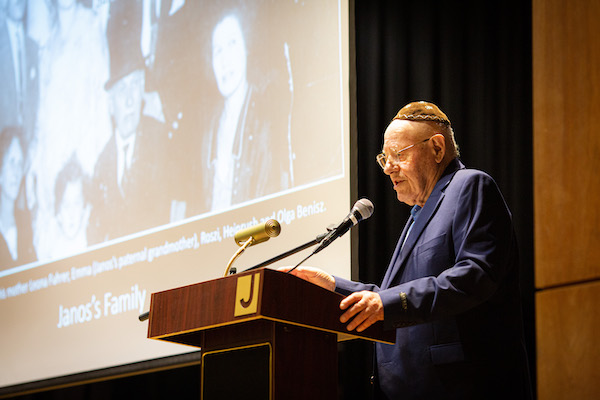
At the community’s commemoration of Yom Hashoah, child survivor Janos Benisz spoke about his experiences during the Holocaust. (photo by Rhonda Dent)

Over the past year, Janos Benisz has watched the news of Ukrainian parents fleeing to Poland and elsewhere in Europe to find safety for their families. While “overjoyed” for the families finding refuge today, he cannot help but reflect back eight decades to his own family’s catastrophic history in that violence-ravaged region.

Benisz was born in the summer of 1938 in the Hungarian city of Esztergom. He is one of the very few children to survive the Nazi concentration camps and is now one of an even smaller number of survivors alive to share their stories of survival. He spoke April 17 at the annual Yom Hashoah Commemoration presented by the Vancouver Holocaust Education Centre, on the 80th anniversary of the beginning of the Warsaw Ghetto Uprising.

Benisz lost his mother in 1943, when she was 38, after she went to hospital for a routine procedure but was, he said, murdered by a fascist there. His father remarried and his stepmother would prove a saviour for the boy.

The following year, the Nazis began rounding up Hungarian Jews and preparing to transport them to forced labour and death camps.

“Like a plague of locusts, the SS came marching into our city,” he recalled. “As they marched past our house, there was a great fear in our family. My father closed the windows and pulled the curtains down and his fear was passed on to me. The next day, we left our home and on the front of our white stucco home was a yellow Magen David. Within hours, an SS commander came to our house and put stickers on our valuables.”

His father took young Janos and his stepmother to relations who were Catholic. It was the last time he saw his father.

“Life was wonderful for six weeks until one of the neighbours reported us and informed that Jews were in this home,” said Benisz.

An SS officer accompanied by Hungarian Arrow Cross fascists knocked on the door and seized Janos and his stepmother, who were sent to the Strasshof concentration camp, in Austria. They remained there for eight or nine months, until liberated by Soviet forces. Benisz credits his stepmother’s determination for his survival.

“It was like a lioness protecting her cub,” he said. “She would go into the circle where the food was, or the slop was, with the big cup and she would always bring food to me. I would drink it and that sustained me.”

After liberation, Janos, 7, and his now-mother made their way back to Esztergom. The devastation was nearly total.

“I had many, many cousins and they all were massacred,” he said. “My mother’s family … it was like the earth had opened up and killed them all.”

The experiences left Janos’s stepmother mentally broken and Janos was placed in an orphanage.

“The only thing I remember is cod liver oil in the morning and brushing my teeth with about 10 or 15 guys beside me brushing their teeth as well,” he said. “After two-and-a-half years in the orphanage, somebody from the Joint [Distribution Committee] picked me up, took me to the train station. There were 14 or 15 other Jewish orphans there and they told us, ‘You’re going to America – North America.’”

The group first spent six months in France, where “they tried to educate us,” he said, but the young survivors were like “a bunch of wild animals.”

The group arrived in Halifax on Dec. 3, 1948. They were given hot soup and delicious sandwiches, as well as ice cream, of which Benisz said he must have eaten a gallon with his bare hands.

On the train across Canada, orphans disembarked at different cities and Benisz arrived in Winnipeg in the midst of a blizzard.

“My first Canadian Jewish home proved to be a disaster,” he said. “I was bounced around like a basketball between foster homes.… I was never part of the family. I was always an outsider.”

The terrors that followed him from Europe, which led to screaming in the night, did not make him a welcome addition to potential foster homes.

“Who wants to have a stranger’s scream waking [one] up every night?” he asked.

He was put in a reformatory for about six months before a Jewish welfare agency rescued him and found him suitable housing and got him caught up in his education.

At a young age, Benisz got a job as a copy boy at the Winnipeg Free Press. A life in the news business followed, especially covering sports, which he did at newspapers across Western Canada. An editor changed his byline from Janos Benisz to Jack Bennett, which became his professional designation.

Eventually, he arrived to a new job at a Vancouver daily just as the press launched what would become a year-long strike. Jack Diamond, the late Jewish businessman and philanthropist, gave Benisz a job. Years later, after a corporate buyout, Benisz had a $25,000 windfall and he and a partner opened a business in Gastown, “and, over the next 15, 18 years, we made a lot of money.”

He spoke of his gratitude for the community of survivors, especially the Child Survivors Group, based at the Vancouver Holocaust Education Centre. For two decades, he has spoken to school groups and others about his Holocaust experiences.

“I speak on behalf of the six million who have no voice, that includes 1.5 million children who were murdered,” he said.

At the commemorative event, Rabbi Dan Moskovitz of Temple Sholom reflected on the longer, formal name of the day, which is Yom HaZikaron laShoah ve-laG’vurah, Holocaust and Heroism Remembrance Day. He emphasized the resistance and revolt inherent in both the name of the day and the fact that Yom Hashoah is marked annually on the anniversary of the Warsaw Ghetto Uprising.

“Our sacred purpose is so much more important, so much more vital, because the life-memory is fading. We gather here this evening at the twilight of an era. As the Survivors’ Declaration hauntingly observes, the age of the Holocaust survivors is drawing to a close. Before long, no one will be left to say, I was there, I saw, I remember what happened…. It is in this void that the deniers and the distortionists will come, they always do, as they have continually on every night and every day since even before the liberation of the camps, to say that this didn’t happen, that it wasn’t so bad or the relativism of comparing trauma to trauma.”

There is one significant difference between the contemporary generation and the generation of the 1930s, said the rabbi.

“That difference is that we have the experience that they didn’t have. We know it can happen because it did,” he said. “We know the antisemitism, if it is not confronted vigourously, forcefully and immediately defeated, can develop into monstrous dimensions. So, we don’t have the luxury or the privilege to say, let’s wait and see how things will develop, how this turns out.”

The VHEC’s Abby Wener Herlin, granddaughter of survivors Aurelia and David Gold, spoke as a representative of the third generation.

“In our family, in order to build a life and live each day, they could not speak about their experiences,” she recalled of her late grandparents. “In order to protect themselves and us from the atrocities and traumas of their past, they shared very little.

“There is a sense of weight that comes from being the grandchild of Holocaust survivors,” Wener Herlin continued, “to know that I am part of the last generation that will ever hear those stories firsthand. I feel it is my duty and responsibility to carry it forward and it is my duty to remember.”

In a video presentation, former Canadian justice minister Irwin Cotler discussed the 1994 genocide against the Tutsis in Rwanda, as well as the Holocaust, and said that what makes both historical instances so horrific are not just the horrors themselves but that both atrocities were preventable.

“Nobody could say that we did not know. We knew but we did not act,” said Cotler.

He addressed remarks specifically to survivors: “You have endured the worst of inhumanity, but somehow you found the resources of your own humanity, the ability to carry on, to build families and to make an enduring contribution to Canada and to the communities in which you settled.”

Corinne Zimmerman, board president of the VHEC, read from a statement Prime Minister Justin Trudeau released for Yom Hashoah and Moskovitz read a message from B.C. Premier David Eby. Sarah Kirby-Yung, Vancouver city councilor, read a proclamation from Mayor Ken Sim.

Cantor Yaacov Orzech chanted El Moleh Rachamim, the memorial prayer for the martyrs. An extensive musical program, produced by Wendy Bross Stuart and Ron Stuart, featured Bross Stuart on piano, Eric Wilson on cello, with Cantor Shani Cohen, Kat Palmer, Lisa Osipov Milton singing, as well as eight young voices collectively dubbed the Yom Hashoah Singers.

The evening was presented by the VHEC with the Jewish Community Centre of Greater Vancouver and Temple Sholom.
Format ImagePosted on April 28, 2023April 26, 2023Author Pat JohnsonCategories LocalTags Abby Wener Herlin, Canadian Jewish Holocaust Survivors and Descendants, child survivor, Corinne Zimmerman, Dan Moskovitz, immigration, Irwin Cotler, Janos Benisz, survivors, Temple Sholom, Vancouver Holocaust Education Centre, VHEC, Yaacov Orzech, Yom Hashoah
Survivors reflect on liberation

Survivors reflect on liberation

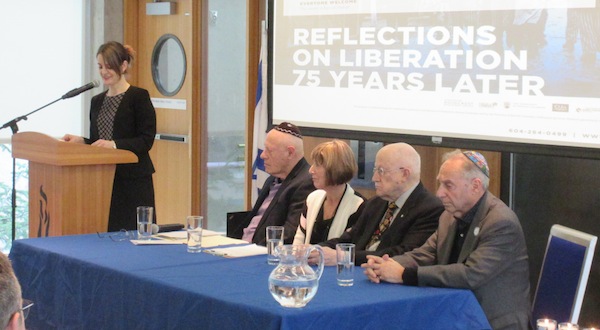
Dr. Ilona Shulman Spaar moderates a panel with Holocaust survivors, left to right, Janos Benisz, Amalia Boe-Fishman, Dr. Peter Suedfeld and Alex Buckman. (photo by Pat Johnson)

One survivor of the Holocaust who spoke at a panel recently believes that, in a generation or two, people will largely forget about the catastrophic events of that time.

“I think the world will forget about Auschwitz,” said Dr. Peter Suedfeld, a professor emeritus in the department of psychology at the University of British Columbia. “The world has already forgotten about ‘never again.’ We’ve had a fair number of genocides since 1945, in which the world did not intervene. A recent poll that I saw … apparently, the proportion of people who remember anything about how many Jews were killed in the Holocaust, what Auschwitz was, what the Holocaust was and so on, is not all that much above 50%.

“This is going to go on generation after generation,” he continued. “The survivors won’t be here to push the story any further. Their children will for awhile, but they have other things to do and other things to be concerned about and their children even more so. In a few more generations, it will be in the history books and people will say, yeah, I read about that or thought about that in grade whatever but, in terms of remembering it as something in your gut, something that arouses an emotion, something that has a personal connection to you, I don’t think it’s going to last all that much longer. I’m sorry to say that, but that’s what I think.”

Suedfeld, who weeks earlier was invested into the Order of Canada for his decades of work on the psychological and physical effects of extreme and challenging environments, was speaking at Hillel House, on the UBC campus, on International Holocaust Remembrance Day, Jan. 27. He was part of a panel of four survivors sharing their reflections 75 years after liberation.

Suedfeld, who was born in Hungary, survived under false papers and a back story as an orphaned Roman Catholic child. He recalled successive bombardments of the various sanctuaries he was in near the end of the war, as Allied bombers repeatedly blew buildings apart while Suedfeld and other children hid in the cellars.

After liberation by Russian forces, Suedfeld was eventually reunited with his father; his mother had been murdered. The lesson he took from the experience, he told the packed afternoon audience, was to cherish and defend the values of freedom.

“Freedom to be who you really are, but freedom of speech, freedom of association, freedom of religion, freedom of everything,” he said. After moving to the United States, Suedfeld became a powerful advocate of the First Amendment, which guarantees freedom of religion and expression. Since coming to Canada, he has been a similar champion of the Charter of Rights and Freedoms, he said.

Suedfeld’s admittedly pessimistic perspective on the future of Holocaust remembrance was contested by Alex Buckman, a fellow survivor on the panel.

As long as organizations exist like the Vancouver Holocaust Education Centre, which co-sponsored the event with Hillel BC, and children of survivors and others who have been touched by their experiences share the lessons they have learned, the future will be better, he said.

“Maybe our children will pick up, speaking on our behalf,” said Buckman. “Maybe they will remember because we will tell them what happened.”

Like Suedfeld, Buckman survived by being hidden by Catholics; in his case, in Belgium.

“They told us that the war was over and that we should rejoice and be happy and our parents would come and pick us up and everything would be hunky-dory,” he recalled. “At 6-and-a-half in an orphanage, nothing was that rosy. We saw parents come and pick up their children and take them home, but nobody came for us. I was there with my sister Annie and she was crying and wondering why our parents weren’t coming and I tried to tell her that I’m sure that they will come. But, like her, I didn’t know why they weren’t coming.”

The pair were moved back to Brussels and put in the care of the Red Cross, which posted the names of orphaned and unclaimed children on sheets around the city. Eventually, a paternal uncle showed up and took the two children to Annie’s parents – who, since little Alex had believed himself to be Annie’s brother, he reasonably concluded were also his parents. The truth came out in a cruel way, when another cousin, in a pique of anger, blurted out to Alex that his parents were dead and that Annie’s parents were not his.

“I took a step back and, for the first time, I realized I was alone,” Buckman recalled. His aunt and uncle did care for him, though, despite the uncle’s misgivings, because of the aunt’s insistence based on a promise she made to the heavens when she learned of her sister’s death.

Also on the panel was Amalia Boe-Fishman, who was born in the northern Netherlands in 1939 and also survived thanks to a Christian family. Like many survivors, her liberation story is not one of joyous freedom but of confusion and fear of the future.

“Liberation should have been a real happy time for me. It wasn’t,” she said. “I was told we were free, but what did that mean? What did that mean to a frightened 5-year-old girl who had been in hiding for three years? What did it mean to be free? I was told that, for the first time I could remember … I would now be able to go outdoors. I didn’t know what to expect. What was there? What was waiting for me outdoors? Indoors had become my entire life. Indoors was where I felt secure and safe. Indoors was all I knew.”

Her first venture out was harrowing. It was odd enough to be surrounded by throngs of strangers after her entire life had been confined to just a few familiar faces. After a victory parade, the girls she knew as her “sisters” decided to walk to the town centre. While crossing a bridge with scores of others – Amalia had never seen a bridge before – a rumour started that the Nazis had returned and panic swept the crowd. Pushing and shoving was accompanied by screaming and concern that the bridge was about to collapse.

“Here I was, trapped outdoors, in a crowd of panicked strangers and I was terrified,” she said. “The bridge didn’t collapse, but, as you can imagine [it was] a very long time before I would ever cross a bridge again.”

Another ostensibly joyous aspect of liberation was also clouded with confusion and fear.

“I was told that I had a real family. I had a real father, a real mother, an older brother and a baby brother,” said Boe-Fishman. “Miraculously, out of many different hiding places, all four of them had survived the war.… But who were these people? They were strangers. So, this is what liberation means to me. To leave the only family I ever had known to go outdoors to a place of terrified strangers, to strange people in a strange home.… I had to adapt to a new and also frightening world.”

For Janos Benisz, liberation was similarly conflicted. As a child, he had seen his father and his grandmother dead in the streets. His mother had been killed earlier by Nazi collaborators, during what was to have been a routine medical procedure.

Young Janos was transported from his hometown of Esztergom, Hungary, to Budapest, where Jews were divided up, many being sent directly to death camps including Auschwitz.

“I ended up in an Austrian slave labour camp,” he said, remaining there for seven or eight months before the Russians liberated them.

“I had the body of a 4-year-old,” he recalled. “At my bar mitzvah, I was under five feet.”

Making his way back to his hometown, he found squatters in the family’s house and learned that, of his immediate family of eight uncles, two aunts and 29 cousins, only Janos and one uncle had survived the Nazis.

Benisz was put in a Jewish orphanage in Budapest, then sent to Halifax, where he was put on a train to Winnipeg. He was bounced from foster home to foster home, back to an orphanage and then to a reformatory.

“I couldn’t fit in,” he said. At 18, he got a job at the Winnipeg Free Press as a copy boy.

“I spent the next 15 years in the newspaper business, then I became a salesman on my own, retired in ’71,” he said. He noted the figurative and literal centrality of the Jewish Community Centre of Greater Vancouver in his life today. He lives 40 yards from the centre, he said, and much of his social life is focused there.

“It’s my second home,” he said. “I work out there. I shmooze there. I’ve got a group of guys I call the ‘kosher nostra.’ I’m very happy. I absolutely adore this country of Canada. It’s been good to me ever since I turned 18.”

Prior to the panel, Holocaust survivors lit candles of remembrance. Vancouver Mayor Kennedy Stewart read a proclamation declaring International Holocaust Remembrance Day in the city. Rob Fleming, British Columbia’s minister of education, spoke on the importance of Holocaust education and credited the partnership of the Vancouver Holocaust Education Centre (VHEC). Student Adam Dobrer shared his family’s Holocaust legacy. Prof. Nancy Hermiston, director of voice and opera at the University of British Columbia, provided opening remarks. Nina Krieger, executive director of the VHEC, introduced the program and spoke of the importance of remembrance and the power of the memory of Auschwitz on the 75th anniversary of its liberation. Dr. Ilona Shulman Spaar, education director and curator of the VHEC, moderated the panel. Rabbi Philip Bregman, chaplain of Hillel BC, chanted El Maleh Rachamim and the Mourners’ Kaddish.

Many other commemorations and events took place throughout the province on and around Jan. 27.

Format ImagePosted on February 14, 2020February 12, 2020Author Pat JohnsonCategories LocalTags Alex Buckman, Amalia Boe-Fishman, commemoration, Holocaust, Janos Benisz, Peter Suedfeld, VHEC
Proudly powered by WordPress