


Douglas Century signs copies of his book Crash of the Heavens at the JCC Jewish Book Festival earlier this year. (photo by Tova Kornfeld)
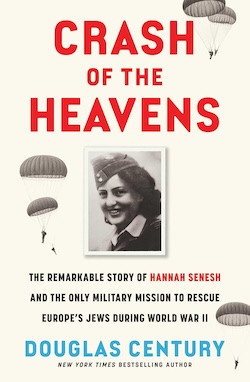
Douglas Century’s Crash of the Heavens: The Remarkable Story of Hannah Senesh and the Only Military Mission to Rescue Europe’s Jews During World War II is a meticulously researched and spell-binding narrative of Senesh’s life, and pre- and postwar Europe and Palestine.
Senesh, born in 1921, grew up in a middle-class family in Budapest until the Nazis came to power in the 1930s. The rise of antisemitism drove her to join a Zionist youth group and she became obsessed with emigrating to British Palestine. In 1938, she made aliyah to a northern kibbutz, and part of her metamorphosis was to Hebraize her identity, changing her name from Aniko Szenes.
As word of the atrocities perpetrated by the Nazis started to leak out, Jews in Palestine (numbering about 600,000) sought ways to rescue their European brethren. British Intelligence MI9, tasked with assisting the escape of thousands of Allied POWs, needed people with local language skills and area knowledge. In 1943, Senesh was recruited, one of three Jewish women in a cohort of 37, to be trained as a paratrooper and radio operator. She made her first jump – into Yugoslavia – in March 1944, where she liaised with Partisan groups to carry out sabotage missions. Her hope was to cross into Hungary to save her family and others, but she was captured by Hungarian gendarmes, imprisoned, tortured, tried for treason and executed by firing squad on Nov. 7, 1944.
Sharing details from her diary, which Senesh kept from the age of 13, Century takes readers into her pains, her joys. Her poetry is part of her legacy: “A Walk to Caesarea” is almost a second national anthem in Israel, where many streets, parks and schools bear her name. Ironically, Hungarians know little about her.
The Independent interviewed Century by email.
JI: How did you first become interested in Senesh?
DC: I first learned about Hannah when I was about 8 years old at the I.L. Peretz Shul in Calgary. Our principal was a Holocaust survivor – he’d lived through the Shoah as a boy in Poland. He told us the story of Hannah’s courage, her refusal to give up her secret British radio codes despite months of horrific physical and psychological torture at the hands of the Gestapo.
At that age, I’m sure it was just the broad strokes of the story: she wouldn’t betray her people, she was sentenced to execution by firing squad when she was 23 years old.
Who could understand the concept of martyrdom at the age of 8? Certainly not me. But I did understand that this was a brave young woman who went to her death and wouldn’t beg for mercy “from hangmen and murderers” – those were her exact words.
She refused to wear a blindfold as she faced the firing squad, daring the Hungarian soldiers with rifles to look her in the eyes as shot.
To hear that story age 8 – well, it was amazing. It was also terrifying. Clearly, it’s haunted me since childhood.
JI: This is the first time you are writing about a woman. Was that decision purposeful?
DC: I never thought about it that way. I’ve tended to write books with male protagonists. Technically, though, the first book I ever published – when I was in my mid-20s – was a young adult biography of the Nobel-laureate novelist Toni Morrison.
I conceptualized this book as a military rescue mission – most of the action takes place between late 1943 and late 1944, with a “ticking-clock” thriller pacing – and, yes, in the book proposal, I consciously chose to focus on the three women Palmach commandos and parachutists: Hannah Senesh, Haviva Reik and Surika Braverman.
As I was writing … it became clear that the central storyline needed to be Hannah’s. To a lesser extent, I write about the other parachutists’ missions in Slovakia, Romania and Yugoslavia.
 JI: What research did you do for the book?
DC: There are so many primary source documents available. All of Hannah’s poetry, diaries, letters and photographs are in the National Library of Israel archive. There are also many memoirs – most of them out of print – by the various parachutists. There are invaluable oral histories in the U.S. Holocaust Museum and at Yad Vashem. For four years, I felt like I was basically living in archives and military libraries, but I knew that I’d never do this story justice solely on previously published research.
I flew to Tel Aviv in the summer of 2023 to do what we used to call “shoe-leather reporting.” I spent weeks in Israel, retracing the footsteps of Hannah Senesh and the other parachutists. That summer of 2023, I met David Senesh – Hannah’s nephew – a renowned psychotherapist specializing in treating trauma. David was himself a POW and tortured by the Egyptians in the 1973 Yom Kippur War.
I’ve become close friends with David and his wife…. They really gave me some valuable personal insights into the family dynamic – and I learned things that have never been in other books.
JI: Was there a particular demographic you were trying to capture?
DC: I set out to write this book for one reader – my daughter, Lena. She’s studying English and wants to be an author. My daughter was 22 when I finished the book; Hannah was 22 when she embarked on her paratrooper mission in March of 1944. My daughter said, “Thank God you’re not writing about another complex, sociopathic antihero! Hannah is a courageous and talented woman who the reader can actually admire.”
JI: How did you arrive at the book’s title?
DC: When I was pitching the idea to my literary agent, I was already writing about Hannah, but it was about to be the centenary of her birth in July 2021 and 150 IDF paratroopers were recreating her jump in a mission called Operation Crash of the Heavens. The title comes from Hannah’s most famous poem, “A Walk to Caesarea,” better known by its musical adaptation, “Eli, Eli.” It’s a very short poem, and Hannah’s next-to-last line in Hebrew is “barak hashamayim.” The literal translation is “the lightning in the sky,” but, to me, the most artful translation is, “the crash of the heavens.”
JI: What has the reception to the book been like?
DC: It’s been wonderful, warm and very appreciative. Even people who know about Hannah Senesh – especially people from Israel – tell me that I introduced stories and things they never knew before.
I’ve spoken at a few schools: the Hannah Senesh Community Day School in Brooklyn, King David High School in Vancouver, Yeshiva University in New York. When I’m talking to teenagers, I try to contextualize the story by stressing how assimilated the Jews of Hungary were, especially in Budapest. They felt fully Hungarian. But then the series of so-called “Jewish Bills” came into effect, limiting the number of Jews in the professions, setting quotas for university – Hannah had wanted to study education and become a schoolteacher but that became impossible. Ultimately, Jews couldn’t own property, couldn’t have a telephone. They were stripped of all civil rights – by the Kingdom of Hungary, of course, not by Nazi Germany.
I ask high school kids and university students: Do you guys feel Canadian? You’re proud of Canada? Cheer for Canada in the Olympics? What if, overnight, the government said: “You’re not Canadian. Turn in your passport. You can’t go to university. You need to move out of your house – you can only live on certain streets in houses marked with a yellow star. You can’t be out in public past noon.” Why? Because Parliament passed a new law that says you’re no longer a Canadian – you’re a Jew. That means you’re an alien living among Canadians without the rights or privileges of a citizen. How would you feel? What would you do?
JI: You started this book before Oct. 7, 2023. Did that tragic event and its aftermath affect the way you wrote the narrative?
DC: Absolutely. I was deep into the writing process before Oct. 7, 2023. I knew that words like Zionism, Israel and Palestine were hot buttons when I started writing the book, but after Oct. 7, they became third rails.
I tried not to let it affect the way I was writing the book. Of course, seeing all the anti-Israel protests exploding on campuses and in city streets the past couple of years, hearing all the outright distortion of history, it affects a writer’s psyche. As we were designing maps for the book, for example, I insisted that they said, “British Mandate for Palestine” as well as “Eretz Israel.”… While writing the first draft, I had non-Jewish friends asking me, “Doug, what is Zionism?” and I realized that, in the post-Oct. 7 world, it was a critical question. I felt I should let Hannah define what Zionism meant to her. On Oct. 27, 1938, she writes in her diary: “I don’t know if I’ve already mentioned that I’ve become a Zionist. This word stands for a tremendous number of things. To me, it means, in short, that I now consciously and strongly feel I am a Jew, and am proud of it.” Full stop.
JI: If you would have been able to interview Senesh, what would you have asked?
DC: I have so many questions. I don’t want to give any plot spoilers, but there’s one story which hasn’t been told before in previous books. In the summer of 1944, Hannah helped a young Slovakian-Jewish woman named Matilda Glattstein to escape from the Gestapo prison in Budapest. Hannah learned that Matilda was pregnant and devised a complicated escape plan, which means she knew exactly how to break out of the prison and yet she herself didn’t. She saved another woman’s life – but not her own. I’d ask Hannah this question: “If you could rescue Matilda Glattstein, a pregnant woman with no military training, why didn’t you rescue yourself?” I’ve got my own theories, but I would love to ask Hannah.
JI: Why should people read your book?
DC: On the most basic level, I hope they want to read a compelling, exciting and emotional story of heroism during the darkest days of World War II. In hindsight, I didn’t write the book just for my daughter, or just for young Jewish women, or for anyone who aspires to do what Hannah did – become a poet or author and leave her mark on the world. Within the story, I’m asking some more universal questions: What do we mean by courage? Where does moral conviction come from?
We’re living in a crazy era, and it’s worth remembering that there are some causes for which it might be necessary to make the ultimate sacrifice….
JI: Tell me about your collaboration with Kosha Dillz?
DC: Kosha Dillz is someone I’ve known for years and years. His real name is Rami Even-Esh. [He’s] an Israeli-American rapper, filmmaker, social media personality and influencer. I sent him an ARC [advance reading copy] of Crash of the Heavens last October and we just started bouncing around ideas.
We agreed that, with this terrifying rise in antisemitism, it’s the perfect time to make the name Hannah Senesh – poet, paratrooper, Palmach commando – known to all the millions of people in their teens, 20s and 30s who are too busy “doom scrolling” to read the book. I figured, what better way to reach them than to have a gifted modern-day poet like Kosha Dillz breathe fresh energy and inspiration into her story? He wrote some amazing lyrics based on my book and we shot a video on the streets of New York for his song called “Hannah Senesh.”… You can find it on all the streaming platforms like Spotify and Apple Music.
JI: Are there any plans to use your book as the basis for a film or play?
DC: Yes, people have been talking about an adaptation, but the world of TV and film adaptations is so mercurial. Right now, we’re working on an adaptation of my previous book, The Last Boss of Brighton, about the life and times of a Soviet-born Jewish mobster – the aforementioned “complex, sociopathic antihero.”… At the same time, one of my earlier books – also about the Mafia in New York City – is being developed for a series…. But we’ll see what happens. Stay tuned.
Tova Kornfeld is a Vancouver freelance writer and lawyer.



