Skip to content
  • Home
  • Subscribe / donate
  • Events calendar
  • Business Directory
  • FAQ
  • News
    • Local
    • National
    • Israel
    • World
    • עניין בחדשות
      A roundup of news in Canada and further afield, in Hebrew.
  • Opinion
    • From the JI
    • Op-Ed
  • Arts & Culture
    • Performing Arts
    • Music
    • Books
    • Visual Arts
    • TV & Film
  • Life
    • Celebrating the Holidays
    • Travel
    • The Daily Snooze
      Cartoons by Jacob Samuel
    • Mystery Photo
      Help the JI and JMABC fill in the gaps in our archives.
  • Community Links
    • Organizations, Etc.
    • Other News Sources & Blogs
  • JI Chai Celebration
  • JI@88! video

Recent Posts

  • Legal help for students
  • Revisiting myth of Lilith
  • Wrong person rebuked
  • Canada’s mixed messages
  • Questions for museum
  • Symposium on antizionism
  • Making soccer political
  • CJPAC lauds Pulver’s impact
  • City recognizes Vrba’s legacy  
  • Organ donation saves lives
  • Theodore’s March premiere
  • A healing Shabbaton
  • Supplying healthy food
  • A chime of metal tags
  • Yellowknife seder a first
  • Ishai energizes, unifies
  • A Lag b’Omer to remember
  • Expanding the healing
  • Hannah Senesh – a unique hero
  • Community milestones … May 2026
  • Sharing her testimony
  • Fall fight takes leap forward
  • The balancing of rights
  • Multiple Tony n’ Tina roles
  • Stories of trauma, resilience
  • Celebrate our culture
  • A responsibility to help
  • What wellness means at JCC
  • Together in mourning
  • Downhill after Trump?
  • Birth control even easier now
  • Eco-Sisters mentorship
  • Unexpected discoveries
  • Study’s results hopeful
  • Bad behaviour affects us all
  • Thankful for the police

Archives

Follow @JewishIndie
image - The CJN - Visit Us Banner - 300x600 - 101625

Tag: heroism

Hannah Senesh – a unique hero

Hannah Senesh – a unique hero

Douglas Century signs copies of his book Crash of the Heavens at the JCC Jewish Book Festival earlier this year. (photo by Tova Kornfeld)

Douglas Century’s Crash of the Heavens: The Remarkable Story of Hannah Senesh and the Only Military Mission to Rescue Europe’s Jews During World War II is a meticulously researched and spell-binding narrative of Senesh’s life, and pre- and postwar Europe and Palestine.

Senesh, born in 1921, grew up in a middle-class family in Budapest until the Nazis came to power in the 1930s. The rise of antisemitism drove her to join a Zionist youth group and she became obsessed with emigrating to British Palestine. In 1938, she made aliyah to a northern kibbutz, and part of her metamorphosis was to Hebraize her identity, changing her name from Aniko Szenes.

As word of the atrocities perpetrated by the Nazis started to leak out, Jews in Palestine (numbering about 600,000) sought ways to rescue their European brethren. British Intelligence MI9, tasked with assisting the escape of thousands of Allied POWs, needed people with local language skills and area knowledge. In 1943, Senesh was recruited, one of three Jewish women in a cohort of 37, to be trained as a paratrooper and radio operator. She made her first jump – into Yugoslavia – in March 1944, where she liaised with Partisan groups to carry out sabotage missions. Her hope was to cross into Hungary to save her family and others, but she was captured by Hungarian gendarmes, imprisoned, tortured, tried for treason and executed by firing squad on Nov. 7, 1944. 

Sharing details from her diary, which Senesh kept from the age of 13, Century takes readers into her pains, her joys. Her poetry is part of her legacy: “A Walk to Caesarea” is almost a second national anthem in Israel, where many streets, parks and schools bear her name. Ironically, Hungarians know little about her.

The Independent interviewed Century by email.

JI: How did you first become interested in Senesh?

DC: I first learned about Hannah when I was about 8 years old at the I.L. Peretz Shul in Calgary. Our principal was a Holocaust survivor – he’d lived through the Shoah as a boy in Poland. He told us the story of Hannah’s courage, her refusal to give up her secret British radio codes despite months of horrific physical and psychological torture at the hands of the Gestapo. 

At that age, I’m sure it was just the broad strokes of the story: she wouldn’t betray her people, she was sentenced to execution by firing squad when she was 23 years old.

Who could understand the concept of martyrdom at the age of 8? Certainly not me. But I did understand that this was a brave young woman who went to her death and wouldn’t beg for mercy “from hangmen and murderers” – those were her exact words.

She refused to wear a blindfold as she faced the firing squad, daring the Hungarian soldiers with rifles to look her in the eyes as shot.

To hear that story age 8 – well, it was amazing. It was also terrifying. Clearly, it’s haunted me since childhood. 

JI: This is the first time you are writing about a woman. Was that decision purposeful? 

DC: I never thought about it that way. I’ve tended to write books with male protagonists. Technically, though, the first book I ever published – when I was in my mid-20s – was a young adult biography of the Nobel-laureate novelist Toni Morrison.

I conceptualized this book as a military rescue mission – most of the action takes place between late 1943 and late 1944, with a “ticking-clock” thriller pacing – and, yes, in the book proposal, I consciously chose to focus on the three women Palmach commandos and parachutists: Hannah Senesh, Haviva Reik and Surika Braverman.

As I was writing … it became clear that the central storyline needed to be Hannah’s. To a lesser extent, I write about the other parachutists’ missions in Slovakia, Romania and Yugoslavia.
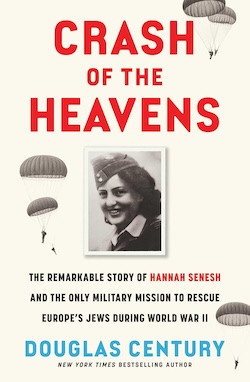
image - Crash of the Heavens book coverJI: What research did you do for the book?

DC: There are so many primary source documents available. All of Hannah’s poetry, diaries, letters and photographs are in the National Library of Israel archive. There are also many memoirs – most of them out of print – by the various parachutists. There are invaluable oral histories in the U.S. Holocaust Museum and at Yad Vashem. For four years, I felt like I was basically living in archives and military libraries, but I knew that I’d never do this story justice solely on previously published research.

I flew to Tel Aviv in the summer of 2023 to do what we used to call “shoe-leather reporting.” I spent weeks in Israel, retracing the footsteps of Hannah Senesh and the other parachutists. That summer of 2023, I met David Senesh – Hannah’s nephew – a renowned psychotherapist specializing in treating trauma. David was himself a POW and tortured by the Egyptians in the 1973 Yom Kippur War. 

I’ve become close friends with David and his wife…. They really gave me some valuable personal insights into the family dynamic – and I learned things that have never been in other books.

JI: Was there a particular demographic you were trying to capture?

DC: I set out to write this book for one reader – my daughter, Lena. She’s studying English and wants to be an author. My daughter was 22 when I finished the book; Hannah was 22 when she embarked on her paratrooper mission in March of 1944. My daughter said, “Thank God you’re not writing about another complex, sociopathic antihero! Hannah is a courageous and talented woman who the reader can actually admire.” 

JI: How did you arrive at the book’s title?

DC: When I was pitching the idea to my literary agent, I was already writing about Hannah, but it was about to be the centenary of her birth in July 2021 and 150 IDF paratroopers were recreating her jump in a mission called Operation Crash of the Heavens. The title comes from Hannah’s most famous poem, “A Walk to Caesarea,” better known by its musical adaptation, “Eli, Eli.” It’s a very short poem, and Hannah’s next-to-last line in Hebrew is “barak hashamayim.”  The literal translation is “the lightning in the sky,” but, to me, the most artful translation is, “the crash of the heavens.”

JI: What has the reception to the book been like? 

DC: It’s been wonderful, warm and very appreciative. Even people who know about Hannah Senesh – especially people from Israel – tell me that I introduced stories and things they never knew before.

I’ve spoken at a few schools: the Hannah Senesh Community Day School in Brooklyn, King David High School in Vancouver, Yeshiva University in New York. When I’m talking to teenagers, I try to contextualize the story by stressing how assimilated the Jews of Hungary were, especially in Budapest. They felt fully Hungarian. But then the series of so-called “Jewish Bills” came into effect, limiting the number of Jews in the professions, setting quotas for university – Hannah had wanted to study education and become a schoolteacher but that became impossible. Ultimately, Jews couldn’t own property, couldn’t have a telephone. They were stripped of all civil rights – by the Kingdom of Hungary, of course, not by Nazi Germany.

I ask high school kids and university students: Do you guys feel Canadian? You’re proud of Canada? Cheer for Canada in the Olympics? What if, overnight, the government said: “You’re not Canadian. Turn in your passport. You can’t go to university. You need to move out of your house – you can only live on certain streets in houses marked with a yellow star. You can’t be out in public past noon.” Why? Because Parliament passed a new law that says you’re no longer a Canadian – you’re a Jew. That means you’re an alien living among Canadians without the rights or privileges of a citizen. How would you feel? What would you do?

JI: You started this book before Oct. 7, 2023. Did that tragic event and its aftermath affect the way you wrote the narrative?

DC: Absolutely. I was deep into the writing process before Oct. 7, 2023. I knew that words like Zionism, Israel and Palestine were hot buttons when I started writing the book, but after Oct. 7, they became third rails.

I tried not to let it affect the way I was writing the book. Of course, seeing all the anti-Israel protests exploding on campuses and in city streets the past couple of years, hearing all the outright distortion of history, it affects a writer’s psyche. As we were designing maps for the book, for example, I insisted that they said, “British Mandate for Palestine” as well as “Eretz Israel.”… While writing the first draft, I had non-Jewish friends asking me, “Doug, what is Zionism?” and I realized that, in the post-Oct. 7 world, it was a critical question. I felt I should let Hannah define what Zionism meant to her. On Oct. 27, 1938, she writes in her diary: “I don’t know if I’ve already mentioned that I’ve become a Zionist. This word stands for a tremendous number of things. To me, it means, in short, that I now consciously and strongly feel I am a Jew, and am proud of it.” Full stop.

JI: If you would have been able to interview Senesh, what would you have asked?

DC: I have so many questions. I don’t want to give any plot spoilers, but there’s one story which hasn’t been told before in previous books. In the summer of 1944, Hannah helped a young Slovakian-Jewish woman named Matilda Glattstein to escape from the Gestapo prison in Budapest. Hannah learned that Matilda was pregnant and devised a complicated escape plan, which means she knew exactly how to break out of the prison and yet she herself didn’t. She saved another woman’s life – but not her own. I’d ask Hannah this question: “If you could rescue Matilda Glattstein, a pregnant woman with no military training, why didn’t you rescue yourself?” I’ve got my own theories, but I would love to ask Hannah. 

JI: Why should people read your book?

DC: On the most basic level, I hope they want to read a compelling, exciting and emotional story of heroism during the darkest days of World War II. In hindsight, I didn’t write the book just for my daughter, or just for young Jewish women, or for anyone who aspires to do what Hannah did – become a poet or author and leave her mark on the world. Within the story, I’m asking some more universal questions: What do we mean by courage? Where does moral conviction come from?

We’re living in a crazy era, and it’s worth remembering that there are some causes for which it might be necessary to make the ultimate sacrifice….

JI: Tell me about your collaboration with Kosha Dillz?

DC: Kosha Dillz is someone I’ve known for years and years. His real name is Rami Even-Esh. [He’s] an Israeli-American rapper, filmmaker, social media personality and influencer. I sent him an ARC [advance reading copy] of Crash of the Heavens last October and we just started bouncing around ideas. 

We agreed that, with this terrifying rise in antisemitism, it’s the perfect time to make the name Hannah Senesh – poet, paratrooper, Palmach commando – known to all the millions of people in their teens, 20s and 30s who are too busy “doom scrolling” to read the book. I figured, what better way to reach them than to have a gifted modern-day poet like Kosha Dillz breathe fresh energy and inspiration into her story? He wrote some amazing lyrics based on my book and we shot a video on the streets of New York for his song called “Hannah Senesh.”… You can find it on all the streaming platforms like Spotify and Apple Music. 

JI: Are there any plans to use your book as the basis for a film or play?

DC: Yes, people have been talking about an adaptation, but the world of TV and film adaptations is so mercurial. Right now, we’re working on an adaptation of my previous book, The Last Boss of Brighton, about the life and times of a Soviet-born Jewish mobster – the aforementioned “complex, sociopathic antihero.”… At the same time, one of my earlier books – also about the Mafia in New York City – is being developed for a series…. But we’ll see what happens. Stay tuned. 

Tova Kornfeld is a Vancouver freelance writer and lawyer.
Format ImagePosted on May 29, 2026May 28, 2026Author Tova KornfeldCategories BooksTags Douglas Century, Hannah Senesh, heroism, history, Holocaust, Second World War

Amid the rescuers, resisters

A nationwide Upstanders Canada keynote lecture to mark Yom Hashoah (Holocaust Remembrance Day) last month reminded the Zoom audience that the belief that Jews simply cowered, while the atrocities around them were being committed during the Second World War, is erroneous.

“The idea of Jewish passivity is part of the narrative, but it is not the truth. Jews, individually and collectively, engaged in acts of resistance and rescue,” said Pat Johnson, founder of Upstanders Canada, at the start of the event.

That people should know this fact “is crucial,” said Johnson, “because it corrects a flawed narrative. It is crucial additionally, not only for Jews but for every person and every people in the world, to see the potential for resistance and courage against authoritarianism hatred and inhumanity.”

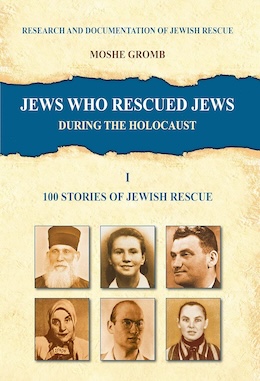
image - Jews Who Rescued Jews During the Holocaust book coverThe April 27 event, titled Jews Who Rescued Jews During the Holocaust, was presented by Rinat Dushansky-Werbner. She was introduced by Moshe Gromb, author of a 15-volume series with the same title, which Dushansky-Werbner and Pnina Jacobi-Yahid translated into English from Hebrew. In her talk, Dushansky-Werbner, a member of the Action Committee for Recognizing Jews Who Rescued Jews During the Holocaust, highlighted several Jewish heroes during the Shoah – their names not widely known. 

“There were operations inside the death camps. There were people smuggling people across borders. They were hiding children in monasteries. They were falsifying documents,” Dushansky-Werbner said.

“The Jews were very, very creative, and tried to think of any possible way to save their brethren. Sadly, many of these Jewish rescuers were caught and murdered by the Nazis. Even though they could have escaped and saved themselves,” she said, “most of them decided not to do so. [They] decided to stand where they are, and try and rescue as many people as possible.”

The people discussed represented a range of backgrounds, ages, geographic locations and levels of religious observance, and were but examples from a much larger number of Jews who took on tremendous risks and used remarkable ingenuity to rescue other Jews during the Holocaust. Thus far, Dushansky-Werbner’s action committee has collected information on more than 2,500 Jewish rescuers and documented more than 50 rescue methods.  

Many of the Jewish rescuers, Dushansky-Werbner said, did not see themselves as great heroes, but rather as people who did what they were compelled to do, and saddened they could not do more.

“There is something very humble about these people,” she said.

Jews rescued other Jews wherever the Germans operated – throughout Europe, North Africa and even the Philippines –  and their operations began once the Nazis rose to power and continued throughout and after the war. Often, their operations involved collaborations with non-Jews.

In Belarus, four brothers named Bielski – Tuvia, Zus (Alexander Zeisal), Asael and Aron – founded a partisan unit, a wandering communal rescue army, that established a family camp in the Naliboki Forest. The camp operated for more than two years during the war, moving occasionally from place to place in the forest, and included a synagogue, a school, a courthouse, a clinic, an armoury and more. It is estimated that the Bielski brothers rescued 1,236 Jews in what became known as the “Jerusalem of the Forests.” Their story is among the more celebrated of Jewish rescuers and was turned into a 2008 film, Defiance, starring Daniel Craig.  

In France, the Loinger family, led by George, who passed away in 2018 at the age of 108, smuggled hundreds of Jewish children across the border to Switzerland, while his wife, Flora, managed the houses in which they hid Jewish children. 

George would play soccer with the children. When the ball flew over to the other side of the border, one or two children would be sent to safety to the other side without the local guard noticing, Dushansky-Werbner explained.

George’s sisters also helped. Fanny hid children in monasteries; Emme prepared abandoned monasteries for Jewish orphans and ran one of the children’s houses; the youngest, Ivette, 13, rode with Jewish children on trains, hiding their money and keeping them calm during the journey. 

French pantomime Marcel Marceau and his brother Alain – who were George’s cousins – forged papers for Jews on the run and helped George smuggle Jewish children out of France.

“Marcel would help keep them calm and would just basically be the clown. He would be like a mother, a father, a brother, and he would make them laugh. And this is how many of them stayed calm and agreed to go from one place to another,” said Dushansky-Werbner, who went on to share another story of heroism.

In Volos, Greece, Rabbi Moshe Shimon Pesach was ordered by a German commander to draw up a list of all the Jews in the city. He turned to his friend, Metropolitan Joachim Alexopoulos, who recommended the Jews leave the city immediately. 

At the age of 74, the rabbi gathered the members of the community and led them to the hills surrounding Volos with the help of the metropolitan and the city’s mayor, and hid them in homes and other buildings. This effort would save 746 of the 882 Jews in Volos.

Dushansky-Werbner ended her talk with the words of Marion Pritchard, a non-Jew who rescued Jews in the Netherlands: “If we do not acknowledge the bravery of those Jewish rescuers who, if caught, were in graver danger than the Righteous Among Nations, that would be a distortion of Holocaust history. It also adds to the false notion that the Jews were led like lambs to the slaughter as cowards. This is far from the truth,” said Pritchard.

Upstanders Canada is a national organization that seeks to mobilize primarily non-Jewish Canadians to stand with the Jewish people and against antisemitism. For more information, visit upstanderscanada.com. 

Sam Margolis has written for the Globe and Mail, the National Post, UPI and MSNBC.

Posted on May 30, 2025May 29, 2025Author Sam MargolisCategories NationalTags education, heroism, Holocaust, Jews Who Rescued Jews, Marion Pritchard, Rinat Dushansky-Werbner, Upstanders, Yom Hashoah
Heroes throughout the ages

Heroes throughout the ages

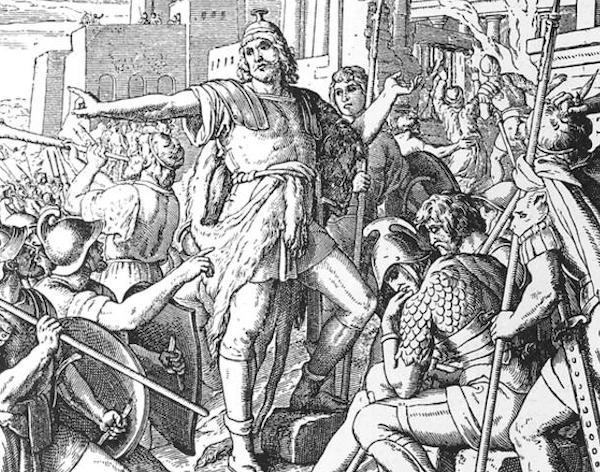
Judah Maccabee purifies the Temple, etching by Julius von Carolsfeld, 1860.

Every year, we look forward to Chanukah, even though it is not even mentioned in the Torah. Its name means “Dedication” and it starts on erev the 25th of Kislev, which, this year, falls on the night of Nov. 28.

The festival celebrates the triumph of the Maccabees, led by Mattityahu and, later, by his son Judah, over the Greek Syrians, led by Antiochus. As a result, Jewish sovereignty was reestablished in Judea for a time.

But we should not forget that this ancient conflict was also a civil war between the Jewish people themselves. The Hellenists admired Greek culture, which they began to emulate; whereas the Maccabees remained steadfast in their adherence to Judaism’s ideals and beliefs. The factions disagreed on various issues, including the rite of circumcision, a fundamental and crucial Jewish ritual that the Hellenists claimed violated the perfection of the body.

In 175 BCE, Antiochus tried to wipe out the Jewish religion entirely by substituting the Greek language, gods and customs. The final blow came when the Temple was defiled and a giant statue of the Greek god Zeus was erected there, with the Jews ordered to worship it.

Some, like Hannah and her seven sons, resisted passively, choosing death rather than idol worship. Hundreds hid in caves and some suffocated to death. But there was no active resistance until the Hasmonean family of Mattityahu and his sons at Modi’in raised a banner: “Whoever is for the Lord, follow me!”

A small army was formed, with Judah Maccabee as its leader. Antiochus sent three armies to suppress the revolt, but the Maccabees triumphed. Their first priority after victory was to purify the Temple.

As the story goes, all the cruses of oil had been defiled except one. Instead of burning for just one day, it miraculously lasted for eight days, until more holy oil could be acquired. Hence, the celebration of Chanukah for eight nights and days.

Today, Chanukah still has relevance. We remember not only the heroism of the Maccabeans, but other heroic acts. Many times in Israel we have seen the victory of a tiny nation against a larger and stronger one, the few against the many.

In 1948, the young Israel Defence Forces defeated much larger Arab armies to usher in the independent state of Israel. Earlier, in the Second World War, there was widespread Jewish resistance to Hitler’s brutal policies and Jews fought in the ghettos and joined partisan units in forests outside Polish and Russian cities conquered by the Nazis.

Israel’s operation into Entebbe to rescue hostages in Uganda is another instance of modern heroism and our history abounds with examples. The revolt of the Hasmoneans is the symbol of the spirit of Zionism. Today, in Western society, no tyrant is forcing us to abandon our faith, but many Jews are in great danger of losing their Jewish identity nonetheless. Hellenism, in a different form, is alive and well.

Chanukah has broad human significance as a festival of liberty and religious freedom, not just for us, but for all people. It is a humanistic festival. The symbol of Chanukah is light and the real miracle is that, despite millennia of persecution and dispersion, the light of our people has never been extinguished.

Dvora Waysman has written 14 books, and the film The Golden Pomegranate was based on her book The Pomegranate Pendant. Her latest novel is Searching for Sarah. She can be contacted at [email protected].

Format ImagePosted on November 19, 2021November 18, 2021Author Dvora WaysmanCategories Celebrating the HolidaysTags assimilation, Chanukah, Hellenism, heroism, Maccabees, progressive Zionism, Zionism
Proudly powered by WordPress