
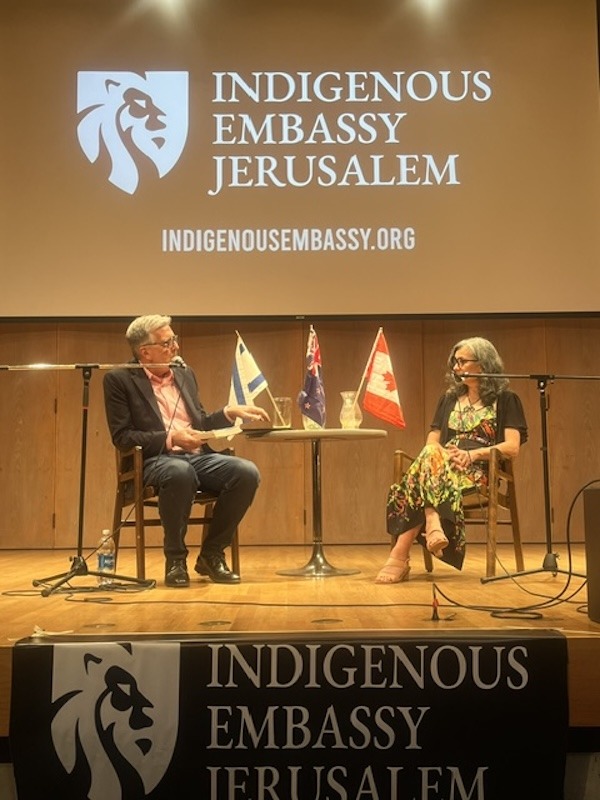

Pat Johnson and Dr. Sheree Trotter at the University of Victoria on June 14, hosted by the Jewish Federation of Victoria and Vancouver Island. (photo by Janet Dirks)
“What we’ve seen happen in New Zealand with our indigenous movement is that Palestine has been held up as a way to fight against what’s happening in our country with our indigenous people,” New Zealand writer and academic Dr. Sheree Trotter told those gathered at the University of Victoria on June 14.
“So, what we do is that we identify with the Palestinians and we see them as brown, oppressed indigenous people; we see Israel as the Western foreign colonizers.” In this context, she said, the antizionist argument is reduced to one of settler colonialism, despite the differing histories of places like New Zealand, Canada and Palestine.
At the Victoria event, which was hosted by the Jewish Federation of Victoria and Vancouver Island, Trotter, who is of Te Arawa iwi origin, spoke on the topic Indigeneity and Zionism Versus Settler Colonialism.
“Each of these topics could be a whole university course,” Trotter acknowledged at the outset. Before talking about Zionism, she explained its standard definition: the right of self-determination and statehood for Jews in their ancestral homeland, the land of Israel.
Trotter said there have been several streams of thought that have led to the current antizionist movement, including the views of the Nazis, who saw Jews as conspiratorial subversives, and Soviet antizionism, which depicted Zionism as a global and racist conspiracy. Added to the mix, Trotter said, are Arab nationalist and Islamic movements and, more recently, Western settler-colonial theory.
Settler colonialism, Trotter said, is an ideology that has developed within academia as a particular kind of colonialism. The key feature of it is an imperial power that has sent its people to a foreign land to settle permanently.
“In this way, you create this binary that you’ve got two classes of people. You may call it the oppressor and the oppressed, the colonizer or the colonized, these sorts of ideas. This binary erases complexity. It’s not accurate. It’s not true to history,” Trotter said.
Using the example of the Māori in New Zealand, Trotter explained some of the problems in the settler-colonialist argument.
“There’s no room for nuance or complexity, no room for indigenous agency – the fact that, in my case, Māori embraced many of the new things that came, new technologies, modernity, certainly literacy,” she said. “In embracing Christianity, Māori turned away from tribal warfare, from cannibalism, from slavery, because they adopted a new way of thinking. Under settler colonialism, you don’t get to hear any of the good things that might have happened. It’s all just labeled as oppression and bad.”
More broadly, she argued, the settler-colonialist theory does not fully consider that many of the people who arrived in places like Canada and New Zealand were poor immigrants who do not fit the settler-colonialist power paradigm.
Regarding Israel, the settler-colonial standpoint is a tremendous stretch, said Trotter, because Jews, with more than 3,500 years of continuous connection to the land, are not foreign to Israel.
“In Māori thinking, we have a concept called ahikā, which means keeping the fires burning. If a tribe wanted to keep their connection to a piece of land, it would keep a fire on that land. It’s symbolic of the idea that somebody stayed on the land, even in small numbers,” she said. “Now, we’re finding the fact that there’s always been a Jewish presence in the land. Even though very small at times, they’ve kept ahikā, they’ve kept the fires burning, they’ve kept a continuous connection.”
Trotter is the co-founder, with former member of New Zealand’s House of Representatives Alfred Ngaro, of the Indigenous Embassy Jerusalem and the Indigenous Coalition for Israel, nonprofits established to provide representation in Jerusalem for indigenous peoples from around the world. Her latest book, Zionism at the Ends of the Earth: A Story of Humanitarianism and Identity, chronicles the social history of the Zionist movements in New Zealand to 1948.
Following her talk, Trotter sat down for an interview and to answer audience questions with journalist Pat Johnson, a member of the Jewish Independent editorial board and founder of Upstanders Canada, an organization working to encourage non-Jewish Canadians to take a stand against antisemitism and antizionism.
The event attracted some protest. According to organizers, the technician who was scheduled to work that evening walked off the job before the event started because of their objection to the subject matter. And, in the middle of Trotter’s talk, a few members of the Jewish Faculty Network of Vancouver Island held up signs rejecting claims of Jewish indigeneity in the Middle East and protesting Israel’s military actions; the group was escorted out of the auditorium without incident.
Sam Margolis has written for the Globe and Mail, the National Post, UPI and MSNBC.



