
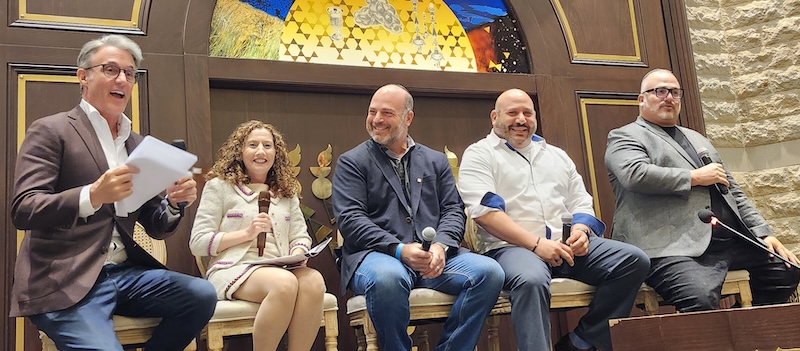

Panelists at the event Faith Not Fear: Building Jewish Leadership for a New Era in Canada, left to right: Ben Mulroney (broadcaster), Natasha Pein (researcher), Simon Wolle (B’nai Brith Canada), Matthew Taub (Unapologetically Jewish) and Amir Epstein (Tafsik). (photo by Dave Gordon)
Two weeks after Mark Carney’s address on antisemitism at Toronto’s Holy Blossom Temple, Jewish community members offered a counterweight – a gathering led by grassroots activists, journalists and elected officials, both Jewish and non-Jewish.
Called Faith Not Fear: Building Jewish Leadership for a New Era in Canada, the nearly four-hour meeting drew roughly 600 people to the city’s Chabad Flamingo synagogue on June 14. Organizers described it as an unprecedented gathering of local pro-Israel groups – many sharing a stage for the first time – aimed at confronting the question of what kind of leadership this moment demands, and what concrete steps the community must take.
Organized by Yalla, partner groups included Canadian Women Against Antisemitism, B’nai Brith Canada, Chai Tech and Tafsik. Jewish panelists included Matthew Taub of Unapologetically Jewish, Amir Epstein of Tafsik, Jesse Brown of Canadaland and Conservative MP Melissa Lantsman. Non-Jewish allies who spoke included broadcaster Ben Mulroney, educator Ali Siadatan, Juno News reporter Melanie Bennet, former MP Kevin Vuong and Vaughan Mayor Steven Del Duca.
The central message was that the community can no longer rely on vague reassurances, symbolic gestures or reactive fundraising alone. Speakers argued that the real work now must be proactive: building stronger Jewish identity, demanding governmental accountability, creating civic pressure and abandoning what several described as a culture of managed decline.
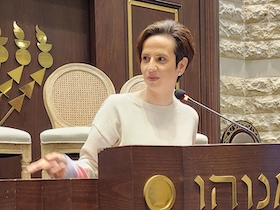
For Lantsman, the answer begins outside politics. She argued that what this moment demands is “a renewed Jewish identity,” adding that “before lobbying, before the press releases, before the next emergency appeal or the fundraising, more Jewish life is actually what’s necessary.” In her telling, public advocacy will only be durable if it is rooted in private conviction, education and continuity.
She also urged the audience to move outward, into politics and public life, “not as a supplicant” but as citizens who vote, donate, organize and remember. Politicians who abandon the Jewish community, she said, should feel it “at the ballot box,” because “this isn’t a Jewish problem, it’s a Canada problem.”
The insistence on moving from rhetoric to measurable action was sharpened by strategy consultant Maureen Leshem in her remarks. Drawing on conversations with intelligence officials, police, community leaders and counterterrorism experts, she said she had concluded that the community is “dangerously unprepared for what’s currently happening, and even less prepared for what lies ahead.”
Leshem argued that the community must rethink “everything, from our leadership choices, to how we spend our money, to how we work together.” Too often, she said, Jewish institutions and donors are stuck in “reaction mode,” raising funds to mitigate threats rather than forcing governments and public agencies to do the jobs they are already obligated to do.
A shooting at a Jewish institution, she said, is not mere vandalism or mischief but “targeted, potentially lethal violence against the Jewish community that demands the full weight of a national security response.” When Jewish families and institutions are expected to fund their own protection, she warned, the result is “a private tax on Jewish existence,” which risks normalizing public failure.
Leshem’s call to action was blunt: enough slogans. “Do not get up here and tell us that antisemitism is unacceptable. We know,” she said. Instead, leaders should explain what they are going to do, what laws they are demanding, what institutions they are pressuring and what risks they are willing to take.
Daniel Warner, co-founder of Yalla, said that, after Carney’s speech and subsequent committee appointments, it “became pretty clear that we’re going to have to take this into our own hands,” both as individuals and as organizations.
Warner said too many people he knows have already left Canada, but he rejected emigration as an answer. “Plan B is not leaving. Plan B is fighting back,” he said, urging attendees to stand up for themselves in new ways and to use their voices “as if their future here depended on it.”
The point, he said, is not simply to denounce antisemitism but to demonstrate Jewish life confidently and publicly in places where falsehoods about Jews are spreading most effectively.
Unapologetically Jewish’s Taub observed that, since Oct. 7, dozens of Jewish organizations have sprung up, but real coordination remains uneven. “Suppressing what others have to say is not unity, that is division,” he said, arguing that calling out institutional mistakes should be understood as honesty rather than disloyalty.
Taub accused parts of the organized community of applying temporary remedies to a crisis. “They are throwing Tylenol at cancer, and it’s not working,” he said, after arguing that some Jewish organizations have spent more energy lobbying internal critics than lobbying governments on behalf of the community.
Bennet addressed what she sees as the nature of the threat itself. Discussing themes she observed at a Muslim Association of Canada convention, she warned of a “destructive anti-Western ideology” in which Jews are often the first target but not the only one. “You guys feel it the strongest,” she said, but the larger struggle, in her view, is the attempt to reshape institutions and public life more broadly. Beware, she said, of “jihadis in Armani suits,” referring to the public propaganda face of Islamist terrorists.
Vuong, another ally, framed the issue in similarly expansive terms. He said his support was motivated not only by solidarity but by “self-preservation,” because “the people who hate you hate me as well,” adding that the old warning holds: what starts with the Jews never ends with the Jews.
Independent of the conference, several of Canada’s national Jewish organizations also have responded to Carney’s remarks.
The Centre for Israel and Jewish Affairs and Jewish federations across Canada, for example, issued an open letter reading, in part: “Instead of urgent, concrete measures, the government announced an advisory council, tasked first with further evaluating a crisis that has already been studied extensively, and which includes individuals who are not suited to lead government action on antisemitism. For many Jewish Canadians, this felt like the rug being pulled out from under us.”
“This was an opportunity for the prime minister to meet the moment,” said Simon Wolle, B’nai Brith Canada’s chief executive officer, in a release. (Wolle also spoke at the Toronto gathering.) “Instead, Canadians heard a speech that described the problem more than it confronted it. The Jewish community did not require another acknowledgment that antisemitism is raging across the country, we needed a plan proportional to the scale of the crisis.
“Canada is not facing an antisemitism awareness problem. Canada has an antisemitism problem,” he said. “The country has been poisoned with Jew-hatred and we need a remedy.”
The Jewish Independent reached out to other national Jewish organizations, as well.
“Carney is correct to note the rise of antisemitism is tied to larger trends of conspiracism, polarization and hate worldwide,” said Vancouver-based Maytal Kowalski, JSpace Canada’s executive director. “It is important to recognize this, not to universalize or trivialize antisemitism, but, in fact, the opposite – to fight it at its root and along with allies.” She said including “allies and leaders from different minority communities” is important if the work is to happen “holistically.”
Gabriella Goliger, national chair of Canadian Friends of Peace Now, said “Israel” was missing from the prime minister’s remarks. “He could have emphasized that he recognizes diaspora Jews’ emotional ties to Israel, that Canada is a friend to Israel,” she said, while also stressing that Canadian Jews “must not be held accountable for Israeli policy” and that there is “a huge difference between legitimate peaceful protest against Israeli actions, and using protest as a smokescreen for antisemitism.”
For the full reactions and recommendations of CIJA, B’nai Brith and JSpace, visit their respective websites.
Dave Gordon is a Toronto-based freelance writer whose work has appeared in more than 100 publications around the world. His website is davegordonwrites.com.



