

In Seattle, hours after the terrorist attacks of 9/11, two FBI agents knock on Monty’s door, asking questions about his Afghan partner, who has seemingly disappeared. How much does Monty really know about Jamal? What does he know about himself?
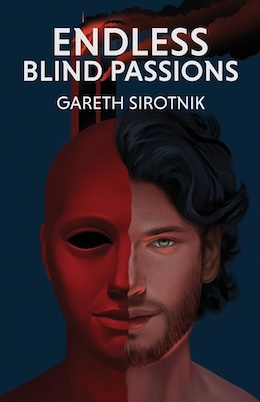 Vancouver writer Gareth Sirotnik’s Endless Blind Passions (Capsicum Press, 2025) jumps right into the chaos and uncertainty that 9/11 sparked in the United States, and beyond. The novel centres on the character of Monty, a Jewish, gay man in his mid-50s, who thought he had finally settled into himself and his life, yet is forced to reevaluate that thought when the FBI arrive.
Alternating between the repeated visits of the FBI agents and the memories their inquiries trigger for Monty, we witness the fragility of Monty’s contentment and the tumultuous paths that he has chosen. He has lived fully, most would say, experimenting sexually, spiritually, politically and morally. He is a seeker and his soul-searching is a work in progress, despite his initial belief that he had found himself – and peace – once he’d met Jamal.
Endless Blind Passions is a thriller-meets-coming-of-age story, unusual perhaps in its seriousness, which sometimes gets in the way (as does dialogue that doesn’t always sound natural), but it’s entertaining. Most of us don’t really “find” ourselves as teenagers – Monty certainly didn’t – but are continually discovering aspects of ourselves. In our lives, we do things that make us proud, and things that carry shame or regret. Hopefully, we learn from our experiences and become a better person, but who is even to say what that means.
Sirotnik’s personal journey inspires Monty’s, that’s for sure. Sirotnik grew up in Los Angeles, graduated from college in Portland, moved to Canada in 1971 (Monty’s brother lives in Canada) and, most notably, is gay, Jewish and a longtime practitioner of Zen Buddhism.
As the novel’s title implies, Zen is a vital component of the story. Monty’s spiritual awakening occurs alongside drug-fueled encounters and unconventional relationships. He works (both consciously and subconsciously) to strip away social personas and confront his “true self.” He lives intensely, even hedonistically, but not necessarily deeply in the introspective sense, or even in knowing his various romantic partners. His ego prevents him from seeing the reality of situations, including the impact of his own actions on others throughout his life.
That’s all on a personal level. Paralleling Monty’s understanding of his “blind passions” is the realization that American society is not what it was, let’s say, sold as being. Sept. 11, 2001, marked a significant increase in racism, xenophobia, paranoia, government surveillance – it did not create them. In the novel, Jamal represents “the other” that became society’s “blind passion” after the attacks that day on the United States, but Monty’s past – though only going back 50ish years – highlights that the concept of “the other” has existed as long as humanity.
Ultimately, the novel posits that true spiritual awakening only happens when we acknowledge our “endless blind passions,” drop our masks and face reality as our true selves. It does this in an engaging way, with readers learning a lot along the way, while rooting for love to win out.



