
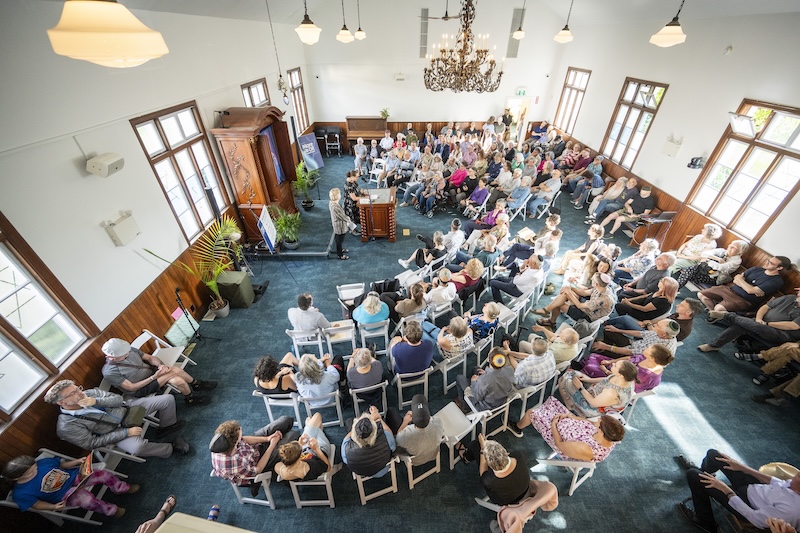

On May 28, Or Shalom Synagogue reopened its doors after a year of renovations. (photo by Wendy D)
On the evening of May 28, Or Shalom Synagogue reopened its doors after a year of renovations, welcoming celebrants for the Chanukat HaBayit, or homecoming. Co-chairs Sally Thorne and Dalia Margalit-Faircloth emceed the event.
“It is our pleasure to welcome you back to our expanded and renewed bayit, our spiritual home, and the first carbon-neutral shul in North America,” said Margalit-Faircloth, thanking Harriet Frost for opening the gathering with song and the shul’s Rabbi Arik Labowitz for receiving everyone into the space.
“Thank you all for joining us here today to celebrate this incredible milestone, the completion of our More Or renovation and expansion project,” she said. “It’s such a pleasure to see this sanctuary full once again and to share this joyful occasion with so many members of the community, supporters and friends.”
After thanking the elected officials and community leaders in attendance, Margalit-Faircloth read a message from Premier David Eby, which the congregation has framed. The premier congratulates Or Shalom on its reopening.
“Or Shalom began as a havurah in 1982, meeting in members’ living rooms. Today, it has grown into a vibrant community of almost 200 households,” he writes, noting that the present location – at 10th and Fraser – was purchased in 1993. “Or Shalom’s success is a testament to the perseverance and contributions of its congregation as well as the vital role it plays in the community.”
Margalit-Faircloth stressed the vital role congregant John Fuerst played in being “the driving force behind the More Or project.”
Fuerst shared with those gathered the story of how the renovation began eight years ago with a question he asked Rabbi Hannah Dresner, who led the congregation at the time: “How are things going?”
Her response was, “We’re growing out of our clothes. We just don’t have the space we need. We need classrooms – we don’t have those classrooms. We need accessibility – our accessibility for people who need it is so awkward, so difficult. We have water damage in our outside walls – we need those fixed.
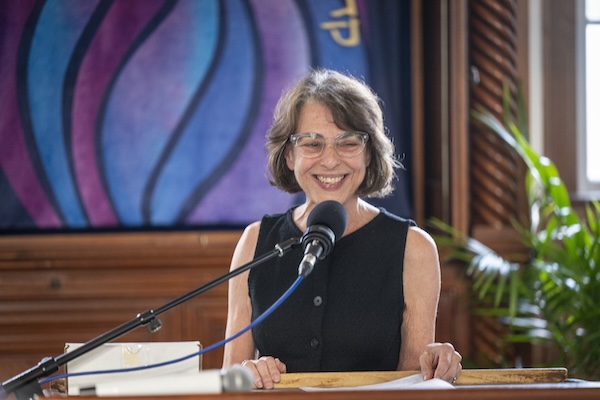
“Well,” said Fuerst, “it’s eight years later and here we are. Actually, not quite so simple. We’re only here today because of the many people who have helped to put this together and it’s my honour to be able to thank them.
“First and foremost, our thanks to the Ronald S. Roadburg Foundation. You often hear at events like this, ‘without your donation, this project, this program, wouldn’t have happened.’ Well, without hyperbole, I can say, without [the foundation’s] contribution, this project would not have happened.”
Fuerst also thanked the Jewish Community Foundation of Greater Vancouver for the “elevator that will be working on Monday”; the Lutsky family Foundation, whose donation allowed Or Shalom to “expand and completely renovate our kitchen”; the Phyliss and Irving Snider Foundation, whose contribution towards the new classrooms was “made in honour of our teacher and our mentor Gloria Levi”; and both the Jewish Federation of BC and the Government of British Columbia, who gave the congregation grants for its security systems.
“My thanks to the Adamah Climate Action Fund, who gave us an interest-free loan, which enabled us to put together our decarbonation system, our heat pump system,” said Fuerst, who thanked RBC Dominion for the shul’s mortgage and architect Erika Gerson, who recently retired. “She heard what we needed and she designed it,” he said, expressing appreciation to Chris Boni and Anthony Boni of Boni Maddison Architects; to the general contractors, Novacom Building Partners; and to Jon Hardybala of PCA Pacific Construction, who was the site superintendent. Instrumental in the decarbonization aspect was Chris Higgins of BC Hydro, said Fuerst. And, offering the congregation a home for the months that the renovations took was Cityview Church, whose spiritual leader, Pastor Trevor Josh, joined the celebration, along with the church’s Pastor Jeff Groulx.
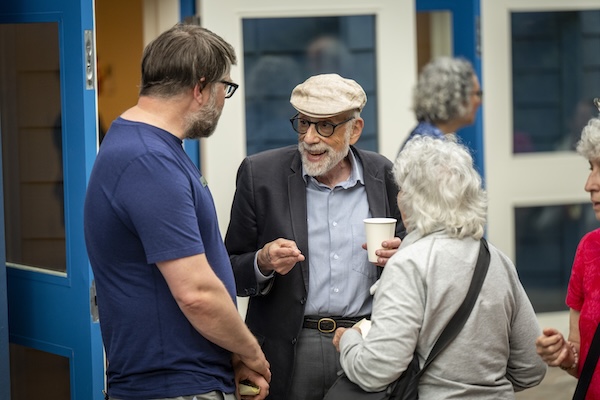
Fuerst thanked rabbis Dresner and Labowitz, and the synagogue’s Efrat Gal-Or – “Coordinating a construction project needs the skills of a surgeon, the vision of an eagle, the patience of a kindergarten teacher. You’ve shown all three and you’ve helped bring this project to where it is.” He voiced appreciation for Or Shalom staff Tracey Fagg and Katy Ormiston.
Or Shalom members contributed $1.8 million toward the project and there were many volunteers on various committees and on other tasks, Fuerst said. “What a wonderful contribution for our little East Side shul.”
He added, “I do want to mention one member in particular, Jackie Levitan, of blessed memory. Jackie served on the housing task force. She’s actually responsible for much of the redesign of the office space. And, a month before Jackie’s passing … she called me up and said, ‘I want to make a donation.’ Jackie donated the largest single donation towards this project.”
David Bogdanov, a director of the Ronald S. Roadburg Foundation, said, “Or Shalom offers a unique and important pathway to Jewish life in Vancouver,” and noted how thrilled he was that it is the first carbon-neutral shul in North America, as decarbonization is a priority of the foundation.
Mira Oreck, who is a board member of the synagogue, spoke as a parent.
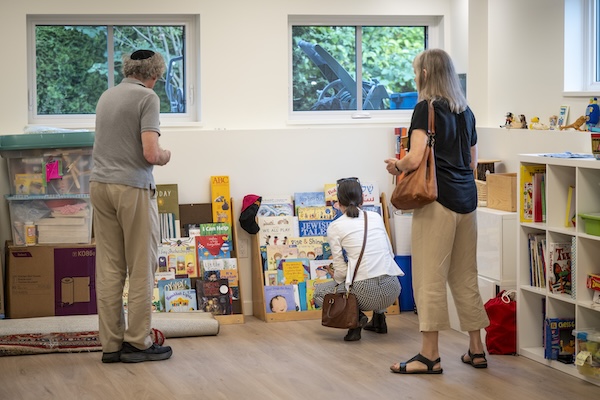
“What is a shul without classrooms for learning, playing, sneaking away from services, and forming Jewish identity and friendships?” she asked. “Our new classrooms will enable our kids, so many of whom do not attend Jewish day school, to be together to learn songs and prayers, holidays and text; a place to study for their simchat mitzvah; and a place to grapple with and hopefully connect to our traditions.
“More than that,” said Oreck, “I want to acknowledge the founders and stewards of Or Shalom for creating a Jewish spiritual community fit for Jewish life and Jewish families today…. The first net-zero synagogue in Canada. A shul with access for people with disabilities. A place where you can come as you are…. A place of songs without words, niggunim, creating more open access to Jewish families of all backgrounds. A Jewish home that incorporates nature, culture, place and community. There is nothing like us in Vancouver.”
When Labowitz returned the bimah, he said, “This moment was built through thousands of visible and invisible acts of devotion, through generosity and patience, through courage, through people saying yes again and again, even when the road was long.” He thanked not only major donors but “those whose gifts may never appear on a plaque but are written into the soul of this place.”
“Judaism understands that there is a holy relationship between the vessel and the light that it carries,” he said. “The vessel alone is not enough, but light without a vessel can scatter and disappear. This renewed bayit is a vessel for the light of Or Shalom. And it is preparing the way for more or [light]: more song, more questioning, more justice, more tenderness, more learning and more becoming, more or.
“This building will continue to hold so much life,” said the rabbi. “These walls will hear children playing, elders teaching, mourners grieving and community growing. They will hold disagreement and reconciliation, search and discovery. They will shelter people who feel at home in Judaism and people still searching for their spiritual home.
“My hope is that everyone who walks through these doors will feel there is room for their whole self here,” said Labowitz, because “that is what sacred community is and can be at its best…. So, we return not simply to a renovated space but to a renewed sense of possibility.”
In calling Dresner up to speak, Labowitz praised her “wisdom, vision, determination and relentless devotion helped bring this dream into a reality.”
“I’m thrilled to be here to mark this milestone in the unfolding of Or Shalom’s history,” said Dresner. “I did put the renovation bug into John Fuerst’s eager ear and, later, I was privileged to write the story of Or Shalom for our seminal Ronald S. Roadburg Foundation grant. Now, I shep nachas, meaning ‘at rest,’ as in resting on my laurels. And I derive profound satisfaction in your achievement bringing this project to near-enough completion. The blessing we celebrate today is not just of a refurbished bayit and what it can hold. We also celebrate the courageous innovations of our leaders who keep Or Shalom on the cutting edge of inclusion and on the cutting edge of social justice work, of dialogue and of spiritual expression in the Jewish world.
“For our elders who created this outreach organization to answer their own unmet needs, this is a celebration of an era and its threshold of paying it forward, as they have given way to renewed policies and modalities that centre you who will carry Or Shalom into its next era,” she continued. “They decided not to wind the experiment of Or Shalom down with their eldering, but instead to outfit her for the next generation, midor l’dor, to bless the next generation with a well-run organization, comfortable in its finances, strong in its professional and lay leadership…. In response and in gratitude, the youngers, you must care for our current role models, taking over their delivery of gemilut chesed, institutional loving kindness, taking over their heroic volunteerism more and more so that they too have a chance to shep nachas, rest in the stewardship of Or Shalom’s younger members, delight in the gorgeous kindness and creativity of the next wave.”
Dresner offered the congregation a benediction framed around the week’s Torah portion, Naso, in which Moshe finishes setting up the tabernacle and sanctifies it. After, Labowitz introduced the mezuzah hanging.
“So, we started this process with a shovel and we’re going to end with a hammer,” he said. “And we have a very special mezuzah that has been gifted to us by our members Harriet Lemur and Ron Einblau.”
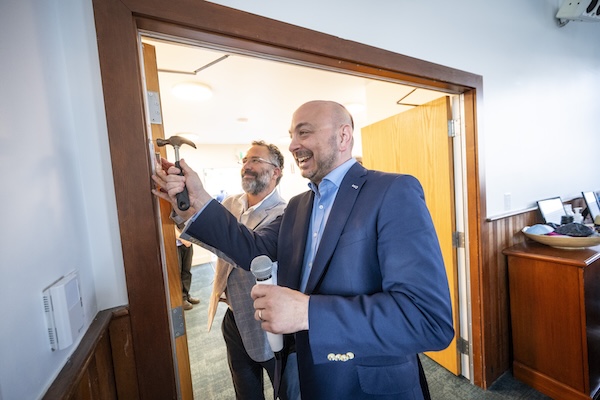
The mezuzah contains shards from the glass that was broken at the renovation’s groundbreaking ceremony last year. Before it was affixed to the door coming into the sanctuary, Josh presented to Labowitz and Or Shalom the gift of a painting. The pastor said he would miss having the congregation as Cityview’s guests.
“I’m going to miss the oneness of spirit,” said Josh. “I’m going to miss the love, the deep love, the gracious love that we show to one another. And I’m going to miss the friendship, the deep, deep friendships that we’ve made. And can I tell you that we would not have known any of those things if we had stayed closeted in our buildings and not reached out.”
Josh was the first person to help Labowitz hang the mezuzah, followed by Jewish Federation of BC chief executive officer Ezra Shanken, Hardybala, Dresner and Fuerst.
“Thank you all for being here,” said Labowitz. “Thank you for being a part of this moment.”



