
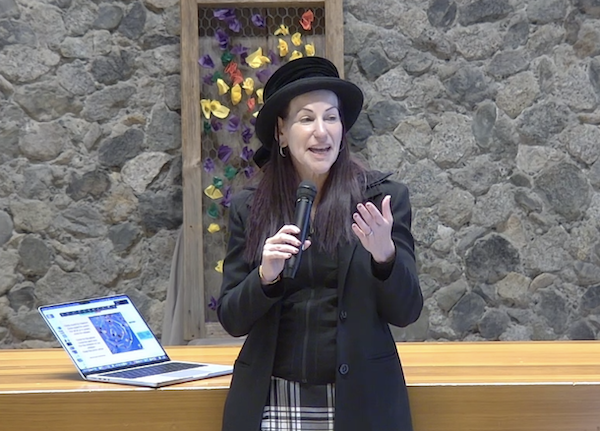

On May 26, Rabbi Dr. Laura Duhan Kaplan gave the public lecture From Conflict to Connection: Spiritual Community in Stressful Times at the annual conference of Vancouver School of Theology’s Inter-Religious Studies Program. (screenshot)
The Walking Together: Sharing the Work and Ideas That Call to Us conference, hosted by Vancouver School of Theology’s Inter-Religious Studies Program last month, included, as it always does, a public lecture. This year’s address was given on May 26 by Rabbi Dr. Laura Duhan Kaplan, dean of the ALEPH Ordination Program, the Jewish Renewal seminary; former director of inter-religious studies at VST; and rabbi emerita of Or Shalom Synagogue. Her topic was From Conflict to Connection: Spiritual Community in Stressful Times.
Duhan Kaplan began and ended her talk with Linda Hirschhorn’s “Circle Chant,” a song about peace, human rights, environmental and intergenerational stewardship.
“If we are talking about the world, or the community, or the variety of communities as a circle,” she said, “let’s get real – it’s not a perfect circle. We are many different people doing many different things, overlapping, intersecting, sometimes clashing. That’s the kind of circle that we have, that we are working with when we try to make things whole.”
She shared a well-known quote from Rabbi Tarfon that is found in the Pirkei Avot, which she translated as Basic Aphorisms, rather than the more common Ethics of the Fathers. She read Tarfon’s adage about the day being short and the work plentiful and, while it is not up to us to finish the work, we’re not free to avoid it.
“What is the work?” the rabbi asked. “Here are some of the kinds of work that people at this conference are going to be talking about: work in climate, food security, interfaith, multicultural community, decolonization, indigenous learning, spiritual care, nonviolence, protest, arts, ritual, refugee support, theology.”
Based on the book Liquid Times: Living in an Age of Uncertainty by Zygmunt Bauman, Duhan Kaplan said we’re living in a globalized world that has not delivered on its promises of integration and freedom.
“In fact, globalization has become primarily the work of a small group of highly wealthy, highly influential people, and what it has brought almost everyone else is increasing income inequality, more displaced people, more incarcerated people, more environmental devastation, more elite criminality, more precarity (that is, precarious life), more anxiety,” said Duhan Kaplan, summarizing Bauman’s ideas.
She spoke about the politics of fear and polarization, which are enforced through segregation: neighbourhoods are increasingly monoethnic and an increased police presence keeps people out of certain places, she contended. “At the national level, in many countries, we have a closing of borders.”
Cities, spiritual communities and social service agencies are left to deal with these global problems, she said, giving an example from her work.
“Let’s say we have a conflict in a class between students and teacher. The students say there’s so much in our religious tradition that is racist. And it’s true…. But, when the students speak to the teacher about it, the teacher says, young adults today don’t respect their teachers the way they used to. And that’s true too,” she said.
Direct dialogue between the parties would be ideal, but “because of habits of polarization, people are saying, no, we don’t even want to talk about it.” Rather than encouraging communication, people have suggested excluding individuals who hold opposing viewpoints, she said. “But why would we do that? We’re a microcosm of the world. We want to be that crazy, misshapen circle, and we want to live together. Isn’t that an essential pastoral skill?”
Duhan Kaplan gave another example.
“Two students in the program are tasked with leading a prayer service together and they want to pray for peace, but one of them identifies themself as an antizionist and the other one identifies themself as a Zionist, and they don’t know how to pray together for the worldwide community of Jews. They’re just paralyzed. And so, they appeal to us, the administration, and they say, tell them they’re wrong. And we say, well, we don’t do that. How about we sit in a room with both of you?… But the students are reticent to do that because, in our larger environment, what is modeled is cutting people off rather than building a community of difference.”
Duhan Kaplan talked more of Bauman, who realized that living together in a multi-class, multi-ethnic place requires skill.
One necessary skill is “the ability to work through miscomprehension – when you say something and you mean something, and somebody else who sees the situation in an entirely different way thinks you meant the opposite,” the rabbi explained.
“We need the ability to persevere, to keep talking in order to work through these issues,” she said, but the current social environment shuts down these skills, and so we end up in a cycle that Bauman calls myxophobia.
“We start off with a fear of the unknown … and it takes skill to deal with that: inner strength, communal support, faith in the future,” she explained. “When we don’t have those things, our fear of the unknown searches for a target. Oh, if only that unknown thing were known or, worse, if only that unknown thing were removed.”
Limiting immigration might make people safer for a period, for example. But, when there are fewer new people in a person’s life, anyone new will seem even more scary, she said, and a person’s epistemic courage, courage to learn, diminishes.
To stop the cycle, we must question propaganda, and become skilled in hearing what is uncomfortable, she said, pointing to a couple of tendencies that make this hard, including “the hasty generalization fallacy.” This is when we make broad conclusions from a small piece of information, like judging every Iranian based on how you feel about your uncle from Iran, who you don’t like.
Generalizations help us protect ourselves, Duhan Kaplan acknowledged, “but we also have to realistically ask: Is this a situation in which I need to protect myself? What is at stake here? If we are not talking our immediate protection, then we can think critically.”
Another hurdle, she said, is the “false dichotomy, false bifurcation, the either-or fallacy … claiming that there are only two options when in fact there are many more. Like the students trying to figure out how to pray. Should we pray for the well-being of Israelis? Or should we pray for the well-being of Palestinians? We can’t do both because that’s too complicated. How will we work out the words? Of course, if you’re training to be a clergy person, it is your job to work out the words, and those skills will come, even if they haven’t come right now.”
Duhan Kaplan also discussed the “bandwagon effect,” which she described as “the 53 million people can’t be wrong fallacy. Oh, yes, they can.”
She has adopted a principle: “If everyone agrees on something, I say, wait a minute, isn’t there also another way to look at this? And there’s a mythical teaching in our tradition about the Sanhedrin, ancient Jewish court, when a death penalty case came before this jury of 70 judges. If there is a unanimous guilty verdict, the person is freed, because there couldn’t possibly have been a unanimous verdict without groupthink. And, when people’s lives are at stake, we don’t want groupthink. We want something nuanced, something we can work together on.”
The rabbi talked about how to listen: “What is the inner work that we do? We quiet the mind. And, to quiet the mind, that takes courage, because you have to say to yourself, I trust that I’m going to be able to understand what I’m hearing…. I trust I’m going to be able to respond.”
Listening, feeling what another person is feeling, hearing what’s important to them, might engender strong reactions, she warned. “Conflict resolution work, courageous work, meeting difference, solving problems, doesn’t always feel good … you might not be happy with what you learn about other people, you might not be happy with what you learn about yourself…. And, of all the points that I made tonight, that’s the one I want people to most take to heart: there’s nothing wrong with you if the work is hard.”
One of Duhan Kaplan’s strategies in this time of heightened anxiety is to recite the 13 Attributes of Compassion.
“Where these come from is in the Bible, when Moses is at Mount Sinai, and he says to God, show me your face, and God says, you can’t see my face, but you can see my after-effects…. What is my true essence? This is what is revealed: God, the ineffable one, compassion, tenderness, patience, forbearance, kindness, awareness. I’m carrying love for thousands of years; lifting guilt, letting go of mistakes; allowing freedom and a fresh start.
“Not immediately,” she said. “Takes time. In fact, the Bible says it might take four generations for all these processes to work through, but, the point is, when I find myself angry and constricted, I will pause and I will recite this mantra.”
Another thing Duhan Kaplan does, when she needs it, is “the Examen, the examination of consciousness,” as taught by St. Ignatius of Loyola (1491-1556), founder of the Jesuit order.
“You find as quiet a space as you can find,” she said. “You allow yourself to become aware of divine presence, whatever that means to you…. And then you review the day with gratitude … you pay attention to your emotions … just notice. And then choose one thing that’s on your heart and mind and pray in the way that you pray…. And then, at the end, you look toward tomorrow and you say whatever it is has come out of your reflection.”
In the Jewish tradition, she said, Aaron “is the consummate peacemaker” and one of his lessons for us is that, if we do the work of peacemaking, “some kinds of peace will come.”
She circled back to Rabbi Tarfon: “we don’t have that much time, there’s so much to do.… It’s not up to you to finish the work … but you have to do something.”



