Skills to live together

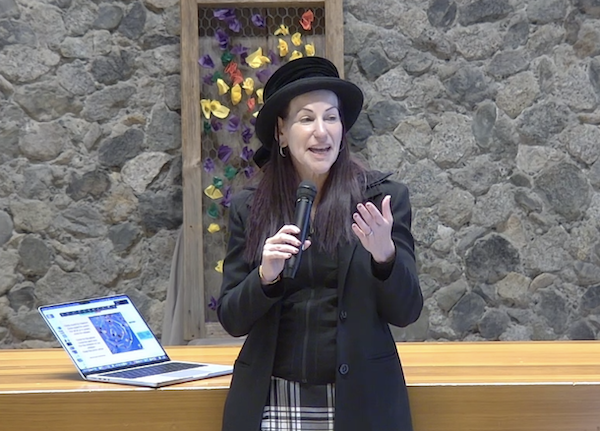
On May 26, Rabbi Dr. Laura Duhan Kaplan gave the public lecture From Conflict to Connection: Spiritual Community in Stressful Times at the annual conference of Vancouver School of Theology’s Inter-Religious Studies Program. (screenshot)

The Walking Together: Sharing the Work and Ideas That Call to Us conference, hosted by Vancouver School of Theology’s Inter-Religious Studies Program last month, included, as it always does, a public lecture. This year’s address was given on May 26 by Rabbi Dr. Laura Duhan Kaplan, dean of the ALEPH Ordination Program, the Jewish Renewal seminary; former director of inter-religious studies at VST; and rabbi emerita of Or Shalom Synagogue. Her topic was From Conflict to Connection: Spiritual Community in Stressful Times.

Duhan Kaplan began and ended her talk with Linda Hirschhorn’s “Circle Chant,” a song about peace, human rights, environmental and intergenerational stewardship. 

“If we are talking about the world, or the community, or the variety of communities as a circle,” she said, “let’s get real – it’s not a perfect circle. We are many different people doing many different things, overlapping, intersecting, sometimes clashing. That’s the kind of circle that we have, that we are working with when we try to make things whole.”

She shared a well-known quote from Rabbi Tarfon that is found in the Pirkei Avot, which she translated as Basic Aphorisms, rather than the more common Ethics of the Fathers. She read Tarfon’s adage about the day being short and the work plentiful and, while it is not up to us to finish the work, we’re not free to avoid it.

“What is the work?” the rabbi asked. “Here are some of the kinds of work that people at this conference are going to be talking about: work in climate, food security, interfaith, multicultural community, decolonization, indigenous learning, spiritual care, nonviolence, protest, arts, ritual, refugee support, theology.”

Based on the book Liquid Times: Living in an Age of Uncertainty by Zygmunt Bauman, Duhan Kaplan said we’re living in a globalized world that has not delivered on its promises of integration and freedom.

“In fact, globalization has become primarily the work of a small group of highly wealthy, highly influential people, and what it has brought almost everyone else is increasing income inequality, more displaced people, more incarcerated people, more environmental devastation, more elite criminality, more precarity (that is, precarious life), more anxiety,” said Duhan Kaplan, summarizing Bauman’s ideas.

She spoke about the politics of fear and polarization, which are enforced through segregation: neighbourhoods are increasingly monoethnic and an increased police presence keeps people out of certain places, she contended. “At the national level, in many countries, we have a closing of borders.”

Cities, spiritual communities and social service agencies are left to deal with these global problems, she said, giving an example from her work.

“Let’s say we have a conflict in a class between students and teacher. The students say there’s so much in our religious tradition that is racist. And it’s true…. But, when the students speak to the teacher about it, the teacher says, young adults today don’t respect their teachers the way they used to. And that’s true too,” she said.

Direct dialogue between the parties would be ideal, but “because of habits of polarization, people are saying, no, we don’t even want to talk about it.” Rather than encouraging communication, people have suggested excluding individuals who hold opposing viewpoints, she said. “But why would we do that? We’re a microcosm of the world. We want to be that crazy, misshapen circle, and we want to live together. Isn’t that an essential pastoral skill?”

Duhan Kaplan gave another example.

“Two students in the program are tasked with leading a prayer service together and they want to pray for peace, but one of them identifies themself as an antizionist and the other one identifies themself as a Zionist, and they don’t know how to pray together for the worldwide community of Jews. They’re just paralyzed. And so, they appeal to us, the administration, and they say, tell them they’re wrong. And we say, well, we don’t do that. How about we sit in a room with both of you?… But the students are reticent to do that because, in our larger environment, what is modeled is cutting people off rather than building a community of difference.”

Duhan Kaplan talked more of Bauman, who realized that living together in a multi-class, multi-ethnic place requires skill.

One necessary skill is “the ability to work through miscomprehension – when you say something and you mean something, and somebody else who sees the situation in an entirely different way thinks you meant the opposite,” the rabbi explained.

“We need the ability to persevere, to keep talking in order to work through these issues,” she said, but the current social environment shuts down these skills, and so we end up in a cycle that Bauman calls myxophobia.

“We start off with a fear of the unknown … and it takes skill to deal with that: inner strength, communal support, faith in the future,” she explained. “When we don’t have those things, our fear of the unknown searches for a target. Oh, if only that unknown thing were known or, worse, if only that unknown thing were removed.”

Limiting immigration might make people safer for a period, for example. But, when there are fewer new people in a person’s life, anyone new will seem even more scary, she said, and a person’s epistemic courage, courage to learn, diminishes.

To stop the cycle, we must question propaganda, and become skilled in hearing what is uncomfortable, she said, pointing to a couple of tendencies that make this hard, including “the hasty generalization fallacy.” This is when we make broad conclusions from a small piece of information, like judging every Iranian based on how you feel about your uncle from Iran, who you don’t like.

Generalizations help us protect ourselves, Duhan Kaplan acknowledged, “but we also have to realistically ask: Is this a situation in which I need to protect myself? What is at stake here? If we are not talking our immediate protection, then we can think critically.”

Another hurdle, she said, is the “false dichotomy, false bifurcation, the either-or fallacy … claiming that there are only two options when in fact there are many more. Like the students trying to figure out how to pray. Should we pray for the well-being of Israelis? Or should we pray for the well-being of Palestinians? We can’t do both because that’s too complicated. How will we work out the words? Of course, if you’re training to be a clergy person, it is your job to work out the words, and those skills will come, even if they haven’t come right now.”

Duhan Kaplan also discussed the “bandwagon effect,” which she described as “the 53 million people can’t be wrong fallacy. Oh, yes, they can.”

She has adopted a principle: “If everyone agrees on something, I say, wait a minute, isn’t there also another way to look at this? And there’s a mythical teaching in our tradition about the Sanhedrin, ancient Jewish court, when a death penalty case came before this jury of 70 judges. If there is a unanimous guilty verdict, the person is freed, because there couldn’t possibly have been a unanimous verdict without groupthink. And, when people’s lives are at stake, we don’t want groupthink. We want something nuanced, something we can work together on.”

The rabbi talked about how to listen: “What is the inner work that we do? We quiet the mind. And, to quiet the mind, that takes courage, because you have to say to yourself, I trust that I’m going to be able to understand what I’m hearing…. I trust I’m going to be able to respond.”

Listening, feeling what another person is feeling, hearing what’s important to them, might engender strong reactions, she warned. “Conflict resolution work, courageous work, meeting difference, solving problems, doesn’t always feel good … you might not be happy with what you learn about other people, you might not be happy with what you learn about yourself…. And, of all the points that I made tonight, that’s the one I want people to most take to heart: there’s nothing wrong with you if the work is hard.”

One of Duhan Kaplan’s strategies in this time of heightened anxiety is to recite the 13 Attributes of Compassion.

“Where these come from is in the Bible, when Moses is at Mount Sinai, and he says to God, show me your face, and God says, you can’t see my face, but you can see my after-effects…. What is my true essence? This is what is revealed: God, the ineffable one, compassion, tenderness, patience, forbearance, kindness, awareness. I’m carrying love for thousands of years; lifting guilt, letting go of mistakes; allowing freedom and a fresh start.

“Not immediately,” she said. “Takes time. In fact, the Bible says it might take four generations for all these processes to work through, but, the point is, when I find myself angry and constricted, I will pause and I will recite this mantra.”

Another thing Duhan Kaplan does, when she needs it, is “the Examen, the examination of consciousness,” as taught by St. Ignatius of Loyola (1491-1556), founder of the Jesuit order.

“You find as quiet a space as you can find,” she said. “You allow yourself to become aware of divine presence, whatever that means to you…. And then you review the day with gratitude … you pay attention to your emotions … just notice. And then choose one thing that’s on your heart and mind and pray in the way that you pray…. And then, at the end, you look toward tomorrow and you say whatever it is has come out of your reflection.”

In the Jewish tradition, she said, Aaron “is the consummate peacemaker” and one of his lessons for us is that, if we do the work of peacemaking, “some kinds of peace will come.”

She circled back to Rabbi Tarfon: “we don’t have that much time, there’s so much to do.… It’s not up to you to finish the work … but you have to do something.” 
Reviving history in theatre, song

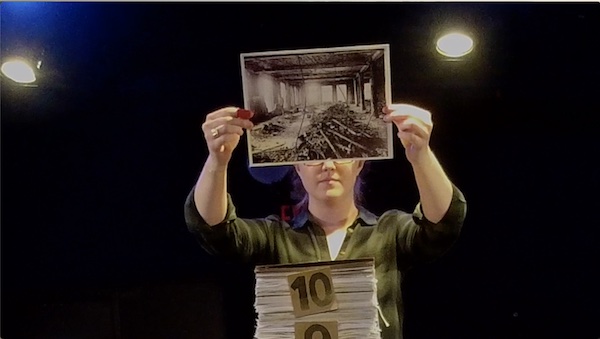
Surplus Production Unit’s Briony Merritt. (photo by Alex McLean)

No matter how well we document history, it matters little unless people are aware of it. Two very different productions at this year’s Chutzpah! Festival, which began this week, were born of personal discoveries of documents from the past – in one case, a trial transcript; in the other, Yiddish compositions. The artists’ unique interpretations help ensure that important aspects of our culture are not forgotten.

Halifax-based Surplus Production Unit, under the direction of Alex McLean, performs A Timed Speed-Read of the Triangle Shirtwaist Factory Fire Trial Transcript on Nov. 21 and 22 at the Jewish Community Centre of Greater Vancouver, in the Wosk Auditorium. Montreal’s Josh “Socalled” Dolgin performs music from his album Di Frosh with a local quartet at the JCC’s Rothstein Theatre Nov. 19 in a concert that will also be livestreamed.

“I had never heard of the Triangle Shirtwaist fire until 2010, when I was doing research for an MA in Toronto,” McLean told the Independent. “I was totally fascinated by the case and got especially swept up in the extensive trial transcript.”

Triangle Shirtwaist Company owners Max Blanck and Isaac Harris were put on trial for manslaughter after a fire at their factory on March 25, 1911, killed 146 people – mostly women and girls – in part because one of the exit doors was locked.

“I think the gender politics were what initially stood out to me – it was an all-male jury, the case hinged on the discrediting of female witnesses, and it was all taking place at a time when women weren’t able to vote in either Canada or the United States. I also knew that this was a time when the labour movement was massive globally and that the Ladies Garment Workers Union had waged its major strike just a couple years earlier. The way that this all reads as subtext in the trial transcript was fascinating to me. I knew that I wanted to work with the material somehow, but wasn’t sure how.”

In 2011, during the 100th anniversary year of the fire, McLean saw an interview with Charles Kernaghan, director of the Institute for Global Labour and Human Rights, who mentioned the Hameen factory fire in Dhaka, Bangladesh. “And then there was the Tazreen factory fire in 2012 and then the collapse of the Rana Plaza building in Dhaka in 2013,” said McLean. “It all made the record of what happened in New York in 1911 hauntingly relevant.

“Somewhere around this time,” he said, “I got a small grant to create a verbatim script from the transcript. I started work on it but it felt lifeless, like a bad ‘historical drama.’ So, I gathered a few actors who I knew and trusted and who were interested in the material. We started playing around with ways to approach the material that felt honest and the current production grew from there.”

McLean believes “it is endlessly worthwhile to think about the hidden costs in our global economy and the conditions under which so many of the products we consume are created.” At the same time, he added, “I was very aware that my life – like those of my colleagues – was radically different from the lives of the people in the trial transcript. None of us are immigrants, none of us are Jewish or Italian (as were almost all of the Triangle victims). As middle-class Canadians in the 21st century, I felt that we had to acknowledge the gulf between us and those New York factory workers in 1911. We had to build this distance into the structure of the show, and so this idea emerged that we would actually sit the trial transcript on the stage and the performance would be a group of people engaging with this historical record, rather than trying to represent it realistically. This felt like the only way we could approach the material respectfully.”

photo - Briony Merritt, left, Kathryn McCormack and Richie Wilcox bring A Timed Speed-Read of the Triangle Shirtwaist Factory Fire Trial Transcript to the Chutzpah! Festival Nov. 21-22
Briony Merritt, left, Kathryn McCormack and Richie Wilcox bring A Timed Speed-Read of the Triangle Shirtwaist Factory Fire Trial Transcript to the Chutzpah! Festival Nov. 21-22. (photo by Alex McLean)

Throughout the trial, said McLean, “witnesses, especially women, were treated with palpable disrespect. Max Steuer, the lawyer defending the factory owners, repeatedly tried to cast suspicion on witness testimony. This came to a head in his cross-examination of Kate Alterman, the ‘star witness’ for the prosecution. Knowing that Alterman’s English wasn’t great, Steuer had her repeat her testimony multiple times to make it appear rehearsed. This ultimately worked for him.

“There’s also a fascinating class dynamic at play: Steuer and his clients, Isaac Harris and Max Blanck, were themselves Jewish immigrants who had worked their way up in New York’s garment district. While at times they appear callous towards the victims and survivors, there is also this sense that they come from the same place. The prosecutor, on the other hand, comes across as much more of a patrician and, at times, this results in condescension. To him, the victims are helpless little girls, while the defence tries to portray them as streetwise conspirators plotting their revenge. Their actual messy humanity gets lost in the crossfire.”

Justice was not served by the trial, nor other legal measures, but there were positive changes that resulted from the tragedy.

“Part of what the case revealed was that workplace safety regulations at the time had no teeth, so the silver lining was that a host of new laws were introduced,” explained McLean. “Frances Perkins, the first woman to serve in a U.S. cabinet, actually witnessed the Triangle Shirtwaist fire and described it as a pivotal moment in her life. She became secretary of labour under FDR [Franklin D. Roosevelt] and was a major player in ushering in the New Deal.”

In terms of lessons learned, however, “we seem doomed to continually forget the inequality that animates our world,” he said. “Going to work under dangerous conditions seems like a reasonable choice to many people in impoverished conditions. As long as those conditions exist, workplace tragedies are likely to occur.”

He added, “There’s a fascinating historian of the Triangle Shirtwaist fire, Michael Hirsch, who argues that it’s a mistake focusing anger and blame on the factory owners. He uncovered the names of several bodies that were unidentified in 1911, and he makes a yearly pilgrimage to the victims’ graves…. To me, Harris and Blanck do appear negligent, but acknowledging systemic imbalances is also important. Economic inequality has proven a difficult problem to solve, but that doesn’t give us the right to forget about it. My sense is that we need a new New Deal today.”

A love of Yiddish music

Josh Dolgin has many artistic interests and musical styles – from composing to photography to puppeteering, from hip-hop to musicals to Yiddish music. As different as they may be, Dolgin said, “all the passions stem from an attraction to ‘realness,’ to things that just deeply move me, spark inspiration, speak to my soul.”

For him, the 2018 album Di Frosh “was a kind of return to a pure, more ‘traditional’ Yiddish music, even though it’s a project of ‘new’ music. I had experimented with using Jewish music sounds in contemporary ways,” he explained, “sampling, mixing, collaborating and fusing to create hip-hop, rap and funky pop music. In so doing, I became rather immersed in the form – in klezmer, in Yiddish folk, art, theatre music, cantorial sounds from the synagogue and Chassidic music – by collecting old records looking for sources. Listening to all that music, I eventually fell in love with the source material … I wanted to play and sing it! I eventually started learning the songs as a pianist, as an accordionist and singer. I wanted to just perform that music, without mixing it, without adding beats, just to play and sing it as is.

photo - Josh “Socalled” Dolgin performs Yiddish music from his album Di Frosh with a local quartet Nov. 19 in a concert that will also be livestreamed
Josh “Socalled” Dolgin performs Yiddish music from his album Di Frosh with a local quartet Nov. 19 in a concert that will also be livestreamed. (photo from Chutzpah! Festival)

“In the meantime, I started getting into four-part harmony singing and collecting choral arrangements, then directing choirs at synagogues and music camps. That love of harmony mixed with my love of singing Yiddish songs and I thought, hmm, it would be cool to present this repertoire in an almost classic style, maintaining all that beautiful real harmony from arrangements from the ‘time.’ Some friends and I created new arrangements based on old sources – all the arrangements are ‘new,’ this repertoire for string quartet never existed before, so it’s ‘new’ music, but it’s more traditional than my fusion/pop experiments.”

Dolgin went to Hebrew school and was raised Jewishly. But, while he “adored” the “holidays and rituals and foods and songs,” he said, “I never was very inspired by the religious aspect of my cultural history, or the establishment ritual practice. When I started to find old records of Yiddish music looking for samples to make hip-hop music, I had stumbled on a part of my cultural identity that I could take pride in, that spoke to me, something I had never been exposed to with the more ‘mainstream,’ ‘modern,’ ‘reform’ version of Judaism I had experienced as a child.”

Musically, he started piano lessons at a young age and “was bribed and forced to keep at it, until I finally was allowed to study ‘jazz,’ i.e., not classical music. Then I got into the ‘rap music’ of my peers, and wanted to participate in that, to make a current music from today. I started looking into studio production techniques, sampling, using drum machines and computers to sequence and combine sounds and compose. Finding the Yiddish sounds and repertoire gave me a voice in hip-hop culture.”

Dolgin has always been one to seek out things that were “off the beaten path” and “a bit more hidden.”

“That led me as a teenager, in the days before the internet, to develop a real love of Brazilian music and funk, by digging and exploring,” he said. “The digging required to find sounds to sample in hip-hop led me unearth … a whole universe of Yiddish music and culture. I never heard Yiddish growing up! I had no idea! It was so fun to discover these treasures of my own cultural history, these sounds, modes, rhythms, poems and songs that were developed by my Eastern European ancestors. I dug around and really got into trying to find as much as I could, and that was more fun for me than having a whole repertoire handed to me on a silver platter.”

Dolgin chose his favourite songs for Di Frosh, ones “that weren’t the same top five Yiddish ‘chestnuts’ that everyone has already sung. Even though it’s not at all a well-known repertoire, there are a few songs that keep coming up, and they’ve been sung and presented enough, thank you very much. I wanted cool, rare repertoire. These could be things I heard from old records, or things I found as piano and choral arrangements on paper that could be brought to life in new arrangements.

“I thought it would be nice to have a range of repertoire from the various sub-genres of Yiddish music, from theatre music, from folk song, from Chassidic song, from postwar things, Holocaust songs, and even some ‘originals’ from contemporary Yiddish writers. Those ‘high concept’ factors were at the back of my mind when putting the program together, but it was mostly just a very subjective process of picking my favourite songs, the songs that blow my mind lyrically, harmonically or melodically.”

He went through another selection process when he was asked by a bass player from Vienna to do some Yiddish songs with a big band. Dolgin said he picked “out a whole new repertoire of more Yiddish songs I was interested in presenting, sent charts and recordings to them and they created arrangements for an actual 19-piece big band! I showed up in Salzburg and, after one rehearsal, performed with them to a sold-out jazz festival audience – it was magical! We have since done the show several times, including this summer with the Toronto Jazz Orchestra for the Ashkenaz Festival.”

They were about to travel with the show in Germany and Austria when COVID struck; the plan is now for a spring tour. During the lockdowns, said Dolgin, “I did manage to write quite a few more arrangements of Yiddish songs for string quartet, so hopefully a Frosh 2 is possible.”

The best part of this project, he said, has been “meeting new string quartets around the world and bringing this new repertoire to them, and then bringing the music to new audiences who may not be too familiar with these songs, with these sounds.

“After recording the music to make the Di Frosh record, with the amazing Kaiser Quartett based in Hamburg,” said Dolgin, “I’ve since presented this music all around the world with ‘local’ quartets: in Vienna, in London, in Venice, New York, Toronto, Montreal, Boston, Paris…. I’m very excited to be in Vancouver and meet Elyse Jacobson and the musicians she will put together for this program.


The Chutzpah! Festival opened Nov. 4 and runs until Nov. 24. For tickets and the full lineup, visit chutzpahfestival.com or call 604-257-5145.