

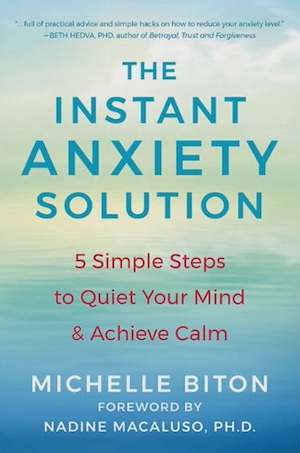
“Our thoughts are influenced by our core belief system. Our opinions are shaped from things we have seen and heard in the past and those opinions affect what we see. The problem is our thoughts are not always necessarily true,” writes Michelle Biton in her new book, The Instant Anxiety Solution (Hatherleigh Press).
“Our own thoughts and beliefs often cause us more anxiety than the actual emotion itself,” she writes. “And sometimes our beliefs are faulty or inaccurate. In order to get to the facts, it’s important to question your thoughts and not always believe everything you think.”
But this is jumping ahead to Step 5 of Biton’s five-step program ALARM, which starts with ways in which we can get our bodies “out of ‘the acute stress’ stage and into a calmer state so you can think properly” (activating the parasympathetic nervous system). It moves to labeling what you’re feeling, then acknowledging that emotions are temporary. Step 4 is about how to remember to avoid building narratives around your thoughts and emotions, and Step 5 is how to move forward and take action.
 Originally from Vancouver, Biton is a Los Angeles-based coach, author and health educator. She has a master’s in holistic nutrition, a bachelor’s in psychology and a certificate in kinesiology, health and fitness studies. Her reasons for writing The Instant Anxiety Solution are personal.
“I had been trying to deal with anxiety as if it was logical, but anxiety is not logical. It’s primal and cannot be rationalized. My best friend helped me realize that, in order to manage mine and my daughter’s anxiety, we were going to have to look it in the eye and go through the discomfort of it,” writes Biton. “Going through the anxiety was the only way out of the vicious cycle.”
Biton’s own experiences with anxiety inform her approach. “You are re-learning ingrained patterns and behaviours that will take time to unlearn,” she acknowledges, “so be easy on yourself and give yourself time to go through the process.”
The Instant Anxiety Solution comprises a foreword by marriage and family therapist Nadine Macaluso; an introduction in which Biton lays out some of her reasons for writing the book; an overview of what anxiety is and its effects; a chapter for each of the ALARM steps; a brief conclusion; many exercises readers can do to learn how to better manage anxiety; and 20-plus blank pages for the purposes of journaling.
There are many causes of anxiety, including biological makeup, learned behaviour, lack of sleep, trauma, not eating properly, financial difficulties.
“When we get triggered by an event, our amygdala gets activated, causing the impulsive fight or flight response, and the prefrontal cortex, the logical thinking part of the brain, shuts off,” writes Biton. Our bodies focus on one thing: survival. The sympathetic nervous system is activated, “causing your heart rate, breathing and blood pressure to rise dramatically…. You’ll likely even feel shaky and nauseous.
“Many people make the mistake of trying to problem solve when anxiety hits, but it is absolutely impossible to do,” she writes. We can’t think until we have calmed down, and Biton offers many ways to shock the body out of its anxious state, such as splashing cold water on our face or putting a cold pack on the back of our neck; intense exercise, like a sprint to the end of the block or some push ups; and humming or singing.
There are ways a person can semi-instantly calm themselves, but the crux of tackling anxiety is self-awareness and, for that, there is no quick fix. Biton offers advice on how to identify and deal with feelings, but a main takeaway is to train ourselves to not act in those first moments. Apparently, an emotion lasts seven minutes max, then runs out of steam. It’s “the additional energy that is added in the form of our ‘extra’ thoughts and emotions that we ‘attach’ to the original emotion that keeps the feeling alive and the suffering occurring,” writes Biton.
“Do not act on impulse,” she warns, “you will only regret it afterwards.” But don’t numb yourself either. If you feel like crying, cry. Notice and acknowledge your emotions without judgment. When you’re calm, you can figure out what is really going on, consider both sides of the situation – what happened or was said and your reaction.
We all have pain, she notes: “It is how we ‘react’ to the pain that determines our ‘suffering.’” Suffering, she says, is a sign that you’re not accepting the here and now. Some clues that you might be fighting against reality are that you’re feeling bitter or resentful, or you’re regularly unhappy or frustrated.
“A major reason that many of us suffer from anxiety today is because we have ‘felt unheard’ or ‘dismissed’ in our lives,” she writes. “We were told that we ‘weren’t good enough’ or that we ‘shouldn’t feel a certain way.’ This negative environment taught us not to trust ourselves, and not to trust our emotions. As a result, we have a lot of self-doubt and anxiety.
“On top of that, many of us project fears from the past into the future. Very rarely do we go into a situation without the ‘baggage’ and ‘opinions’ that we have carried from past experiences.”
Biton believes it possible to “become unstuck from the past.” The advice and exercises in The Instant Anxiety Solution may not result in instant results, but they do offer tangible steps to a solution.
For more information, visit michellebiton.com.



