
Skip to content
  • Home
  • Subscribe / donate
  • Events calendar
  • Business Directory
  • FAQ
  • News
    • Local
    • National
    • Israel
    • World
    • עניין בחדשות
      A roundup of news in Canada and further afield, in Hebrew.
  • Opinion
    • From the JI
    • Op-Ed
  • Arts & Culture
    • Performing Arts
    • Music
    • Books
    • Visual Arts
    • TV & Film
  • Life
    • Celebrating the Holidays
    • Travel
    • The Daily Snooze
      Cartoons by Jacob Samuel
    • Mystery Photo
      Help the JI and JMABC fill in the gaps in our archives.
  • Community Links
    • Organizations, Etc.
    • Other News Sources & Blogs
  • JI Chai Celebration
  • JI@88! video

Recent Posts

  • SFU honours Gloria Gutman
  • Lifting people’s spirits
  • Wedding a ray of light
  • Indigeneity and Zionism
  • Rule of law broken: councilor
  • Football and its roles
  • The burden of defence
  • Fish Café returns after fire
  • All right in what goes wrong
  • Nuns & mermaids at TUTS
  • Camp offers holiday retreat
  • Students and mentors inspire
  • Once-in-a-lifetime trip
  • 100 dancers, one heart
  • Money for the sciences
  • What “Jewish food” means
  • Have a cookie, schnitzel too
  • Federation now across BC
  • Israel fighting for its existence
  • Deal strengthens Iran
  • Patriotic belonging diminishes
  • A campaign to engage
  • Upstanders’ first live event
  • Responding to Carney
  • Having your own home
  • Music a family tradition
  • Musical to warm heart
  • Community milestones … June 2026
  • Sharing her passion for Israel
  • Or Shalom reopens its doors
  • JFS from past to future
  • Need holistic approach
  • Sharing stories, advice
  • Journalist shares fears
  • Skills to live together
  • Road to independence

Archives

Follow @JewishIndie
image - CJN box ad Rockowers 2026

Tag: inter-religious studies

Skills to live together

Skills to live together

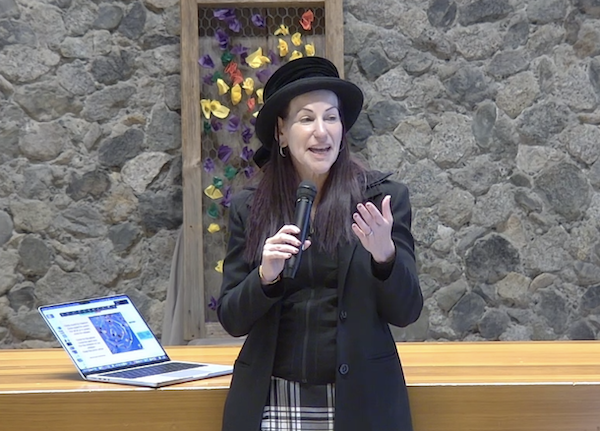
On May 26, Rabbi Dr. Laura Duhan Kaplan gave the public lecture From Conflict to Connection: Spiritual Community in Stressful Times at the annual conference of Vancouver School of Theology’s Inter-Religious Studies Program. (screenshot)

The Walking Together: Sharing the Work and Ideas That Call to Us conference, hosted by Vancouver School of Theology’s Inter-Religious Studies Program last month, included, as it always does, a public lecture. This year’s address was given on May 26 by Rabbi Dr. Laura Duhan Kaplan, dean of the ALEPH Ordination Program, the Jewish Renewal seminary; former director of inter-religious studies at VST; and rabbi emerita of Or Shalom Synagogue. Her topic was From Conflict to Connection: Spiritual Community in Stressful Times.

Duhan Kaplan began and ended her talk with Linda Hirschhorn’s “Circle Chant,” a song about peace, human rights, environmental and intergenerational stewardship. 

“If we are talking about the world, or the community, or the variety of communities as a circle,” she said, “let’s get real – it’s not a perfect circle. We are many different people doing many different things, overlapping, intersecting, sometimes clashing. That’s the kind of circle that we have, that we are working with when we try to make things whole.”

She shared a well-known quote from Rabbi Tarfon that is found in the Pirkei Avot, which she translated as Basic Aphorisms, rather than the more common Ethics of the Fathers. She read Tarfon’s adage about the day being short and the work plentiful and, while it is not up to us to finish the work, we’re not free to avoid it.

“What is the work?” the rabbi asked. “Here are some of the kinds of work that people at this conference are going to be talking about: work in climate, food security, interfaith, multicultural community, decolonization, indigenous learning, spiritual care, nonviolence, protest, arts, ritual, refugee support, theology.”

Based on the book Liquid Times: Living in an Age of Uncertainty by Zygmunt Bauman, Duhan Kaplan said we’re living in a globalized world that has not delivered on its promises of integration and freedom.

“In fact, globalization has become primarily the work of a small group of highly wealthy, highly influential people, and what it has brought almost everyone else is increasing income inequality, more displaced people, more incarcerated people, more environmental devastation, more elite criminality, more precarity (that is, precarious life), more anxiety,” said Duhan Kaplan, summarizing Bauman’s ideas.

She spoke about the politics of fear and polarization, which are enforced through segregation: neighbourhoods are increasingly monoethnic and an increased police presence keeps people out of certain places, she contended. “At the national level, in many countries, we have a closing of borders.”

Cities, spiritual communities and social service agencies are left to deal with these global problems, she said, giving an example from her work.

“Let’s say we have a conflict in a class between students and teacher. The students say there’s so much in our religious tradition that is racist. And it’s true…. But, when the students speak to the teacher about it, the teacher says, young adults today don’t respect their teachers the way they used to. And that’s true too,” she said.

Direct dialogue between the parties would be ideal, but “because of habits of polarization, people are saying, no, we don’t even want to talk about it.” Rather than encouraging communication, people have suggested excluding individuals who hold opposing viewpoints, she said. “But why would we do that? We’re a microcosm of the world. We want to be that crazy, misshapen circle, and we want to live together. Isn’t that an essential pastoral skill?”

Duhan Kaplan gave another example.

“Two students in the program are tasked with leading a prayer service together and they want to pray for peace, but one of them identifies themself as an antizionist and the other one identifies themself as a Zionist, and they don’t know how to pray together for the worldwide community of Jews. They’re just paralyzed. And so, they appeal to us, the administration, and they say, tell them they’re wrong. And we say, well, we don’t do that. How about we sit in a room with both of you?… But the students are reticent to do that because, in our larger environment, what is modeled is cutting people off rather than building a community of difference.”

Duhan Kaplan talked more of Bauman, who realized that living together in a multi-class, multi-ethnic place requires skill.

One necessary skill is “the ability to work through miscomprehension – when you say something and you mean something, and somebody else who sees the situation in an entirely different way thinks you meant the opposite,” the rabbi explained.

“We need the ability to persevere, to keep talking in order to work through these issues,” she said, but the current social environment shuts down these skills, and so we end up in a cycle that Bauman calls myxophobia.

“We start off with a fear of the unknown … and it takes skill to deal with that: inner strength, communal support, faith in the future,” she explained. “When we don’t have those things, our fear of the unknown searches for a target. Oh, if only that unknown thing were known or, worse, if only that unknown thing were removed.”

Limiting immigration might make people safer for a period, for example. But, when there are fewer new people in a person’s life, anyone new will seem even more scary, she said, and a person’s epistemic courage, courage to learn, diminishes.

To stop the cycle, we must question propaganda, and become skilled in hearing what is uncomfortable, she said, pointing to a couple of tendencies that make this hard, including “the hasty generalization fallacy.” This is when we make broad conclusions from a small piece of information, like judging every Iranian based on how you feel about your uncle from Iran, who you don’t like.

Generalizations help us protect ourselves, Duhan Kaplan acknowledged, “but we also have to realistically ask: Is this a situation in which I need to protect myself? What is at stake here? If we are not talking our immediate protection, then we can think critically.”

Another hurdle, she said, is the “false dichotomy, false bifurcation, the either-or fallacy … claiming that there are only two options when in fact there are many more. Like the students trying to figure out how to pray. Should we pray for the well-being of Israelis? Or should we pray for the well-being of Palestinians? We can’t do both because that’s too complicated. How will we work out the words? Of course, if you’re training to be a clergy person, it is your job to work out the words, and those skills will come, even if they haven’t come right now.”

Duhan Kaplan also discussed the “bandwagon effect,” which she described as “the 53 million people can’t be wrong fallacy. Oh, yes, they can.”

She has adopted a principle: “If everyone agrees on something, I say, wait a minute, isn’t there also another way to look at this? And there’s a mythical teaching in our tradition about the Sanhedrin, ancient Jewish court, when a death penalty case came before this jury of 70 judges. If there is a unanimous guilty verdict, the person is freed, because there couldn’t possibly have been a unanimous verdict without groupthink. And, when people’s lives are at stake, we don’t want groupthink. We want something nuanced, something we can work together on.”

The rabbi talked about how to listen: “What is the inner work that we do? We quiet the mind. And, to quiet the mind, that takes courage, because you have to say to yourself, I trust that I’m going to be able to understand what I’m hearing…. I trust I’m going to be able to respond.”

Listening, feeling what another person is feeling, hearing what’s important to them, might engender strong reactions, she warned. “Conflict resolution work, courageous work, meeting difference, solving problems, doesn’t always feel good … you might not be happy with what you learn about other people, you might not be happy with what you learn about yourself…. And, of all the points that I made tonight, that’s the one I want people to most take to heart: there’s nothing wrong with you if the work is hard.”

One of Duhan Kaplan’s strategies in this time of heightened anxiety is to recite the 13 Attributes of Compassion.

“Where these come from is in the Bible, when Moses is at Mount Sinai, and he says to God, show me your face, and God says, you can’t see my face, but you can see my after-effects…. What is my true essence? This is what is revealed: God, the ineffable one, compassion, tenderness, patience, forbearance, kindness, awareness. I’m carrying love for thousands of years; lifting guilt, letting go of mistakes; allowing freedom and a fresh start.

“Not immediately,” she said. “Takes time. In fact, the Bible says it might take four generations for all these processes to work through, but, the point is, when I find myself angry and constricted, I will pause and I will recite this mantra.”

Another thing Duhan Kaplan does, when she needs it, is “the Examen, the examination of consciousness,” as taught by St. Ignatius of Loyola (1491-1556), founder of the Jesuit order.

“You find as quiet a space as you can find,” she said. “You allow yourself to become aware of divine presence, whatever that means to you…. And then you review the day with gratitude … you pay attention to your emotions … just notice. And then choose one thing that’s on your heart and mind and pray in the way that you pray…. And then, at the end, you look toward tomorrow and you say whatever it is has come out of your reflection.”

In the Jewish tradition, she said, Aaron “is the consummate peacemaker” and one of his lessons for us is that, if we do the work of peacemaking, “some kinds of peace will come.”

She circled back to Rabbi Tarfon: “we don’t have that much time, there’s so much to do.… It’s not up to you to finish the work … but you have to do something.” 
Format ImagePosted on June 12, 2026June 10, 2026Author Cynthia RamsayCategories LocalTags conflict resolution, dialogue, globalization, inter-religious studies, Laura Duhan Kaplan, peace, spirituality, Vancouver School of Theology, VST
Refugee policy evolves

Refugee policy evolves

Rabbi Dan Moskovitz, left, and Dr. Harold Troper. (photo by David Berson)

The current refugee crisis – and Canada’s responses to past crises – was the topic of an interfaith panel recently, which raised issues especially relevant as Passover approaches.

Our Home and Native Land? A Multi-Faith Symposium on Refugee Settlement featured a keynote presentation by Dr. Harold Troper, co-author of None is Too Many: Canada and the Jews of Europe, 1933-1948. The event, on March 18, also included a panel discussion that featured Rabbi Dan Moskovitz of Temple Sholom. Catalina Parra brought a First Nations perspective, Imam Balal Khokhar spoke from a Muslim point of view and Rev. Dr. Richard Topping spoke as a Christian.

Troper recalled being part of a Canadian group that traveled to eastern Germany two decades ago, after the Berlin Wall fell. States in the east of the newly reunified Germany were seeing an upsurge in migration from countries further to the east. A group of Canadians was invited to listen and give advice on Canada’s experience integrating newcomers. At one point, a local official thanked Troper for his comments, but asked, “What do you do with your foreigners?”

Troper expounded on the concept of “new Canadians,” a formulation perhaps unknown in any other country, in which people arriving with the intent of making Canada their home are acknowledged not as foreigners or as migrants, but as people becoming part of our polyglot population already on a path to inclusion.

Of course, Troper acknowledged, this was not always so. None is Too Many, published in 1983, was a seminal book that has had lasting impacts on Canadian views of migration and refugees. The title comes from a quote from an anonymous Canadian immigration official who responded with these words to the question of how many post-Holocaust refugees to admit. The words have been attributed, in some tellings, to F.C. Blair, Canada’s then-director of immigration. However, while this is not provable, Blair’s actions were in line with the words.

Recounting this country’s exclusionary policies toward the desperate Jewish populations of Europe in the prewar period, but also a similar disregard after the war, the book has been held up as an object lesson in how not to respond to people in crisis. Troper said he didn’t know until years later the impact the book had had on one very significant episode in Canadian history.

In 1979, Troper and Abella sent an academic paper that preceded the book to Ron Atkey, Canada’s immigration minister. Atkey was a member of Joe Clark’s cabinet and, though that Progressive Conservative government lasted only nine months, it was during Clark’s term as prime minister that the decision was made to welcome 60,000 Vietnamese refugees, known as “boat people.” Troper said he found out later that the manuscript they sent played a role in the decision.

“We hope Canada will not be found wanting in this refugee crisis the way it was in the previous one,” the authors wrote in a note accompanying the manuscript. They expected no response and they received none. But, several years later, Troper said, Atkey told him that he had read it.

“He told us he was shocked and dismayed when he saw the political parallels between the Vietnamese and Jewish refugee crises,” Troper recalled. “Then and there, Atkey told us, he decided he was not going to go down as the F.C. Blair of the boat people.”

Already predisposed to encourage his cabinet colleagues to take a generous approach, the article stiffened his resolve to stand firm against ministers who disagreed. The government initiated a joint federal-private sponsorship program.

“It today serves as the prototype for Canada’s Syrian refugee program,” said Troper.

Now, as refugees are coming from North Africa, Asia and, most notably, the Middle East, fleeing civil war and ruin in Syria and Iraq, Troper sees parallels between the fears expressed now and those of seven decades ago.

“The fears are not only around the expenses of accommodating these refugees, but that the intake of a population of different race, religion and cultural assumptions and social expectations will destabilize destination countries,” he said.

Not dissimilar, he said, were fears that European Jews might bring socialism, communism, anarchism – even Nazism – with them.

“Foreshadowing the kind of anti-refugee arguments commonly heard today,” Troper said, “reports of persecution were dismissed as exaggerated if not bogus, fabrications designed to justify an end-run around Canadian immigration restrictions. And who were these refugees anyway? Were they really innocent victims? Surely they must have done something to turn their fellow citizens against them. Why make Europe’s problem our problem? And weren’t Jews in Canada already a pesky problem? Do we want more? And who’s to say that communists or even Nazis would not pose as refugees to infiltrate as subversives into Canada? Keeping Canada strong and united meant keeping Jews out.”

Another haunting parallel was the galvanizing photo of the 3-year-old Kurdish child who washed up on a Turkish beach and a photo Troper came across decades ago in his research for None is Too Many while going through archival boxes in the Toronto office of the Jewish Immigrant Aid Society. The boxes were filled with prewar letters from European Jewish parents who, knowing that entire families were unlikely to be granted admission to Canada, begged that their children might be taken in by a Canadian family. In each case, a terse response told the desperate parents that Canada was not admitting any Jews but that the request would be held on file in case something changed.

“Going through these files, I came across a letter that impacted me the way I imagine the photo of 3-year-old Alan Kurdi lying facedown in the sand of a Turkish beach impacted on all of us,” he said. “The letter was from a father begging for some shelter for his two daughters. A picture of two smiling children was attached. As I read this letter, my eyes began to tear; you see, I am also the father of two girls. At the time they were 3 and 5 years old. For a split moment, it was as if I was that desperate father, his children were my children and his fears were my fears.”

As part of the panel that followed, Moskovitz spoke of the bread of affliction.

“How inappropriate it might seem to hold up a matzah when we sit around a seder table filled with food, and to think that we are supposed to connect with this when we have so much,” the rabbi told the Independent after the event. “The point is to remind us that there was a time in our lives when we didn’t have so much.

“Each of the faith traditions,” he said, “spoke about that lens of empathy, of remembering historically that we once ate the bread of affliction, that we once didn’t have much and so we have to share with those who do.”

Religious perspectives are critical in this discussion, he added.

“Left to our own devices, society will often do what they think is in [their] own immediate best interest, which is often isolationism – we’re seeing that in the U.S. elections today – and fear of the other,” he said. “The role of religion is to compel us to do what is morally right and good, what is spiritually elevated, what is holy. It’s a religious foundation that is compelling us to love the stranger, because our political reality, especially in the wake of the terrorist attack in Brussels, is telling us to fear the stranger.”

For Jews, he said, the plight of refugees is not a momentary news story.

“This is not just a headline that has come and gone,” said Moskovitz. “Our Passover Haggadah makes it a headline for Jews every year, that we are reminded to see the world through the lens of a refugee every single year. It’s the most observed Jewish holiday in the Jewish calendar – that says something about how important the status of a refugee is in Jewish tradition.”

The multi-faith symposium was organized by the Inter-Religious Studies program at Vancouver School of Theology and facilitated by Rabbi Laura Duhan Kaplan, the program’s director.

Format ImagePosted on April 15, 2016April 13, 2016Author Pat JohnsonCategories LocalTags Atkey, Haggadah, Holocaust, inter-religious studies, interfaith, Passover, refugees, Syria, Troper, Vietnam, VST
Proudly powered by WordPress