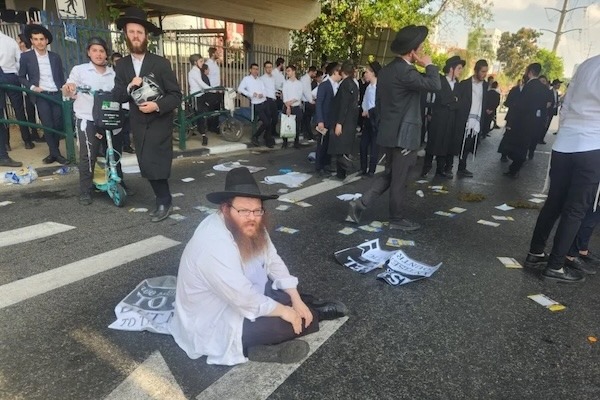

Haredi demonstrators protesting the arrest of draft-dodgers block traffic in Bnei Brak on June 17. (photo by Eitan Elhadez-Barak/TPS-IL)
When I celebrated my bar mitzvah in Toronto in 1968 by reading parshat Shelach Lecha about the 12 spies Moses sent to scope out Canaan, my hometown was flooded with US draft-dodgers who had crossed from Buffalo, NY, to Fort Erie, Ont., to avoid being shipped off to Vietnam. As documented in John Hagan’s 2001 book Northern Passage, for those 50,000 Americans, Canada was the promised land of freedom. Most remained in Toronto, Montreal and Vancouver even after Jan. 21, 1977, when President Jimmy Carter granted an unconditional amnesty to the young men who refused to fight in the Vietnam War.
Two things were furthest from my mind when I was 13 – that I should ever heed the age-old urging of Joshua bin Nun and Caleb ben Yefuneh to make aliyah, and that another flood of draft dodgers would arise in my new homeland.
Nearly daily this summer, clashes have taken place between Israel Police and some of the 80,000 Haredi men aged 18-24 who refuse to report to
Israel Defence Forces induction centres. Highways and tram routes are routinely blocked, causing massive traffic jams. In a riot on June 3, scores of ultra-Orthodox protesters stormed the home of Supreme Court Deputy President Noam Sohlberg and his wife Meira in Alon Shvut, a town in Gush Etzion, south of Jerusalem. Sixty-two Torah students were arrested. Four were indicted on charges of rioting and trespassing with intent to commit an offence. According to the indictment, the rioters threw stones at the villa and tried to break in while the judge and his wife were at home; the rioters chanted slogans like “Nazi” and carried Israeli flags with the Star of David replaced by a swastika.
Police subsequently transferred 19 of those arrested into IDF custody after ascertaining they were draft dodgers. This triggered a new wave of violent protests outside Neve Tzedek Military Prison in the IDF’s Gur base, near the city of Kfar Yona.
As I write this article, the IDF is being crippled by a labour shortage. After three years of conflict in Gaza, Lebanon, Yemen and Iran, reservists are carrying an impossible burden. The number of soldiers wounded or incapacitated by post-traumatic stress disorder is staggering. Suicide among the ranks is soaring. Even as soldiers have reached their breaking point, the yeshiva study halls are packed with those who have illegally ignored their call-up notice.
One needs some historical background to understand how Israel arrived at this situation.
Dov Yosef, the Montreal-born military commander of Jerusalem when the city was besieged by the Jordanian and Egyptian armies, wrote in his memoirs, The Faithful City, of a meeting in May 1948 with Rabbi Mordechai Weingarten and other Haredi leaders. The rabbis urged Yosef to surrender to avoid further hardship for civilians. Yosef responded, you do what you please and I’ll do what I wish, to which the rabbis asked, and what is it your excellency wishes to do? Yosef responded: to shoot deserters.
Indeed, Haredim participated in the War of Independence. Notably, Rabbi Shmuel Tukachinsky, a son of Haredi leader Yechiel Michel Tukachinsky, was killed by Arab Legion shellfire while fighting for Jerusalem in 1948.
As Israel absorbed more than one million Holocaust survivors and Jews from Arab lands, the labour shortage was somewhat alleviated. Thus, on Oct. 20, 1952, David Ben-Gurion, the founding prime minister of the Jewish state, held a meeting in the Haredi city of Bnei Barak with Rabbi Avraham Yeshayahu Karelitz (1878-1953). Known as the Chazon Ish, the Belarussia-born sage was one of the Jewish world’s foremost Haredi leaders. Settling in Mandate Palestine in 1933, he held no official post yet was a global address for guidance in Jewish law. While Ben-Gurion was a socialist and atheist, he had a deep if nostalgic sympathy for the lost world of the Eastern European shtetl he had left nearly half a century earlier.
A blog from the National Library of Israel’s The Librarians magazine (blog.nli.org.il) explains what happened, beginning with an entry from Ben-Gurion’s diary: “This morning I went to Bnei Brak for a meeting with the Chazon Ish…. I asked him the question to which I have yet to receive a sufficient answer from my observant friends. We are divided in different ways; in the matter at hand, we are divided by our views of religious tradition. There are Jews like you and like me, how do we live together? How will we become a unit?”
The Chazon Ish cited the talmudic parable (Sanhedrin 32b) about two camels traveling down a narrow path, one carrying a large burden and the other carrying nothing. The rabbi explained that the unburdened camel was to make way for the one carrying the burden. The Chazon Ish said the ultra-Orthodox community bears the burden of the Torah and its commandments; therefore, the non-religious Zionists must defer to them and move out of the way. Ben-Gurion replied: “And what of the absorption of immigrants? What of security? What of establishing the state? Are these not burdens?”
Though Ben-Gurion acknowledged the importance of Torah study, he wanted the ultra-Orthodox to become integrated with the modern state being forged. The Chazon Ish was appalled at what he saw as the desecration of the Sabbath and the Zionist rejection of the yoke of the commandments – a burden shared by every practising religious Jew. He believed that recreating the world of Torah that was annihilated in the Holocaust was the only way to save the Jewish people.
After that October 1952 meeting, the Prime Minister’s Office issued the following statement: “PM D. Ben-Gurion met privately with Rabbi A. Y. Karelitz (the Chazon Ish) in Bnei Brak yesterday. The purpose of the visit was to exchange general views regarding the following issue: How can observant and non-observant (Jews) live together harmoniously in the state of Israel? The question of recruiting women (to the army) was not discussed, and the visit had no relation to current political matters.”
According to the blog, “Contrary to the report, the meeting was much more than a ‘general exchange of views.’ The prime minister made a gesture towards the ultra-Orthodox community by agreeing to continue the exemption of a limited number of Torah scholars from military service. As early as February 1948, before the state of Israel had even been formally established, a limited number of young ultra-Orthodox men were exempted from being drafted into the armed forces, which were already fighting in what would come to be known as Israel’s War of Independence. On Jan. 9, 1951, the prime minister ordered the Israeli army’s chief of staff to exempt yeshiva students from regular service. Ben-Gurion’s meeting with the Chazon Ish did not set the ground for the current ultra-Orthodox exemption from military service, but it did give the controversial early arrangement a substantial political boost and, equally significant – symbolic support.”
When Ben-Gurion called for army exemptions for the 400 yeshiva students in 1949, he could not have known the number would grow to 80,000 by 2026, triggering resentment among their fellow citizens. Nor could he have envisioned that the detainment of even a token number of draft dodgers would set off rioting in the country’s Haredi enclaves.
The Haredi refusal to help relieve the burden of defence has resulted in the attorney-general and the courts reducing the financial benefits that ultra-Orthodox formerly received. In April, the High Court of Justice ordered the state to take concrete steps to revoke key financial benefits from draft dodgers and to move toward criminal enforcement against Haredi men who evade military service. In mid-July, the government’s subsidized national housing program restricted participation in the real estate lottery to those with IDF discharge papers.
A moment of truth is approaching with the Oct. 27 election. If Naftali Bennett forms a centrist coalition, his new government could revoke all benefits for draft dodgers. Short of jail time for 80,000 draft dodgers, these steps could include not issuing passports, driver’s licences and other government documents to those over the age of 18 who don’t have an IDF release form.
Gil Zohar is a journalist and tour guide who lives in Jerusalem.