
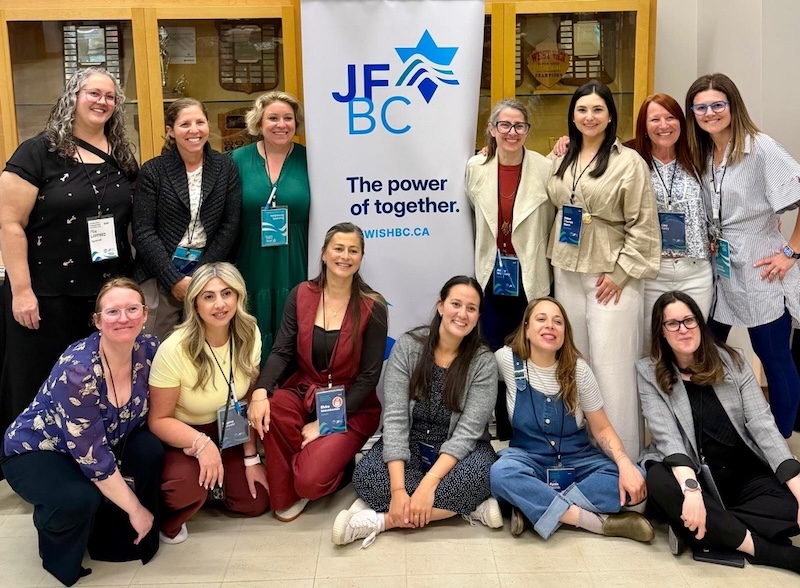

Jewish Federation of British Columbia Community Connectors and others from around the province. (photo from JFBC)
At its June 22 annual general meeting, the Jewish Federation of Greater Vancouver officially launched its new identity as the Jewish Federation of British Columbia (JFBC).
The legal name change was approved at last year’s AGM, becoming legally official a few months later. However, it was only soft-launched at the recent Whistler Engagement Summit (May 29-31) and publicly rolled out this week.
“In becoming a provincial federation, JFBC now represents the largest geographic region of any of the 140 Jewish federations in North America, reflecting both the scale of British Columbia and the organization’s commitment to serving communities across the province,” reads the press release.
“This moment arrives as Jewish communities everywhere face a substantial rise in antisemitism, heightened security concerns and increasing social fragmentation,” it continues.
“In a moment where distance could easily become disconnection, we are choosing something different,” Ezra Shanken, Federation’s chief executive officer, told the Jewish Independent. “We are choosing to build a network of communities that see themselves as part of a shared whole, where responsibility does not stop at the edge of a city or region, and where no one is left to navigate this moment alone. When people begin to understand that they are not isolated but connected, something shifts. Commitment deepens, relationships strengthen and resilience becomes something we build together, not something any one community carries on its own.”
“Over the past few years, the Federation has steadily expanded its engagement across the province, reaching nearly 9,000 community members this past year alone,” said Mijal Ben-Dori, chief planning officer of JFBC, in an email interview with the Independent. “This growth has been driven by three key initiatives: expanding our team of Community Connectors from a single individual to a robust team of 11; supporting regional supplementary schools through Chabad; and investing in local hubs like Burquest and the White Rock/South Surrey JCC. Our provincial work does not begin with our new name; rather, the name change reflects a reality we have already built.
“This transition is entirely additive,” she said. “At the Federation, we know that our local community’s success relies on the robust network of organizations working day in and day out – including the JCC, JFS, JSA, Hillel, VHEC, the Jewish Museum and Archives, and the Vancouver Jewish Film Festival, to name just a few. We are wholeheartedly committed to supporting this network and ensuring it remains vibrant and thriving.”
The expansion has been possible because of a strategic partnership with the Ronald S. Roadburg Foundation, “which is deeply committed to supporting thriving Jewish life in smaller communities across Canada,” said Ben-Dori. “Moving forward, our focus is on building capacity throughout the province. By leveraging our collective network, regional communities can access expertise and resources more cost-effectively, moving toward self-sustainability without diverting vital Vancouver-raised funds.”
Initially, the primary shift will be in how support is delivered, she said. “Rather than coordinating remotely with a program manager based in Vancouver, community members will now have a direct link to their local Community Connector. This localized approach ensures our team is deeply connected to the ground, allowing us to provide more responsive, personalized and relevant support.”
Currently, there are 11 connectors, who reside in 10 communities, with additional volunteers in additional communities that work closely with Federation, said Ben-Dori. “Our connectors are based in Victoria (two), Salt Spring Island, Comox Valley, Whistler, Squamish, Delta, South Surrey/White Rock, Tri-Cities/Burnaby, Langley, Kelowna. Each of the connectors serves the adjacent communities as well. For example, our connector in Kelowna serves the entire Okanagan and beyond, and our connector in Langley services Abbotsford, Chilliwack, Hope, etc. We also have very strong lay leaders who lead communities in Prince George, Revelstoke, Kamloops, Nanoose Bay and others.”
The long-term vision is for the regional communities to become self-sustainable.
“Research consistently demonstrates that true resilience is built from within, rather than through prolonged dependency; strong communities are those equipped to meet their own evolving needs,” said Ben-Dori. “By plugging into our broader network, regional communities can significantly lower their operational costs through shared resources, collective expertise and ongoing grant opportunities. Ultimately, our goal is to help build local capacity from the ground up. We are fully committed to providing the training, mentorship and foundational support necessary to pave the way toward that independent future.”
Federation has already integrated more regional voices into its various committees, as well as its board of directors.
“Regarding our operational model, we believe that local leadership and community members know their unique needs best,” Ben-Dori said. “We are not here to dictate identity or leadership styles; we deeply respect local autonomy. True community sustainability is built from the ground up, allowing each region to develop its own distinct character, culture and governance. Communities will always remain independent entities with full decision-making authority.
“While our Community Connectors are always available to provide guidance and support, there are natural operational boundaries,” she added. “Connectors cannot facilitate events, nor can the Federation’s name or resources be lent to initiatives that fall outside our charitable mandate or diverge from our core organization values. However, local communities retain full independence to host and fund these distinct events on their own.”
According to Ben-Dori, JFBC employs approximately 50 people (full and part time) and has an operational budget of more than $30 million, which includes the Jewish Community Foundation of Greater Vancouver, all grants, allocations, flowthroughs, etc.
“We are now in the process of figuring out the exact back-office support required,” she said of the anticipated staffing and annual financial requirements for the provincial organization. “It is in flux because we are currently introducing various systems to Federation in general that would create organizational efficiency. In principle, we are looking at an admin position and a manager position to support the 11 connectors (all are already in place). The total operational budget for our work at the regions is approximately $1 million. We have been working with the same budget for the past two years and do not expect to increase the budget in the year ahead or as a result of the change. If anything, we are hoping to find more back-office support efficiencies.”
Regarding how the success of the expansion will be measured, Ben-Dori said, “We will evaluate the success and growth of our regional communities through several key quantitative and qualitative metrics:
“Community engagement: we will track the number of local events and gatherings relative to community size, alongside the depth of the local volunteer base.
“Leadership and governance: we will look for indicators of sustainable leadership, including individuals stepping into leadership roles, participation in our training programs and the formal establishment of local boards or committees.
“Resource development: we will assess financial capacity, measuring a community’s ability to conduct local fundraising or generate independent revenue streams.
“Network integration: we will monitor how deeply a community plugs into the broader ecosystem by tracking metrics such as youth participation in summer camps and Israel travel, the mobilization of local community security volunteers, and regional members joining the boards of other organizations across our network.
“Qualitative impact: finally, we will measure the deeper, qualitative shifts within these communities, specifically looking for an increased sense of community resilience and Jewish identity.”
The overarching benefit of this provincial model, said Ben-Dori, “is the profound strengthening of Jewish identity, the enrichment of community life and the cementing of a vibrant Jewish presence across the province for generations to come.”
The main risks associated with the expansion are financial sustainability and navigating the centre-periphery power dynamic, she said.
“This initiative is currently made possible through the strategic and generous support of the Ronald S. Roadburg Foundation. However, relying heavily on a single funding source presents long-term vulnerabilities,” she explained. “Our strategic priority is to develop localized capacity as efficiently as possible to diversify and secure our financial baseline.”
About the possible struggles that can develop between an urban centre and smaller regional hubs, even when local independence is explicitly prioritized, Ben-Dori said, “Balancing central support with local autonomy is a continuous, collective learning process. We are committed to maintaining deep self-awareness and open, ongoing dialogue among all partners to successfully navigate this relationship.”
And what happens when a larger urban centre starts working more closely with a smaller urban centre? One of the yet-to-be-determined aspects of the Jewish Federation of Greater Vancouver’s evolution into the Jewish Federation of British Columbia is its impacts on the Jewish Federation of Victoria and Vancouver Island, the only other federation in British Columbia.
“Because a standalone federation requires a critical mass of residents to sustain a fundraising model, fund local agencies, cover operational overhead and maintain a consistent pipeline of volunteer leadership, this institutional model has historically only been viable in BC’s two largest Jewish centres,” explained Ben-Dori. “Vancouver holds a population of roughly 24,000, Victoria stands at 6,000, and Kelowna follows at just under 2,000.
“Over the past few years,” she said, “our two federations have actively deepened our collaboration on key priorities, including community security and advocacy. Last year, we partnered to launch two Community Connectors based directly in Victoria. Today, with Victoria’s Jewish population growing at an incredible rate of 67% – making it the fastest-growing Jewish community in the country – both organizations are actively redefining our relationship. We are focused on designing a new structure that maximizes cost efficiency while delivering the most effective support possible to this rapidly expanding community.”
More about the Federation can be found at jewishbc.ca.



