Canada’s new Combatting Hate Act, which has just come into force, says many of the right things. The question is whether anyone in the justice system will act on them.
The passage of Bill C-9 into law creates a distinct hate-motivated crime offence, defines hatred in the Criminal Code and prohibits intentionally intimidating or obstructing people trying to enter places of worship, schools, community centres, cultural facilities and other spaces used by identifiable groups. It also makes it an offence to wilfully promote hatred through the public display of symbols principally associated with listed terrorist organizations, as well as specified Nazi symbols. The legislation removes the former defence based on good-faith expression of a religious opinion in certain hate-propaganda cases.
The law does not ban peaceful protest, political advocacy, religious teaching, disagreement or criticism. Its threshold remains high: expression must amount to the wilful promotion of hatred, which the Criminal Code now defines as an intense and extreme emotion associated with vilification and detestation. Merely offending, humiliating or discrediting someone is not enough.
Despite claims of threats to free expression, Canadians remain free to criticize governments, religions, ideologies and political movements. The law will (theoretically) intervene when protest becomes intimidation or when access to a synagogue or community centre is deliberately obstructed.
Of course, Canada already had laws against assault, threats, arson, vandalism, criminal harassment, intimidation and hate propaganda. Hatred was already an aggravating factor at sentencing. Yet, Jewish Canadians have watched an alarming procession of apparently serious incidents produce no charges, no convictions, no outcomes that reflect the gravity of the conduct.
In October 2023, in Montreal, Adil Charkaoui led a public prayer asking God to count the “enemies of the people of Gaza,” exterminate them and spare none. Prosecutors concluded that the evidence could not prove beyond a reasonable doubt that the words constituted incitement to hatred against an identifiable group. No charges were laid.
In Ontario, Waisuddin Akbari was convicted after threatening to plant bombs in every Toronto synagogue and kill as many Jews as possible. In July 2025, he received 60 days of house arrest, followed by probation and a weapons prohibition. The judge rejected a discharge, but a sentence served at home for threats of mass murder against Jewish worshippers hardly communicates the full force of public denunciation.
Here in Vancouver, more than two years ago, an unidentified attacker poured accelerant at the entrance of Vancouver’s Schara Tzedeck Synagogue and set it on fire. Police released surveillance footage, but no suspect has publicly been identified or charged. The inability to identify an offender is not the same as prosecutorial reluctance, of course, but, for the targeted community, the practical result is identical: an attack occurred and nobody was held accountable.
These cases reveal different failures at different stages. Police may not recognize the significance of antisemitic language or symbolism. Investigators may lack the resources or specialized knowledge required to build a case. Prosecutors may decide that the high legal threshold or limited prospect of conviction makes proceeding unwise. Courts may convict but impose nominal sentences.
As we have said before in this space, passing a law does not close any of these gaps.
Police officers need training in the legislation and more broadly in the contemporary forms antisemitism (and its sister scourge antizionism) takes, including violence-inciting slogans like “from the river to the sea” and “globalize the intifada.” Crown prosecutors need the expertise and institutional will and support to bring difficult cases forward. Attorneys general must provide timely consent where the Criminal Code requires it. Judges must apply the law in ways that recognize not only harm to an individual victim, but the broader intimidation inflicted on an entire community.
The Combatting Hate Act may help. A distinct hate-crime offence could make motivation central to a prosecution rather than an afterthought at sentencing. The access provisions respond directly to the intimidation that has increasingly surrounded synagogues, Jewish schools and community gatherings, and neighbourhoods with a higher proportion of Jewish residents. Clearer statutory language may also give police and prosecutors more confidence about where lawful protest ends and criminal conduct begins.
Still, legislation is mere paper until institutions give it life.
That said, laws do have a purpose beyond prosecution. They express the moral judgment of society. At a time when antisemitism and antizionism have become louder, more extreme, more brazen and more socially tolerated, Parliament has drawn a line.
That imprimatur is significant in itself. Enforcement will determine whether the Combatting Hate Act becomes an effective instrument or another unfulfilled promise. But, even before the first prosecution, the law sends a necessary message: hatred is not acceptable, intimidation is not activism and Canadians should not have to run a gauntlet of hostility and danger to worship, study, gather or just go about daily life in this country.
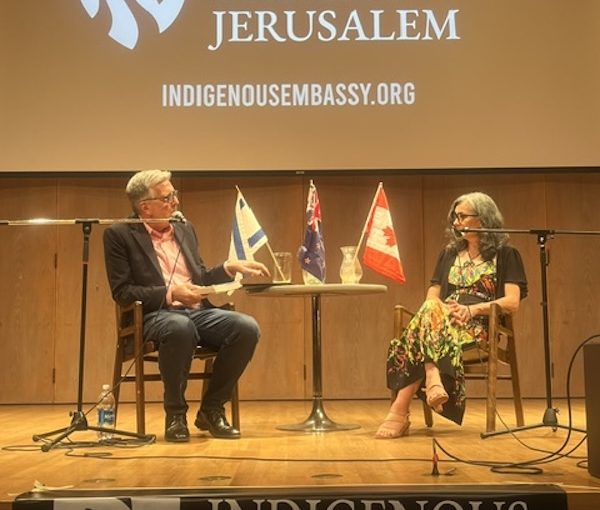
Pat Johnson and Dr. Sheree Trotter at the University of Victoria on June 14, hosted by the Jewish Federation of Victoria and Vancouver Island. (photo by Janet Dirks)
“What we’ve seen happen in New Zealand with our indigenous movement is that Palestine has been held up as a way to fight against what’s happening in our country with our indigenous people,” New Zealand writer and academic Dr. Sheree Trotter told those gathered at the University of Victoria on June 14.
“So, what we do is that we identify with the Palestinians and we see them as brown, oppressed indigenous people; we see Israel as the Western foreign colonizers.” In this context, she said, the antizionist argument is reduced to one of settler colonialism, despite the differing histories of places like New Zealand, Canada and Palestine.
At the Victoria event, which was hosted by the Jewish Federation of Victoria and Vancouver Island, Trotter, who is of Te Arawa iwi origin, spoke on the topic Indigeneity and Zionism Versus Settler Colonialism.
“Each of these topics could be a whole university course,” Trotter acknowledged at the outset. Before talking about Zionism, she explained its standard definition: the right of self-determination and statehood for Jews in their ancestral homeland, the land of Israel.
Trotter said there have been several streams of thought that have led to the current antizionist movement, including the views of the Nazis, who saw Jews as conspiratorial subversives, and Soviet antizionism, which depicted Zionism as a global and racist conspiracy. Added to the mix, Trotter said, are Arab nationalist and Islamic movements and, more recently, Western settler-colonial theory.
Settler colonialism, Trotter said, is an ideology that has developed within academia as a particular kind of colonialism. The key feature of it is an imperial power that has sent its people to a foreign land to settle permanently.
“In this way, you create this binary that you’ve got two classes of people. You may call it the oppressor and the oppressed, the colonizer or the colonized, these sorts of ideas. This binary erases complexity. It’s not accurate. It’s not true to history,” Trotter said.
Using the example of the Māori in New Zealand, Trotter explained some of the problems in the settler-colonialist argument.
“There’s no room for nuance or complexity, no room for indigenous agency – the fact that, in my case, Māori embraced many of the new things that came, new technologies, modernity, certainly literacy,” she said. “In embracing Christianity, Māori turned away from tribal warfare, from cannibalism, from slavery, because they adopted a new way of thinking. Under settler colonialism, you don’t get to hear any of the good things that might have happened. It’s all just labeled as oppression and bad.”
More broadly, she argued, the settler-colonialist theory does not fully consider that many of the people who arrived in places like Canada and New Zealand were poor immigrants who do not fit the settler-colonialist power paradigm.
Regarding Israel, the settler-colonial standpoint is a tremendous stretch, said Trotter, because Jews, with more than 3,500 years of continuous connection to the land, are not foreign to Israel.
“In Māori thinking, we have a concept called ahikā, which means keeping the fires burning. If a tribe wanted to keep their connection to a piece of land, it would keep a fire on that land. It’s symbolic of the idea that somebody stayed on the land, even in small numbers,” she said. “Now, we’re finding the fact that there’s always been a Jewish presence in the land. Even though very small at times, they’ve kept ahikā, they’ve kept the fires burning, they’ve kept a continuous connection.”
Trotter is the co-founder, with former member of New Zealand’s House of Representatives Alfred Ngaro, of the Indigenous Embassy Jerusalem and the Indigenous Coalition for Israel, nonprofits established to provide representation in Jerusalem forindigenous peoples from around the world. Her latest book, Zionism at the Ends of the Earth: A Story of Humanitarianism and Identity, chronicles the social history of the Zionist movements in New Zealand to 1948.
Following her talk, Trotter sat down for an interview and to answer audience questions with journalist Pat Johnson, a member of the Jewish Independent editorial board and founder of Upstanders Canada, an organization working to encourage non-Jewish Canadians to take a stand against antisemitism and antizionism.
The event attracted some protest. According to organizers, the technician who was scheduled to work that evening walked off the job before the event started because of their objection to the subject matter. And, in the middle of Trotter’s talk, a few members of the Jewish Faculty Network of Vancouver Island held up signs rejecting claims of Jewish indigeneity in the Middle East and protesting Israel’s military actions; the group was escorted out of the auditorium without incident.
Sam Margolis has written for the Globe and Mail, the National Post, UPI and MSNBC.
On May 17, Tafsik Organization and Stop Antizionism hosted a full-day World Symposium Against Antizionism. With justifiable pride, the organizers declared that this was the first conference in the world specifically dedicated to combating antizionism. Keynote speaker was Ben Shapiro, co-founder of The Daily Wire, along with Gad Saad, Eve Barlow, Leora Shemesh and a packed A-list of inspiring Jewish leaders from around the world.
The fire of Jew-hatred has been ravaging the Jewish community across our country, and elsewhere, and absolutely every option must be considered to put it out. At the same time, I wonder, What if this conference had been organized around the topic of Zionism, where these same speakers focused on all the many visions, projects and ways that Jews everywhere could support the cause of Zionism?
Whether you identify more with Zionism, Jewish peoplehood, Israel or Judaism, if we really want to declare war on antizionism and antisemitism, I think it is by embracing everything that makes us proud to be Jewish and to live Jewishly. For every action each of us takes to combat antisemitism/antizionism, imagine the impact if we also did an equal action that deepens our Jewish identity. Consider it a one-to-one combating antisemitism, promoting Zionism challenge.
As Canadian Jews, we have endured longstanding discrimination. Many of us remain vigilant, knowing our lives will be shaped by the latest surge of“protesters” in Jewish neighbourhoods, or by flash mobs of such protesters at Toronto subway stations or at public forums like Phillips Square in Montreal. where effigies were hung.
When, in Vancouver, someone sets fire to the entrance of Schara Tzedeck Synagogue and the Jewish Federation of BC reports that 62% of Jewish community members have experienced at least one antisemitic incident, wearing Jewish symbols in public is an act of pride and defiance against any of our fellow Canadians who secretly, or openly, hate us for being Jews.
Even before Oct. 7, 2023, B’nai Brith recorded that, in Canada, in 2021, for the sixth consecutive year, records were set for antisemitic incidents in the country, reaching 2,799 that year. In their recently released 2025 Annual Audit of Antisemitic Incidents, B’nai Brith found there were 6,800 incidents of antisemitism documented that year.
Zach Bodner, chief executive officer of the Palo Alto Jewish community centre and the head of the Zionism 3.0 movement, declares: “We have to stop pretending that anti-antisemitism will keep Judaism alive for the next generation…. We have to stop believing that fighting against antizionism will keep our kids loving Israel.”
Rabbi David Hartman, in his 1982 essay “Auschwitz or Sinai?” challenges us to examine if we will live our Judaism shaped by trauma, persecution and hatred, or if will we be shaped by covenant, responsibility and moral purpose. “It was not Hitler who brought us back to Zion, but rather belief in the eternal validity of the Sinai covenant,” he wrote.
Recently, as a simple test, I went to the Jewish Independent archives and clicked on the antisemitism tag, I found 45 pages of articles. When I went to the Zionism tag, I found only four, but the tag for Israel had 111 pages, while antizionism/anti-Zionism had three pages of results combined.
I then decided to compare the number of articles published in 2026 between the antisemitism and Israel tags. I found about 30 articles in the former and roughly 25 in the latter. Of those 25 Israel stories published in 2026, at least four dealt with antisemitism and included that tag search as well. Of the 21 remaining Israel articles, most could be construed as some form of cultural connection, solidarity with or interest in Israel, more than enough to classify as Zionism.
While close in number, so far in 2026, antisemitism stories are outpacing stories about Israel and/or Zionism. I have no doubt this same test could be used with any other Canadian Jewish publication, with similar findings.
I’m sure we can agree that there is so much more we can do to inspire ourselves and pass the torch from Sinai to our future generations, rather than allow so much of our creative and intellectual drive and energy to be focused on those who hate us.
We are living in the aftermath of 1948, the year when we Jews finally transformed the seemingly impossible dream of reestablishing statehood into reality. We have a strong North American Jewish community and representative organizations that make us an undeniable political force.
With these resources that were unimaginable to previous generations of Jews, we have new goals to set, new visions to dream, new swamps to drain, new heights to achieve – as Jews.
So, I ask every one of you reading this: What inspires you about being Jewish? What about Judaism, Zionism or Israel inspires you? What leads you to live a Jewish life and gives you strength during tough times? What drives you to be the best Jew you want to be?
For every statement, action, rally or event you attend where you roar with defiance against our haters, please take a moment to express why you are the Jew you are; how you live Jewishly; and why you are proudly part of the Jewish nation. Your words, your ideas, your vision can and will inspire many others.
Alan Hermanhas lived in Israel twice, including when attending Ben-Gurion University, where he completed his master’s degree in Middle Eastern studies. He participated in the Quebec-Israel Committee’s parliamentary program in Montreal, and organized many Israel and Zionism related events as a co-chair for the Toronto chapter of the Canadian Institute for Jewish Research from 2013 to 2025. He is a proud member of the board of Upstanders Canada.
The Canadian Museum for Human Rights’ planned exhibit Palestine Uprooted: Nakba Past and Present, set to open in June, is cause for concern. While what will be in the exhibit remains to be seen and is likely not yet finally determined, the very announcement that the exhibit will happen sends out wrong signals.
What are the boundaries of Palestine? There are a wide variety of proposals, as well as significant differences in the historical territory once called Palestine. Whatever those boundaries are, Palestine is land, not people. Contrary to what the title of the exhibit suggests, the land was not uprooted; it is still there.
The reference to land instead of people is a commonplace of antizionism. The PLO is called the Palestine Liberation Organization, not the Palestinian Liberation Organization. Pervasive antizionist pamphlets, posters, placards and signs say “Free Palestine,” not “Free Palestinians.”
For antizionists, this reference to land and not people is deliberate. For antizionists, the land that is now Israel is or should be Arab, Muslim land. That a Jewish state exists on that land means to them, bizarre as it may seem, that the land itself is not free.
Let’s suppose that the museum was not aware of this connotation and what they really meant to write was “Palestinians uprooted.” One question that arises is “Why only Palestinians?” There were more Jewish refugees from Arab countries and Iran created by the refusal of Arab and Muslim states to recognize the existence of Israel and the consequent wars against Israel than Arabs who left Israel during and after the 1948 Arab invasion. An exhibit that addresses the woes of only one side of an armed conflict is patently unbalanced.
Also what was the catastrophe? The text of the announcement of the exhibit states “Palestinians use the word ‘Nakba’ … to describe their forced displacement in 1948.” Some Palestinians indeed use the word in that way. Others use the word to refer to the creation of the state of Israel. For still others, albeit a minority, the catastrophe was the 1948 Arab invasion of Israel and the rejection of the United Nations peace plan, which would have created an Arab state alongside Israel.
Some of those who since 1968 have self-identified as Palestinians were forcibly displaced during the 1948 war. Others fled the crossfire, as the text of the museum announcement of the exhibit acknowledges. Others still left voluntarily, with organized Arab assistance, heeding the calls of Arab leadership to get out of the way of the Arab invasion so that the invaders could target Jews living in Israel without risk of harming Arabs, a reality that the announcement of the exhibit does not mention.
Who are the Palestinians? Does the term include all those present in the territory of former British Mandate Palestine at least two years prior to the time of the 1948 Arab invasion of Israel and who left during that invasion and their descendants, as the United Nations Relief and Works Agency now does? Or, is it limited to “those persons who acquired or had the right to acquire Palestinian nationality as of 6 August 1924” and their descendants, the PLO proposal of 2012 for Palestinian citizenship?
The text of the museum announcement states that the exhibit would explore “the human rights violations related to the ongoing forced displacement and dispossession of Palestinians.” The immediate violation of those rights after the 1948 Israeli-Arab war was the refusal to allow those who left Israel because of the war to be locally integrated into the neighbouring Arab states to which they had gone, an integration for which UNRWA was created to facilitate. The states of arrival have kept those who left in a permanent pseudo-refugee status, intended as a permanent indictment of the creation of the state of Israel. Will the museum exhibit explore that?
Antizionists, not least Hamas, have engineered a wide variety of human rights violations and atrocities against the Arab population of Israel who left Israel and their descendants in order to shift blame to Israel for the purpose of discrediting its existence. Is the museum exhibit going to explore that?
The suffering of Palestinians is plain to see. The antizionist attacks on the existence of Israel have caused suffering for both Palestinians and Jews. In its exhibition, the museum must show awareness of the antizionist efforts to engineer and manipulate the victimization of Palestinians to discredit the existence of Israel. If the museum were to say nothing about that engineering and manipulation, it would discredit itself.
David Matasis a Winnipeg lawyer and senior honorary counsel to B’nai Brith Canada. He was a member of the original content advisory committee for the museum. Noemi Gal-Oris an international lawyer based in Vancouver.
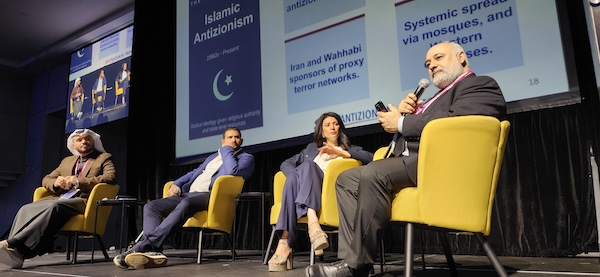
At the first World Symposium Against Antizionism, left to right: Jacob Smith, Eyal Jacoby, Nick Matau and Anastasia Zorchinsky. (photo by Dave Gordon)
The first World Symposium Against Antizionism took place on May 17 in Toronto, with some 30 speakers, from educators and lawyers to influencers and politicians and other activists in the pro-Israel space.
Ben Shapiro, an American pundit and broadcaster, told the thousand people gathered that “antizionism is evil, it is wrong, it is predicated on lies, and it requires violence to achieve the ends it seeks.”
The first World Symposium Against Antizionism took place on May 17 in Toronto, with some 30 speakers, including Ben Shapiro. (photo by Dave Gordon)
He said, “Antizionism argues that the Jewish state of Israel, a thing that … exists in the world today and has 10 million citizens, some two million of them Muslim, another 200,000 Christians, should be destroyed; that Israel ought to be treated unlike any other country, because Israel is somehow uniquely evil.
“Now, in order to make that case, antizionists must lie…. The antizionists must claim that Israel is an apartheid state, despite the citizenship of two million Arab Israelis…. The antizionist must lie that Israel discriminates against Christians and Muslims, despite it being the only state in the Middle East that provides the highest level of rights to both.”
He added: “the people who argue that Israel ought to be eliminated are antisemitic, for whatever that’s worth. They believe that Israel ought to be destroyed and, to accomplish that purpose, they lie incessantly, and then they spread the biggest lie of all – that global Jewry has bamboozled the population, taken over the institutions and used its magic mind lasers to control the world.”
The symposium was produced by Tafsik Organization and Stop Antizionism.
Syrian-born Rawan Osman, who has a large following with her online advocacy, shared the stage with fellow Arabs United Arab Emirates-based Loay Alshareef and Damascus-born Abraham Hamra, who lives in New York.
Years ago, before befriending Jews in France, she said she was “one of Hezbollah’s biggest fans,” someone who “hated the Israelis, the Zionists and the Jews, and I repeat the three terms because, in the Arab world, we do not make a distinction between the three.”
Growing up in Lebanon, Osman saw the “bombardment” of indoctrination against Jews. That same hatred has been spread in the West, she told the Independent. Her “red line” for engagement is anyone who “justifies or denies Oct. 7.”
“Because they are so deeply indoctrinated that they cannot summon any sympathy for the Israelis, including children …I will not go that close, and I’ll let others fight them,” she explained. “I would rather focus on something else. The same way I think many Jews would not have a conversation with someone who denies the Holocaust, especially if they are descendants of Holocaust survivors.”
She drew a sharp contrast with Abraham Accord countries, like UAE, where their culture has “taught children to tolerate others, to be accepting. You, as a Jew, are safer wearing a kippah walking in Dubai and Abu Dhabi than you are in Paris and in London,” she said.
Left to right: Loay Alshareef, Abraham Hamra, Rawan Osman and Ali Siadatan. (photo by Dave Gordon)
Lebanon-born Gad Saad, a former professor at Concordia University and author of Parasitic Mind and Suicidal Empathy, argued that antisemitism “in a sinister way, is akin to the immune system, and that it so evolves into new variants of Jew-hatred.” In modernity, that means Jews are blamed for open borders that let in rapists, profiting from the COVID vaccine, and even poisoning the minds of sharks, he said.
Toronto lawyer Leora Shemesh shared the stage with American law experts Matthew Schweber, Rona Kaufman and Mark Goldfeder (via Zoom). Shemesh noted that certain small groups in the country have been attempting to mainstream antizionism. “We have an entire political party, the NDP, that ran on a platform of being antizionist,”said Shemesh. “A Jewish guy, Avi Lewis, ran on that platform, and he joined forces with Independent Jewish Voices of Canada, and they have attempted, and have been somewhat successful, to intervene in certain cases.”
Montreal-based Anastasia Zorchinsky, a Concordia Student Union councilor and co-founder of StartUp Nation Montreal, an Israeli organization at Concordia and McGill universities, moderated the panel called NXT GEN: Future Advocates.
“We really try to do lots of events that collaborate between different cultures, so I think the first step is really to take that step to reach out to those other communities,” she told the JI of her organization’s educational initiatives. “If we just approach people with the thought, with the optimism, that, yes, they will accept us or, maybe, they don’t have to agree, but we can still talk, then maybe that’s something that we should keep in mind.”
Dave Gordonis a Toronto-based freelance writer whose work has appeared in more than 100 publications around the world. His website is davegordonwrites.com.
I am graduating and, somehow, my school, the University of British Columbia, feels more isolating than ever. This campus prides itself on the ideas of critical thinking and open dialogue. But, right now, it feels like neither is being practised. Instead, I see a culture where misinformation about Israel and the Jewish people spreads easily, where hateful slogans replace dialogue and where Jewish students are intimidated and harassed for expressing their Zionism and connection to Israel as an integral part of their Jewish identity. More than that, it feels like expressing these views comes with a social cost – one that many students quietly calculate before deciding whether it is even worth speaking at all.
I’m a Jewish student at UBC. And I’m done pretending this is normal.
Universities are supposed to be spaces where ideas are tested, challenged and debated openly. My four years at UBC have shown me that certain perspectives are treated as inherently unacceptable before the conversation even begins. If freedom means anything, it must include viewpoints that fall outside dominant campus narratives, including Zionist perspectives.
The role of campus groups and student politics cannot be ignored. UBC Staff for Palestine and the way BDS (boycott, divestment and sanction from Israel) is promoted within spaces like the Alma Mater Society elections are not just frustrating. They reflect a campus environment where hateful and discriminatory movements and campaigns are tolerated and normalized.
While BDS is framed as a progressive, justice-oriented movement, it seeks to end Israel’s existence and strip away Jewish rights to self-determination. If BDS were to achieve its political goals, Israeli Jews would either be killed, ethnically cleansed or forced to live as an oppressed minority. According to an official BDS handbook, campus divestment is merely a “stepping-stone” to larger-scale boycotts and other measures aimed at ending Israel’s existence. This hateful and destructive movement is experienced by most Jewish students as contributing to an environment that marginalizes and endangers the campus community.
At its core, this is where the disconnect becomes impossible to ignore. A movement presented as advancing human rights dismisses the legitimacy of a Jewish homeland altogether. When that position becomes the norm on campus without any serious scrutiny, it is not political activism but the legitimization of hate and exclusion.
It is also worth asking why this issue dominates student political spaces in the first place. In a world full of ongoing conflicts and humanitarian crises, Israel is consistently singled out in student government discourse with false and misleading accusations. It does not feel like a coincidence or a legitimate concern for human rights, but rather a pattern of disproportionate focus that shapes how we are perceived and treated on this campus.
These narratives often leave no room for nuance. There is no space to acknowledge complexity, no willingness to engage with perspectives that don’t fit a predetermined frame, and no recognition that calling for the dismantling of a Jewish homeland has real implications for Jewish students on this campus. BDS, for instance, actively tries to shut down Israeli-Palestinian cooperation and dialogue.
You cannot claim to advocate for justice while erasing the legitimacy of other people’s existence. And yet, that contradiction is increasingly accepted here at UBC.
Students like me are excluded from conversations that directly affect them. Discussions about our own homeland often unfold without any Zionist Jewish perspective present. And, many of us are hesitant to speak up, not because we lack arguments, but because we know how quickly disagreement is shut down or mischaracterized.
And there is one final point that cannot be ignored.
The rhetoric and imagery that have surfaced within anti-Israel activism on this campus go far beyond political critique and cross into something far more disturbing. Slogans, symbols and messaging that frame violence as “resistance” or elevate martyrdom are not abstract ideas. For Jewish students, they are not theoretical – they are deeply personal, and they create a real and growing sense of fear for our safety on campus.
When violence is normalized or even implicitly justified, it sends a message about whose lives are seen as expendable. That is not activism. That is not justice. And it has no place at a university that claims to value safety, inclusion and critical thought. UBC cannot continue to ignore this.
What kind of campus we are willing to accept? One where certain students feel unsafe, unheard and pushed to the margins, or one where difficult conversations happen without crossing the line into dehumanization? Right now, we are closer to the former.
A university should not act as an ideological gatekeeper. Its role is not to decide which perspectives are acceptable, but to ensure that all students can participate in good faith without fear of exclusion or intimidation.
UBC, it’s time to wake up.
Avigail Feldman is a fourth-year student at the University of British Columbia, completing a bachelor’s in political science, and set to begin a master of management. She is also a StandWithUs Canada Emerson Fellow.
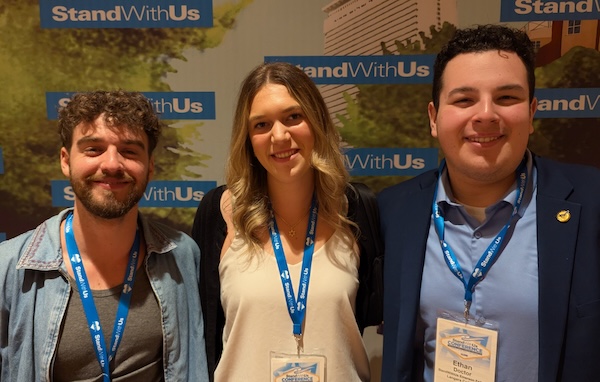
BC students at the StandWithUs conference in Las Vegas March 15-18 included, left to right, Adar Latak, Alexis Moscovitz and Ethan Doctor. (photo by Pat Johnson)
What happens in Las Vegas doesn’t stay in Vegas. That was the defiant message from Roz Rothstein, the chief executive officer and co-founder of StandWithUs, as she welcomed about 1,000 Jewish and pro-Israel high school and college students, alumni, activists and assorted allies to the organization’s conference in the Nevada city, March 15 to 18. They assembled to become more informed and empowered, to return to their campuses and communities to advance the fight against antisemitism and antizionism.
Among the delegates were about 100 Canadians, including 15 BC students, as well as Vancouverite Zara Nybo, StandWithUs Canada’s campus and high school manager for Western Canada.
StandWithUs, a pro-Israel advocacy and education organization, provides leadership training and educational programs to students at hundreds of schools, as well as operating many other initiatives, including legal supports for Jewish and pro-Israel individuals and groups.
Among the BC students were four Leventhal high school interns and 10 Emerson fellows, who are part of the organization’s college and university track, Nybo said.
Students are selected based on demonstrated leadership in pro-Israel activism. They attend two immersive educational international conferences like the Vegas meeting during their year of service and are required to initiate several Israel-related programs in their communities or on campus.
Delegates heard from a roster of noted speakers in plenary sessions and more intimate, often hands-on breakout sessions.
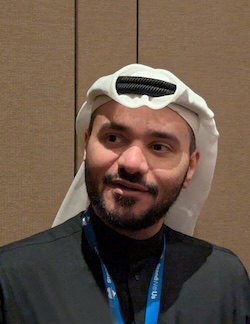
The intensive morning to late-night schedule included speakers like New York Times columnist Bret Stephens; singer, dancer and online influencer Montana Tucker; sociologist David Hirsh, who is head of the London Centre for the Study of Contemporary Antisemitism; Loay Alshareef, a Saudi-born activist who advocates for normalization with Israel; Luai Ahmed, a Yemeni-Swedish journalist; Oct. 7 survivors, including Omer Shem Tov, who was held hostage for 505 days; and scores of others.
New York Times columnist Bret Stephens (photo by Pat Johnson)
Stephens, the New York Times columnist, spoke of the revolutionary impact the potential fall of the Iranian regime could have on regional and global affairs but also warned of unintended consequences.
“Regime change is not at all easy,” he said. “There are all kinds of imponderables.”
The state could spiral into chaos and even more bloody and brutal repression than the government has already brought down on anti-regime protesters, he said.
“I do think there is, in fact, quite a plausible scenario [of regime change] – not now, not during this war, but in six months or a year – if [it’s] a militarily crippled and humiliated regime that is still under sanctions, still cannot pay its bills, cannot pay its civil servants, cannot pay its soldiers,” said Stephens.
Iranian street activists, he said, need to “kick this regime when it’s down.”
“If anyone can do it, 90 million Iranians, 88% of whom, at least, despise the regime and had the courage to come out and cheer when the late ayatollah was killed … I think that that creates conditions in which I can see it happen,” he said.
Ahmed spoke of his ideological and physical journey from being an antisemitic young man in Yemen to a new life in Sweden advancing coexistence with Jews.
“It is our duty as reformist Arab Muslims to stand with our Israeli and Iranian brothers and sisters to reject radical Islam, to fight radical Islam,” he said. “It is our duty to fight the terrorists who occupied my country, who believe that firing ballistic missiles at Jews is more important than feeding the starving population of Yemen.
“Radical Islam occupied Iran, Yemen, Lebanon, Gaza,” he said. “Radical Islam married my mother off at the age of 8. Radical Islam is our problem and, today, I stand here as a Yemeni who was taught to hate Jews. And I’m telling you something that radical Islamists fear the most: Jews and Israel are not our enemies.”
Alshareef shared a similar transformation.
“I used to be hardcore antizionist,” he said. “I used to be deeply antisemitic. In my local mosque, I repeated after my imams, ‘Death to Israel, death to Jews, death to Zionists,’ without ever having met a Jew or a Zionist before. Today, thank God, I no longer believe in that cancerous ideology that not only impacts the Jewish community, but it also impacts my community as well.… A society that learns to hate Jews more than loving our own children is not a healthy society.”
Loay Alshareef, a Saudi-born activist who advocates for normalization with Israel. (photo by Pat Johnson)
After Oct. 7, 2023, Alshareef decided to visit Israel.
“I learned that the Jewish community and Israelis were desperate for peace, that the vast majority of Jews and Israelis do not want war with us,” he said. “They want peace, and they are very desperate for this peace. That is something that no one had ever told me until I went to Israel myself to see the truth. I then took it upon myself to try to hammer this newfound truth to my friends and family members. And, since then, I’ve been creating content, sharing the hidden truths about Israelis and Jews that my society either dismisses or is completely unaware of.”
Students shared their experiences with antisemitism and bias from teachers, administrators and fellow students. A high school student explained how he helped get an ahistoric and antisemitic handout removed from his school’s curriculum – it had gone unchallenged since 1998. In plenaries and breakouts, individuals shared personal experiences of harassment, discrimination and loss of friendships.
StandWithUs does not only educate but also uses the law to seek fair outcomes in cases of discrimination.
The conference heard from Yael Lerman, founding director of Saidoff Law, a legal arm of StandWithUs, which includes a team of attorneys backed by a network of hundreds of pro bono lawyers and law firms.
“Imagine being a Jewish student in a high school where there are very few other Jewish kids,” Lerman said. “Day after day, classmates taunt you. They call you ‘dirty Jew’ and ‘Zio,’ they send antisemitic messages. Sometimes, they shove you or punch you. You never know when the next message or the next attack is coming. The school knows about it. Nothing changes. Then you reach out to StandWithUs Saidoff Law. Our attorneys step in. We represent you, we fight for you, and we win. We secure a transfer to a new school, and the original school must pay for it for the rest of your time in high school.”
No student should ever face antisemitism alone, Lerman said.
“Since Oct. 7, we’ve seen a dramatic rise in legal complaints, not only on campuses, but across everyday community spaces,” she continued.
“Recently, one man went to pick up a clothing order at a store where he had been a loyal customer for several years. The clerk looked at his kippa and muttered, ‘You Jews think you can get everything you want.’
“Later that day, he received an email telling him he was banned from the store and the entire chain. So, he reported the incident to StandWithUs. Our lawyer filed a complaint with the appropriate government agency and negotiated a settlement. The store had to lift the ban and compensate him. That is what accountability looks like,” said Lerman.
The conference heard diverse emotional testimonies.
Shem Tov shared the harrowing story of dancing at the Nova festival and, minutes later, being thrown in the back of a pickup truck and transported across the border into Gaza, beginning a nightmarish ordeal of 505 days of being shuttled between locations and then confined in underground labyrinths. For 50 consecutive days, at one point, he was held in complete darkness in a cell where he could not stand up.
“They used to abuse me physically and mentally,” he said of his captors. “There wasn’t any human interaction, I would say.”
Shem Tov was held in near-starvation even as he saw piled boxes of United Nations-supplied rations.
His captors once took him to a house above a tunnel that had been rigged with explosives and told him he would be forced to trigger an explosive blast when Israeli soldiers entered the boobytrapped structure. When they threatened to kill him if he refused, Shem Tov told them they could shoot him, but he would not do it.
After Shem Tov’s presentation, hundreds of students rushed to the front of the hall, surrounding the former hostage and dancing ecstatically as music blared and massive screens declared: “We are dancing again.”
The executive director of StandWithUs Australia, Michael Gencher, led a memorial for the 15 victims murdered during a Hanukkah celebration at Bondi Beach last Dec. 14.
Sami Steigmann, a child survivor of the Holocaust, spoke of the series of flukes and strokes of luck that saved his life.
In addition to Canada and all regions of the United States, student delegations came from Europe, Latin America and Australia. Due to war-related airspace closures, only two delegates were able to travel from Israel for the event.
BC delegates spoke to the Independent about their experiences.
Adar Latak, a University of Victoria psychology student in his final year, said he gained confidence at the conference and made important connections.
“You’re meeting Jews from around the world, and that’s beautiful,” he said. “It’s easy to get brought down by everything, and coming here really lifts your spirits. You’re with other Jews, you’re all facing the same thing, and you’re all talking about it, and you’re giving each other advice and tips, and it is really just a beautiful thing.”
Alexis Moscovitz, a second-year physical and health education student, also at the University of Victoria, echoed Latak’s sense of community.
“Obviously, everybody has different experiences, but it’s all basically the same,” she said. “We’re all fighting antisemitism on our campuses and so, having a support system, amazing staff here, it’s just amazing to be able to be with people that you know are experiencing the same things.”
Vancouverite Ethan Doctor, a Langara College student, has faced threats on campus, including being followed and intimidated by a group of masked and keffiyeh-clad activists. His experience as an Emerson Fellow helped him navigate the college bureaucracy, seeking appropriate security and prevention steps.
“If it wasn’t for organizations like StandWithUs, I wouldn’t know how to properly deal with it and wouldn’t know the proper steps to take,” said Doctor. “I am just eternally grateful to organizations like this.”
Michael Dickson, executive director of StandWithUs Israel, left, speaks with Omer Shem Tov, who was held hostage in Gaza for 505 days. (photo by Pat Johnson)
Jesse Primerano, executive director of StandWithUs Canada, told the Independent his group’s role is to help young pro-Israel activists, but also people of all ages, find their voices.
“In many cases, they don’t feel comfortable with the facts, to engage with people who are coming at them very aggressively,” he said. “So, our job is to help them understand the facts and how to communicate them to people who disagree.”
Earlier, Primerano briefed the convention on the state of affairs in Canada.
“We look back on times [of] the Holocaust, and I think what we said for many generations was that, as long as our government didn’t turn on us, we would be safe in the countries that we live,” he said. “And, you know, since Oct. 7, antisemitism has become emboldened in a way in Canada that it feels like our politicians know the only way to stay in office is to take an anti-Israel position.
“So, we’ve seen our mayor of Toronto be unwilling to come to an Oct. 7 vigil, unwilling to come to an Israeli flag-raising,” Primerano continued. “Our prime minister in Canada said that he would arrest Bibi [Israel’s Prime Minister Binyamin Netanyahu] should he come to Canada. He put an arms embargo on Israel and, most importantly, as I’m sure many of you are aware, he rewarded Hamas with support for the establishment of a Palestinian state.
“That type of rhetoric and action from our government has spilled into the streets because it has emboldened those who are willing to take shots at the Jewish community. And I mean that both literally and figuratively. Just [days earlier] in Toronto, we had three synagogues that were shot overnight in four days,” he said.
StandWithUs partners with many different groups, Primerano said, but because they work extensively with university students, some people might wonder how they fit with agencies like Hillel.
“Hillel is, in many ways, the voice on campus,” he said. “They are the coordinators of Jewish life. Their goal and their work and their ultimate obligation is to bring Jewish students and their allies together. Our job is, once those students are together, to help supplement the work that Hillel is doing with Israel education, with helping awareness towards antisemitism. Hillel has a wide array of responsibilities that go far beyond just advocacy. Our job is to supplement their work, to work with them as a partner and bring our resources into their space while they bring the students here to meet our resources.”
At the Vegas conference, StandWithUs unveiled SWUBOT, a free, downloadable artificial intelligence tool providing at-the-fingertips information on Israel, antisemitism and activism.
StandWithUs was marking 25 years since Rothstein founded the group with her husband, Jerry Rothstein, who is the organization’s chief operating officer, and Esther Renzer, who is the president.
We are failing in a battle we cannot afford to lose. Canadians and the world are trying, unsuccessfully, to control the spread of misinformation and disinformation at the source, policing online platforms, flagging content and regulating perpetrators.
This “supply-side” approach is fundamentally flawed. Information today moves too fast, too freely and too globally to ever be contained. Controlling what is produced is a losing battle. Our main hope is to vaccinate consumers of information against the pandemic of lies.
In recent issues, the Independent has reported on steps being taken by the provincial and federal governments to police boundaries (for example, provincial legislation that would create “bubble zones” around religious institutions) and strengthening hate crime laws (the federal government’s Bill C-9). These are deeply necessary and well-intentioned steps.
They are also like plugging a collapsing dike.
In the immediate term, we need to police speech that is hateful and potentially violent. In the longer term, we need to educate citizens to differentiate between truth and lies so they are less susceptible to bigoted ideas and misinformation.
B’nai Brith Canada has launched a national digital literacy campaign that is timely and necessary. (Click here for story.) Even this initiative, though, should go further. Digital literacy alone is not enough. Canadians – and people everywhere – require a much broader foundation in critical thinking and media consumption. They need to know not just how to use digital tools, but how to question and critique all manner of information: how to evaluate sources, how to distinguish fact from fiction, commentary from reporting, propaganda from legitimate information.
If individuals are equipped to interrogate what they see – if they instinctively ask, “Who created this? Why? What evidence supports it? What motivations might the creator have beyond informing me?” – then misinformation loses some of its power. It stops spreading, not because it has been removed, but because it has been assessed and rejected by its targets.
Importantly, this is not just about young people, though teaching students these skills early is essential. Misinformation does not discriminate by age, and neither should our response. In many cases, older generations, who did not grow up in a digital environment, are even more susceptible.
The world is experiencing a tsunami of information. Everything – everything – depends on the ability of each of us to navigate these surging waters. If people cannot tell what is real, they cannot make informed decisions or vote responsibly. If they cannot distinguish truth from manipulation, democracy itself erodes.
This is especially relevant right now to Jewish Canadians, who are deeply concerned by surging antisemitism and antizionism. We are wringing our hands over how to successfully confront this crisis. If we can train people to identify misinformation, propaganda and assorted falsehoods and conspiracies, the Jew-hatred problem may not entirely resolve itself. Those steps would, however, almost certainly be the most effective and enduring contemporary response to an ancient and enduring bigotry.
A society that can think critically is a society that is less easily misled. And, in today’s world, that may be the most important skill of all.
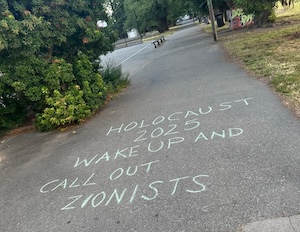
The Douglas Park area is being covered with hateful chalk and stickers. (photo by Joshua)
A residential pocket near Vancouver’s Oak Street corridor has become the site of an increasingly bitter battle over political messaging, public space and antisemitism. At the centre of it is one Jewish resident who says his neighbourhood – and his sense of safety – has been upended by a neighbour’s anti-Israel graffiti campaign.
Joshua, who asked that his surname be omitted, said one particular individual began tearing down hostage posters shortly after the Oct. 7, 2023, attacks. The same individual was filmed tearing posters down in front of a group of community members outside Schara Tzedeck before a commemorative event a year after 10/7.
The Vancouver Police Department’s diversity unit initially advised Joshua to stop putting up pro-Israel or hostage posters and allow the city to “neutralize” the space to de-escalate tensions. He complied for several months, he said, but anti-Israel messages only intensified. He has been in discussions with police since last June; he worries that the situation will escalate as the weather improves.
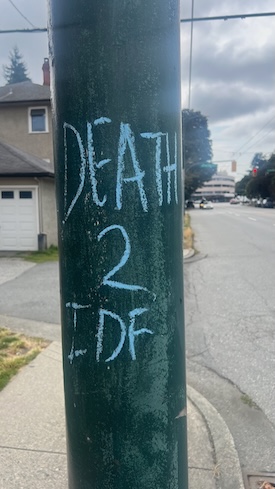
Over the past six to seven months, chalked and adhesive messages have appeared across sidewalks, utility boxes, crosswalk placards and construction signage. (photo by Joshua)
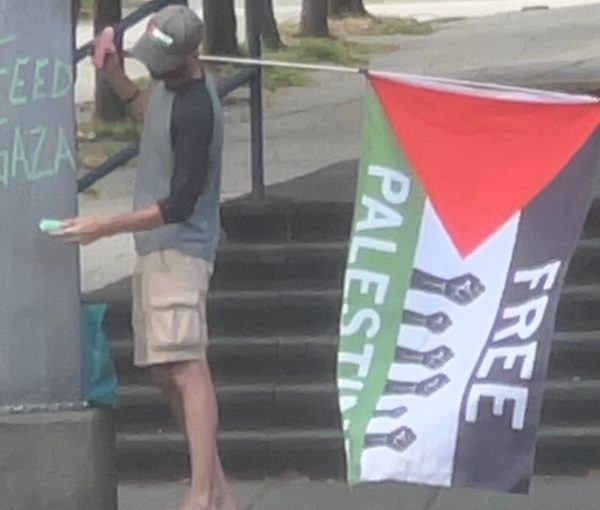
The same individual has become a near-constant presence in the area, waving a Palestinian flag at busy intersections such as Oak and 12th, usually at rush hour and sometimes for hours at a time. According to Joshua, who admits he has done his share of flag-waving as a regular participant at City Hall rallies for Israeli hostages, the anti-Israel activism has gone far beyond flag-waving.
Over the past six to seven months, chalked and adhesive messages have appeared across sidewalks, utility boxes, crosswalk placards and construction signage. While some read “Gaza” or “Free Gaza,” the messaging has grown more aggressive, including “Zionism is terrorism” and “Death to the IDF,” sometimes accompanied by an inverted triangle associated with Hamas imagery and implying terrorist targets.
The most recent messaging, Joshua said, is “Stop Israel Sadistic Cult” and equating the US Immigration and Customs Enforcement (ICE) with Israel – “ICErael.”
Joshua said he has documented the activity extensively, as well as the antisemitic rhetoric on the individual’s social media, and filed numerous 311 complaints with the City of Vancouver. If graffiti appears on city property, the city contracts a third-party removal company. But response times range from 48 hours to more than a week – sometimes longer, Joshua said. In one park, spray-painted slogans remained for more than three weeks before being removed.
Because chalk is temporary and easily reapplied, the individual can rewrite messages almost as soon as they are washed away.
Frustrated by what he sees as municipal inaction on targeted harassment and hate speech, Joshua has purchased an 11-litre backpack sprayer and walks the neighbourhood with water and scrub brushes to remove the chalk.
According to Joshua, the individual leaving the messages has “doxed” at least six area residents, sharing their personal information online, including their images and their licence plates. He posted Joshua’s first and last names and the cross street where he lives, with the comment, “Be sure to say hi and other things if you see him.”
Someone wrote Joshua’s full name on a public sign along with the words “IOF soldier” – IOF meaning “Israeli Occupying Forces” – and he has been accused online and in person of serving in the IDF, which he has not. In one incident, a woman confronted and filmed him at 7 a.m., shouting accusations and telling him, “We know where you live” and calling him an “IOF baby-killer.”
Joshua reported that encounter, as well as the doxing incidents, to police. Officers took a statement but indicated their options were limited, citing freedom of expression, Joshua told the Independent.
Meanwhile, the impact on the neighbourhood is tangible. A local rabbi told him that one Jewish family moved away because their children felt unsafe seeing hostile messages near their home and synagogue.
Joshua has removed his name from his building directory out of concern for his family’s safety. Confrontations and cleanup efforts are framed online as attempts by “Zionists” to silence dissent.
Within the Jewish community, there is debate about how to respond. Some have suggested stopping cleanup efforts in hopes that broader community frustration will grow. Joshua believes a coordinated, multi-block volunteer cleanup effort – involving Jews and non-Jews – is the only way to demonstrate that the issue is about shared civic space, not a private feud. He has set up an online group at facebook.com/groups/cleaningupdouglaspark.
Because chalk is temporary and easily reapplied, the individual can rewrite messages almost as soon as they are washed away. (photo by Joshua)
Residents should not have to navigate obscenities and hostile rhetoric on sidewalks and parks, said Joshua, and he questions whether the city would respond differently if racist or homophobic messages appeared in neighbourhoods with significant populations of the targeted communities.
This sort of conflict, in different permutations, is taking place in cities across Canada and worldwide. In Toronto, anti-Israel protesters have routinely set up demonstrations in areas with concentrations of Jewish residents and even marched through residential areas. Many Jews and their allies have repeatedly asked why there do not seem to be consequences for perpetrators of such deliberate harassment and intimidation.
That question was the subject of a Feb. 10 webinar with legal and policing experts, organized by the Centre for Israel and Jewish Affairs, titled Why Can’t There Be More Consequences?, which was moderated by Richard Marceau, CIJA’s senior vice-president and general counsel.
Mark Sandler, the chair of the Alliance of Canadians Combatting Antisemitism, and Rochelle Direnfeld, that organization’s senior criminal counsel, have been delivering educational modules to police, making them aware of tools they have to enforce existing laws. Training for prosecutors is also necessary, Sandler noted.
Law enforcement and justice officials need to be able to recognize antisemitism and how it manifests, said Sandler.
Direnfeld provided examples, noting that average police officers cannot, for example, be expected to understand a sign that appeared at one rally: it read “Israel’s only friend is the Gharqad tree.” This is a reference to a Muslim religious verse about the only tree that would protect Jews from Muslims at the end-times.
Even the nuances of more seemingly straightforward messages – “From the river to the sea,” “Globalize the intifada” and “By any means necessary” – may not be immediately evident to those who are not engaged with the narrative, panelists said.
Sandler said police have been asking for sharper tools and the federal government is responding with Bill C-9. (See jewishindependent.ca/new-bill-targets-hate-crimes.) Panelists noted that existing laws against mischief, intimidation and unlawful assembly should suffice in cases where protesters are blocking roads or crowding into shopping malls.
Hank Idsinga, a retired inspector with the Toronto Police Service, said insufficient staffing can be used as an excuse for inaction, but this is not an appropriate response. “Police need to be prepared for various scenarios,” he said.
On the other hand, said Joseph Neuberger, chair of the Canadian Jewish Law Association, Jewish community members need to know what is and is not acceptable within the bounds of the law. Chanting allegations of genocide is protected speech, he said, whether or not the allegations are false.
Neuberger is enthusiastic about components of C-9 that would criminalize intimidation around and obstruction of cultural and religious spaces. The bill is in committee stage.
As a political science student at the University of British Columbia, I believe fiercely in free expression, open debate and intellectual diversity. I have defended the idea that universities should be places where ideas are rigorously challenged, interrogated and tested against competing visions of the world. But debating controversial ideas is not the same as giving a platform to only one side. It’s not the same as presenting individuals whose speech crosses the line into hate and dehumanization.
Universities are not neutral stages without consequence. They are institutions that make choices, and those choices carry weight. The people a university decides to platform is never incidental. It is a statement of values. It shapes the tone of campus discourse. It sends a message about whose voices are elevated and whose concerns are dismissed. And, in moments of deep political tension, it can determine whether students feel genuinely safe, respected and included, or alienated in their own community.
It is because of these reasons that I am deeply concerned that UBC decided to include Hasan Piker in its America First, America Alone? lecture series.
The Phil Lind Initiative claims to explore global politics in an age of uncertainty. That is an important and timely goal. But the credibility of such a series depends on the seriousness and integrity of its speakers. When a university invites someone whose public commentary has repeatedly included inflammatory, dehumanizing or violent remarks, it undermines the very academic rigour it claims to promote.
US Democratic Congressman Ritchie Torres warned about the amplification of antisemitism on Twitch and specifically in reference to Piker: “Since October 7th, there has been an explosion of Jew-hatred on social media platforms,” Torres wrote. “Hasan Piker has emerged as the poster child for the post-October 7th outbreak of antisemitismin America.”
This is not about disagreement. Universities should host controversial thinkers. They should invite people whose views make us uncomfortable. But there is a difference between complex ideological debate and rhetoric that outright promotes violence, questions the suffering of victims and/or uses language that dehumanizes and endangers entire communities, including marginalized groups.
Piker is not merely a “polarizing” internet personality. He has built a brand around extremist commentary, from justifying 9/11 to repeated attacks on Israel and Zionism that go beyond policy criticism to attacking Jewish identity and calling for the destruction of Israel.
He has compared Zionism to Nazism, a comparison that is as morally distorted as it is historically indefensible. This kind of talk isn’t political critique, it’s erasure. Piker takes Zionism, a movement rooted in Jewish survival and self-determination, and distorts it into the Nazis’ attempt to annihilate us. These are not accidental slips of the tongue. They reflect a consistent pattern of language that crosses from criticism into dehumanization.
Piker has been temporarily suspended from Twitch multiple times for violating community guidelines related to hateful or abusive speech. That matters. Even if someone wants to defend his right to speak, we can’t pretend his public record reflects thoughtful, careful debate.
His style is built on provocation – on pushing buttons and escalating outrage – because that’s the business model of social media. The louder and more inflammatory the take, the more clicks, the more engagement, the more money. Academic spaces are supposed to prioritize nuance, depth and serious inquiry, not viral moments designed to generate cash and controversy.
For Jewish students on UBC’s campus, this isn’t some abstract political theory debate. Since Oct. 7, 2023, campus has felt different. Heavier. As antisemitism and openly hostile rhetoric have increased, many of us feel more exposed than we did before. I know I do. It has changed how openly we express our identity, how we participate in class discussions and how comfortable we feel in spaces that once felt safe. Friendships have been strained. Conversations are more tense.
So, when the university invites a speaker who has compared Zionism to Nazism, brushes aside concerns about antisemitism and treats Jewish self-determination as inherently illegitimate, it is difficult to believe this is simply about “intellectual curiosity.” It does not feel neutral. It feels dismissive. It feels like our fears and lived experiences are being minimized. More than anything, it feels like no one is listening.
UBC often speaks about inclusion, safety and belonging. Those commitments are not tested when we invite speakers everyone agrees with. They are tested when we decide whether “academic freedom” should be used as a shield for rhetoric that alienates vulnerable students.
To be clear: academic freedom protects speech from censorship, but it does not obligate a university to amplify any individual voice. Universities curate speakers all the time. They reject invitations. They choose who represents them.
Some will argue that silencing controversial figures sets a dangerous precedent. I agree that censorship is not the answer. But accountability is not censorship. Standards are not censorship. Students have every right to question whether this invitation reflects the kind of discourse a serious institution should highlight.
At the least, UBC has a responsibility to ensure ideological balance in the series. But where are the scholars who defend liberal democracy from the populist left and right? Where are the voices that articulate the Jewish experience of antisemitism in progressive spaces? Where is the intellectual diversity that the series claims to value?
Universities should be raising the nuance of conversation, not bringing the loudest parts of internet culture into serious academic spaces. Piker already has millions of followers. He did not need UBC to amplify him. The real question is whether our university’s stage should have been used to legitimize Piker’s approach – I don’t think it should have been.
As students, we deserve better.
We deserve debate that is rigorous, not reactionary. We deserve speakers who challenge our ideas without dehumanizing entire communities in the process. We deserve administrators who understand that inclusion cannot be selective.
Inclusion cannot mean protecting some students while asking others to tolerate hostility in the name of “dialogue.” If UBC is serious about equity, then protecting Jewish students from being dehumanized should not be controversial. It should be common practice.
If views like Piker’s were directed at almost any other marginalized group, there would have been immediate outrage, with statements, listening sessions and other institutional responses. There would have been no confusion about whether they crossed a line. So why was it different when it came to Jewish students?
UBC’s brand is built on excellence, inclusion and global leadership. Excellence requires discernment. Inclusion requires sensitivity. Leadership requires moral clarity.
The decision to host Hasan Piker fell short on all three values.
Avigail Feldman is a fourth-year student at the University of British Columbia, with a bachelor’s in political science and going into a master’s of management. She is also a StandWithUs Canada Emerson Fellow.