Skip to content
  • Home
  • Subscribe / donate
  • Events calendar
  • News
    • Local
    • National
    • Israel
    • World
    • עניין בחדשות
      A roundup of news in Canada and further afield, in Hebrew.
  • Opinion
    • From the JI
    • Op-Ed
  • Arts & Culture
    • Performing Arts
    • Music
    • Books
    • Visual Arts
    • TV & Film
  • Life
    • Celebrating the Holidays
    • Travel
    • The Daily Snooze
      Cartoons by Jacob Samuel
    • Mystery Photo
      Help the JI and JMABC fill in the gaps in our archives.
  • Community Links
    • Organizations, Etc.
    • Other News Sources & Blogs
    • Business Directory
  • FAQ
  • JI Chai Celebration
  • JI@88! video

Recent Posts

  • Sharing her testimony
  • Fall fight takes leap forward
  • The balancing of rights
  • Multiple Tony n’ Tina roles
  • Stories of trauma, resilience
  • Celebrate our culture
  • A responsibility to help
  • What wellness means at JCC
  • Together in mourning
  • Downhill after Trump?
  • Birth control even easier now
  • Eco-Sisters mentorship
  • Unexpected discoveries
  • Study’s results hopeful
  • Bad behaviour affects us all
  • Thankful for the police
  • UBC needs a wake-up call
  • Recalling a shining star
  • Sleep well …
  • BGU fosters startup culture
  • Photography and glass
  • Is it the end of an era?
  • Taking life a step at a time
  • Nakba exhibit biased
  • Film festival starts next week
  • Musical with heart and soul
  • Rabbi marks 13 years
  • Keeper of VTT’s history
  • Gala fêtes Infeld’s 20th
  • Building JWest together
  • Challah Mom comes to Vancouver
  • What to do about media bias
  • Education offers hope
  • Remembrance – a moral act
  • What makes us human
  • המלחמות של נתניהו וטראמפ

Archives

Follow @JewishIndie
image - The CJN - Visit Us Banner - 300x600 - 101625

Tag: StandWithUs Canada

Wrong choice to host Piker

As a political science student at the University of British Columbia, I believe fiercely in free expression, open debate and intellectual diversity. I have defended the idea that universities should be places where ideas are rigorously challenged, interrogated and tested against competing visions of the world. But debating controversial ideas is not the same as giving a platform to only one side. It’s not the same as presenting individuals whose speech crosses the line into hate and dehumanization. 

Universities are not neutral stages without consequence. They are institutions that make choices, and those choices carry weight. The people a university decides to platform is never incidental. It is a statement of values. It shapes the tone of campus discourse. It sends a message about whose voices are elevated and whose concerns are dismissed. And, in moments of deep political tension, it can determine whether students feel genuinely safe, respected and included, or alienated in their own community. 

It is because of these reasons that I am deeply concerned that UBC decided to include Hasan Piker in its America First, America Alone? lecture series. 

The Phil Lind Initiative claims to explore global politics in an age of uncertainty. That is an important and timely goal. But the credibility of such a series depends on the seriousness and integrity of its speakers. When a university invites someone whose public commentary has repeatedly included inflammatory, dehumanizing or violent remarks, it undermines the very academic rigour it claims to promote.

US Democratic Congressman Ritchie Torres warned about the amplification of antisemitism on Twitch and specifically in reference to Piker: “Since October 7th, there has been an explosion of Jew-hatred on social media platforms,” Torres wrote. “Hasan Piker has emerged as the poster child for the post-October 7th outbreak of antisemitism in America.” 

This is not about disagreement. Universities should host controversial thinkers. They should invite people whose views make us uncomfortable. But there is a difference between complex ideological debate and rhetoric that outright promotes violence, questions the suffering of victims and/or uses language that dehumanizes and endangers entire communities, including marginalized groups.

Piker is not merely a “polarizing” internet personality. He has built a brand around extremist commentary, from justifying 9/11 to repeated attacks on Israel and Zionism that go beyond policy criticism to attacking Jewish identity and calling for the destruction of Israel. 

He has compared Zionism to Nazism, a comparison that is as morally distorted as it is historically indefensible. This kind of talk isn’t political critique, it’s erasure. Piker takes Zionism, a movement rooted in Jewish survival and self-determination, and distorts it into the Nazis’ attempt to annihilate us. These are not accidental slips of the tongue. They reflect a consistent pattern of language that crosses from criticism into dehumanization.

Piker has been temporarily suspended from Twitch multiple times for violating community guidelines related to hateful or abusive speech. That matters. Even if someone wants to defend his right to speak, we can’t pretend his public record reflects thoughtful, careful debate. 

His style is built on provocation – on pushing buttons and escalating outrage – because that’s the business model of social media. The louder and more inflammatory the take, the more clicks, the more engagement, the more money. Academic spaces are supposed to prioritize nuance, depth and serious inquiry, not viral moments designed to generate cash and controversy.

For Jewish students on UBC’s campus, this isn’t some abstract political theory debate. Since Oct. 7, 2023, campus has felt different. Heavier. As antisemitism and openly hostile rhetoric have increased, many of us feel more exposed than we did before. I know I do. It has changed how openly we express our identity, how we participate in class discussions and how comfortable we feel in spaces that once felt safe. Friendships have been strained. Conversations are more tense.

So, when the university invites a speaker who has compared Zionism to Nazism, brushes aside concerns about antisemitism and treats Jewish self-determination as inherently illegitimate, it is difficult to believe this is simply about “intellectual curiosity.” It does not feel neutral. It feels dismissive. It feels like our fears and lived experiences are being minimized. More than anything, it feels like no one is listening.

UBC often speaks about inclusion, safety and belonging. Those commitments are not tested when we invite speakers everyone agrees with. They are tested when we decide whether “academic freedom” should be used as a shield for rhetoric that alienates vulnerable students.

To be clear: academic freedom protects speech from censorship, but it does not obligate a university to amplify any individual voice. Universities curate speakers all the time. They reject invitations. They choose who represents them. 

Some will argue that silencing controversial figures sets a dangerous precedent. I agree that censorship is not the answer. But accountability is not censorship. Standards are not censorship. Students have every right to question whether this invitation reflects the kind of discourse a serious institution should highlight. 

At the least, UBC has a responsibility to ensure ideological balance in the series. But where are the scholars who defend liberal democracy from the populist left and right? Where are the voices that articulate the Jewish experience of antisemitism in progressive spaces? Where is the intellectual diversity that the series claims to value?

Universities should be raising the nuance of conversation, not bringing the loudest parts of internet culture into serious academic spaces. Piker already has millions of followers. He did not need UBC to amplify him. The real question is whether our university’s stage should have been used to legitimize Piker’s approach – I don’t think it should have been. 

As students, we deserve better.  

We deserve debate that is rigorous, not reactionary. We deserve speakers who challenge our ideas without dehumanizing entire communities in the process. We deserve administrators who understand that inclusion cannot be selective.

Inclusion cannot mean protecting some students while asking others to tolerate hostility in the name of “dialogue.” If UBC is serious about equity, then protecting Jewish students from being dehumanized should not be controversial. It should be common practice.

If views like Piker’s were directed at almost any other marginalized group, there would have been immediate outrage, with statements, listening sessions and other institutional responses. There would have been no confusion about whether they crossed a line. So why was it different when it came to Jewish students?

UBC’s brand is built on excellence, inclusion and global leadership. Excellence requires discernment. Inclusion requires sensitivity. Leadership requires moral clarity. 

The decision to host Hasan Piker fell short on all three values. 

Avigail Feldman is a fourth-year student at the University of British Columbia, with a bachelor’s in political science and going into a master’s of management. She is also a StandWithUs Canada Emerson Fellow.

Posted on February 27, 2026February 26, 2026Author Avigail FeldmanCategories Op-EdTags antisemitism, antizionism, free speech, Hasan Piker, hate, speakers, StandWithUs Canada, UBC, University of British Columbia
Israel and international law

Israel and international law

British barrister Natasha Hausdorff speaks with StandWithUs Canada executive director Jesse Primerano in Toronto on June 11, as part of a four-city Canadian tour. (photo by Dave Gordon)

British barrister Natasha Hausdorff is challenging prevailing narratives about Israel’s legal rights, arguing that the uti possidetis juris principle of international law – which mandates that newly independent states inherit their predecessor’s borders – undermines claims of “illegal occupation” and “settlements” in the West Bank and Gaza, and exposes what she calls a double standard in global responses to territorial disputes.

Hosted by StandWithUs Canada, Hausdorff spoke June 9 in Vancouver, at King David High School. On June 10, she was in Calgary and, on June 12, Montreal. On June 11, she spoke in Toronto at the Nova Exhibition, which features videos, presentations and artifacts from the Hamas-led Oct. 7, 2023, attack on the Nova music festival in Israel. (See jewishindependent.ca/ visiting-the-nova-exhibition.)

Uti possidetis juris “is a universal rule that applies as a default wherever there is no agreement to the contrary,” Hausdorff explained at the Toronto talk. Mandatory Palestine – which included today’s Israel, Judea and Samaria (the West Bank) and Gaza – would, by law, become Israel’s territory, at the time of independence.

In 1967, Israel recovered Judea and Samaria, the eastern part of Jerusalem and Gaza, and expected a forthcoming “land for peace” formula with Jordan, she said. But, in the 1994 peace agreement between the two countries, Jordan stepped back from any demands for territory.

Hausdorff said there are modern parallels, giving as an example the “consensus that Russia has occupied Crimea from Ukraine.” According to international law, once the Soviet Union collapsed and its former states declared independence, the states inherited the previous borders, which means Crimea is Ukrainian territory.

If Ukraine were to recover Crimea from Russia in the same way that Israel recovered East Jerusalem and Judea and Samaria from Jordan in 1967, she said, most likely no one except for Russia would complain Ukraine had taken what didn’t belong to them.

She sees world bodies guilty of a double standard, “a total inversion of international law.”

“You cannot have a general rule and an exception for a country you don’t like very much, that you have some political or ideological opposition to,” she said. “You cannot occupy what is your own sovereign territory – it puts the lie to illegal settlements, which is predicated on calling this land occupied.”

Hausdorff, an expert in international law, regularly briefs politicians and organizations worldwide on legal matters, and has spoken at parliaments across Europe.

On the charge of genocide against Israel, she said Amnesty International’s report with the allegation had faulty methodology – including using “local authorities in Gaza,” a codeword for Hamas, as a source. The report cycled through several parts of the United Nations and, in turn, made its way to the International Court of Justice, she said.

The “disinformation cycle” continues to spin its way through the media, who “are complicit in parroting this Hamas propaganda and in snuffing out the realities of the situation,” she added.

Several issues cast a pall over the international court, including that it has no jurisdiction over Israel, which isn’t a signatory – and neither is the Palestinian Authority, for lack of a state, said Hausdorff.

The International Court of Justice lost more credibility when, last year, it called for the ethnic cleansing of Jews from East Jerusalem and Judea and Samaria, she said. “That is unacceptable on every basic moral level. The position that Jews should not live in certain areas simply because they are Jews is what is being advocated by the international community?” she questioned.

The court’s former president, Nawaf Salam, who left his post earlier this year to become Lebanon’s prime minister, had called Israel a terror state while he was an ambassador to the UN. “A judge like that would need to recuse himself,” she said, owing to a clear conflict of interest.

“If we are going to be honest about the drivers of this conflict,” she said, it would be “indoctrination to terror, incentivization to terror – that is what the international community needs to commit itself to counter.”

StandWithUs Canada executive director Jesse Primerano told the Jewish Independent that the speaking tour’s goal was for attendees “to hear the legal truths buried beneath the headlines.” 

“With Israel’s legitimacy and actions constantly under scrutiny, it’s more important than ever to turn to experts who can clarify the facts,” said Primerano.

“What became most clear over the week,” he said, “was this: in a world where truth is often distorted, Canadians are eager for clear, fact-based insight to push back against the rising tide of misleading narratives.” 

Dave Gordon is a Toronto-based freelance writer whose work has appeared in more than 100 publications around the world. His website is davegordonwrites.com.

Format ImagePosted on June 27, 2025June 26, 2025Author Dave GordonCategories WorldTags genocide, history, International Court of Justice, international law, Israel, Natasha Hausdorff, occupation, settlemenets, StandWithUs Canada
Putting allyship into action

Putting allyship into action

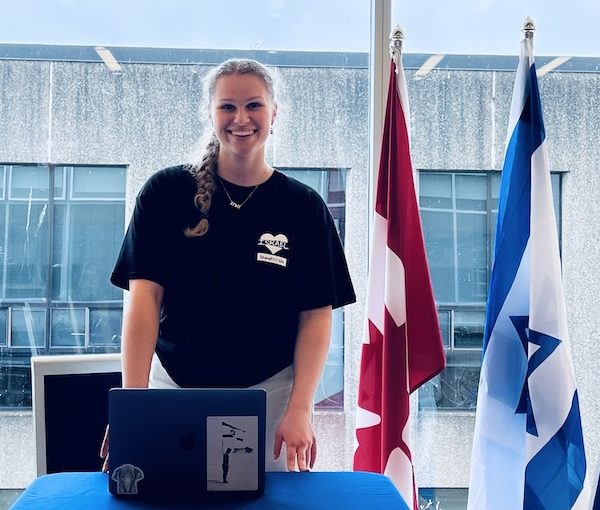
Zara Nybo leads an Israel on Campus meeting at the University of British Columbia. Nybo is the new BC representative for StandWithUs Canada. (photo from Zara Nybo)

When Zara Nybo transferred to the University of British Columbia from Camosun College on Vancouver Island, she wasn’t sure if Hillel was a place where she belonged, since she is not Jewish. Her partner encouraged her to check it out anyway – and it set her on a course to become an ally for Jewish students.

Recently, Nybo was hired as educational outreach and content manager for StandWithUs Canada, a nonprofit dedicated to pro-Israel education and advocacy. Though still finishing her degree in sociocultural anthropology and Jewish studies, she works full-time, overseeing the Emerson Fellowship for university students in British Columbia and the Leventhal Internship for high school students in Western Canada. She’s also responsible for non-Jewish outreach and community partnerships across the province.

“I think a lot of people assume this work is just for Jewish students,” Nybo said, “but education is the pathway to peace, for everyone.”

That idea fuels her days managing fellowships, mentoring students and helping young people navigate what have become among the most emotionally and politically charged issues on campus: Israel and antisemitism. In recent years, as anti-Zionist activism – and antisemitism – have surged across Canadian universities, Jewish students have increasingly found themselves isolated and targeted. Nybo has been impacted by what she has seen.

“What really struck me,” she said, “was watching Jewish and Israeli students grow afraid to go to class, to speak openly, to walk freely with a Star of David necklace. I wanted them to know – you’re not alone. There are people who see you, who care, and who are willing to stand with you.”

Nybo’s advocacy didn’t come out of nowhere. Raised in a family that prioritized global experience over staying in one place – she moved 13 times before age 13 – she learned early how to build bridges. But it was through Hillel and a series of fellowships, including the Campus Media Fellowship, a joint initiative of Allied Voices for Israel and Honest Reporting Canada, and the Israel Leadership Network, which consisted of more than 150 of the top Israel-focused student leaders from within the Hillel movement across North America, that she gained the knowledge, tools and confidence to become a leading pro-Israel advocate at UBC.

“I used to think of antisemitism as a historic form of hatred,” she said. “But once you learn to see the invisible forms of antisemitism, you realize how present and widespread it really is. Once you see it, you can’t unsee it.”

As a 2024/25 Canadian Emerson Fellow and Campus Media Fellowship alumna, Nybo staffed tables, hosted dialogues and wrote op-eds that challenged misinformation and promoted empathy. She’s continued to write ever since, crediting those programs with awakening her voice.

Now, in her leadership role, she trains others to do the same – Jewish and non-Jewish students alike.

“The Emerson Fellowship isn’t about slogans,” she said. “It’s about education. It’s about staying calm in hard conversations, being grounded in facts and speaking with authenticity – even when it’s scary.”

Nybo acknowledges she sometimes feeling “shaky” while tabling on campus. But she refuses to let fear stop her and she sees it as an important part of her role to encourage others to stand up even when it is daunting.

“Our job isn’t to scare students out of advocacy,” she said. “It’s to empower them to do it anyway.”

As tensions around Israel and antisemitism continue in Canada – on campus and beyond – Nybo is one of a small but crucial group of non-Jewish individuals who have stepped up to contest the atmosphere that is making Jews on campus uncomfortable and vulnerable.

“This isn’t just about being pro-Israel,” she said. “It’s about being anti-hate. No student – Jewish or otherwise – should walk around feeling like there’s a target on their back.”

In her new role, Nybo has already filled the BC positions open next year to Jewish and non-Jewish students seeking to broaden their knowledge and skills by participating in the programs StandWithUs Canada offers. She will oversee the students as they proceed through the range of learning and experiential projects she herself engaged in last year. These students, like Nybo, will go on to amplify the voices of Jews and allies on campus and, after graduation, take their places as leaders in the fight against antisemitism and anti-Zionism. 

Format ImagePosted on June 27, 2025June 26, 2025Author Pat JohnsonCategories LocalTags advocacy, allyship, anti-hate, Israel, StandWithUs Canada, Zara Nybo, Zionism
Proudly powered by WordPress