Skip to content
  • Home
  • Subscribe / donate
  • Events calendar
  • News
    • Local
    • National
    • Israel
    • World
    • עניין בחדשות
      A roundup of news in Canada and further afield, in Hebrew.
  • Opinion
    • From the JI
    • Op-Ed
  • Arts & Culture
    • Performing Arts
    • Music
    • Books
    • Visual Arts
    • TV & Film
  • Life
    • Celebrating the Holidays
    • Travel
    • The Daily Snooze
      Cartoons by Jacob Samuel
    • Mystery Photo
      Help the JI and JMABC fill in the gaps in our archives.
  • Community Links
    • Organizations, Etc.
    • Other News Sources & Blogs
    • Business Directory
  • FAQ
  • JI Chai Celebration
  • JI@88! video

Recent Posts

  • האלימות בישראל מורגשת בהרבה מגזרים
  • טראמפ עוזר דווקא לנושא הפלסטיני
  • New rabbi settles into post
  • A light for the nations
  • Killed for being Jewish 
  • The complexities of identity
  • Jews in time of trauma
  • What should governments do?
  • Annie will warm your heart
  • Best of the film fest online
  • Guitar Night at Massey
  • Partners in the telling of stories
  • Four Peretz pillars honoured
  • History as a foundation
  • Music can comfort us
  • New chapter for JFS
  • The value(s) of Jewish camp
  • Chance led to great decision
  • From the JI archives … camp
  • עשרים ואחת שנים להגעתי לונקובר
  • Eby touts government record
  • Keep lighting candles
  • Facing a complex situation
  • Unique interview show a hit
  • See Annie at Gateway
  • Explorations of light
  • Help with the legal aspects
  • Stories create impact
  • Different faiths gather
  • Advocating for girls’ rights
  • An oral song tradition
  • Genealogy tools and tips
  • Jew-hatred is centuries old
  • Aiding medical research
  • Connecting Jews to Judaism
  • Beacon of light in heart of city

Archives

Follow @JewishIndie
image - The CJN - Visit Us Banner - 300x600 - 101625

Tag: allyship

An uplifting moment

Vancouver hosted the largest convention in the city’s history over the weekend. About 50,000 members of Alcoholics Anonymous descended on the convention centre and BC Place stadium. Among the throngs was a booth representing Jewish Addiction Community Services – JACS Vancouver.

Rabbi Joshua Corber, the organization’s recently appointed director of addictions and mental health services, wanted the group to have a presence at the massive international confab. The booth shared information about JACS’s work, as well as literature from partner agencies in other cities.

For Elana Epstein, who attended the booth and greeted passersby, the experience was transformative – but not for the reasons she expected.

Epstein and her family have shared their journey with addiction and recovery openly, including in these pages (jewishindependent.ca/family-hopes-to-save-lives). She and husband David Bogdonov and their son Noah Bogdonov have become some of the most familiar faces in this community speaking about and advocating for awareness around addiction and recovery. 

At a public event at King David High School last fall, the family shared the path they have been on since Noah began his recovery journey two years ago. The entire family has become engaged with this cause. Noah and Elana have both become professionals in the field – Noah recently moved to Calgary to launch a new recovery centre and Elana was credentialized and recently hired to lead JACS’s new family group, which began earlier this week.

But it was not recovery – or, at least, not recovery in the sense she anticipated – that uplifted her at the AA convention. It was the outpouring of empathy and words of encouragement she received from passersby to her as a Jew, and to the Jewish community more broadly.

A steady stream of people dropped by to peruse the information at the booth, but Epstein was deeply moved by the number who just expressed a few words of support for the situation Jewish people find themselves facing in today’s world.

This sort of acknowledgement is something that has been glaringly absent among her non-Jewish circles in Vancouver, she said.

“I personally needed it,” she said. “I haven’t felt that kind of outreach since the war started.” In one of her local circles, her experience has been quite the opposite.

Since Oct. 7, 2023, at the latest, most Jews have probably, consciously or unconsciously, at different times and in different spheres, become aware of dangers and vulnerabilities when we identify ourselves in public. Any reservations Epstein had quickly evaporated, leaving her “completely surprised.”

“Tears,” she said of her response. “Overwhelming gratitude. I really didn’t expect this and it is a beautiful thing. A really beautiful, heartfelt thing.”

There were other surprises – a lot of non-Jews subscribed to stereotypes that addiction did not exist in the Jewish community. For Epstein, though, it was the few words from a stream of strangers that raised her spirits.

Why did it take strangers from other cities to say the words she needed to hear? Maybe it is easier to speak with people you don’t know. By putting herself out there as a visible Jew in a primarily non-Jewish environment, she attracted the goodwill of people who wanted to share expressions of kindness. Are people who deal in addiction and recovery more sensitive to the pain of others? Is there some other explanation?

We would like to imagine this was an indication that the world is kinder than some recent evidence would suggest.

For one thing, there is a simple phenomenon: haters are loud. The chanters who march through the streets condemning Israel (and often Jews) are few but extremely vocal. Their stickers, spray-paint and graffiti might suggest numbers greater than they represent.

Empathy is quiet. Seeing a Jewish individual standing invitingly at a booth presents an opportunity for a few quiet words that maybe some people have been waiting to express.

It may be rare enough that it bears highlighting. It is still, though, a reminder that compassion abounds, often in places we least expect it. This is a small example – and just one – that modest acts of kindness have profound ripples.

As we enjoy the full bloom of summer, with its (hopefully) bright days and reinvigorating outdoor activities, we thought it was worth sharing that the world can be a more welcoming place than it sometimes seems. 

We naturally share with friends our moments of disappointment and distress, seeking commiseration when the world lets us down. Remember also to share your moments of uplift, as this one individual chose to do. We need them. 

Posted on July 11, 2025July 18, 2025Author The Editorial BoardCategories From the JITags addictions, allyship, Elana Epstein, empathy, JACS, Jewish Addiction Community Services, resilience
Putting allyship into action

Putting allyship into action

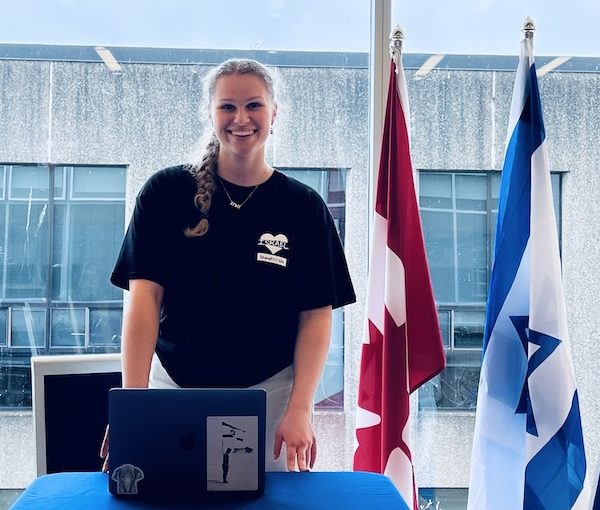
Zara Nybo leads an Israel on Campus meeting at the University of British Columbia. Nybo is the new BC representative for StandWithUs Canada. (photo from Zara Nybo)

When Zara Nybo transferred to the University of British Columbia from Camosun College on Vancouver Island, she wasn’t sure if Hillel was a place where she belonged, since she is not Jewish. Her partner encouraged her to check it out anyway – and it set her on a course to become an ally for Jewish students.

Recently, Nybo was hired as educational outreach and content manager for StandWithUs Canada, a nonprofit dedicated to pro-Israel education and advocacy. Though still finishing her degree in sociocultural anthropology and Jewish studies, she works full-time, overseeing the Emerson Fellowship for university students in British Columbia and the Leventhal Internship for high school students in Western Canada. She’s also responsible for non-Jewish outreach and community partnerships across the province.

“I think a lot of people assume this work is just for Jewish students,” Nybo said, “but education is the pathway to peace, for everyone.”

That idea fuels her days managing fellowships, mentoring students and helping young people navigate what have become among the most emotionally and politically charged issues on campus: Israel and antisemitism. In recent years, as anti-Zionist activism – and antisemitism – have surged across Canadian universities, Jewish students have increasingly found themselves isolated and targeted. Nybo has been impacted by what she has seen.

“What really struck me,” she said, “was watching Jewish and Israeli students grow afraid to go to class, to speak openly, to walk freely with a Star of David necklace. I wanted them to know – you’re not alone. There are people who see you, who care, and who are willing to stand with you.”

Nybo’s advocacy didn’t come out of nowhere. Raised in a family that prioritized global experience over staying in one place – she moved 13 times before age 13 – she learned early how to build bridges. But it was through Hillel and a series of fellowships, including the Campus Media Fellowship, a joint initiative of Allied Voices for Israel and Honest Reporting Canada, and the Israel Leadership Network, which consisted of more than 150 of the top Israel-focused student leaders from within the Hillel movement across North America, that she gained the knowledge, tools and confidence to become a leading pro-Israel advocate at UBC.

“I used to think of antisemitism as a historic form of hatred,” she said. “But once you learn to see the invisible forms of antisemitism, you realize how present and widespread it really is. Once you see it, you can’t unsee it.”

As a 2024/25 Canadian Emerson Fellow and Campus Media Fellowship alumna, Nybo staffed tables, hosted dialogues and wrote op-eds that challenged misinformation and promoted empathy. She’s continued to write ever since, crediting those programs with awakening her voice.

Now, in her leadership role, she trains others to do the same – Jewish and non-Jewish students alike.

“The Emerson Fellowship isn’t about slogans,” she said. “It’s about education. It’s about staying calm in hard conversations, being grounded in facts and speaking with authenticity – even when it’s scary.”

Nybo acknowledges she sometimes feeling “shaky” while tabling on campus. But she refuses to let fear stop her and she sees it as an important part of her role to encourage others to stand up even when it is daunting.

“Our job isn’t to scare students out of advocacy,” she said. “It’s to empower them to do it anyway.”

As tensions around Israel and antisemitism continue in Canada – on campus and beyond – Nybo is one of a small but crucial group of non-Jewish individuals who have stepped up to contest the atmosphere that is making Jews on campus uncomfortable and vulnerable.

“This isn’t just about being pro-Israel,” she said. “It’s about being anti-hate. No student – Jewish or otherwise – should walk around feeling like there’s a target on their back.”

In her new role, Nybo has already filled the BC positions open next year to Jewish and non-Jewish students seeking to broaden their knowledge and skills by participating in the programs StandWithUs Canada offers. She will oversee the students as they proceed through the range of learning and experiential projects she herself engaged in last year. These students, like Nybo, will go on to amplify the voices of Jews and allies on campus and, after graduation, take their places as leaders in the fight against antisemitism and anti-Zionism. 

Format ImagePosted on June 27, 2025June 26, 2025Author Pat JohnsonCategories LocalTags advocacy, allyship, anti-hate, Israel, StandWithUs Canada, Zara Nybo, Zionism
Saying goodbye to a friend

Saying goodbye to a friend

Left to right: Rabbi Philip Bregman, Archbishop Michael Miller and Rabbi Jonathan Infeld. (photo by Pat Johnson)

A lesson from a Jewish professor decades ago has remained with Archbishop Michael Miller all his life.

Miller retired last month as archbishop of Vancouver – head of the region’s nearly half a million Catholics. During his last week in office, he spoke with the Independent about his relationship with the Jewish community. 

The new head of the Catholic Church, Pope Leo XIV, has emphasized the need for dialogue between Catholics and Jews, and spoke almost immediately after his election as pontiff about how close the issue is to his heart. But Miller didn’t need a nudge from the Vatican. According to several Vancouver rabbis, Miller has been a stalwart friend to the community since he arrived in the city more than a decade-and-a-half ago. 

When Miller was a student, he and a group of other young Catholics were in a professional setting with noted medieval scholar Julian Wasserman, who was Jewish. Someone made a comment that was antisemitic. Miller doesn’t remember the exact context, but he does remember what happened next. No one in the meeting had contested the antisemitic remark and the professor challenged them on it afterwards.

“I remember Julian expressed to us his disappointment,” said Miller. “And that stung, because it was true.”

It wasn’t as though Jews were unfamiliar to Miller. He grew up in a heavily Jewish neighbourhood in Ottawa and attended friends’ bar mitzvahs. At university and in seminary, he had several Jewish professors and he has always had an interest in Jewish topics.

As a member of the clergy, he sees interfaith dialogue as central to his role. “And the first place of dialogue, of course, is with the Jewish community,” he said, “which preexisted Christianity by at least 1,500 years, maybe 1,800 years.”

Miller was named archbishop of Vancouver in 2009. In the hierarchy of the Catholic Church, an archbishop is a bishop who leads an archdiocese. Above them are the cardinals who, among other roles, come together to elect a new pope, as they did last month. 

Rabbi Philip Bregman, who leads an interfaith group called the Other People and is rabbi emeritus of Temple Sholom, has been in the city since 1980.

“It wasn’t until I met Archbishop Miller that I actually had a relationship with an archbishop,” Bregman told the Independent. “Even though Pope John XXIII [in the 1960s] had really opened the door of dialogue between Christians and Jews previously closed, it still took time before that concept actually trickled down. Archbishop Miller was the one who really walked the walk and not simply talked a talk.” 

Bregman noted that he had heard the new pope speak about the necessity of Catholics renewing relationships with Jews.

“Archbishop Miller has been there for many, many years and we are tremendously grateful,” he said. “This is an incredible man, who has reached out to the Jewish community and has been there in the most open fashion, for dialogue, for consultation, for support.”

Rabbi Jonathan Infeld of Congregation Beth Israel had equally enthusiastic praise. 

“His spiritual leadership, because of his forward thinking and his intelligence, goes well beyond the Catholic community and has truly touched the hearts and souls of all religious people in the city, which is really due to his leadership, his insight and his intelligence and we wish him the best of luck in retirement but are sad to see him leave,” said Infeld, who wandered the dozen or so blocks from the synagogue to the archbishop’s office to bid Miller farewell.

The archbishop’s relationship with the Jewish community was strong before Oct. 7, 2023, but has only strengthened since then. Rabbi Dan Moskovitz, Bregman’s successor as senior rabbi at Temple Sholom, has spoken publicly in appreciation of Miller’s support in the days after the terror attacks. 

The lesson Miller learned from Prof. Wasserman decades earlier may have ensured he did not remain silent about what happened on Oct. 7.

“The history of the Jews in Germany before the Second World War, before there was blatant antisemitism, there was a lot of silence,” he said. “Even though we now know that a lot of people were uneasy, they were not uneasy enough to say anything. That silence is often very damning. That’s true, certainly, today as well [about antisemitism], but also on other issues where we are not so willing to speak up, [where] we are a little cowardly and we can find reasons to justify it.”

Before being appointed a bishop, Miller was a professor and later president at the University of St. Thomas, in Houston, Tex. In 2003, Pope John Paul II appointed him secretary of the Congregation for Catholic Education, in the Vatican. He came to Vancouver in 2007 as coadjutor – effectively, the assistant to the archbishop and the apparent successor.

Fluent in English, French, Spanish and Italian, Miller has authored several books on Catholic education and the papacy. He is succeeded by Archbishop Richard W. Smith, who previously served as archbishop of Edmonton. 

Miller credits his team at the archdiocese office for their commitment to Catholic-Jewish dialogue, and he and Bregman both praised Ann Marie McGrath, who serves as the religion lead at St. Patrick Regional Secondary School in Vancouver. Bregman has connected McGrath with King David High School, and a new relationship is budding between those schools. 

Miller has now relocated to Houston. He does not like the term “retirement,” he said, and his first few weeks have been filled with speaking engagements and other responsibilities. He will be sharing his wisdom when invited to do so.

“I’ll probably read more – I look forward to that – and, God willing,” he said, “pray a little more because not every moment will be scheduled as it has been.” 

Format ImagePosted on June 13, 2025June 12, 2025Author Pat JohnsonCategories LocalTags allyship, archdiocese, Catholic Church, interfaith relations, Jonathan Infeld, Michael Miller, Philip Bregman

Don’t leave. Engage!

Anthony Housefather has decided to remain in the federal Liberal caucus. Housefather, member of Parliament for the Quebec riding of Mount Royal, is one of only two Liberals to have voted against the NDP motion last month that called for a ceasefire, an end to Canadian military trade with Israel, as well as other positions about Israel and the current conflict.

As discussed in this space last issue, the New Democratic Party motion had some of its rough edges sanded down in order to make it palatable to almost all Liberal MPs. The rest of the House of Commons voted predictably. Conservatives unanimously opposed the motion, which they viewed as biased against Israel. The Bloc Québecois and the Green party sided with the NDP.

The daylong negotiations over amendments to the motion were a face-saving effort by the Liberal government to avoid the embarrassment of a serious schism in their caucus over foreign policy. In the end, a less inflammatory motion was passed.

Housefather, who is Jewish and represents a riding that has one of the largest concentrations of Jewish voters in Canada, was joined on the government side in opposing the motion only by Ontario Liberal MP Marco Mendocino.

Housefather was open about his frustration. Anyone who has found themselves in a place where they do not feel welcomed, based on their core identity, can certainly appreciate his feelings of isolation. However, we are pleased that he has decided to remain in the Liberal caucus.

Crossing the floor and joining the Conservatives, which he had said he was considering, would not have been advantageous to Jewish and pro-Israel voters. Since the administration of former prime minister Stephen Harper, at the latest, the Conservative party has been perceived as overwhelmingly pro-Israel. This approach has been welcomed by many Jewish Canadians.

However, this reality means that, were Housefather to switch parties, he would become just another pro-Israel voice in the Conservative caucus. By staying where he is, he will be a necessary voice for Israel and the Jewish community in the governing party. In an announcement a week ago, he said the prime minister has asked him to lead the government’s efforts in fighting antisemitism. This effort needs as much multi-partisan support as possible.

Anyone who has had difficult conversations with friends or family in recent months understands the emotional burden of being a voice for Israel in this challenging time. This, however, makes Housefather’s presence in the Liberal party that much more important.

We face a similar challenge at the provincial level. With the firing of Selina Robinson from cabinet, and her subsequent withdrawal from the governing New Democratic Party caucus, the Jewish community’s most outspoken ally, liaison and voice is gone from the government side of the legislature. Neither Robinson, who now sits as an independent, nor George Heyman, the other Jewish New Democrat in Victoria, are seeking reelection. It is entirely possible that the Jewish community will not have any community members in the next legislature.

This is not to say we do not have friends there.

Michael Lee, the MLA for Vancouver-Langara, has been a steadfast ally of the Jewish community and a stalwart presence at the weekly Sunday rallies for the Israeli hostages. Recently, when he addressed that audience, he went to lengths to warn against making Israel a political football. A community that can be taken for granted by one party and written off by another will find itself unrepresented in the halls of power. Lee reassured Jewish British Columbians that they not only have friends on the opposition side of the house, but in the governing NDP as well.

We know that there are allies for Israel and the Jewish people in the provincial NDP. It is a symptom of a larger concern that some of these people feel constrained around expressing that solidarity fully because of segments of their own party who would almost certainly single them out for that support.

As Robinson herself told the Independent last issue, she has friends and supporters in the caucus – but she wouldn’t mention them by name for fear of putting a target on their backs. This is a serious problem, of course. But it is better to have quiet allies than no allies at all. Their presence can potentially moderate extreme elements in their party. Were they not there, restraining impulses might be minimized.

As we approach a provincial election this fall, and a federal election at some unpredictable date (remember, there is a minority government in Ottawa) Jewish Canadians and allies of Israel should not abandon the parties that include voices with alternative views. We should, like Housefather has chosen to do, make sure our voices are heard in all of Canada’s diverse political venues. 

Posted on April 12, 2024April 10, 2024Author The Editorial BoardCategories From the JITags allyship, Anthony Housefather, antisemitism, governance, House of Commons, Israel, Liberal Party of Canada, Michael Lee, NDP, politics
The lights of allyship

The lights of allyship

This Chanukah, kindle the light of liberation, not just for you and your loved ones, but for all people whose freedom of expression is threatened. (photo by Robert Couse-Baker / flickr.com)

In a time of identity searching, introspection and anticipation, Chanukah can be an inviting space to reflect and refract the light before us. From the Chanukah that was to the Chanukah we arrive at, the world has shifted and we are not the same. This holiday of chocolate, oil and games of dreidel beckons us into a moment of contemplation.

Chanukah expresses a language of novelty, innovation and a miraculous expansion from what we thought was possible. The ease and accessibility, the simplicity of candles, the sense that Chanukah is predictable and performative belies the very creative, radical nature of the Festival of Lights.

The annual Chanukah experience, at its core, is an opportunity to receive new insight, empowerment and opportunity to overcome the forces that oppress, debase and deny our most essential identities. Had the few Maccabees not searched to provide that light for the many, none of us would have a miracle to celebrate today. Even though we are privileged to be able to publicly observe our traditions, Chanukah reminds us that our work is not complete until everyone can safely and freely express their identities.

Visibility and proximity

One of the unique aspects of Chanukah is that it is the only festival that occurs in two different months. It is literally positioned between Kislev and Tevet to help us be aware and adapt to changing times. In the light of the candles, it is possible to see our roles anew, clarifying our commitment to ensuring that the privilege and expression of being is available to everyone.

When the Talmud explores modalities of the mitzvah of lighting the chanukiyah, it says that each and every person should have a candle. It continues to explain that an even greater beautification of the mitzvah is when everyone is able to increase the light with each additional day. When everyone has their own chanukiyah, when everyone is able to light all the candles on each night, then everyone is bringing the fullest light possible. This is the hope: with so much light, the world is relieved of darkness.

Our rabbis teach that this attribute of adding is connected to Joseph, whose story we read on Shabbat Chanukah. Joseph’s name means to increase, and his story reveals the relationship between proximity and visibility. The Talmud, Shabbat 22a, juxtaposes the narrative of Joseph being thrown into a pit with the laws detailing the proper placement of the menorah and the limits on how far off the ground it can be.

In Genesis 37:18, Joseph’s brothers “saw [Joseph] from afar … and they conspired against him.” They throw him into a pit, which Genesis 37:24 says “was empty and didn’t have water.” But the rabbis disagree, arguing that, while “empty” implies that the pit didn’t have water in it, it was not without venomous pit-dwellers. There were snakes and scorpions that the brothers didn’t know about, because they were not close enough to the pit to see.

Moreover, the distance at which the brothers first saw Joseph approaching made it easy for them to plot against him. In not one, but two cases, the brothers’ lack of proximity leads to actions that degrade and humiliate. If only they waited to see their little brother up close before acting, they might have changed their plan. If only they approached the pit to look inside, they might have seen the snakes and scorpions. The Torah is clear: proximity and visibility lead to responsibility.

It is for that reason the Talmud instructs us that we cannot place a menorah too far off of the ground – we must be close enough to see and be affected by the candles. If the menorah can’t be seen, we miss the message of the miracle, and the opportunity to take responsibility is lost.

The Hasmoneans were descendants of Aaron, who, the Mishnah tells us, was a lover of peace, pursuer of peace and lover of peoples.

Judaism is a religion of action, and we must be practitioners of our tradition’s wisdom by taking responsibility.

Today, even with technologies that keep us connected across oceans and continents, we understand the challenge and, more so, the threat of being too distant. Jews have a response to prevent the dehumanization that often comes when we are distanced from the lived experience of others – draw in close.

A great miracle happens with allyship

The Hebrew words behind the story of Chanukah and Joseph also reaffirm the holiday’s charge to increase visibility, to be an ally. The rabbis saw our world as created through speech and language and, thus, all Hebrew letters represent hidden truths. Just like the story of Joseph in the pit, the closer you look, the more that is revealed.

The mystics teach that the Hebrew letters for Greece (Yavan is spelled yud, vav, nun) are three lines that descend as the word progresses. The great and mighty culture that claimed elite thought and refinement was in fact a culture that debased and denigrated. Greek leadership prioritized the body over the spirit; what was seen on the outside was of greater value than that which was within. Thus, it could be said that Greece, by elevating the external, actually debases it, a message hidden within the descending letters: yud, vav, nun.

The Hebrew word for Joseph, Yosef, begins with the same first two letters. But the third letter is where the comparison is stark. Instead of a nun sofit (a nun at the end of a word), which is a straight line going down, we have the round letter samech, a symbol for equality. Unlike the hierarchy of the nun, the circle of the samech allows every point on its circumference to be equidistant to the centre. Joseph chooses to chaver (friend) up and stops the descent by treating others as equals.

The nun and samech form the word miracle, nes. The first letter, nun, is the only letter in Hebrew that doesn’t appear in the alphabetical acrostic of the prayer Ashrei. Our rabbis explain that this letter stands for nefela, falling, and, therefore, is omitted. The next letter in the alphabet is the samech and it starts the Ashrei verse, “samech l’chol hanoflim,” “supporting all those who have fallen.” Jews in those days, as in ours, had a choice between the “nun” and the “samech” – to align with the oppressors and feel secure or to ally with those who needed support. In choosing the latter, a great miracle (nes) happened there.

Kindling the light

As the story and words of Chanukah convey, the Jewish response to oppression is not just to be free but to dismantle the system of oppression and provide equality for others. Today, we place a menorah in the window in order to publicize our engagement in the ancient and ongoing story of this struggle. We stand up in broken places of despair and hopelessness to rededicate ourselves and our institutions to this cause. Now, when we see an injustice, when we are proximate to the dehumanization of a child of G-d, we not only see the unholy act itself but also we recognize the imperative to respond.

This Chanukah, kindle the light of liberation, not just for you and your loved ones, but for all people whose freedom of expression is threatened. Kindle a light to banish the darkness of hatred, racism, transphobia and misogyny. Kindle a light that signals to outsiders that you are a home (or an organization) committed to rededication and the recreation of holy space, particularly in the most broken of places.

Chanukah was not immediately established as a holiday. The Talmud teaches that the rabbis waited until the following year to institute a permanent commemoration. When they realized that the miracle could be replicated – that, in every generation, Jews could learn to take the little they had and turn it into something miraculous – they created the holiday. That is the holy ask of Chanukah: to be the light that can extend and expand, to be the miracle that someone else needs.

Michael Walzer writes that “wherever we go, it is eternally Egypt,” but that there is a Promised Land, and the only way to make it across the wilderness is by “joining hands, marching together.” The story of oppression and liberation is also a story of allyship. We will not survive without hands to support and guide us, to hold and elevate us. This year, on Chanukah, be the light and bring the light out of the closet and into the world.

Rabbi Mike Moskowitz is scholar-in-residence of trans and queer Jewish studies at Congregation Beit Simchat Torah in New York and Rabbi Dara Frimmer is senior rabbi at Temple Isaiah in Los Angeles. This article was originally published in the Jewish Journal and articles by other Shalom Hartman Institute scholars can be found at shalomhartman.org.

Format ImagePosted on November 19, 2021November 18, 2021Author Rabbi Mike Moskowitz and Rabbi Dara FrimmerCategories Celebrating the HolidaysTags allyship, anti-Judaism, diversity, inclusion, Judaism, Shalom Hartman Institute
Proudly powered by WordPress