Skip to content
  • Home
  • Subscribe / donate
  • Events calendar
  • News
    • Local
    • National
    • Israel
    • World
    • עניין בחדשות
      A roundup of news in Canada and further afield, in Hebrew.
  • Opinion
    • From the JI
    • Op-Ed
  • Arts & Culture
    • Performing Arts
    • Music
    • Books
    • Visual Arts
    • TV & Film
  • Life
    • Celebrating the Holidays
    • Travel
    • The Daily Snooze
      Cartoons by Jacob Samuel
    • Mystery Photo
      Help the JI and JMABC fill in the gaps in our archives.
  • Community Links
    • Organizations, Etc.
    • Other News Sources & Blogs
    • Business Directory
  • FAQ
  • JI Chai Celebration
  • JI@88! video

Recent Posts

  • Eby touts government record
  • Keep lighting candles
  • Facing a complex situation
  • Unique interview show a hit
  • See Annie at Gateway
  • Explorations of light
  • Help with the legal aspects
  • Stories create impact
  • Different faiths gather
  • Advocating for girls’ rights
  • An oral song tradition
  • Genealogy tools and tips
  • Jew-hatred is centuries old
  • Aiding medical research
  • Connecting Jews to Judaism
  • Beacon of light in heart of city
  • Drag & Dreidel: A Queer Jewish Hanukkah Celebration
  • An emotional reunion
  • Post-tumble, lights still shine
  • Visit to cradle of Ashkenaz
  • Unique, memorable travels
  • Family memoir a work of art
  • A little holiday romance
  • The Maccabees, old and new
  • My Hanukkah miracle
  • After the rededication … a Hanukkah cartoon
  • Improving the holiday table
  • Vive la différence!
  • Fresh, healthy comfort foods
  • From the archives … Hanukkah
  • תגובתי לכתבה על ישראלים שרצו להגר לקנדה ולא קיבלו אותם עם שטיח אדום
  • Lessons in Mamdani’s win
  • West Van Story at the York
  • Words hold much power
  • Plenty of hopefulness
  • Lessons from past for today

Archives

Follow @JewishIndie
image - The CJN - Visit Us Banner - 300x600 - 101625

Tag: anti-Judaism

Arab Zionist recalls journey

Arab Zionist recalls journey

On June 12, Rawan Osman spoke with Daniel Koren, founder and executive director of Allied Voices for Israel, which brought her to the West Coast. (photo by Pat Johnson)

Rawan Osman, among the most visible Arab advocates contesting antisemitism and anti-Israel ideology, recently brought to Vancouver a bleak overview of hate ideologies across the Middle East and North Africa – but her prognosis is hopeful.

Osman is a Syrian-born, Lebanon-raised, German-based – and soon to be Israeli – accidental activist who shared her experience going from what she said is a characteristically antisemitic Arab into an “Arab Zionist.” She spoke at Temple Sholom June 12, in conversation with Daniel Koren, founder and executive director of Allied Voices for Israel, which brought her to the West Coast.

Osman took Islamic and then Jewish studies at Heidelberg University. After Oct. 7, 2023, she founded a social media channel called Arabs Ask, to combat antisemitism in the Arab world. She is writing a book about her relationship with Judaism and Israel, and is the narrator and central figure in the documentary film Tragic Awakening, about antisemitism after Oct. 7.

“My case is unusual,” she acknowledged. “There aren’t many people born in the Arab world who support Israel.”

She recounted the story of her first encounter with a Jew. She had moved to Strasbourg, France, and found herself living in the Jewish Quarter. She had assumed that the neighbourhood’s name was like the Jewish Quarter in Beirut or Damascus – an historical designation. When she went into a grocery store on her first day there, she stumbled into a kosher grocery and saw real-life Jews for the first time.

She had a panic attack, left her purchases and belongings behind and fled to her apartment. After she recovered and returned to collect her things, she had a life-altering experience.

She made an excuse that she had forgotten her wallet but she is certain the shopkeeper knew what had happened. He asked where she was from and how long she had been in town. He helped her with her groceries and behaved like a human being, not the monster she had been told was the way of the Jew.

“He allowed me to save face and, that day, without knowing it, that gentleman converted me from an enemy to an ally,” she said. “I realized it was the first time in my life that I was sharing the same space with a Jew, the enemy, and it was the first time in my life when I asked, why is the Jew my enemy?”

Osman’s father was Sunni from Damascus and her mother was Shia from the Beqaa Valley, which is the stronghold of Hezbollah.

“I grew up in Lebanon, attending a French Catholic school,” she said. But, negotiating between her family’s dual Muslim identities and Christians in Lebanon, she chose a middle path of atheism.

“They were secular, progressive, relaxed, laid-back,” she said of her family and the broader environment in which she was raised – with one exception. “The only thing everybody hated was Israel and the Jews and the Zionists.”

She said she employs these three terms – Israeli, Jewish and Zionist – interchangeably because that is how they are used in the Arab world.

“They say, I am anti-Zionist, not antisemitic. That’s a farce,” she said. “I grew up in that part of the world and I too believed [they were different things].” 

Studying abroad and having access to uncensored information in Europe was a privilege with which she was unaccustomed. The more she explored the history of Judaism and met and interacted with Jews, the more she rejected the antisemitism with which she was raised. Eventually, she moved back to the Middle East and decided to challenge the prevailing narrative.

“After living in the Middle East for awhile, I decided, OK, it’s hopeless,” she said. “I’m going to leave. I’m going to move to Europe. And I did.”

She chose Europe because she identified with Western values, she said, and because, as one person, “what can I change?”

She opted to mind her own business in Germany. Even so, she was alarmed by what she was seeing.

She viewed the notorious gang rapes that took place in Cologne on New Year’s Eve and the early hours of 2016 as a symptom of Arab misogyny imported to Europe. What was more jarring to her was seeing herself in the place of others perpetrating hate crimes. She watched a video of a young Arab man encountering a Jew in Berlin.

“He took off his belt and he was hitting the young Jew with the metal buckle on his head,” she recounted. “This was me. I was the civilized version … I wouldn’t hit a Jew. But I had a panic attack the first time I saw a Jew.”

She did not plan to become an activist. After Oct. 7, it just happened.

“I started speaking on social media and became an accidental activist and influencer,” she said. “I thought influencers made nail designs, baking and makeup.”

She is part of a small but notable group of Arabs who are speaking out against antisemitism and other regressive realities.

“We refuse to continue to raise our children and grandchildren in a world that tolerates what happened on Oct. 7,” she said. 

It is something she could not have undertaken if her extended family did not also live abroad, she said. To be known as an activist for Jews and Israel would endanger family in the Arab world, which means even many who live in the West remain silent, she said. But those who have the freedom to do so need to join her, she contended.

Osman receives private messages from Arabs and Iranians lauding what she does. She admires the courage of those who write to her from the Middle East. For those writing from Sydney or Toronto, she has strong advice.

“Those people who are living in the comfort of Toronto or Sydney tell me, I’m proud of you, I wish I could do what you’re doing,” said Osman. “Don’t be proud of me, darling. Do it. Do it. You might lose a friend or two but you will make a thousand more.”

Osman has chosen to convert to Judaism and is making aliyah this summer.

“The thing I love most about Judaism, what’s phenomenal, is that Judaism encourages your imagination. It encourages debate. Two Jews, three opinions. This is the talmudic tradition. It encourages challenging ideas.

“Islamic ideology is exactly the opposite,” she said.

When she decided to convert to Judaism, she got pushback – from Jews.

“Jews will tell me, you have to be a Muslim Arab ally,” she said, noting that some have told her she has a more powerful voice as an outsider. “You’re missing the point. Converting to Judaism is a privilege, my privilege. It’s not my dirty secret. It is time to say, I stand for that.… Your ancestors accepted that mission not because you’re special – you are the chosen people because you accepted that mission.”

Israel is not an easy place, she acknowledged, but the dichotomy of life in the Jewish state amazes her. The Israeli who pushes in front of her in queue and steps on her toes would, conversely, take a bullet for her, she said. 

“As soon as there is an alarm, a siren, they have each other’s back,” she said. “It’s unbelievable.”

Osman ultimately is hopeful. The new Syrian president, Ahmed al-Shara, is a jihadi terrorist turned – apparently – a suit-and-tie-wearing diplomat. Some doubt his sincerity. Osman believes that young Arabs who are drawn to extremism can see his transformation and believe there is an alternative path for them as well.

A billion Muslims are not going anywhere, she said. The only resolution to what she sees as a civilizational conflict is internal reform within Islam. This is already visible in the Abraham Accords – which she is certain that Syria will join – and the small number of activists like her speaking out.

Gabriela Rosenblum, director of education with Allied Voices for Israel, welcomed the audience and thanked Dr. Neil and Michelle Pollock of Pollock Clinics for sponsoring the event. Rabbi Carey Brown, associate rabbi of Temple Sholom, welcomed guests to the synagogue and led a prayer for the redemption of those held captive and a prayer for the soldiers of the Israel Defence Forces. 
Format ImagePosted on June 27, 2025June 25, 2025Author Pat JohnsonCategories LocalTags Allied Voices for Israel, anti-Judaism, Islam, Israel, Judaism, Rawan Osman

Learning to accept changes

Whew, we’re dealing with so much these days. The pandemic seemed all-consuming, until the serious weather events started. It’s a lot.

Lately, I’ve thought about a Jewish folk tale, often retold in children’s books. Usually, it’s a man who goes to his rabbi because his small house, full of relatives, is too loud. The rabbi suggests he brings his chickens inside. Then maybe a dog, or a cat, goats, a horse and a cow. Then, the man is beside himself with all the noise and mess! He goes back to the rabbi, who suggests he return those animals to the barnyard. Suddenly, his house seems big and quiet. The rabbi’s lesson, of course, is to be grateful for what we’ve got. We have to realize (over and over) that whatever we have, even if it’s small or loud, maybe wasn’t so bad in the first place. Through this sort of change and gratitude practice, we may come to realize that there are good aspects to many situations that perhaps previously seemed dire.

Last week, I felt so lucky. I managed to “score” my twins (age 10) COVID vaccine appointments in a medical clinic about two blocks from our home. We were absolutely thrilled. I’d gotten us on a list at this clinic just in case they should gain access to the pediatric vaccine. We were expecting and willing to wait awhile because we didn’t want to go to a supersite. To our surprise, the clinic got the vaccines in quickly. They called us at 11 in the morning, I picked the kids up from school early, a little after 1 p.m., and the vaccines were in their arms by 1:45.

I’d promised the twins gelati afterwards, but the windchill had been -30 that morning, and our neighbourhood gelato shop is not doing dine-in. Even Winnipeggers have their winter limits. We celebrated by eating pastries from a local bakery instead. Then we watched the Macy’s Thanksgiving Day Parade on the couch together. It was, coincidentally, American Thanksgiving. We had a lot to be thankful about.

All this luck evened out when, a couple days later, one of my twins developed what seemed like a full-blown head cold. We all went off to get tested because maybe we have new allergies, maybe it was a head cold or maybe it was COVID. The good news is that we all tested negative. Whew.

Bad news is that the kid still had a cold and he had to stay home from school with his twin while we waited for the test results. The good part is that, while at home, we had time to go through the kids’ bookshelf, removing all the easy readers and things we no longer needed. (It was then that I encountered multiple versions of that noisy house story I described above.)

I mention all this because, like me, you may be surrounded by those who are yearning for things to get better. Of course, this isn’t a bad hope. Sometimes, when things change, it’s seriously awful news, or it’s not a huge improvement in our lives. So, we maybe have to be grateful for what we’ve got, and learn to accept the change and work with it. It’s working with what’s in front of us, whether it’s climate change weather events or pandemic challenges.

I considered thoughts about change while doing my daily page of Talmud and studying the talmudic tractate of Taanit. In Taanit, on page 17, there’s a discussion about whether those who were high priests in the Temple can drink alcohol. In Rabbi Elliot Goldberg’s introduction from the My Jewish Learning website, he explains this situation. When the Temple stood in Jerusalem, the priests weren’t allowed to drink when they were on duty. Yet, when the rabbis are debating this in the Talmud, it’s been a long time, more than a century, since the Temple was standing. At first, their conclusion is that all priests must stand by, forever, completely sober. After all, they must be ready to be on duty, if the Temple should be rebuilt.

However, according to Rashi’s explanation, Rabbi Judah HaNasi’s decision becomes law. He says that, since it’s unlikely the Temple will be rebuilt any time soon, priests are allowed to drink alcohol every now and again. Rabbi Judah HaNasi is willing to accept that a big change has happened. He finds something good in a hard situation, which might bring somebody a little enjoyment.

Change happens, whether we like it or not. Maybe, like the loss of the Temple, or the destruction of homes due to climate change or people who die from the pandemic, it’s a horrible loss. There’s no denying some losses are life-changing.

Yet, there is also just change. At the beginning of the pandemic, I was working flat out to schedule my kids into a series of summer camps. In March 2020, I was desperate to find the next best experience. Long story short, in Manitoba, many camps were canceled in 2020. We had to learn a whole new way of keeping our kids busy all summer long. We were oddly prepared when, in summer 2021, our preliminary summer plans again hit a snag.

Oddly, for both me and my kids, those unstructured summer days were a gift. I would never have changed our lives that substantially if the pandemic hadn’t hit. Now, faced with twins at home for a day in December due to a head cold, I was happy to let them wile away the unexpected time. There was a lot of creative play. There were books to read and activities to do, the dog to feed and dinner to make. The day passed. My kids were upset at missing school but, like Judah HaNasi, we can try to find the bright side.  Roughly 2,000 years ago, it meant high priests could have an alcoholic beverage if they wanted. It goes without saying that this doesn’t make up for the loss of the Temple, but it’s not a bad side benefit, either.

May the changes that come be easy to cope with and good ones for you. At the very least, let’s hope some of the changes have an unexpected benefit!

Joanne Seiff has written regularly for CBC Manitoba and various Jewish publications. She is the author of three books, including From the Outside In: Jewish Post Columns 2015-2016, a collection of essays available for digital download or as a paperback from Amazon. Check her out on Instagram @yrnspinner or at joanneseiff.blogspot.com.

Posted on December 10, 2021December 8, 2021Author Joanne SeiffCategories Op-EdTags anti-Judaism, change, Judaism, lifestyle, Talmud, Torah, vaccinations
The lights of allyship

The lights of allyship

This Chanukah, kindle the light of liberation, not just for you and your loved ones, but for all people whose freedom of expression is threatened. (photo by Robert Couse-Baker / flickr.com)

In a time of identity searching, introspection and anticipation, Chanukah can be an inviting space to reflect and refract the light before us. From the Chanukah that was to the Chanukah we arrive at, the world has shifted and we are not the same. This holiday of chocolate, oil and games of dreidel beckons us into a moment of contemplation.

Chanukah expresses a language of novelty, innovation and a miraculous expansion from what we thought was possible. The ease and accessibility, the simplicity of candles, the sense that Chanukah is predictable and performative belies the very creative, radical nature of the Festival of Lights.

The annual Chanukah experience, at its core, is an opportunity to receive new insight, empowerment and opportunity to overcome the forces that oppress, debase and deny our most essential identities. Had the few Maccabees not searched to provide that light for the many, none of us would have a miracle to celebrate today. Even though we are privileged to be able to publicly observe our traditions, Chanukah reminds us that our work is not complete until everyone can safely and freely express their identities.

Visibility and proximity

One of the unique aspects of Chanukah is that it is the only festival that occurs in two different months. It is literally positioned between Kislev and Tevet to help us be aware and adapt to changing times. In the light of the candles, it is possible to see our roles anew, clarifying our commitment to ensuring that the privilege and expression of being is available to everyone.

When the Talmud explores modalities of the mitzvah of lighting the chanukiyah, it says that each and every person should have a candle. It continues to explain that an even greater beautification of the mitzvah is when everyone is able to increase the light with each additional day. When everyone has their own chanukiyah, when everyone is able to light all the candles on each night, then everyone is bringing the fullest light possible. This is the hope: with so much light, the world is relieved of darkness.

Our rabbis teach that this attribute of adding is connected to Joseph, whose story we read on Shabbat Chanukah. Joseph’s name means to increase, and his story reveals the relationship between proximity and visibility. The Talmud, Shabbat 22a, juxtaposes the narrative of Joseph being thrown into a pit with the laws detailing the proper placement of the menorah and the limits on how far off the ground it can be.

In Genesis 37:18, Joseph’s brothers “saw [Joseph] from afar … and they conspired against him.” They throw him into a pit, which Genesis 37:24 says “was empty and didn’t have water.” But the rabbis disagree, arguing that, while “empty” implies that the pit didn’t have water in it, it was not without venomous pit-dwellers. There were snakes and scorpions that the brothers didn’t know about, because they were not close enough to the pit to see.

Moreover, the distance at which the brothers first saw Joseph approaching made it easy for them to plot against him. In not one, but two cases, the brothers’ lack of proximity leads to actions that degrade and humiliate. If only they waited to see their little brother up close before acting, they might have changed their plan. If only they approached the pit to look inside, they might have seen the snakes and scorpions. The Torah is clear: proximity and visibility lead to responsibility.

It is for that reason the Talmud instructs us that we cannot place a menorah too far off of the ground – we must be close enough to see and be affected by the candles. If the menorah can’t be seen, we miss the message of the miracle, and the opportunity to take responsibility is lost.

The Hasmoneans were descendants of Aaron, who, the Mishnah tells us, was a lover of peace, pursuer of peace and lover of peoples.

Judaism is a religion of action, and we must be practitioners of our tradition’s wisdom by taking responsibility.

Today, even with technologies that keep us connected across oceans and continents, we understand the challenge and, more so, the threat of being too distant. Jews have a response to prevent the dehumanization that often comes when we are distanced from the lived experience of others – draw in close.

A great miracle happens with allyship

The Hebrew words behind the story of Chanukah and Joseph also reaffirm the holiday’s charge to increase visibility, to be an ally. The rabbis saw our world as created through speech and language and, thus, all Hebrew letters represent hidden truths. Just like the story of Joseph in the pit, the closer you look, the more that is revealed.

The mystics teach that the Hebrew letters for Greece (Yavan is spelled yud, vav, nun) are three lines that descend as the word progresses. The great and mighty culture that claimed elite thought and refinement was in fact a culture that debased and denigrated. Greek leadership prioritized the body over the spirit; what was seen on the outside was of greater value than that which was within. Thus, it could be said that Greece, by elevating the external, actually debases it, a message hidden within the descending letters: yud, vav, nun.

The Hebrew word for Joseph, Yosef, begins with the same first two letters. But the third letter is where the comparison is stark. Instead of a nun sofit (a nun at the end of a word), which is a straight line going down, we have the round letter samech, a symbol for equality. Unlike the hierarchy of the nun, the circle of the samech allows every point on its circumference to be equidistant to the centre. Joseph chooses to chaver (friend) up and stops the descent by treating others as equals.

The nun and samech form the word miracle, nes. The first letter, nun, is the only letter in Hebrew that doesn’t appear in the alphabetical acrostic of the prayer Ashrei. Our rabbis explain that this letter stands for nefela, falling, and, therefore, is omitted. The next letter in the alphabet is the samech and it starts the Ashrei verse, “samech l’chol hanoflim,” “supporting all those who have fallen.” Jews in those days, as in ours, had a choice between the “nun” and the “samech” – to align with the oppressors and feel secure or to ally with those who needed support. In choosing the latter, a great miracle (nes) happened there.

Kindling the light

As the story and words of Chanukah convey, the Jewish response to oppression is not just to be free but to dismantle the system of oppression and provide equality for others. Today, we place a menorah in the window in order to publicize our engagement in the ancient and ongoing story of this struggle. We stand up in broken places of despair and hopelessness to rededicate ourselves and our institutions to this cause. Now, when we see an injustice, when we are proximate to the dehumanization of a child of G-d, we not only see the unholy act itself but also we recognize the imperative to respond.

This Chanukah, kindle the light of liberation, not just for you and your loved ones, but for all people whose freedom of expression is threatened. Kindle a light to banish the darkness of hatred, racism, transphobia and misogyny. Kindle a light that signals to outsiders that you are a home (or an organization) committed to rededication and the recreation of holy space, particularly in the most broken of places.

Chanukah was not immediately established as a holiday. The Talmud teaches that the rabbis waited until the following year to institute a permanent commemoration. When they realized that the miracle could be replicated – that, in every generation, Jews could learn to take the little they had and turn it into something miraculous – they created the holiday. That is the holy ask of Chanukah: to be the light that can extend and expand, to be the miracle that someone else needs.

Michael Walzer writes that “wherever we go, it is eternally Egypt,” but that there is a Promised Land, and the only way to make it across the wilderness is by “joining hands, marching together.” The story of oppression and liberation is also a story of allyship. We will not survive without hands to support and guide us, to hold and elevate us. This year, on Chanukah, be the light and bring the light out of the closet and into the world.

Rabbi Mike Moskowitz is scholar-in-residence of trans and queer Jewish studies at Congregation Beit Simchat Torah in New York and Rabbi Dara Frimmer is senior rabbi at Temple Isaiah in Los Angeles. This article was originally published in the Jewish Journal and articles by other Shalom Hartman Institute scholars can be found at shalomhartman.org.

Format ImagePosted on November 19, 2021November 18, 2021Author Rabbi Mike Moskowitz and Rabbi Dara FrimmerCategories Celebrating the HolidaysTags allyship, anti-Judaism, diversity, inclusion, Judaism, Shalom Hartman Institute

Sukkot a time for happiness

As a kid, Sukkot wasn’t a holiday we observed at home. Our congregation was where I decorated and visited a sukkah, but it wasn’t a big festival for us. The temple did feel like an extension of my house since my mom worked full time there – but it wasn’t my house.

By contrast, as a married adult, we’ve really embraced Sukkot at home. We’ve built a sukkah in the backyard of each home we’ve lived in. We’ve more than 20 years now of experience in inviting guests for big sukkah dinner parties and having quiet family meals together, too. We enjoy buying a lulav and etrog so we can “shake it in the sukkah!” on our own.

It’s brought us lots of pleasure, which is apt because Sukkot is the only festival that is labeled “z’man simchateinu” or “our time of happiness.” It’s literally our time to party. In Tractate Sukkah, it describes the special “in the place of the drawing of water” celebrations at the Temple on Sukkot as the party to end all parties. In Tractate Sukkah 51a, it says this twice, in both the Mishnah and Gemara, “One who did not see the celebration … never saw celebration in his days.”  The Gemara goes further to explain: “One who did not see Jerusalem in its glory, never saw a beautiful city. One who did not see the Temple in its constructed state, never saw a magnificent structure.”

Like any spare, ancient text, we can read this several ways. My first tendency is to recall overhearing university acquaintances laughing. When they saw me, as they laughed, they explained that their fraternity bash was “the party to end all parties” and “they were so blasted” and “it’s a shame you weren’t there!” Then I’d feel some shame. I hadn’t been invited, feeling left out and uncomfortable. Then, as an introvert, I’d privately admit relief!  I didn’t have to deal with the noise, drunks, drugs and cigarettes, either.

Yet this is not at all the negative, emotional reading that I think the rabbis intended. The talmudic sages were describing a truly joyous, amazing, mind-blowingly big celebration. It’s hard during the pandemic to wrap my brain around this huge way of celebrating. The Temple in Jerusalem and its way of observing the festivities are also long past, but there are still big sukkahs out there in the world, full of party-goers, no matter the year.

Many of us struggle at times to find the joy in our lives – the world news, natural disaster and ongoing pandemic waves can leave us reeling and wondering when things will get better. When we can gather, many people are flooded with joy at a crowded wedding or a big festive event. However, modern-day Sukkot can bring us joy even without the enormous shindig or party to end all parties at the Temple in Jerusalem.

For me, being outside, at any time of year, helps me find that inner calm, contentment and grounding. I’ve also recently observed moments when I start feeling anxious or sucked into negativity. At those times, I’m consciously trying to step away from the news and the social media feed. I’m giving myself time every day to read a book, cook, study Talmud, knit, and watch my kids and dog play. I need to make space for finding that joy.

This summer, we’ve had a lot of wasps outside in Winnipeg, along with heat, drought and wildfire smoke. It was so bad that our difficult-to-assemble patio table never made it out onto the deck. We used the matching chairs, but gave up on eating outside. I recently tested the waters with my husband, asking if he felt it would be worth it to assemble everything for Sukkot anyway. After all, three out of four family members have gotten wasp stings in the yard so far. It hasn’t been auspicious.

He responded positively, as only a biology professor who studies insects might, noting that wasps weren’t active at night, that cooler temperatures and winds helped, and that we should set things up as usual. He was right. By planning to build a sukkah despite everything, we could optimize our chances at “our time of rejoicing.” Studying Tractate Sukkah this summer made me anticipate the holiday so much that I couldn’t wait for this joyful holiday this time around.

Towards the end of August, the weather started to turn. Our lawns have finally gotten enough rain to turn green again and, as the temperatures drop, the wasps are less active. Winnipeg isn’t a place where many people consider sleeping in the sukkah, or even insist on eating every meal there. It’s often just too cold, but that also kills wasps! Once or twice since we moved here, it’s even snowed during Sukkot.

In Tractate Sukkah 26a, the talmudic rabbi Rava suggests leniency in terms of dwelling in the sukkah. Sick people are exempt from this commandment, but Rava suggests that, if you’re suffering, you too are exempt. His examples include biting flies or a foul-smelling sukkah floor but, when comparing the weather in Israel or Babylonia to Winnipeg, Rava would likely suffer here. Our freezing fall temperatures are sufficiently uncomfortable that many seek only a brief moment in the sukkah rather than a camp out.

I’m still drawn to crisp, clear fall evenings outside in the dark, however. We’ll be wearing our coats and smelling the leaves turning. It’s not the right year to invite lots of guests for parties. We’ve got kids too young to be vaccinated yet. We’re being very cautious.

Still, Sukkot gifts us with excuses to stay up late and enjoy the outdoors each autumn just a little bit longer. The chance to celebrate, this time of our happiness, is upon us. Give yourself that chance to let go of the negativity, worries and anxieties. Have a completely legitimate, Jewishly commanded break outdoors. It’s that time of year to get out into nature and party!  Sukkot is here. Enjoy.

Joanne Seiff has written regularly for CBC Manitoba and various Jewish publications. She is the author of three books, including From the Outside In: Jewish Post Columns 2015-2016, a collection of essays available for digital download or as a paperback from Amazon. Check her out on Instagram @yrnspinner or at joanneseiff.blogspot.com.

Posted on September 24, 2021September 23, 2021Author Joanne SeiffCategories Celebrating the Holidays, Op-EdTags anti-Judaism, Gemara, joy, Judaism, lifestyle, Sukkot

Tackling the hatred head on

When white supremacists converged on Charlottesville, Va., four years ago chanting “Jews will not replace us,” it was the first encounter most of us had had with the conspiracy theory known as “the Great Replacement.”

In the pretzel logic of racists, immigration and multiculturalism are products of the Jewish imagination, with Jews perpetrating, through behind-the-curtains jiggery-pokery, what the tiny number of actual Jews in the world cannot do demographically: replace Aryan culture with alien races and cultures. The absurdity of the “theory” makes a lot more sense as one delves deeper into the trends and characteristics of antisemitism. Three wildly different but related books show that the projection of all that is wrong in society onto an empty vessel that happens to be Jewish recurs repeatedly. As ludicrous as the Great Replacement is, it dovetails magnificently with thousands of years of anti-Jewish prejudice and propaganda.

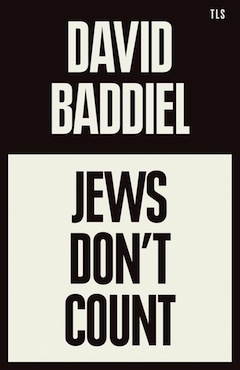
In Jews Don’t Count: How Identity Politics Failed One Particular Identity (TLS Books, 2021), author David Baddiel explores how the treatment of Jews is the exception to effectively everything today’s progressives espouse.

“It is a progressive article of faith – much heightened during the Black Lives Matter protests following the murder of George Floyd in 2020 – that those who do not experience racism need to listen, to learn, to accept and not challenge when others speak about their experiences,” he writes. “Except, it seems, when Jews do. Non-Jews, including progressive non-Jews, are still very happy to tell Jews whether or not the utterance about them was in fact racist.”

image - Jews Don’t Count book coverBaddiel discusses how racism and antisemitism are disentwined to disadvantage Jews, placing antisemitism lower on a “hierarchy of racisms” than other forms.

“Jews are stereotyped, by the racists, in all the same ways as the other minorities are – as lying, thieving, dirty, vile, stinking – but also as moneyed, privileged, powerful and secretly in control of the world,” he says. “And, if you believe, even a little bit, that Jews are moneyed, privileged, powerful and secretly in control of the world … well, you can’t put them into the sacred circle of the oppressed. Some might even say they belong in the damned circle of the oppressors.”

Baddiel confronts the canard that Jews can’t be victims of racism because they represent a religion, not a race – an audacious defining of an entire people by others who do not belong to the group, itself an example of something progressives would deign to do with no group other than Jews. By pushing antisemitism down the victimization scale, perpetrators can then accuse people who call out antisemitism as diminishing the experiences of minorities with legitimate claims to oppression.

When Baddiel called out one prominent antisemite, saying he had rarely heard so blatant a statement from someone with so large an audience, the perpetrator replied: “’Cos everyone was scared, that’s why.”

By alleging that a cabal of powerful Jews is policing the language of critics, the perpetrator, Baddiel writes, “isn’t a racist, he’s a hero, finally standing up and saying the things that need to be said even though it will bring down the wrath of this all-powerful Jewstablishment on his head.”

Similarly, when an article in the New York Times seemed like an attempt to rehabilitate the notorious antisemite Louis Farrakhan, the author replied to a critic who mooted the negative impact this could have on Jews: “Somehow, among the million concerns, you believe that yours are supposed to rise to the top.… That is called privilege.”

A recurring theme is that, unlike other minorities, Jews are not “innocent victims.” Baddiel (and the other authors mentioned here) do not explicitly say it, but it is understood that, for antisemites, Jews are not victims because, whatever the calamity, they bring it on themselves.

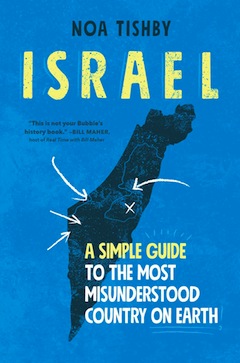
Another recent book, Israel: A Simple Guide to the Most Misunderstood Country on Earth by Noa Tishby (Free Press, 2021), picks up on some of Baddiel’s themes.

Tishby is an Israeli-American actor with a strong Zionist lineage. Her grandmother was a founder of the first kibbutz in Israel. Her grandfather was Israel’s first ambassador to West African countries and served on the Israeli delegation to the United Nations. Her great-grandfather was the founder of Israel’s ministry of industry and trade. Tishby served in the Israel Defence Forces entertainment troops, which she describes as, basically, “a nightly USO [United Service Organizations] tour.” She starred in an Israeli prime time soap opera – Ramat Aviv Gimmel, a sort of Israeli Melrose Place – then made the move to Hollywood.

image - Israel book coverHer book is aimed at people of her demographic – young, hip, leftist (though presumably non-Jewish) readers – and she presents, through biography and history, a tidy Zionist narrative that hits the bases. She does what pro-Israel writers rarely do: she uses emotion and personal stories, rather than dogged reliance on facts, chronology and empiricism. This is not to diminish the fact-based foundation of the book, but her first-person narrative connects the reader to the land and people of Israel in a way that cold facts do not.

Tishby provides a simple but thorough overview of regional history and the development of Israel, as well as the parallel history of the Palestinian and Arab peoples in the area. She dissects the claims of the BDS movement one by one, debunking the prevailing leftist narrative in the West. She pillories the obsession of the United Nations with anything Israeli and rebuts allegations of colonialism, apartheid, ethnic cleansing, unequal warfare and occupation quite effectively.

She recounts how, in the years after the Second World War, there were roughly 11 million refugees worldwide, 700,000 of whom were Palestinian.

“The 10,300,000 non-Palestinian refugees were funneled into UNHCR (United Nations High Commissioner for refugees, created in 1951), the UN agency dedicated to resettling and integrating refugees and/or stateless peoples,” she writes. The Palestinians got their own unique refugee agency: the UN Relief and Works Agency for Palestine Refugees in the Near East (UNRWA).

“While UNHCR is constantly working on getting the global number of refugees down, with UNRWA the numbers go up, up, up,” Tishby writes. “After the 1948 war, there were approximately 700,000 displaced people. Now UNRWA has 5.6 million ‘refugees’ registered in their books. How is that possible?”

Even Palestinians living in Gaza and the West Bank are counted as refugees by UNRWA, she notes, asking: “Can you be a refugee from Palestine when you currently live in … Palestine?”

Near the end of the book, Tishby throws some questions at the reader: “How would you handle a wannabe Sharia state 30 miles from your house? How should Israel retaliate when Hamas fires thousands of rockets into southern Israeli towns? Why haven’t the Palestinians agreed to make a final peace deal? Will the PA unite with Hamas and, if so, will Hamas denounce violence, like, ever? Why is Israel singled out? What about other countries that actually do systematically abuse human rights? Why aren’t activists focused on their freedoms of religion, speech, and assembly, which Israel grants all her citizens? Where are the boycott movements of neighbouring countries that literally kill people for their beliefs, desire for freedoms and democracy, or sexual orientation?”

Tishby’s Israel is an engaging, entertaining read and an ideal primer for newbies to the subject. For those more immersed academically or through lived experience with this topic, there is little new information, but it is largely an enjoyable read although, in an effort to be hip and approachable, she routinely employs gratuitous profanities, which might grate on some readers.

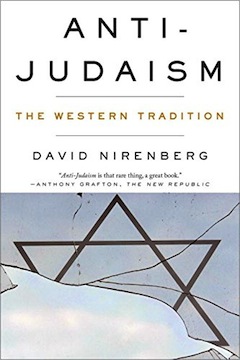
Far from these two volumes on the scale of page-turning readability is the monumental tome Anti-Judaism: The Western Tradition by David Nirenberg (W.W. Norton & Co., 2013). Published eight years ago, it had somehow escaped my eye and, when I did get my hands on it, it sat for some time on my pile. Cracking the spine was daunting because the thesis is dark and unnerving.

Nirenberg undermines the received wisdom that antisemitism is characteristic of ideological extremes in Western civilization. Instead, he depicts “anti-Judaism” as absolutely central and foundational to the very identity of Western civilization. (He differentiates “antisemitism,” which is discrimination against Jews, and “anti-Judaism,” which is perhaps a more pernicious, guileful thing, attributing “Judaism” and “Jewishness” to anything undesirable, whether the object is Jewish or not.) Applying Nirenberg’s thesis to Charlottesville is a simple way of understanding it. In the eye of the racists, immigration and multiculturalism are bad, ergo, by definition, they are “Jewish,” whether actual Jews have any hand in them or not.

image - Anti-Judaism book coverNirenberg provides a sadly compendious recital of civilizations for whom “Jews,” “Jewishness” and “Judaism” were used as a prism through (and against) which non-Jews defined their own identities.

“Why did so many diverse cultures – even many cultures with no Jews living among them – think so much about Judaism? What work did thinking about Judaism do for them in their efforts to make sense of their world?” he asks.

In Christianity, Jews are viewed as “materialist” and earthly, which is juxtaposed with Christians’ self-image as being concerned with the spiritual and the divine. In a theology where things terrestrial are equated with all things evil, the corollary is predictable.

Nirenberg quotes Jean-Paul Sartre, who said: “if the Jew did not exist, the antisemite would invent him.” The subtext of Nirenberg’s book, one could say, is that both things are true: the Jew does exist and the antisemite invented him. There are, in effect, two different “Jews”: real Jews and the image antisemites have created and refined for millennia.

It is this latter imaginary “Jew” that has been used not only to torment generations of actual Jews, but also to contrive the self-identities of civilizations. Nirenberg includes both Christianity and Islam under the rubric of Western civilization when he writes: “anti-Judaism should not be understood as some archaic or irrational closet in the vast edifices of Western thought. It was rather one of the basic tools with which that edifice was constructed.”

Since Christianity and Islam were both founded as supercessionary religions to Judaism, juxtaposing that theological parentage with an antipathy to the descendants of the parent religion creates a cognitive dissonance that Nirenberg describes as the “truth of Jewish scripture and the falsity of the Jews.”

Somehow, adherents of both religions have intrepidly managed to accommodate the dissonance.

“The simultaneous inclusion and exclusion of Judaism became for Islam – as it had been for Christianity – a structuring principle of the world, one through which Islamic truth was explored, discovered and articulated,” he writes. Jews were “both necessary and noxious, prophetic and pernicious.”

The religious bigotry permeates Western civilization, not just its religion, he argues. Nirenberg discusses how Marx employed typical Christian perceptions of Jews as materialistic to fit his atheistic ideology. He also analyzes how it influenced the Enlightenment and the French Revolution. For example, while the Declaration of the Rights of Man and of the Citizen, the great document of the French Revolution, does not mention Jews or Judaism, “it was famously presented and represented to the people – in a painting and in print – as two new tablets of law, replacing those handed Moses on Mount Sinai.” Never mind Christianity and Islam, when it came time for what was probably the most progressive, liberal society yet in modern history to define itself, the revolutionaries took Jewish imagery and firmly demarcated themselves as “not that.”

What is striking when immersing oneself in volumes about antisemitism is the stark certainty of today’s “critics of Israel” that they are untainted with antisemitic bias. They apparently have given little, if any, thought or effort to learn the history of antisemitism and its myriad permutations.

While Nirenberg speaks very little about Israel, he packs a powerful punch when, after hundreds of dense pages excruciatingly dissecting how civilizations for thousands of years have understood their identities and their most significant beliefs in direct opposition to Judaism, he declares: “We live in an age in which millions of people are exposed daily to some variant of the argument that the challenges of the world they live in are best explained in terms of ‘Israel.’”

Coincidence? It doesn’t seem so to those have studied the history and malleability of anti-Jewish ideas.

Posted on August 27, 2021August 25, 2021Author Pat JohnsonCategories BooksTags anti-Jewish, anti-Judaism, anti-Muslim, antisemitism, David Baddiel, David Nirenberg, history, identity, Jewish history, Noa Tishby, politics, racism, religion, Western culture
Proudly powered by WordPress