
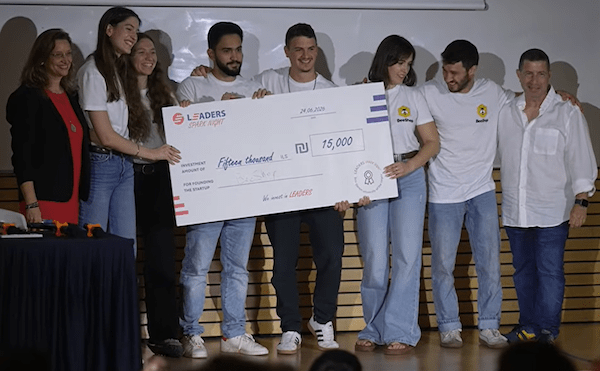
The Ben-Gurion University student team of BeeShop receives the top prize from Dana Gavish, left, and Gadi Bahat, right. (photo from BGU)
Palpably exuberant crowds, both in person in Be’er Sheva and virtually, assembled on June 24 to watch and vote in Leaders’ Spark Night, a live-pitch session featuring six student teams from Ben-Gurion University of the Negev’s Yazamut 360° entrepreneur program. The teams presented startup venture concepts they had been developing throughout the year.
Originally planned as a live RBC Lions’ Den competition in Vancouver in April, travel disruptions in Israel led to the postponement of the event. In the interim, the students continued building, and last month’s Leaders’ Spark Night showcased the culmination of their work.
Dana Gavish, founder of Yazamut 360°, began the event by offering thanks to the Friends of BGU organizations in the diaspora, making special mention of those in New York, Boston and Vancouver for “pushing the program forward.”
“The past year was extremely challenging for all of us, and especially for our dear students. Yet, even after all the uncertainty that we experienced, here we are today showing you their amazing and incredible work,” Gavish said.
“As the world is transformed by AI, big data and automation, the pace of change often exceeds our ability to predict it. In this reality, the most valuable skill is the ability to adapt. This is exactly what we try to instil in our students – the confidence to navigate uncertainty, embrace it and lead it.”
Before introducing the teams, Gadi Bahat, head of academic programs at Yazamut, said, while the program fosters the development of ideas into fruition, its objective is also to promote leadership, to get students through difficult situations, such as standing on a stage or hearing the word “no” when pitching their ventures.
Each student group had five minutes to pitch their concept. Industry experts from North America then asked questions. Afterwards, audiences in Israel and abroad scanned a code to vote. The three teams with the most votes won cash prizes to help them continue to develop their startups.
The pitches reflected the times, with an emphasis on computer and cellphone applications, as well as harnessing the positive potential of artificial intelligence.
DEXO, an online platform that connects customers and skilled designers to create precisely customized products, led off the proceedings. According to the student entrepreneurs, the venture has already launched in the United States, aims to complete 100,000 projects in 2028 and expand to other countries.
NightLine, a tele-health service linking new mothers with professional consultants for personalized, accessible and immediate parenting support, followed. The group, which will use AI to triage urgency, addressed the universal need for postpartum care and the market it represents.
In the third slot was BuilDEER, whose goal is to change the construction industry through an AI plugin that analyzes design codes and past solutions to generate the engineering fix that is compliant with building regulations, thereby reducing delays and costs.
Heedly, a service that prevents phone scams in real time – before damage is done – came next. Such scams are a problem worldwide, with elderly people most likely to fall victim. Heedly representatives said their fraud detection alerts the victim, a trusted family member and the financial institution when a scam call is taking place.
BeeShop, a group buying platform that hopes to leverage shared demand to lower prices, was the fifth to pitch. The concept behind the venture is that the more people who want a particular product and shop in bulk will force a supplier to reduce the cost of an item, whereas a single shopper is forced to pay a higher markup.
CourtX concluded the pitches. The startup focuses on sports, particularly basketball. Their service analyzes data in real time – i.e., during a game and using AI – to help coaches make quicker decisions than pen and paper allow. Capitalizing on basketball’s popularity internationally, the group plans to market its product in Europe initially and later in North America. They also intend to branch out into other sports.
The atmosphere online and in the Negev turned electric after the pitches wrapped up and voting began on the question: Which venture would you invest in? A screen appeared with the logos of all six teams, and the attendees could watch the results as the votes were tallied.
In the end, BeeShop was the convincing winner with BuilDEER in second and CourtX a close third. The three top finishers received cheques to invest in their ventures.
The three Vancouver industry experts who were slated for the April competition took part virtually, asking questions of the teams. They were Wendi Campbell, president and chief executive officer of Junior Achievement of British Columbia; Ryan Benn, CEO of Alive Publishing Group Inc.; and Shuli Gortler, CEO of SimplyAsk and a BGU alumnus.
Since its establishment in 2018, Yazamut – which means entrepreneurship in Hebrew – has seen more than 240 startups and ventures, with more than 2,000 program participants, 11,000-plus members of its entrepreneurial community, and more than $45 million in funds invested in its companies.
Sam Margolis has written for the Globe and Mail, the National Post, UPI and MSNBC.