בחודש פברואר ימלאו עשרים ואחת שנים לחיי בוונקובר. במקביל, המרחק שלי מישראל רק הולך וגדל
הזמן אץ לו רץ לו והשנים בהן אני נמצא כאן בוונקובר עברו כל כך מהר. אני זוכר את ההתחלה הקשה כאשר לא הייתה לי עבודה במשך שבעת החודשים הראשונים. באותה עת התחלתי ללכת ברחבי העיר ולהכיר מקרוב את הבית החדש שלי. בוונקובר ויתרתי על נהיגה כיוון שאני גר באזור הדאון טאון ואפשר להסתדר טוב ללא רכב
בהתחלה עבדתי בעבודה מזדמנת אצל חבר ולאחר מכן עבדתי בחברת גביה גדולה בתפקיד מחפש מידע לאור הרקע שלי בעיתונות. אחרי כשבע שנים ויותר עברתי לחברה פיננסית המספקת הלוואות ללקוחות שלא יכולים לקבל הלוואות מהבנק. עד היום אני עובד באותה חברה – למעלה מאחת עשרה שנים וחצי, ומשמש מבקר החברה בדרגת מנהל
בתחילת חיי כאן בוודאי שהרגשתי זר בוונקובר אך לשמחתי מהר מאוד מצאתי את מקומי, בתחום המקצועי והחברתי ובכלל. השתלבתי לא רע בחיי העיר, הכרתי מקומיים ולא רק ישראלים ולא חיפשתי להתחבר אל חיי הקהילה היהודית כאן. אני לא דתי ואינני שומר מסורת ואינני אף מרגיש את הצורך להדגיש את יהדותי או היותי ישראלי לשעבר. כל אלה עזרו לי בהשתלבות בחיים המקומיים. מרבית שנותי בוונקובר לא הרגשתי זר והחיים בקנדה בכלל הרבה יותר מתאימים לי מאשר בישראל
למען האמת התחלתי להרגיש כשגרתי בארץ כיוון שראיתי שהמדינה צועדת לכיוונים שאינם מתאימים לי ולהשקפת חיי. זה מאוד עצוב להרגיש כך במדינה בה נולדת כאשר את מרבית חייך עשיתה בה. ישראל הייתה מקום נפלא הצעירותי והחל משנות השמונים המאוחרות התחלתי להרגיש בשינוי לרעה. בסוף אלף תשע מאות שמונים ושמונה עברתי לתל אביב ובשנים הראשונות הרגשתי טוב ומחובר יותר. אך לאחר מספר שנים הרגשתי שוב שאני הופך יותר ויותר לזר ולא מסוגל להתחבר לתפיסת העולם הישראלית הבסיסית, להתנהגות של הישראלי הממוצע, לתזוזה ימינה ואל הדת ועוד. הנסיעות הרבות שלי לחוץ לארץ ובעיקר לאירופה רק החריפו את הפער ביני לבין ישראל
למרות שהייתה לי עבודה מעולה בתחום המדיה הבנתי שעלי לעזוב ולחפש עתיד טוב יותר מחוץ לישראל. לצערי רק בראשית אלפיים וחמש עזבתי את ישראל למרות שכבר שנים רבות קודם לכן רציתי לעשות זאת. המעבר רק היטיב עם חיי והפכתי להיות יותר מאושר ושלו. כואב לי מאוד על מה שקורה בישראל והמציאות הרבה יותר גרועה ממה שחזיתי. הקשר היחידי שלי עם ישראל נובע מהעובדה שיש לי משפחה וחברים שם. חלקם מיואשים והחלק האחר מתעלם מהמציאות הקשה ומנהל את חייו כאילו הכל בסדר. אני מבין את כולם ומאחל למציאות טובה יותר בישראל, אם כי אינני חושב שזה מה שהולך לקרות
באופן אישי היום אני מודאג מאוד ממה שקורה מעבר לגבול מדרום לאור השליט המטורף שמנהל את ארצות הברית, דונלד טראמפ. הוא גורם נזק גדול למדינתו, לקנדה ולמערב כולו. טראמפ מעולם לא חשב על תוצאות מעשיו והתנהגותו החמורה, גם בעת היה איש עסקים וכמובן מאז נכנס לבית לבן. קנדה התרגלה להיות תלויה בארה”ב ולסמוך עליה, עת שתי המדינות האלה היו קרובות מאוד בכל. כיום המציאות שונה לחלוטין בעידן טראמפ, והקנדים מתחילים להבין שקנדה צריכה להיות עצמאית ולהעמיק את הקשרים עם אירופה. במקביל יש להזיז את החסמים בין הפרובינציות ולאפשר חופש מסחר מקסימלי ביניהן
בראשית השנה החדשה ימלאו עשרים ואחת שנים להגעתי לונקובר ואין ספק שהזמן רץ כל כך מהר. לו יכולתי להחזיר את שעון הזמן אחורה הייתי עוזב את ישראל שנים קודם לכן. כבר בראשית שנות השמונים (לאחר השחרור מהשירות הצבאי) היה לי חלום שלא הרפה ממני והוא לעבור לגור בחו”ל. לאורך המשך שנות חיי הצטרפו סיבות נוספות (לחלום) מדוע רציתי לעזוב את ישראל ולבסוף עשיתי זאת רק בראשית שנת אלפיים וחמש.השנים הראשונות היו קשות במיוחד על רקע העבודה שנאלצתי להתמודד עם המציאות הלא פשוטה שבונקובר לא אוכל לעבוד עוד בתחום המדיה, כפי שעשיתי שנים בישראל. אמנם כתבתי כפרילאנס במשך שנים מכאן לישראל עבור ידיעות אחרונות ווינט, אך אין מקום להשוואה לעבודה הקבועה בארץ. במקביל התחלתי להבין שהמנטליות הקנדית שונה לחלוטין מזו שבישראל וזה לוקח זמן די רב להתאים את עצמך לכך
מכל מקום אחרי שעבדתי במשך כשבע שנים כמחפש מידע עבור חברה פיננסית מקומית, לאור הרקע העיתונאי שלי, הצטרפתי לחברת פרוגרסה שבה אני עובד עד היום – במשך אחת עשרה וחצי שנים. מדובר בחברה פיננסית שמספקת הלוואות ללקוחות שלא יכולים לקבל הלוואה מהבנק (בשל קרדיט גרוע). בשנתיים הראשונות שימשתי מנהל קשרי לקוחות ומזה קרוב לתשע וחצי שנים אני הוא מבקר החברה. זו עבודה אחראית ומאתגרת ואני אוהב לעשותה. אני לא חושב בשלב זה כלל על נושא הפרישה למרות שבקנדה הגיל הרשמי לצאת לפנסיה הוא 65. מבחינתי הכל פתוח לגבי השאלה עד מתי אמשיך לעבוד בחברה
בהיבט האישי יש לי זוגיות קרובה במשך למעלה משמונה שנים וזה מעניק יציבות לחיי שנינו. בת הזוג שלי הגיעה מסין והפכה את ונקובר כמוני, לבית הקבוע שלה. למרות הרקע השונה יש לנו עניין משותף בלא מעט תחומים בהם אמנות, מוסיקה ועיצוב. שנינו מאוד אוהבים את אירופה והקלאסיות שבה. מאוד נהנינו לבקר בשנים האחרונות בציריך, ברצלונה, מדריד, לונדון, דבלין ואמסטרדם – שהיא עדיין העיר האהובה עלי. אנו מתכננים בשנים הקרובות להמשיך ולטייל בערים המרכזיות של אירופה
אני אוהב לחלק את בני האדם לשתי קבוצות מרכזיות: עכברי עיר ועכבר שדה. אנו עכברי עיר שאוהבים את מה שהערים יכולות להציע, ובעיקר בתחום התרבות. בנוסף הנוף העירוני מושך אותנו בעיקר כשמדובר במבנים עם היסטוריה ארוכה
בשעות הפנאי ביוזמתי אנו לוקחים חלק באירועי מוזיקה המתרחשים בונקובר בהם: קונצרטים של התזמורת הסימפונית המקומית ואופרות של בית האופרה המקומי. בנוסף אנו הולכים בקביעות למועדון הג’אז המקומי שמארח אמנים מארה”ב ומקומיים כאחד. בתחום מוסיקת הפופ הלכנו למספר הופעות באצטדיון הגדול (שנמצא סמוך לביתנו) ובהן של: פול מקרטני, אלטון ג’ון, פיטר גבריאל, להקת קולדפליי וטיילור סוויפט.
יש לי כאן גם מספר חברים ורובם לא ישראלים וזה טוב כי חיפשתי להשתלב בחברה המקומית ולא להישאר זר לנצח . גיוון החברים שלא שייכים לקבוצה אחת ואף לא מכירים אחד את השני, הופכים את המפגשים עימם למעניינים ופוריים. מי שמכיר אותי יודע שאני לא אוהב מפגשים חברתיים בקבוצות גדולות, אלה מפגשים של אחד עם אחד או זוג עם זוג נוסף
ונקובר נחשבת לאחת הערים היפות בעולם עם טבע מדהים גם ממש בעיר עצמה. לא צריך להרחיק לכת כדי להגיע לפינות טבע שקטות, כיוון שהעיר מוקפת במים ובתוכה נמצאים מספר פרקים בהם סטנלי פארק שהוא גדול מהסנטרל פארק של ניו יורק. בהחלט עיר שמומלץ לבקר בה
OneTable dinners – a platform for young professionals to meet on Shabbat – are occurring in 700 cities, including Toronto, but not yet Vancouver. (photo from OneTable)
My son moved to Florida in August, choosing the Sunshine State for its large Jewish community, great weather and the many outdoor recreational possibilities it offers when Vancouver is soaked with rain. He quickly found opportunities to engage with young Jewish professionals like himself, through a synagogue, but also through OneTable Shabbat dinners.
“I had an amazing Shabbat experience,” he told me, as he explained how it works.
Someone agrees to host a Shabbat dinner for a certain number of people, who each bring an item to help with the meal. OneTable reimburses the host $10 per person, which doesn’t cover the costs, but it helps, particularly if the host is feeling cash-strapped.
In my son’s case, the meal was take-out sushi, which was completely fine with the 20-somethings gathered around that Florida table. They talked, laughed and ate together, kindling new friendships and inspiring my son to play host at a OneTable Shabbat soon.
My curiosity piqued, I started making inquiries about OneTable. What a great fit this would be for Vancouver, I thought, given how difficult it is to make new Jewish friends here. That’s especially true for young Vancouverites looking for Jewish partners in a city with an intermarriage rate of 43%, according to a 2011 study and intermarriage rates in Canada have increased, according to another study that came out this year, so likely Vancouver’s has, too.
But it’s also a challenge for Gen Xers like me. What an incredible idea, to surround yourself with potentially new Jewish friends at a home table defined by challah and shared food! Alas, OneTable is not offered here.
Irit Gross, chief advancement officer at OneTable, described how the organization began in 2014, when two philanthropists united to address the epidemic of loneliness that was occurring. Young Jewish adults were focusing heavily on their mobile phones, and disassociating themselves from the traditional Jewish institutions where their parents and grandparents had socialized.
OneTable sent out a survey, asking young people what it would take to get them to choose Shabbat on a Friday night, rather than another option.
“People were socializing online, so we knew we needed to meet them in a virtual space,” Gross said. “We began investing in a platform similar to Airbnb, where, as a host, you could go online and post your dinner and, as a guest, you could join one. That’s the essence of how we started, with the goal of people going online to be offline.”
The $10 per person remuneration was added when OneTable realized money was a barrier to millennials wanting to host five to 10 people in their homes. The reimbursement allows the host to elevate their offering; for example, by buying better wine, or a nicer tablecloth for the event.
That first year, OneTable began in the Jewish heartbeat of North America – New York City. As the organization fundraised and collaborated with local federations in other cities, it quickly expanded to Chicago, Los Angeles, Boston and Miami.
“We knew where the young adults were and went to set up shop in those locations,” said Gross. Today, OneTable dinners are occurring in 700 cities, including Toronto, and 49 states, as well as Washington, DC.
The organization has engaged 320,000 unique individuals, with many returning for more. “Those 320,000 people have come back and either guested or hosted two or three times. That engagement rate shows that our goal and mission of creating a Shabbat ritual is coming to fruition and happening in the community,” she said.
Prior to Oct. 7, 2023, OneTable was engaging 40,000 unique individuals annually. “After Oct. 7, that jumped to 82,000 unique people, meaning we doubled in 2023 and sustained that increase in 2024,” Gross noted. “It’s been a marker for our organization, catapulting us to really think not just about how we’re addressing millennials, but, also, bringing Gen Zs together.”
After reading reports about how Jews across many different age groups were looking for ways to find community, OneTable expanded its offerings, though its core audience remains the 20-to-30-something demographic, which accounts for 95% of its time and budget.
The organization’s research is far from over. “We’re still trying to figure out how to stay relevant and continue to be the number one choice for young adults in their 20s and 30s, so they can create their own Shabbat rituals,” said Gross.
Five years ago, the UJA Federation of Greater Toronto requested collaboration with OneTable, beginning a conversation that would take two years before the program launched. OneTable began operating in Toronto in 2023 with a three-year funding grant, and Gross said Toronto has been one of its most successful communities.
OneTable is not in Vancouver, and there seems to be no conversations about it coming here. Prior to Oct. 7, the Ronald S. Roadburg Foundation reached out to OneTable.
“I think it’s a great organization, but we’re not funding in the space of young adult engagement,” said Mark Gurvis, the foundation’s chief executive officer. “If we were funding young adult engagement, we’d fund this for sure. Federation’s involvement is the key for this, and whether we’ll step in with Federation remains to be seen.”
I asked the Jewish Federation of Greater Vancouver about the possibility.
“While Vancouver doesn’t have OneTable, we’re fortunate to have many organizations that host meaningful Shabbat dinners and gatherings that bring people together throughout the community,” said Caryl Dolinko, Federation’s communications and marketing director.
“We are continuing to develop a family-connector model to strengthen engagement. We’re also happy to explore other initiatives and opportunities that are out there in the community, as we would love to do with OneTable.”
She continued, “Our focus remains on supporting the many partnerorganizations and community initiatives that already create opportunities for meaningful Shabbat experiences and peer connection.”
Dolinko gave the example of Axis, a Federation initiative for Jews in their 20s and 30s. “Last year, Axis held 15 events for 682 unique participants, with 345 attending multiple events,” she told the Independent. The network connected 32 volunteers to community organizations and maintains active WhatsApp and Instagram engagement, she said.
“We are restructuring our PJ program to prioritize mixed-heritage families and have expanded PJ Library access into public school libraries, pediatrician offices and other community spaces,” she added.
With an intermarriage rate like ours in Vancouver, I’d argue that the current model is not working. But no one is asking me.
I moved to this city to start my family, in 2000. Now, a quarter-century later, three of my children have left for other cities and countries, where their odds of meeting Jewish partners are much better. My youngest will follow in two years. I miss them desperately, but I want them to spread their wings – and I want them to marry someone Jewish.
Gross understands all too well that funding dollars need to go to other worthy initiatives.
“There are a lot of people out there fighting against hate,” she noted. “I don’t know if there are enough people fighting for the joy of Jewishness, the special rituals that remind us why we love our traditions.”
Lauren Kramer, an award-winning writer and editor, lives in Richmond.
Editor’s note: This article has been updated from the print version to better reflect Jewish Federation of Greater Vancouver’s commitment to youth engagement in the community.
היום השאלה האם להמשיך ולגור בישראל, לעזוב או לחזור ולגור בה או לעשות עלייה -היא רלוונטית יותר מאי פעם. מצד אחד ישראל נמצאת במצב בטחוני, כלכלי וחברתי לא פשוטים, ומצד שני האנטישמיות ופגיעה בישראלים וביהודים היא ממשית ביותר
אני עזבתי את תל אביב ועברתי לגור בוונקובר שבמערב קנדה לפני למעלה מעשרים שנה. אני יכול רק להצטער שלא עזבתי שנים קודם לכן בעת היותי צעיר יותר כי זה היה חלום חיי. חברו לחלום ההרגשה שהפכתי להיות זר בישראל ולכן העדפתי להיות זר בחו”ל. בנוסף, המצב הבטחוני של ישראל גם הוא הטריד אותי. אילו הן שלוש הסיבות המרכזיות שהביאו אותי לעזוב את ישראל. כבר בראשית שנות השמונים (אחרי השירות הצבאי) התחלתי לחלום על מעבר לחו”ל ולצערי רק כעבור עשרים שנה הגשמתי זאת
לקום ולעזוב לחו”ל זה דבר לא פשוט שכרוך בהרבה מאוד סיכונים. וצריך גם אומץ רב והאמת שזה היה חסר במקרה שלי. רק בסוף שנת 2004 כאשר קיבלתי את הניירת ההגירה לקנדה החלטתי שהפעם אני לא נותן לעצמי שום הנחות ותירוצים – מדוע שלא לעזוב. כעבור שלושה חודשים סיימתי את כל ענייני בתל אביב ועליתי למטוס שהביא אותי לוונקובר, בה אני חי עד היום
בשנות השמונים והתשעים רציתי לעבור לאירופה (תחילה ללונדון ולאחר מכן לאמסטרדם). בראשית אלפיים זכיתי בגרין קארד ואז החלטתי לעבור לניו יורק. אך היעדר האומץ כפי שציינתי והעבודה שכל כך אהבתי בתחום המדיה: “החזיקו” אותי בישראל. עבדתי בעיתונות במשך שבעה עשרה שנים והיה לי מאוד קשה להיפרד ממנה. בשנים האחרונות למגורי בישראל קיבלתי הצעות מפתות מהעורכים המובילים בעיתונות אך דחיתי את כולן, כי אחרת הייתי מתקשה עוד יותר קשה לעזוב. משה ורדי הציע לי לעבוד בידיעות אחרונות, אמנון דנקנר – מעריב, גיא רולניק ואיתן אבריאל – דה מרקר (שהיה מופרד אז מהארץ) וחגי גולן – גלובס
לבסוף הצלחתי להתגבר על כל המכשולים הנפשיים ועזבתי את ישראל לטובת קנדה. מרבית בני משפחתי וחברי הבינו אותי, ותמכו בצעדי. כמובן שהיו בודדים שלא ראו בעין טובה את “ירידתי” מישראל ולאורך הזמן היחסים ביננו הפכו לקרירים ואף נותקו. הגעתי לוונקובר, ובשנותי הראשונות עבדתי כמחפש מידע בחברה כלכלית. לשמחתי במשך מרבית שנותי כאן כתבתי (כפרילנס) עבור ידיעות אחרונות ווינט על מה שקורה בקנדה. לפני למעלה מאחת עשרה שנים הצטרפתי לחברה הפיננסית המספקת הלוואות סאב-פריים, ואני משמש מבקר החברה ואף עובד מהבית בשמונה השנים האחרונות
עוד שגרתי בישראל ראיתי עתיד שחור למדינה שהופכת להיות יותר דתית-חרדית-ימנית-לאומנית. אז התחלתי לקלוט שאין לי יותר מקום במדינה בה נולדתי וגדלתי ושהייתה בית מצויין במשך שנים. לצערי המציאות השתנתה לרעה וכאמור התחלתי להרגיש זר בישראל. מצאתי את עצמי שייך למיעוט שהוא וקטן וכיום ההבדלים בין שני המחנות עצומים ולא ניתנים לגישור. מלחמת ששת הימים עם הניצחון הגדול הביאה את תחילתה של תנועת ההתיישבות בשטחים הכבושים. וכך גם החל לגדול המחנה המשיחי. ומטבע הדברים לדתיים וחרדים יש הרבה ילדים והמספרים מנצחים. מציאות זו לא מתיישבת עם עקרונותי ודרכי ועל כן מצאתי לי בית חדש בקנדה
כיום אני מנותק כמעט לחלוטין מהוויה והתרבות הישראלית ורק השפה העברית מקשרת אותי לישראל. הקשר עם בני משפחה וחברים בישראל עדיין חשוב לי אך במקביל המרחק ביני ובין המדינה הולך וגדל. ישראל לא תשוב עוד להיות ביתי
Jewish agencies have filed a complaint against Sean Orr, a Vancouver city councilor who spoke earlier this month at an event they say has links to terrorism.
Orr was elected to council in a by-election last April, representing the Coalition of Progressive Electors. He spoke at the “Flood Vancouver for Palestine” rally at the Vancouver Art Gallery Oct. 4.
The protest was organized by Al-Awda Vancouver, an organization that the Centre for Israel and Jewish Affairs (CIJA) says has documented links to Samidoun: Palestinian Prisoner Solidarity Movement, which the Government of Canada last year designated as a terrorist entity under the Criminal Code.
CIJA identified Al-Awda Vancouver as being connected with Samidoun through Samidoun’s international coordinator, Charlotte Kates, who was listed as a member of Al-Awda’s national board as recently as Nov. 6, 2024, on a webpage that has since been deleted. Both Al-Awda and Samidoun are members of the NY4Palestine Coalition, according to CIJA, which noted that Dave Diewart, a director listed on Samidoun’s corporate filings, was seen working at the Oct. 4 event.
CIJA, with the Jewish Federation of Greater Vancouver, filed a formal complaint with the City of Vancouver’s integrity commissioner, Lisa Southern, regarding Orr’s participation in the protest.
“Sean Orr is an elected official of the city of Vancouver,” Nico Slobinsky, CIJA’s vice-president, Pacific region, told the Independent. “We strongly believe that those who hold public office should hold themselves, and should be held to, a higher standard. We believe that it is inappropriate for an elected official to use their public office, to use their platform, and to give legitimacy to organizations that have links to terrorist organizations, terrorist entities.”
The complaint was filed on Oct. 9, and an acknowledgment from the integrity commissioner’s office was received. The complainants are now waiting to hear back.
Sean Orr, a Vancouver city councilor, spoke at the “Flood Vancouver for Palestine” rally at the Vancouver Art Gallery Oct. 4. (photo from vancouver.ca/your-government/sean-orr)
Orr’s speech was shared on social media. The councilor insists there is nothing controversial in his remarks.
“Being against what the UN calls of a genocide is not controversial,” he said. “Being against apartheid is not controversial. Calling for an end to illegal settlements is not controversial. Being in favour of enforcing international law is not controversial. Condemning the murder of journalists, doctors and children is not controversial. Calling for an arms embargo is not controversial. Calling for a boycott on Israeli wines is not controversial. But here we are. I think silence is controversial. I think famines are controversial. I think blockades are controversial. I think intercepting aid ships is controversial.”
Orr cited his family’s history as explaining his position.
“As someone whose parents are from the north of Ireland, I’m deeply aware of the effects of colonialism, famine, checkpoints and collective punishment,” he said in the speech. “So, while some will criticize me for speaking here today, I will remember where I’m from.”
Slobinsky said Orr’s presence at the rally sends the wrong message.
“At a time when cities in our country are seeing an unprecedented rise in antisemitism,” said Slobinsky, “and when cities like Manchester … have come face-to-face with the deadly impacts of extremism and support for terrorism, our civic leaders in Vancouver should be a model for dialogue, for inclusion and for protection and safety for all communities. I would like to remind Sean Orr that that is his duty to the residents of the city.”
Prior to and after his election on April 5, Orr was called out by Jewish organizations and others for statements on social media, including statements after the 10/7 terror attacks in Israel.
“[M]erely 23 days after Hamas’s barbaric Oct. 7 massacre in which over 1,200 Israelis were murdered, Councilor Orr falsely accused the state of Israel of committing acts of genocide while it acted to defend its citizens and sovereign territory from terrorist aggression,” the Jewish Federation of Greater Vancouver and CIJA said in a joint statement three days after Orr was elected. “Such reckless and inflammatory language not only distorts reality but also endangers Jewish communities by further inflaming antisemitism and denying Israel’s right to defend itself.”
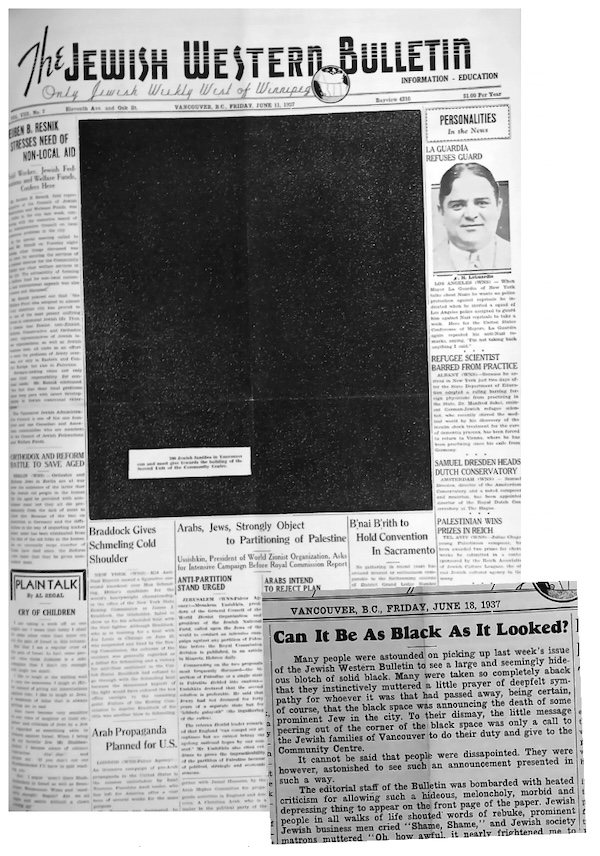
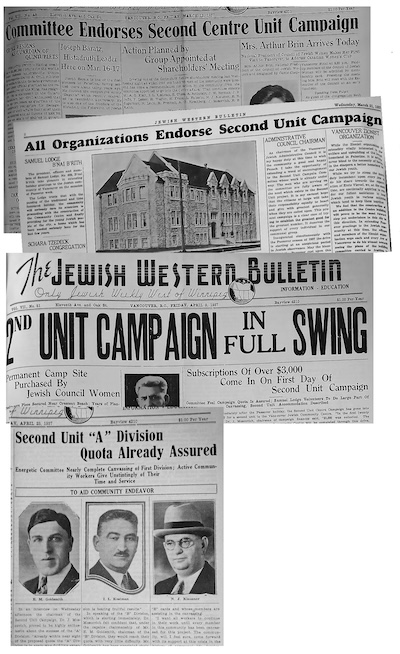
It was the big black square on the cover of the June 11, 1937, Jewish Western Bulletin that caught my attention initially. Then, as I flipped backwards and forwards through the archived papers, it was the weekly drama – that kind of left me hanging – and the sheer bluntness of tactics that drew me in to the JWB’s coverage of the 1937 campaign to raise funds for a second unit of the Jewish Community Centre, then located at Oak and 11th. (The building still exists, the home of the BC Lung Association for a long time now.)
The campaign action plan came out of a shareholders’ meeting in March of that year, at “which over one hundred men of the community were present,” according to the March 12, 1937, JWB, the JI ’s predecessor. I’ve no idea who the shareholders of the centre were. Nor if any women were at that planning meeting, but Lillian Freiman Hadassah, Council of Jewish Women and the Schara Tzedeck Auxiliary were among the organizations that helped solicit and collect pledges.
The appointed campaign committee set a quota of $12,500 (or $271,217 in today’s dollars) and collections were divided into three divisions: donors of $100-$250 (Group A), $25-$100 (Group B) and up to $25 (Group C). The “keynote” of the campaign was “that each give according to his ability,” and every organization on the committee committed “its intention of getting whole-heartedly behind the task ahead.” Meanwhile, “The proposal submitted to shareholders by Schara Tzedeck Congregation of taking over the building has been tabled for a period of three weeks.”
While that proposal obviously fizzled out, I couldn’t find any later mention of it. As I’ve often found when looking through the paper’s archives, it’s easy to find when things start, but harder to find out how they ended up. What is clear is that there was a hard push to raise the $12,500, and, while the March 12 article noted that, “possibly, for the first time in community history, there is no division of opinion concerning the necessity of and the urgent need for doing constructive work for [the] community Centre,” the JWB did feature some disparate views as soon as the next issue.
Rabbi J.L. Zlotnik summed up those concerns in a March 19 article: the quota was too much, given other community concerns and organizations that also needed financial support; and the quota was too little, given that actual building costs are almost always larger than planned, and the community would, therefore, become even more indebted as a result.
“After a period of ten years, twenty thousand dollars are still to be paid before this building can truly be called our own,” wrote Rabbi Samuel Cass in the March 31 issue, about the existing centre, while also pointing to the need for a second unit. He observed, “First, we must not repeat the mistakes of the past,” so the second unit should “be paid for in cash to the very last penny, before the first sod is turned. Second, the campaign must go beyond the amount necessary to erect the contemplated addition.” Lastly, he said, the whole community must agree that the debt on the first unit be paid off “even speedily, and at a near time.”
The advice seems to have gone unheeded. In the same March 31 paper as Cass’s article, the page 2 headline read, “All Organizations Endorse Second Unit Campaign.”
The next edition’s cover blared, “2ND UNIT CAMPAIGN IN FULL SWING,” with the news that more than $3,000 had come in on the campaign’s first day, “collected from twenty men.” The building plans were also outlined in the April 9 paper: a two-storey building with a balcony was envisioned. The lower floor would be a gymnasium and banquet room, with “kitchen, showers, wash room, steam rooms, cloak-room, etc.” The upper floor would house an “Auditorium and Ball Room, cloak-room and lounge.” The balcony would be divided into small meeting rooms. “This present building is 33 feet 11 inches on 11th Ave. The addition would be 47 feet 9 inches or more than 40% larger,” the article stated.
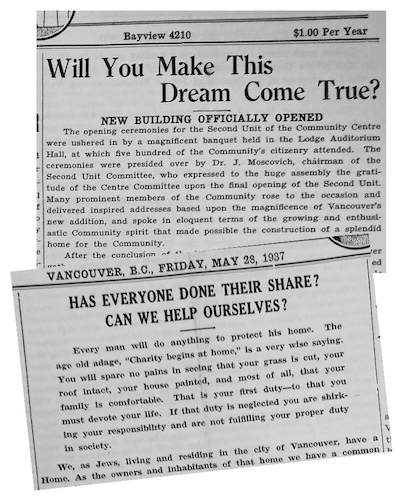
By the April 23 issue, the A Division quota was “already assured.” A couple of weeks later, in the May 7 paper, a completely fictional piece was published on the cover, titled “Will You Make This Dream Come True?” It was written as if the second unit of the centre had opened, with a banquet, a highlight of which was the announcement of a $5,000 gift from an anonymous donor to pay for all the unit’s furnishings and appliances. The article imagined what meetings and other banquets were already being held in the new building and the great number of athletics classes available now that “the use of the gymnasium was available to all persons in the Community.”
By the end of May, though, the JWB was asking whether everyone had “done their share.” By June, the optimism hit a wall.
The cover of the June 11 issue featured the large black square that caught my eye. The label-sized caption with a white background read: “700 Jewish families in Vancouver can and must give towards the building of the Second Unit of the Community Centre.”
The dramatic editorial choice was explained in the June 18 paper:
“The editorial staff of the Bulletin was bombarded with heated criticism for allowing such a hideous, melancholy, morbid and depressing thing to appear on the front page of the paper. Jewish people in all walks of life shouted words of rebuke, prominent Jewish business men cried ‘Shame, Shame,’ and Jewish society matrons muttered ‘Oh, how awful, it nearly frightened me to death.’
“No one, however, said ‘That little message in white, standing so pure, apart from that black hideousness was TRUE. Every body should give to the Centre – How we need that second unit – How essential it is to our Youth to have a proper meeting place.
“What our Community needs is more players, and less bench criticisizers. More workers, and less kickers.”
It concluded: “If you have a conscience, if you have the true community spirit – come through and show it. If you haven’t already given your contribution to the Second Unit – Mail it in to the Centre – tell them this article made you feel your responsibility. If you have given your donation, send in notification to the Centre to have it doubled. No matter what you give, make it as much as you can afford. Don’t let us be criticisers – LET’S BE BUILDERS.”
Over the summer, a couple of meetings were held about the centre. There was a large notice on the cover of the July 2 paper about a July 5 meeting, but I couldn’t find a report in the paper about what transpired. Nor could I find out how the Sept. 22 “mass meeting” on “the Future of Vancouver Jewry” went – its Sept. 14 front-page notice declaring that “By your attendance … YOU SHALL BE JUDGED!”
There are no August or October 1937 papers in the bound archival collection I have, and I don’t know if they were lost to history or never published. Until June 1937, the reporting had been detailed and consistent, but the next mention of a campaign, in the Nov. 12 paper, is “the Recent Centre Drive” – not the second unit drive. In this campaign, there were seven grades, ranging from Grade A ($500 and up) to Grade G ($1 to $49). The Grade A donors were listed by name in that paper, the Grade Bs in the next issue, the Cs in the next, through to the Gs in the Dec. 24 issue, wherein the committee was congratulated for its work and the community for its “whole-hearted support to the campaign.”
Since there is no useable digital archive of the paper, sadly, my time-limited flipping came across no more mention of a second unit. The editorial two years after that campaign, on June 23, 1939, started, “Much water has gone under the bridge since our Centre Building has been re-financed. Inside and outside improvements on the building, in addition to the Amortization Plan itself has gone forward.
“Never have local Jewish efforts been more active, and the response greater, nor has the attendance within the building itself been so large. Much of the success is due to the liberal atmosphere of the Centre itself, which means the use of this building for any and all worthy Jewish efforts with but one thought – helping others to help themselves. One shudders to think of what might have happened to Jewish efforts in our city had not our fellow-Jews responded to the call for funds when it was made.”
The editorial also noted: “Some, however, have through oversight or neglect failed to send their payments in as yet.” It was hoped that “the pledgors in arrears will … see that their respective remittances are made … upon receipt of the notices.”
As far as I know, the second unit of the Oak and 11th JCC never materialized. It would be more than two decades later that a new centre would be built, at Oak and 41st, opening in 1962.
Summer is a time when our routines are happily disrupted. Kids are out of school and many of us take time off from work to enjoy the hometown that draws tourists from around the world. Maybe we wander off the beaten path and see parts of our own city we usually miss on our repetitive commute. Perhaps we leave town for a week or two and return with fresh eyes.
Anyone who has lived in Vancouver and environs for more than a few years can’t help but see change at every turn. Many of us are watching our old elementary and high schools being replaced with new structures, memories being ploughed under with the old bricks. Community centres throughout the city are seeing replacements. Canada’s oldest business, the Hudson’s Bay Company, is being liquidated, leaving another gaping hole (for now, at least) in the retail landscape at the heart of downtown. Woodward’s is a distant memory. And, of course, what old-timers call “the new Oakridge” is being redeveloped into the new new Oakridge, as anyone trying to navigate by car or bus along 41st or Cambie cannot help but be reminded.
Not everyone likes change, put mildly. But, it is inevitable.
It is simplistic to say there is only one way to go – up. There is an alternative, albeit not a good one. We could continue a 20th-century trend to suburban sprawl, in which we lay housing and concrete across precious arable land.
Novelties like laneway houses have attempted to increase capacity in erstwhile single-family neighbourhoods. Along arteries like Oak, Cambie and Granville, single-family homes are giving way to four-, six- and eight-unit developments. As was always the plan, mixed residential and commercial hubs are skyrocketing from the ground up around transit stations, as evidenced most profoundly around Brentwood, Metrotown, Marine Drive and Oakridge.
Which brings us back to what, for most of the past century, has been the “Jewish neighbourhood.”
That term is a bit of a misnomer. A place where most Jews live does not equate to a place where most people are Jews. Even in the most Jew-dense neighbourhoods, we remain single-digit or low-two-digit proportions of the population. Emotionally, traditionally, spiritually and institutionally, since the 1950s at the latest, the rough area around Oakridge, down Oak and Granville and the surrounding blocks, have been home to Metro Vancouver’s Jews.
This reality began fraying about three decades ago, when housing prices began their notorious upward escalations. (Great for homeowners. Not great for first-time buyers.) And the Jewish community became more geographically dispersed, with inevitable positive and negative consequences.
While the City of Vancouver still holds the largest share of the BC Jewish population (at 58%), other municipalities now have significant Jewish populations, including, in order of size, Richmond, Surrey, the District of North Vancouver and Burnaby. Greater Vancouver’s proportion of the BC Jewish population has decreased, though, from 81% in 2011 to approximately 75% in 2021. (For much more data, see jewishindependent.ca/quick-look-at-canadian-jews.)
For Jewish institutions, this reality has demanded accommodations, with services becoming less geographically rooted. Many agencies, notably the Jewish Federation of Greater Vancouver, Jewish Family Services and even the Jewish Community Centre, which by its nature is geographically rooted, are successfully delivering programs across the region.
For Metro Vancouver’s Jews, and for every cultural group, this relentless change has personal and collective impacts.
The JWest development on the 41st and Oak JCC site will include – among other things – hundreds of new homes, notably purpose-built rentals, the scarcity of which is a major contributor to the crisis in the housing market. These hundreds of new homes will not, of course, all be occupied by Jews. But they will be a dramatic increase in available homes in what was, and may again become, the heart of a “Jewish neighbourhood.”
This does not take into account the thousands of other new homes being developed within a radius of a few kilometres, not least at the Oakridge site. Will these be affordable housing? In Vancouver, that term has perhaps lost all meaning. Everything is relative. But volume and variety of housing options are the key to what approaches the concept of affordability.
We can only remotely predict the sociological impacts these dramatic physical changes in our city will have on our day-to-day life, including the vibrancy of Jewish life – not only here, but around the Lower Mainland and the rest of the province.
Last month, 16 students from three different high schools in the Galilee visited Vancouver, where they participated in several activities. (photo by Kristin McIlhenney)
“It is nearly impossible to put into words the profound experience we had in Vancouver,” Dr. Rachel Ravid, co-director of Galilee Dreamers, told the Independent. “For the first time, host families welcomed us directly at the airport – a moment of emotion I will never forget. The level of care and thought given to our visit was evident even before our arrival, through a preliminary Zoom meeting during which we shared about the Galilee Dreamers program and the backgrounds of the students they would be hosting. From afar, we could already feel the warmth that awaited us.”
Galilee Dreamers is a program of Oranim College of Education, in Israel. Established nearly a decade ago, it “brings together Jewish and Arab high school students from northern Israel, cultivating dialogue, empathy and mutual respect, while helping participants explore their personal and collective identities,” Ravid said.
A key aspect of the program is connecting these Israeli students with peers abroad and Galilee Dreamers groups have traveled to cities in several countries, including Canada, where Toronto has participated in previous years. Last month, 16 students from three different high schools in the Galilee came to Vancouver, where they were hosted by 12 local families, visited a few schools and participated in several activities. The delegation then headed to Seattle.
There were six students from Akhva-brotherhood High School in Yarka, a Druze school; five students from Jewish schools Einot Yarden and Misgav Regional High School; and five students from Atid Bir al-Maksur, a Muslim school representing a Bedouin way of life, said Ravid. “The students ranged in age from 16 to 18 and were selected for their leadership potential and their capacity to develop leadership skills.”
The co-director of Galilee Dreamers, Dr. Malek Hujeirat, who is deputy principle at Atid, led the group from there, and Diana Mulla, a Druze English teacher, led the delegation from the Druze school. “I was responsible for accompanying the Jewish students and overseeing the delegation,” said Ravid.
While the process of planning the April 18-25 trip was challenging, Ravid said “the spirit of volunteerism and support from community members in Vancouver was truly remarkable. Marion Rom led the planning team with vision and dedication, alongside Dalia Margalit, who offered support from both near and afar.
Galilee Dreamers participants at Tsleil-Waututh Nation siʔáḿθət School. (photo by Kristin McIlhenney)
“The intention was to create as many opportunities as possible for interaction with different parts of the Vancouver community, in order to better understand the local realities and challenges,” said Ravid. “In parallel, we aimed to connect the visiting students with the natural environment, the region’s history and its diverse cultures.
“Alongside school visits with Jewish students – where we discussed the core values of the Galilee Dreamers and universal values such as solidarity, listening, compassion and empathy – our students also learned what daily life looks like for peers their own age in a different society.
“A key element of the itinerary was community volunteering,” said Ravid, and, at the Jewish Community Garden, the group spent some time working and learning.
The host families also “initiated activities rooted in their own strengths and passions, allowing each student to experience something unique within each household,” added Ravid.
One of those families – Tal and Avital Jarus Hakak, who had two Jewish students stay at their home – “hosted a dinner that included another host family of two Druze students and a hike afterwards. One of us also helped with a tour of UBC,” the couple said.
“The positive impact of this trip on the students’ attitudes towards their peers and teachers from different communities and cultures was heartwarming. We felt like these impacts have a great importance for the future,” said the couple, who were motivated to take part because, they said, “The idea of a youth program for facilitating dialogue between Jewish, Arab and Druze sounded very appealing and interesting, particularly in this time of local and global conflicts.”
Kristin McIlhenney found out about the visit from a friend.
“Knowing I had previously hosted international students, she encouraged me to consider it,” said McIlhenney, who hosted a student from the Bedouin school and teacher Hujeirat, “who also serves as the principal overseeing multiple schools in his village.”
“As an educator, I deeply believe in the transformative power of travel and intercultural exchange to build empathy and global awareness,” she said. “That belief, combined with my background, made me genuinely enthusiastic about supporting the Galilee Dreamers by becoming a host.”
Beyond providing room, board and transportation for her guests, McIlhenney said “the experience organically evolved into something much richer. Groups often gathered in the evenings, leading to shared dinners and deeper connections, both in our home and in others’. It was incredibly moving to hear three languages spoken under our roof, and to learn everything from simple cultural details – like the high price of sushi where they live – to complex and personal perspectives on life in a conflict-affected region.”
For McIlhenney, there were two particularly special benefits of being a host. “First,” she said, “my two elementary-aged sons formed a strong bond with the student who stayed with us. A gifted soccer player, he spent hours playing with them and they even accompanied him to a match where they watched [Lionel] Messi play against the Whitecaps – a memory they’ll cherish for years. Second, as a former educator, I deeply appreciated the profound conversations I had with the principal. Whether while preparing meals, driving or winding down in the evening, our discussions gave me a rare and meaningful glimpse into his reality – and helped me reflect more critically on my own.”
Both McIlhenney and the Jarus Hakaks would “absolutely” host again. And trip co-organizer Rom would “definitely help bring those kids in the northern Galilee next year if they want to come back.”
Rom, Margalit’s brother and Galilee Dreamers co-founder Dr. Desmond Kaplan all went to high school together in South Africa, explained Rom of the local connection to the program and how the Vancouver stop came to be.
Rom and Margalit found the host families, and Margalit, who was out of town when the visit took place, “gave this program ‘legs’ in the early stages of planning,” said Rom.
“I wanted to help because I believe that dialogue and interaction of the Jewish, Bedouin and Druze high school youth in the northern Galilee is one of the most impressive paths to peace in that region,” said Rom.
“The most moving part,” she added, “was when the youth and host families all met together one evening to talk about life in northern Israel since Oct. 7, 2023, and what this program means to them.”
“For my part,” said Margalit, “I agreed to assist in arranging the visit when I heard that the group would be made up of students from the Bedouin, Druze and Jewish communities. At this time of tensions between Israel and Palestine, I felt this was a particularly important aspect of the visit, and of daily life in Israel, that would be very important for the Vancouver Jewish community to hear about.”
“As the region faces heightened tensions and conflict, the lack of mutual understanding and shared vision between Arab and Jewish communities threatens the very fabric of society,” said Ravid. “These divisions are compounded by systemic separations: Jewish and Arab teenagers grow up in separate neighbourhoods and towns, attend schools where different languages are spoken, and rarely – if ever – encounter one another in meaningful ways that could challenge stereotypes and foster understanding. Frameworks that nurture mutual respect, empathy and collaboration are critically absent.
“This reality not only affects the people of Israel,” she said, “but also perpetuates a global lack of awareness about the rich and diverse voices that make up Israeli society. Around the world, young people often have little understanding of the complexities of life in Israel and few models for overcoming divisions to build shared futures.”
Galilee Dreamers “creates safe and meaningful spaces where young people from different backgrounds – who might otherwise remain strangers – build real relationships based on trust, empathy and common purpose,” said Ravid.
“Equally important is the program’s impact on the communities that host us – whether in Israel or abroad,” she continued. “By sharing their personal stories and experiences of living in a complex, multicultural society, Galilee Dreamers offer host communities a window into what grassroots peacebuilding can look like. These encounters inspire interfaith dialogue, foster global solidarity and leave lasting impressions on local families, educators and youth who engage with the group. The mutual learning is profound, and many host communities describe the visit as hopeful, eye-opening and deeply moving.”
While some communities and institutions in Israel and the diaspora “have become more cautious about engaging with programs like Galilee Dreamers” since Oct. 7, “the program continues to operate, with participants expressing a renewed commitment to dialogue and understanding,” Ravid said.
Galilee Dreamers students visited Jewish and other institutions, including Peace Mennonite Church, while they were in Vancouver. (photo by Kristin McIlhenney)
The students who participated in the delegation that came to Vancouver shared with Ravid “that they had never experienced such a meaningful and warm form of hospitality. They spoke about the deep love and care shown to them, and how much the host families prioritized their personal well-being,” she said. “They expressed sincere gratitude for the time and attention their hosts gave to hearing their personal stories – and the stories of their families. The connection was so strong that many of the students affectionately referred to their hosts as their ‘second parents.’
“In addition to the emotional connection, the students also appreciated the opportunity to take part in activities they had never experienced in Israel: from ice hockey games and bike rides, to hiking in nature, riding a ferry, and taking a cable car up a snow-covered mountain. Perhaps most enthusiastically, they spoke about the unique food experiences, especially the sheer number of donuts they joyfully consumed without pause!”
For Ravid, “One of the most emotional moments of the trip was the community gathering toward the end of our stay,” she said. “Each of us shared reflections and feelings from the journey. I was particularly moved by the words of Ezra Shanken, chief executive officer of the Jewish Federation of Greater Vancouver, who said that the Galilee Dreamers’ visit brought out the strengths of the local Jewish community and its ability to mobilize around a meaningful initiative. His emphasis on solidarity was incredibly powerful and deeply relevant – especially in these days, when personal and collective security in Israel and around the world feels fragile.”
Both the Jewish Community Centre of Greater Vancouver and the Jewish Federation contributed to the local visit, the latter helping with the planning as well as funding. There were many other organizations and people that Rom, Margalit and Ravid thanked.
“On the day of departure,” said Ravid, “I saw many tears and heartfelt hugs – testament to the meaningful connections and impact this journey had on both the students and the families.”
The left in Vancouver came roaring back to life last Saturday, April 5. In the civic by-election to replace two city councilors, Sean Orr, candidate of the far-left Coalition of Progressive Electors, topped the polls, with Lucy Maloney of the left-leaning OneCity coming second.
The two candidates of Mayor Ken Sim’s ABC slate finished far back. ABC candidate and Jewish community member Jaime Stein, who was bombarded with extreme antisemitic hate on social media during the campaign, came sixth, with 9,267 votes. His running mate, Ralph Kaisers, came seventh with 8,915. By contrast, Orr took 34,448 and Maloney 33,732 (all numbers are unofficial election night results).
The first results were not reported for three hours after polls closed, as officials held back counts until every voter had a chance to cast a ballot. The city was apparently caught off guard by higher-than-expected voter turnout, leading to hours-long lineups at voting stations, even after the 8 p.m. scheduled poll closing. Election day turnout was 15% of eligible voters, representing a 40% increase from the last civic by-election, in 2017.
Orr has a history of anti-Israel activism and social media posts, as well as arguably antisemitic expressions, including reposting comments such as “What does the ‘I’ in CIJA stand for?” and “Antisemitism is when I’m not allowed to chant ‘Death to Arabs.’”
The results seem to spell disenchantment with Sim’s ABC slate, which still holds seven seats on the 11-member council. ABC swept into office in 2022 on a platform of public safety, affordability and housing.
Jaime Stein hopes to bring a Jewish voice to the table at Vancouver City Hall. He is vying for one of the two seats that will be filled in a by-election April 5.
One seat opened after Councilor Christine Boyle was elected as a New Democrat to the BC Legislature in the provincial election last year. She had been the sole representative on council for the OneCity electoral organization.
The other seat opened after Councilor Adriane Carr, one of two Green party councilors, resigned, citing frustration with the governing style of Mayor Ken Sim and his ABC majority.
Jaime Stein said that, when meeting with a couple of hundred voters every day, he and his running mate, Ralph Kaisers, are hearing that people are “really happy with how ABC is willing to take on difficult issues.” (Courtesy Jaime Stein)
Stein is on the ABC slate, with running mate Ralph Kaisers. They hope to increase ABC’s existing majority on council. ABC currently holds the mayor’s chair and six of the 10 councilor positions.
Aiming to prevent a larger ABC majority are four electoral organizations.
TEAM for a Livable Vancouver has nominated former city councilor Colleen Hardwick and community organizer and urban researcher Theodore Abbott.
The three other groups have nominated one candidate each. OneCity has nominated schools and street safety activist Lucy Maloney. COPE, the Coalition of Progressive Electors, has nominated writer and punk musician Sean Orr. The Green party has nominated filmmaker and advocate Annette Reilly.
There are six independent candidates running: Jeanifer Decena, Guy Dubé, Charles Ling, Karin Litzcke, Gerry Mcguire and Rollergirl.
The dual by-election is the first test of the ABC majority on Vancouver city council since Sim and his party were first elected in 2022.
Stein said that, when meeting with a couple of hundred voters every day, he and his running mate Kaisers are hearing that people are “really happy with how ABC is willing to take on difficult issues, whether it’s in the Downtown Eastside or whether it’s with crime and safety or whether it’s just examining new ways to do things that maybe councils in the past haven’t done.”
He thinks there is a silent majority that doesn’t make a lot of noise but who are generally pleased with the direction the city has been taking in the past three years.
The issues that led to the ABC victory in 2022 have not changed significantly, according to Stein.
“I think the biggest issue, number one, is crime and safety,” he said. “People want Vancouver to be a safer city, one that they can get out and enjoy.”
The second most common issue he hears about, he said, is “making Vancouver open for business again.”
“That means reducing red tape for businesses,” said Stein. “It means making it easier for people to interact with the city, whether they need permits, etc., and also opening it to the world, like bringing more festivals and events here, like FIFA or Web Summit, and trying to generate tourism dollars in the city for folks.”
While Stein sees value in having a Jewish voice at the table, he said Vancouver already has Canada’s “most friendly mayor and council to the Jewish community.”
Although Vancouver’s second mayor, David Oppenheimer, was Jewish, there have never been a great many Jews in elected positions either locally, provincially or federally from British Columbia. Stein hopes his candidacy inspires other Jews to get involved.
“It’s a voice that needs to be at the table, not only to advocate for our community but also to serve as a role model for others to get involved in either the political process or in civic discourse in general,” he said.
Stein has corporate and nonprofit sector leadership experience, including in the technology sector at companies including BroadbandTV, Taplytics and Hootsuite. He partnered with Canadian Blood Services to raise $12.5 million for establishing Canada’s national public cord blood bank, inspired to do so by the loss of his father, Howard Stein, to leukemia, in 2006. He is also on the board of an agency advancing Alzheimer’s research.
In the Jewish community, Stein was selected as a 2024 Wexner Fellow, a two-year educational program focused on Jewish learning and leadership development. He chairs a committee on the Antisemitism and Israel Crisis Response Team. With the Jewish Federation of Greater Vancouver, Stein has worked with elected officials to develop public policy to strengthen community safety and security. He has been a volunteer and fundraiser supporting Jerusalem’s Shaare Zedek Medical Centre and has volunteered in different capacities with the Centre for Israel and Jewish Affairs, the Canadian Jewish Political Affairs Committee, the Jewish Community Centre of Greater Vancouver and others.
Last year, Stein was nominated as the BC United candidate in Vancouver-Langara, but did not run in the provincial election after the party folded its campaign and endorsed the BC Conservatives.
Polls are open election day, which is Saturday, April 5, from 8 a.m. to 8 p.m., but there are opportunities to vote early at Vancouver City Hall, on Tuesday, April 1, from 8 a.m. to 8 p.m., and people can also cast their vote by mail. For full details, go to vancouver.ca/vote.