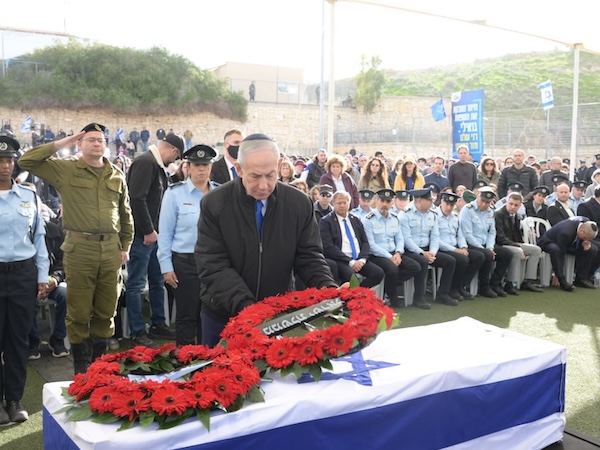
Yasam (Israel Police Special Patrol Unit) Master-Sgt. Ran Gvili z”l was buried on Jan. 28 in his hometown of Meitar. The last remaining hostage from the Hamas attacks of Oct. 7, 2023, his body was brought back to Israel on Jan. 26. After 843 days, the clock in Tel Aviv’s Hostages Square stopped ticking, and the displays of the kidnapped at Ben-Gurion Airport and the National Library of Israel were removed. For the first time since 2014, not a single Israel Defence Forces soldier or civilian is being held hostage in the Gaza Strip.
Two years, three months and 20 days after Gvili, 24, fell in a battle at Kibbutz Alumim near the Gaza Strip, the hero was given a fitting military funeral. Thousands of police officers, IDF soldiers and residents stood in silence along the streets of the Beer Sheva suburb as the funeral procession passed.
The service was attended by President Isaac Herzog, Prime Minister Binyamin Netanyahu, Police Commissioner Daniel Levy and Sephardi Chief Rabbi David Yosef, alongside senior political and security figures. The sombre ceremony was the first funeral of a hostage from Oct. 7 attended by the prime minister.
Netanyahu eulogized Gvili: “He considered his injured shoulder meaningless because he believed with all his heart and strength that the security of the state rested on him and the shoulders of his comrades.
“He saved lives – many, many lives,” said Netanyahu.
The prime minister also announced that a new town, Renanim, would be established near Meitar in Gvili’s memory.
Addressing the family, Herzog apologized on behalf of the people of Israel, saying: “I’m sorry we were not there for him. I am sorry that, along with so many other families, you had to wait so many long, agonizing days for the return of your loved one.”
He added: “Without hesitation and without asking, again and again, [Gvili] said, ‘Here I am,’ and went into the line of fire to protect us.”
When the attacks began at 6:29 a.m. on Oct. 7, Gvili was at home, where he had been recovering from a broken shoulder sustained in a motorcycle accident. As news began trickling in of kibbutzim and cities near the Gaza frontier being overrun and their residents massacred, he decided to join the battle. Though on medical leave, he reached for his gun and his uniform, and went to help.
His father, Itzik Gvili, told Ynet News that his son “just put on a uniform and said to me, ‘Abba, I’m going.’ I said to him, ‘Where do you think you’re going?’ and he answered, ‘What do you think? Do you think that my friends will fight alone? I’m going to help them.’ He didn’t ask me. Rani can’t be stopped.”
Driving west toward the carnage at the Nova music festival, Gvili rescued an estimated 100 people fleeing the rave. He then engaged in a battle with dozens of Hamas gunmen near Kibbutz Alumim, killing 14 terrorists before being fatally shot when he ran out of ammunition. At 10:50 that morning, he texted friends that he had been shot in the leg.
For months, Gvili’s family held out hope that he was alive and being held hostage somewhere in the Gaza Strip.
His mother, Tali, told Haaretz in November 2024 that the family had received photos from Oct. 7 showing him arriving unconscious at Shifa Hospital in Gaza City, and later in Zeitoun on the back of a motorcycle, “but they aren’t conclusive … in this situation, hoping for a miracle feels reasonable.”
Gvili’s body was recovered by IDF search teams following a months-long intelligence operation. Under combat conditions in the northern Gaza Strip, some 700 bodies were disinterred at al-Bats Muslim cemetery in Shuja’iya and Gvili’s was identified by IDF dentists after carrying out the forensic examination of 249 corpses. Many noted that the word ran (singing) has a numerical value in gematria of 250. Gvili was still wearing his uniform, and he was buried in it rather than in shrouds as is customary for civilians.
According to the Hostages and Missing Families Forum, “Ran had a passion for motorcycles, enjoyed gatherings with friends, cherished moments with his sister and brother, and relished playing the guitar while sipping lemon arak.”
Gil Zoharis a journalist and tour guide based in Jerusalem.
The overwhelming joy of seeing the remaining hostages reunited with their loved ones, and Israelis and Jews heaving a sigh of relief after two excruciating years, is tempered with the sadness of all that was lost on and since Oct. 7, 2023. The entirely reasonable fear, also, is that this eight-decade conflict is not over. With the days-old ceasefire already fraying, it is not clear that even the immediate conflict is decisively ended.
For Jews in the diaspora, the past two years have seen two related but distinct conflicts. The war in the Middle East, with the fate of the hostages as well as the loss of Palestinian and Israeli lives, has been a constant source of pain. The paroxysm of antisemitism worldwide has been a parallel phenomenon.
We are careful to note that the phenomenon of antisemitism is parallel to the war in Gaza, not caused by it. The blame for antisemitism must always be placed where it belongs – on antisemites. To justify it as being a consequence of international affairs is to excuse the perpetrators and avoid the problem. Even so, it is naïve to ignore the parallel – for decades, every time violence flares between Israelis and Palestinians, trouble increases for Jews worldwide.
Assuming that the war is over, we will see whether the antisemitism we have witnessed and experienced – the violence against Jews, the attacks on Jewish institutions, the loss of jobs, the end of friendships, the graffiti, vandalism, and tsunami of online and verbal hatred and conspiratorial speculation (and even unintended offence) – abate. Even if it does subside, the underlying issue remains. Antisemitism in Canada is a Canadian problem. To accept that it ebbs and flows with international news is not an acceptable approach for people who claim to oppose racism and advance inclusion.
Two interesting approaches – and doubtlessly scores more that have received less publicity – take aim at the issue. They come from organizations with significantly different views and propose significantly different responses. This diversity is understandable, in part because antisemitism manifests in diverse ways and so requires diverse responses. This also points to a larger problem: antisemitism is so diffuse and varied, and so historically enduring, that we can disagree on its very nature, its manifestations and causes, let alone how to confront and overcome it. If anyone had the magic solution, we wouldn’t be having this discussion three millennia on.
The latest intervention is a report by the Nexus Project, a US-based nonprofit focused on combating antisemitism while protecting democratic norms like free speech and civil rights. The Shofar Report: A Call to Defend Democracy and Confront Antisemitism contends the best way to combat antisemitism is to strengthen the values of American society (and other Western societies). It argues that Jewish safety and security and American (or, we might extrapolate, Western democratic) institutions are inseparable. Put succinctly, their approach rests on the conventional wisdom that the very societies where antisemitism flourishes are endangered in existential ways. As such, antisemitism is a kind of canary in the coal mine of societal erosion.
The report has several calls to action, including expanding education around the Holocaust, media literacy and diverse Jewish contributions to society; strengthening civil rights enforcement; countering disinformation and conspiracy theories; preserving academic freedom; building cross-community coalitions; and so forth. It critiques antisemitism on the left and right of the political spectrum. While these are not fresh ideas, they are compiled and contextualized here within the apparent erosion of American democracy. If these approaches have not seemed to work, a response might be that we have not been doing them forcefully enough or with enough resolve. With a rapidly changing landscape, might focused attention and some new tactics yield better results?
The Heritage Foundation has a rather more assertive approach. The foundation is perhaps best known in this era as the authors of Project 2025, which serves as a policy map for the current American administration.
Project Esther: A National Strategy to Combat Antisemitism, which was released a year ago, rests on the assumption that antisemitism in the United States (and, again, to extrapolate, in the West) is not an incidental, populist phenomenon, but a deliberately fomented strategy of a coordinated “Hamas Support Network.” The strategy of this report is to put pressure across academic, social, legal, financial and religious spheres to identify and isolate forces they see as perpetrators, supporters or fence-sitters. Their aim is to dismantle the “pro-Palestinian” movement as it is currently constituted, including associated liberal and progressive organizations. To that end, they focus exclusively on left-wing antisemitism. They recommend a combative strategy based on existing and new counter-terrorism and hate-crime laws, investigations and litigation.
We may agree with aspects of one approach more than the other, or take nuggets from each and a thousand other tactics. The solution to antisemitism’s rise, if there is one, will probably come from some synthesis of strategies: building bridges, fighting for democracy, and holding individuals and institutions accountable for their failures and fomentation. The most important thing is to be engaged in the struggle and not to assume that, if an overseas conflict is resolved, the domestic problem will be solved. That would be a form of denial and, while we can disagree over the potential resolutions, we must be unanimous in recognizing the painful realities of the problem.
News of a possible breakthrough that could lead to the end of the war between Israel and Hamas is encouraging, but there is effectively no happy ending to this situation. Nothing can return the lives lost or undo the horrors of the past two years. Even if it ends tomorrow, the tragedy of this war will go down as one of the saddest, most protracted chapters in a heartbreaking history.
The international repercussions have been less lethal but will have permanent implications for, among other things, the stability and well-being of Jewish communities in the diaspora. Global antisemitism has reached unimagined heights. And, globally, Jewish people and organizations are at odds over how to proceed.
For many months, voices in Israel, among Jews worldwide and in our own local community have been divided over, among other things, whether Israel should unilaterally end the war, pursue it to the stated end of eliminating Hamas or, depending on the perspective, something on a spectrum between these views. Some are calling for an Israeli or international occupation of Gaza.
Here in British Columbia, weekly solidarity rallies at Vancouver City Hall have continued, sometimes with small numbers, and featuring a diversity of voices. Other rallies, including marches across the Burrard Street Bridge and, this week, a community commemoration of the second anniversary of 10/7, have brought together overlapping and different participants.
It is sometimes hard for human beings, especially those deeply determined to do the right thing, to accept that there can be legitimate but differing opinions on the best way forward. We should be able to agree on this: no one can predict the future or know for certain what is best for the people of that region (or for Jews worldwide). We may disagree on fundamentals, such as whether a two-state solution remains a viable possibility or whether, at the other end of opinion, the West Bank and Gaza should be absorbed into an enlarged state of Israel (a perspective still generally viewed as extremist), or whether some kind of federated one-state system might integrate both peoples’ needs and futures. If we disagree on the end goal, we will almost certainly find fault with the other side’s means of reaching it.
Stuck as we may be in what seems an ideological, moral, political, strategic and theological disagreement, it is easy to view others, even those in our own community, as adversaries – this certainly is reflected in some of the messages we have received in recent days. On the one hand, we received an open letter to community rabbis ostensibly reminding them what Jewish morality entails, and, on a different hand, we received messages declaiming those in our community who call for a ceasefire as being in cahoots with nefarious groups, including one proscribed by the federal government as a terrorist entity. Both missives encourage community members to call out those who do not agree with their approach.
The passions ignited around this topic are understandable. These are existential issues faced by our people and our homeland. With no universally agreed-upon ends or means, division is inevitable. We should, though, keep in mind that, while it is our obligation to pursue justice, that pursuit includes minimizing harm in our own community. We should be guided by the understanding that our actions will have greater impacts on our people’s well-being here at home than on events halfway around the world.
While it may be difficult in the moment of discord to see the sincerity and humanity of those we see as our opponents, there is a commonality at play. Believe it or not, the people in our community most vehemently hostile toward your outlook are convinced, as you are, that they are acting in the best interests of the Jewish people, and, in most circumstances, the best interests of our homeland.
Human affairs are an art, not a science. There are – surprise! – no right answers, only opinions and presumptions. As convinced as we may be otherwise, not one of us can conclusively know for certain the best avenue to pursue to bring about the future we dream of.
At a minimum, let us presume we are all committed to a future of peace, justice and security. What that looks like, and how we get there, will differ.
Let us further presume the best intentions in others and celebrate our shared desire for positive outcomes and the impassioned commitment even of those with whom we disagree.
In the Gaza Youth Committee campaign We Live Together, We Die Together, young Gazans hold, in a show of solidarity with Israelis, photographs of Israeli children who were killed on Oct. 7, 2023. (photo from Rami Aman)
“People must understand that the people of Gaza are not victims and they are not superheroes. We are human beings, a group of people like any other society. We love life and hate death, we love singing and we hate violence. We are not terrorists. Parents pay to educate their sons and daughters in medicine, engineering, pharmacy, art, business, English and other languages. Gaza is not Hamas, and Hamas is not Gaza – Hamas is part of the Muslim Brotherhood,” Palestinian journalist Rami Aman, founder of the Gaza Youth Committee, told the Independent in a recent interview.
JI readers may have seen on social media one of the latest Gaza Youth Committee (GYC) campaigns, called We Live Together, We Die Together. Its images feature young Gazans holding, in a show of solidarity with Israelis, photographs of Israeli children who were killed on Oct. 7, 2023. The Gazans stand amid buildings and neighbourhoods destroyed in the Israel-Hamas war. The Independent was connected with Aman by Vancouver Friends of Standing Together.
“As the months of war passed, many voices increased within Israeli society opposing the killing of Gaza’s children, expressing solidarity with their families, and calling for an end to the war,” he explained about the social media campaign. “In Gaza, we saw tens of thousands of Israeli demonstrators carrying pictures of child victims in the Gaza war. Therefore, despite the killing, hunger, siege and shortages in Gaza, it was important for us to prove that, in Gaza, there are Palestinians who object to the killing of any child, and to show their solidarity with all the child victims who have fallen in the war, Israeli or Palestinian.
“We have lost a large number of Muslim, Christian and Jewish children because of this war between Hamas and the Israeli army,” he said. “This campaign emerged from Gaza to emphasize the people’s rejection of the war and the killing of children, and the need to release the Israeli hostages, end the war and provide medical treatment for the children of Gaza.”
Palestinian journalist Rami Aman, founder of the Gaza Youth Committee, speaking at an event. One of his goals is to hold meetings between Palestinians and Israelis to help them respect one another and determine their own fate. (photo from Rami Aman)
Aman started the GYC after the first Israel-Hamas war, which he described as “a turning point” in his life.
“I began thinking about trying to do something two months after the end of the war in 2009. I decided to look for a place to establish an FM radio station in Gaza that would emphasize the voice of the peaceful people of Gaza,” said Aman, who has a bachelor’s degree in electronics and communication engineering. “At the beginning of August 2009, I received my first request from Hamas security. They interrogated me for long hours, and I was subjected to repeated assaults by Hamas members in the following days. They warned me against broadcasting any radio station or publishing any media content about Gaza without their permission.”
Realizing that Hamas wanted no other voice from Gaza than their own, Aman said, “At the beginning of 2010, I decided to form an independent youth group whose goal was to spread awareness internally and to strengthen our relations externally. Our first meeting included 30 young men and women from Gaza, and we agreed on the need to form an independent youth body that would advocate for Palestinian reconciliation and spread the voice of peace from Gaza to the entire world.”
The Gaza Youth Committee currently has more than 300 members inside and outside Gaza, said Aman, “and we are still trying to reach our goals.”
“We are all working to convey the true image of the people of Gaza and to build genuine partnerships with Israelis to help Palestinians and Israelis understand and respect each other,” he said.
Over the past 15 years of activities and meetings, Aman said he has learned a lot, “including how to influence public opinion within Gaza and how to build pressure and advocacy campaigns.
“Over these years,” he said, “I’ve realized the importance of inviting enemies to dialogue, instead of fighting, and trying to shape a different image of the other. These years have helped me differentiate between the Palestinian who wants to build their society for the better and the Palestinian who seeks to achieve their own interests from the Israelis or Palestinians at the expense of others.
“After many different activities between the Gaza Youth Committee and several Israeli movements and organizations, we have built many bridges and created a lot of connections and relations.”
GYC initiatives have included the release of 200 doves from Gaza with messages of peace, Skype calls between Gazans and Americans, and Gazans and Israelis, and a cycling marathon along the border in which both Israelis and Gazans participated.
This work has not been without risk. Aman has been arrested and tortured by Hamas more than once for his peace initiatives with Israelis, as have people with whom he has worked. After a GYC Zoom call in April 2020, he was arrested, Hamas apparently being alerted by the social media post of journalist Hind Khoudary, who was consulting for Amnesty International at the time.
According to a 2020 Jerusalem Post article, “she did not tag Hamas officials in her Facebook posts against Rami Aman to get him arrested but as a protest against normalization activities.
“‘I want all the normalization activities he is doing with Israel from Gaza to stop immediately because any joint activities, cooperation or dialogue with Israelis is unacceptable, even engaging with Israeli ‘peace activists,’” she said in an interview with the Post.
To secure his release, Aman was told he’d have to divorce his then-wife, the daughter of a Hamas official, who was also among those arrested. He eventually signed the papers in August of that year. His wife had already been released at that point, but Aman remained in prison, despite what he’d been told. He was prosecuted in September 2020 for “weakening revolutionary spirit,” and ultimately convicted. After international pressure, he was released in late October, with a suspended sentence, according to a 2021 article in the Times of Israel.
His former wife traveled with a Hamas escort to Cairo while Hamas released Aman from prison one day later. The couple kept in touch after Aman’s release from prison and subsequent move to Cairo in 2021, but have drifted apart for various reasons. Intending to return to Gaza in late 2023, the war caused Aman to change his plans.
“When I first started working for Gaza from abroad, I felt strong and free, and I regained my energy,” he said. “With the outbreak of the war, I began to feel stuck. I couldn’t call on people to demonstrate to end the war while I was on Facebook. People in Gaza trusted me because I was always the first to demonstrate against Hamas, from 2011 until before I left Gaza. If I were in Gaza, I would certainly demonstrate, even for an hour every day, to end the war. Then I would call on people to demonstrate while I was on the street.”
While he would prefer to be in Gaza, Aman said technology has helped GYC’s activism greatly, even before he had to leave his homeland.
“From 2007 until now, Israel has consistently imposed blockades on the residents of the Gaza Strip,” he explained, “while Hamas remained unaffected by any crises and received hundreds of millions of dollars with the help of the Qataris and [Israeli Prime Minister Binyamin] Netanyahu, in addition to Hamas’s control over travel through the Rafah crossing.
“The real blockade was imposed on us in the Gaza Youth Committee and the majority of Palestinians, so we used Skype and Zoom to communicate with our friends and partners outside Gaza, the most famous of which was the Skype with Your Enemy initiative in 2014.
“We also organized hundreds of meetings that helped introduce me to the world and led several organizations to extend invitations to visit them abroad. I traveled to India because of these meetings, which led to me meeting with the Dalai Lama. A few months ago, I was in Europe to speak about Gaza in several European cities.
“Most of the news coming from media outlets and news agencies will not present the truth to anyone, and it is better to communicate directly with the people in Gaza,” said Aman. “Israel has not provided us with permits to enter the West Bank and Jerusalem. Since 2010, the Israeli authorities have only granted me a 12-hour permit to attend a workshop in 2014 and permits to transit to Jordan when traveling from Gaza. For me and others, these applications have resulted in the building of a large number of personal friendships that continue to this day because they have been created between people, both Palestinians and Israelis.”
Aman has strong criticisms of the media in general, and Al Jazeera in particular, as well as UNRWA (the United Nations Relief and Works Agency for Palestine Refugees in the Near East).
“No Palestinian in Gaza watches Al Jazeera. No Palestinian in Gaza trusts in UNRWA. No Palestinian in Gaza trusts in all of these media,” Aman told UN Watch in an interview earlier this month.
In this atmosphere, the GYC continues its efforts.
“We at the Gaza Youth Committee work to strengthen the capacities of Palestinian youth, develop their skills and create a Palestinian movement from Gaza, the West Bank and the diaspora that expresses the aspirations of the independent Palestinian people,” said Aman. “At the Gaza Youth Committee, we always strive to hold meetings between Palestinians in Gaza and Israelis, helping them respect each other and determine their own fate by implementing joint initiatives and conveying their voices to the Americans and Europeans.
“Before the war,” he said, “we always tried to organize demonstrations to demand that Hamas hold elections, resolve the unemployment and electricity crises, and step back from governing Gaza. Even now, during the war, we are working to direct the people of Gaza to demand an end to the war.”
Aman contends that most Gazans want peace, despite polls that indicate the opposite.
“I don’t believe that much in polls,” he said, “but I understand Palestinian and Israeli public opinion. The two societies have been at war for years and have seen nothing but bloodshed and destruction, and wars only create enemies. Trust was lost before Oct. 7 and the distrust increased after the war.
“I have always believed in the importance of talking to enemies and engaging in dialogue instead of fighting. This is what I do through Zoom and Skype meetings. If there is one Palestinian and one Israeli who believe in a peaceful solution, then there is hope. We need courageous decision-makers who can lead their societies toward peace, not lead them toward fighting, hostage-taking and spreading hatred.”
Given his years of organizing video conferences, Aman said, “I have considerable experience, gained from speaking with thousands of Palestinians and thousands of Israelis. Their beliefs and opinions differ, but the common humanity that unites them always remains. They don’t know each other because of the media, and I believe in what I do and in every person’s right to life and safety, regardless of their religious or political beliefs.”
Working with “the enemy” has become Aman’s life mission. This, despite having been imprisoned and tortured by Hamas, having had loved ones killed or taken away from him by both Israeli forces and Hamas, and his neighbourhood in Gaza being destroyed by Israeli bombs.
“It’s true that, as a person, I suffer every day from this news and all the memories,” he admitted. “In addition to what Hamas did to me, it was horrific and psychologically and physically painful. However, there are people around me from whom I get this energy, and I always feel that I must be their partner in promoting dialogue and respect between Palestinians and Israelis.
“With every loss of a person, I always feel that they are advising me to continue my path and take care of their children,” he said. “Therefore, in my activities, I always aim to help families and individuals I know well, and I don’t want them to feel that I am far away from them. That is why I do my best to make their voices heard and that is from where my sense of responsibility for this matter comes.”
Aman is certain there are partners for peace on both sides.
“I consider myself a partner to any Israeli who seeks peace and an end to the war,” he said. “I know that there are Israelis who consider themselves peace partners with the Palestinians. I know Palestinians and Israelis who have lost their children and parents and still believe in peace, so that no more victims fall.”
He stressed the need to stand together.
“Our voices must unite to stop the war, free the Israeli hostages, protect the Palestinians in Gaza and help them rebuild their society,” he said. “We must find 50 Palestinian and Israeli leaders who will work to bring Palestinians and Israelis together.”
As Aman responded to the Independent’s questions, he said Israel Defence Forces tanks were “stationed hundreds of metres away from where my family and friends are. But I always know,” he said, “that life exists and so does death. Anyone can be the next hope and anyone can be the next victim.”
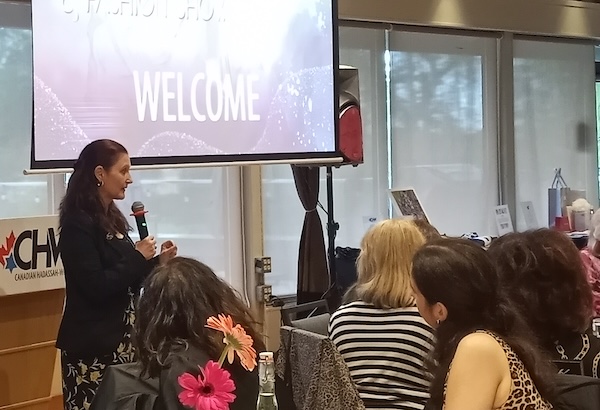
Israeli journalist Rolene Marks, chair of WIZO’s Hasbara Division, was the keynote speaker at CHW Vancouver Centre’s Opening Lunch and Fashion Show on Sept. 14. (photo by Cynthia Ramsay)
“I know that, as a community, you are feeling vulnerable and you are feeling that you have to be the mouthpiece or, as I call it, the litmus test, for however Israel is prosecuting a war so many miles, so far away, from you,” Israeli journalist and advocate Rolene Marks told those gathered at CHW Vancouver Centre’s Opening Lunch and Fashion Show on Sept. 14. “And I want to tell you that, although Israel’s not perfect – even though we are the only country in the world expected to prosecute a perfect war – you can be proud of the state of Israel.”
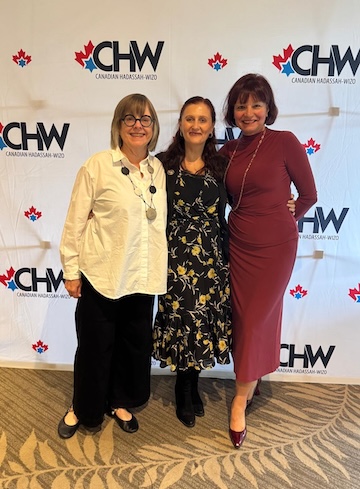
Left to right: Claudia Goldman, Rolene Marks and Toby Rubin at the Sept. 14 event. (photo from CHW)
Marks, who, among other things, chairs WIZO’s Hasbara Division, was the event’s keynote speaker. Toby Rubin, president of CHW Vancouver Centre, welcomed the 150-plus guests at the Richmond Country Club Sept. 14, acknowledging the presence of Judy Mandleman, Rochelle Levinson and Claudia Goldman – three local Jewish community members who have been presidents of national CHW. She noted that the current national president, Tova Train, would be speaking, as would Lisa Colt-Kotler, chief executive officer of CHW, and Marks.
“This luncheon today is raising funds for two very important projects that we have here locally,” said Rubin. “One is JOLT, and the other is Franny’s Fund [which supports six youth advocacy centres across Canada, including the Treehouse Vancouver Child and Youth Advocacy Centre]. JOLT is the Jewish Outreach Leadership Training program at Canadian Young Judaea, and provides camperships to seven camps across Canada, including our very own Camp Hatikvah. Today, we are honoured to have with us the president of Camp Hatikvah, Joanna Wasel, who, along with the camp director and staff has worked with CHW these past two summers with the campers.”
Last year, Wasel and staff spearheaded making keychains and bracelets for Israeli soldiers, which Colt-Kotler and Train hand-delivered on a visit last January to patients at the Gandel Rehabilitation Centre at Hadassah Hospital, said Tobin.
This year, campers in Hatikvah’s first session created their own version of the Maccabi Games, as a fundraiser for HaGal Sheli (My Wave), “a surfing program that is used to help people combat stress, anxiety and PTSD,” said Rubin. “And you can only imagine, since Oct. 7, how important that program is.”
The initiative raised more than $7,000 for HaGal Sheli, said Rubin, who also noted that the brunch’s table decorations of books, toy cars and pens would be given to Treehouse Vancouver. Many of the books were donated by Vancouver Talmud Torah, she said.
Train, who came to the event from Toronto, spoke about being from Edmonton, calling herself “a Westerner at heart.”
“I never imagined myself taking on the role of national president,” she said, “but I’ve always believed with my whole heart that, if I cannot serve Israel by wearing a uniform, then my obligation is to serve in every other way I can. That’s why CHW speaks so deeply to me. For more than a century, this organization has invested in education, health care and social services. And, today, especially after Oct. 7, those needs have never been greater – Rolene shared with me a statistic this morning that more than 10,000 IDF soldiers have been treated for mental health issues across the country since Oct. 7.”
After a video about CHW’s various impacts, Colt-Kotler presented a plaque to Bernard Pinsky, in his role as chair of the Ronald S. Roadburg Foundation.
“CHW, at our core, is philanthropy, and we were founded, as you know, in 1917, by a very dedicated, special woman named Lillian Freiman,” said Colt-Kotler, describing Freiman as “an example of philanthropy” and “of dedication to the Jewish community,” and as “the essence of what a CHW woman is … an empowered woman.”
Lisa Colt-Kotler, chief executive officer of CHW, presents a plaque to Bernard Pinsky, chair of the Ronald S. Roadburg Foundation. (photo from CHW)
She continued, “We created the Lillian Freiman Society to recognize individual donors for their generous philanthropy, starting at $100,000, and the Ronald S. Roadburg Foundation generously donated to Michal Sela Forum …to combat domestic violence, to provide innovative solutions for the protection from and prevention of intimate partner violence,” said Colt-Kotler.
Pinsky said he pushed the foundation to have women’s empowerment as one of its focuses because, from the time he was a teenager, he has been influenced by his sister, Helen Pinsky, who attended the brunch.
“She’s a real feminist,” he said. “And somebody who taught me that women’s empowerment and women’s protection is very, very important in life, and I think it’s no less important today than it was over 50 years ago, when she talked to me about it.”
When Marks took to the podium, she acknowledged the Israel Defence Forces soldiers, who are “fighting 24/7 to protect the state of Israel.”
“I also want to take a moment to acknowledge the over 900 soldiers who have fallen in defence of the state of Israel and the many who are wounded, both physically and who carry those invisible wounds,” said Marks.
“It is an absolute imperative that I mention that we still have 48 hostages languishing in the hell of Gaza,” she added. “Every second counts…. We want them home now.”
Marks specializes in media, public relations and training on Jewish- and Israel-related issues. She hosts a radio program called Modiin and Beyond and is a contributor on Johannesburg’s Chai FM. She co-founded Lay of the Land, hosts The Israel Brief on YouTube and serves as a national spokesperson for the South African Zionist Federation. She is currently doing a doctorate at Middlesex University London, in media, politics and antisemitism.
“I’m the W in the CHW [Canadian Hadassah-WIZO] – I represent World WIZO, Israel’s foremost women’s organization in terms of working for empowerment,” said Marks. “And we have seen, certainly in the last two years, the voices of Jewish women and the experience of Israeli women on the 7th of October completely erased from the feminist landscape.”
Israel is fighting a war on multiple fronts, she said, acknowledging how vulnerable the diaspora community feels because of what is put out in the media, which filters onto the streets and makes it into government policy.
“I know that every day you hear the accusations: genocide, mass starvation, bombing of civilian infrastructure, like hospitals. And I can tell you that, as somebody who is living through the war and covering the war, the situation is not what you are being painted out to answer for.”
Marks was in Gaza a few weeks before the CHW brunch.
“I saw mountains – mountains and mountains – of humanitarian aid marked United Nations, UNICEF, World Food Program, and more. Things like medical kits, baby formula, flour, oil, pasta, hygiene kits, all languishing in the sun. Now, accompanying the few of us that went in, apart from our incredible soldiers, were two journalists from Australia’s ABC [network]…. The IDF said to us, we’re here to answer questions, but, guys, go off, find your stories; there was no interference. And these two journalists stood in front of a big mountain of aid marked United Nations and, in his piece to camera, the correspondent said, ‘This is the image that Israel wants you to see with regards to humanitarian aid.’ And you could hear the collective jaw drop from the rest of us, including colleagues from the Arab media, because we know what we saw. But my point is this: the bias and the narrative-building start in the field.
“I’ve had several instances where I’ve gone into the field with the foreign media,” she said. “And, despite what they have seen, they have turned it into an agenda that they can push to put the pressure on Israel, and to put the pressure on you as a community.”
Marks stressed that “we can hold our heads up high as a community and as a people. There is nothing dirty about the Z word.”
Zionist, she said, “just means a belief in the existence of the nation-state of the Jewish people in our ancient homeland.”
In the fight against antisemitism, everyone must play a role, said Marks, whether “sharing on your social media or writing letters to the press or getting involved in your community organizations. We are a people that have survived millennia of blood libels, persecution, and attempts to erase our history and our narrative.”
This can include something like wearing a Magen David, she said: “When you show your pride and you show your strength, you stand up to the hate, you stand up to the misinformation.”
She added, “The truth always comes, but we need your help to make that happen. When people accuse us of genocide, I can tell you, as somebody who has been working on the ground, the complete opposite is true.… Our army inoculates children against polio in the Gaza Strip, and drops leaflets, and moves civilians out of harm’s way.”
She recommended people follow Israel’s COGAT (Coordinator of Government Activities in the Territories) website, where you can track the humanitarian aid going to the Gaza Strip and related news.
Referring to the murder of American activist Charlie Kirk, she said “it was symptomatic of something very, very frightening that is spreading around the world, and that is a move to disengage in discourse, a move to shut down conversation. And it is so important that we have these conversations. It is so important that we interrogate the truth and the facts.”
In the question-and-answer period, Marks suggested the lack of support from allies like Canada, France, the United Kingdom, Australia and others, is “a big campaign to deflect from problems that are domestic.”
“It’s very, very distressing for us in Israel to see our allies taking the side of Hamas, and also treating us like the naughty child of the world,” she said. “And part of that is, we believe, that many countries have forgotten or don’t know what it’s like to live under constant threat. We live under constant threat … wars within wars.”
Marks recalled what Israeli President Isaac Herzog told British Prime Minister Keir Starmer in a recent meeting: “Friends can sometimes disagree – but don’t reward terror.”
While in Vancouver, Marks also spoke at a CHW-Community Kollel event on Sept. 12.
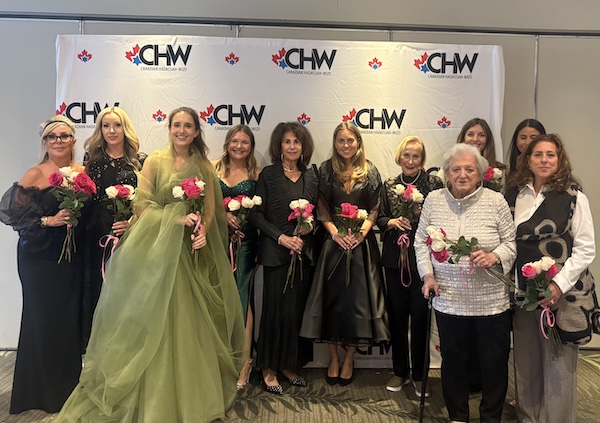
The fashion show part of CHW Vancouver Centre’s opening event featured local community members sporting clothes from Maison Labelle Boutique and After Five. (photo from CHW)
The Sept. 14 speeches and brunch were followed by an intergenerational fashion show, with models sporting clothes from MaisonLabelle Boutique and After Five. Walking down the runway were grandmothers, mothers, daughters, granddaughters and friends.
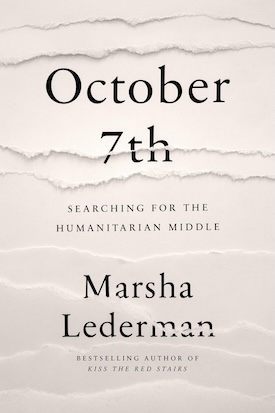
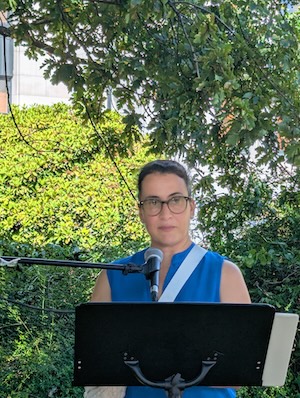
At the local launch for her new book, October 7th: Searching for the Humanitarian Middle, Globe & Mail columnist Marsha Lederman admitted she’s “not doing great.”
“A lot of us in this room can say that,” she said in her opening remarks at the Jewish Community Centre of Greater Vancouver Sept. 18. “It’s been another terrible week with terrible news.”
Lederman was the Western arts correspondent for the Globe for 15 years, before moving to the opinion section in 2022. Her memoir, Kiss the Red Stairs: The Holocaust, Once Removed, was published that same year. (See jewishindependent.ca/a-story-of-two-families.)
On Oct. 9, 2023, Lederman began writing columns on the aftermath of the Oct. 7 massacre in Israel and the tide of antisemitism that followed it. When an editor suggested she publish a book containing a full year of those columns, together with other material she’d written on Jewish identity, she began working on October 7th.
The process of collecting material for the book was emotionally wrenching, said Lederman, a child of Holocaust survivors whose intergenerational trauma was triggered by the Hamas attack.
“It was really hard to relive those early days, rereading the columns and remembering what was happening in the world at that time. When I read through older articles I’d written about my Jewish identity, I was shocked at how many times that subject matter had come up and the extent to which they foreshadowed what would happen in the war.”
When she filed that first column on Oct. 9, Lederman said she wrote it in a haze of shock, emotion, upset and fear. “I knew it wasn’t what had just happened, but what would happen next: retaliation, that it would be terrible for Palestinians, and that there would be anti-Israel sentiment. But I could never have predicted that all things would have exploded the way they have and that it would still be there, almost two years later.”
Describing herself as a “progressive Zionist,” Lederman said she believes the state of Israel has a right to exist but is “strongly against the war and the occupation. I’m horrified by what some of the settlers are doing in the West Bank, but I love Israel and Israelis – though not the ones in power right now. I don’t blindly approve of everything Israel does and part of my caring for Israel is what has led me to speak out.”
In an hour-long talk moderated by Kathryn Gretsinger, a journalist and associate professor at the University of British Columbia, Lederman discussed her hope for a two-state solution, her annoyance at how people speaking out in favour of Palestinians have been branded antisemitic, and the threats she has received in response to her columns.
“My trauma is nothing compared to what people in the war zone are experiencing, but it’s still a horrible experience,” she said.
Prior to Oct. 7, Lederman said she saw herself as a journalist who happened to be Jewish. After Oct. 7, as she began writing about the attack and subsequent war, she said she put herself on the page, explaining her Jewish background. When she wrote about plastic surgery recently, the Globe received a letter to the editor stating, “how dare Lederman write about that when children are dying in Gaza!”
The book’s subtitle, Searching for the Humanitarian Middle, deals with the quandary of holding several feelings simultaneously: concern for Israel and the Israeli soldiers, as well as Palestinians who are being killed.
“I believe the humanitarian middle is essential, and there are a lot of caring people who want to see an end to this war. The numbers are terrible: 60,000 Gazans have been killed in this war,” she said, citing numbers released by the Hamas-controlled Ministry of Health.
“That’s appalling to me,” she continued. “Hostages are still underground and antisemitism has reached a level that’s shocking, even to me, as a pessimistic catastrophizer. The word genocide carries so much weight for us as Jewish people. Israel was born out of the ashes of the worst genocide we have known. So, for Israel to be accused of that very crime is heartbreaking.”
Asked what her solution to the war would be, Lederman said a ceasefire deal is the way to go. “I believe what we’re seeing from Israel is an over-
reaction and I would urge the government of Israel to consider a two-state solution. I believe that’s the answer.”
She said, “My heart aches for the hostages and their families, and for all the people in Gaza. When I think about the intergenerational trauma from this time, it’s shattering. I feel a responsibility to write about this as a Jewish person, a journalist, a mother, as someone who cares about other human beings, and as a child of Holocaust survivors, but I’m feeling the weight of the world in my fingers.”
Lauren Kramer, an award-winning writer and editor, lives in Richmond.
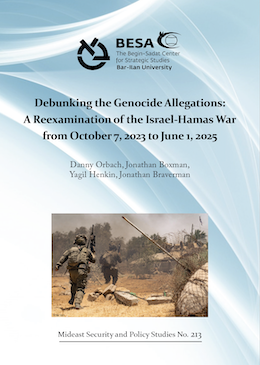
The authors of Debunking the Genocide Allegations: A Reexamination of the Israel-Hamas War from October 7, 2023 to June 1, 2025 sought to do two things in their research: assess the factual basis of war crime and genocide allegations, and examine how information is gathered and transmitted in conflict zones. Among the claims examined is whether enough aid was getting into Gaza from Israel. (IDF Spokesperson via besacenter.org)
A new study conducted by a team of researchers critically examines accusations that Israel committed crimes against humanity, such as planned starvation, deliberate massacres and even “genocide,” during the Israel-Gaza War, between Oct. 7, 2023, and June 1, 2025. Using a blend of quantitative-statistical analysis, forensic documentation, primary sources and comparative military history, the study aims to distinguish propaganda from fact and highlight systemic failures in major international information bodies. Its authors emphasize that their objective is not legal or moral exoneration, but a factual analysis of the methodologies and evidence behind genocide claims.
Research for the 311-page study – Debunking the Genocide Allegations: A Reexamination of the Israel-Hamas War from October 7, 2023 to June 1, 2025 – was led by Prof. Danny Orbach, a military historian from the department of history at the Hebrew University of Jerusalem, in collaboration with Dr. Jonathan Boxman, an expert in quantitative research; Dr. Yagil Henkin, a military historian at the Shalem Centre and the Jerusalem Institute for Strategy and Security; and attorney Jonathan Braverman, a member of the Israeli bar and a lawyer for International Humanitarian Law. It is published by the Begin-Sadat Centre for Strategic Studies at Bar-Ilan University in collaboration with the aforementioned institutions.
The researchers sought to do two things: assess the factual basis of war crime and genocide allegations, and examine how information is gathered and transmitted in conflict zones, particularly in regions ruled by oppressive regimes and/or populated by closed societies with a strong “resistance” ethos. Special emphasis was placed on cross-referencing Israeli, Palestinian and international sources, while actively avoiding ideological bias and preconceived assumptions. The authors highlight that subordinating factual analysis to advocacy narratives can undermine public policy and distort ethical and legal discourse.
The study’s key findings are:
No basis for starvation claims prior to March 2025
• More food entered Gaza during the war than before Oct. 7, 2023. The claim that 500 aid trucks are required daily stems from a misrepresentation by United Nations bodies, one that was left unchallenged and unchecked. Prewar UN records cite an average of 73 food trucks per day in 2022. During the fighting (until Jan. 17, 2025), the Coordination of Government Activities in the Territories (COGAT) recorded an average of 101 food trucks daily whereas retroactively corrected but still incomplete UN Relief and Works Agency for Palestine Refugees (UNRWA) data indicated 83 food trucks per day. Food that entered the Gaza Strip during the ceasefire should have sufficed until late July 2025, according to World Food Programme projections, even absent any aid following the resumption in the fighting. It is hard to explain this gap without considering extensive looting by Hamas, for which the study’s authors provide ample evidence.
• Although UNRWA initially reported a 70% drop in aid after May 2024 and the Rafah operation, it later retroactively corrected these reports. This correction was effectively unannounced and hence the supposed aid drop continues to be cited broadly.
• Contrary to the claim that 44% of Gaza’s food comes from local agriculture, the study finds this number was baseless even before the Hamas takeover. It is likely that, even in 2005, Gazan agriculture accounted for no more than 12% of Gazan caloric consumption and the number is almost certainly much lower today. The study further finds that even if every ton of crops produced in Gaza in 2011 (the last year in which an analysis was published) was substituted, the number of trucks entering Gaza per capita throughout the war would still be 58% higher per capita than it was in 2011.
• Notwithstanding the above, the authors strongly criticize the decision to stop aid to Gaza between March and May 2025.
No evidence of a systematic civilian targeting policy
While isolated incidents may point to negligence or localized misconduct and suspicion of individual war crimes, no evidence was found of overarching directives aimed at harming civilians. The authors did, however, try to map the patterns of Israel Defence Forces misconduct and possible crimes, and examine which crimes were probably more prevalent and which ones were relatively absent from this conflict.
Data manipulation by Hamas
The Gaza Health Ministry, per Hamas directives, categorizes all deaths as civilian. This manipulation has significantly skewed international reporting. Indications have been found for the inclusion of age-related natural deaths, particularly of women, in the ministry of health’s lists and exclusion of combat-aged men.
IDF’s exceptional precautionary measures
The IDF has implemented unprecedented steps, such as early warnings, precision targeting and mission aborts to avoid civilian harm. These actions, while costly to the IDF, have reduced non-combatant casualties.
Evacuation zones were significantly safer
According to partial data, less than 4% of deaths occurred in Mawasi and the central camps – areas marked as evacuation zones by the IDF – undermining claims of deliberate attacks on safe areas. The failure of the UN to cooperate with the establishment of such zones resulted in considerable loss of civilian life.
Systematic failures in UN and NGO reporting
Numerous claims were based on circular citation, opaque assessments and unannounced retroactive corrections. For instance, UNRWA’s truck count discrepancies were corrected without sufficient publicity. Updated UN data confirms Israel’s consistent assertion of increased aid after May 2024.
A precedent for this kind of flawed reporting can be found in the aftermath of the 2009 Gaza War. Former UN jurist Richard Goldstone, who led the United Nations Fact-Finding Mission on the Gaza Conflict, later expressed regret over some of the report’s conclusions. In a 2011 Washington Post op-ed, he wrote: “If I had known then what I know now, the Goldstone Report would have been a different document.”
The suffering of civilians in Gaza is both tragic and undeniable. However, this research calls on the international community to ensure that humanitarian discourse remains anchored in verifiable facts. Without accurate data, advocacy loses credibility – and future atrocities may be overlooked due to inflated or politicized claims.
While the suffering of civilians in Gaza is indisputable, the authors caution against humanitarian advocacy narratives built on unverified or manipulated data. Their study does not aim to exonerate or diminish the suffering experienced, but rather to protect the integrity of academic discourse and, by implication, humanitarian and public discourse. When advocacy eclipses accuracy, policy decisions become distorted and genuine accountability is compromised, the authors warn. They urge the international community to uphold higher evidentiary standards in conflict reporting – regardless of the actors involved.
Broader methodological analysis
This study is not unique to the Israel-Gaza conflict. Similar patterns of humanitarian data distortion were identified in Iraq under sanctions, raising broader questions about the methodologies employed in closed or authoritarian environments.
The study also examined other conflict zones, such as Iraq in the 1990s. During that period, it was widely claimed – based on Iraqi government data and a UN Food and Agriculture Organization survey – that hundreds of thousands of children died due to sanctions. The survey reported a rise in infant mortality from 40.7 to 198.2 per 1,000 children. These findings were later revealed to be fabricated by Iraqi authorities. Even when the researcher who conducted the survey acknowledged being misled, the correction failed to impact the wider humanitarian discourse.
Likewise, inflated assessments of violent and nonviolent Iraqi deaths during the Iraq War were widely disseminated and accepted during the conflict – only being laid to rest definitively in 2023.
“Humanitarian bias”
The authors introduce the term “humanitarian bias” to describe a tendency among aid organizations to accept alarming claims from stakeholders in order to mobilize urgent action. In this context, factual corrections are often met with hostility or ignored altogether – undermining accuracy in humanitarian reporting. Even when myths are disproven, corrections are rarely incorporated into public or academic understanding.
The study proposes a new methodological framework for analyzing violent conflicts – one that prioritizes cross-referencing multiple sources, systematic scrutiny and transparency, and resistance to political and media-driven narratives.
The authors emphasize that credible allegations of war crimes demand serious legal and ethical investigation – not only due to their consequences but also in adherence to international law, Israeli law and moral standards.
Orbach warns: “If every severe urban war were defined as genocide, it would ultimately dilute the legal and moral power of the term. ‘Genocide’ would become an empty political slogan, rather than a tool to prevent atrocities.”
This study builds on that call for greater evidentiary caution, particularly in war zones governed by authoritarian regimes.
Debunking the Genocide Allegations can be downloaded at besacenter.org. Following the publication of the Hebrew edition on July 4, 2025, there was extensive feedback from readers, critics, experts and commentators. In some cases,there was valid criticism that warranted corrections and revisions. Consequently, the English edition is not a mere translation of the Hebrew version but a thoroughly revised, corrected and updated work.
The August 2025 Israeli Voice Index, conducted by the Viterbi Centre for Public Opinion and Policy Research at the Israel Democracy Institute (IDI), asked whether Israel should agree to a deal that would include the release of all Israeli hostages, the cessation of hostilities and the complete withdrawal of the Israel Defence Forces from Gaza. Sixty-two percent of Jewish Israelis and 81% of Arab Israelis support such a deal.
Looking at political orientation among Jews, a large majority on the left (92%) and centre (77%) support such a deal, while the right is more divided, with slightly more in favour (47%) than opposed (44%). A breakdown by vote in the 2022 elections reveals a majority of supporters for this deal among voters for all opposition parties and all coalition parties, except for Religious Zionism voters.
Military operations in Gaza
A plurality of Jewish Israelis (49%) support the decision to expand military operations in Gaza while the overwhelming majority of Arab Israelis (81.5%) oppose the decision.
“There is a substantial share of Israelis who support a hostage deal that involves a full withdrawal from Gaza while also saying they support the expansion of fighting in Gaza,” said IDI’s Prof. Tamar Hermann. “This is due to the context-specific nature of each question – many Israelis prioritize bringing the hostages home even at a great cost, but if a deal cannot be struck, they support the expansion of operations in Gaza.”
Jewish settlement in Gaza
Similar to IDI’s polling from November 2024, last month, 53% of Jewish Israelis and 86.5% of Arab Israelis oppose Jewish settlement in the Gaza Strip. Most on the left (93%) and centre (77%) oppose settlement while most on the right (61%) support it. Rates of support increase in tandem with levels of religiosity, with the highest rate of support among Haredim (75%) and lowest among secular Israelis (21%).
The release of hostages
More than half of the Israeli public (53%) think that their leadership is not making every effort to secure the release of the hostages (Jews, 51.5%; Arabs, 63%). A breakdown by political orientation (Jews) shows that, on the right, as in the past, 63% think that the leadership is indeed doing everything it can. By contrast, this view is held by 28.5% in the centre and 6% on the left.
Control of Gaza after war
Similar to past measurements, a plurality of Jewish Israelis (44%) believe a multinational force should control Gaza after the war, as does 22% of Arab Israelis. Twenty-three percent of Arab Israelis believe the Palestinian Authority should control Gaza.
The burden of fighting
A plurality of Jewish (34%) and Arab (37%) Israelis assess that Israeli society can only bear the burden of fighting for another few months. A decreasing share of Jews think Israelis can bear the burden for as long as it takes, down from 39.5% in March 2024 to 28% today.
National mood
In this latest survey, IDI found no major changes in the levels of optimism about the future, excepting a slight improvement (2% in the total sample) in the share of optimists about the future of the economy. There was a small decline in optimism about the future of security (3%), though this is within the margin of error and thus should not be taken as evidence of a new trend. As in previous surveys, in three of the four indicators (security, democracy and economy), the share of optimists is larger among Jews than among Arabs. Overall, in all four indicators and among both Jews and Arabs, less than half the public are optimistic.
The Abraham Accords
Five years after signing the Abraham Accords, 46% of Jewish Israelis say the accords met their expectations, down from 64% in 2021, one year after signing them. Among Arab Israelis, 41% say the accords met their expectations, similar to 43% in 2021, and a substantial share of Arabs (28%) say they don’t know.
Survey methodology
The survey was conducted via the internet and by telephone (to include groups that are under-represented on the internet) Aug. 24-28, 2025, with 600 men and women interviewed in Hebrew and 150 in Arabic, constituting a nationally representative sample of the adult population in Israel aged 18 and over. The maximum sampling error was ±3.58% at a confidence level of 95%. Field work was carried out by Shiluv I2R. More of the report and the full data file can be found at en.idi.org.il/articles/61601.
Almost every Sunday since the first days after Oct. 7, Daphna Kedem has led a vigil for the hostages. People have gathered in solidarity and to hear from a diverse array of speakers, first outside the Vancouver Art Gallery and now at Vancouver City Hall. (photo by Pat Johnson)
Almost 700 days have passed since the horrors of Oct. 7, 2023, and the holding of Israeli hostages in the tunnels of Gaza.
In Vancouver, as in cities worldwide, Jews and their allies gather frequently to mourn the lost, stand in solidarity with Israelis and remind the families whose loved ones are still in captivity that there are people across the planet who hold them in their thoughts.
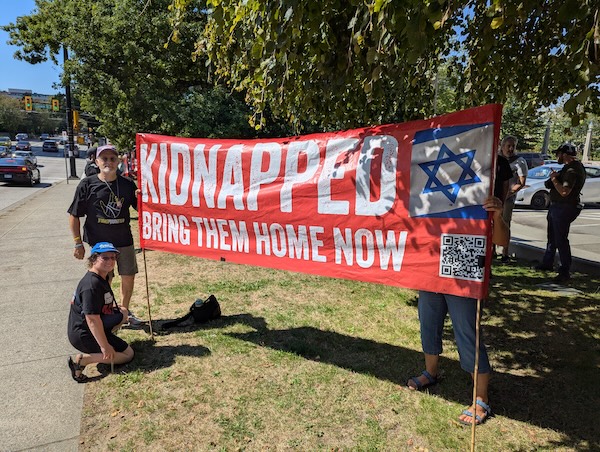
Almost every Sunday since the first days after Oct. 7, Daphna Kedem has led a vigil for the hostages – first outside the Vancouver Art Gallery and now at Vancouver City Hall. Missing only a few weeks due to Jewish or statutory holidays or, like this month, because police security was stretched thin with the Pride Parade, a stalwart group gathers at 12th and Cambie in solidarity and to hear from a diverse array of speakers.
Another regular gathering also takes place, with the group Vancouver Stands With Israel organizing marches across the Burrard Street Bridge and back, waving Canadian and Israeli flags. This past Sunday, scores of participants were greeted with a few hostile catcalls, an exponentially larger number of supportive messages, and a great deal of nonchalance and curiosity. Joining the parade were members of the Persian- and Indian-Canadian communities, carrying their respective flags.
Jews and allies assemble near Burrard Street Bridge in a march last Sunday, Aug. 24. (photo by Pat Johnson)
The competing events reflect divisions in the community. At a rally earlier this month, Kedem acknowledged that she has received “a lot of backlash” from people who believe she and some of her speakers are “too political.” Kedem calls for an immediate end to the war, which she views as the most likely path to get the remaining live hostages home safely.
“If this is too political, then I’m probably very political,” she said.
Over the course of almost two years, the Sunday rallies organized by Kedem have featured diverse voices, both hawkish and dovish, with many speakers expressing personal reflections that cannot be pegged on a political spectrum. Christian pastors have spoken and sung. First Nations representatives have taken part. Rabbis are usually in attendance, including Rabbi Philip Bregman, who, most weeks, leads the group in national anthems.
Kedem begins the events by reading excerpts from the previous evening’s rallies in Tel Aviv, usually voices of family members of those held hostage.
Rabbi Carey Brown, associate rabbi of Temple Sholom and a fellow of the Rabbinic Leadership Institute of Shalom Hartman Institute, spoke this past Sunday of the significance of the month of Elul, which began the night before.
“It’s the time that we as a people and as individuals begin our journey of self-reflection and soul-searching as we prepare for the new year,” she said. “It is a month that whispers to us: return, reflect, renew.”
Rabbi Carey Brown speaks at the Aug. 24 vigil for the hostages, which took place at Vancouver City Hall. (photo by Pat Johnson)
When she is asked how to live more Jewishly, Brown suggests people let the Jewish calendar guide them.
“It’s a map,” she said. “It’s a heartbeat. It’s the soul’s clock. We measure time in many sacred ways. In Judaism, we count days, months, years … a reminder of the holiness in time, and even our grief and our longing are measured in time. Today is Day 688 … of the captivity of still 50 hostages, living and dead. We count because we care. We count because they matter. We count because time is sacred and their time has been stolen. Think of all the time that has passed: 688 days of missed holidays, 688 days without their families, 688 days of fear, torment and waiting. And now, here we are again, standing on the threshold of Elul, preparing once more for Rosh Hashanah, for Yom Kippur. This time, time feels different. It feels heavy.”
Toby Rubin, local chapter president of Canadian Hadassah-WIZO, urged attendees to stand firm until all the hostages are returned.
“We ask that all of you continue to support, to advocate, to push and to ask your allies and your political leaders to continue to do what they need to do to get every one of those 50 home,” she said. “And, again, whether they’re dead or alive, we want them back.”
Earlier in August, on Tu b’Av, community activist and leader David Berson blew the shofar and reflected on the date, which is a commemoration of love and unity.
“The shofar isn’t only a High Holiday symbol, it’s also a biblical emblem of revelation and covenant,” he said. “As I blow the shofar today, let this be a clarion call to rebuilding the wholeness of our people, of listening and understanding, of hearing what is troubling the other and taking that into consideration, of opening our hearts and being curious about what is hurting. We have all been through so much since Oct. 7 and, while we cannot put the genie back in the bottle, we must stand together and embrace that which does bind us in an eternal bond of community, of belonging and embracing our humanity and the humanity of others.”
That same day featured Karen James, a past board chair of the Jewish Federation of Greater Vancouver and current chair of the local partnership council for the Centre for Israel and Jewish Affairs. She is also on the board of governors of the Jewish Agency for Israel.
James reflected on her experiences as a competitive swimmer, including participating in the Maccabiah Games in Jerusalem in 1965, which connected her more deeply not only to her Jewishness and to Israel, but to the branch of her family that had made its way to Palestine in the era when her grandfather settled in Canada.
She shared another personal story that affected her connection to her identity and to Israel.
In 1972, James was on Canada’s Olympic swim team. She and teammates were out celebrating after their competitions were over, watching the Canada-Russia hockey series. As they walked back to the Olympic Village in the wee hours of the morning, they saw four men with a big duffle bag. The four men clambered over the fence to get into the Olympic Village and the Canadians did likewise.
“I went to my dorm, slept for a little bit, but then was woken up to all the commotion in the village,” James recalled. She became a firsthand witness to the terrorist attack on Israeli athletes at the Munich Games.
“I watched the negotiations happen between [the terrorists] and the Germans and, in the evening, I saw when the Israeli team members were led out onto a bus with their hands bound and they were blindfolded,” she said. “Later that night, we’d heard that they were safe and alive, that they’d been freed. But that was wrong. They made a mistake. I don’t know how that got out there because, in fact, the Germans tried to storm the planes and the Palestinians threw grenades and shot the remaining Israeli hostages.”
James went on to describe a more intimate experience with antisemitism. In a consultation with a medical specialist, the doctor repeated the words “It could be worse” twice. On the second occasion, James asked the doctor what she meant by noting that “it could be worse.”
“And she said, ‘Look at what’s happening in Gaza,’” James recalled the doctor telling her. “It was so inappropriate to say that to me.”
Antisemitism is growing, said James. “The main thing that keeps me going is community,” she said. “All of you. All of my community.”
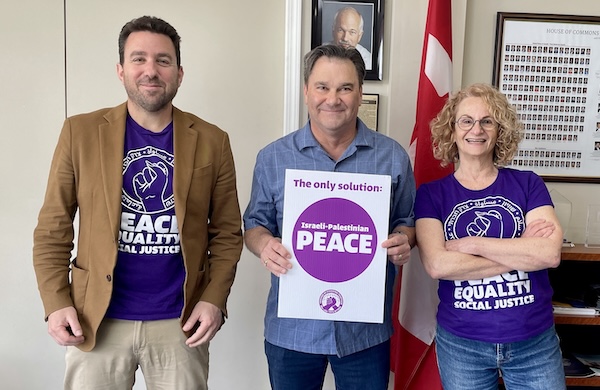
Interim leader of the New Democratic Party of Canada Don Davies, centre, with Itai Bavli and Avril Orloff of Vancouver Friends of Standing Together. (photo from Vancouver FOST)
This summer, Vancouver Friends of Standing Together has been holding weekly vigils in front of City Hall to continue the call for the return of the hostages, an end to the war in Gaza and an end to settler violence against Palestinians in the West Bank.
“We organize rallies, vigils and information sessions to raise awareness of the situation in Israel/Palestine and promote ‘another way’ that is not exclusively pro-Israel or pro-Palestine but pro-humanity,” Avril Orloff, who started the Vancouver Friends of Standing Together (FOST) chapter, told the Independent.
Adi Keidar, one of the chapter’s co-administrators, said, “If you are willing to accept that both Israelis and Palestinians deserve to live freely and safely on this land, I will be standing with and supporting you. Someone told me, ‘if you need to choose between pro-Israel or pro-Palestine, it is obvious for me, as a Jew/Israeli where I stand. However, if I knew and trusted that there is another way, I would choose both.’ Standing Together, for me, brings that other voice.”
“I joined the FOST group in June 2024 because it reflects my values and my belief that finding a just solution to the conflict is the only way forward,” Itai Bavli, also a Vancouver FOST co-administrator, said. “I care about all people living between the river and the sea and believe that both peoples can thrive if given the chance. I support Israelis and Palestinians alike and believe they both have the right to live freely and safely. Which means ending the occupation and supporting a Palestinian state. For me, it’s a responsibility I carry.”
Currently, there are nine local co-administrators, who play active roles as their other work and responsibilities permit, Orloff explained. “We try to divide up responsibilities, so no one is overburdened,” she said, noting that everyone involved is a volunteer. “We meet on an ad hoc basis as needed to brainstorm ways to increase awareness, bring out the voice of Standing Together and address issues that come up.”
Standing Together is an Israeli grassroots social movement made up of Jewish and Palestinian citizens that, according to its website, “envision[s] a society that serves all of us and treats every person with dignity. A society that chooses peace, justice and independence for Israelis and Palestinians, Jews and Arabs. A society in which we all enjoy real security, adequate housing, quality education, good healthcare, a liveable climate, a decent salary and the ability to age with dignity.”
Since the Hamas terror attacks on Oct. 7, 2023, and the ensuing war, Standing Together in Israel has been organizing demonstrations – attended by tens of thousands – calling for a hostage deal and a ceasefire agreement. They also have been engaging in public campaigns “aimed at re-humanizing the discourse, retaining humanity, mourning all lives lost and rejecting violence on social media in Hebrew, Arabic, and English.” Last May, they launched the Humanitarian Guard initiative at Tarqumiyah checkpoint to protect “aid trucks headed to Gaza from attacks by extremist settlers that come out to attack the trucks.” This month, they started a campaign to collect food and humanitarian aid for residents of Gaza.
In addition to the eight chapters of Standing Together that operate in Israel, there are Friends of Standing Together chapters worldwide that have formed since Oct. 7. The chapters in the diaspora raise awareness of and funds for Standing Together, as well as offer a local communal space for people who share the movement’s values and goals. Orloff is an ambassador for ST’s global crowdfunding campaign and recently surpassed her personal goal of raising $6,000 for the movement.
“I started the Vancouver FOST group in February 2024, when I first learned about Standing Together and discovered they had support groups around the world,” said Orloff. “I was drawn to ST because I felt that a lot of groups advocating for either Israel or Palestine focused on only one side or the other, which seemed short-sighted to me. Standing Together’s stance, by contrast, is that, with seven million Jews and seven million Palestinians living ‘between the river and the sea,’ none of whom are going anywhere, the only sustainable future is a shared one grounded in equality, security, peace and justice for all.”
Orloff, Keidar and Bavli said they appreciate that ST is about more than ending the war and that it’s “a broad-based social movement that goes beyond the specifics of Jewish/Palestinian issues to encompass social change at all levels of society, from the bottom up.”
“One of the biggest concerns and confusions I had on Oct. 7 and the events that followed was the rise of hate and polarization on both sides,” said Keidar. “It was rare that I could agree with much that was said, and I was constantly trying to hold two thoughts at the same time. I felt alone and was not seeing the benefit of supporting one side – it felt wrong and unjust and it didn’t fit my values.
Adi Keidar at one of Vancouver Friends of Standing Together’s vigils. (photo from Vancouver FOST)
“When I learned about Standing Together, it was the closest group that I felt spoke to my values and beliefs, as their focus is not one side or the other but humanity, which was the voice I felt was drowning in the hate that was brewing. I wasn’t willing to accept just one side. I believe that the only way to get out of this cycle is by compassionately seeing both sides, taking responsibility, finding the people that speak these values and bringing their voices out.”
Keidar participates in the weekly Bring Them Home rallies. Both she and Bavli spoke at a BTH rally this summer to raise the voice of Standing Together, to show “that it’s possible (indeed, necessary) to support both Israel and Palestine, and remind people that the immediate end of this war is only the beginning of the work to build a shared society in which all peoples live in peace and security.”
Vancouver FOST does local community-building through their WhatsApp group, social events (for example, film evenings, picnics, in-home gatherings), rallies and other activities. They raise awareness on social media via Instagram and work to build their membership, liaising with Standing Together and FOST groups globally. They meet monthly on Zoom with other Canadian FOSTs and build relationships with groups that share ST’s values and principles, like Women Wage Peace and various faith organizations. They have started doing outreach to Canadian politicians.
“We have endorsed Canada FOST’s Call to Action to the Canadian government and politicians to advance key priorities,” said Orloff, “including taking urgent diplomatic action to permanently end the war in Gaza; providing long-term support for peace and equality, not war; and supporting solidarity and partnership in our own society.”
The group organized and hosted an event in June last year, which brought Raja Khouri and Jeffrey Wilkinson to Vancouver to talk about their book, The Wall Between: What Jews and Palestinians Don’t Want to Know About Each Other. (See jewishindependent.ca/not-such-a-great-divide.) They have plans to host an information table at the University of British Columbia in the fall.
In an email, Orloff, Keidar and Bavli described Vancouver FOST as being “for more than we’re against. We don’t argue about terminology or labels or traffic in simplistic black-and-white ‘solutions,’ but are comfortable living with complexity and difference. We love to have juicy discussions, but, more than talk, we’re about supporting action that will bring about real, practical, sustainable change. We aren’t pro-Israel or pro-Palestine but pro-humanity,” they reiterated, “and we don’t see this as a left-right divide or an Israel-Palestine divide, but a divide between those who want peace and life for everyone and those who traffic in death and destruction. We’re here to offer a different way of thinking about the conflict and a different path forward, not to convince people that we’re right.”
Orloff said group members aren’t “settling for simplistic, one-sided solutions that make heroes of one side and villains of the other, but recognize that geopolitical issues have history and context that create layers of complexity, compounded by historical and intergenerational trauma on both sides. What I tell people is that, in this ongoing conflict, there is no win/lose: it’s either win/win or lose/lose. If we don’t find a way to justice, equality, peace and security for all, there won’t be justice, equality, peace or security for anyone.”
“We are involved with Standing Together,” the three co-administrators stressed, “because of deep feeling for Israel and the people living in the land. Many of our FOST members are Israelis who are heartsick at what Israel is doing in Gaza, the West Bank, and to its own Palestinian Israeli citizens. We believe in Israel’s promise and want to hold Israel to its highest ideals. There is no other way. It’s our responsibility to bring about the change.”