
Skip to content
  • Home
  • Subscribe / donate
  • Events calendar
  • News
    • Local
    • National
    • Israel
    • World
    • עניין בחדשות
      A roundup of news in Canada and further afield, in Hebrew.
  • Opinion
    • From the JI
    • Op-Ed
  • Arts & Culture
    • Performing Arts
    • Music
    • Books
    • Visual Arts
    • TV & Film
  • Life
    • Celebrating the Holidays
    • Travel
    • The Daily Snooze
      Cartoons by Jacob Samuel
    • Mystery Photo
      Help the JI and JMABC fill in the gaps in our archives.
  • Community Links
    • Organizations, Etc.
    • Other News Sources & Blogs
    • Business Directory
  • FAQ
  • JI Chai Celebration
  • JI@88! video

Recent Posts

  • BGU fosters startup culture
  • Photography and glass
  • Is it the end of an era?
  • Taking life a step at a time
  • Nakba exhibit biased
  • Film festival starts next week
  • Musical with heart and soul
  • Rabbi marks 13 years
  • Keeper of VTT’s history
  • Gala fêtes Infeld’s 20th
  • Building JWest together
  • Challah Mom comes to Vancouver
  • What to do about media bias
  • Education offers hope
  • Remembrance – a moral act
  • What makes us human
  • המלחמות של נתניהו וטראמפ
  • Zionism wins big in Vegas
  • Different but connected
  • Survival not passive
  • Musical celebration of Israel
  • Shoppe celebrates 25 years
  • Human “book” event
  • Reclaiming Jewish stories
  • Bema presents Perseverance
  • CSS honours Bellas z”l
  • Sheba Promise here May 7
  • Reflections from Be’eri
  • New law a desecration
  • Resilient joy in tough times
  • Rescue dog brings joy
  • Art chosen for new museum
  • Reminder of hope, resilience
  • The national food of Israel?
  • Story of Israel’s north
  • Sheltering in train stations

Archives

Follow @JewishIndie
image - The CJN - Visit Us Banner - 300x600 - 101625

Tag: Shai DeLuca

Farm transforms lives

Farm transforms lives

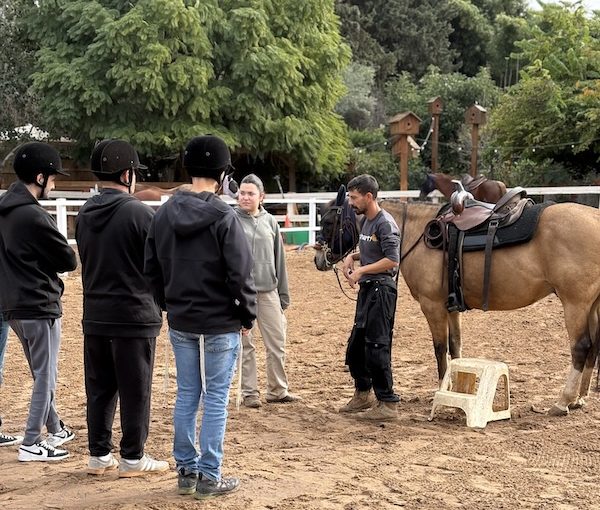
Danny’s Farm is a leading Israeli centre for holistic healing, offering animal-assisted trauma care, among other services. (photo from Danny Stirin)

After Canadian-Israeli media personality Shai DeLuca was critically wounded in 1996 during his service in the Israel Defence Forces, the instructions from his peers were as blunt as they were unhelpful: be a man, move on. 

The injury – that left him with temporary loss of use of his legs –  kept him in hospital and rehabilitation for nearly a year, in an era when post-traumatic stress was rarely named, let alone treated. “Back then, PTSD wasn’t understood the way it is today,” said DeLuca. “No one had language for it. No one recognized the symptoms.”

At the end of July 2025, DeLuca traveled to a ranch southeast of Rehovot, Israel, with a Canadian organization supporting IDF veterans with post-traumatic stress disorder, families of Oct. 7 victims and Israelis living with trauma caused by terror. What began as just a visit to Danny’s Farm, a unique therapeutic centre, turned into a revelation. 

At the end of the tour, ranch owner and chief executive officer Danny Stirin sensed something about DeLuca and asked a pointed question – why had he not dealt with the mental after-effects of his injury?

“I felt like I didn’t even need to say a lot and he understood what I meant,” recalled DeLuca. “He said, ‘the moment you’re ready, just message me. I will be there with you every step of the way.’”

The visit was “life-changing” for DeLuca and returning to the farm later allowed him “to understand parts of my own story buried for years.”

DeLuca credits Stirin as “the person who freed me in a lot of ways from a lot of weight that I’ve been carrying for so many years.”
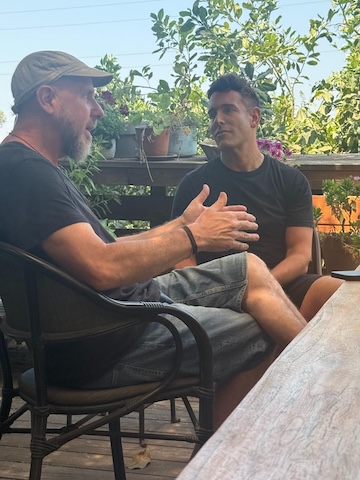
photo - Danny Stirin, left, and Shai DeLuca in conversation. DeLuca credits Stirin as “the person who freed me in a lot of ways from a lot of weight that I’ve been carrying for so many years"
Danny Stirin, left, and Shai DeLuca in conversation. DeLuca credits Stirin as “the person who freed me in a lot of ways from a lot of weight that I’ve been carrying for so many years.” (photo from Shai DeLuca)

Since its inception in 2016, Danny’s Farm has become a refuge for Israelis grappling with trauma, be it from war or terror. At first glance it looks like a ranch – stables with dozens of horses and many small animals about – but amid the pastoral view is a clinic, recognized as a leading Israeli centre for holistic, animal-assisted trauma care. Treatment rooms for art, music, bodywork and complementary medicine sit alongside the barns, and a multidisciplinary staff of psychologists, social workers and emotional-therapy instructors anchors the work with patients. The farm treats some 1,500 people each week.

Even before Oct. 7, the farm was treating children with special needs, survivors of sexual violence, and adults with complex trauma, filling a gap in an under-resourced mental-health system. Since the Hamas attacks and ensuing war, it has become a safe zone for reserve soldiers, evacuees from the south and north, and families coping with loss, dislocation and rocket fire.

For Stirin, the farm grew out of his own brush with crisis and a decision about what kind of fulfilment he sought professionally. “It’s like there’s a point in your life when you’re looking for a purpose,” he said, adding that he wanted the farm to be a tangible example for his children: “so they can see that somebody is going with his heart, all the way.”

A deeper motivation, though, was to help other people with their pain. “I felt that I have to hold the hope for others having a crisis, as I did,” he said. 

Stirin’s choice to place animals at the centre of this work came from his childhood. “Since I was a boy, I had a long attraction to animals. All my life I was near them,” he said.

Born in Argentina to a grandfather who worked as a “gaucho,” or cowboy, he grew up with horses and dogs and carried that bond into adulthood. “I realized in the best way, the very powerful way, I felt the energy of the healing, just being near the simplicity of these creatures,” said Stirin.

On the farm, that idea has been formalized into a program that pairs equine therapy with group and individual treatment, and specialized tracks for traumatized children and families. The model, developed in partnership with the resilience organization Tkuma and supported by various funders, is designed to give long-term structure to people who might otherwise never access, or have access to, sustained care.

If there is a single principle guiding Danny’s Farm, it is that trauma is both ubiquitous and intensely personal. “The human soul is very fragile, and very different from one to one,” Stirin said. “The trauma … it plays with you. It can come in all kinds of different ways, shapes.”

Because the nature of trauma depends on a person’s personality, history, physical and mental structure, he said, therapists must approach treatment with “a lot of flexibility.”

“Each one needs something else. That’s what I believe,” he said. 

For veterans like DeLuca, who was told to tough it out, the encounter with this kind of care was “liberating.” 

Coming back to the ranch last month to introduce visiting media to the farm, he said he found at the farm the space to see his injury “through a different lens,” as part of a story that “did not have to end in silence.” 

He said, “With PTSD, the challenge is not closing the door, but opening it, and dealing with it. And what Danny did was [tell] me that I don’t have to keep that door closed.” 

Dave Gordon is a Toronto-based freelance writer whose work has appeared in more than 100 publications around the world. His website is davegordonwrites.com. His trip to Israel was co-sponsored by the Or Ofir Foundation.
Format ImagePosted on February 13, 2026February 11, 2026Author Dave GordonCategories IsraelTags Danny Stirin, equine therapy, health care, Israel, PTSD, Rehovot, Shai DeLuca, war
The strength of community

The strength of community

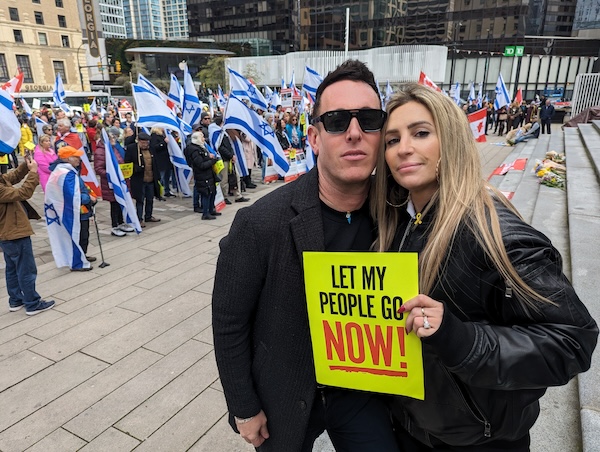
Shai DeLuca and Alexandra Smith flew in Sunday from Toronto to address Vancouver’s weekly vigil for Israeli hostages on the six-month anniversary of the atrocities committed on Oct. 7. (photo by Pat Johnson)

Unity, defiance and determination were the overriding messages at the community rally Sunday, April 7, marking six months since the atrocities of Oct. 7.

“Our hearts are heavy with the weight of loss and sorrow,” said Michael Sachs, regional director of the Jewish National Fund of Canada. As Israelis were called up for service at the start of that war, another battle began in the diaspora, he said.

“Jews worldwide were drafted for a different, yet related, war,” said Sachs. “In the wake of Oct. 7, we witnessed a disturbing and radical rise in antisemitism and Jew-hatred right here in Canada.”

Canada today does not resemble the Canada of Oct. 6, he said, as anti-Jewish ideas and actions have “emerged from the alley and are now openly displayed on our streets and threatening the very fabric of our society.

“We should always draw strength from the resilience and courage of the survivors,” Sachs said. The souls of those murdered that day, he said, live on “in our commitment to build a world with compassion, justice, that will triumph over the cruelty and ignorance that we are seeing.

“The brave soldiers, of all faiths, who have made the ultimate sacrifice in defence of Israel – we mourn you and we will never forget you,” said Sachs.

The Jewish response to evil is goodness, he said.

“In the face of their darkness, let us shine our light on them by rejecting forces of division, and continue to embrace the power of the unity of our community and our amazing allies,” he said. “Let us stand together, hand in hand, to be the hope and strength to the families of those held hostage. Let us show the world that our Zionism – not the Zionism that they have created – our Zionism, our love of Israel, is stronger than any hate they can throw at us.”

Aron Csaplaros, BC regional manager of B’nai Brith Canada, recalled his own family’s history.

“For hundreds of years, we have overcome expulsions, pogroms, massacres,” he said. “During the Holocaust, my grandmother spent months hidden in a dark basement, constantly hearing the footsteps of Nazi officers walking above her head, knowing that she could be found and murdered at any minute. But she, like Jews have done throughout our history, survived. She is here today standing in the crowd and we, the Jewish people, are still here, stronger and more united in our resolve than ever.”

He reiterated the demand of the weekly events, that the hostages be released, and added that Hamas should accept its defeat and unconditionally surrender to facilitate a new era of peace between the Palestinian and Israeli people.

“We will never stop fighting those who wish to destroy us,” Csaplaros said. “And we will not stop fighting to defend our indigenous homeland, the land of Israel.”

Until the hostages are released, he said, “We will not stop rallying. We will not stop marching. We will not stop advocating and we will not stop calling on our elected leaders in government to act until every single one of our brothers and sisters held hostage is safely returned.”

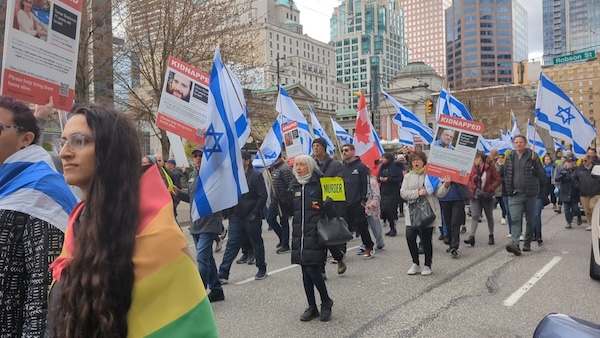
photo - Calls for the return of the hostages being held by Hamas rang through the streets of Vancouver Sunday
Calls for the return of the hostages being held by Hamas rang through the streets of Vancouver Sunday. (photo by Pat Johnson)

Shai DeLuca, an interior designer who lives in Toronto and Israel, is a familiar face to audiences of Toronto’s CityTV and Global television. During the Hamas war in 2014, he pivoted to being a voice for Israel and has led battles against anti-Zionist campaigns in Toronto. He said he was nonchalant when he awoke to alerts on Oct. 7. But, as he and his husband took refuge in a shelter, he realized this was not routine.

“I have lived through enough attacks, hundreds upon hundreds of Hamas rocket attacks throughout my life, to know that this felt different,” said DeLuca.

Soon, Israeli phones were lighting up with push notifications, videos and images showing murder, rape and other atrocities. 

“It was from numbers we did not recognize,” he said. “Only later did we find out that these were targeted push notifications from Hamas.”

Last week, DeLuca was back in Israel and visited the site of the Nova music festival, where hundreds were murdered. The site is about 15 minutes from his family home.

He spoke with Rotem, a young woman who had been a vocal advocate for reconciliation between Israelis and Palestinians. She had spent 30 hours in a safe room with her children before the terrorists gave up and sought out easier prey.

That day, Rotem told DeLuca, was “the day that I realized they really don’t care who we are.”

“A Jew is a Jew,” she told him. “They want us all dead.”

Many of Israel’s most avid peace activists lived on the kibbutzim that were attacked.

“The belief that one day we would have peace with our neighbours wasn’t something she could foresee anymore and that was heartbreaking to see,” said DeLuca. “She had strived to work toward a better tomorrow for all and was met with the worst massacre of the Jewish people since the Holocaust, on her community specifically…. A community that employed Gaza workers and worked daily to build bridges. That bridge no longer exists, she said, they torched it.”

Now, in the diaspora, Jews are faced with what DeLuca equates to the antisemitic marches of the 1930s and ’40s.

“We have never been able to depend on others,” he said. “Our history has proven that.… The difference today, unlike times past, is that we have our home to go to. While the hate marches we see repeatedly across cities and across countries call to deny the existence of the only indigenous home the Jewish people have ever known, they continue to prove why its existence is so very important.”

Alexandra Smith, director of End Jew Hatred Canada, came with DeLuca from Toronto on a delayed flight, arriving just in time for the event. 

“Today, we are called upon not only to demand the immediate and unconditional release of those unjustly held, but to reaffirm our commitment to each other as members of a shared community, a shared nation, a shared destiny and, indeed, a shared humanity,” said Smith.

“Starting on Oct. 8, for many in the Jewish community, the open, brazen, unashamed Jew-hatred exhibited on college campuses and on our streets came as a terrible shock and a deep sense of betrayal,” she said. “But, for those of us who have been working in this space for a length of time, it came as no surprise. Antisemitism has always been there, only hidden under wraps. It took a war in the Middle East for it to rear its ugly head. It’s not an exaggeration to call this a profound crisis. In moments of crisis, however, the strength of a community is seen not only in its leaders but in the spirit of its people. Unity is our beacon of hope. Shoulder to shoulder, regardless of backgrounds, beliefs and life experiences, we embody the resilience that has helped communities throughout history overcome adversity.”

Rabbi Andrew Rosenblatt of Congregation Schara Tzedeck chanted El Moleh Rachamim, invoking the name of Elad Katzir, a hostage whose body was recovered by Israeli soldiers the day before the rally. Rabbi Susie Tendler of Beth Tikvah in Richmond said the prayer for the hostages. 

Format ImagePosted on April 12, 2024April 10, 2024Author Pat JohnsonCategories LocalTags Alexandra Smith, Aron Csaplaros, Israel-Hamas war, Israeli hostages, Michael Sachs, Oct. 7, rally, Shai DeLuca
Proudly powered by WordPress