Skip to content
  • Home
  • Subscribe / donate
  • Events calendar
  • News
    • Local
    • National
    • Israel
    • World
    • עניין בחדשות
      A roundup of news in Canada and further afield, in Hebrew.
  • Opinion
    • From the JI
    • Op-Ed
  • Arts & Culture
    • Performing Arts
    • Music
    • Books
    • Visual Arts
    • TV & Film
  • Life
    • Celebrating the Holidays
    • Travel
    • The Daily Snooze
      Cartoons by Jacob Samuel
    • Mystery Photo
      Help the JI and JMABC fill in the gaps in our archives.
  • Community Links
    • Organizations, Etc.
    • Other News Sources & Blogs
    • Business Directory
  • FAQ
  • JI Chai Celebration
  • JI@88! video

Recent Posts

  • Hateful messages intensify
  • Creating entrepreneurs
  • Wrong choice to host Piker
  • Attack on Jewish kids
  • Multiple benefits of a break
  • Dialing up the perfect thriller
  • Empowerment & more
  • Songs in war of peace
  • Successful trip to Cuba 
  • Tackling antizionism head on
  • Thinking of leaving Canada?
  • Kindness as a matter of fact
  • Personal stories, vital lessons
  • Connecting generations
  • Vancouver to Vienna
  • Recipes a form of resistance
  • Community milestones … February 2026
  • Generations … It’s all yours!
  • נתניהו לא מתבייש להאשים את ביידן באחריות להרג חיילים ברצועת עזה
  • Last hostage home
  • New bill targets hate crimes
  • Concerning actions
  • Recipes not always required
  • Survivor urges vigilance
  • Seniors profoundly affected
  • Farm transforms lives
  • Musical legacy re-found
  • A range of Jewish literature
  • A concert of premieres
  • Variety telethon on Feb. 22
  • Victoria club’s many benefits
  • Avodah dedicated to helping
  • Artists explore, soar, create
  • Life’s full range of emotions
  • Community needs survey closes March 29
  • Jerusalem marathon soon

Archives

Follow @JewishIndie
image - The CJN - Visit Us Banner - 300x600 - 101625

Tag: PTSD

Farm transforms lives

Farm transforms lives

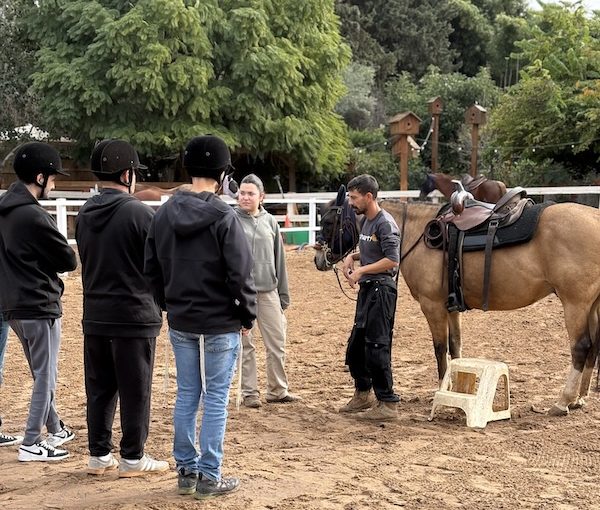
Danny’s Farm is a leading Israeli centre for holistic healing, offering animal-assisted trauma care, among other services. (photo from Danny Stirin)

After Canadian-Israeli media personality Shai DeLuca was critically wounded in 1996 during his service in the Israel Defence Forces, the instructions from his peers were as blunt as they were unhelpful: be a man, move on. 

The injury – that left him with temporary loss of use of his legs –  kept him in hospital and rehabilitation for nearly a year, in an era when post-traumatic stress was rarely named, let alone treated. “Back then, PTSD wasn’t understood the way it is today,” said DeLuca. “No one had language for it. No one recognized the symptoms.”

At the end of July 2025, DeLuca traveled to a ranch southeast of Rehovot, Israel, with a Canadian organization supporting IDF veterans with post-traumatic stress disorder, families of Oct. 7 victims and Israelis living with trauma caused by terror. What began as just a visit to Danny’s Farm, a unique therapeutic centre, turned into a revelation. 

At the end of the tour, ranch owner and chief executive officer Danny Stirin sensed something about DeLuca and asked a pointed question – why had he not dealt with the mental after-effects of his injury?

“I felt like I didn’t even need to say a lot and he understood what I meant,” recalled DeLuca. “He said, ‘the moment you’re ready, just message me. I will be there with you every step of the way.’”

The visit was “life-changing” for DeLuca and returning to the farm later allowed him “to understand parts of my own story buried for years.”

DeLuca credits Stirin as “the person who freed me in a lot of ways from a lot of weight that I’ve been carrying for so many years.”

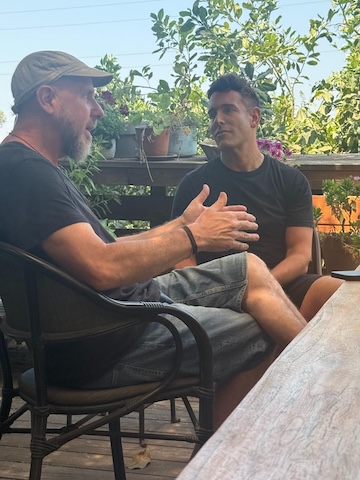
photo - Danny Stirin, left, and Shai DeLuca in conversation. DeLuca credits Stirin as “the person who freed me in a lot of ways from a lot of weight that I’ve been carrying for so many years"
Danny Stirin, left, and Shai DeLuca in conversation. DeLuca credits Stirin as “the person who freed me in a lot of ways from a lot of weight that I’ve been carrying for so many years.” (photo from Shai DeLuca)

Since its inception in 2016, Danny’s Farm has become a refuge for Israelis grappling with trauma, be it from war or terror. At first glance it looks like a ranch – stables with dozens of horses and many small animals about – but amid the pastoral view is a clinic, recognized as a leading Israeli centre for holistic, animal-assisted trauma care. Treatment rooms for art, music, bodywork and complementary medicine sit alongside the barns, and a multidisciplinary staff of psychologists, social workers and emotional-therapy instructors anchors the work with patients. The farm treats some 1,500 people each week.

Even before Oct. 7, the farm was treating children with special needs, survivors of sexual violence, and adults with complex trauma, filling a gap in an under-resourced mental-health system. Since the Hamas attacks and ensuing war, it has become a safe zone for reserve soldiers, evacuees from the south and north, and families coping with loss, dislocation and rocket fire.

For Stirin, the farm grew out of his own brush with crisis and a decision about what kind of fulfilment he sought professionally. “It’s like there’s a point in your life when you’re looking for a purpose,” he said, adding that he wanted the farm to be a tangible example for his children: “so they can see that somebody is going with his heart, all the way.”

A deeper motivation, though, was to help other people with their pain. “I felt that I have to hold the hope for others having a crisis, as I did,” he said. 

Stirin’s choice to place animals at the centre of this work came from his childhood. “Since I was a boy, I had a long attraction to animals. All my life I was near them,” he said.

Born in Argentina to a grandfather who worked as a “gaucho,” or cowboy, he grew up with horses and dogs and carried that bond into adulthood. “I realized in the best way, the very powerful way, I felt the energy of the healing, just being near the simplicity of these creatures,” said Stirin.

On the farm, that idea has been formalized into a program that pairs equine therapy with group and individual treatment, and specialized tracks for traumatized children and families. The model, developed in partnership with the resilience organization Tkuma and supported by various funders, is designed to give long-term structure to people who might otherwise never access, or have access to, sustained care.

If there is a single principle guiding Danny’s Farm, it is that trauma is both ubiquitous and intensely personal. “The human soul is very fragile, and very different from one to one,” Stirin said. “The trauma … it plays with you. It can come in all kinds of different ways, shapes.”

Because the nature of trauma depends on a person’s personality, history, physical and mental structure, he said, therapists must approach treatment with “a lot of flexibility.”

“Each one needs something else. That’s what I believe,” he said. 

For veterans like DeLuca, who was told to tough it out, the encounter with this kind of care was “liberating.” 

Coming back to the ranch last month to introduce visiting media to the farm, he said he found at the farm the space to see his injury “through a different lens,” as part of a story that “did not have to end in silence.” 

He said, “With PTSD, the challenge is not closing the door, but opening it, and dealing with it. And what Danny did was [tell] me that I don’t have to keep that door closed.” 

Dave Gordon is a Toronto-based freelance writer whose work has appeared in more than 100 publications around the world. His website is davegordonwrites.com. His trip to Israel was co-sponsored by the Or Ofir Foundation.

Format ImagePosted on February 13, 2026February 11, 2026Author Dave GordonCategories IsraelTags Danny Stirin, equine therapy, health care, Israel, PTSD, Rehovot, Shai DeLuca, war

Pill-popping for peace?

Antisemitism, dubbed “the longest hatred,” has seemed impervious to challenge. It is a social problem that shifts to meet demand, allowing perpetrators to tailor it to fit their “need.” What if there were a pill you could prescribe to “cure” a person of antisemitism? There may be.

It seems almost like an April Fool’s joke or a Purim spoof, but the timing isn’t quite right. Rob Eshman, senior contributing editor to the Forward, published a piece last weekend suggesting there may indeed be a pharmaceutical answer to this age-old problem.

MDMA, the understandably needed short form for the drug methylenedioxymethamphetamine – aka “Ecstasy” or “Molly” – has been popular for some time, primarily with people who enjoy what the U.S. National Institutes of Health calls its effects of “sympathomimetic arousal, sensual enhancement, feelings of euphoria, and emotional closeness to others.”

Like most good things, of course, this drug comes with a wide range of unwelcome side effects. But the trade-offs have been deemed worthy enough that the drug has been used in Israel since 2019 to combat post-traumatic stress disorder, Eshman writes, and the U.S. Food and Drug Administration is expected to approve it for some uses in the next couple of years.

Israel’s use of MDMA for PTSD is far from the only Jewish connection the author found. The drug was first synthesized more than a century ago by Alexander Shulgin, a California pharmacologist whose Jewish family fled Russia, and who has been called “the zeyde of psychedelics.”

Last month, science journalist Rachel Nuwer (also Jewish) published the book I Feel Love: MDMA and the Search for Connection in a Fractured World, in which she shares the story of a white supremacist who was integral to the 2017 hate rally in Charlottesville, Va. After treatment with MDMA, the individual renounced his racist orientation and declared “Love is the most important thing.”

If there is a chance that an ingestible element (currently a banned substance in Canada, the United States and most places) could address a major scourge of civilization – not just antisemitism but all forms of hatred – do we not owe it to ourselves to allocate resources to investigating the pros (and cons)?

A variety of research is ongoing, of course, including an annual Jewish Psychedelic Summit, where medical, religious, psychology and other experts discuss psychedelics and Judaism. (It’s a virtual affair, so one can only imagine the hospitality suites if it were in-person.)

The application of plant medicines and synthetic drugs to combat what we generally deem a social problem may seem dubious – and researchers say it probably wouldn’t work if the recipient isn’t predisposed to change. However, the idea may not be as outrageous as it sounds. We recently ran an article about the late psychotherapist Dr. Theodore Isaac Rubin, whose landmark 1990 book Anti-Semitism: A Disease of the Mindposited that bias against Jews could in many instances be considered a mental disorder. We have long accepted, welcomed even, pharmaceutical responses to treatable mental issues. Why not this one?

Of course, anything that changes brain chemistry or neurobiology should be approached with immense care – more care, for example, than we have demonstrated in wildly embracing over the past several decades the new technologies that have been shown to shorten our attention spans and alter the functioning of our brains, as we discussed in this space last issue.

At the same time, we would be foolish to ignore the potential for something that could ameliorate some of the worst characteristics of the human experience. Think back at the horrors that might have been alleviated had we been able to slip a “love potion” into the water glasses of history’s most evil figures.

Some experts, Eshman explains, are looking into the role MDMA could play in addressing the Israeli-Palestinian conflict. While we work on other avenues for the changes needed to bring more love and justice to the challenges inherent in that conflict, if there is a glimmer of hope that a chemical solution exists for some of the most destructive features of our species, we would be fools to dismiss it.

Posted on July 21, 2023July 20, 2023Author The Editorial BoardCategories From the JITags Alexander Shulgin, Israeli-Palestinian conflict, MDMA, mental health, methylenedioxymethamphetamine, psychedelics, PTSD, Rachel Nuwer, Rob Eshman, science, Theodore Isaac Rubin
Proudly powered by WordPress