
Skip to content
  • Home
  • Subscribe / donate
  • Events calendar
  • News
    • Local
    • National
    • Israel
    • World
    • עניין בחדשות
      A roundup of news in Canada and further afield, in Hebrew.
  • Opinion
    • From the JI
    • Op-Ed
  • Arts & Culture
    • Performing Arts
    • Music
    • Books
    • Visual Arts
    • TV & Film
  • Life
    • Celebrating the Holidays
    • Travel
    • The Daily Snooze
      Cartoons by Jacob Samuel
    • Mystery Photo
      Help the JI and JMABC fill in the gaps in our archives.
  • Community Links
    • Organizations, Etc.
    • Other News Sources & Blogs
    • Business Directory
  • FAQ
  • JI Chai Celebration
  • JI@88! video

Recent Posts

  • BGU fosters startup culture
  • Photography and glass
  • Is it the end of an era?
  • Taking life a step at a time
  • Nakba exhibit biased
  • Film festival starts next week
  • Musical with heart and soul
  • Rabbi marks 13 years
  • Keeper of VTT’s history
  • Gala fêtes Infeld’s 20th
  • Building JWest together
  • Challah Mom comes to Vancouver
  • What to do about media bias
  • Education offers hope
  • Remembrance – a moral act
  • What makes us human
  • המלחמות של נתניהו וטראמפ
  • Zionism wins big in Vegas
  • Different but connected
  • Survival not passive
  • Musical celebration of Israel
  • Shoppe celebrates 25 years
  • Human “book” event
  • Reclaiming Jewish stories
  • Bema presents Perseverance
  • CSS honours Bellas z”l
  • Sheba Promise here May 7
  • Reflections from Be’eri
  • New law a desecration
  • Resilient joy in tough times
  • Rescue dog brings joy
  • Art chosen for new museum
  • Reminder of hope, resilience
  • The national food of Israel?
  • Story of Israel’s north
  • Sheltering in train stations

Archives

Follow @JewishIndie
image - The CJN - Visit Us Banner - 300x600 - 101625

Tag: Rehovot

Farm transforms lives

Farm transforms lives

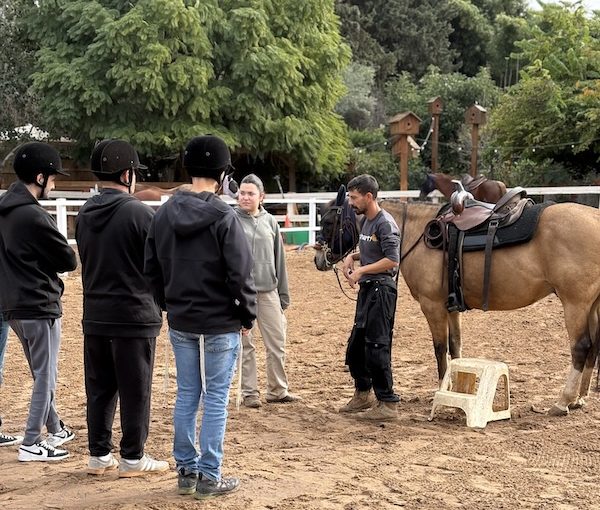
Danny’s Farm is a leading Israeli centre for holistic healing, offering animal-assisted trauma care, among other services. (photo from Danny Stirin)

After Canadian-Israeli media personality Shai DeLuca was critically wounded in 1996 during his service in the Israel Defence Forces, the instructions from his peers were as blunt as they were unhelpful: be a man, move on. 

The injury – that left him with temporary loss of use of his legs –  kept him in hospital and rehabilitation for nearly a year, in an era when post-traumatic stress was rarely named, let alone treated. “Back then, PTSD wasn’t understood the way it is today,” said DeLuca. “No one had language for it. No one recognized the symptoms.”

At the end of July 2025, DeLuca traveled to a ranch southeast of Rehovot, Israel, with a Canadian organization supporting IDF veterans with post-traumatic stress disorder, families of Oct. 7 victims and Israelis living with trauma caused by terror. What began as just a visit to Danny’s Farm, a unique therapeutic centre, turned into a revelation. 

At the end of the tour, ranch owner and chief executive officer Danny Stirin sensed something about DeLuca and asked a pointed question – why had he not dealt with the mental after-effects of his injury?

“I felt like I didn’t even need to say a lot and he understood what I meant,” recalled DeLuca. “He said, ‘the moment you’re ready, just message me. I will be there with you every step of the way.’”

The visit was “life-changing” for DeLuca and returning to the farm later allowed him “to understand parts of my own story buried for years.”

DeLuca credits Stirin as “the person who freed me in a lot of ways from a lot of weight that I’ve been carrying for so many years.”
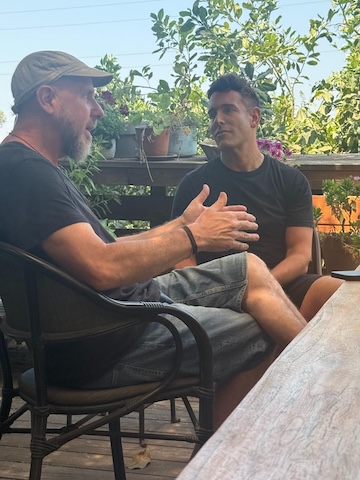
photo - Danny Stirin, left, and Shai DeLuca in conversation. DeLuca credits Stirin as “the person who freed me in a lot of ways from a lot of weight that I’ve been carrying for so many years"
Danny Stirin, left, and Shai DeLuca in conversation. DeLuca credits Stirin as “the person who freed me in a lot of ways from a lot of weight that I’ve been carrying for so many years.” (photo from Shai DeLuca)

Since its inception in 2016, Danny’s Farm has become a refuge for Israelis grappling with trauma, be it from war or terror. At first glance it looks like a ranch – stables with dozens of horses and many small animals about – but amid the pastoral view is a clinic, recognized as a leading Israeli centre for holistic, animal-assisted trauma care. Treatment rooms for art, music, bodywork and complementary medicine sit alongside the barns, and a multidisciplinary staff of psychologists, social workers and emotional-therapy instructors anchors the work with patients. The farm treats some 1,500 people each week.

Even before Oct. 7, the farm was treating children with special needs, survivors of sexual violence, and adults with complex trauma, filling a gap in an under-resourced mental-health system. Since the Hamas attacks and ensuing war, it has become a safe zone for reserve soldiers, evacuees from the south and north, and families coping with loss, dislocation and rocket fire.

For Stirin, the farm grew out of his own brush with crisis and a decision about what kind of fulfilment he sought professionally. “It’s like there’s a point in your life when you’re looking for a purpose,” he said, adding that he wanted the farm to be a tangible example for his children: “so they can see that somebody is going with his heart, all the way.”

A deeper motivation, though, was to help other people with their pain. “I felt that I have to hold the hope for others having a crisis, as I did,” he said. 

Stirin’s choice to place animals at the centre of this work came from his childhood. “Since I was a boy, I had a long attraction to animals. All my life I was near them,” he said.

Born in Argentina to a grandfather who worked as a “gaucho,” or cowboy, he grew up with horses and dogs and carried that bond into adulthood. “I realized in the best way, the very powerful way, I felt the energy of the healing, just being near the simplicity of these creatures,” said Stirin.

On the farm, that idea has been formalized into a program that pairs equine therapy with group and individual treatment, and specialized tracks for traumatized children and families. The model, developed in partnership with the resilience organization Tkuma and supported by various funders, is designed to give long-term structure to people who might otherwise never access, or have access to, sustained care.

If there is a single principle guiding Danny’s Farm, it is that trauma is both ubiquitous and intensely personal. “The human soul is very fragile, and very different from one to one,” Stirin said. “The trauma … it plays with you. It can come in all kinds of different ways, shapes.”

Because the nature of trauma depends on a person’s personality, history, physical and mental structure, he said, therapists must approach treatment with “a lot of flexibility.”

“Each one needs something else. That’s what I believe,” he said. 

For veterans like DeLuca, who was told to tough it out, the encounter with this kind of care was “liberating.” 

Coming back to the ranch last month to introduce visiting media to the farm, he said he found at the farm the space to see his injury “through a different lens,” as part of a story that “did not have to end in silence.” 

He said, “With PTSD, the challenge is not closing the door, but opening it, and dealing with it. And what Danny did was [tell] me that I don’t have to keep that door closed.” 

Dave Gordon is a Toronto-based freelance writer whose work has appeared in more than 100 publications around the world. His website is davegordonwrites.com. His trip to Israel was co-sponsored by the Or Ofir Foundation.
Format ImagePosted on February 13, 2026February 11, 2026Author Dave GordonCategories IsraelTags Danny Stirin, equine therapy, health care, Israel, PTSD, Rehovot, Shai DeLuca, war

Living under fire of missiles

Working from home, it was after 6 p.m. and my global Teams meeting had just started. Comfortably settled and talking about suppliers, delivery times and prices, my smartphone beeped incessantly – the Code Red missile warning app. More than 350 missiles fired at Israel over the last couple of days.

Rehovot has managed to dodge almost all the missiles. We could see them soaring overhead and hear the guided collision with our Iron Dome anti-missiles. And the nonstop news cycles informed us in real time where rockets were being intercepted.

Since terrorist Khader Adnan died from his hunger strike at an Israeli prison, Israel had been bracing for reaction from the Islamic Jihad in Gaza. In the same way my Canadian cousins warn their loved ones about a pending blizzard – Did you hear the weather report? It’s going to be a cold one. Potential white out. Bundle up. Hurry home. We do the same here but for different reasons – Did you hear the news? Adnan died. Might be terrorist attacks or missiles from Gaza. Be aware of your surroundings. Hurry home.

Sure enough, we felt the reprisals, with about 100 missiles fired from Gaza. Israel waited, preferring to respond at a time and place of its choosing. Our reaction came about eight days later, with the targeted assassination of three Islamic Jihad leaders; their names of no consequence, each responsible for reprehensible terrorist crimes over the years. And, with that, Operation Shield and Arrow began.

Back to Teams. Another siren went off. This one not only coming from my app, but also from outside. “Bruce!” my wife yelled. “Missiles!” “Hurry!” Not sure my European and U.S. coworkers understood when I shouted into my headset, “Missile siren! Gotta go!” Abruptly exiting my meeting, I darted to our TV room … er … reinforced safe room, which doubles as a den in quieter times.

We have about 75 seconds to reach our shelter before a missile hits or, preferably, gets knocked out of the sky – as apposed to the 15 seconds for those living closer to Gaza. Can’t imagine their stress during these times.

We just managed to close the heavy steel door and fortified iron window shutter when “BOOM!” The loudest boom we ever heard. My wife and I almost hit the ceiling, knowing this was more than the reassuring and softer crash of an Iron Dome antimissile intercepting an Islamic Jihad rocket high in the sky. No. This was something much closer, much more ominous.

Numerous calls from friends and family followed. Were we OK? Amazing how quickly news travels. My son texted from the safety of his dorm in the United States – a missile had landed next to his best friend Amit’s home. Then my daughter texted from the relative safety of her work north of Tel Aviv – a missile hit near the home of her best friend (and Amit’s sister) Shira. And on it went. With more chilling calls from neighbours.

I tried rejoining my Teams meeting, to create some normalcy. But I was too hyper, too distracted. Couldn’t focus on discussions about price variances and purchasing systems. I excused myself again, advising them the precariousness of the situation.

Rehovot had suffered a direct hit, due to the malfunction of our Iron Dome system. It was just around the corner, not far from Amit and Shira’s home. Curiosity being a strange animal, I walked the two blocks into what was literally a war zone. A chill engulfed my entire body as my skin crawled.

My favourite bakery nearby became a gathering place for the shocked. I considered buying cookies and cakes for our first responders, then thought better of it – didn’t want the action to be confused with the celebrating Palestinian street, which hands out sweets after such attacks.

The smell of sulfur, carbon and potassium nitrate dominated. A flash back to younger days of playing with cap guns … my mind looking for a safer place.

Time seemed to halt. Somewhat apocalyptic. Traffic snarled and jammed. Red-and-blue flashing lights from police vans, fire trucks and ambulances. Army sappers and Israel’s 669 search-and-rescue unit moving about in their yellow vests. Local and international news crews mustering about. ZAKA – the Orthodox volunteers who collect the remains of the wounded and dead after terror or missile attacks – were scouring the area. There were five wounded, one dead.

Alas, Israelis have learned to move on quickly. Within hours, the streets were reopened, the destroyed building draped with Israeli flags. And I joined another work meeting later that evening, this time much calmer. Again, in search of normalcy and routine. Echoing Herb Keinon from the Jerusalem Post, specific memories of these military operations – whether they last weeks, days or a weekend – quickly fade into the background. It’s difficult to differentiate one from the other: Rains, Summer Rains, Autumn Clouds, Black Belt, Breaking Dawn, Cast Lead, Pillar of Defence and, now, Shield and Arrow. The list goes on, unfortunately.

Israel takes maximum precautions to avoid collateral damage. We are known for our warning methods. Sometimes a “knock on the door,” unarmed missiles skimming the roofs as a warning of incoming rockets. Sometimes dropping leaflets advising of a pending attack. Missions are even aborted when civilians are spotted nearby. But our enemies indiscriminately shoot missiles – hundreds of them – towards Israel, hoping for maximum death, maximum damage. Fortunately, our missile defence system renders much of this arsenal ineffective. Until one gets through. As it did in Rehovot. My little shtetl. Paraphrasing from the Torah – may we be blessed with peace.

Bruce Brown is a Canadian and an Israeli. He made aliyah … a long time ago. He works in Israel’s high-tech sector by day and, in spurts, is a somewhat inspired writer by night. Brown is the winner of the 2019 AJPA Rockower Award for excellence in writing, and wrote the 1998 satire An Israeli is…. Brown reflects on life in Israel – political, social, economic and personal.

Posted on May 26, 2023May 25, 2023Author Bruce BrownCategories Op-EdTags Gaza, Israel, missiles, Rehovot, terrorism
ביקור חגיגי

ביקור חגיגי

נציגי קהילת יהודי טורונטו ביקרו בשכונת אבן גבירול בעיר רחובות שאותה הם מאמצים. (צילום: Little Savage)

ראשי קהילת יהודי טורונטו קיימו בשבוע שעבר ביקור חגיגי בשכונת אבן גבירול בעיר רחובות שבמרכז הארץ (במישור החוף הדרומי), אותה הם מאמצים כבר שנים רבות. ביקור קודם של ראשי הקהילה היהודית באבן גבירול התקיים לפני שתיים עשרה שנים.

האימוץ כולל תרומות נרחבות לתמיכה בתושבי לאבן גבירול (ובשמה הקודם כבר גבירול) מכל הגילאים. הוא כולל: הקמת בית הספר בשכונה (בשנת 1988) על שם ראש הממשלה לשעבר מנחם בגין – שכולל חטיבה הצעירה וכן משמש את לתמידי המגזר החרדי, מתנ”ס, מרכז יחודי לגיל הרח, מרכז שכונתי לבני גיל הזהב וכן מלגות לסטודנטים מקומיים.

בביקור הפעם נכחה משלחת גדולה של ראשי קהילת יהודי טורונטו שמנתה שלוש מאות וחמישים איש. אותם קיבלו בברכה בין היתר ראש העיר רחובות רחמים מלול, סגניו עו”ד מתן דיל וזהר בלום, יו”ר ועדת שכונת אבן גבירול גבי גולן (המנהל קשר קבוע ומתמשך עם ראשי קהילת טורונטו) וכן חברי מועצת העיר תל אביב איטח רונן ואמיר רונן.

המשלחת מטורונטו השתתפה בטקס חגיגי לחנוכת הכיכר בצומת הרחובות יוני נתניהו ובן גוריון (במערב רחובות) על שם יהדות טורונטו. זאת כדי לבטא את הקשר החזק והעמוק בין תושבי שכונת אבן גבירול לבין קהילת יהודי טורונטו. לאחר הטקס התקיים אירוע ברחבה המרכזית של בית הספר על שם בגין, שכלל הפנינג גדול עם מאות מתושבי השכונה.

בתום האירועים אמר ראש העיר מלול: “אנו מוקירים את ראשי הקהילה היהודית בטורונטו על תרומתם הגדולה לשכונה ולעיר רחובות. הקשר הפורה הזה הביא ברכה גדולה בליבה של השכונה המתפתחת הזו. לשותפות זו בינם

לביננו יש משמעות ערכית, חינוכית ולאומית. אם בתפוצות ואם בישראל כולנו עם אחד”.

כפר גבירול וכיום שכונת אבן גבירול נקראת על שמו של הרב שלמה אבן גבירול, שהיה מגדולי המשוררים והפילוסופים היהודים בימי הביניים. לפני מלחמת העצמאות שכן במקום הכפר הערבי אל-קוביבה (בערבית הכוונה לכיפה קטנה או קציצה), שחלקו ננטש וחלקו פונה מידי תושביו (במסגרת מבצע ברק של חטיבת גבעתי במאי 1948). השכונה מורכבת מאוכלוסייה מגוונת של יהודים מהמזרח והמערב. תחילה היא אוכלסה ביהודים שעלו מבולגריה ולאחר מכן מיהודים שהגיעו מתימן. בשנות השישים הגיעו יהודים שעלו ממרוקו, בשנות השבעים יהודים שהגיעו מברית המועצות לשעבר, ולאחר מכן יהודים שעלו מאתיופיה. במשך השנים לאור עליית מחירי הנדל”ן באזור תל אביב עברו להתגורר בשכונה זוגות צעירים, בעיקר במגדלי הדיור החדשים של חברת הבנייה אביסרור.

השכונה ידעה שני פיגועים בשנת 1955: חולית מודיעין ממצריים רצחה בחודש פברואר תושב מקומי. לאחר מספר חודשים באוגוסט חוליית פדאיון רצחה אף היא תושב מקומי.

קצת היסטוריה: בני שבט היין התיישבו באזור קוביבה במאה השלושה עשר, על שרידים של כפר מתקופת הברונזה. השבט הגיע בנדודיו מחצי האי ערב. בהמשך ניצבה במקום העיר אלתקה (אחת מערי הלווים). בתקופת השלטון העותומאני רכשה קרן קיימת לישראל כששת אלפים ושלוש מאות דונם מאדמות הכפר קוביבה. האדמה חולקה לארבעה צרכים עיקריים: לגידולים חקלאיים, לגידולי מספוא, לגידולי שלחין (פרדסים וירקות) וכן לגידולי כרמים (אדמה זו התאימה אף לבנייה).

ברחובות שהוקמה בשנת 1890 מתגוררים כיום כמאה וארבעים אלף תושבים. היא נחשבת לעיר השניים עשר בגדולה בישראל. למעלה מעשרים אחוז מהתושבים הם עולים כאשר רובם (בדומה לשכונת אבן גבירול) הגיעו מברית המועצות לשעבר מתימן וכן מאתיופיה.

Format ImagePosted on November 15, 2017Author Roni RachmaniCategories עניין בחדשותTags Canada, Israel, Rahamim Malul, Rehovot, Toronto, טורונטו, ישראל, קנדה, רחובות, רחמים מלול
Proudly powered by WordPress