
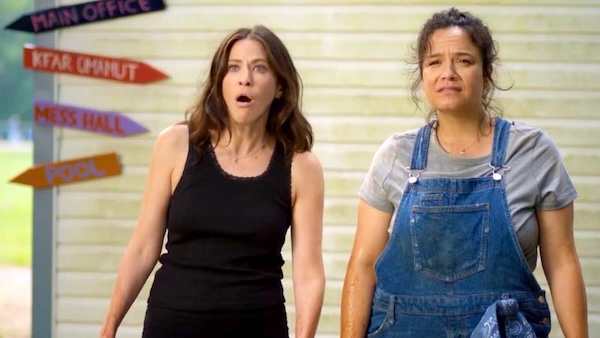

Jackie Tohn, left, and Sarah Podemski play longtime best friends Nomi and Mara in The Floaters. (still from film)
The Vancouver Jewish Film Festival opens on April 30 with the award-winning The Ring (Israel/Hungary) and closes on May 10 with the multiple-award-winning Once Upon My Mother (France/ Canada). In between, there are more than two dozen films from several other countries, most of which have been recognized with honours.
Among the offerings at this year’s festival are two locally produced documentaries that the Jewish Independent has reviewed previously: Becky Wosk’s One Thread (jewishindependent.ca/different-but-connected) and Kai Balin’s Son of a Seeker (jewishindependent.ca/sharing-a-personal-journey). Each young filmmaker engagingly investigates, in different ways, what it means to be Jewish. Both docs screen on May 3.
Also screening on May 3 is the American film The Floaters. Leading the cast are Jackie Tohn (Nobody Wants This) and Sarah Podemski (Reservation Dogs) as longtime best friends Nomi, a struggling musician, and Mara, a struggling Jewish summer camp director. When Mara finds herself a counselor short at the last minute, she asks Nomi, who just got fired from her own band, to step in. Reluctantly, Nomi agrees and Mara puts her in charge of a group of teens who don’t fit in at camp for various reasons and who didn’t sign up for any activities – hence, they are “floaters.”
Directionless in life herself, Nomi proves an apt mentor to these lost kids. She learns from them, they learn from her. Nomi and Mara’s friendship is put to the test, the kids are put to a test. It’s a charming movie, with plenty of laughs, that, thankfully, doesn’t resort to crude gags, though a malfunctioning septic tank does add a lightly gross element.
The Floaters is a coming-of-age film about friendship and second chances, firmly rooted in Jewish traditions, from Orthodox to secular, featuring characters who are Jews by birth and Jews by choice. It has a John Hughes-esque feel and a few actors who were popular in the 1980s/1990s have supporting roles. But director Rachel Israel makes the film her own, and Nomi, Mara and the young misfits are at the movie’s heart.
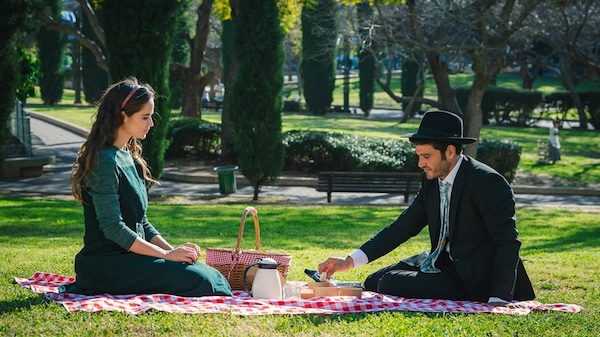
Matchmaking 2 (Israel), which screens on May 5, also has a misfit at its heart. Many of the actors from the first movie reprise their roles, including Maor Schwitzer as Baruch Auerbach, a former rising star scholar in his ultra-Orthodox community, now in his late 20s and yet to find a wife. There is no need to have seen the first movie to fully enjoy its sequel. The characters are likeable and, even when Baruch acts like an idiot, you still cheer for him and hope that he’ll find his match.
While Matchmaking 2 gives viewers a glimpse into the cultural differences between Ashkenazi and Sephardic Jews, and into the ultra-Orthodox shidduch (matchmaking) system, it is mainly a rom-com. As The Floaters does, the movie celebrates Judaism and Jewish life with humour, tenderness and respect.
As entertaining, in a completely different way, is the documentary The Stamp Thief (United States/ Poland/Germany), which screens May 7.
The Stamp Thief, produced/directed by Dan Sturman, is fascinating on many fronts. The filmmakers make a potentially convoluted detective story into an easy-to-follow “page-turner” and there are a few moments where you’ll find yourself holding your breath. There are also many moments – well after the film – where you’ll be thinking about humanity’s capacity for doing good and evil, intergenerational trauma, generational responsibility, and many other issues.
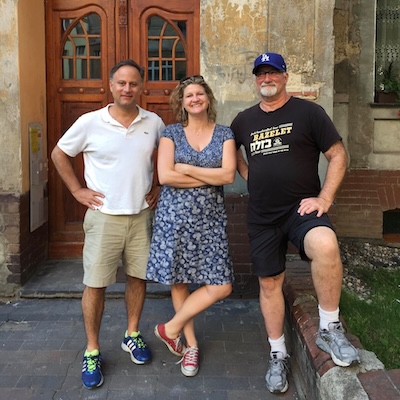
In The Stamp Thief, it’s refreshing how open the filmmakers are about the morality of what they’re trying to do – steal back for the Jewish community some rare stamps that were stolen by a Nazi officer whose task was to catalogue and appraise the possessions being stolen from Jews entering Auschwitz. The conversations between producer/writer Gary Gilbert and his family are uplifting, even as his family questions his motives and actions, because that’s what loved ones should do – be supportive but not uncritically so.
The story behind the filmmakers’ quest came from screenwriter David Weisberg’s father, who was a psychiatrist. His dad had a patient in the 1970s who was married to the daughter of a former Nazi. The patient revealed that his father-in-law had buried a case of stolen stamps in the basement of his home in Legnica, which was part of Germany until 1945, but is now in Poland.
Weisberg had no desire to return to Poland, but his friend Gilbert was game, and Gilbert had a plan – one based on an elaborate “fake movie” scheme that Weisberg’s father had
drawn up in the ’70s. Sturman would direct a fake film, giving him, Gilbert, producer Dylan Nelson and their handpicked team a non-controversial reason to explore the former Nazi’s apartment building. The help they receive from Polish film professional Sylwia Szczechowicz-Warszewska is moving, and the resulting documentary is compelling.
The Vancouver Jewish Film Festival runs April 30-May 8 at Fifth Avenue Cinemas, which is a 19+ venue, and concludes on May 10 at the Rothstein Theatre with a few films. For the full lineup and tickets, go to vjff.org.



