
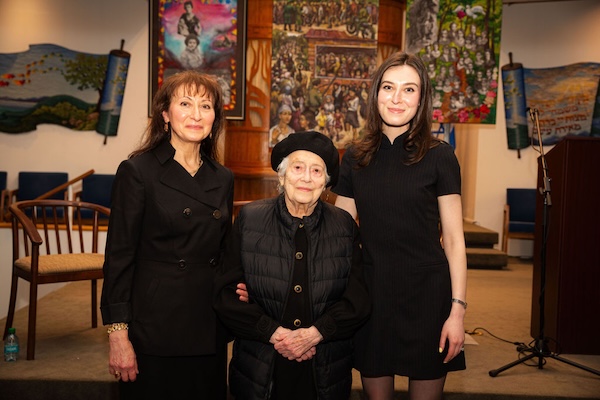

Malka Pischanitskaya, centre, told her story of survival at the Vancouver community’s Yom Hashoah ceremony. Her daughter, Inna Turner, and granddaughter, Sophie Turner, also spoke at the April 14 event. (Rhonda Dent Photography)
Even before the Holocaust upended her life, Malka Pischanitskaya’s family was hobbled by poverty. Her father left before she was born, and she was largely raised by her grandmother and great-aunt while her mother worked elsewhere. After the Nazi invasion reached Romaniv, Ukraine, in 1941, when Malka was 10 years old, she saw Jews murdered in the streets. On Aug. 25, 1941, Romaniv’s Jews were rounded up for mass execution.
On that day, there was a pounding on the family’s front door and orders to assemble at a central location. What followed was chaos, crowds converging from all directions, families separated. Men were taken away and executed.
“The screams of men were just horrible,” she recalled.
Malka and her mother survived only because, after hours of terror, some mothers with children were unexpectedly released. Most of their family and community were murdered.
What followed were years of hiding, near-starvation and repeated brushes with death. The title of Pischanitskaya’s memoir, A Mother to My Mother, published by the Azrieli Foundation, comes from the reversal forced on her by war: her mother was so traumatized that young Malka often became the more practical, protective figure, begging for food and helping keep them alive. (See jewishindependent.ca/a-harrowing-survival-story.)
Pischanitskaya shared her story April 14 at the annual Yom Hashoah community event, marking Holocaust Remembrance Day, in conversation with Ellie Lawson, education manager of the Vancouver Holocaust Education Centre.
Each day, Malka left her mother hidden – in a haystack, a trench, wherever they could remain unseen – and went from door to door in nearby villages, begging for bread. Malka had gone to a Ukrainian public school and spoke Ukrainian fluently, while her mother was identifiably Jewish by her accent. Sometimes people helped, sometimes they could not, but two people in particular probably ensured Malka and her mother lived.
One of those people was Lydia. When Malka first approached her, Lydia demurred. “My home is so empty,” she said. “Like a crystal bowl.”
Malka proposed that, if Lydia would hide her and her mother, she would continue to gather food and share it. Lydia agreed and, for more than a year, Malka and her mother lived hidden in Lydia’s home.
Eventually, neighbours became suspicious. Malka and her mother moved, this time to the home of a young orphan who, like Lydia, chose to help despite the risks.
Both women would be recognized at Yad Vashem as Righteous Among the Nations.
“They needed us as much as we needed them,” Pischanitskaya said of the relationships forged in desperation.
By the end of the war, nearly 40 members of her family were gone – and she began to rebuild a life. “I was not sitting and crying,” she said. “I was mobilized.”
They returned to Romaniv to find almost nothing left. Malka finished school, earned a teaching diploma in Zhytomyr in 1954. She married, had two children, lived in Tashkent and Uzhhorod, and immigrated to Vancouver in 1975. For decades, she did not speak about her Holocaust experiences.
Pischanitskaya’s daughter, Inna Turner, who joined her at the Yom Hashoah event, grew up with the emotional weight of that silence.
“I didn’t know she was a Holocaust survivor,” Turner said. “But I felt it.”
Turner said the silence had a profound effect on her life.
“I think many Holocaust survivors suffer from PTSD,” she said. “And, in the olden days we didn’t know much about it. We know more now, or at least we think we do, and we know that it affects an individual. But it affects not just an individual, it affects people who are the closest to the individual, like children, grandchildren, spouses, siblings, the family. Being a child of a Holocaust survivor, well, what can I say? Not a walk in the park, that’s for sure.”
Only years later did Pischanitskaya begin to speak – through a community of survivors, art and writing.
Pischanitskaya’s granddaughter, Sophie Turner, introduced her not only as a survivor, but as a grandmother who is strong and resilient. She sees her grandmother’s story as a responsibility she and others of her generation are obligated to sustain. “This is not only history,” she said. “It is living memory that we carry with us.”
Survivors lit candles representing six million lives lost, including one and a half million children. Vancouver Mayor Ken Sim and US Consul General Shawn Crowley were among the dignitaries who attended. Rabbi Dan Moskovitz, senior rabbi at Temple Sholom, which hosted the event with the Vancouver Holocaust Education Centre and the Jewish Community Centre of Greater Vancouver, with support from the Jewish Federation’s annual campaign and the Province of British Columbia, welcomed attendees.
“We live in a time when the language of the Holocaust is being used in ways that empty it of meaning,” said Moskovitz, “Words like genocide, once anchored in specific historical reality, are now invoked casually…. Comparisons are made that collapse moral distinctions rather than clarify them. And, perhaps most troubling, the Holocaust itself is sometimes inverted – Jews recast not as victims, but as perpetrators. This is not just inaccurate, it is dangerous. The Holocaust was not a metaphor. It was not a slogan. It was the systematic, industrialized attempt to annihilate the Jewish people. Six million Jews were murdered, families were erased, entire communities were destroyed. That reality demands precision, honesty and reverence. And when that truth is blurred, something else is lost as well. Empathy is lost. Understanding is lost. And the moral clarity that the Holocaust calls us to carry into the world begins to fade.”
“Remembrance is not a passive state of being,” said Hannah Marazzi, executive director of the VHEC. “It is an act of moral choice … an act of resistance.”
In addition to mourning those murdered, she said, Yom Hashoah is about honouring survivors. “Those who endured unimaginable suffering and yet found the strength to go on,” she said. “Many rebuilt their lives here in Canada. Their resilience, wisdom and testimony have shaped not only this community, but the city of Vancouver, and continue to shape the work that we undertake at the Vancouver Holocaust Education Centre.”
A musical program included Abbygail Sandler, Cantor Michael Zoosman, Cantor Shani Cohen, Lisa Kesselman and Ellie Sherman. They were accompanied by Eric Wilson on cello, Erin Marks on oboe, Wendy Bross Stuart and Perry Ehrlich on piano. Cantor Yaacov Orzech chanted the memorial prayer El Moleh Rachamim.



