
Skip to content
  • Home
  • Subscribe / donate
  • Events calendar
  • News
    • Local
    • National
    • Israel
    • World
    • עניין בחדשות
      A roundup of news in Canada and further afield, in Hebrew.
  • Opinion
    • From the JI
    • Op-Ed
  • Arts & Culture
    • Performing Arts
    • Music
    • Books
    • Visual Arts
    • TV & Film
  • Life
    • Celebrating the Holidays
    • Travel
    • The Daily Snooze
      Cartoons by Jacob Samuel
    • Mystery Photo
      Help the JI and JMABC fill in the gaps in our archives.
  • Community Links
    • Organizations, Etc.
    • Other News Sources & Blogs
    • Business Directory
  • FAQ
  • JI Chai Celebration
  • JI@88! video

Recent Posts

  • Hateful messages intensify
  • Creating entrepreneurs
  • Wrong choice to host Piker
  • Attack on Jewish kids
  • Multiple benefits of a break
  • Dialing up the perfect thriller
  • Empowerment & more
  • Songs in war of peace
  • Successful trip to Cuba 
  • Tackling antizionism head on
  • Thinking of leaving Canada?
  • Kindness as a matter of fact
  • Personal stories, vital lessons
  • Connecting generations
  • Vancouver to Vienna
  • Recipes a form of resistance
  • Community milestones … February 2026
  • Generations … It’s all yours!
  • נתניהו לא מתבייש להאשים את ביידן באחריות להרג חיילים ברצועת עזה
  • Last hostage home
  • New bill targets hate crimes
  • Concerning actions
  • Recipes not always required
  • Survivor urges vigilance
  • Seniors profoundly affected
  • Farm transforms lives
  • Musical legacy re-found
  • A range of Jewish literature
  • A concert of premieres
  • Variety telethon on Feb. 22
  • Victoria club’s many benefits
  • Avodah dedicated to helping
  • Artists explore, soar, create
  • Life’s full range of emotions
  • Community needs survey closes March 29
  • Jerusalem marathon soon

Archives

Follow @JewishIndie
image - The CJN - Visit Us Banner - 300x600 - 101625

Tag: community-building

Kindness as a matter of fact

Kindness as a matter of fact

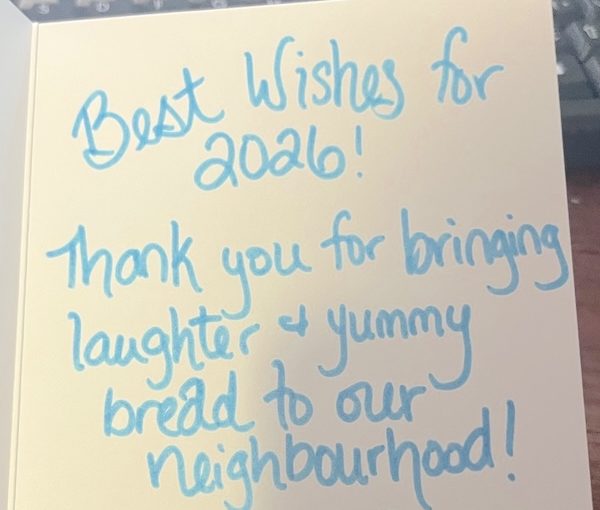
A note that was delivered to the Okanagan Chabad Centre recently. (photo from Okanagan Chabad Centre)

A handwritten note showed up in our mailbox a few weeks ago. It was from neighbours of a different faith, with just a few lines: “Best wishes for 2026! Thank you for bringing laughter & yummy bread to our neighbourhood.”

That was all. No mention of beliefs or interfaith-type language. No apparent agendas. Just the neighbourhood.

Here’s what happened. 

On Friday afternoons, just before sunset, when our family welcomes Shabbat, a few fresh loaves of Fraidy’s homemade challah usually leave our house. Not for any special reason. It’s simply Friday. That’s what the end of the week looks like in our home.

We usually run out with some of the kids. We go next door, across the street, behind the alley, and beyond. We’re making connections, formed among people with very different beliefs and backgrounds.

One week, kosher wine appeared at our door. Another week, neighbours opened their home when our guests needed a place to sleep. Another week, children’s clothing arrived. Another week, unexpected help showed up when it was needed most. The small stories are endless.

All of this just because fresh yummy bread goes out consistently – with no strings attached. That’s all that really happened. 

Kindness now moves back and forth the way it does when it’s real: without announcements, without keeping score, without any agendas.

People don’t live next to ideas. They live next to people.

Long before anyone asks what you believe, they already know whether life feels easier around you. Kinder. More decent. More human.

They know whether generosity shows up naturally, or only when it’s requested. Almost anyone can be kind once, or when there’s a need.

What changes the environment is when kindness happens often enough that it stops feeling like an act that someone did and starts feeling like the way things are.

They didn’t thank us for what we believed. They didn’t thank us for our faith. They didn’t even really thank us for the bread either. They thanked us for what the neighbourhood feels like. 

That’s why this handwritten note is so special. Not because it notices an act we had done, but because it describes the laughter and yumminess that the neighbourhood is starting to feel. And what one neighbourhood feels like is what a city – and a world – will become. 

Kindness will change the world when it grows from being a random act and starts becoming a matter of fact. 

Rabbi Shmuly Hecht is co-director of the Okanagan Chabad Centre with his wife, Fraidy Hecht.

Format ImagePosted on February 27, 2026February 26, 2026Author Rabbi Shmuly HechtCategories LocalTags Chabad, community-building, Jewish life, kindness, Okanagan

Inspiration is nearby

Light amid darkness is a common theme in the winter festivals of many wisdom traditions. As befitting a Jewish holiday, the meanings of Hanukkah are many and varied, among these the resilience of the Jewish people and the imminence of miracles. These are welcome themes this year.

At vigil after rally after menorah lighting after social media post after dinner table conversations during Hanukkah, the theme has been reprised endlessly over the past days: in a world of darkness, we are called upon to generate light, even to be the light. 

Finding the light – let alone being the light – is not easy. It is understandable to respond to events in the world today with hopelessness. A dramatic spike in antisemitic incidents locally and internationally is only an iceberg’s tip. It does not require a physical assault or desecrated property to be victimized by the tsunami of hatred sweeping over the world.

In the face of this conflict and the ensuing uptick in hatred, what have Canadian Jews done? In British Columbia and across the country, we have joined with Jews around the world to volunteer, donate and do whatever is necessary to repair, as much as it can be, the brokenness that happened on Oct. 7 and since. 

This is the light we are called upon to be. This is the resilience that is not just a word, but an actualized embodiment of Jewish values.

It is worth remembering that the greatest period of growth and expansion of our own local community occurred in the late 1940s and early 1950s. Even as the magnitude of the unprecedented historic trauma was just beginning to be understood, new synagogues were constructed, new day schools opened, social service agencies launched, refugee aid groups mobilized. Hillel welcomed students for the first time at the University of British Columbia mere months after the end of the Second World War.

In the shadow of unfathomable darkness, Jews in Vancouver redoubled their commitment to nationhood. Similar epochs of regeneration took place worldwide, not least being the fulfilment of the ancient dream of Jewish self-determination as a free people in our own land. 

This extraordinary burst of collective local regeneration was, of course, due in part to the influx of refugees, as well as the greatest period of sustained economic growth in human history. But, it was, first and foremost, an expression of the determination of the surviving remnant to plant for the future generations even while mourning those who had planted for them.

The chalutzim, the pioneers, who built the foundations of the community we live in today remain with us – some only in spirit, some very much still with us at advanced ages. Likewise, the founders who built the state of Israel are present, some in body but all in spirit, as we rededicate ourselves to girding the defence, strength and future of that country. Together, the examples of these forces of resilience are models for us to emulate as we struggle in these dark times.

We do not need to search hard for inspiration to get us through and embolden our commitment to carry on, to be the light. It is in the example of our families, our community and millennia of being a people that the poet Yehuda Amichai called “infected with hope.” May we merit to grow in hope, compassion, resilience and light in the coming days and weeks. 

Posted on December 15, 2023December 14, 2023Author The Editorial BoardCategories From the JITags Chanukah, community-building, Hanukkah, Israel, Judaism, Vancouver
“Hacking” community

“Hacking” community

Kara Mintzberg, left, and Dana Troster at the Community Hackathon. (photo from Jewish Federation of Greater Vancouver)

On a sunny Sunday, June 25, 40 Jewish young adults gave up a day at the beach and devoted themselves to building a better community. And three teams within this group saw their ideas chosen to be developed and piloted.

Led by Jewish Federation of Greater Vancouver’s young adult program Axis, the goal of the Community Hackathon is a more connected community whose members design the programs and services they wish to see. This is the second phase of the project, which began in January, when a core group of Jewish young adults convened for a pre-Hackathon workshop focused on improving the Jewish experience for young adults and young parents.

“Jewish Federation has demonstrated that they are committed to engaging the next generation of Jewish leaders,” said Bryan Hack, chair of the Axis steering committee. “We’ve seen that in how they’ve included young adult engagement as a key element of their 2020 Strategic Priorities and in creating opportunities like the Community Hackathon, that are platforms for the involvement and leadership of young Jewish adults.”

Jewish Federation is one of only three organizations in North America to host a Community Hackathon. They received a grant from the PresenTense Group and the Covenant Foundation to facilitate the program and to fund the ideas generated through it.

The Community Hackathon was a full-day event at the Museum of Vancouver. Participants used design thinking to generate and prototype project ideas to tackle this challenge: “How to identify what people find meaningful in Jewish connection and then respond with appropriate experiences, infrastructure and communication.” Using this question as a framework, participants worked collaboratively in smaller teams to come up with tangible and sustainable solutions. They were led through the process by a facilitator from UpStart, an organization committed to being an engine for Jewish innovation.

Three of the teams will see their ideas piloted, using seed grants of $2,500 US each plus training and mentorship from UpStart and local coaches over the months to follow. The selected proposals were:

Shabbat Share (Adina Goldberg, Elliot Cheng, Jonathan Polak, Rebecca Denham, Bryan Hack and others), with the idea to create crowdsourced Shabbat dinners;

Shmooz (Rebecca Shaw, Gabby Switzer, Ali De Levie, Courtney Cohen, Kathleen Muir and Tamir Barzelai), which proposes the creation of a personalized interface that represents current events in the community, along with opportunities and a directory in a consolidated format with map and calendar capabilities; and

Treehouse Mentorship (Simone Landa, Lia Hershkovitz, Shayna Goldberg, Genna Cohen, Noah Kass and Dave Elezam), which will connect established Jewish mentors and community leaders with young professionals and newcomers to Vancouver to build a stronger community.

For more about Axis and to become involved, visit axisvancouver.com.

Format ImagePosted on August 18, 2017May 19, 2021Author Jewish Federation of Greater VancouverCategories LocalTags community-building, Hackathon, Jewish Federation, technology
Proudly powered by WordPress