
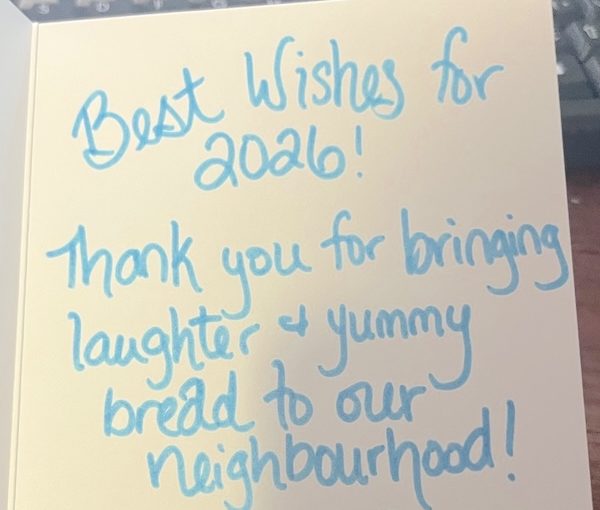
A note that was delivered to the Okanagan Chabad Centre recently. (photo from Okanagan Chabad Centre)
A handwritten note showed up in our mailbox a few weeks ago. It was from neighbours of a different faith, with just a few lines: “Best wishes for 2026! Thank you for bringing laughter & yummy bread to our neighbourhood.”
That was all. No mention of beliefs or interfaith-type language. No apparent agendas. Just the neighbourhood.
Here’s what happened.
On Friday afternoons, just before sunset, when our family welcomes Shabbat, a few fresh loaves of Fraidy’s homemade challah usually leave our house. Not for any special reason. It’s simply Friday. That’s what the end of the week looks like in our home.
We usually run out with some of the kids. We go next door, across the street, behind the alley, and beyond. We’re making connections, formed among people with very different beliefs and backgrounds.
One week, kosher wine appeared at our door. Another week, neighbours opened their home when our guests needed a place to sleep. Another week, children’s clothing arrived. Another week, unexpected help showed up when it was needed most. The small stories are endless.
All of this just because fresh yummy bread goes out consistently – with no strings attached. That’s all that really happened.
Kindness now moves back and forth the way it does when it’s real: without announcements, without keeping score, without any agendas.
People don’t live next to ideas. They live next to people.
Long before anyone asks what you believe, they already know whether life feels easier around you. Kinder. More decent. More human.
They know whether generosity shows up naturally, or only when it’s requested. Almost anyone can be kind once, or when there’s a need.
What changes the environment is when kindness happens often enough that it stops feeling like an act that someone did and starts feeling like the way things are.
They didn’t thank us for what we believed. They didn’t thank us for our faith. They didn’t even really thank us for the bread either. They thanked us for what the neighbourhood feels like.
That’s why this handwritten note is so special. Not because it notices an act we had done, but because it describes the laughter and yumminess that the neighbourhood is starting to feel. And what one neighbourhood feels like is what a city – and a world – will become.
Kindness will change the world when it grows from being a random act and starts becoming a matter of fact.
Rabbi Shmuly Hecht is co-director of the Okanagan Chabad Centre with his wife, Fraidy Hecht.