Skip to content
  • Home
  • Subscribe / donate
  • Events calendar
  • News
    • Local
    • National
    • Israel
    • World
    • עניין בחדשות
      A roundup of news in Canada and further afield, in Hebrew.
  • Opinion
    • From the JI
    • Op-Ed
  • Arts & Culture
    • Performing Arts
    • Music
    • Books
    • Visual Arts
    • TV & Film
  • Life
    • Celebrating the Holidays
    • Travel
    • The Daily Snooze
      Cartoons by Jacob Samuel
    • Mystery Photo
      Help the JI and JMABC fill in the gaps in our archives.
  • Community Links
    • Organizations, Etc.
    • Other News Sources & Blogs
    • Business Directory
  • FAQ
  • JI Chai Celebration
  • JI@88! video

Recent Posts

  • Eby touts government record
  • Keep lighting candles
  • Facing a complex situation
  • Unique interview show a hit
  • See Annie at Gateway
  • Explorations of light
  • Help with the legal aspects
  • Stories create impact
  • Different faiths gather
  • Advocating for girls’ rights
  • An oral song tradition
  • Genealogy tools and tips
  • Jew-hatred is centuries old
  • Aiding medical research
  • Connecting Jews to Judaism
  • Beacon of light in heart of city
  • Drag & Dreidel: A Queer Jewish Hanukkah Celebration
  • An emotional reunion
  • Post-tumble, lights still shine
  • Visit to cradle of Ashkenaz
  • Unique, memorable travels
  • Family memoir a work of art
  • A little holiday romance
  • The Maccabees, old and new
  • My Hanukkah miracle
  • After the rededication … a Hanukkah cartoon
  • Improving the holiday table
  • Vive la différence!
  • Fresh, healthy comfort foods
  • From the archives … Hanukkah
  • תגובתי לכתבה על ישראלים שרצו להגר לקנדה ולא קיבלו אותם עם שטיח אדום
  • Lessons in Mamdani’s win
  • West Van Story at the York
  • Words hold much power
  • Plenty of hopefulness
  • Lessons from past for today

Archives

Follow @JewishIndie
image - The CJN - Visit Us Banner - 300x600 - 101625

Tag: Bring Them Home

Almost 700 days of waiting

Almost 700 days of waiting

Almost every Sunday since the first days after Oct. 7, Daphna Kedem has led a vigil for the hostages. People have gathered in solidarity and to hear from a diverse array of speakers, first outside the Vancouver Art Gallery and now at Vancouver City Hall. (photo by Pat Johnson)

Almost 700 days have passed since the horrors of Oct. 7, 2023, and the holding of Israeli hostages in the tunnels of Gaza.

In Vancouver, as in cities worldwide, Jews and their allies gather frequently to mourn the lost, stand in solidarity with Israelis and remind the families whose loved ones are still in captivity that there are people across the planet who hold them in their thoughts.

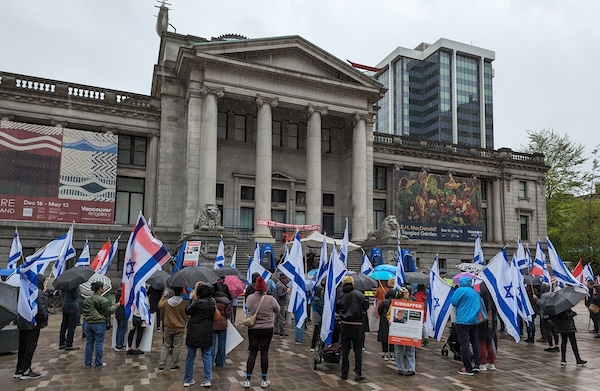
Almost every Sunday since the first days after Oct. 7, Daphna Kedem has led a vigil for the hostages – first outside the Vancouver Art Gallery and now at Vancouver City Hall. Missing only a few weeks due to Jewish or statutory holidays or, like this month, because police security was stretched thin with the Pride Parade, a stalwart group gathers at 12th and Cambie in solidarity and to hear from a diverse array of speakers.

Another regular gathering also takes place, with the group Vancouver Stands With Israel organizing marches across the Burrard Street Bridge and back, waving Canadian and Israeli flags. This past Sunday, scores of participants were greeted with a few hostile catcalls, an exponentially larger number of supportive messages, and a great deal of nonchalance and curiosity. Joining the parade were members of the Persian- and Indian-Canadian communities, carrying their respective flags.

photo - Jews and allies assemble near Burrard Street Bridge in a march last Sunday, Aug. 24
Jews and allies assemble near Burrard Street Bridge in a march last Sunday, Aug. 24. (photo by Pat Johnson)

Over the summer, the group Vancouver Friends of Standing Together began holding weekly vigils, also at Vancouver City Hall. (See jewishindependent.ca/encouraging-another-way.)

The competing events reflect divisions in the community. At a rally earlier this month, Kedem acknowledged that she has received “a lot of backlash” from people who believe she and some of her speakers are “too political.” Kedem calls for an immediate end to the war, which she views as the most likely path to get the remaining live hostages home safely. 

“If this is too political, then I’m probably very political,” she said. 

Over the course of almost two years, the Sunday rallies organized by Kedem have featured diverse voices, both hawkish and dovish, with many speakers expressing personal reflections that cannot be pegged on a political spectrum. Christian pastors have spoken and sung. First Nations representatives have taken part. Rabbis are usually in attendance, including Rabbi Philip Bregman, who, most weeks, leads the group in national anthems.

Kedem begins the events by reading excerpts from the previous evening’s rallies in Tel Aviv, usually voices of family members of those held hostage.

Rabbi Carey Brown, associate rabbi of Temple Sholom and a fellow of the Rabbinic Leadership Institute of Shalom Hartman Institute, spoke this past Sunday of the significance of the month of Elul, which began the night before.

“It’s the time that we as a people and as individuals begin our journey of self-reflection and soul-searching as we prepare for the new year,” she said. “It is a month that whispers to us: return, reflect, renew.”
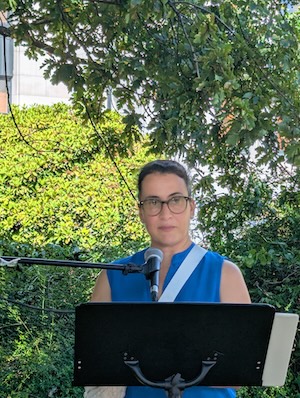
photo - Rabbi Carey Brown speaks at the Aug. 24 vigil for the hostages, which took place at Vancouver City Hall
Rabbi Carey Brown speaks at the Aug. 24 vigil for the hostages, which took place at Vancouver City Hall. (photo by Pat Johnson)

When she is asked how to live more Jewishly, Brown suggests people let the Jewish calendar guide them.

“It’s a map,” she said. “It’s a heartbeat. It’s the soul’s clock. We measure time in many sacred ways. In Judaism, we count days, months, years … a reminder of the holiness in time, and even our grief and our longing are measured in time. Today is Day 688 … of the captivity of still 50 hostages, living and dead. We count because we care. We count because they matter. We count because time is sacred and their time has been stolen. Think of all the time that has passed: 688 days of missed holidays, 688 days without their families, 688 days of fear, torment and waiting. And now, here we are again, standing on the threshold of Elul, preparing once more for Rosh Hashanah, for Yom Kippur. This time, time feels different. It feels heavy.” 

Toby Rubin, local chapter president of Canadian Hadassah-WIZO, urged attendees to stand firm until all the hostages are returned.

“We ask that all of you continue to support, to advocate, to push and to ask your allies and your political leaders to continue to do what they need to do to get every one of those 50 home,” she said. “And, again, whether they’re dead or alive, we want them back.”

Earlier in August, on Tu b’Av, community activist and leader David Berson blew the shofar and reflected on the date, which is a commemoration of love and unity. 

“The shofar isn’t only a High Holiday symbol, it’s also a biblical emblem of revelation and covenant,” he said. “As I blow the shofar today, let this be a clarion call to rebuilding the wholeness of our people, of listening and understanding, of hearing what is troubling the other and taking that into consideration, of opening our hearts and being curious about what is hurting. We have all been through so much since Oct. 7 and, while we cannot put the genie back in the bottle, we must stand together and embrace that which does bind us in an eternal bond of community, of belonging and embracing our humanity and the humanity of others.”

That same day featured Karen James, a past board chair of the Jewish Federation of Greater Vancouver and current chair of the local partnership council for the Centre for Israel and Jewish Affairs. She is also on the board of governors of the Jewish Agency for Israel.

James reflected on her experiences as a competitive swimmer, including participating in the Maccabiah Games in Jerusalem in 1965, which connected her more deeply not only to her Jewishness and to Israel, but to the branch of her family that had made its way to Palestine in the era when her grandfather settled in Canada.

She shared another personal story that affected her connection to her identity and to Israel.

In 1972, James was on Canada’s Olympic swim team. She and teammates were out celebrating after their competitions were over, watching the Canada-Russia hockey series. As they walked back to the Olympic Village in the wee hours of the morning, they saw four men with a big duffle bag. The four men clambered over the fence to get into the Olympic Village and the Canadians did likewise.

“I went to my dorm, slept for a little bit, but then was woken up to all the commotion in the village,” James recalled. She became a firsthand witness to the terrorist attack on Israeli athletes at the Munich Games.

“I watched the negotiations happen between [the terrorists] and the Germans and, in the evening, I saw when the Israeli team members were led out onto a bus with their hands bound and they were blindfolded,” she said. “Later that night, we’d heard that they were safe and alive, that they’d been freed. But that was wrong. They made a mistake. I don’t know how that got out there because, in fact, the Germans tried to storm the planes and the Palestinians threw grenades and shot the remaining Israeli hostages.”

James went on to describe a more intimate experience with antisemitism. In a consultation with a medical specialist, the doctor repeated the words “It could be worse” twice. On the second occasion, James asked the doctor what she meant by noting that “it could be worse.”

“And she said, ‘Look at what’s happening in Gaza,’” James recalled the doctor telling her. “It was so inappropriate to say that to me.” 

Antisemitism is growing, said James. “The main thing that keeps me going is community,” she said. “All of you. All of my community.” 
Format ImagePosted on August 29, 2025August 27, 2025Author Pat JohnsonCategories LocalTags Bring Them Home, Burrard Bridge march, Carey Brown, Daphna Kedem, David Berson, hostages, Israel, Israel-Hamas war, Karen James, rallies, Selichot, Vancouver Friends of Standing Together, VFOST
Holding faith at rallies

Holding faith at rallies

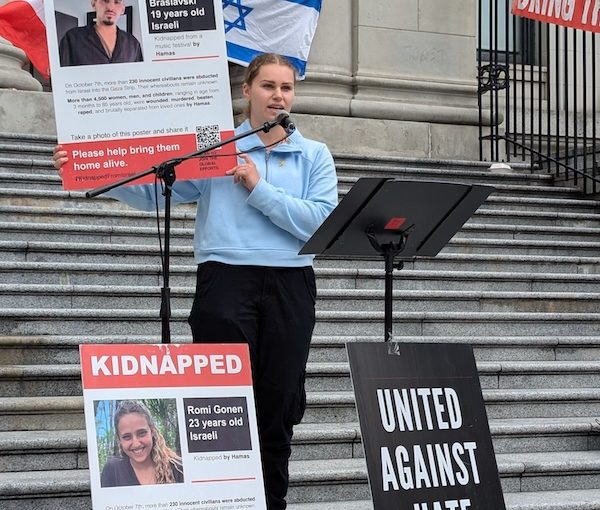
UBC student Zara Nybo, a non-Jewish ally, holds a poster of Rom Braslavski, as she speaks of his heroism before he was taken hostage to Gaza on Oct. 7. (photo by Pat Johnson)

As negotiations continued in Doha, Qatar, for the release of Israeli hostages, the weekly rallies in support of those held, their families and all Israelis continued Sunday, Aug. 18, at the Vancouver Art Gallery.

“As a university professor and as a Jew, I have been forced to witness the frontlines of a propaganda war to dehumanize and demonize Jews and to delegitimize the nation of Israel,” said Prof. Steven Plotkin, a University of British Columbia physicist.

The Hamas strategy is one of “asymmetric warfare,” he said, in which they bait Israel Defence Forces with attacks and hostage-takings, then use their own Palestinian civilians as human shields, knowing that the casualty numbers and horrible images will evoke sympathy in the West.

“And we’ve seen it,” he said. “The encampment and the protests at UBC quickly turned from advocating for the human rights of Palestinians to a call for the end of Israel.”

On campus, the messages he saw included the now familiar “From the river to the sea, Palestine will be free,” but others on the same theme, including “We don’t want your two states! Take us back to ’48” and “Resistance is justified when you are occupied.” Another common refrain, he said, is “‘Globalize the intifada.’ That means bring terrorism everywhere, including here in Canada.”

“Long live Oct. 7” was yet another slogan the professor saw on his campus. 

“Let that sink in,” he said. 

When reports of extensive sexual abuse by Hamas and other Palestinians who broke through the border on Oct. 7 became known, he said, “I saw posters at UBC that announced a discussion group for ‘the lies that Zionists spread about the sexual abuse that didn’t occur on Oct. 7.’”

Plotkin reflected back to the days after the 9/11 terror attacks in New York City, when people put up posters of their lost loved ones.

“Could you imagine what kind of person would think to tear one of those down? No one would have dreamed of it,” he said. “And now we’re seeing a world whose moral compass has completely lost its direction.”

Posters of Israeli hostages are routinely torn down at UBC, elsewhere in Vancouver and around the world. Plotkin shared a psychological hypothesis for why this desecration is so rampant.

In the identity-centred worldview of many activists, Plotkin said, morality is determined by one’s position in the hierarchy of oppression.

“The less powerful are pardoned, the more powerful must be guilty,” he said. Because Hamas is less powerful than Israel, Israel must be guilty, despite the evidence of Hamas murdering, raping and abducting Israeli civilians. 

“A hostage poster, however, throws a wrench into that framework because it forces them to cope with the idea that the people that they thought were oppressed could actually be in the wrong,” Plotkin said. “Their whole simplistic worldview of the blameless oppressed and the evil oppressor is undermined by the ugly facts contained in the posters. A hostage poster induces a cognitive dissonance and, rather than question their own worldview, it’s easier for them to see it as pro-Israel propaganda designed to elicit their sympathy for the Jews in Israel, the bad guys, and so they feel compelled to tear the poster down.”

Eyal Daniel, a Burnaby high school teacher who specializes in Holocaust and genocide studies and who is president of the Holocaust and Antisemitism Educators’ Association, spoke about how his group was denied recognition by the BC Teachers’ Federation. 

Representing close to 150 educators, the group applied to become one of the BCTF’s provincial specialist associations.

“Our application was rejected without any given reason,” he said. “Currently, there are no educational resources about the Holocaust and antisemitism for teachers in the province.”

Conversely, Daniel said, the province’s 50,000 teachers are bombarded by their union with materials promoting the elimination of the state of Israel.

The provincial government has mandated that Grade 10 students must receive Holocaust education beginning in 2025 and it is said to be working on curriculum materials. 

Despite the lack of recognition from the BCTF, Daniel’s group will continue to work “as if we had been approved,” he said.

“Therefore, these days, we are in the process of constructing a new website, developing useful, meaningful professional development opportunities for teachers, assessing and developing appropriate educational materials and working with the minister of education on the upcoming Grade 10 Holocaust education curriculum framework,” he said.

Daniel spoke of his family’s recent visit to Israel, where they visited the site of the Nova music festival.

“Stepping out of the car into the desert heat, we were immediately surrounded by the haunting silence,” he said, “but, yet, 364 voices called out from the ground: Where is the humanity? The Nova memorial site is a barren killing field where humanity ceased to exist.”

Rabbi Susan Tendler of Congregation Beth Tikvah, in Richmond, spoke of the need for dialogue.

“In civic discourse … we’re yelling more than we’re listening,” she said. “So many of us will talk about the need to listen to one another but instead we’re just angry and have an inability to actually talk to one another.”

She asked people to see the humanity of others as a starting point to dialogue.

“To be a Jew means to respect and understand that every single human being was created in the image of God,” she said. “Let us continue to work for peace in the region that so, so sorely needs healing.”

Zara Nybo, a fourth-year student at UBC, is an ally to the Jewish community, president of the Israel on Campus club, and an Emerson Fellow with the international advocacy group StandWithUs. She shared recollections of a training conference in Los Angeles from which she and scores of other campus activists recently returned. At an LA rally for the hostages, she heard profoundly moving testimonies from family members of those still held in Gaza.

“Most people around me, men, women, had tears streaming down their face,” said Nybo. “We were all holding each other in collective grief.”

The mother of Rom Braslavski spoke of how her son had been a security guard at the Nova music festival and took it upon himself to hide the bodies of murdered women, both so they would not be taken to Gaza and so that they would not be posthumously raped or mutilated, as he had seen other female bodies desecrated. Braslavski was taken hostage in Gaza.

As Nybo and her fellow students prepare for the new academic year, she emphasized the training they have undergone and the determination with which they will return to campus.

“I will tell you we are committed to this fight,” she said. 

Richard Lowy, who has provided vocal and guitar inspiration at almost every rally for months, spoke of the hope that a resolution will come through negotiation.

Event organizer Daphna Kedem recounted the rally in Tel Aviv the evening before and expressed hope that the hostages will be released soon and that the weekly rallies she has organized for 10 months will cease to be necessary.

Format ImagePosted on August 23, 2024August 22, 2024Author Pat JohnsonCategories LocalTags antisemitism, BCTF, Bring Them Home, Daphna Kedem, Eyal Daniel, Hamas terror attacks, Holocaust education, hostages, Oct. 7, rally, Richard Lowy, Steven Plotkin, Susan Tendler, terrorism, Zara Nybo
Rally carries added meaning

Rally carries added meaning

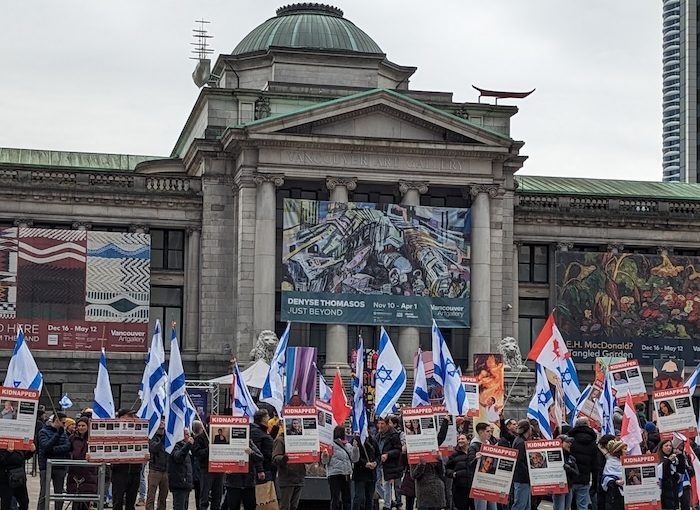
The rally for the hostages at the Vancouver Art Gallery on May 5. (photo by Pat Johnson)

The weekly rally for the hostages at the Vancouver Art Gallery carried added resonance Sunday, May 5, hours before the world marked Yom Hashoah. Myer Grinshpan, a survivor of the Holocaust, spoke, as did his son, Roy Grinshpan. Anna Mae Wiesenthal, a scholar of the Holocaust, and Stephen Lowy, whose father, Leo Lowy, was a “Mengele twin,” also spoke. Rabbi Yitzchok Wineberg, Vancouver’s longest-serving rabbi, shared reflections on the Holocaust and current events and recited the Mourner’s Kaddish.

Format ImagePosted on May 10, 2024May 8, 2024Author Pat JohnsonCategories LocalTags Bring Them Home, Israel, Oct. 7, Oct. 7 hostages
Mishpacha comes together

Mishpacha comes together

The weekly rally for Israeli hostages at the Vancouver Art Gallery Sunday, Feb. 18. (photo by Pat Johnson)

Family was the theme at the weekly rally for Israeli hostages at the Vancouver Art Gallery Sunday, Feb. 18, the day before British Columbians marked the Family Day holiday. Speakers took to a stage at the edge of the gallery’s north face out of respect for a makeshift memorial to Alexei Navalny, the Russian opposition leader who died in custody two days earlier.

“Family Day will be celebrated here tomorrow,” said Daphna Kedem, organizer of the weekly vigils for the hostages. “But this year casts a heavy shadow over the day for some families of our community here and in Israel…. It is difficult to be happy when families are waiting to be reunited with their loved ones, or for many families who have lost their loved ones.”

Dr. Michael Elterman, a psychologist, spoke of the psychological effects of what is happening in Israel and worldwide.

“We see the indescribable anguish in the families and we easily feel ourselves in their shoes and intuitively imagine what we might feel if that happened to us,” he said. “There has developed a related construct of post-traumatic stress disorder over the past decade … this is the sadness, anger and sometimes spiritual distress that arises from moral outrage. It is a broader set of reactions that arise even when the individual themselves were not present at the trauma but rather are morally outraged and left furious and depressed by events. This is even more likely where we identify so strongly with those who are personally impacted by Oct. 7.”

This anxiety is heightened by increases in antisemitic rhetoric and attacks, including in Vancouver. 

“Some of you may be experiencing the symptoms of post-traumatic stress, such as disturbed sleep, intrusive thoughts, trouble concentrating and being easily startled,” Elterman said, adding that help is available through Jewish Family Services and other resources. Getting involved in the community response can help ease feelings of helplessness and he directed people to the Community Toolkit on the website of the Jewish Federation of Greater Vancouver. 

“Remember to practise self-care in small ways, like proper nutrition and sleep,” he said. “Continue to do the things you previously enjoyed, even if you don’t feel like doing them. Finally, hug each other a little longer and a little tighter.”

Aviya Kones, who works at Jewish Family Services, spoke not about the services offered by that organization, but about the people of Kfar Aza, where she grew up.

photo - Aviya Kones speaks about the people of Kfar Aza, where she grew up
Aviya Kones speaks about the people of Kfar Aza, where she grew up. (photo by Pat Johnson)

“Kfar Aza was a desert oasis,” said Kones. “It was home, it was love and life, it was filled with unique and quirky and hilarious traditions and it was generations of family. It was also savagely and brutally destroyed after countless and seemingly endless hours of horrors.”

Her own childhood home was destroyed on Oct. 7.

She shared memories of three people who died that day.

“Smadar, a year above me, was tall, slender, so elegant,” she said. “Even as a child, I recall looking up to her. She had big, beautiful brown eyes and thick brown hair. I remember being awed by her grace, kindness and gentle nature.

“Nadav was two years older than me,” she said. “He knew how to make everyone laugh in every situation – not at anyone’s expense but maybe his own.

“Yoav was my age group,” she continued. “He had blue eyes, blond hair and a genuine smile. All the girls thought he was cute and all the guys wanted to be his best friend. He was shy, kind, creative and athletic. He loved his family. He was so close with his parents, his siblings and the many, many cousins he had living on the kibbutz.

“All three, amongst many others, tragically, brutally and with unimaginable cruelty, lost their lives on Oct. 7,” said Kones. “They were living in our beautiful oasis, our safe place, our home. They are survived by a broken and mourning community, generations of family that absolutely adored them and … all three were also survived by their young children. Nadav had two daughters, Smadar had three children and Yoav was a first-time dad to a little girl who was only 10 days old on Oct. 7.”

Rabbi Jonathan Infeld, senior rabbi at Congregation Beth Israel and head of the Rabbinical Association of Vancouver, said that Oct. 7 was not just an attack on Israelis or those living in Israel.

“It was indeed the beginning of an attack on the entire Jewish people,” he said. “It was a catalyst for antisemitism across the world that we have felt even here in Vancouver…. Too many of us have felt the antisemitism that began to boil over on that day.”

Gordon Shank, a First Nations member, a business innovator and a survivor of the Sixties Scoop, which saw Indigenous children abducted from their families and placed with white families, spoke of the centrality of family and the trauma of separation. 

“I’ve known the pain of separation from family, being torn from the embrace of loved ones, albeit under different circumstances,” he said. “The Sixties Scoop and the current crisis in Gaza might stem from vastly different contexts yet, at their core, they resonate with the universal cry for the right to family, to unity and to belonging. This parallel is not to equate the experiences but to underline the shared understanding that every individual deserves to grow, to dream and to thrive within the warmth of their family’s love.” 

Of the hostages and their families, Shank said: “Their pain is our pain. Their hope is our hope. Let our gathering today send a powerful message that we stand together across cultures and histories, united in our resolve to bring the hostages home.”

The march through downtown streets that has been a feature of the weekly events since October will be a monthly activity only for the coming weeks, Kedem told those gathered. The crowd then moved to the sidewalk adjacent Georgia Street for a demonstration, with a brief disruption by an individual waving a Palestinian flag.

Kedem has organized the weekly events since October and, early on, affiliated with the ad hoc international group Bring Them Home which, in turn, is affiliated with the Hostage and Missing Families Forum, in Israel. 

Recently, Kedem also associated her activities with another international group, Run for their Lives, which encourages groups as small as a single individual to demonstrate solidarity with Israel and its hostages by walking, biking or running. 

Format ImagePosted on February 23, 2024February 22, 2024Author Pat JohnsonCategories LocalTags Aviya Kones, Bring Them Home, Daphna Kedem, hostages, Israel-Hamas war, Jewish Family Services, JFS, Kfar Aza, mental health, Michael Elterman, Oct. 7, Vancouver
A plea for the hostages

A plea for the hostages

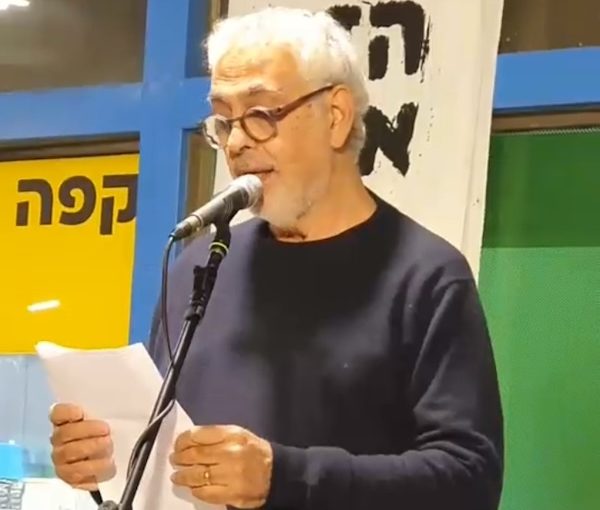
A screenshot of former Israel Air Force pilot Uri Arad speaking at the Jan. 20 Bring Them Home rally in Jerusalem.

***

Weekly rallies have been held in “Hostages Square,” the plaza in front of the Tel Aviv Museum of Art, since the Oct. 7 terror attacks by Hamas, who killed 1,200 people and kidnapped 240 that day. Every week, thousands gather in the square and in other locations, calling for the release of the 136 hostages still being held in Gaza, at least 32 of whom are now believed to be dead. At the Jan. 20 Bring Them Home rally in Jerusalem, one of the speakers was Uri Arad, a former pilot who was held in captivity in Egypt for six weeks during the 1973 Yom Kippur War. Arad is not related to Ron Arad, an Israeli Air Force officer missing in action since 1986, who Arad mentions in his speech. The remarks below were translated into English by Rahel Halabe, a Vancouver translator and educator, who is a family friend.

***

I was asked to speak here today because I have been a prisoner of war. Until recently, I had avoided talking publicly about my captivity or even identifying as a past captive. The reason I stand here today and talk to you stems from my deep empathy with the hostages and their families, my fear for the hostages’ fate and the need to join the call for their immediate release.

Indeed, I can testify from my experience that captivity is a very difficult experience, physically and mentally. Still, it is important for me to emphasize that, as difficult as my experience was, it is not the same as what our hostages in Gaza are going through. As a pilot of the air force, I was totally aware of the possibility of falling into captivity and I was prepared physically and mentally to cope with the experience. This is not the same for innocent civilians who are kidnapped out of the blue, without any previous preparation. As time goes on, it shows that the hostages are indeed going through hell.

Moreover, being held captive by a state is not the same as being held captive by a murderous terrorist organization. Being held by a state, I did not feel the constant existential threat on my life – I knew that, eventually, I would return home. This is unlike the hostages in Gaza, who are in constant existential fear of being murdered by their captors, or even killed by our own forces. It is, therefore, a much more difficult experience than what I went through.

I shut my eyes and imagine Noa Argamani, the Bibas family, Amit Buskila, Elyakim Libman, Yusef and Hamza Alziadneh, Liri Elbag, and all the other hostages, and my heart is shattered. Here in Israel, there are so many tormented families who are suffering from uncertainty and worry for their loved ones, some of them after experiencing losses without the ability to properly mourn. It’s just horror. We have to say clearly and loudly: we have reached a stage in which every day that passes is like Russian roulette in the life of the hostages. Therefore, it is necessary to do everything, everything, to bring them home now!

When people ask what reassured me most and helped me get through my time in captivity, I answer without any hesitation: I knew that the state would do all that it could to bring me back home. The ability to cope with torture, difficult interrogations and the uncertainty of my fate mostly came from my belief in the contract between me and the state, from knowing that I would not be abandoned. This confidence is what accompanies all soldiers who are ready to give their life for the state. This is the Israeli ethos of solidarity, the most sublime expression of which is that those injured on the battlefield are never abandoned, even if their rescue may involve losses, and that the state goes above and beyond to bring its captives and hostages home.

This is why I came here today, to say in a clear voice: the return of the hostages is the most important mission, maybe the only one, that should guide decision-makers at this moment. This is the necessary condition for our ability as a nation to recuperate from the horrendous disaster that hit us on Black Saturday. All of us are tormented knowing that Ron Arad never came back. It is, therefore, important to say it is unthinkable that there will be tens more of “Ron Arads.” If we don’t regain our composure and immediately bring the hostages home, this will happen. Some of the hostages will return in coffins, others will be forever lost.

But, I am asked, how do we bring them back? Don’t they keep telling us that the objective of destroying Hamas is not less important, that there have been great attempts to bring them back, that both objectives are interconnected and that we must keep putting military pressure on Hamas to bring the hostages back? It must be said, at this point in time, as Gadi Eisenkot expressed so well two days ago, this is senseless. The truth is that, today, these two objectives contradict each other. And the evidence is that – except for one hostage – all the hostages who have come back were returned in the framework of a deal. The military operation not only did not help in the return of the hostages, but it even cost the life of a few of them, and every day that passes just increases the danger to their lives. The conclusion is clear and sharp: the only way to bring the hostages back alive is through a deal. Now!

There are those who object to stopping the war, claiming that it would be a repetition of the same mistake that brought Oct. 7 upon us, and that it will eventually bring upon us many more Black Shabbats and an existential danger to the state in the long run. They mistakenly think that the destruction of Hamas is just around the corner. This is a delusion! Today, it is clear to all who are reasonable that the destruction of Hamas is an extremely difficult goal, which will require years to achieve. It is important to understand that what really hides behind this claim is the willingness to give up on the hostages. In the clash between short-term and long-term interests, those who claim the above prefer the long-term. I say, first, we must bring back the hostages! In the long-run, we will be able to continue weakening the terrorists through both military pressure and political initiatives, while striving for comprehensive agreements that will bring an end to the conflict.

I know that the thought of being forced to stop the fighting and, on top of that, pay the heavy price of a mass release of terrorists, is difficult for many people. I, too, have found it hard to swallow and say this grudgingly, but there is no escape. It is necessary to internalize that the hostages are the major asset Hamas has in its hands, and that [Hamas leader Yahya] Sinwar will not give up this asset except in exchange for the end of fighting. The strategic failure of Black Shabbat puts us, after more than 100 days of fighting, in a position in which we are forced to clearly make a decision and pay the price. The Israeli government, therefore, should initiate a deal of “all for all,” including a stop to the fighting. Now!

Binyamin Netanyahu refused to take responsibility for what happened on Oct. 7, but has been “gracious” enough to declare that he is responsible for all that will happen. If so, it must be clearly said: Netanyahu is responsible for the fate of the hostages. From here, I would like to address the prime minister and say: Netanyahu, you have brought upon us the worst catastrophe in the history of the state. This will be your legacy; you will be inscribed in history with shameful disgrace. Still, you have a chance to somehow soften history’s judgment, if you bring the hostages back alive. This is the time to rise above the political considerations that have led you and initiate a deal for the return of the hostages. Now!

Finally, I would like to say: continuing the current policy will cause a rupture, impossible to repair, in Israeli society. Israel will lose its soul, one of its most significant elements. We will never again be able to say that we hold human life sacred. This is an unbearable price. Therefore, bring the hostages back in exchange for stopping the fighting. Now!

Thank you all. 

Format ImagePosted on February 9, 2024February 8, 2024Author Uri AradCategories IsraelTags Bring Them Home, hostages, Israel, Israel-Hamas war, Netanyahu
Rally and march for hostages

Rally and march for hostages

Hundreds marched on Oct. 22, calling for the release of the more than 200 Israeli hostages being held by Hamas and other terror groups in Gaza. (photo by Pat Johnson)

Erez, aged 12, and his sister Sahar, 16, had spent the night at their father’s house in Kibbutz Nir Oz when Hamas terrorists stormed the home. The kids jumped out the window and hid in the bushes while gunmen rampaged their community, shooting entire families in their beds and safe rooms. “Mom, be quiet, don’t move,” he texted his mom, Hadas. She texted back: “I love you forever. I hope you survive.”

Erez did not reply. For hours, Hadas called Erez’s cellphone repeatedly, even as she fought for her life, physically blocking terrorists from breaking down her safe room door. Then Erez’s older sister found an 18-second video circulating on social media. It showed Erez in a black T-shirt, being gripped by both arms and led into captivity.

In all, five members of the Kalderon family were taken: Erez, Sahar, their 50-year-old father, Ofer, their 80-year-old grandmother, Carmela, and 12-year-old cousin, Noya, were grabbed from another house in the community.

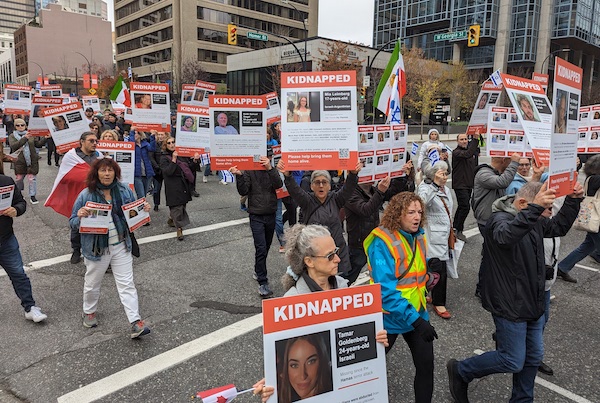
This was one of many individual stories shared at a vigil and march in Vancouver Sunday, Oct. 22, where hundreds of Vancouverites chanted “Bring them home!” and “Let our people go!” as they marched from the Vancouver Art Gallery, protected by a large police presence, along Georgia Street, over to Robson and back to the original site. The steps of the art gallery’s north side were packed with people holding posters of the hostages – and these posters represented only half of the total number of Israeli hostages held by Hamas and other terror groups in Gaza.

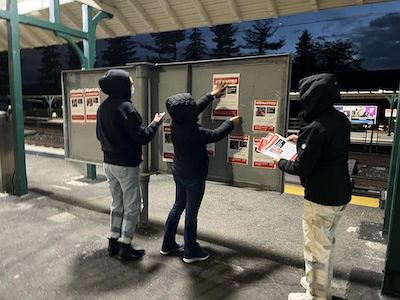
The faces are also seen on thousands of posters around Metro Vancouver and elsewhere. Activists in communities worldwide have downloaded and printed the sheets, plastering them around city streets. The Vancouver efforts – which have seen probably 20,000 posters distributed so far – are led by Daphna Kedem, who also initiated the Sunday afternoon event and an earlier vigil two days after the Oct. 7 terror attacks.

photo - About 20,000 posters – the cost of which was covered by two anonymous non-Jewish donors – have been put up by volunteers all around Metro Vancouver
About 20,000 posters – the cost of which was covered by two anonymous non-Jewish donors – have been put up by volunteers all around Metro Vancouver. (photo from Daphna Kedem)

Kedem is also a lead organizer of the local branch of UnXeptable, which, until the current crisis, was agitating against proposed Israeli government efforts to undermine responsible government there. Her current activism, she stressed, is done in her capacity as an individual, but she expressed gratitude to Rabbi Dan Moscovitz of Temple Sholom for helping organize, and to other synagogues, the Jewish Federation of Greater Vancouver and others for unhesitatingly jumping in to help.

Putting a human face to the hostages is the right thing to do, Kedem said.

“We have to bring it out to the public because it’s a humanitarian crisis,” she told the Independent. “Once you personalize it and you see that it’s an innocent baby or a child, you care more.”

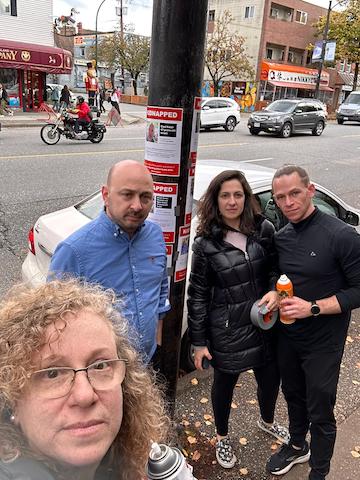
photo - Left to right: Flavia Markman, Ezra Shanken, Anet Bernadette and William Wolff. The four are among the many volunteers who have put up around the city approximately 20,000 posters with the faces, names and ages of Israelis taken hostage by the terrorist group Hamas. For more on the Bring Them Home Now effort
Left to right: Flavia Markman, Ezra Shanken, Anet Bernadette and William Wolff. The four are among the many volunteers who have put up around the city approximately 20,000 posters with the faces, names and ages of Israelis taken hostage by the terrorist group Hamas. For more on the Bring Them Home effort. (photo by Flavia Markman)

Kedem said the cost of printing the thousands of posters was covered by two anonymous non-Jewish donors and, at the rally this past Sunday, Christian clergy spoke, including a Catholic representative and two evangelical ministers.

Nevertheless, frustration over the silence of so many others was evident in the words of Moskovitz to the rally.

“Once again, Jews are being slaughtered and violently attacked and the world is silent,” he told hundreds of attendees, many carrying Israeli or Canadian flags. “Or they say, ‘Yes, but.’ There is no ‘but’ to murder. There can be no ‘but’ to hate. There can be no ‘but’ to the kidnapping of civilians, of children, of grandparents, of pregnant mothers, of disabled people. There can be no ‘but’ to that. There can be no justification for that. This is 2023, not 1943. And yet ‘Never again’ is happening again right now. The Jewish people will not be silent. You must not be silent.”

Moskovitz slammed the moral equivocation heard in commentary and seen in street rallies worldwide.

“This was not an act of resistance,” he said. “This was not a military campaign. This was not a popular uprising. This was cold, calculated and barbaric murder and rape and kidnapping of innocent civilians, the vast majority of them Jews.”

Motioning to the posters of the hostages, he added: “We call on those in our own city who cheer and celebrate what Hamas has done to these people and thousands of others on that horrible day to stop. Stop cheering the terrorists. Stop denying our grief, our human value. Stop your whataboutism. Stop tearing down pictures of children who have been kidnapped. Stop helping the terrorists. Stop justifying their brutality. Simply, stop.… Find your moral compass. Find the compassion you have for everyone and everything except Jews. Join us in this most basic of human cries: return our children to their parents, return our families to their homes.”

A WhatsApp group, “BTH – Vancouver,” is coordinating the postering activities: to join, visit bit.ly/BTH-Vancouver. Posters are downloadable by anyone at kidnappedfromisrael.com.

Format ImagePosted on October 27, 2023October 26, 2023Author Pat JohnsonCategories LocalTags Bring Them Home, Daphna Redeem, Gaza, Hamas, hostages, Israel, terrorism
Proudly powered by WordPress