Skip to content

  • Home
  • Subscribe / donate
  • Events calendar
  • News
    • Local
    • National
    • Israel
    • World
    • עניין בחדשות
      A roundup of news in Canada and further afield, in Hebrew.
  • Opinion
    • From the JI
    • Op-Ed
  • Arts & Culture
    • Performing Arts
    • Music
    • Books
    • Visual Arts
    • TV & Film
  • Life
    • Celebrating the Holidays
    • Travel
    • The Daily Snooze
      Cartoons by Jacob Samuel
    • Mystery Photo
      Help the JI and JMABC fill in the gaps in our archives.
  • Community Links
    • Organizations, Etc.
    • Other News Sources & Blogs
    • Business Directory
  • FAQ
  • JI Chai Celebration
  • JI@88! video
image - Weizmann Canada Physics Tournament 2025
image - The CJN - Visit Us Banner - 300x600 - 101625

Recent Posts

  • Vrba monument is unveiled
  • Music to build bridges
  • A better future possible
  • Anne Frank exhibit on now
  • Human rights in sport
  • Telling the story of an icon
  • Crawl bigger than ever
  • JCC Maccabi in Toronto
  • A way to meet fellow Jews
  • Time to include
  • Add Jewish joy to the mix
  • Reminder of humanity’s light
  • From the archives … editorials
  • Year-round holiday recipes
  • מדוע עזבתי את ישראל ואינני חושב לחזור ארצה
  • OJC hosts Oct. 7 memorial
  • A journey beyond self
  • Antisemitism a problem
  • Young man is missed
  • Orr action sparks complaint
  • Prison sentence for hate
  • Etgar Keret comes to Vancouver
  • New fall lecture series
  • Series explores music
  • Doc on Zapiro screens Nov. 6
  • Joy of shared existence
  • Community milestones … October 2025
  • MAID vs Jewish values
  • Cheshvan a great month, too
  • Bull, bear or bubble?
  • From the archives … a coin, etc.
  • מדוע האנטישמיות הולכת וגואה בעולם
  • New bio gives Vrba his due
  • Joy brighter than ever
  • When approaches differ
  • New leadership at the JCCV

Archives

Follow @JewishIndie

Tag: Eyal Daniel

Holding faith at rallies

Holding faith at rallies

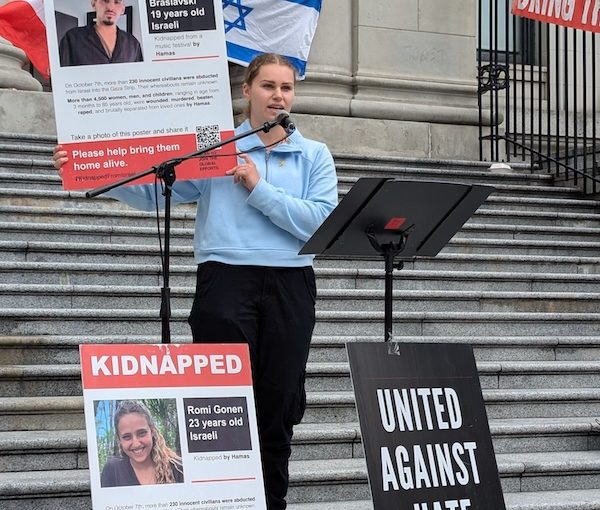
UBC student Zara Nybo, a non-Jewish ally, holds a poster of Rom Braslavski, as she speaks of his heroism before he was taken hostage to Gaza on Oct. 7. (photo by Pat Johnson)

As negotiations continued in Doha, Qatar, for the release of Israeli hostages, the weekly rallies in support of those held, their families and all Israelis continued Sunday, Aug. 18, at the Vancouver Art Gallery.

“As a university professor and as a Jew, I have been forced to witness the frontlines of a propaganda war to dehumanize and demonize Jews and to delegitimize the nation of Israel,” said Prof. Steven Plotkin, a University of British Columbia physicist.

The Hamas strategy is one of “asymmetric warfare,” he said, in which they bait Israel Defence Forces with attacks and hostage-takings, then use their own Palestinian civilians as human shields, knowing that the casualty numbers and horrible images will evoke sympathy in the West.

“And we’ve seen it,” he said. “The encampment and the protests at UBC quickly turned from advocating for the human rights of Palestinians to a call for the end of Israel.”

On campus, the messages he saw included the now familiar “From the river to the sea, Palestine will be free,” but others on the same theme, including “We don’t want your two states! Take us back to ’48” and “Resistance is justified when you are occupied.” Another common refrain, he said, is “‘Globalize the intifada.’ That means bring terrorism everywhere, including here in Canada.”

“Long live Oct. 7” was yet another slogan the professor saw on his campus. 

“Let that sink in,” he said. 

When reports of extensive sexual abuse by Hamas and other Palestinians who broke through the border on Oct. 7 became known, he said, “I saw posters at UBC that announced a discussion group for ‘the lies that Zionists spread about the sexual abuse that didn’t occur on Oct. 7.’”

Plotkin reflected back to the days after the 9/11 terror attacks in New York City, when people put up posters of their lost loved ones.

“Could you imagine what kind of person would think to tear one of those down? No one would have dreamed of it,” he said. “And now we’re seeing a world whose moral compass has completely lost its direction.”

Posters of Israeli hostages are routinely torn down at UBC, elsewhere in Vancouver and around the world. Plotkin shared a psychological hypothesis for why this desecration is so rampant.

In the identity-centred worldview of many activists, Plotkin said, morality is determined by one’s position in the hierarchy of oppression.

“The less powerful are pardoned, the more powerful must be guilty,” he said. Because Hamas is less powerful than Israel, Israel must be guilty, despite the evidence of Hamas murdering, raping and abducting Israeli civilians. 

“A hostage poster, however, throws a wrench into that framework because it forces them to cope with the idea that the people that they thought were oppressed could actually be in the wrong,” Plotkin said. “Their whole simplistic worldview of the blameless oppressed and the evil oppressor is undermined by the ugly facts contained in the posters. A hostage poster induces a cognitive dissonance and, rather than question their own worldview, it’s easier for them to see it as pro-Israel propaganda designed to elicit their sympathy for the Jews in Israel, the bad guys, and so they feel compelled to tear the poster down.”

Eyal Daniel, a Burnaby high school teacher who specializes in Holocaust and genocide studies and who is president of the Holocaust and Antisemitism Educators’ Association, spoke about how his group was denied recognition by the BC Teachers’ Federation. 

Representing close to 150 educators, the group applied to become one of the BCTF’s provincial specialist associations.

“Our application was rejected without any given reason,” he said. “Currently, there are no educational resources about the Holocaust and antisemitism for teachers in the province.”

Conversely, Daniel said, the province’s 50,000 teachers are bombarded by their union with materials promoting the elimination of the state of Israel.

The provincial government has mandated that Grade 10 students must receive Holocaust education beginning in 2025 and it is said to be working on curriculum materials. 

Despite the lack of recognition from the BCTF, Daniel’s group will continue to work “as if we had been approved,” he said.

“Therefore, these days, we are in the process of constructing a new website, developing useful, meaningful professional development opportunities for teachers, assessing and developing appropriate educational materials and working with the minister of education on the upcoming Grade 10 Holocaust education curriculum framework,” he said.

Daniel spoke of his family’s recent visit to Israel, where they visited the site of the Nova music festival.

“Stepping out of the car into the desert heat, we were immediately surrounded by the haunting silence,” he said, “but, yet, 364 voices called out from the ground: Where is the humanity? The Nova memorial site is a barren killing field where humanity ceased to exist.”

Rabbi Susan Tendler of Congregation Beth Tikvah, in Richmond, spoke of the need for dialogue.

“In civic discourse … we’re yelling more than we’re listening,” she said. “So many of us will talk about the need to listen to one another but instead we’re just angry and have an inability to actually talk to one another.”

She asked people to see the humanity of others as a starting point to dialogue.

“To be a Jew means to respect and understand that every single human being was created in the image of God,” she said. “Let us continue to work for peace in the region that so, so sorely needs healing.”

Zara Nybo, a fourth-year student at UBC, is an ally to the Jewish community, president of the Israel on Campus club, and an Emerson Fellow with the international advocacy group StandWithUs. She shared recollections of a training conference in Los Angeles from which she and scores of other campus activists recently returned. At an LA rally for the hostages, she heard profoundly moving testimonies from family members of those still held in Gaza.

“Most people around me, men, women, had tears streaming down their face,” said Nybo. “We were all holding each other in collective grief.”

The mother of Rom Braslavski spoke of how her son had been a security guard at the Nova music festival and took it upon himself to hide the bodies of murdered women, both so they would not be taken to Gaza and so that they would not be posthumously raped or mutilated, as he had seen other female bodies desecrated. Braslavski was taken hostage in Gaza.

As Nybo and her fellow students prepare for the new academic year, she emphasized the training they have undergone and the determination with which they will return to campus.

“I will tell you we are committed to this fight,” she said. 

Richard Lowy, who has provided vocal and guitar inspiration at almost every rally for months, spoke of the hope that a resolution will come through negotiation.

Event organizer Daphna Kedem recounted the rally in Tel Aviv the evening before and expressed hope that the hostages will be released soon and that the weekly rallies she has organized for 10 months will cease to be necessary.
Format ImagePosted on August 23, 2024August 22, 2024Author Pat JohnsonCategories LocalTags antisemitism, BCTF, Bring Them Home, Daphna Kedem, Eyal Daniel, Hamas terror attacks, Holocaust education, hostages, Oct. 7, rally, Richard Lowy, Steven Plotkin, Susan Tendler, terrorism, Zara Nybo

BCTF nixes antisemitism efforts 

A group of public school teachers who are pressing for resources and  supports to help educate about antisemitism and the Holocaust have been rejected by the provincial teachers’ union.

The recently formed Holocaust and Antisemitism Educators Association was informed earlier this month that their application for recognition as a provincial specialist association has been rejected by the relevant branch of the BC Teachers’ Federation.

Provincial specialist associations (PSAs) support the development of teaching resources and host professional development sessions on specific subject areas. They receive funding from the BC Teachers’ Federation (BCTF) to do so.

The Holocaust and Antisemitism Educators Association (HAEA) was created in response to the Government of British Columbia’s decision last October to make Holocaust education a mandatory part of the BC curriculum.

Eyal Daniel, the president of the HAEA, said he is shocked by the decision and is hoping the BCTF executive will reverse it. 

“The letter I received said that we should work with other PSAs – which is confusing because the formation of our group was specifically supported by the relevant PSA, the social studies group, as being important and necessary,” Daniel said in a media release.

Ginaya Peters, the founder of BC Teachers Against Antisemitism, expressed dismay. 

“I am trying to comprehend this and am failing,” she said in the same release. “When the Vancouver Holocaust Education Centre tells the BCTF that our PSA is needed in order to implement the mandatory Holocaust curriculum that they are helping to develop, they are literally ignoring the voices of experts in the field, and they are denying us the resources to teach the topic properly.”

Ezra Shanken, chief executive officer of the Jewish Federation of Greater Vancouver, said the decision seems to confirm reports heard by members of the Jewish community recently.

“We have heard a number of disturbing rumours in the past few weeks about people fighting against the formation of this teachers’ specialist association – including that people believe that antisemitism isn’t related to the Holocaust,” said Shanken. “If this is their rationale, it is a form of Holocaust denial and flies in the face of what we have been told by Premier David Eby and his minister of education.”

“The HAEA has told me that they met every single requirement to be recognized by their union, and that no one can remember a time when a PSA that met every requirement was turned down,” said Nico Slobinsky, vice-president of the Centre for Israel and Jewish Affairs.

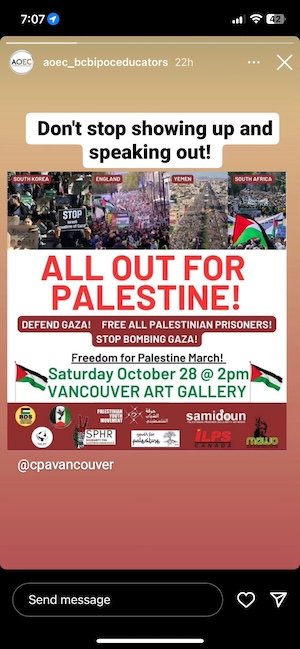
screenshot - A social media post shared by the Anti-Oppression Educators Collective, a provincial specialist association of the BC Teachers’ Federation, which mentions Samidoun, which is linked to a listed terror organization and has organized events that glorify the murders and rapes that took place on Oct. 7
A social media post shared by the Anti-Oppression Educators Collective, a provincial specialist association of the BC Teachers’ Federation, which mentions Samidoun, which is linked to a listed terror organization and has organized events that glorify the murders and rapes that took place on Oct. 7. (image from BCTAA)

Jonathan Dyck, the chair of the BCTF Provincial Specialist Association Council, informed the HAEA of the decision last week, following a meeting of the council where the decision was taken June 4. According to the HAEA, he provided no rationale for the decision to recommend that resources and recognition not be provided to HAEA but was “strongly of the opinion that they would like to find ways to help members of your association feel valued and included.”

In a separate statement, BC Teachers Against Antisemitism lamented the absence of any explanation for the rejection.

“We are confused by the BCTF’s statement … as the statement fails to give any indication why a PSA dedicated to developing teaching resources and professional development around soon to be mandatory Holocaust education was rejected.

“As well, as of today there are no teaching resources available on the Holocaust or antisemitism available on the BCTF’s TeachBC site.”

In a series of social media posts on the BCTF’s X (Twitter) platform, the union outlined the standards aspiring PSAs must meet – but did not indicate any areas where the HAEA had fallen short.

“The tweets listed all the conditions which must be met for a PSA to be approved by the PSA council,” BC Teachers Against Antisemitism said in their statement. “The HAEA met these conditions, yet the council refused to recommend that the PSA be approved. The only condition not met was approval by the PSA council. This is surprising as no one can remember a PSA that met all the criteria ever being turned down before.”

The suggestion that the Holocaust and antisemitism educators instead work with existing PSAs is problematic and perplexing, they wrote, because the BC Social Studies Teachers Association recommended that the new PSA be approved, as did the Vancouver Holocaust Education Centre. Moreover, antisemitism has not been addressed by any other PSA. In fact, BC Teachers Against Antisemitism accuses the Anti-Oppression Educators Collective of promoting antisemitism, including by sharing posts on social media that include mention of Samidoun, which is linked to a listed terror organization and has organized events that glorify the murders and rapes that took place on Oct. 7.

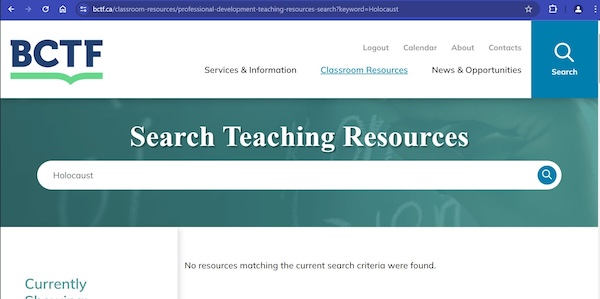
Confounding matters further, the statement on BCTF’s website regarding the PSA vote, and antisemitism and Holocaust education, says, “It is our understanding that the council determined that existing PSAs already can and do support the proposed work.” However, separate searches of BCTF’s website for classroom resources on antisemitism and the Holocaust yield the results: “No resources matching the current search criteria were found.”

screenshot - search for Holocaust on BCTF website yields no resources found“The arguments that the HAEA work with existing PSAs to create Holocaust and antisemitism materials seems to fly in the face of established BCTF practices,” the BCTAA statement states. “The BCTF cannot present a valid reason for denying the approval of our PSA dedicated to helping educators deliver critical lessons on the Holocaust and antisemitism. We ask the BCTF to reverse its decision so we can move forward like other established PSAs and work with likeminded colleagues on supporting educators in BC.” 

– Information from Centre for Israel and Jewish Affairs, Jewish Federation of Greater Vancouver, BC Teachers Against Antisemitism and BC Teachers Federation

Posted on June 14, 2024June 13, 2024Author Various organizationsCategories LocalTags BC Teachers Against Antisemitism, BC Teachers' Federation, BCTAA, BCTF, education, Eyal Daniel, Ezra Shanken, Ginaya Peters, HAEA, Holocaust and Antisemitism Educators Association, Jonathan Dyck, Nico Slobinsky, provincial specialist associations
Teaching about Shoah

Teaching about Shoah

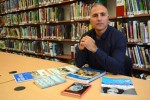
Eyal Daniel (photo from Eyal Daniel)

Three Vancouver-area teachers who traveled to Israel last summer for an intensive three-week symposium on teaching about the Holocaust now plan to share their knowledge with other educators throughout the region.

The three were chosen to study at Yad Vashem, the Holocaust Martyrs’ and Heroes’ Remembrance Authority, with many of the world’s foremost scholars on the Shoah. The focus was on how to educate students of diverse cultures and faiths about the Holocaust and to leverage that knowledge as a framework for teaching about human values, responsible citizenship and social justice.

Eyal Daniel, former head of school at Vancouver Talmud Torah elementary and high school, the latter of which became King David High School, now teaches at Buckingham elementary in Burnaby. As a Jewish person and a native of Israel, Daniel said his experience was somewhat different from most of the other participants from across Canada, but he tried to go into the process ready to absorb everything presented.

“The symposium was three weeks, from 8:30 to 5:30 every day,” he said. “It included lectures about all the different facets connected to the Holocaust by really top lecturers.”

The group also visited different parts of Israel, including Kibbutz Lohamei Haghetaot, the Ghetto Fighters’ Kibbutz, formed by survivors of the Warsaw Ghetto. In addition to teachers, participants included Christian clergy, researchers and some people from the U.S. Holocaust Memorial Museum in Washington, D.C. The Canadian teachers were sponsored by the Canadian Society for Yad Vashem.

Among the most impactful aspects, said Daniel, was meeting and hearing from people with perspectives on well-known aspects of the Shoah.

“One of them was Anne Frank’s childhood friend, a woman at the age of 94, who knew her personally because she met her before [Frank] died in Bergen-Belsen concentration camp,” he said. “The second one was a couple that was on Schindler’s list, people that worked in Schindler’s factory and knew him personally.” Hearing firsthand accounts leaves a deep impact, he said. “You’re part of this history.”

He was also impressed to see how many non-Jewish people are touched and moved by the Holocaust and how committed they are to teach people from different cultures, he said.

The provincial education ministry curriculum does not require educators at any grade level to teach the Holocaust, although it usually comes up when studying the Second World War. It falls to the individual teacher to determine what to emphasize. Daniel has incorporated the topic into social studies, language arts and art. His students, for example, wrote poems about the Holocaust and Daniel sent the seven best to a competition for young writers by the Poetry Institute of Canada. All seven were published in an anthology.

He also incorporates books like The Boy in the Striped Pyjamas, The Old Brown Suitcase (by Vancouver writer Lillian Boraks-Nemetz) or Anne Frank’s diary, and films like the documentaries Paper Clips and Freedom Writers.

“The Holocaust is a one-time event, but it is also connected to racism and prejudice and stereotypes and genocide,” he said. The multicultural students of Metro Vancouver can often personally relate to the historical or contemporary manifestations of these topics.

“The idea is to show that, first of all, you need to learn about this kind of an event because even though it’s an exceptional event, it can happen – or may not happen – because of you,” he said.

Delta high school teacher Stephanie Henderson participated in the program, as well. She too tries to weave the topic into the curriculum when appropriate. When studying the history of Venice, for example, she will note the history of the Venice ghetto, the original Jewish ghetto but not the last.

“The Holocaust is getting to be far away,” she said. “Slowly, people are forgetting about it. This is giving us the ability to keep talking about it.”

The third local teacher on the program was Surrey high school teacher Mark Figueira. “Having been there, it’s something that I think about every day now, whereas before I had been to Israel, it was a topic that I covered in my class, but now it’s become much more than that,” he said. “When I teach about the Holocaust now, it’s so much more rich. It’s stories about people that we met. Just having been there gave me such a really good context for it now.”

The three have created a presentation they will share with other teachers during professional development days, beginning in Delta next February. They will offer advice and approaches on educating about the Holocaust for teachers at every level of knowledge and experience.

In the last decade, the Canadian Society for Yad Vashem has sent more than 200 teachers to attend the summer seminar, where they acquire pedagogical tools for teaching about the Holocaust to Canada’s multicultural students.

Format ImagePosted on December 18, 2015December 16, 2015Author Pat JohnsonCategories LocalTags Eyal Daniel, Holocaust, Mark Figueira, Stephanie Henderson, Yad Vashem
Proudly powered by WordPress