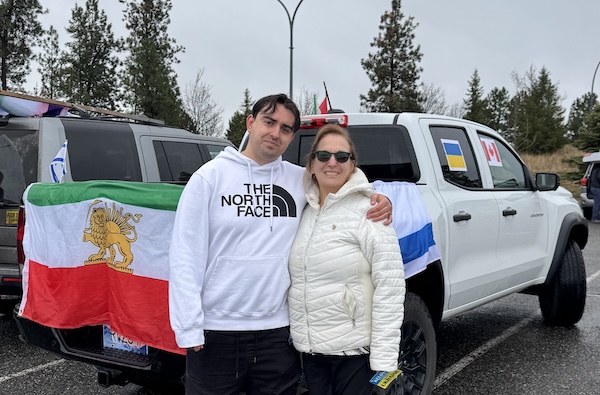
Harley Kushmier and his mother, Samantha Kushmier, at the March 8 Car Rally for Iranian Voices. (photo from the Kushmiers)
Members of the Kelowna Jewish community participated in the Car Rally for Iranian Voices on March 8.
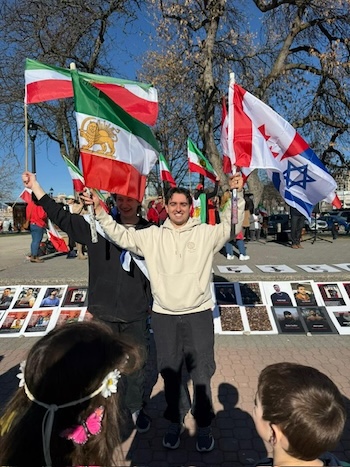
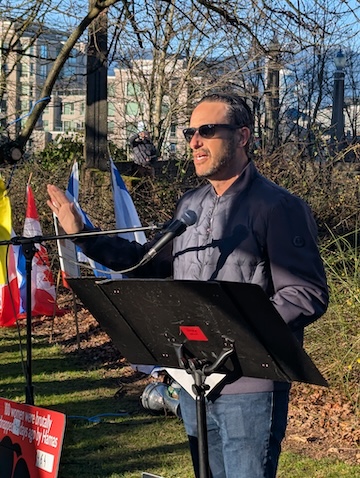
Harley Kushmier at the March 1 weekly rally in Kelowna in support of those protesting the Iranian regime. (photo from the Kushmiers)
Every Sunday in downtown Kelowna a protest is held in support of loved ones lost in the Shir-o-Khorshid (Lion and Sun) Revolution – the ongoing anti-regime protests in Iran – and of those who remain detained in Iran, subjected to unspeakable hardship. The protests ask that Crown Prince Reza Pahlavi be recognized as transitional leader of the country.
Rally organizers thanked Israel for its support and help, and asked the local Jewish community to attend the car rally. Organizers also reached out to the local Ukrainian community to join.
Samantha Kushmierand son Harley Kushmierare part of the Okanagan Jewish community.
Warren Kinsella has spent much of his career studying the darker corners of political life. A lawyer by training, author of about a dozen books and a longtime political strategist, he has written about Holocaust denial, far-right extremism and organized hate movements.
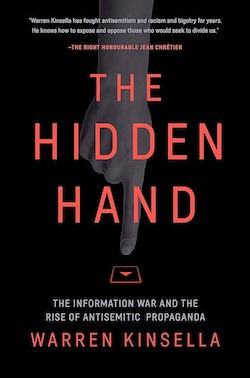
In his just-released book, The Hidden Hand: The Information War and the Rise of Antisemitic Propaganda, he follows these threads down the unseemly rabbit hole that has perplexed many observers since Oct. 7, 2023: the sudden and superficially spontaneous eruption of anti-Israel activism across Western campuses and cities in the aftermath of the horrendous atrocities of that day.
Kinsella’s thesis is straightforward and, to most readers of these pages, probably neither controversial nor surprising. The worldwide surge in anti-Israel protests, he argues, is not organic. Rather, it reflects a long-developed propaganda infrastructure – the “hidden hand” – involving the Iranian regime, Hamas, Hezbollah and a constellation of worldwide activist organizations that have spent years building networks capable of shaping Western public opinion.
Hamas, Kinsella argues, fights two wars simultaneously. One is the familiar military campaign conducted with rockets, bullets and suicide attacks. The other is an information war, waged through imagery, messaging and propaganda. Israel may well win the first war, he suggests, but the second – the battle for global public opinion – is far less certain.
The book opens with the immediate aftermath of the Hamas attacks of Oct. 7. While Israelis were still grappling with the scale of the massacre, demonstrations against Israel began sweeping Western campuses and cities. In the United States, a “national student walkout” took place within days of Oct. 7. Activists insisted these events were spontaneous expressions of outrage over the war in Gaza – but many of them took place before there was even a war in Gaza.
Many of the protests, Kinsella writes, appeared to have been organized rapidly with shared messaging, identical slogans and coordinated materials. Student groups that claimed to be independent grassroots organizations were often connected to larger activist networks. Manuals, posters and protest toolkits circulated almost immediately.
This pattern is central to the book’s argument. What looks like decentralized activism, Kinsella contends, often reveals indisputable signs of coordination.
One of the more striking anecdotes in the book involves Gary Wexler, a California professor who worked with the Ford Foundation on programs in Israel and Palestine during the Oslo peace process. Wexler recalls being warned by a leading Palestinian civil society coordinator that pro-Palestinian networks would one day rival – and surpass – the vaunted Jewish advocacy organizations in their ability to mobilize globally. Funding, the activist reportedly told him, would come from European institutions, Arab governments and wealthy donors.
Years later, Wexler began to see the prediction materialize in movements such as the push for boycott, divestment and sanctions (BDS), Israel Apartheid Week and international flotillas challenging Israel’s blockade of Gaza.
Kinsella stops short of claiming a single command centre orchestrating these movements. Instead, he suggests a looser ecosystem in which state actors, activist organizations and sympathetic nongovernmental organizations amplify one another’s messaging.
If there is a common theme running through the book, it is the power of narrative.
According to Kinsella, Hamas and its allies have been remarkably successful at shaping the language through which the conflict is discussed in the West. Terms such as “colonialism,” “apartheid” and “genocide” now dominate activist discourse, particularly among younger audiences. These ideas circulate widely on social media platforms, where emotionally charged content spreads faster than verified information.
The book devotes considerable attention to misinformation and the speed at which it travels. One example Kinsella cites is the widely circulated claim that Israel had bombed the al-Ahli Arab Hospital in Gaza, killing hundreds of civilians. The allegation ricocheted around the world within hours, sparking protests and diplomatic condemnations from the highest levels. Later evidence indicated the explosion was caused by a misfired rocket from Palestinian Islamic Jihad – and that the casualty figures had been exaggerated exponentially. The correction, of course, traveled neither as far nor as fast as the original claim.
Social media algorithms amplify this dynamic, Kinsella argues, pushing users toward increasingly extreme content. The phenomenon is not unique to Middle East politics. The same mechanisms drive conspiracy theories about vaccines, elections and countless other subjects. But, in the case of Israel, he suggests, the misinformation taps into something older and deeper: an antisemitic proclivity to believe the worst and most fantastical allegations about Jews.
In the contemporary context, antisemitic narratives often blend with modern ideological frameworks. In activist discourse, Jews are sometimes recast as embodiments of colonialism or “whiteness,” placing them on the oppressor side of social justice frameworks. The result, Kinsella suggests, is a rhetorical environment in which hostility toward Israel can slide easily into hostility toward Jews.
Polling data cited in the book underscores the generational divide in attitudes toward the conflict. Surveys in North America and Europe have found large numbers of younger respondents expressing sympathy for Hamas or believing that the 10/7 attacks were justified. Other polls show significant numbers of young people convinced that Israel is committing genocide. Such findings shocked even the pollsters who conducted them.
Kinsella argues that universities have played a significant role in shaping these attitudes. For decades, he writes, academic discourse has increasingly framed Israel through the lens of “settler-colonialism.” At the same time, foreign governments – particularly that of Qatar – have donated billions of dollars to Western universities.
The media also come under scrutiny. Western news organizations, he argues, routinely rely on casualty figures supplied by the Hamas-controlled Gaza Health Ministry, numbers that critical analysis suggests are inflated, particularly in terms of non-combatant casualties. Journalists reporting on what’s happening in Gaza frequently depend on local stringers who operate either directly under Hamas authority or in a context where anything but pro-Hamas reporting is existentially dangerous. This situation effectively grants terrorist propaganda the imprimatur of legitimate media platforms.
Because Kinsella is Canadian, The Hidden Hand is rife with Canadian content. This will be interesting to Canadian readers – and a meaningful contribution to the sad litany of incidents in this country – but it is additionally relevant because Canada has been among the worst places for these sorts of offences. Last year, an Israeli government report analyzing the problem worldwide called Canada the “champion of antisemitism.” So, while Canada may not be a major player in many of the world’s foremost competitions or concerns, when it comes to anti-Jewish discrimination, we regrettably find ourselves owning the podium. That makes what happens here – and how (or whether) we confront it – especially relevant.
The thesis of Kinsella’s book, of course, is that these problems know no boundaries (figuratively or literally).
Much of the evidence he presents is circumstantial rather than definitive. He has found no single document or intercepted communication that proves the existence of a centralized propaganda command. The accumulation of connections, coincidences and patterns is what gives the book its force, but Kinsella does not provide the proverbial smoking gun. This is partly understandable because, if there were incontrovertible proof linking ostensibly legal, legitimate activist groups in Canada and around the world with known terrorist entities, surely Western governments would have acted by now.
Ah, but there’s the rub. The very fact that someone like Kinsella, without, say, top-level security clearance, could amass such a damning catalogue of evidence begs the question of just how much effort governments and security services are devoting to this problem. That so many deeply problematic and potentially illegal cases in Canada, including here in British Columbia, have not resulted in charges or even, seemingly, any serious investigation, makes Kinsella’s book especially valuable. If there is this much smoke, where are the governmental and security agencies that are supposed to be the firefighters?
Whether one accepts all of Kinsella’s conclusions or not, The Hidden Hand forces readers to confront the possibility that the global conversation about Israel is shaped by forces far more organized and odious than many seem willing to believe.
If Hamas fights both with bombs and with words, as Kinsella argues, then the information battlefield may prove just as consequential as the physical one. And, on that battlefield, the outcome is still very much in doubt.
From the first of Vancouver’s weekly vigils for Israeli hostages, after the 10/7 attacks, members of the local Iranian community were a welcome presence. Asked by the Independent why he was moved to join the mostly Jewish crowd at one of the first vigils, an Iranian-Canadian man explained that no one knows better than Iranians the enemy Israel is up against.
Now, it is the Iranians in Vancouver who are gathering regularly to show solidarity with their families halfway around the world. And it is uplifting not only to see Israeli flags and Jewish community members amid the throngs, but additionally inspiring that the Jewish presence is as profoundly welcomed at these gatherings as the Iranian-Canadian support was at our own community’s vigils.
The escalating confrontation between the United States, Israel and the Islamic Republic of Iran is fraught with danger. War in the Middle East rarely unfolds in neat or predictable ways. Yet, for all the risks, the present moment might represent a genuine opportunity.
For more than four decades, the regime in Tehran has destabilized the Middle East. Since the Iranian Revolution in 1979, the Islamic Republic has invested enormous resources in regional proxy networks, backing armed groups across the Middle East while suppressing dissent and freedoms at home. Iran is one of the world’s foremost state sponsors of terror and the primary backer of both Hamas and Hezbollah – Israel’s most dangerous terrorist enemies.
Many Iranians living outside Iran, probably most, support efforts to weaken or eliminate the Islamist regime in Tehran. Diaspora communities across North America and Europe include people who fled political persecution, censorship and the stifling of basic freedoms.
Domestic opposition – the courageous Iranians who have taken to the streets in opposition to government tyranny – has not dislodged the regime, obviously. Many hope that the US-Israel military action could create an environment that might topple it.
The Israelis and Americans, it needs to be noted, have both explicit and less overt objectives in this war. One stated aim, of many unclear objectives, is to ensure that Iran is prevented from developing nuclear weapons. Regime change is not an explicit goal. The US president has instead called on the Iranian people to take this opportunity to continue to rise up against their oppressors. However, the US administration has not made it clear that ending the theocracy is their aim or that the US will be there for the Iranian people if the war’s other geopolitical aims are met.
For Israelis, regime change in Iran probably presents the greatest chance for stability the country has experienced, at least in the past four decades.
A post-theocratic Iran might pursue normal relations with its neighbours and with the West. It could redirect vast resources away from proxy wars and toward economic development.
None of this, of course, is guaranteed or, perhaps, even likely. History offers sobering reminders that the collapse of authoritarian regimes can produce chaos as easily as freedom.
Iran is not Iraq in 2003 or Afghanistan in 2001. It has a large, educated population, a long, cohesive national history and a strong sense of cultural identity that predates the current regime. Civil society – though heavily suppressed – has shown remarkable resilience, from women’s rights movements to waves of protests demanding political reform. These internal forces matter a great deal. Ultimately, the future of Iran will be determined not by foreign militaries but by the Iranian people.
That is why the current moment, dangerous as it is, should also be understood as holding possibility. If external pressure weakens the regime enough to create space for internal change, Iranians may have a chance to shape a different future.
The risks are undeniable. Escalation could spiral. More civilian lives will be lost – especially as a regime saturated with end-times theology sees its very survival threatened. The region could face new volatility before it finds stability. Civil war could break out.
Sometimes, though, the status quo is the deeper danger. The Islamist regime in Tehran has spent decades exporting conflict and constraining the aspirations of its people. As long as it remains in power, Israel and other countries in the region will not know dependable calm or have much chance to fulfil any dreams of peace.
For the Iranian people, for the region and for the world, this may be one of those rare instances when risk and opportunity arrive together. What follows will depend not only on military outcomes but on whether the international community – and Iranians themselves – can seize the chance to build something better.
As events unfold half a world away, something positive is happening closer to home. In this time of danger and war, it is uplifting to witness Jewish British Columbians standing alongside our Iranian neighbours as they have stood alongside us in our most challenging moments.
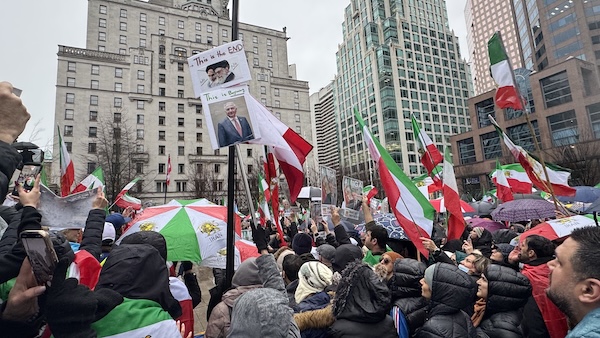
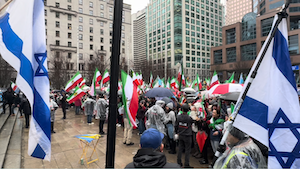
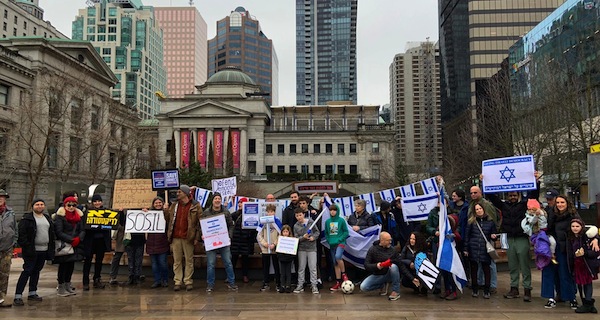
A huge demonstration filled the blocks around the Vancouver Art Gallery last weekend, part of a weekly presence of Persian and other Vancouverites calling for regime change and democracy for Iran. (photo by Richard K. Lowy)
As the street protests in Iran grow – and the death toll caused by the regime’s police and military crackdown increases – so do solidarity rallies worldwide.
A huge demonstration consumed the blocks around the Vancouver Art Gallery last weekend, part of a weekly presence of Persian and other Vancouverites calling for regime change and democracy for Iran.
The global movement against the Islamic regime has coalesced around Reza Pahlavi, son of the late shah who was deposed in the 1979 revolution. Posters of the crown prince fluttered among hundreds of pre-revolutionary Iranian flags amid chants of “javid shah,” long live the shah.
“I am Stephen and I am Jewish,” said one of the speakers at the rally a week earlier, on Jan. 10, who preferred not to use his surname.
“I have attended almost all the Iranian rallies in recent years for one reason and one reason only: to tell the Iranian people loudly and clearly you are not alone,” he said. ”Anyone who knows what the Iranian people have suffered over the past 47 years can empathize, especially now.”
He emphasized the ancient and contemporary relationship between Jewish and Persian peoples.
“When Israel was attacked on Oct. 7, 2023, the Iranian people came out in bad weather, in the rain and the cold and the snow, to march side by side with Jews all over the world. Why? Because they understand our pain, because it is their pain,” he said. “It is the collective pain of peoples who want what everyone wants: to live in peace and unmolested by those who want to control the world, who tell you what to think, what to wear, what to do, what to believe in.
Several people at the rally carried an Israeli flag. (photo by Richard K. Lowy)
“Persia was the first empire in the world, under Cyrus the Great, that brought people together and did not, did not oppress them,” he continued. “This is part of the Iranian historical identity. You can have all the Islamic revolutions you want. You will never erase this historical identity, with its great, great culture.”
He commended Iranian Canadians for their contributions to Canada and their devotion to democracy in their homeland.
“You here are Iranians who know what I talk about because you have been living in freedom in Canada and look how you’ve flourished. When people speak of Canadian Iranians, they do so with respect for a people that knows how to work hard and how to contribute to society, to give back, to become productive citizens of a free and open society,” he said. “Is that so much to ask for your brothers and sisters, mothers and fathers, sons and daughters in Iran?And it is a blessing that, when Iran is finally free, many of you will return to Iran to help rebuild.”
He called Pahlavi “a man who understands the world.”
“He knows the Iranian people inside Iran and outside Iran. Anyone who questions his commitment to his people can read about how he has worked tirelessly throughout his life to pursue a free Iran and return independence to Iranian people.”
Hundreds are dying in the name of freedom, Stephen said.
“The crackdown is brutal,” he said. “Many of us have seen the image of the older white-haired Iranian woman on the streets of Iran, bleeding from the mouth, her fist raised in defiance: ‘I am not afraid. I am not afraid. I have been dead for 47 years.’”
He commended US President Donald Trump and Israeli Prime Minister Binyamin Netanyahu for forcefully supporting the Iranian protests, and called for the leaders of Canada and other Western countries to express their support as forcefully.
David Zacks was one of several people at the rally carrying an Israeli flag. The response, he said, was“a hundred percent positive.” People were asking to take photos with him and thanking him for his presence.
“Iranians and Jews have been great friends for thousands of years,” said Zacks. “Everybody I talk to says, once the regime falls, they’ll be great friends again.”
Almost every Sunday since the first days after Oct. 7, Daphna Kedem has led a vigil for the hostages. People have gathered in solidarity and to hear from a diverse array of speakers, first outside the Vancouver Art Gallery and now at Vancouver City Hall. (photo by Pat Johnson)
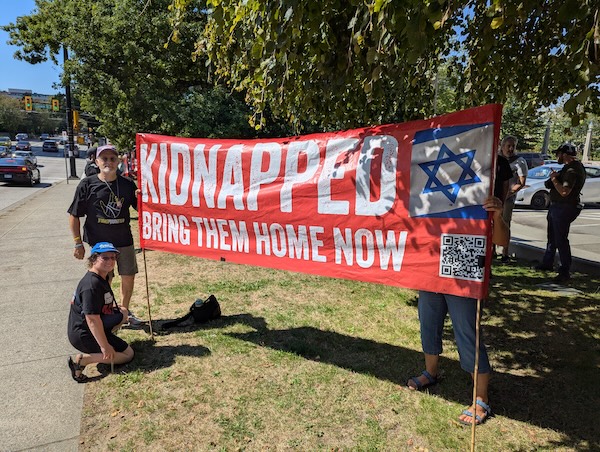
Almost 700 days have passed since the horrors of Oct. 7, 2023, and the holding of Israeli hostages in the tunnels of Gaza.
In Vancouver, as in cities worldwide, Jews and their allies gather frequently to mourn the lost, stand in solidarity with Israelis and remind the families whose loved ones are still in captivity that there are people across the planet who hold them in their thoughts.
Almost every Sunday since the first days after Oct. 7, Daphna Kedem has led a vigil for the hostages – first outside the Vancouver Art Gallery and now at Vancouver City Hall. Missing only a few weeks due to Jewish or statutory holidays or, like this month, because police security was stretched thin with the Pride Parade, a stalwart group gathers at 12th and Cambie in solidarity and to hear from a diverse array of speakers.
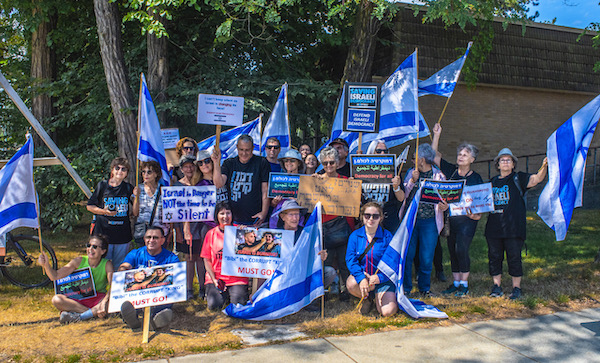
Another regular gathering also takes place, with the group Vancouver Stands With Israel organizing marches across the Burrard Street Bridge and back, waving Canadian and Israeli flags. This past Sunday, scores of participants were greeted with a few hostile catcalls, an exponentially larger number of supportive messages, and a great deal of nonchalance and curiosity. Joining the parade were members of the Persian- and Indian-Canadian communities, carrying their respective flags.
Jews and allies assemble near Burrard Street Bridge in a march last Sunday, Aug. 24. (photo by Pat Johnson)
The competing events reflect divisions in the community. At a rally earlier this month, Kedem acknowledged that she has received “a lot of backlash” from people who believe she and some of her speakers are “too political.” Kedem calls for an immediate end to the war, which she views as the most likely path to get the remaining live hostages home safely.
“If this is too political, then I’m probably very political,” she said.
Over the course of almost two years, the Sunday rallies organized by Kedem have featured diverse voices, both hawkish and dovish, with many speakers expressing personal reflections that cannot be pegged on a political spectrum. Christian pastors have spoken and sung. First Nations representatives have taken part. Rabbis are usually in attendance, including Rabbi Philip Bregman, who, most weeks, leads the group in national anthems.
Kedem begins the events by reading excerpts from the previous evening’s rallies in Tel Aviv, usually voices of family members of those held hostage.
Rabbi Carey Brown, associate rabbi of Temple Sholom and a fellow of the Rabbinic Leadership Institute of Shalom Hartman Institute, spoke this past Sunday of the significance of the month of Elul, which began the night before.
“It’s the time that we as a people and as individuals begin our journey of self-reflection and soul-searching as we prepare for the new year,” she said. “It is a month that whispers to us: return, reflect, renew.”
Rabbi Carey Brown speaks at the Aug. 24 vigil for the hostages, which took place at Vancouver City Hall. (photo by Pat Johnson)
When she is asked how to live more Jewishly, Brown suggests people let the Jewish calendar guide them.
“It’s a map,” she said. “It’s a heartbeat. It’s the soul’s clock. We measure time in many sacred ways. In Judaism, we count days, months, years … a reminder of the holiness in time, and even our grief and our longing are measured in time. Today is Day 688 … of the captivity of still 50 hostages, living and dead. We count because we care. We count because they matter. We count because time is sacred and their time has been stolen. Think of all the time that has passed: 688 days of missed holidays, 688 days without their families, 688 days of fear, torment and waiting. And now, here we are again, standing on the threshold of Elul, preparing once more for Rosh Hashanah, for Yom Kippur. This time, time feels different. It feels heavy.”
Toby Rubin, local chapter president of Canadian Hadassah-WIZO, urged attendees to stand firm until all the hostages are returned.
“We ask that all of you continue to support, to advocate, to push and to ask your allies and your political leaders to continue to do what they need to do to get every one of those 50 home,” she said. “And, again, whether they’re dead or alive, we want them back.”
Earlier in August, on Tu b’Av, community activist and leader David Berson blew the shofar and reflected on the date, which is a commemoration of love and unity.
“The shofar isn’t only a High Holiday symbol, it’s also a biblical emblem of revelation and covenant,” he said. “As I blow the shofar today, let this be a clarion call to rebuilding the wholeness of our people, of listening and understanding, of hearing what is troubling the other and taking that into consideration, of opening our hearts and being curious about what is hurting. We have all been through so much since Oct. 7 and, while we cannot put the genie back in the bottle, we must stand together and embrace that which does bind us in an eternal bond of community, of belonging and embracing our humanity and the humanity of others.”
That same day featured Karen James, a past board chair of the Jewish Federation of Greater Vancouver and current chair of the local partnership council for the Centre for Israel and Jewish Affairs. She is also on the board of governors of the Jewish Agency for Israel.
James reflected on her experiences as a competitive swimmer, including participating in the Maccabiah Games in Jerusalem in 1965, which connected her more deeply not only to her Jewishness and to Israel, but to the branch of her family that had made its way to Palestine in the era when her grandfather settled in Canada.
She shared another personal story that affected her connection to her identity and to Israel.
In 1972, James was on Canada’s Olympic swim team. She and teammates were out celebrating after their competitions were over, watching the Canada-Russia hockey series. As they walked back to the Olympic Village in the wee hours of the morning, they saw four men with a big duffle bag. The four men clambered over the fence to get into the Olympic Village and the Canadians did likewise.
“I went to my dorm, slept for a little bit, but then was woken up to all the commotion in the village,” James recalled. She became a firsthand witness to the terrorist attack on Israeli athletes at the Munich Games.
“I watched the negotiations happen between [the terrorists] and the Germans and, in the evening, I saw when the Israeli team members were led out onto a bus with their hands bound and they were blindfolded,” she said. “Later that night, we’d heard that they were safe and alive, that they’d been freed. But that was wrong. They made a mistake. I don’t know how that got out there because, in fact, the Germans tried to storm the planes and the Palestinians threw grenades and shot the remaining Israeli hostages.”
James went on to describe a more intimate experience with antisemitism. In a consultation with a medical specialist, the doctor repeated the words “It could be worse” twice. On the second occasion, James asked the doctor what she meant by noting that “it could be worse.”
“And she said, ‘Look at what’s happening in Gaza,’” James recalled the doctor telling her. “It was so inappropriate to say that to me.”
Antisemitism is growing, said James. “The main thing that keeps me going is community,” she said. “All of you. All of my community.”
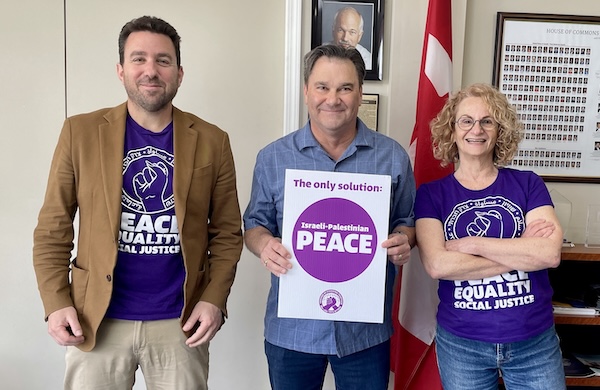
Interim leader of the New Democratic Party of Canada Don Davies, centre, with Itai Bavli and Avril Orloff of Vancouver Friends of Standing Together. (photo from Vancouver FOST)
This summer, Vancouver Friends of Standing Together has been holding weekly vigils in front of City Hall to continue the call for the return of the hostages, an end to the war in Gaza and an end to settler violence against Palestinians in the West Bank.
“We organize rallies, vigils and information sessions to raise awareness of the situation in Israel/Palestine and promote ‘another way’ that is not exclusively pro-Israel or pro-Palestine but pro-humanity,” Avril Orloff, who started the Vancouver Friends of Standing Together (FOST) chapter, told the Independent.
Adi Keidar, one of the chapter’s co-administrators, said, “If you are willing to accept that both Israelis and Palestinians deserve to live freely and safely on this land, I will be standing with and supporting you. Someone told me, ‘if you need to choose between pro-Israel or pro-Palestine, it is obvious for me, as a Jew/Israeli where I stand. However, if I knew and trusted that there is another way, I would choose both.’ Standing Together, for me, brings that other voice.”
“I joined the FOST group in June 2024 because it reflects my values and my belief that finding a just solution to the conflict is the only way forward,” Itai Bavli, also a Vancouver FOST co-administrator, said. “I care about all people living between the river and the sea and believe that both peoples can thrive if given the chance. I support Israelis and Palestinians alike and believe they both have the right to live freely and safely. Which means ending the occupation and supporting a Palestinian state. For me, it’s a responsibility I carry.”
Currently, there are nine local co-administrators, who play active roles as their other work and responsibilities permit, Orloff explained. “We try to divide up responsibilities, so no one is overburdened,” she said, noting that everyone involved is a volunteer. “We meet on an ad hoc basis as needed to brainstorm ways to increase awareness, bring out the voice of Standing Together and address issues that come up.”
Standing Together is an Israeli grassroots social movement made up of Jewish and Palestinian citizens that, according to its website, “envision[s] a society that serves all of us and treats every person with dignity. A society that chooses peace, justice and independence for Israelis and Palestinians, Jews and Arabs. A society in which we all enjoy real security, adequate housing, quality education, good healthcare, a liveable climate, a decent salary and the ability to age with dignity.”
Since the Hamas terror attacks on Oct. 7, 2023, and the ensuing war, Standing Together in Israel has been organizing demonstrations – attended by tens of thousands – calling for a hostage deal and a ceasefire agreement. They also have been engaging in public campaigns “aimed at re-humanizing the discourse, retaining humanity, mourning all lives lost and rejecting violence on social media in Hebrew, Arabic, and English.” Last May, they launched the Humanitarian Guard initiative at Tarqumiyah checkpoint to protect “aid trucks headed to Gaza from attacks by extremist settlers that come out to attack the trucks.” This month, they started a campaign to collect food and humanitarian aid for residents of Gaza.
In addition to the eight chapters of Standing Together that operate in Israel, there are Friends of Standing Together chapters worldwide that have formed since Oct. 7. The chapters in the diaspora raise awareness of and funds for Standing Together, as well as offer a local communal space for people who share the movement’s values and goals. Orloff is an ambassador for ST’s global crowdfunding campaign and recently surpassed her personal goal of raising $6,000 for the movement.
“I started the Vancouver FOST group in February 2024, when I first learned about Standing Together and discovered they had support groups around the world,” said Orloff. “I was drawn to ST because I felt that a lot of groups advocating for either Israel or Palestine focused on only one side or the other, which seemed short-sighted to me. Standing Together’s stance, by contrast, is that, with seven million Jews and seven million Palestinians living ‘between the river and the sea,’ none of whom are going anywhere, the only sustainable future is a shared one grounded in equality, security, peace and justice for all.”
Orloff, Keidar and Bavli said they appreciate that ST is about more than ending the war and that it’s “a broad-based social movement that goes beyond the specifics of Jewish/Palestinian issues to encompass social change at all levels of society, from the bottom up.”
“One of the biggest concerns and confusions I had on Oct. 7 and the events that followed was the rise of hate and polarization on both sides,” said Keidar. “It was rare that I could agree with much that was said, and I was constantly trying to hold two thoughts at the same time. I felt alone and was not seeing the benefit of supporting one side – it felt wrong and unjust and it didn’t fit my values.
Adi Keidar at one of Vancouver Friends of Standing Together’s vigils. (photo from Vancouver FOST)
“When I learned about Standing Together, it was the closest group that I felt spoke to my values and beliefs, as their focus is not one side or the other but humanity, which was the voice I felt was drowning in the hate that was brewing. I wasn’t willing to accept just one side. I believe that the only way to get out of this cycle is by compassionately seeing both sides, taking responsibility, finding the people that speak these values and bringing their voices out.”
Keidar participates in the weekly Bring Them Home rallies. Both she and Bavli spoke at a BTH rally this summer to raise the voice of Standing Together, to show “that it’s possible (indeed, necessary) to support both Israel and Palestine, and remind people that the immediate end of this war is only the beginning of the work to build a shared society in which all peoples live in peace and security.”
Vancouver FOST does local community-building through their WhatsApp group, social events (for example, film evenings, picnics, in-home gatherings), rallies and other activities. They raise awareness on social media via Instagram and work to build their membership, liaising with Standing Together and FOST groups globally. They meet monthly on Zoom with other Canadian FOSTs and build relationships with groups that share ST’s values and principles, like Women Wage Peace and various faith organizations. They have started doing outreach to Canadian politicians.
“We have endorsed Canada FOST’s Call to Action to the Canadian government and politicians to advance key priorities,” said Orloff, “including taking urgent diplomatic action to permanently end the war in Gaza; providing long-term support for peace and equality, not war; and supporting solidarity and partnership in our own society.”
The group organized and hosted an event in June last year, which brought Raja Khouri and Jeffrey Wilkinson to Vancouver to talk about their book, The Wall Between: What Jews and Palestinians Don’t Want to Know About Each Other. (See jewishindependent.ca/not-such-a-great-divide.) They have plans to host an information table at the University of British Columbia in the fall.
In an email, Orloff, Keidar and Bavli described Vancouver FOST as being “for more than we’re against. We don’t argue about terminology or labels or traffic in simplistic black-and-white ‘solutions,’ but are comfortable living with complexity and difference. We love to have juicy discussions, but, more than talk, we’re about supporting action that will bring about real, practical, sustainable change. We aren’t pro-Israel or pro-Palestine but pro-humanity,” they reiterated, “and we don’t see this as a left-right divide or an Israel-Palestine divide, but a divide between those who want peace and life for everyone and those who traffic in death and destruction. We’re here to offer a different way of thinking about the conflict and a different path forward, not to convince people that we’re right.”
Orloff said group members aren’t “settling for simplistic, one-sided solutions that make heroes of one side and villains of the other, but recognize that geopolitical issues have history and context that create layers of complexity, compounded by historical and intergenerational trauma on both sides. What I tell people is that, in this ongoing conflict, there is no win/lose: it’s either win/win or lose/lose. If we don’t find a way to justice, equality, peace and security for all, there won’t be justice, equality, peace or security for anyone.”
“We are involved with Standing Together,” the three co-administrators stressed, “because of deep feeling for Israel and the people living in the land. Many of our FOST members are Israelis who are heartsick at what Israel is doing in Gaza, the West Bank, and to its own Palestinian Israeli citizens. We believe in Israel’s promise and want to hold Israel to its highest ideals. There is no other way. It’s our responsibility to bring about the change.”
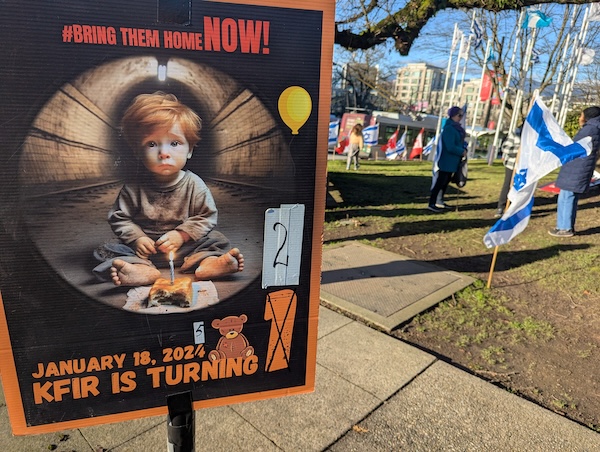
Kfir Bibas was abducted before his first birthday. His second birthday is this Saturday. (photo by Pat Johnson)
The Gregorian calendar has turned over a new year, but the vigils for the Israeli hostages continue without interruption.
Daphna Kedem, who has organized the weekly events since hours after the Oct. 7, 2023, terror attacks, acknowledged that it has been effectively an additional full-time job and that the commitment has taken a toll.
“But it’s also given me energy to continue, in a strange way,” she told the Independent in the moments before the vigil at Vancouver City Hall last Sunday. “I have to be here. I have to do it. I can’t be anywhere else.”
Inevitably, numbers have dwindled from the initial weeks, and some people have suggested to Kedem that she alter the events from weekly to monthly to get the numbers up. She’s not confident that would make a difference and, she added, that would send a negative message. To shift from the weekly routine would imply “that we are normalizing and accepting the situation of the hostages” and that is a message she will not accept, she said.
Ari Mansell is a core volunteer who is present for setup and teardown every week, as well as occasionally playing violin.
“I come here as the smallest thing I can do to help my community,” he said. “It’s a labour of love for me. It’s hard for me to stay away.”
His participation has made him feel more connected to his community.
“I’ve increased my community around me,” he said. “Moving here eight years ago [from Edmonton], I didn’t really know anyone here. This unfortunate event has brought us together and I’m so thankful for the people that I’ve got to know over this time – the musicians, Daphna, the organizers – it’s enriched my life. I don’t do it for me, but at the same time it’s helped me.”
Joanita Nakasi is one of many Christians who attend on a regular basis. She has always prayed for Israel, she said, and so, when Oct. 7 happened, she felt moved to stand with the local Jewish community. She urges others to accompany her.
“They should also come and join,” she said. “We stand together until all our brothers and sisters are back.”
Richard Lowy, who has performed music and sung at many of the vigils, lauded the community for coming together across ideological lines.
“The idea that you’re secular, you’re religious, you’re nonreligious, you’re right-wing, you’re left-wing, you’re for Trump, you’re for Biden, you’re Jewish – it doesn’t matter,” he said. “It doesn’t matter what you think. When the Nazis came, they came for the Jews regardless of your beliefs or where you stood.”
He recounted an experience he had during the process of writing a book about the Holocaust experiences of his father, Leo Lowy, a “Mengele twin.” The book will be released on Jan. 27, which is International Holocaust Remembrance Day.
“While I was working [on the book], I’m reliving the horror of Auschwitz and looking at the faces of the people that are in this concentration camp and the families and the people that were brutalized and I had to take a break because it’s just so horrific,” he said. “As I walk out to the front, where the bike lane is, there is a group of young kids riding their bicycles with their Palestinian flags yelling, ‘From the river to the sea’ right in front of my house. It’s just so devastating to see this.”
In the cold sunshine Sunday, Jonathon Leipsic asked to be described solely as “part of klal Yisrael.”
Leipsic said he was asked to speak about antisemitism, but demurred.
“For me, antisemitism is a relatively irrelevant topic,” he told those gathered. “You may say have I lost my mind. What about this rising antisemitism?”
Jonathon Leipsic, “part of klal Yisrael,” fears sinat chinam, baseless hatred, more than antisemitism. (photo by Pat Johnson)
He said the Jewish community has done a good job teaching the next generations about antisemitism and the Shoah, to be good stewards of memory.
“We as a people undoubtedly will suffer, but we are eternal,” he said. “At the end of the day, we are eternal if we follow the words and the guidance provided to us.”
What worries him more, he said, is sinat chinam, baseless hatred.
“Baseless hatred among klal Yisrael and division and a lack of shalom bayit [peace in the home] within our people – this is, by far, and has always been, the only true threat to the eternity of am Yisrael. Our rabbis teach us that the First Temple was destroyed because of the most profound and abominable sins one could imagine that could be happening within a place of Hashem…. But yet, what brought down the Second Temple? Sinat chinam. Baseless hatred among klal Yisrael.”
He urged the audience to embrace the diversity of opinion within the community and “be less afraid of antisemitism and much more concerned about sinat chinam.”
Ohad Arazi moved to Canada from Israel in 2006 and has spent two decades bringing together Israeli and Canadian technology companies and people. As a son of a diplomat, he has spent more time living outside Israel than in it.
He reacted negatively when, prior to moving to Canada, his mother warned him that, as a Jew, “The only place you will ever feel truly safe is here in Israel.”
“I was so angry at her. I said, ‘I am a child of the world,’” Arazi recalled. “I am moving to one of the most liberal and pluralistic countries in the world. Please, Ima, don’t project your scarred Holocaust psyche on me.”
Then Oct. 7 happened.
“On that day, the world witnessed unspeakable atrocities as Hamas launched a brutal attack on Israel, resulting in the loss of innocent lives and the abduction of many,” he said. “But one more thing happened that day, which is that Canadians got their first glimpse of where our country could be headed. Shortly after the news of the scope of the atrocities began coming to light, revelers and anti-Israel protesters took to the streets in Canada.… Across governments, schools, unions and media, a toxic environment has emerged, fueling hostility against Canadian Jews.”
Israel’s war against Hamas, Hezbollah and the Houthis is proceeding successfully, he said. “But our war, as Jews in the diaspora, the war we are facing day in and day out, is a war of ideas, a war of words, ideology and truth,” said Arazi. “Our Canada should be the model for building a future where the values of humanity triumph over hatred and where every hostage is safely returned to their loved ones.”
Aliya Oran Dobres, a 15-year-old Grade 9 student at King David High School, shared her harrowing experiences of being pursued by a threatening group at a mall because of her Star of David necklace, as well as the threats her friends have experienced. In the days after Oct. 7, her fellow students covered their uniforms when in public, she said.
“We should not be scared for who we are,” she said. “As Jews, we must stick together and be strong.”
Ebube Anachebe is a fourth-year electrical engineering student at the University of Calgary, who is in Vancouver for an internship. She returned days ago from her second trip to Israel in the past year, with a Christian organization called Passages.
“The aim of the mission is to bring Christian students to the Holy Land to walk in the footsteps of Jesus,” she said. “However, since Oct. 7, they have been shifting their focus toward not just bringing students to the Holy Land, but also mobilizing Christian students to stand alongside their Jewish brothers and sisters against antisemitism.”
About 100 others joined Anachebe on the nine-day tour.
“We experienced the Jewish roots of our faith, we experienced the love of our saviour, gifted to us by you guys, our Jewish brethren,” she said. “We encountered modern Israel and we bore witness to the realities of what happened on Oct. 7.”
She shared several memorable encounters with Israeli individuals, including Shahar, a resident of Kfar Aza.
“His beloved community was torn apart and ransacked by Hamas terrorists. When we asked him why he returned, he said, ‘Israel is my home, this kibbutz is my home, I have nowhere else that I would want to go.’
“The group’s tour guide, Danny, recounted how, on Oct. 7, when awakened by sirens at 6:30 am, his son asked him, ‘Daddy, why won’t the bad people let Israelis sleep?’
“He shared about the difficult moment when, a couple of hours later, he was called to the reserves and he had to tell his son, ‘I won’t be here for your birthday tomorrow,’” Anachebe said.
She said that, when Oct. 7 happened, “it awoke two different camps of people.”
“It awakened the antisemites, who had been slumbering,” she said. “But I tell you it also woke up leaders who didn’t even realize that they were leaders until they were called up for such a time as this, to stand up against this evil of antisemitism. This is what I witnessed when I went to Israel. I witnessed leaders who will rise up and pray for Israel, the hostages and the brokenhearted.”
Anachebe said, “We Christians see you, our Jewish brothers and sisters, as mishpachah, family. We are standing and we are standing alongside you. Am Yisrael chai.”
UnXeptable Vancouver has been rallying for Israeli democracy for 28 weeks. Here they are on 41st Avenue near Oak Street. (photo from UnXeptable Vancouver)
It has been many months since we first wrote to the Jewish Independent with our plea to voice our concern for democracy in Israel.
On Jan. 17, when the new government came to power, we saw the writing on the wall: the end of Israel as was envisioned in its Declaration of Independence – that Israel “will uphold the full social and political equality of all its citizens, without distinction of race, creed or sex; will guarantee full freedom of conscience, worship, education and culture; will safeguard the sanctity and inviolability of the shrines and holy places of all religions; and will dedicate itself to the principles of the Charter of the United Nations” – meaning Jewish and democratic.
Hundreds of thousands of Israelis have been going to the street for 31 weeks, holding flags and demanding democratia, democracy. And we have been echoing this outcry in Vancouver for 28 weeks – we joined 64 other cities around the world, as part of UnXeptable.
You might have seen us at Robson Square or, lately, around 41st Avenue and Oak Street. As we gather for our weekly rallies, holding Israeli flags, we try to hold onto the fabric of the Israel that we know and love. We try to hold onto one another in this ongoing rollercoaster, and we end each rally with Hatikvah (The Hope). We hope that Israel’s forces of liberty, freedom and diversity will overcome the agenda of this government – a government that is working towards its own personal interests rather than the good of the Israeli people.
We are fully aware of what happens when good people are silent, as bad things are happening. We cannot be silent as we see Israeli democracy crushed in front of our eyes. Dictatorship, orchestrated by a government that has lost its legitimacy, is turning out to be the biggest existential danger to our country.
We fear for Israel. We fear a civil war, as the rift and hatred that was stoked by the prime minister is growing. We fear for the security of Israel and its ability to defend itself, as soldiers no longer feel that they can commit to a government that does not adhere to the basic agreement, based on the accountability of the government to the judicial system.
The Knesset’s passing of the clause limiting the Supreme Court’s power to rule on the “reasonableness” of government decisions was a fatal blow to Israeli democracy. This clause provides the temporary majority of 64 members of the parliament (out of 120) the ability to legislate any unreasonable law. The government has more than 200 laws in its queue as the beginning of sweeping changes that will make Israel unrecognizable to us, or anybody that has any reference to Israel.
Day after day, things are getting darker for Israeli democracy. We fear that a constitutional crisis is looming. In the past week, the prime minister of Israel, Binyamin Netanyahu, when approached, would not guarantee to the Israeli people that he would obey the ruling of the court if this law were to be struck down.
What illuminates the darkness is the rising of the Israeli liberal forces, protesting and reviving the spirit that brought about the “Israeli magic” – Israel’s economic, political, cultural and scientific rise. Their nonviolent, spirited and creative protests, week after week, are the engine that drives the locomotive of hope. It carries the young and the elderly, Sephardim, Ashkenazim, religious and secular people to resist, sometimes facing the violent response of police acting under government orders. Our group seeks to resonate this protest and, at the same time, provide support to our families and friends in Israel.
After many efforts, the Jewish Federation of Greater Vancouver agreed to set up a meeting between chief executive officer Ezra Shanken and Nico Slobinsky of the Centre for Israel and Jewish Affairs and members of our group, UnXeptable, plus a limited number of people of the community at large. Our members addressed the meeting, illuminating different concerns we all share, as Israel is facing these contentious times. The meeting took place on July 24, just two days before Tisha b’Av, and we could hear the wings of history. We reiterated our two main requests:
A town hall meeting, open to the whole community, not limited by the size of the room, with the objective of clearly bringing forth the complex issues Israel is facing.
A clear and public statement from the Jewish Federation of Greater Vancouver to the community that outlines where they stand, as our leaders, on the judicial overhaul.
If not for the amazing protest movement, Israel would already be a dictatorship, a government in which a small group possesses absolute power without effective constitutional limitations.
UnXeptable voices Israel’s cry for democracy all over the world. Recently, the Philadelphia UnXeptable group, through its continued protests, succeeded in getting billionaire Arthur Dantchik – a main contributor to the Kohelet Policy Forum – to withdraw his donations to the organization, one of the designers of the judicial coup in Israel.
At the moment, 64 members of the Knesset are derailing Israel from being a strong country, of law and order, with a strong economy and a strong army, to being a dark, weak country – economically, militarily, internationally – ruled by a prime minister indicted on three charges, an MK convicted of bribery, Haredim trying to legitimize their refusal to serve in the army and, last but not least, religious zealots seeking to legitimize the occupation and to govern Israel by religious law. There have been warnings from all sectors, including the previous head of Israel’s General Security Service and Israel Defence Forces, banking professionals, the International Monetary Fund and many heads of state.
We believe that the Federation, based on its support of human rights and Jewish values, should take a stand supporting the protesters in Israel and the values they are trying to protect, helping us save the national homeland of the Jewish people, which was established, after thousands of years in exile, with a vision to be Jewish and democratic. In historian and philosopher Yuval Harari’s words: “either a messianic dictatorship will rise or a democracy for all [will be established]. It is in our hands.”
We call for our local leaders to stop sitting on the fence. Come to Israel’s defence to prevent it from becoming a messianic, poor state that discriminates against minorities. Help us protect and keep Israel Jewish and democratic as per the Israeli Declaration of Independence.
– The UnXeptable Vancouver team (Rina Vizer, Dalite Har Toov,
David Berson, Edna Leyland, Ornit and Ron Haber,
Noga and Gideon Levit, and Daphna Kedem)
The Vancouver action group UnXeptable has been rallying on Sundays, at noon, at Robson Square, as part of an international grassroots movement to save Israeli democracy. (photo from Daphna Kedem)
We are a group of Israelis and Canadian Jews watching the grim news from Israel closely and feel that Israel’s democracy is on a very slippery slope, without brakes. The judicial crisis is leading to a dramatic loss of checks and balances in a state that has been democratic since its inception. It is shaking Israel and tearing apart its very fabric. We are terrified that the road to dictatorship will be quick and abrupt.
Israelis have been going to the streets in masses for the last many weeks. The biggest demonstrations drew more than 300,000 people to the street, yet we don’t see reference to these events in our local community. It seems that Jewish organizations and leaders are choosing to be on the sidelines, by toning down the crisis. Some are choosing to be silent altogether.
We are utterly frustrated by this silence. We know very well the horrific consequences that silence can bring about. But we realize that unprecedented events have been unfolding. Israel has been our source of pride throughout changing times and because events are happening fast, leaders might feel lost, without a compass in an uncharted territory.
We would highlight the facts as we see them: the Israel that we have known has changed.
Recent elections brought to power a group of people with personal interests counter to the public interest. One is a convicted criminal (bribery) who wants to clear his way to be a minister. The religious parties seek to release religious young people from army service, which is compulsory in Israel. A messianic, racist party wants to spread its agenda. And the prime minister is a defendant in three indictments and, in our opinion, to get away from his trial, he is promoting a change of regime in Israel, a radical move that will eliminate the separation of powers and the independence of the Supreme Court. The legal system will become part of the ruling party.
Until now, the selection of judges to the Supreme Court required agreement between the representatives of the judges and the representatives of the government. But the coalition has voted on a series of laws that approve a change in the judicial system. According to the new proposal, only the representatives of the coalition will be able to choose judges for the court. It seems clear that a preliminary committee will appoint judges that will dismiss the defendant, Binyamin Netanyahu, from all his charges.
The core issue is that the Netanyahu we knew from his 15 years in power previously is not the same Netanyahu. In his previous terms, he defended the Supreme Court as an anchor for freedom and justice. The new Netanyahu’s trial is going into its third year.
Israel has no constitution and no other checks and balances. The Supreme Court is the sole judicial body that secures the rights and freedoms of individuals and minorities. We would like to encourage our local leaders and the community at large to address these issues that will no doubt influence the close and delicate relationship we have with Israel. We would like to encourage people to stand up in defence of Israel’s democracy – our family members in Israel, our friends and colleagues, and the democratic forces in Israel need our help.
We urge you to join the Vancouver action group UnXeptable – Vancouver, which is part of an international grassroots movement in more than 30 cities to save Israeli democracy. Rabbis and community leaders have come out to such rallies around the world to speak out and support the movement. We hope that you, too, will join us. Our next rallies will be held on March 12 and 19, at noon, at Robson Square in downtown Vancouver.
Protesters in Rishon Le-Tzion Demonstrating against judicial reform February 25, 2023. (photo by Hayden)
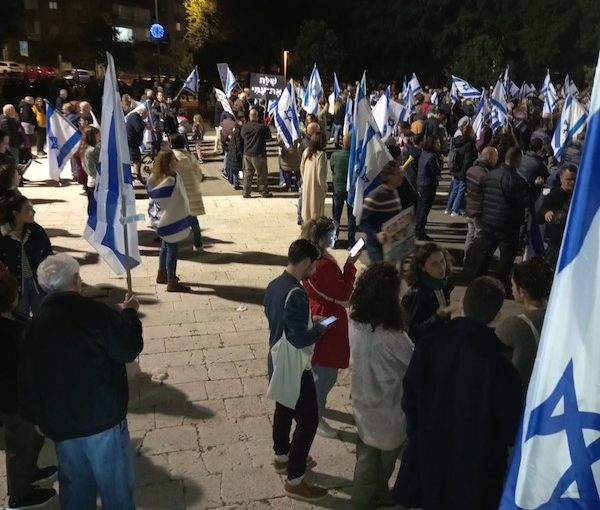
It was a valuable experience to attend a protest rally in Rishon Le-Tzion. Several hundred people gathered in a city square to express concerns about the dramatic changes being initiated by the new Israeli government. The rally was more poignant, given that it was held in a square that commemorates people from this city who have died in combat.
As a Canadian, I had mixed feelings about attending. Who am I to be here protesting, as I don’t pay taxes and haven’t served in the army? On the other hand, the changes proposed by the government are going to affect Jews around the world and not just in Israel. Also, having three grandchildren in Israel increases my interest in what happens.
Rishon Le-Tzion, established in 1882, is well known as one of the first cities to be established in modern Israel. Its name, translating as “first in Zion,” says it all. The first Israeli Hebrew school was established here. Baron Edmond de Rothschild established what evolved to be a thriving wine industry here. The city predates the establishment of Tel Aviv by 27 years.
The square itself commemorates the large number of Israelis from Rishon Le-Tzion who have died in combat. Engraved in a monument is a listing, year by year, of names of the deceased. Israel today is one of the most successful countries in the world. When you visualize the large number of names engraved on these walls, it is clear that Israel’s achievements did not come without major losses of life.
The rally itself consisted of many people waving large Israeli flags. There were people of all ages, including many children present.
One of the speakers, Meir Sheetrit, served as minister of several different portfolios in previous Likud governments. Sheetrit was so respected that his name was brought forth as a candidate for the presidency of Israel in 2014. As a Likudnik, he decried the changes taking place and asserted that the current government is deviating radically from the direction of previous Likud governments.
Another speaker was Yair Golan, who was a member of the Knesset and has served on government committees. He was a former general in the Israel army and, at one point, was considered for the position of army chief of staff. He said he values a democracy that is based on law and not on tyranny, a press that is free and not based on peoples’ whims and a government that will protect the rights of minorities.
Merav Michaeli, the leader of the Labour party, was in attendance. She circulated through the audience, but, according to the protocols of the demonstration, being a sitting member of the Knesset, she was not permitted to speak.
The audience was mainly attentive, though occasional side conversations took place. People frequently erupted with Boosha! (Shame) in reference to various proposed government changes. The slogan De-mo-cra-tia frequently reverberated through the audience.
Periodic references were made to the diminishing status of women, LGBTQ+ people and minorities, especially Arab minorities, with the thought that these groups will bear the brunt of the changes.
Jews of non-Orthodox denominations feel that their rights will be diminished under the new government. The Women of the Wall fear they will always be relegated to second-class citizens when they pray at the Kotel. Several of the new government ministers want to cancel the annual Gay Pride parades. Many Israelis and leaders of other countries think the new government will end the possibility of ever having a two-state solution.
Most of all, people are concerned about the future of Israel’s fiercely independent judiciary. In a bill recently introduced into the Knesset, the government will have the ultimate say in who is appointed to the courts. Also, the Knesset will have the ability with a simple majority to overrule decisions of the Supreme Court. Many people, including a large number of Canadian judges and lawyers, have spoken out against these changes.
I came to Israel with major concerns about the new government’s policies and directions. It was instructive to see that a large percentage of the Israeli population shares similar feelings.
The demonstration I attended was only one of many that took place that night. According to reports in the press, there were 40,000 demonstrators in Tel Aviv, 20,000 in Haifa, 2,000 in Beersheva and smaller rallies all over the country. Clearly, a large percentage of the Israeli population strongly objects to the proposed changes. Large demonstrations occur every Saturday night, but also at other times during the week. If public engagement is a sign of a functioning democracy, then Israel is a healthy society.
Will these protests make a difference? So far, the new government has been firm in its conviction that major new directions are needed and is not backing down.
Rallies such as the one in Rishon Le-Tzion raise many questions. Are rallies an effective way to advocate for change in a society? Do democratic governments need to respond to what people participating in rallies are advocating? Are the proposed changes going to lead to a better or worse Israel? Is it important for Diaspora Jews to express their opinions about what is happening in another country far away?
As a Canadian, I came back with a firm opinion about the latter question. Diaspora Jews, who can be greatly affected by what is happening in Israel, need to express their opinions about the changes that may affect them. People who support democratic systems should weigh in anywhere in the world when they perceive that democracy is threatened.
But it is up to Israelis themselves to answer the basic questions as to what type of electoral and judicial systems they prefer. For the sake of the Jewish Diaspora and the rest of the free world, we hope that they will make the right decisions.
Larry Barzelai is a semi-retired physician living in Vancouver. He’s always had strong ties with Israel through the Canadian Zionist Federation, CJPAC and the annual Public Speaking Contest. His main connection now is his three grandchildren who call Israel their home.