Skip to content
  • Home
  • Subscribe / donate
  • Events calendar
  • News
    • Local
    • National
    • Israel
    • World
    • עניין בחדשות
      A roundup of news in Canada and further afield, in Hebrew.
  • Opinion
    • From the JI
    • Op-Ed
  • Arts & Culture
    • Performing Arts
    • Music
    • Books
    • Visual Arts
    • TV & Film
  • Life
    • Celebrating the Holidays
    • Travel
    • The Daily Snooze
      Cartoons by Jacob Samuel
    • Mystery Photo
      Help the JI and JMABC fill in the gaps in our archives.
  • Community Links
    • Organizations, Etc.
    • Other News Sources & Blogs
    • Business Directory
  • FAQ
  • JI Chai Celebration
  • JI@88! video

Recent Posts

  • האלימות בישראל מורגשת בהרבה מגזרים
  • טראמפ עוזר דווקא לנושא הפלסטיני
  • New rabbi settles into post
  • A light for the nations
  • Killed for being Jewish 
  • The complexities of identity
  • Jews in time of trauma
  • What should governments do?
  • Annie will warm your heart
  • Best of the film fest online
  • Guitar Night at Massey
  • Partners in the telling of stories
  • Four Peretz pillars honoured
  • History as a foundation
  • Music can comfort us
  • New chapter for JFS
  • The value(s) of Jewish camp
  • Chance led to great decision
  • From the JI archives … camp
  • עשרים ואחת שנים להגעתי לונקובר
  • Eby touts government record
  • Keep lighting candles
  • Facing a complex situation
  • Unique interview show a hit
  • See Annie at Gateway
  • Explorations of light
  • Help with the legal aspects
  • Stories create impact
  • Different faiths gather
  • Advocating for girls’ rights
  • An oral song tradition
  • Genealogy tools and tips
  • Jew-hatred is centuries old
  • Aiding medical research
  • Connecting Jews to Judaism
  • Beacon of light in heart of city

Archives

Follow @JewishIndie
image - The CJN - Visit Us Banner - 300x600 - 101625

Tag: UnXeptable

Judges slap down Knesset

Israel’s government pushed the country’s Supreme Court into a corner – but instead of weakening the judicial system and putting more power into the hands of the government, which was the aim of the coalition’s judicial reform package, the gambit incited a showdown that made the court stronger than it had been a year earlier.

That is the synopsis of a leading Israeli legal scholar. Yaniv Roznai, associate professor and vice-dean of the Reichman University’s law school and co-director at the Rubinstein Centre for Constitutional Challenges, was speaking virtually to North American audiences hours after Israel’s Supreme Court released a landmark decision Jan. 1. During the presentation, which was organized by UnXeptable, the international group that emerged in opposition to the judicial reforms, Roznai said the court also now has more legitimacy among the public, according to opinion surveys.

The 250,000-word written decision, with contributions from all 15 Supreme Court justices, represents the first time in Israeli history that the high court struck down a component of the Basic Law, which is effectively Israel’s constitution. The opinion overturned legislation the Knesset passed in July curbing the ability of judges to use “reasonableness” as a legal standard.

One justice wrote that Israel’s limited system of checks and balances means that the cancellation of the court’s ability to freely judge decisions by governments and ministers removed much of the ability of courts to defend individual and public interests.

While subjective, the idea of reasonableness has been a legal doctrine in Israel since the 1980s and was used a year ago to prevent Prime Minister Binyamin Netanyahu from appointing Aryeh Deri, the leader of the Shas party, from serving in cabinet because Deri had been convicted of tax fraud and bribery. The court declared it was not reasonable to appoint a convicted felon to lead a government department. This was the apparent impetus for a significant raft of legislation intended to reform the judicial system – proposals critics have called a “judicial coup.”

The reasonableness doctrine is available to the court if judges believe that elected officials did not take into account all relevant considerations before making a decision, or that those considerations were not given appropriate weight. It has been invoked numerous times on significant and less momentous government decisions.

In response to mass protests throughout 2023, the government at least temporarily backtracked on some of its judicial reform proposals, including efforts that would allow the Knesset to overturn court decisions by a majority vote and to give the government more direct control over the appointment of judges. That left the reasonableness doctrine as the remaining portion of the broader judicial reform proposal – and its rejection by the court is a blow to Netanyahu’s government. It also reopens the divisive topic, which has been largely dormant since the terror attacks of Oct. 7, possibly inviting social division at a time of national trauma.

Critics of the legislation, which passed the Knesset in July, argued that eliminating the reasonableness doctrine would allow the government to fire senior civil servants such as the heads of law enforcement agencies, making it easier to subvert the rule of law. Israel’s attorney general, for example, oversees the public prosecution system and determines whether politicians can be indicted on alleged crimes.

Since Israel has no formal constitution, the Basic Law serves as an alternative. However, whereas the American, Canadian and most other national constitutions have complex, in some cases almost impossible, amending formulas, Israel’s Basic Law can be amended by the Knesset by a majority vote. Therefore, Roznai said, “The only real check on political power is the attorney general and the judiciary, and the [Netanyahu government’s] reasonableness amendment was aimed to weaken precisely those two bodies.”

While the decision to overturn the law was close, with eight of the 15 justices in favour and seven opposed, three additional judges agreed that the court has the authority to strike down basic laws, but argued the time was not right.

The government defended the legislation by arguing that the idea of reasonableness was too arbitrary and, therefore, gave the court too much scope to intervene in areas the government considered the purview of the legislative branch. Critics, including Attorney General Gali Baharav-Miara, responded that the law eliminated guardrails that protect Israeli democracy.

Roznai, speaking Jan. 2, expressed mixed emotions about the court’s decision.

“I’m happy but, on the other hand, I’m a bit sad,” he said, noting that the entire controversy could have been avoided, “if the government had only worked a bit more gently, in a more clever manner. They could have enacted a more balanced amendment and then the court would not interfere.… I do not object to a reform in the judicial system. I think that any governmental system needs reform. In the education system we need to reform, in the health system we need reform, and also in the judicial system we need reform. But we need good reform. We need balanced reform. We don’t want something that would completely destroy the judicial system. We want something that would improve our systems and our democracy.”

A process that engaged different sectors of the society and tried to find a consensus on some of these issues could have resulted in constructive reforms, he said. Instead, millions of people took to the streets and polls showed that 80% of Israelis were opposed to the proposed judicial changes and a political schism has wrenched Israeli society amid a war.

Two days after Roznai spoke, UnXeptable hosted another event for North American audiences, featuring Dr. Tomer Persico, a research fellow of the Shalom Hartman Institute and former Koret Visiting Assistant Professor of Jewish and Israel Studies at the University of California Berkeley, where he was also a senior research scholar in the Centre for Middle Eastern Studies. He is a social activist advocating for freedom of religion in Israel.

Persico warned of cataclysmic impacts on global perceptions not only of Israel but of Jews if the trajectory of Israeli politics does not change. The current Israeli government, he said, includes individuals who are expressing ideas about the treatment of the people of Gaza that advocate ethnic cleansing and even genocide. Amichai Eliyahu, who was Israel’s heritage minister, was suspended from cabinet after saying that dropping a nuclear bomb on the Gaza Strip was “one of the possibilities” the government is considering. 

While the pro-democracy groups and individuals who were rallying against the government before Oct. 7 have closed ranks in a show of unity and determination since the Hamas terror attacks, these recent statements – including reports that the government is considering moving Palestinians from Gaza to third countries and returning Israeli settlers to the enclave – make this fragile unity difficult, said Persico.

Most Israelis tell opinion pollsters they want new elections and a different government. Persico warned that approaches to internal and external affairs by the current government might not only further tarnish Israel’s reputation in the world, but Judaism’s. Former governments have failed to find common ground with Palestinians to create a two-state solution, he said, but even the hawkish past administrations publicly expressed support for the concept. With the current government seemingly giving up on the idea and some voices in the coalition speaking of expulsions of Palestinians, Israel is on a path to becoming more of an international pariah, he said.

“There will be a breaking point between Israel and the liberal West and that includes liberal Jews,” he said. “I really fear that Judaism itself is going to be stained by the mark of the occupation.… It might materialize that that Judaism itself will be stained in the same way as Christianity has been stained by the Crusades, the same way as Islam has been stained by Islamic terrorism and ISIS.” 
Posted on January 12, 2024January 11, 2024Author Pat JohnsonCategories IsraelTags Israel, judicial reform, law, Supreme Court, Tomer Persico, UnXeptable, Yaniv Roznai
חודש שלישי ברציפות של הפגנות

חודש שלישי ברציפות של הפגנות

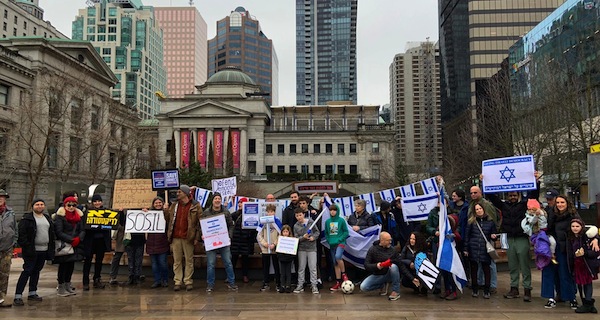
(photo by Roni Rachmani)

בוונקובר כמו בעשרות רבות של ערים ברחבי העולם ממשיכים ישראל ויהודים מקומיים להפגין נגד המהפכה המשפטית של ממשלת נתניהו, ובעד שמרית הדמוקרטיה בישראל. ההפגנות בוונקובר נערכות זה החודש השלישי ברציפות עד כה נערכו כבר שנים עשר אירועים, בכיכר רובסון בדאון טאון בסמוך לוונקובר ארט גלרי – בימי ראשון בשתיים עשרה בצהריים. משתתפים בהן בין עשרים לחמישים איש לכל היותר. למארגני האירוע ברור שמטבע הדברים לישראלים וליהודים שגרים כאן אין רצון להשתתף באירועים קהילתיים כאלה או אחרים, או בהפגנות הקשורות בישראל. חשוב להם להראות שגם כאן יש הפגנות תמיכה בדמוקרטיה הישראלית ונגד הצעות החוק של נתניהו ואנשיו להריסתה, גם אם המשתתפים בהן הוא מועט באופן יחסי לערים אחרות בעולם

מארגני ההפגנות בארץ ובעולם כותבים באתר שלהם בפייסבוק: “עכשיו זה הזמן. הזמן השחור. עכשיו זה הרגע לקום ולזעוק: הארץ הזאת בנפשנו היא
מה שקורה בה היום יקבע מי היא תהיה ומי אנו וילדינו נהיה. (דויד גרוסמן)

ישראל נמצאת כעת תחת מתקפה על בסיס קיומה – על הדמוקרטיה שלה. מול המתקפה הזו קמה מחאה חסרת תקדים בישראל, בקרב ישראלים רבים ברחבי העולם. בשבת נצא מהבית – מוונקובר ועד סידני כדי לקחת חלק במאבק לעצירת המהפכה המשטרית, כדי להשמיע את קולנו במלחמה על

הדמוקרטיה. תביאו שלטים ודגלים, תביאו כלים מוזיקליים.
תבואו צבעוניים. אנחנו רוצים לשתף את הקהילות הפלורליסטיות וססגונית תזמינו את החברים שלכם, את המשפחות שלכם, את הילדים שלכם, את ההורים שלכם. תזמינו חברים שאוהבים את ישראל ורוצים לתמוך המאבק שלנו על הדמוקרטיה בארץ. הפיצו ושתפו”

בן הסיסמאות שמופצות בהפגנות בוונקובר ובערים אחרות בעולם כולל בישראל: “שקרן קטן”, “בא לריב”, “מלשכת ראש הממשלה מבקשים להבעיר”, “נתנהיו הסיר את הדמוקרטיה מהקבוצה”, “עשבים שולטים”, “אף אחד לא מדבר על צדק”, “יחריב לוין”, “שמחה ואסון”, “שהמדינה תישרף”, “דיקטטורה בעזרת אשם”, “מושחתים שתו אותנו בקשית”, “צדק עזב את הקבוצה”, “חירות עזב את הקבוצה”, “חירות סוף”, “אנו מחריבים בזאת”, “אתה ואני נהרוס את העולם”, “חיקקה בנוסקר”, “השר לביטחון על הפנים”, “משנכס אדר מרביצים בשמחה”, “ישראל מתפרקת”, “אני ימני דמוקרטי”, “הועדה למינוי שפוטים”, “איך אומרים איראן בעברית”, “אל תקרע לי עם”, “ביי-טק. ההפיכהמרסקת את הכלכלה”, “ביבי איבדת את זה”, “נלחמנו למען המדינה, עכשיו נילחם עליה”, “לא יהיה כלום, כי לא נשאר כלום”, “Jוקה עכשיו”, “אנחנו חרדים!”, “שלוש רשויות: מבצעת, מבצעת, מבצעת”, “אין לכם רשות (שופטת)”, “דמוקרטיה על מלא”, “אנחנו המחנה המשותף (הרוב הדמוקרטי)”, “אחדות עכשיו”, “שלא ידע דמקורטיה”, “נבצרות עכשיו”, “מר קלקלה”, “רפורמה עושים לאט לאט. הפיכה עושים מהר מהר”, “לא לדיקטטורה! נלחמים על הדמוקרטיה”, “חובה להתנגד”

מרבית המשתתפים בהפגנות בוונקובר כו העמיתים בישראל די מיואשים ממה שקורה בארץ, משלטונו המפחיד של בנימין נתניהו, שכל שחשוב לו הוא לשמור על כיסא ראש הממשלה. רבים לא מאמינים שאפשר לחזור אחורה לשלטון אחר – ללא נתניהו. לרבים ברור שכיבוש השטים כתוצאה ממלחמת ששת הימים מצד אחד ריבוי הילודה אצל החרדים ויוצא מדינות ערב, הביאו למצב הנוכחי, שבו הימין, החרדים והקיצוניים עושים כמעט כרצונם. מספר מפגינים שחזרו מישראל סיפרו על מצב הרוח שם שהוא קודר ביותר. לכולם כמעט ברור שהאשם העיקרי במצב הבלתי נסבל הזה שמביא נזק גדול ישראל הוא נתניהו. הוא נמצא בשלטון כבר למעלה מחמש עשרה שנים

Format ImagePosted on May 3, 2023May 1, 2023Author Roni RachmaniCategories עניין בחדשותTags democracy, demonstrations, Israel, judicial reforms, Netanyahu, UnXeptable, Vancouver, דמוקרטיה, המהפכה המשפטית, וונקובר, ישראל, נתניהו, פגנות
Diaspora voices its concerns

Diaspora voices its concerns

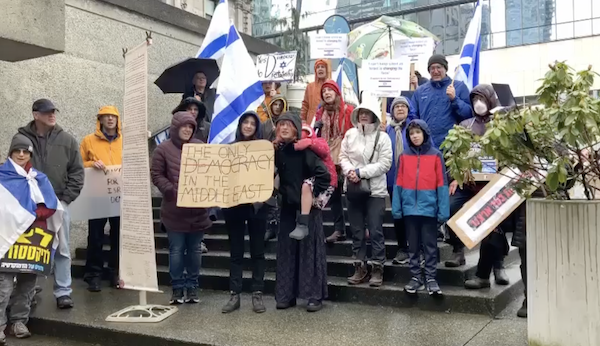
The message on the Facebook post of this video from UnXeptable, who have been gathering weekly at Robson Square to protest the Israeli government’s proposed judicial reforms, reads: “Rain never stops Vancouver 🇨🇦 from supporting you in your struggle ❤️🇮🇱” (screenshot from Facebook.com/DefendIsraeliDemocracy)

Reverberations from the political tumult in Israel continue to rumble across the Diaspora, including here in British Columbia.

For 10 weekends in a row now, a few dozen Vancouver-area residents, many of them Israeli expats or Israeli-Canadians, have gathered in downtown Vancouver. On March 30, an “emergency meeting” took place at Or Shalom synagogue, titled Saving Israeli Democracy.

Daphna Kedem, one of the organizers of unXeptable, which is behind the rallies, told the group at Or Shalom that similar events are now taking place in more than 50 Diaspora communities.

“There is a point to going out in the street and saying we are here and we care and we want a lot of others to share what we feel,” she said, noting that between 20 and 50 people tend to show up at the weekly gathering at Robson Square.

“It would be great to be 200,” she said, adding that the masses of Israelis taking to the streets have forced a delay in the government’s proposals, but the fight is far from over.

The protests in Vancouver, in Israel and around the world centre on so-called “judicial reforms,” which would remove an existing multifaceted process of appointing Supreme Court justices and centralize it in the hands of the government executive, the cabinet. Among the reams of related proposals is a bill that would allow the Knesset to overturn Supreme Court decisions by majority vote.

Dr. Erez Aloni, an associate professor at the Allard School of Law at the University of British Columbia, said the proposals are “not a legal reform” and that it is “not a joke” to call what the government of Binyamin Netanyahu is attempting to do “a revolution.” Aloni is one of some 200 signees to the “Statement by Canadian jurists on proposed transformation of Israel’s legal system,” which was issued Feb. 9.

“A democracy needs checks and balances and these checks and balances include checks and restrictions on the government so we can enforce laws against the government, so we make sure that the government doesn’t abuse its right, in particular against minorities,” he said. “In Israel, the only checks, the only restrictions on the government, on the executive, is the Supreme Court.”

The power of the cabinet, the lack of a second chamber of parliament, the strictness of party discipline, the absence of a presidential veto, and the lack of a written constitution all combine to put extraordinary reliance on the Supreme Court to rein in any potential overreach by elected officials, said Aloni.

The proposals, which would give the government effective veto power over Supreme Court appointments, is a dramatic step, he said.

“The coalition, the executive, is going to be almost solely responsible for selecting judges by themselves,” Aloni explained.

Not only would this impact the Supreme Court, he argued, but any lower court judge with aspirations of appointment to the highest judicial body would presumably consider political repercussions when handing down decisions.

In addition to the proposals to alter the judiciary, Aloni told the audience that the government is also threatening “independent public broadcasting, control of academia, immunity for IDF soldiers and police actions, increasing jurisdiction of the rabbinical courts and so forth.”

Video-recorded remarks from Achinoam Nini, the well-known Israeli singer commonly known as Noa, were aired at the meeting, with portentous background music.

“The situation is not good,” said Nini. “In fact, Israel is on the verge of the worst tragedy in her short history, worse than any war so far: the death of her democracy and a total system breakdown. The so-called judicial reform … is no such thing. It is rather an antidemocratic coup, a grab for limitless power by a democratically elected government composed of convicted criminals, messianic zealots, corrupt opportunists and ultranationalists, turning democracy against itself and against the citizens of Israel.”

Dr. Lisa Richlen of the David Abraham Centre for International and Regional Studies at Tel Aviv University spoke of the impacts the proposals would have on nongovernmental organizations, especially those she works with that serve non-Jews, non-citizens and asylum-seekers. She addressed the apparent absence of Arab citizens of Israel in the demonstrations.

“I want to make the point that, for them, they haven’t felt that it’s a democracy since even before this,” she said, adding that the apparent attack on minorities has struck a chord with mainstream Israelis.

“When you start with weaker social groups,” said Richlen, “what you have is what you see today, where the mainstream of Israeli society is starting to feel increasingly threatened.”

Dr. Itai Bavli of UBC’s School of Population and Public Health echoed Richlen’s concerns for the rights of those outside the Green Line. He also disputed the idea that opponents of the government’s proposals are overstating the threat to democracy.

“Democracy is disagreeing and I get it that you have political differences, that’s the idea of democracy,” he said. “But these people, they don’t want democracy.… We have to oppose, we have to fight against these forces and support democracy in Israel.”

Rabbi Hannah Dresner, spiritual leader of Or Shalom, spoke and David Berson emceed.

The gathering was only one of many discussions in Jewish communities worldwide, some more public than others, around events in Israel and their impacts inside and outside that country. A February poll commissioned by JSpaceCanada and the New Israel Fund of Canada showed that, while three-quarters of Canadian Jews are emotionally attached to Israel, 73% oppose the judicial reforms (jewishindependent.ca/opposition-to-policies).

“Tensions that had been brewing for months in Israel came to head earlier this week, with the prime minister ultimately postponing the judicial reforms until the next legislative session,” wrote Jewish Federation of Greater Vancouver chief executive officer Ezra Shanken in his March 31 community email. “It is a very welcome decision, and, if our calculations are correct, it gives all parties until sometime in the summer to work out a compromise. A pause is not a halt and we implore the parties to come to the table with President [Isaac] Herzog, which is what we have advocated for since the start.”

The Jewish Federations of North America, the umbrella of 146 Jewish federations and more than 300 communities, released a brief open letter to Israel’s prime minister and opposition leader in February, stating, in part: “[W]e urge you to make clear that a majority of just 61 votes of the Knesset is not sufficient to override a decision of the Supreme Court. The essence of democracy is both majority rule and protection of minority rights. We recognize that any system of checks and balances will be different than those in our own countries, but such a dramatic change to the Israeli system of governance will have far-reaching consequences in North America, both within the Jewish community and in the broader society.”

On March 27, the Centre for Israel and Jewish Affairs, the advocacy voice of Jewish federations in Canada, lauded the Israeli government’s decision to delay the judicial reform legislation and urged more consensus on any changes.

Shimon Koffler Fogel, president and chief executive officer of CIJA, issued a statement, which noted, “The government’s decision must be met with a good faith effort on the part of the opposition parties, engaging in a constructive dialogue and ensuring people feel part of the policy process. Israel was founded on the principle of inclusion and must reaffirm those values at every opportunity. While there may not be uniformity around every decision, Canadian Jews must express unity around the existence of Israel and her contributions to the world, and acknowledge healthy debate is part of a continually evolving and growing democracy.”

Format ImagePosted on April 14, 2023April 12, 2023Author Pat JohnsonCategories LocalTags Achinoam Nini, CIJA, Daphna Kedem, David Abraham Centre, democracy, Erez Aloni, Ezra Shanken, governance, Israel, Itai Bavli, Jewish Federation, JSpaceCanada, judicial reform, Lisa Richlen, New Israel Fund Canada, Nini, Shimon Koffler Fogel, UBC, UnXeptable
Join rally to support Israeli democracy

Join rally to support Israeli democracy

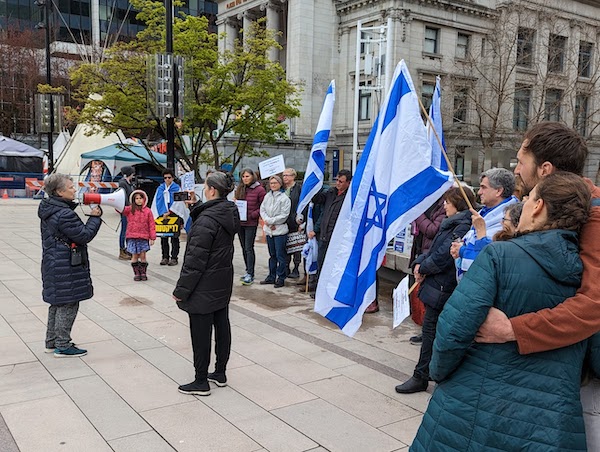
The Vancouver action group UnXeptable has been rallying on Sundays, at noon, at Robson Square, as part of an international grassroots movement to save Israeli democracy. (photo from Daphna Kedem)

We are a group of Israelis and Canadian Jews watching the grim news from Israel closely and feel that Israel’s democracy is on a very slippery slope, without brakes. The judicial crisis is leading to a dramatic loss of checks and balances in a state that has been democratic since its inception. It is shaking Israel and tearing apart its very fabric. We are terrified that the road to dictatorship will be quick and abrupt.

Israelis have been going to the streets in masses for the last many weeks. The biggest demonstrations drew more than 300,000 people to the street, yet we don’t see reference to these events in our local community. It seems that Jewish organizations and leaders are choosing to be on the sidelines, by toning down the crisis. Some are choosing to be silent altogether.

We are utterly frustrated by this silence. We know very well the horrific consequences that silence can bring about. But we realize that unprecedented events have been unfolding. Israel has been our source of pride throughout changing times and because events are happening fast, leaders might feel lost, without a compass in an uncharted territory.

We would highlight the facts as we see them: the Israel that we have known has changed.

Recent elections brought to power a group of people with personal interests counter to the public interest. One is a convicted criminal (bribery) who wants to clear his way to be a minister. The religious parties seek to release religious young people from army service, which is compulsory in Israel. A messianic, racist party wants to spread its agenda. And the prime minister is a defendant in three indictments and, in our opinion, to get away from his trial, he is promoting a change of regime in Israel, a radical move that will eliminate the separation of powers and the independence of the Supreme Court. The legal system will become part of the ruling party.

Until now, the selection of judges to the Supreme Court required agreement between the representatives of the judges and the representatives of the government. But the coalition has voted on a series of laws that approve a change in the judicial system. According to the new proposal, only the representatives of the coalition will be able to choose judges for the court. It seems clear that a preliminary committee will appoint judges that will dismiss the defendant, Binyamin Netanyahu, from all his charges.

The core issue is that the Netanyahu we knew from his 15 years in power previously is not the same Netanyahu. In his previous terms, he defended the Supreme Court as an anchor for freedom and justice. The new Netanyahu’s trial is going into its third year.

Israel has no constitution and no other checks and balances. The Supreme Court is the sole judicial body that secures the rights and freedoms of individuals and minorities. We would like to encourage our local leaders and the community at large to address these issues that will no doubt influence the close and delicate relationship we have with Israel. We would like to encourage people to stand up in defence of Israel’s democracy – our family members in Israel, our friends and colleagues, and the democratic forces in Israel need our help.

We urge you to join the Vancouver action group UnXeptable – Vancouver, which is part of an international grassroots movement in more than 30 cities to save Israeli democracy. Rabbis and community leaders have come out to such rallies around the world to speak out and support the movement. We hope that you, too, will join us. Our next rallies will be held on March 12 and 19, at noon, at Robson Square in downtown Vancouver.

Format ImagePosted on March 10, 2023August 17, 2023Author Daphna Kedem and Rina Vizer and Dalite Har ToovCategories Op-EdTags democracy, Diaspora, governance, Israel, justice, Netanyahu, protests, rallies, UnXeptable
Proudly powered by WordPress