
Skip to content
  • Home
  • Subscribe / donate
  • Events calendar
  • News
    • Local
    • National
    • Israel
    • World
    • עניין בחדשות
      A roundup of news in Canada and further afield, in Hebrew.
  • Opinion
    • From the JI
    • Op-Ed
  • Arts & Culture
    • Performing Arts
    • Music
    • Books
    • Visual Arts
    • TV & Film
  • Life
    • Celebrating the Holidays
    • Travel
    • The Daily Snooze
      Cartoons by Jacob Samuel
    • Mystery Photo
      Help the JI and JMABC fill in the gaps in our archives.
  • Community Links
    • Organizations, Etc.
    • Other News Sources & Blogs
    • Business Directory
  • FAQ
  • JI Chai Celebration
  • JI@88! video

Recent Posts

  • עשרים ואחת שנים בוונקובר
  • Supporting the Iranian people
  • The power of photography
  • A good place to start
  • When boundaries have shifted
  • Guitar virtuosos play
  • Different concepts of home
  • Broadway’s Jewish storylines
  • Sesame’s breadth and depth
  • Dylan Akira Adler part of JFL festival
  • Mortality learning series
  • A new strategy to brighten up BC
  • Sharing latkes and light
  • Johnson awarded for human rights work
  • Cherished tradition ensured … Silber Family Agam Menorah
  • Nothing as lovely as a tree
  • Camp welcomes new director
  • Popular family camp expands
  • A life-changing experience
  • Benefits of being a counselor
  • Camper to counselor
  • האלימות בישראל מורגשת בהרבה מגזרים
  • טראמפ עוזר דווקא לנושא הפלסטיני
  • New rabbi settles into post
  • A light for the nations
  • Killed for being Jewish 
  • The complexities of identity
  • Jews in time of trauma
  • What should governments do?
  • Annie will warm your heart
  • Best of the film fest online
  • Guitar Night at Massey
  • Partners in the telling of stories
  • Four Peretz pillars honoured
  • History as a foundation
  • Music can comfort us

Archives

Follow @JewishIndie
image - The CJN - Visit Us Banner - 300x600 - 101625

Tag: Itai Bavli

Heroic survival at kibbutz

Heroic survival at kibbutz

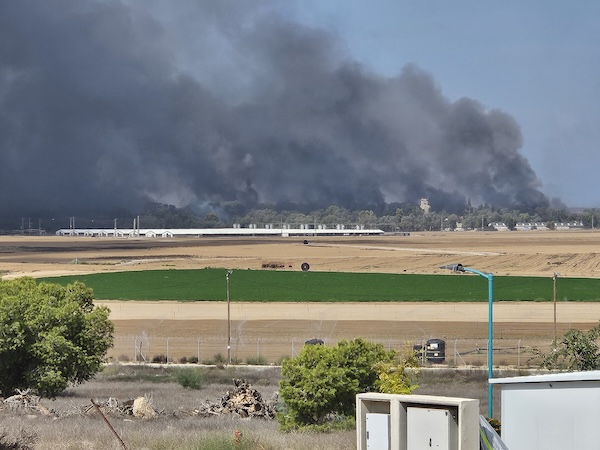
A photo Dekel Agami took Oct. 7, 2023, of Kibbutz Nir Oz in flames. (phot by Dekel Agami)

On Oct. 7, Kibbutz Magen, from which residents can see the Gazan city of Khan Yunis, was infiltrated by dozens of terrorists from Gaza. While two of the approximately 400 kibbutzniks were murdered and two seriously injured, a more horrific outcome was avoided, thanks to the heroic acts of a small squad of kibbutz civilian defenders, who held off the terrorists during a seven-hour gun battle.

A member of that response team was in Vancouver last week, sharing his story.

Kibbutz Magen is a kilometre away from Kibbutz Nir Oz, a village with a similar population, but which suffered exponentially more tragic outcomes that day – 46 Nir Oz residents were murdered and 71 taken hostage.

One reason for the less catastrophic death toll in Magen is that the terrorist infiltrators blew apart the perimeter fence a good distance from the kibbutz’s residential area. But the heroism and tireless response of Magen’s civilian emergency squad played a big role.
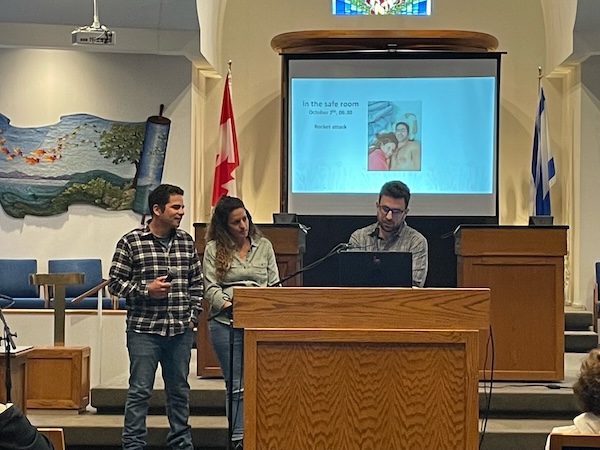
photo - Dekel Agami, left, and his partner Nufar Gal-Yam, share their Oct. 7 experiences with Vancouver audiences April 14. Itai Bavli, right, a University of British Columbia academic, grew up with Agami on Kibbutz Magen, near the Gaza border
Dekel Agami, left, and his partner Nufar Gal-Yam, share their Oct. 7 experiences with Vancouver audiences April 14. Itai Bavli, right, a University of British Columbia academic, grew up with Agami on Kibbutz Magen, near the Gaza border. (photo by Daphna Kedem)

Dekel Agami, who grew up on the kibbutz, and his partner, Nufar Gal-Yam, who grew up in Sde Boker, the kibbutz most noted as the home of David Ben-Gurion, had moved in together on Kibbutz Magen on Oct. 4.

Since both had grown up in southern Israel, close to Gaza, the red alerts on Oct. 7 did not disturb them unduly. Around 7 a.m., Agami, an Israel Defence Forces veteran who served in the special forces, headed out with his weapon to meet other members of the security squad, a group of civilians and off-duty soldiers ranging in age from 20 to 70. He quickly realized this was not a routine day.

As he walked to meet his colleagues, Agami saw figures near the kibbutz border. The first one he encountered was wearing an Israel Defence Forces uniform – as numerous terrorists were that day – and so he did not shoot.

He came across the head of his security team, Baruch Cohen, who had been shot in the leg. As Agami was delivering first aid, an anti-tank missile hit the vehicle they were next to. Agami does not know how they survived.

In the event of an emergency, civilian and off-duty military personnel on kibbutzim are expected to manage on their own for 20 to 30 minutes until the arrival of the IDF. On Oct. 7, the dozen emergency squad members in Kibbutz Magen battled 30 to 40 terrorists on their own from 7 in the morning until 2 in the afternoon.

The terrorists breached the fence at a location relatively remote from the residential area of the kibbutz, giving the defenders a small tactical advantage. Fighting soon moved to the terrorists’ targets, the kibbutz’s homes, and, after providing first aid to Cohen, Agami fought the terrorists from one of the houses. The kibbutzniks successfully flushed the infiltrators back to the fence, where some of them fled – maybe back to Gaza, possibly off to murder easier prey.

During the fighting, Agami took a photo of nearby Nir Oz, where multiple plumes of smoke were rising in an ominous foreshadowing of their potential fate. The photo went viral in Israel.

“When I took this picture, I thought we were next,” Agami said to an audience at Temple Sholom on the evening of April 14. He and Gal-Yam also spoke at the weekly rally earlier that day, outside the Vancouver Art Gallery.

When the IDF finally made it to Kibbutz Magen, about 2 p.m., they killed the remaining terrorists. Then the larger trauma began to dawn on Agami and his fellow kibbutzniks.

Agami’s two daughters from a previous relationship were with their mother at a moshav a few kilometres away. During the battle, he didn’t worry about them – partly because, he said, he “couldn’t go there” but more because it never crossed his mind that the battle he was engaged in was part of a much larger crisis. When he finally did get in touch, he found out the three were safe.

The Magen fighters were too occupied keeping the terrorists at bay – Agami alone expended 15 magazines, about 450 bullets – to check their phones to see what was going on elsewhere. They did, though, have cellular connectivity, which was not the case in many kibbutzim. The terrorists were strategic, first targeting army bases and bringing down communications systems.

As the smoke cleared midafternoon on Oct. 7, several stunning realities came to light.

Three wounded residents – Cohen, Nadav Rot and Avi Fleisher – had been transported by the kibbutz doctor to a nearby community, from which they were helicoptered to hospital. Fleisher did not survive. Cohen would eventually have his leg amputated. No one – including those who made the journey – understand how they made it to safety. The terrorists had taken control of all the roads in the region, killing every Israeli they encountered. Even the military had not breached the area by the time the medical transport got through.

The exhausted kibbutz defenders soon discovered that what they had experienced was a comparatively small part of the worst terror attack in Israel’s history. In just a hint of the depths of preparation that went into the attacks, the fleeing terrorists left behind not only weapons, flashlights and food for an extended siege, but even supplies of blood for infusions.

Agami and Gal-Yam were brought to Vancouver by Itai Bavli, a postdoctoral fellow and lecturer in public health at the University of British Columbia. He and Dekel grew up together in Magen.

The friends estimate that 60 alumni of their regional high school died on Oct. 7. Including those killed in the subsequent war, they estimate 100 of their circle of friends are dead, including Bavli’s stepbrother, Tamir Adar, who lived in Nir Oz.

Agami downplays his heroism, but Bavli is emphatic.

“He saved my family,” Bavli said.

Gal-Yam, who is expecting a baby in July, just completed a five-month call-up as a major in the IDF. She and Agami are now in temporary accommodations on her home kibbutz of Sde Boker. Agami spent five months relocated in Eilat.

“It’s like some area after a hurricane,” Gal-Yam said of the chaos at Kibbutz Magen, which was founded in 1949 and is one of the oldest communities adjacent to the Gaza Strip.

She has since returned to her day job, but everything has changed, she said.

“It seems unimportant to do again whatever it was I was doing before Oct. 7,” she said, noting that creating a normal routine is impossible. “Nothing is normal now. I’m not normal. I’m a completely different person. We are living completely different lives than before. Nothing is the same. Nothing at all.”

The Israeli visitors demurred from making predictions about the political or military ramifications of events.

“Some people are going to have to give answers after all this will be over,” Gal-Yam said.

The length of time the hostages have been in captivity – more than six months – is something that was unimaginable on that first, terrible day, she said. “Not a person in Israel thought it would take more than six months to bring them home,” she said. “This is a reality none of us expected.”

An audience member asked how they view residents of Gaza now.

Bavli reflected on how, before Hamas took over the Gaza Strip, workers from Gaza came to their kibbutz, even staying overnight.

“People from Gaza worked on our kibbutz and were treated as family,” he said. “We wanted to have them as neighbours, to find political solutions, to find a way to live together.

“We don’t have anything against people from Gaza,” he said. “What broke our hearts was, at Kibbutz Nir Oz, the first wave [of infiltrators on Oct. 7] was Hamas, but the second wave was just people who came to steal. But they also killed people. That’s what broke our hearts, confused us.”

For the future, Bavli sees the willingness of Gazans to live in peace as key.

“Hopefully,” he said, “there are enough good people there to find a way to live together.”
Format ImagePosted on April 26, 2024April 26, 2024Author Pat JohnsonCategories IsraelTags Dekel Agami, Israel, Itai Bavli, Kibbutz Magen, Nufar Gal-Yam, Oct. 7, survivors, Temple Sholom, terrorism
Diaspora voices its concerns

Diaspora voices its concerns

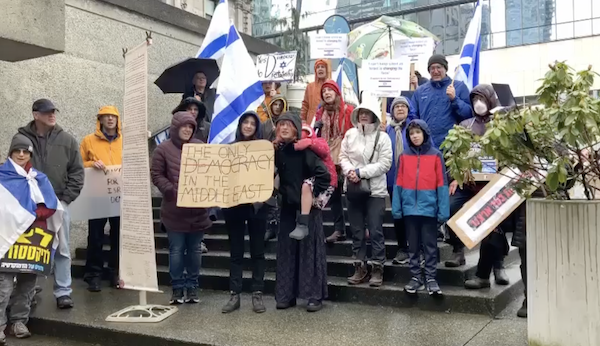
The message on the Facebook post of this video from UnXeptable, who have been gathering weekly at Robson Square to protest the Israeli government’s proposed judicial reforms, reads: “Rain never stops Vancouver 🇨🇦 from supporting you in your struggle ❤️🇮🇱” (screenshot from Facebook.com/DefendIsraeliDemocracy)

Reverberations from the political tumult in Israel continue to rumble across the Diaspora, including here in British Columbia.

For 10 weekends in a row now, a few dozen Vancouver-area residents, many of them Israeli expats or Israeli-Canadians, have gathered in downtown Vancouver. On March 30, an “emergency meeting” took place at Or Shalom synagogue, titled Saving Israeli Democracy.

Daphna Kedem, one of the organizers of unXeptable, which is behind the rallies, told the group at Or Shalom that similar events are now taking place in more than 50 Diaspora communities.

“There is a point to going out in the street and saying we are here and we care and we want a lot of others to share what we feel,” she said, noting that between 20 and 50 people tend to show up at the weekly gathering at Robson Square.

“It would be great to be 200,” she said, adding that the masses of Israelis taking to the streets have forced a delay in the government’s proposals, but the fight is far from over.

The protests in Vancouver, in Israel and around the world centre on so-called “judicial reforms,” which would remove an existing multifaceted process of appointing Supreme Court justices and centralize it in the hands of the government executive, the cabinet. Among the reams of related proposals is a bill that would allow the Knesset to overturn Supreme Court decisions by majority vote.

Dr. Erez Aloni, an associate professor at the Allard School of Law at the University of British Columbia, said the proposals are “not a legal reform” and that it is “not a joke” to call what the government of Binyamin Netanyahu is attempting to do “a revolution.” Aloni is one of some 200 signees to the “Statement by Canadian jurists on proposed transformation of Israel’s legal system,” which was issued Feb. 9.

“A democracy needs checks and balances and these checks and balances include checks and restrictions on the government so we can enforce laws against the government, so we make sure that the government doesn’t abuse its right, in particular against minorities,” he said. “In Israel, the only checks, the only restrictions on the government, on the executive, is the Supreme Court.”

The power of the cabinet, the lack of a second chamber of parliament, the strictness of party discipline, the absence of a presidential veto, and the lack of a written constitution all combine to put extraordinary reliance on the Supreme Court to rein in any potential overreach by elected officials, said Aloni.

The proposals, which would give the government effective veto power over Supreme Court appointments, is a dramatic step, he said.

“The coalition, the executive, is going to be almost solely responsible for selecting judges by themselves,” Aloni explained.

Not only would this impact the Supreme Court, he argued, but any lower court judge with aspirations of appointment to the highest judicial body would presumably consider political repercussions when handing down decisions.

In addition to the proposals to alter the judiciary, Aloni told the audience that the government is also threatening “independent public broadcasting, control of academia, immunity for IDF soldiers and police actions, increasing jurisdiction of the rabbinical courts and so forth.”

Video-recorded remarks from Achinoam Nini, the well-known Israeli singer commonly known as Noa, were aired at the meeting, with portentous background music.

“The situation is not good,” said Nini. “In fact, Israel is on the verge of the worst tragedy in her short history, worse than any war so far: the death of her democracy and a total system breakdown. The so-called judicial reform … is no such thing. It is rather an antidemocratic coup, a grab for limitless power by a democratically elected government composed of convicted criminals, messianic zealots, corrupt opportunists and ultranationalists, turning democracy against itself and against the citizens of Israel.”

Dr. Lisa Richlen of the David Abraham Centre for International and Regional Studies at Tel Aviv University spoke of the impacts the proposals would have on nongovernmental organizations, especially those she works with that serve non-Jews, non-citizens and asylum-seekers. She addressed the apparent absence of Arab citizens of Israel in the demonstrations.

“I want to make the point that, for them, they haven’t felt that it’s a democracy since even before this,” she said, adding that the apparent attack on minorities has struck a chord with mainstream Israelis.

“When you start with weaker social groups,” said Richlen, “what you have is what you see today, where the mainstream of Israeli society is starting to feel increasingly threatened.”

Dr. Itai Bavli of UBC’s School of Population and Public Health echoed Richlen’s concerns for the rights of those outside the Green Line. He also disputed the idea that opponents of the government’s proposals are overstating the threat to democracy.

“Democracy is disagreeing and I get it that you have political differences, that’s the idea of democracy,” he said. “But these people, they don’t want democracy.… We have to oppose, we have to fight against these forces and support democracy in Israel.”

Rabbi Hannah Dresner, spiritual leader of Or Shalom, spoke and David Berson emceed.

The gathering was only one of many discussions in Jewish communities worldwide, some more public than others, around events in Israel and their impacts inside and outside that country. A February poll commissioned by JSpaceCanada and the New Israel Fund of Canada showed that, while three-quarters of Canadian Jews are emotionally attached to Israel, 73% oppose the judicial reforms (jewishindependent.ca/opposition-to-policies).

“Tensions that had been brewing for months in Israel came to head earlier this week, with the prime minister ultimately postponing the judicial reforms until the next legislative session,” wrote Jewish Federation of Greater Vancouver chief executive officer Ezra Shanken in his March 31 community email. “It is a very welcome decision, and, if our calculations are correct, it gives all parties until sometime in the summer to work out a compromise. A pause is not a halt and we implore the parties to come to the table with President [Isaac] Herzog, which is what we have advocated for since the start.”

The Jewish Federations of North America, the umbrella of 146 Jewish federations and more than 300 communities, released a brief open letter to Israel’s prime minister and opposition leader in February, stating, in part: “[W]e urge you to make clear that a majority of just 61 votes of the Knesset is not sufficient to override a decision of the Supreme Court. The essence of democracy is both majority rule and protection of minority rights. We recognize that any system of checks and balances will be different than those in our own countries, but such a dramatic change to the Israeli system of governance will have far-reaching consequences in North America, both within the Jewish community and in the broader society.”

On March 27, the Centre for Israel and Jewish Affairs, the advocacy voice of Jewish federations in Canada, lauded the Israeli government’s decision to delay the judicial reform legislation and urged more consensus on any changes.

Shimon Koffler Fogel, president and chief executive officer of CIJA, issued a statement, which noted, “The government’s decision must be met with a good faith effort on the part of the opposition parties, engaging in a constructive dialogue and ensuring people feel part of the policy process. Israel was founded on the principle of inclusion and must reaffirm those values at every opportunity. While there may not be uniformity around every decision, Canadian Jews must express unity around the existence of Israel and her contributions to the world, and acknowledge healthy debate is part of a continually evolving and growing democracy.”

Format ImagePosted on April 14, 2023April 12, 2023Author Pat JohnsonCategories LocalTags Achinoam Nini, CIJA, Daphna Kedem, David Abraham Centre, democracy, Erez Aloni, Ezra Shanken, governance, Israel, Itai Bavli, Jewish Federation, JSpaceCanada, judicial reform, Lisa Richlen, New Israel Fund Canada, Nini, Shimon Koffler Fogel, UBC, UnXeptable
Proudly powered by WordPress