The value(s) of Jewish camp

Summer camp experiences, which encompass a range of activities campers get to try, can be costly.  (photo from Camp Hatikvah)

If you get sticker shock when you see the cost of Jewish summer camp, you’re not alone. Pay full fare and you could easily be spending $1,000 per week. But there’s a reason it’s so high, say camp directors. Running a Jewish camp is an expensive endeavour – and it’s not getting any cheaper.

For Camp Hatikvah, which welcomes 480 summer campers to the Okanagan each year and a staff of 90, the biggest chunk of its operating budget – just over $2 million in 2024 – is salaries and honorariums. Only two staff members have year-round employment and the rest serve only in seasonal roles, said Liza Rozen-Delman, executive director. Food is the next largest expense, followed by costs related to site operations. And the general program experiences, which encompass the range of activities campers get to try, don’t come cheap either. Hatikvah campers get to waterski and wakeboard, and have access to an inflatable thunderdome on the lake, among other experiences. Now add the cost of insurance to the equation.

“Camper fees cover the direct costs of care, supervision, food and other daily needs, but donors fund all capital projects, major equipment purchases and our financial assistance program,” she said. “Camp could never break even on fees alone. We rely on our donors to help offset operational costs by funding anything considered an investment that lasts beyond a single summer.”

The biggest challenge facing Jewish camps across North America is maintaining affordability for middle-income families, Rozen-Delman said. “All camps, including ours, have wonderful financial assistance programs for those in clear need. What is harder to manage is families who earn higher incomes but struggle to balance the high cost of living an engaged Jewish life.”

Hatikvah tries to manage this by setting its camp fees as low as possible and requesting donations from those who can donate. “We’re fortunate to have donors who understand the immense importance of a Jewish camping experience,” she said.

The same is true for other camps. 

“Camp tuition doesn’t cover the cost of operating Camp Miriam and, as expenses continue to rise, that gap only widens,” said Leya Robinson, Miriam’s community director, who noted that no camper is turned away due to lack of funds and about 40% of campers receive a scholarship each summer. 

“We rely heavily on donors and grants not only to uphold this commitment but also to cover essential camp operating costs,” said Robinson. “Operating costs include salaries, staff training and benefits, food services, facility maintenance, utilities, insurance, programming, transportation, property taxes, equipment, medical supplies, annual organizational dues and fees, and security.” She added that the camp, which is located on Gabriola Island, is in the midst of a capital campaign “to upgrade our physical facilities so we can continue delivering the ‘Miriam magic’ for generations to come.”

Camp Miriam has more than 350 campers each summer and 85 summer staff. Throughout the year, they have three full-time and three part-time staff.

In Washington State, Camp Solomon Schechter welcomes 630 campers over the course of a summer, and has a staff of 80 to 100.

“Tuition covers only 80% of our operating costs, so we rely on the community to help us with donations, and on our diversifying revenue stream, which includes an outdoor school and a retreat centre available for rent,” said Zach Duitch, executive director. 

Schechter is a kosher camp, and kosher food, especially meat, chicken and cheese, are much more expensive than their non-kosher equivalents. The cost of taking care of 100 staff is high, and running high-quality programs infused with Jewish values and themes requires significant funds, too. Up to 30% of camp staff comes from Israel, South America and the United Kingdom. “We love that delegation and we can’t run the camp without them, but, between agency fees, flights and visas, the costs add up,” Duitch said.

Programming fees are expensive, too. “Today’s parents want and expect their kids to develop new skills at camp, and that demands staff and supplies,” he said. “It’s not enough to play gaga or kick a soccer ball around for three weeks. They want a new toolkit and to know their kids are advancing their skills in terms of tefillah [prayer], sports, arts, cooking and everything we do at camp.”

Like Rozen-Delman, Duitch emphasized the quandary of camp fees for middle-class families. “Affluent families can afford to send their kids to camp. About 25% of our camper base requests some level of financial aid,” he said. “The trickiest part is for middle-class families that want to send their kids to camp. Maybe they need to put a new roof on their house, and that takes priority. How do we make sure all families can come to camp? We know how essential the camp experience is in terms of developing lifelong friendships, connecting to Israel and fomenting a strong Jewish identity.”

Schechter’s annual operating budget is $5.5 million and, while the camp has figured out how to stay financially solvent, it can get challenging when donors drop the size of their gift, or if the camp doesn’t meet its campership goals. “We’re creative and, if we have to pivot, we certainly do,” Duitch said. “We need to focus on endowment, life or legacy gifts, because those can add thousands of dollars into your operations without touching the principal. Our goal is to grow our endowment to secure our programs and infuse cash into our operating budget.”

Consider this, said Stacy Shaikin, executive director of Camp BB Riback in Alberta. “We open six weeks ahead of summer camp, to ‘turn the machine on’ before the kids can come out. There’s an insane number of requirements – health, safety, certifications, and all that stuff has increased in price. We don’t just pay the counselors, we house and feed them. And, remember, nothing in the Jewish community comes cheap. You’re dealing with a market that is small and has ethnocentric needs, such as kashrut and special skills required for teaching. We bring in Israelis to add those cultural pieces to the experiences, and that comes at a cost, too.”

Camp BB Riback welcomes around 250 campers and 70 staff each summer, and its prices run at the lower end of the Jewish camp fee spectrum Canada-wide, said Shaikin. However, there are costs of running a Jewish summer camp that can’t be avoided.

“I have 40-plus buildings that use electricity, a boat that requires maintenance and fuel, a ropes course that has to be certified every year, a horse program and a swimming pool. Anyone that runs a swimming pool will tell you it’s a money pit,” Shaikin said. “And, every year that goes by, you have to think about renovations and replacements.”

He stressed, “I’m not complaining – I’m just offering insight into the business. We’re not-for-profit and our goal is to not lose money, but also to put something back into keeping our campsite up.” 

Most of the nearby Jewish summer camps were established more than 70 years ago and maintenance costs run high – keeping the property competitive and its facilities clean, safe and up to code, means putting money back in every year. 

So, as you start to consider a Jewish camp experience for your child, keep in mind the value being offered, as well as the values being imparted.

“We’re not making money at our Jewish camp. We’re literally just trying to keep the business afloat and out of debt, which is a struggle for not-for-profits,” Shaikin said. “We’re a community entity and we’re not gouging families in any shape or form. We take our responsibility seriously: to encourage people to send their kids to Jewish summer camp. If they do, then we will continue to have a flourishing Jewish identity in our province, our country and in the world.”

Lauren Kramer, an award-winning writer and editor, lives in Richmond.

Beacon of light in heart of city

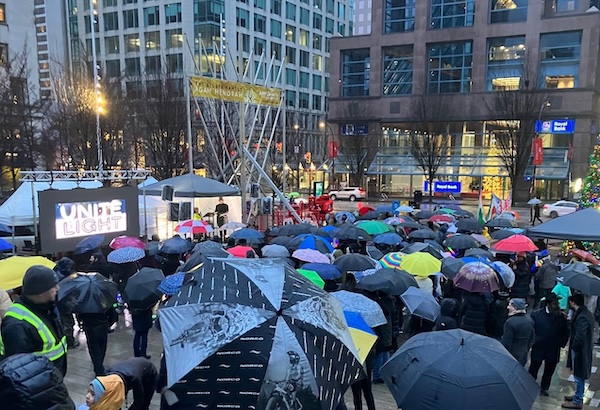
The lighting of the Silber Family Agam Menorah in the Vancouver Art Gallery Plaza is an annual tradition. This year, the first candle will be lit on Dec. 14. (photo from Lubavitch BC)

The lighting of the Silber Family Agam Menorah in the Vancouver Art Gallery Plaza is an annual tradition. This year, the first candle will be lit on Dec. 14.

As the first night of Hanukkah approaches, the Vancouver Art  Gallery Plaza will once again welcome the annual lighting of the Silber Family Agam Menorah. Rising at the corner of Georgia and Hornby streets, this work of public art has become an enduring symbol of Jewish pride, resilience and unity for more than three decades.

photo - Silber Family Agam Menorah
(photo from Lubavitch BC)

Designed and built in 1991 by internationally renowned Israeli artist and sculptor Yaacov Agam, the menorah was commissioned by Fred Silber and the Silber family for Chabad Lubavitch of British Columbia. More than a sculpture, it was envisioned as a joyful and unapologetic statement of Jewish presence in the centre of downtown Vancouver. Since its debut, the menorah has returned each year with ceremony and celebration, illuminating the city skyline with its vibrancy and timeless message: that even in the darkest seasons, the light of Jewish identity continues to shine.

What began as a family’s dedication has grown into one of the largest annual Jewish gatherings in the province. Each year, hundreds of community members, friends, supporters and neighbours bundle up and fill the plaza for the first lighting of Hanukkah. Children clutch chocolate gelt and jelly donuts, elders share stories of holidays past, and young families, students and professionals gather to feel connected and uplifted.

Distinguished guests from across the civic and political landscape will join the festivities Dec. 14, reflecting the wide recognition the Agam Menorah lighting has earned as a Vancouver tradition. Member of Parliament Wade Grant will attend on behalf of the Canadian government and MP Melissa Lantsman will represent the official opposition. Their presence underscores not only the event’s Jewish significance, but also its role as a valued civic moment celebrating inclusiveness and the strength of community bonds.

“Each candle we kindle is more than a flame – it’s a statement of Jewish pride and a reminder that light, unity and hope will always overcome darkness,” said Rabbi Dovid Rosenfeld, director of Chabad Lubavitch BC. “This menorah has become part of Vancouver’s identity, and this celebration brings our entire community together in a beautiful and powerful way.”

The evening will feature traditions that light up the plaza each year: chocolate gelt, donuts, music, dancing, and greetings exchanged among old friends and new faces. 

The message of the Silber Family Agam Menorah is as relevant today as it was 30 years ago. In a world often challenged by uncertainty, its light stands as a reminder of the enduring spirit of the Jewish people and the importance of gathering publicly, proudly and joyfully.

As the candles are kindled once more, the entire community is invited to join in this Vancouver tradition. The gathering on Dec. 14 starts at 3:30 p.m. For more about Chabad Lubavitch of British Columbia’s holiday events, lightings and activities, go to lubavitchbc.com.

– Courtesy Lubavitch BC

Community milestones … October 2025

photo - Anita and Arnold Silber
Anita and Arnold Silber (photo from Jewish Federation of Greater Vancouver)

Last month, the Jewish Federation of Greater Vancouver received the generous gift of $500,000 from the Arnold and Anita Silber Family Foundation toward the postwar renovations and expansion of Beit Vancouver in Kiryat Shmona. 

The Silber family are long-time supporters of Federation’s work in its partnership region of Etzba Hagalil. This recent gift will jumpstart the launch of the centre into the next era, advancing the upgrades the facility requires in its role as the central hub of growth and resilience for the youth and children of Kiryat Shmona. As part of the renovation, the new Silber Family Wing will provide spaces for small-to-medium-sized group programs and activities, helping meet the growing needs of the community as they return to the region and rebuild their lives. 

Established in 1980, Beit Vancouver has long been a centre of learning, creativity and community. More than 1,000 children and youth participate in weekly programs, including the Youth City Council, Krembo Wings (an inclusive youth movement), the Studio Program (a social-emotional therapeutic initiative) and a music centre. Since the mid-1990s, Jewish Federation and donors from the Vancouver community have invested funds to strengthen Etzba Hagalil, with Beit Vancouver at the heart of this work – supporting education, social welfare and regional development to help youth grow, lead and shape their futures. 

“I don’t come from a strong home at all … and my folks are always struggling. Beit Vancouver was the one place I could rely on after school and during vacations. My other option was to hang out for hours at the park,” shared Hodaya, who grew up in Kiryat Shmona. “My experiences at Beit Vancouver have made me connected to my community and city until today. Beit Vancouver changed my life.”

Throughout the Iron Swords war, Beit Vancouver stood empty, suffering damage from nearby rocket hits and neglect. Now, as families return to the region, the need to restore and renew this space is more urgent than ever. 

“Beit Vancouver represents the heart of the community in Kiryat Shmona. Our family believes in the power of youth to lead and heal, and we are honoured to help create a space where they can thrive. This gift is our way of standing with them as they rebuild their lives and their city,” said Arnold Silber.

• • • 

photo - “The Frigatebird and the Diamond Ring” by Liron Gertsman
“The Frigatebird and the Diamond Ring” by Liron Gertsman

Liron Gertsman’s “The Frigatebird and the Diamond Ring” has been awarded the Bird Photographer of the Year title, selected from more than 33,000 entries. His image also won Gold Award in the Birds in Flight category.

“I spent well over a year of planning to capture my dream of a bird in front of the total solar eclipse,” said Gertsman. “I enlisted the help of a boat to position myself near some islets off Mazatlán that were frequented by seabirds. As the moon uncovered the sun’s edge at the end of totality, I captured this image during the eclipse phase known as the ‘diamond ring’ – a moment that lasts mere seconds.”

Celebrating bird life from around the world, the Bird Photographer of the Year images comprise some of the most incredible bird photos in the world, while also raising funds for Bird Photographer of the Year’s partner charity, Birds on the Brink.

Check out the behind-the-scenes clip at birdpoty.com/2025-winners to see the moment that Gertsman took the photograph. To attend one of Gertsman’s workshops or tours, visit vancouverbirdingtours.com.

• • • 

The Jewish Federation of Greater Vancouver welcomes several new community connectors – local leaders who foster engagement, connection and belonging. 

Abbey Westbury is the community connector for the Okanagan. She has been a pillar of Jewish life in the region for more than a decade, serving as vice-president of the Okanagan Jewish Community Centre and as a board member of the Jewish Museum and Archives of British Columbia. 

On Salt Spring Island and the Gulf Islands, Ayala Reznik has already begun her work, and Elvira Molochkovetski and Anabel Wind are on the Victoria team, in partnership with the Jewish Federation of Victoria and Vancouver Island (JFVVI).

In Squamish, Sara Evans will support local Jewish engagement, strengthen connections between individuals and organizations, and work closely with both Federation and grassroots partners. 

In South Delta, Lizz Kelly has joined the team, bringing her experience in community engagement with the Chamber of Commerce to her new role. 

In the Comox Valley, Jessica Benoualid’s work over the past year to create welcoming spaces for the Jewish community made her the perfect fit for this position. 

To learn more or connect with a community connector near you, email regionalcommunities@jewishvancouver.com.

Find the funny in you

In Irwin Levin’s upcoming Jewish Humour Playshop, participants will discover and/or build upon their own creativity and sense of humour through improv games, written and spoken exercises.

With a background in stand-up comedy and improvisation, Levin is a man with a message: “Everyone is funny!” He encourages community members (18+) to join in his three-hour “playshop” at the Jewish Community Centre of Greater Vancouver on Oct. 19, starting at 10:15 a.m.

“Come as you are, ready to play and have some laughs!” he told the Independent, adding, “I’m looking forward to teaching fellow members of the tribe at this unique event, where we can let loose and be the funny people we know we are.”

Featured exercises will include Wisdom from Chelm, Mensch on the Bench, and Jokes from Jewish Entertainers.

photo - Irwin Levin encourages community members to join his Oct. 19 improv playshop at the Jewish Community Centre of Greater Vancouver
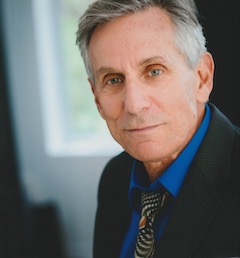
Irwin Levin encourages community members to join his Oct. 19 improv playshop at the Jewish Community Centre of Greater Vancouver. “Come as you are, ready to play and have some laughs!” he said. (photo from Irwin Levin)

Levin has had what he calls “a wicked sense of humour” since childhood.

“Being funny is very important to me,” he said. ”I hated school because of problems with focus, and I didn’t bond well with other kids. My solace was making kids, teachers and others laugh, but, most importantly, I made myself laugh – like when I was 17 and accidentally reversed my dad’s car instead of going forwards, thus making a hole in the side of the garage and then crashing through the back onto our back lawn. After being very upset, I had the thought that we have the only three-door garage on the block – that made me laugh and helped me a lot. 

“The point is, sometimes it helps to look at the funny side of life. Laughter is very healthy and sometimes necessary, especially in a stressful world. That doesn’t mean you shouldn’t take life seriously, but it’s always nice to find someone to laugh with or on your own.”

Over the last five years, Levin has taken improv classes from David C. Jones, stand-up comedy classes with David Granirer and sketch comedy classes at Blind Tiger Comedy. He has performed at China Cloud Studios in Vancouver and is currently teaching a three-month improv series at Carousel Theatre with his wife, Cass Freeman.

“I started taking stand-up courses before improv, to see if that was something I wanted to do for a living. Around that time, I started dating Cass and she was into improv and got me interested. This was in the mid-’90s,” Levin said.

“Improv can relieve stress, reduce stage fright and improve self-esteem,” Freeman told the Independent in an interview a few years ago about the theatrical form. (See jewishindependent.ca/many-reasons-to-learn-improv.)  “Improv games encourage creativity, quick thinking and communication skills, and are a great tool for breaking the ice, having fun and building team spirit,” she said.

“When taking classes, improv is mostly playing games and doing short scenes,” Levin explained about what people can expect at his upcoming playshop. “There are no mistakes in improv! In improv, you aren’t trying to say funny things – you say things funny. The comedy just comes organically in a scene.

“The games in my playshop will be low pressure, because a lot of the exercises will be written, so that participants can take their time with coming up with answers and read out in a circle. Also, they don’t have to participate in any game that they won’t be comfortable playing.”

The cost to attend Levin’s Jewish Humour Playshop is $30 or pay what you can. People can register by texting Levin at 778-862-4638. 

Remembering, learning

Hillel BC’s Holocaust Education Week takes place on campus at the University of British Columbia Jan. 29-Feb. 2. Every day of that week, there will be something going on to attend and learn from, including the exhibit from Yad Vashem called Shoah: How Was It Humanly Possible?, which will be on display the whole week.

photo - Rachel Mines
Rachel Mines (photo from Hillel BC)

Jan. 29, 6 p.m.: Unheard Echoes: Jews in Lithuania Before, During and After the Holocaust. Presentations about the Jewish connection to Lithuania throughout history, focusing on the Holocaust, by Rachel Mines and Gene Homel, two members of the Lithuanian community. Register at forms.office.com/r/s4uAFqv8gc.

Jan. 30, 6 p.m.: Unheard Echoes: The Far Reach of the Holocaust in Asia. Ryan Sun is a PhD candidate in the department of history at UBC, working with Prof. Leo Shin and Prof. Richard Menkis. His transnational project expands the geography of Jewish exile outside Europe and beyond Shanghai, and onto the British colonies of Hong Kong and Singapore. He is particularly interested in Jewish refugees’ ship-bound experiences, how transiting colonial port-cities and encountering local inhabitants informed their understanding of “the Orient,” as well as how these ship-moments disrupt the standard narratives of the Holocaust and survivor testimonies. Register at forms.office.com/r/aQx4LG2Fhi.

photo - Ryan Sun
Ryan Sun (photo from Hillel BC)

Jan. 31, 5 p.m.: In a partnership between Hillel, brothers of the AEPi chapter of Vancouver and Chabad UBC, there will be a reading of the names of those who were murdered in the Holocaust. Meet at Hillel, then walk over to the fountain at the main mall, where the reading of the names will begin at 5:30 p.m. The reading can also be joined online, live on Hillel BC Facebook and Instagram, as well as the Instagram page for AEPi. 

photo - Marie Doduck
Marie Doduck (photo from Hillel BC)

Feb. 1, 5 p.m.: A Fireside Chat and Q&A with Survivor Marie Doduck & Dr. Lauren Faulkner Rossi. Marie (Mariette) Rozen Doduck was born in Brussels, Belgium, in 1935. She immigrated to Canada in 1947 as a war orphan with three of her siblings and settled in Vancouver. She is actively involved in Holocaust education and is a cofounder of the Vancouver Holocaust Education Centre. 

Rossi is currently researching child survivors of the Holocaust, the significance of their memoirs to Holocaust studies and the shared language of trauma among child survivors of different genocides.

Register at forms.office.com/r/1MtRu24BWT.

Feb. 2, 5 p.m.: Students-only Shabbat Dinner with Honoured Guests: Holocaust Survivors will feature a candlelighting ceremony and survivors spread out among the dining tables with students. Students can register at forms.office.com/r/ayufQr3Zmy.

For more information or help with the registration links, email info@hillelbc.com or call 604-224-4748. 

– Courtesy Hillel BC

Creating a community

Laura Rosenberg and Andy Muchin co-founded the Victoria Jewish Culture Project with Farley Cates. Here, the two participate in the group’s 2021 Passover seder (screenshot)

In late 2019 and early 2020, before the pandemic struck and lockdowns took effect, a group of friends in Victoria gathered to talk about forming a cultural group – a havurah, or casual and friendly meeting place for people to discuss art and social events through a Jewish lens.

As COVID hit, with everyone at home and in-person meetings impossible, the group, which had called itself the Victoria Jewish Culture Project, held its first gatherings over Zoom. These days, the VJCP, under the leadership of members Laura Rosenberg, Andy Muchin and Farley Cates, still meets weekly and for Jewish holidays over Zoom.

“As a result of what at that time felt like an interim, for-the-moment format, we started having a variety of events on Zoom, including holiday celebrations and commemorations, as well as a weekly discussion group,” said Rosenberg. “I am shocked to note that here we are almost four years in.” 

The discussion group at first would meet to go over the Torah portion of the week. Once the biblical cycle was complete, the group shifted to different social and cultural topics from week to week. While most of the VJCP attendees are based in Victoria, they have active members elsewhere. Because their meetings are held on Zoom, geography does not pose a barrier.

“We have an active Zoomer from Salt Spring Island every Saturday,” said Muchin. “For some of our holiday events, we have people pop in from various places – relatives of friends, friends of friends, even my sons played roles in our Zoom Purim spiels, from different American cities.”

“VJCP is basically a group of people who generally view things from a secular humanist perspective. The biggest thing we are offering right now is the opportunity for some discussion among people of different backgrounds,” said Cates. “We want to look at things critically and think things through.”

Rosenberg said, while she was excited about a weekly discussion group four years ago, she never anticipated it would end up becoming such an important venue for the exchange of ideas and a catalyst for many of the other events the group has organized. Holiday celebrations have included a drag Purim spiel, co-sponsored with the Klezbians band and an outdoor Tashlikh ceremony at Esquimalt Gorge Park.

“It has been a generative force and this, I think, is something which will continue to be a core activity for this group, and [it will] continue to generate ideas and thoughts that can bring a number of different activity spin-offs,” Cates said.

“I would go so far to call the Saturday morning a ritual we have developed for ourselves. It is really a part of my Saturdays. There’s always a critical mass of people,” said Muchin. “It is a great ongoing connection for us in addition to being a wonderful way to explore issues.”

“What we are trying to do,” explained Cates, “is reflect on what the Jewish community is faced with, as well as what other communities are faced with, and what the world is faced with generally.”

Since the events of Oct. 7, the members of VJCP have expressed gratitude for having a “safe haven” in which civil and open discussion can take place.

“We have a forum where we can discuss these things that were obviously deeply painful and could have been very divisive, but we could discuss them in a respectful manner – even when, as individuals, we did not always agree,” Rosenberg said.

Aside from the VJCP, Rosenberg, Muchin and Cates have been engaged in various aspects of Jewish cultural life and beyond for a long time. Rosenberg plays concertina for the Victoria-based, all-female klezmer ensemble Kvell’s Angels. She is also the newly appointed director of Klezcadia, a klezmer music and Yiddish culture festival run through Victoria’s Congregation Emanu-El. The festival will have its inaugural season in June 2024.

For the past 13 years, Muchin has been the host and producer of Sounds Jewish, a weekly radio show that airs on Mississippi Public Broadcasting and is distributed on PRX, a web-based radio platform. As well, he is active with the Victoria International Jewish Film Festival (VIJFF) and has written for several Jewish publications.

Cates has been co-director of the VIJFF for four seasons. Outside the Jewish community, his “pet project” is Theatre Inconnu, the longest-surviving alternative theatre company on the island, where he serves on the board. Furthermore, he is involved in various cultural activities in the Victoria area, such as a performing arts centre on the West Shore and the Arts & Culture Colwood Society. 

The VJCP says the group is open to new members and welcomes suggestions for activities or programs others are interested in pursuing. They are holding a Hanukkah party over Zoom on Dec. 15 at 7 p.m. For more information about the event and/or the VJCP, write to myrna.oy@gmail.com.

Sam Margolis has written for the Globe and Mail, the National Post, UPI and MSNBC.

Community milestones … Wasserman & Feldman

Theatre critic, author and actor Jerry Wasserman is the winner of this year’s Max Wyman Award in Critical Writing.

photo - Jerry Wasserman
Jerry Wasserman

The annual award celebrates critical commentary on the visual, performing and literary arts in the province of British Columbia. It is intended to honour informed and compelling writing that stimulates critical thinking, fosters ongoing discussion about the role of arts and culture in contemporary society and demonstrates the value of creative commentary in our understanding of the world around us.

The winner receives a prize of $5,000 and a gold and emerald pin designed by Vancouver artist Robert Chaplin. A mentee, named by the laureate, receives a $1,000 prize. This year’s mentee is Angie Rico, an emerging writer and media artist.

The award was established in 2017 by philanthropist Yosef Wosk to honour the career and lifetime contributions of the Vancouver author, arts critic and commentator Max Wyman. It recognizes writers who have amassed a significant body of work. Eligible subjects of criticism include the visual arts, architecture and design, theatre, literature, dance, music, film and television, as well as more general cultural commentary.

Wasserman began working as a theatre critic on CBC national radio in the mid-1980s and broadcast weekly reviews on Vancouver’s The Afternoon Show from 1987 to 2003. He has since served as theatre critic for the Province and, currently, the Vancouver Sun. About 400 of his articles and reviews have appeared in those papers; since 2004, his website, vancouverplays.com, has received more than 1.6 million visits. He taught English and theatre at the University of British Columbia for more than four decades and served as head of the department of theatre and film from 2007 to 2012. His acting resumé includes stage appearances for the Arts Club, Playhouse, City Stage, Westcoast Actors, New Play Centre, United Players and Western Gold Theatre, and more than 200 film and TV appearances, from The X-Files, Look Who’s Talking and Alive to I, Robot, Watchmen and The Last of Us.

The jury citation reads: “Jerry Wasserman’s remarkable career in many ways embodies the aims of this award. His decades as a teacher and as a performer give his writing about the theatre a sympathetic and thoughtful understanding that is expressed in language that is lively, direct and deeply informed. The jury was unanimous in its appreciation of the way he has encouraged and enhanced a wider appreciation of the richness of the Vancouver arts scene and the talents of those who make that richness possible – both through his print and media reviews and through his website, which is a consistent source of information and critical context on all things theatre in Vancouver.”

Wosk commented: “Jerry Wasserman’s voice has been a steady and trusted source of information and context about the Vancouver theatre scene for decades. He treats criticism and commentary as an integral part of the cultural fabric, and sees the role of the critic not as an antagonist to the performer and creator but as a collaborator. I am delighted that he is to receive this award.”

* * *

Brighton Feldman has been named to the U-18 Canadian National Rugby Team for a tour in the Netherlands this summer. At the school-based age group, however, team members have to pay all their own travel expenses, so Feldman has started a GoFundMe page.

photo - Brighton Feldman
Brighton Feldman

“Ever since I started playing rugby, I’ve wanted to wear the leaf on my chest,” he writes. “Now that I have that opportunity, I need a little help to get me there. I promise to work my butt off and come away with some wins. Any support is appreciated.”

Feldman is the son of Steve Feldman and Kristen Sandborn of Victoria, and grandson of Pearl Feldman of South Surrey, B.C. He is a graduate of Congregation Emanu-El Hebrew School and is completing Grade 12 at Royal Bay Secondary School in Victoria. He plays basketball and rugby for his school teams, as well as playing rugby for the WestshoreFC and, now, for Team Canada. He has previously played and captained the B.C. Bears provincial rugby team.

Next year, Feldman will be attending the University of Victoria, working towards a degree in physical and health education. At UVic, he will compete as a member of the Vikes Rugby Team.

To help Feldman represent Canada in the Netherlands, make a donation at gofundme.com/f/brighton-play-for-team-canada.

Community milestones … Diamonds, Baitelmans, Bea Goldberg

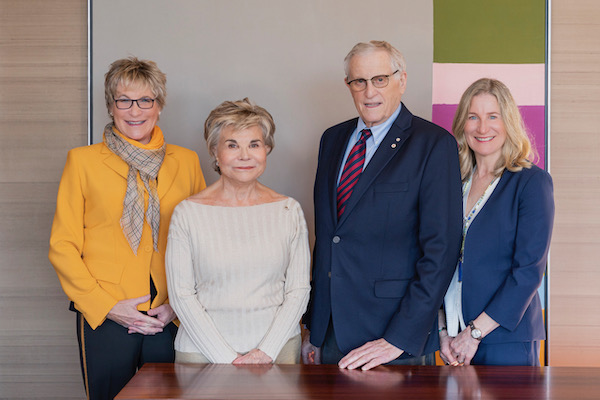
Left to right: Lauri Glotman, Leslie and Gordon Diamond, and Jill Diamond.

The Diamond family has donated $7.2 million to the BC Cancer Foundation to expand BC Cancer’s Hereditary Cancer Program – expanding identification and screening for the BRCA gene mutation. This gene mutation increases the risk of breast, ovarian and prostate cancer. Individuals of Ashkenazi Jewish decent are 10 times more likely (1 in 40) to carry the gene mutation. Screening for the gene enables early detection and intervention, and even prevention in some cases.

“We’re really proud to partner with BC Cancer because it fulfils one of our most important Jewish values, tikkun olam, which is the obligation to repair the world and make it a better place,” said Jill Diamond.

The Diamond family personally knows the impact of the BRCA gene mutation. “Our grandmother unfortunately died of breast cancer. Had she known she had a BRCA gene mutation, and been screened properly, the cancer could have been caught earlier and we would have enjoyed many more years with her,” Diamond explained.

The family’s gift – one of the largest ever to the BC Cancer Foundation – will fuel three clinical projects to:

• Expand outreach to people of Ashkenazi Jewish descent, who are at greater risk.

• Establish a first-in-Canada initiative to directly contact high-risk relatives of mutation carriers to pursue genetic testing.

• Implement immediate genetic testing for breast cancer patients age 60 and under upon biopsy, eliminating the need for a doctor’s referral for screening and removing the burden on patients.

It will also fund three breast imaging fellowships at BC Cancer Vancouver, increasing the centre’s capacity and expertise for specialized breast radiologists.

“The Diamond Foundation’s generous donation is a giant step on the path towards transforming hereditary cancer care across B.C. Not only will this support three critical initiatives now, but it will also provide the groundwork for future programs and greatly increase our impact by reaching more families at higher risk of cancer,” said Drs. Kasmintan Schrader and Sophie Sun, co-directors of BC Cancer’s Hereditary Cancer Program.

“This is for our daughters, for everyone’s daughters,” said Jill Diamond and Lauri Glotman. “It will allow women to continue to be the backbone of their family, their community and society, and – armed with knowledge about their increased cancer risk and the preventative measures they can take – protect and care for future generations.”

The Diamond family has a long history of supporting BC Cancer, including donating the land that the BC Cancer Research Centre stands on in Vancouver.

The Diamond Foundation’s generosity will make BC Cancer a leader in hereditary cancer care, providing the groundwork for future programs, saving lives for generations of families.

* * *

photo - Rabbi Yechiel and Chanie Baitelman receive the Richmond Centre Outstanding Constituent Award from MP Wilson Miao
Rabbi Yechiel and Chanie Baitelman receive the Richmond Centre Outstanding Constituent Award from MP Wilson Miao.

Rabbi Yechiel and Chanie Baitelman, co-directors of Chabad Richmond, were recently honoured as recipients of the Richmond Centre Outstanding Constituent Award by Wilson Miao, member of Parliament for Richmond Centre.

Serving their community for more than 25 years, the Baitelmans are known for their compassion, inclusiveness and commitment to bettering the lives of Jews and non-Jews alike. Their mission has been to connect the values and ethics of the Torah and Judaism with the Jewish community and beyond. Together, they created the weekly Light of Shabbat Meal program that feeds both Jewish and non-Jewish households, with 150 meals delivered weekly by volunteers.

This award celebrates the contributions the Baitelmans have made to Chabad Richmond and other organizations in Richmond Centre, including their ongoing outreach, educational and social service programs. The Baitelmans’ hallmark is respect and love for every person, regardless of religious beliefs, social status or education. Generous with their time as well as their talents, they live their life’s mission by serving others.

Both of the Baitelmans sit on a variety of community boards, and the rabbi has served as a chaplain for the Correctional Services Canada prison system and is the chaplain to the local RCMP detachment in Richmond.

* * *

photo - Bea GoldbergBea Goldberg was born on April 25, 1923. Yes, that means Bea is 100 years old!! And what she has accomplished in those 100 years!

Bea, born Bernice Gropper, was known as “Bessie” during her school years. She was smart as a whip and graduated University of Saskatchewan by age 20.

She moved out to Vancouver, where she met Myer Goldberg, and the two were married in 1945. The day after returning from her honeymoon, Bea joined Hadassah-WIZO and chaired just about every event the organization had, including the Hadassah Bazaar, and held leadership positions both locally and nationally. She even rewrote (or reorganized) Hadassah-WIZO’s constitution!

photo - Bea Goldberg at 100
Bea Goldberg turned 100 years old on April 25.

Bea was also involved with the Jewish Federation, the Jewish Community Centre (from when it was on Oak and 11th), the Louis Brier Home and Vancouver Talmud Torah, and supported Hillel BC, the Hebrew University, Jewish Family Services and many others.

Family and community are very important to Bea and she still is a woman who lives by her values and principles.

Mazal tov to Bea Goldberg, 100 years young!

JNF welcomes Noa Tishby

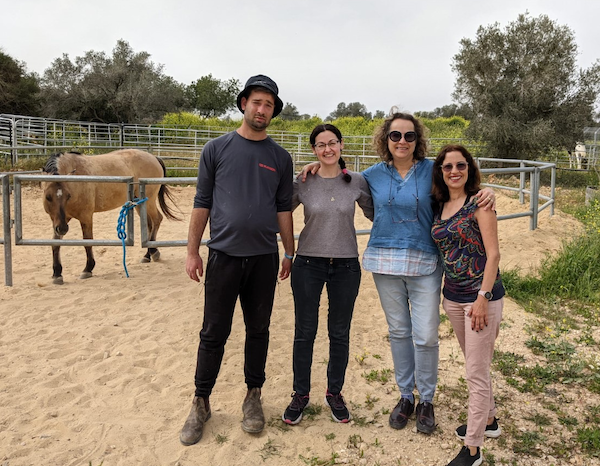
At the therapeutic horse farm in Meir Shfeya Youth Village are, left to right, Yuval Perry, Moran Nir, Rachel David and Orly Sivan. Perry is a horse groomer at the farm, and David and Sivan are two of its four founders. Nir is manager of campaign and operations for JNF Pacific. (photo from JNF Pacific)

Noa Tishby, the Hollywood-transplanted Israeli actor and activist who was just stripped of her special envoy position for weighing in on the political crisis there, is headed to Vancouver.

Tishby, author of the 2021 book Israel: A Simple Guide to the Most Misunderstood Country on Earth, had been Israel’s special envoy for combating antisemitism and the delegitimization of Israel. Appointed a year ago by then-prime minister Yair Lapid, Tishby was summarily ejected from the role this month after she criticized the proposed judicial reforms of Binyamin Netanyahu’s government. She will be the keynote speaker at the 2023 Negev event of the Jewish National Fund, Pacific Region, June 29.

“We are sad to hear the news that Noa is now the former special envoy against antisemitism and the delegitimization [of Israel] as she has been an important voice for Israel and Jewish communities around the world in the face of antisemitism/anti-Israel sentiment,” Michael Sachs, executive director of JNF Pacific, told the Independent. “Her years of service, both officially and non-officially, have only benefited world Jewry and we are ecstatic to welcome her with open arms on June 29th.”

Sachs explained that this year’s Negev event is a break with decades of tradition, following the pandemic shutdown of community gatherings. The annual tradition had generally featured a gala dinner with an honouree.

The centrepoint of this year’s event, which will take place at Beth Israel, is a theatre-format presentation with no meal, and tickets at an accessible price, which, Sachs said, is intended to allow the largest number of community members to hear Tishby’s message. A reception for larger donors will generate the revenue to realize the project that this year’s Negev is sponsoring.

That initiative is a therapeutic horse farm in Meir Shfeya Youth Village, located south of Haifa near Zikhron Ya’akov. Moran Nir, manager of campaign and operations for JNF Pacific, was at the facility several weeks ago.

“It’s a beautiful farm,” she said. “I met with two of the [four] founding mothers and it’s just incredible to see how they dedicate their lives and they give their heart and soul to this farm.”

The horse farm has two riding areas, one uncovered and the other only partly covered. Completing the facility to protect riders from sometimes intense Israeli weather is part of the JNF initiative.

“We want projects that are going to be impactful to the people in Israel but that are also taking a grassroots project and helping get it to the next level,” said Sachs. There is also a crucial local connection to this project, he added.

“There is no shortage of people in our community that understand the importance of equestrian therapy for kids with special needs, but also adults with stress and anxiety and PTSD,” he said. In a relatively new twist on the organization’s commitment to Israel, 10% of this year’s Negev revenues will be held back for a local partnership with STaRS, Southlands Therapeutic Riding Society. Leaders from the Southlands group will mentor those at the Israeli facility, “creating a lifelong connection between these like-minded organizations,” said Sachs.

The Meir Shfeya farm currently has six horses and six horse groomers. Groomers are hired from among youth and young adults who benefited from the equestrian therapy as kids, said Sachs. Therapeutic riding has been demonstrated effective for a range of cognitive conditions, including autism, attention-deficit / hyperactivity disorder, and post-traumatic stress disorder.

About 90 kids per week come to the farm from all over the area and demand is growing. Allowing them to meet the demand is the reason for the support from JNF Pacific.

The fundraising goal for the June 29 event – which is co-chaired by Michael and Lisa Averbach – is $350,000, Sachs said, emphasizing the dual objective of generating funds to support the equestrian programs and of drawing the largest number of people possible to hear Tishby’s message.

“If you want to buy a ticket, buy four,” he said. “Buy four tickets, find three friends and bring them. We want more people hearing her. And, if you buy four tickets and can’t find three friends, let us know because we want to bring students. We want kids from the community to be able to hear her.”

Tishby will be in conversation with Danielle Ames Spivak, executive director of the American Friends of the Israel Philharmonic Orchestra, a born-and-raised Vancouverite who is a friend of Tishby’s.

The event will also feature the bestowing of the Bernard M. Bloomfield Medal for Meritorious Service on Harvey Dales.

“Harvey’s been a member of our board, he’s on the national board, he is the past president,” said Sachs. “For us, the opportunity to honour Harvey for his dedication and everything he’s given to JNF and Israel, we are really excited about that.”

The JNF Educator Award will also be presented. It will be given to teachers from the four Vancouver-area Jewish day schools.

“We’re coming out of the worst pandemic in 100 years,” said Sachs. “Teachers were frontline … so each school is going to be choosing a teacher-representative to accept an award on behalf of the teaching body in their school.”

Reflecting on her visit to the Israeli horse farm and meeting some of the mothers who launched it, Nir is inspired to share what she witnessed.

“It’s always nice to see the impact of JNF in Israel,” she said, “to actually be there and see the impact. Every parent wants their kids to be healthy and happy. We will keep doing this job and build Israel together for the people of Israel.”

מספר הישראלים המעוניינים לעזוב למדינה אחרת אלה הולך וגדל

 כצפוי מספר הישראלים המעוניינים לעזוב למדינה אחרת לאור המשבר הקשה הפוקד את המדינה בימים אלה הולך וגדל. זאת בעיקר לאור הרפורמה במערכת המשפטית אותה מציעה ממשלת הימין בראשות ראש הממשלה, בנימין נתניהו. קנדה משמשת באופן קבוע אחד היעדים הבולטים בעולם להגירה כולל לאלה שרוצים להגיע מישראל. בקנדה יש כיום את הריכוז השלישי-רביעי בעולם של יהודים הגרים מחוץ לישראל וגם נקודה זו חשובה לישראלים

הנה מספר תגובות בנושא שמתפרסמות בימים אלה בפורומים השונים של ישראלים בקנדה של פייסבוק – בנושא המעבר מישראל אל קנדה

אלינור כהן כותבת: יש עלייה של מאה אחוז במספר הבקשות שאני מנהלת ואני מוצפת בשאלות ממשפחות שחושבות לעבור לגור בקנדה מהסיבות הכי עצובות שיש

לגבי נושא המחאה נגד תוכנית הרפורמה במערכת המשפט כותבת דפנה קדם: בטורונטו וונקובר אנו מוחים זה שבוע שלישי למען שמירת הדמוקרטיה בישראל. היא מציעה למעוניינים להצטרף לקבוצות המחאה בטורונטו, ונקובר או גם בערים אחרות בקנדה

אסנת קמחי חושבת לעבור עם המשפחה לקנדה. היא שואלת: אנו חושבים לעבור לקנדה. נשמח לקבל עצות, טיפים והמלצות

דניאלה בואנו גם היא מעוניינת לעבור לקנדה. היא כותבת בפורום: מחפשת לעשות רילוקיישן לקנדה עם בעלי והילד בן השנה. יש לי ניסיון של שלוש שנים בצילומי רנטגן של שיניים. אשמח באם תוכלו לעזור לי בנושא

ליאת מרסו מחפשת עזרה דחופה בנוגע להגירה לקנדה ושואלת איך מתחילים ובמי היא יכולה להיעזר

עידן סטולרוב מחפשת עורך דין מומחה להגירה לקנדה

נטלי קיינן מחפשת להכיר ישראלים שגרים באדמונטון שבמחוז אלברטה כיוון שהיא מעוניינת להגר לשם

ג’ניפר סיל כותבת כי אחיה בן העשרים ושתיים הוא שחקן כדורגל (חופשי) שמעוניין לעבור לקנדה. היא שואלת האם מישהו מכיר סוכן מקומי או מישהו אחר שיכול לעזור לו

אלמוני המציין כי משפחתו מתכננת להגר לקנדה בקיץ הקרוב. הוא שואל האם ניתן לפתוח חשבון בנק בקנדה און-ליין מישראל, כדי להעביר כספים לקראת ההגעה

אלדד בלייש שמעוניין לעבור לקנדה הוא טכנאי רנטגן. הוא שואל האם בקנדה מקבלים תעודות רשמיות מישראל ומה התהליך לאישורן

מאיה טאוב מעוניינת לעבור לקנדה והיא שואלת מה האתגר המרכזי של זוגיות ברילוקיישן

אלמונית כותבת כי היא גרה כיום בישראל. היא מעוניינת לחדש את האזרחות הקנדית שלה ולהשיג אזרחות קנדית לבעלה ולילדים. היא שואלת כיצד עושים זאת בצורה היעילה ביותר ומה התנאים לכך

מעיין עופרי שהיא פרמדיקית בישראל שואלת בפורום על פרמדיקים שעובדים כיום בקנדה. היא רוצה מידע מפורט בתחום התעסוקה הזה

מספר הפורומים של ישראלים בקנדה בפייסבוק הולך וגדל עם השנים. הרשימה כוללת כיום בין היתר: חמישה פורומים שונים בעלי אותו שם של ישראלים בקנדה (הכוללים 18 אלף חברים, שמונת אלפים חברים, שבעת אלפים חברים, שש מאות חברים, כחמש מאות חברים, כשלוש מאות חברים), שני פורומים בעלי אותו שם של ישראלים בטורונטו (הכוללים כעשרים ואחד אלף חברים ועשרת אלפים חברים), ישראלים החיים בקנדה (הכולל כארבעת אלפים ושש מאות חברים), ישראלים בהייטק באמריקה – מיועד לאלה שגרים בארה”ב ובקנדה (כולל כארבעת אלים חברים), סטודנטים ישראלים בקנדה (כולל אלף שלוש מאות חברים), שני פורומים בעלי או שם של ישראלים באמריקה – מיועד לאלה שגרים בארה”ב ובקנדה (כוללים עשרים אלף חברים ואלף ארבע מאות חברים) וכן קנדה למטיילים (הכולל כתשעת אלפים חברים)