Skip to content
  • Home
  • Subscribe / donate
  • Events calendar
  • Business Directory
  • FAQ
  • News
    • Local
    • National
    • Israel
    • World
    • עניין בחדשות
      A roundup of news in Canada and further afield, in Hebrew.
  • Opinion
    • From the JI
    • Op-Ed
  • Arts & Culture
    • Performing Arts
    • Music
    • Books
    • Visual Arts
    • TV & Film
  • Life
    • Celebrating the Holidays
    • Travel
    • The Daily Snooze
      Cartoons by Jacob Samuel
    • Mystery Photo
      Help the JI and JMABC fill in the gaps in our archives.
  • Community Links
    • Organizations, Etc.
    • Other News Sources & Blogs
  • JI Chai Celebration
  • JI@88! video

Recent Posts

  • SFU honours Gloria Gutman
  • Lifting people’s spirits
  • Wedding a ray of light
  • Indigeneity and Zionism
  • Rule of law broken: councilor
  • Football and its roles
  • The burden of defence
  • Fish Café returns after fire
  • All right in what goes wrong
  • Nuns & mermaids at TUTS
  • Camp offers holiday retreat
  • Students and mentors inspire
  • Once-in-a-lifetime trip
  • 100 dancers, one heart
  • Money for the sciences
  • What “Jewish food” means
  • Have a cookie, schnitzel too
  • Federation now across BC
  • Israel fighting for its existence
  • Deal strengthens Iran
  • Patriotic belonging diminishes
  • A campaign to engage
  • Upstanders’ first live event
  • Responding to Carney
  • Having your own home
  • Music a family tradition
  • Musical to warm heart
  • Community milestones … June 2026
  • Sharing her passion for Israel
  • Or Shalom reopens its doors
  • JFS from past to future
  • Need holistic approach
  • Sharing stories, advice
  • Journalist shares fears
  • Skills to live together
  • Road to independence

Archives

Follow @JewishIndie
image - CJN box ad Rockowers 2026

Tag: milestones

SFU honours Gloria Gutman

SFU honours Gloria Gutman

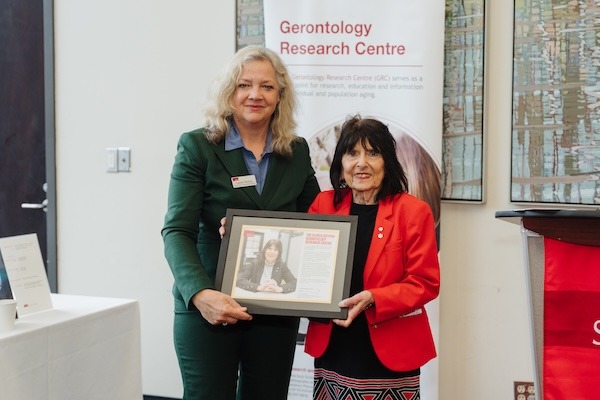
Laurel Weldon, dean of Simon Fraser University’s faculty of arts and social sciences, and Dr. Gloria Gutman at the April 22 reception celebrating the naming of the university’s Gerontology Research Centre in honour of Gutman’s service and lasting impact. The event was held at SFU Harbour Centre. (photo from SFU)

Simon Fraser University has honoured Dr. Gloria Gutman, a pioneer in the field of aging, by naming the Gerontology Research Centre, which she founded, after her. They have also bestowed upon her an honorary doctor of laws. 

This is not the first recognition of Gutman’s work in her areas of research, which include, but are not limited to, seniors housing, health promotion, elder abuse, LGBTQ+ aging, age-friendly hospitals and communities, and advance care planning. She has been awarded the Order of British Columbia and a Queen Elizabeth II Diamond Jubilee Medal, and been appointed to the Order of Canada, the country’s highest civilian honour.

“I really feel grateful for the opportunities that SFU gave me, and the honorary degree in particular – universities very seldom honour their own,” she told the Independent in a recent interview. “Usually, if you look at who are the recipients of honorary degrees, it’s people from elsewhere.”

Almost as a proof of point, Gutman received an honorary doctorate from the University of Western Ontario in 2010 for her work “as an international authority in the field of gerontology.”

Part of the appreciation for such awards is that they highlight her field, said Gutman. “That’s the important thing for me, that it puts the word gerontology, or aging, or the concepts that I’ve worked on, or areas that I’ve tried to work on, brings them forward, gives them visibility. So, the honours are really a way of continuing to promote the organizations, the academic units, that I work for.”

Laurel Weldon, the dean of SFU’s faculty of arts and social sciences, which includes the gerontology department, has known Gutman for a few years. “But,” Weldon told the JI, “I first heard her on the radio being interviewed about Martha Stewart’s cover for Sports Illustrated!”

In 2023, Stewart became the oldest model to be featured on the magazine’s cover. In her convocation address last month, Gutman expressed the goal of a future of “aging without ageism,” which “involves making assumptions about a person’s abilities, values or role in society based solely on age rather than their individual characteristics.”

While their research areas overlap, including on gender and age discrimination, Weldon said, “the real way I’ve got to know Gloria has been as dean of the faculty in which she is a very active retired faculty member, applying for grants, running conferences, giving me her input and background on the department of gerontology and the Gerontology Research Centre.”

By the time the JI reached Gutman for a 10 a.m. Zoom interview on June 18, she had already been a panelist in an international webinar on witchcraft (in the larger context of financial abuse of the elderly) and attended a webinar on the Canadian Longitudinal Study on Aging. It was a typical start to the day for Gutman, who was heading to a FIFA watch party in the afternoon.

“I’m essentially a curious person, and I attend a lot of different webinars, some where I know nothing about the topic, mainly because I want to learn,” she said.

In her convocation address, Gutman talked about “not being afraid to undertake work in an area or sub-area that is unfamiliar. In my case, it was being invited to lead a research project on seniors’ housing. When offered that job,” she recalled, “I blurted out, ‘But I don’t know anything about seniors’ housing.’ I was told, ‘You have 90 days to learn.’ I read everything I could lay my hands on and became a 90-day expert.”

After having been invited to the FIFA watch party, Gutman told the JI she used AI to learn all the fundamentals of soccer and how the World Cup worked – she became “a three-day expert,” she said.

In her knowledge on aging, however, Gutman is a decades-long expert, though she attributes her career choice to happenstance.

“It was serendipitous,” she said of becoming a gerontologist.

Gutman lived in Calgary for some of her childhood – though she was born in Seattle – and her late husband, Gary, was from the city. Because of these connections, she did part of her post-secondary schooling there, at the University of Alberta’s satellite campus (which became the University of Calgary in 1966).

Gutman, who had majored in English and psychology at the University of British Columbia, said she went to the U of A English department and was told, basically, “Why don’t you go home and have a baby?” (She and her husband would have three children.) Her experience with the psychology department went differently. 

Faculty member Dr. A.E. David Schonfield, a pioneering figure in gerontology and the psychology of aging, suggested Gutman do a master’s in the field – and she did.

After about five years in Calgary, the Gutmans moved back to Vancouver. Her husband continued to build his practice as an accountant and Gutman started her PhD at UBC. “At that time, nobody was doing aging, so I had to do it in social and developmental psychology,” which then covered ages 0 to 14, she said.

After finishing her PhD in 1971, Gutman taught Psych 100 for 10 years at UBC. She developed the first psychology of aging course ever to be taught in the province. She was a part-time assistant professor when she asked her dean for a full-time position. He refused, describing the study of aging as a “flash-in-the-pan phenomena.”

“The next day, I called out to SFU, made an appointment with Jack Blaney, who, at the time, was the dean of continuing education, and I went to see him,” said Gutman. “I was called the coordinator of programs in aging, but my first job was to create a program to coordinate.”
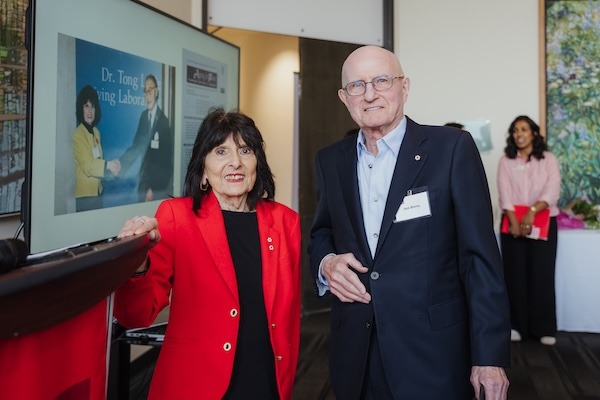
photo - Dr. Gloria Gutman with Dr. Jack Blaney at the April 22 reception at SFU Harbour Centre. Blaney hired Gutman when he was dean of continuing studies at Simon Fraser University
Dr. Gloria Gutman with Dr. Jack Blaney at the April 22 reception at SFU Harbour Centre. Blaney hired Gutman when he was dean of continuing studies at Simon Fraser University. (photo from SFU)

While still at UBC, Gutman had written a proposal for the development of a research centre on aging in response to a call for proposals from the Social Sciences and Humanities Research Council of Canada. The competition was delayed, and there was a second call for proposals when she was at SFU, so she wrote one – the Gerontology Research Centre at SFU was established in 1982.

Gutman also wanted to create a gerontology department, and she did. It began as a post-baccalaureate diploma, grew to a master’s program, followed by the addition of a minor and a PhD.

“I would define myself as an academic entrepreneur,” Gutman told the JI. “The people that have developed research centres, or who have developed a teaching program, tend to have similar kinds of characteristics and part of it is curiosity. And the other is identifying a gap and leaping in.”

And yet another, she identified in her convocation address, is: “You can’t be a one-person show if what you develop is to be sustainable. If it takes a village to raise a child, it takes a team to develop successful academic and research units.”

Despite all her successes, Gutman had to retire after she turned 65, as mandatory retirement was a widespread policy in that era. She was director of the GRC and the department of gerontology until 2005.

“The way the Gerontology Research Centre is structured is that it has a director and it has research associates, so I stepped down as director, but could still be a research associate of the centre,” she explained. “And, having been a full professor in the department, could be a professor emeritus…. But I never used the term for the first 10 years after age 65, because people roll their eyes sometimes when they see it. They figure you’re passé.”

When Gutman wrote the proposals for the research centre, she identified three areas in which it would specialize.

“The first one was housing for the elderly, which is what I had started and where I became the expert at UBC,” she said. “The second one, I looked around the campus, [and asked] who’s doing what? And there was a professor in the criminology department who was interested in crime and victimization of the elderly … and the third one, there was a professor in sociology who was interested in changing demography and lifestyles.

“We started out with those three and, gradually, then I added health and aging when I realized I was a health promoter,” said Gutman. “And, subsequently, I got interested in technology, so we added a fifth theme to the research centre, which was gerontechnology.”

Currently, Gutman – who has held many high-profile roles in national and international associations – is the vice-president of the International Society for Gerontechnology, is on International Longevity Centre-Canada advisory committees and is a member of the Research Management Committee of the Canadian Frailty Network. She has a long list of monographs, articles and books.

“What I said in my convocation address,” she said, “is there are the people that retire and are happy to sit in their rocking chair; the people who unretire themselves and go back to work, but in something different; and then there’s the never-retires.”

She’s in that last category. “It’s still interesting,” she says of her work, “and these issues come up, new issues, every day.”

That said, she makes sure she leaves the house every day. Up at 6 a.m., she usually shuts off the computer by 3 p.m. and goes out to do her 6,000 steps. She watches TV in the evenings. Her six grandchildren, ranging in age from single digit to university-age, don’t live in the city, “so I don’t have access to grandkids here,” she said.

In the Jewish community, Gutman (née Chertkow) was on the original advisory committee to develop the L’Chaim Adult Day Centre. She noted that Leah Deslauriers, who heads the program, is an SFU gerontology grad.

Gutman’s father attended L’Chaim, which brought Gutman back onto the board. “And,” she said, “when my husband [was] in his last years, that was a lifeline for me, as I cared for him at home in his last six months. It was one of the few places that I felt it was safe to leave him…. It gave me respite.”

She also has been on the board of the Louis Brier Home and Hospital, consulted with JQT (Jewish Queer Trans) Vancouver and other organizations. Notably, B’nai B’rith was a family endeavour of sorts.

Weldon, the SFU dean, describes Gutman as “an impressive, energetic, brilliant person. She is great at identifying important research topics and themes and has incredible persistence.”

“I am so happy that SFU was able to recognize and elevate Gloria Gutman in this way,” said Weldon. “It is so well deserved and, in this day and age, it’s wonderful to see someone who has worked hard, been a conscientious contributor and mentor, and who has done so much for her students, colleagues, the university, discipline and community, be recognized.” 
Format ImagePosted on July 10, 2026July 9, 2026Author Cynthia RamsayCategories LocalTags gerontology, Gerontology Research Centre, Gloria Gutman, milestones, SFU, Simon Fraser University

Wedding a ray of light

This week, Sasha Troufanov and Sapir Cohen were married. The couple had only recently begun building a life together in Ramat Gan when terrorists burst into the home where they were visiting with family on Kibbutz Nir Oz on Oct. 7, 2023. Troufanov was beaten and stabbed. Cohen hid beneath a bed, wrapped in a blanket, but was discovered. They were dragged into Gaza separately.

Cohen was released after about two months, during the November 2023 ceasefire. Troufanov remained in captivity for more than 400 days. During that time, he believed he would never return home.

After his release, Troufanov told Cohen that, throughout his captivity, he prayed not for himself, but that Cohen would find another man to love. He wanted her to have a future, because he had lost hope that he would have one.

On Sunday evening, surrounded by family, friends and fellow former hostages, they were married.

“I want to thank you for coming today to share this joy with us,” the groom told the guests. “You’ve been with us every step of the way. Thank you so much. I love you.”

For the pair, and for those who love them, this must have been a deeply meaningful simcha. For those of us who do not know them, it is also a ray of light emerging from a time of worldwide Jewish anxiety and grief. To know that two people who had endured such suffering are celebrating love and committing to a life together is uplifting.

Much has been said about the fact that, for the released hostages, and anyone who has endured prolonged trauma, the end of the ordeal is rarely the conclusion of the suffering. 

Jews worldwide celebrated the return of hostages, thousands embraced them on their arrival home, we felt vast relief that, for the surviving hostages, the worst was behind them. We did not, though, assume that the future would be entirely rosy. We understand trauma now in ways we did not in times of earlier Jewish catastrophes. We know that each survivor will experience varying consequences from what they experienced.

For Troufanov, there is also the knowledge that, while he survived, his father, Vitaly, was murdered on Oct. 7. His mother and grandmother survived captivity. Countless others in their circle did not.

The road ahead will not be easy. Probably not for the happy couple and not for thousands of other families who have lost loved ones and experienced a range of tragedies. But every long journey begins with a single step. This wedding was one of those steps.

Judaism has always understood that joy is not a life without suffering. Joy is an obligation despite suffering. In Deuteronomy, Moses conveys G-d’s command to the Israelites: “I have set before you life and death, blessing and curse. Therefore, choose life.” That injunction, u’vacharta ba’chayim, is not addressed to people whose lives are uncomplicated. It is addressed to a people whose story has already been marked by slavery, wandering and loss. Choosing life is not always easy.

Jewish tradition insists on remembering and re-experiencing. At every wedding, a glass is broken to remind us that even at the height of personal joy, the world remains imperfect. But the converse is also true. Even in the deepest darkness, we insist on making room for joy. The defiant slogan of the Nova survivors was “We will dance again.”

There are people who imagine resilience as stoicism – the refusal to cry or to be affected by pain. Jewish resilience permits grief. It sanctifies memory. It insists that mourning has its time and place. Then, slowly, even painfully, it asks us to re-enter life, to love again, to laugh, to rebuild. This response, we understand, is not because the past does not matter or that it no longer has a hold on us. It is because the present and the future matter too; that what is past and what is to come are a balance, like joy and grief.

Sasha Troufanov and Sapir Cohen may have been, to some, symbols of unimaginable suffering. This week, for one evening at least, they were not former hostages. They were simply a bride and groom. That is worth celebrating.

In Jewish tradition, we often speak of bringing light into darkness. It is an image that can become so familiar we risk overlooking its profound meaning. Light does not eliminate the darkness all at once. It pushes it back, one candle at a time – this wedding was one such candle.

May there be many more joyous occasions, as survivors, their families, their friends and everyone affected by this tragedy – and that means all of us – rededicate ourselves to building the future. 

Posted on July 10, 2026July 9, 2026Author The Editorial BoardCategories From the JITags Israel, Judaism, milestones, Oct. 7, Sapir Cohen, Sasha Troufanov, weddings

Community milestones … June 2026

At Jewish Federation of British Columbia’s annual general meeting June 22, several individuals were honoured for their dedication to and impact on our community.

photo - Jackie Cristall Morris
Jackie Cristall Morris (photo from Jewish Federation of BC)

In recognition of her years of dedicated service and heartfelt leadership in Federation’s annual campaign, her role as women’s philanthropy chair and as a Federation board member, Jackie Cristall Morris was recognized with the Elaine Charkow Award.

Federation also recognized leaders beyond our community whose partnership and advocacy make a meaningful difference. Allies of the Year Awards went to Keerit Jutla, chief executive officer of Jutla Strategies; Terry Glavin, author and journalist; and Niels Veldhuis, president of the Fraser Institute.

Young Leadership Awards were given to Daniel Segal (young adult category), Joey Hector (university student category) and Ellie Epstein (high school student category).

***

Jewish Family Services (JFS) was recently named a 2025 Innovation Exchange Winner by the Network of Jewish Human Service Agencies, a distinction awarded to a select group of organizations whose work demonstrates measurable impact, strong design and adaptability across the broader human services sector.

photo - Tanja Demajo
Tanja Demajo (photo from Jewish Federation of BC)

JFS’s Beyond the Waitlist was recognized for addressing persistent barriers to care. In response to growing demand, long wait times and limited system capacity, JFS redesigned how individuals access counseling and support services.

At the centre of this approach is a digital assessment platform that enables real-time triage and connects people to the appropriate level of care. This was paired with the development of an intern counseling clinic, bringing in up to 15 graduate-level students annually alongside a network of registered clinical counselors, family and community.

This model has significantly reduced wait times, expanded access and strengthened future workforce capacity. Through the Innovation Exchange, JFS will join peer organizations to exchange insights and extend the reach of this work to benefit more individuals and families.

As Tanja Demajo, chief executive officer at JFS, shared: “This recognition speaks to the strength of JFS’s mission and values, the creativity and dedication of its team, and the trust placed in its work by partners, funders and the broader community. It also affirms JFS’s role in advancing forward-thinking solutions that improve lives.”

***

The Jewish Independent took home two American Jewish Press Association Rockower Awards this year, for work published in 2025. The honours were presented on June 4 at the 45th Annual Simon Rockower Awards Banquet, held in conjunction with the AJPA’s annual conference, in New York City.

The JI competes in the weekly and biweekly newspapers category. This year’s winners happen to both be Canadians who made aliyah years ago.

Gil Zohar won first place for excellence in North American Jewish history with his article “US long interested in Mideast.” The jury commented: “Timely article traces largely unknown efforts, by private Americans, to colonize or settle the land of Israel.”

Bruce Brown received an honourable mention for excellence in personal essay writing for his piece, “Life amid 12-Day War,” about his and his family’s experiences during the conflict with Iran. The jury called it “[a] sobering view.”

To read these and other JI articles, go to jewishindependent.ca.

***

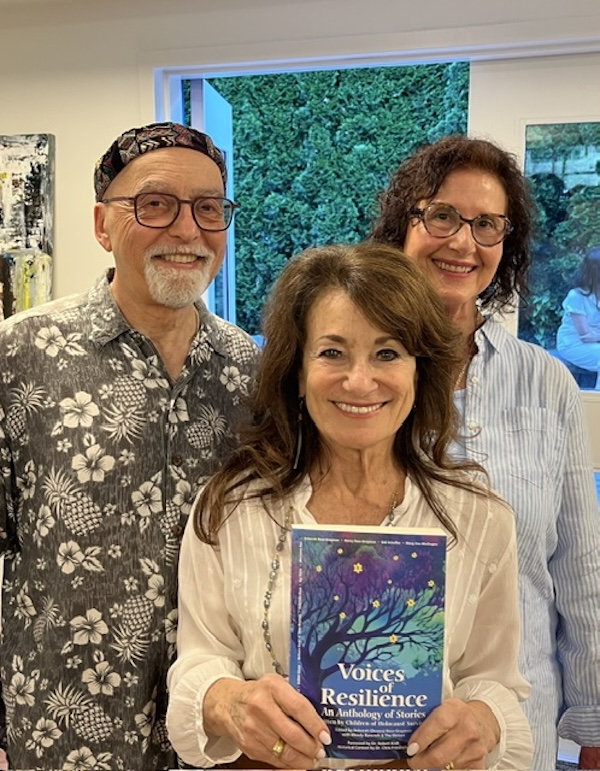
photo - Henry and Deborah Ross-Grayman with Rabbi Tirzah Firestone
Henry and Deborah Ross-Grayman with Rabbi Tirzah Firestone. (photo by Deborah Ross-Grayman)

Henry and Deborah Ross-Grayman pose with Rabbi Tirzah Firestone, who was in Vancouver recently for an Or Shalom Shabbaton. Firestone holds her copy of Voices of Resilience: An Anthology of Stories Written by Children of Holocaust Survivors, edited by Deborah Ross-Grayman with Wendy Bancroft and the contributors. For more on the book, go to jewishindependent.ca/stories-of-trauma-resilience.

Posted on June 26, 2026June 24, 2026Author Community members/organizationsCategories LocalTags Jewish Federation, Jewish Independent, JFS, milestones, Rockower Awards, Tirzah Firestone, Voices of Resilience, volunteerism
Or Shalom reopens its doors

Or Shalom reopens its doors

On May 28, Or Shalom Synagogue reopened its doors after a year of renovations. (photo by Wendy D)

On the evening of May 28, Or Shalom Synagogue reopened its doors after a year of renovations, welcoming celebrants for the Chanukat HaBayit, or homecoming. Co-chairs Sally Thorne and Dalia Margalit-Faircloth emceed the event.

“It is our pleasure to welcome you back to our expanded and renewed bayit, our spiritual home, and the first carbon-neutral shul in North America,” said Margalit-Faircloth, thanking Harriet Frost for opening the gathering with song and the shul’s Rabbi Arik Labowitz for receiving everyone into the space.

“Thank you all for joining us here today to celebrate this incredible milestone, the completion of our More Or renovation and expansion project,” she said. “It’s such a pleasure to see this sanctuary full once again and to share this joyful occasion with so many members of the community, supporters and friends.”

After thanking the elected officials and community leaders in attendance, Margalit-Faircloth read a message from Premier David Eby, which the congregation has framed. The premier congratulates Or Shalom on its reopening.

“Or Shalom began as a havurah in 1982, meeting in members’ living rooms. Today, it has grown into a vibrant community of almost 200 households,” he writes, noting that the present location – at 10th and Fraser – was purchased in 1993. “Or Shalom’s success is a testament to the perseverance and contributions of its congregation as well as the vital role it plays in the community.”

Margalit-Faircloth stressed the vital role congregant John Fuerst played in being “the driving force behind the More Or project.”

Fuerst shared with those gathered the story of how the renovation began eight years ago with a question he asked Rabbi Hannah Dresner, who led the congregation at the time: “How are things going?”

Her response was, “We’re growing out of our clothes. We just don’t have the space we need. We need classrooms – we don’t have those classrooms. We need accessibility – our accessibility for people who need it is so awkward, so difficult. We have water damage in our outside walls – we need those fixed.

photo - Rabbi Hannah Dresner addresses those gathered on May 28 for Or Shalom’s Chanukat HaBayit, or homecoming
Rabbi Hannah Dresner addresses those gathered on May 28 for Or Shalom’s Chanukat HaBayit, or homecoming. (photo by Wendy D)

“Well,” said Fuerst, “it’s eight years later and here we are. Actually, not quite so simple. We’re only here today because of the many people who have helped to put this together and it’s my honour to be able to thank them.

“First and foremost, our thanks to the Ronald S. Roadburg Foundation. You often hear at events like this, ‘without your donation, this project, this program, wouldn’t have happened.’ Well, without hyperbole, I can say, without [the foundation’s] contribution, this project would not have happened.”

Fuerst also thanked the Jewish Community Foundation of Greater Vancouver for the “elevator that will be working on Monday”; the Lutsky family Foundation, whose donation allowed Or Shalom to “expand and completely renovate our kitchen”; the Phyliss and Irving Snider Foundation, whose contribution towards the new classrooms was “made in honour of our teacher and our mentor Gloria Levi”; and both the Jewish Federation of BC and the Government of British Columbia, who gave the congregation grants for its security systems.

“My thanks to the Adamah Climate Action Fund, who gave us an interest-free loan, which enabled us to put together our decarbonation system, our heat pump system,” said Fuerst, who thanked RBC Dominion for the shul’s mortgage and architect Erika Gerson, who recently retired. “She heard what we needed and she designed it,” he said, expressing appreciation to Chris Boni and Anthony Boni of Boni Maddison Architects; to the general contractors, Novacom Building Partners; and to Jon Hardybala of PCA Pacific Construction, who was the site superintendent. Instrumental in the decarbonization aspect was Chris Higgins of BC Hydro, said Fuerst. And, offering the congregation a home for the months that the renovations took was Cityview Church, whose spiritual leader, Pastor Trevor Josh, joined the celebration, along with the church’s Pastor Jeff Groulx.

photo - John Fuerst, the driving force behind the renovation project, speaks with attendees after the ceremony
John Fuerst, the driving force behind the renovation project, speaks with attendees after the ceremony. (photo by Wendy D)

Fuerst thanked rabbis Dresner and Labowitz, and the synagogue’s Efrat Gal-Or – “Coordinating a construction project needs the skills of a surgeon, the vision of an eagle, the patience of a kindergarten teacher. You’ve shown all three and you’ve helped bring this project to where it is.” He voiced appreciation for Or Shalom staff Tracey Fagg and Katy Ormiston. 

Or Shalom members contributed $1.8 million toward the project and there were many volunteers on various committees and on other tasks, Fuerst said. “What a wonderful contribution for our little East Side shul.”

He added, “I do want to mention one member in particular, Jackie Levitan, of blessed memory. Jackie served on the housing task force. She’s actually responsible for much of the redesign of the office space. And, a month before Jackie’s passing … she called me up and said, ‘I want to make a donation.’ Jackie donated the largest single donation towards this project.”

David Bogdanov, a director of the Ronald S. Roadburg Foundation, said, “Or Shalom offers a unique and important pathway to Jewish life in Vancouver,” and noted how thrilled he was that it is the first carbon-neutral shul in North America, as decarbonization is a priority of the foundation.

Mira Oreck, who is a board member of the synagogue, spoke as a parent.

“What is a shul without classrooms for learning, playing, sneaking away from services, and forming Jewish identity and friendships?” she asked. “Our new classrooms will enable our kids, so many of whom do not attend Jewish day school, to be together to learn songs and prayers, holidays and text; a place to study for their simchat mitzvah; and a place to grapple with and hopefully connect to our traditions. 

“More than that,” said Oreck, “I want to acknowledge the founders and stewards of Or Shalom for creating a Jewish spiritual community fit for Jewish life and Jewish families today…. The first net-zero synagogue in Canada. A shul with access for people with disabilities. A place where you can come as you are…. A place of songs without words, niggunim, creating more open access to Jewish families of all backgrounds. A Jewish home that incorporates nature, culture, place and community. There is nothing like us in Vancouver.”

photo - Guests check out the synagogue’s new classroom
Guests check out the synagogue’s new classroom. (photo by Wendy D)

When Labowitz returned the bimah, he said, “This moment was built through thousands of visible and invisible acts of devotion, through generosity and patience, through courage, through people saying yes again and again, even when the road was long.” He thanked not only major donors but “those whose gifts may never appear on a plaque but are written into the soul of this place.”

“Judaism understands that there is a holy relationship between the vessel and the light that it carries,” he said. “The vessel alone is not enough, but light without a vessel can scatter and disappear. This renewed bayit is a vessel for the light of Or Shalom. And it is preparing the way for more or [light]: more song, more questioning, more justice, more tenderness, more learning and more becoming, more or. 

“This building will continue to hold so much life,” said the rabbi. “These walls will hear children playing, elders teaching, mourners grieving and community growing. They will hold disagreement and reconciliation, search and discovery. They will shelter people who feel at home in Judaism and people still searching for their spiritual home.

“My hope is that everyone who walks through these doors will feel there is room for their whole self here,” said Labowitz, because “that is what sacred community is and can be at its best…. So, we return not simply to a renovated space but to a renewed sense of possibility.”

In calling Dresner up to speak, Labowitz praised her “wisdom, vision, determination and relentless devotion helped bring this dream into a reality.”

“I’m thrilled to be here to mark this milestone in the unfolding of Or Shalom’s history,” said Dresner. “I did put the renovation bug into John Fuerst’s eager ear and, later, I was privileged to write the story of Or Shalom for our seminal Ronald S. Roadburg Foundation grant. Now, I shep nachas, meaning ‘at rest,’ as in resting on my laurels. And I derive profound satisfaction in your achievement bringing this project to near-enough completion. The blessing we celebrate today is not just of a refurbished bayit and what it can hold. We also celebrate the courageous innovations of our leaders who keep Or Shalom on the cutting edge of inclusion and on the cutting edge of social justice work, of dialogue and of spiritual expression in the Jewish world.

“For our elders who created this outreach organization to answer their own unmet needs, this is a celebration of an era and its threshold of paying it forward, as they have given way to renewed policies and modalities that centre you who will carry Or Shalom into its next era,” she continued. “They decided not to wind the experiment of Or Shalom down with their eldering, but instead to outfit her for the next generation, midor l’dor, to bless the next generation with a well-run organization, comfortable in its finances, strong in its professional and lay leadership…. In response and in gratitude, the youngers, you must care for our current role models, taking over their delivery of gemilut chesed, institutional loving kindness, taking over their heroic volunteerism more and more so that they too have a chance to shep nachas, rest in the stewardship of Or Shalom’s younger members, delight in the gorgeous kindness and creativity of the next wave.”

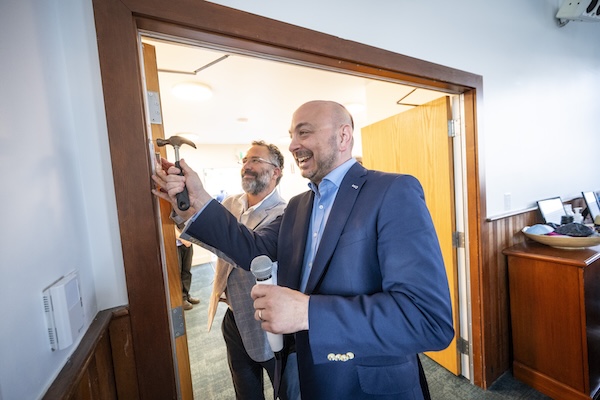
Dresner offered the congregation a benediction framed around the week’s Torah portion, Naso, in which Moshe finishes setting up the tabernacle and sanctifies it. After, Labowitz introduced the mezuzah hanging.

“So, we started this process with a shovel and we’re going to end with a hammer,” he said. “And we have a very special mezuzah that has been gifted to us by our members Harriet Lemur and Ron Einblau.”

photo - Rabbi Arik Labowitz, left, and Jewish Federation of BC’s Ezra Shanken participate in the mezuzah hanging
Rabbi Arik Labowitz, left, and Jewish Federation of BC’s Ezra Shanken participate in the mezuzah hanging. (photo by Wendy D)

The mezuzah contains shards from the glass that was broken at the renovation’s groundbreaking ceremony last year. Before it was affixed to the door coming into the sanctuary, Josh presented to Labowitz and Or Shalom the gift of a painting. The pastor said he would miss having the congregation as Cityview’s guests. 

“I’m going to miss the oneness of spirit,” said Josh. “I’m going to miss the love, the deep love, the gracious love that we show to one another. And I’m going to miss the friendship, the deep, deep friendships that we’ve made. And can I tell you that we would not have known any of those things if we had stayed closeted in our buildings and not reached out.”

Josh was the first person to help Labowitz hang the mezuzah, followed by Jewish Federation of BC chief executive officer Ezra Shanken, Hardybala, Dresner and Fuerst.

“Thank you all for being here,” said Labowitz. “Thank you for being a part of this moment.” 

Format ImagePosted on June 12, 2026June 10, 2026Author Cynthia RamsayCategories LocalTags Chanukat HaBayit, continuity, Judaism, milestones, Or Shalom, renovations
JFS from past to future

JFS from past to future

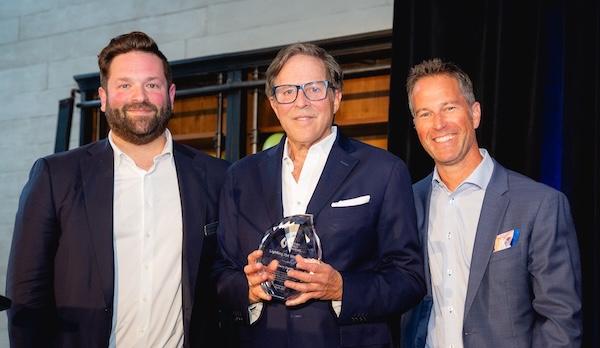
Garry Zlotnik, centre, received the JFS Lighting the Way Award from Brent Davis, left, and Todd Thal at the Innovators event May 26. (Rhonda Dent Photography)

‘Jewish Family Services (JFS) hosted its annual Innovators event on May 26. This year’s gathering commemorated the organization’s 90 years of service to the community and 20 years of Innovators. 

Held at the JW Marriott Parq Vancouver, guests filled the D/6 Bar & Lounge. JFS board members Candice Stein Thal and Raechelle Paperny were the event co-chairs.

Stein Thal spoke about JFS’s “nine decades of supporting our community with dignity, compassion and care.” Innovators itself is an example, she said, of “People showing up for one another, investing in one another and making sure that no one has to navigate life’s challenges alone.”

Paperny described the wide range of services offered by JFS, “whether that’s putting food on the table, accessing mental health support or simply feeling less alone.” She said JFS’s power lies not in “what we do but how we do it. We meet people with compassion and with dignity, we respond with innovation and we continue to evolve because the needs of our community are increasing and ever-changing.” While proud of their 90-year history, Paperny said they’re even more focused on the future.

photo - JFS Innovators co-chairs Candice Stein Thal, left, and Raechelle Paperny. The event took place May 26 at the JW Marriott Parq Vancouver
JFS Innovators co-chairs Candice Stein Thal, left, and Raechelle Paperny. The event took place May 26 at the JW Marriott Parq Vancouver. (photo by Ray Shum)

Brent Davis and Todd Thal presented the Lighting the Way Award to Garry Zlotnik for his leadership. Davis noted that Zlotnik had “earned the respect of this community long before he started sponsoring events or making donations.” The award recognized Zlotnik’s capacity for “leadership, compassion and moving others forward.” With financial and volunteer contributions that have spanned decades, Zlotnik “has never failed to make a difference with his time, his leadership and his energy,” said Davis.

Both Thal and Davis described the positive influence Zlotnik has had on their lives, as a mentor and role model. “He showed me that success isn’t just about building a business, it’s what you do with that success, how you help people and give back to the community,” said Thal, who described Zlotnik as someone who “makes connections and helps others succeed – and he does it without wanting any recognition.”

Davis added that donations were a good way to honour a man who is “always one of the first to say yes,” when a cause or an organization needs support. 

Before the award was presented, a short video was shown featuring Zlotnik speaking of his involvement with JFS. He said he was raised in a family where the attitude of “giving back was instilled in me at a very early age.” One of the greatest rewards has been, he said, meeting “so many unbelievably fantastic people.” He appreciated that donors could “share the benefits of what you’re doing on a direct basis with people” who have been in hard times. Having turned 70 in 2025, Zlotnik said this was a good time “to reflect on the legacy and the work that I’ve done for the Jewish community,” and he quoted the late Joseph Segal, who said, “the more you give, the more you get – and what you get is fulfilment.” Zlotnik hopes that this legacy of giving back will endure through his kids, grandkids and great-grandkids: “hopefully, they will do the same thing.”

In person, Zlotnik added that he’d had his birthday party in the same room last year. He reminisced about one of his proudest moments, working on the Maccabi Games, and pointed out that his brother, Marty, was a former board member. He reminded everyone that this was a great opportunity to support local people who “just need a little extra help.”

Shay (Shy) Keil, the event’s presenting sponsor, introduced a video about JFS’s 90-year history: “A powerful reminder that, behind every service, every meal, every act of care, there is a person whose life has been changed because this community chose to step forward, extend a hand and act. I encourage you to watch closely and open your hearts.” 

Keil spoke about the importance of the Innovators event. “I cannot imagine any other event in our community as important as this one,” he said. “For decades, JFS has been there for people in moments of hardship, uncertainty and vulnerability … not just for support, but for dignity, compassion and hope.”

photo - Shay (Shy) Keil, presenting sponsor of the Innovators event
Shay (Shy) Keil, presenting sponsor of the Innovators event. (Rhonda Dent Photography)

He reminded the audience that the need in the community was still growing, and “so does the impact of JFS. From food security and counseling to seniors’ support, addiction services, they’re helping rebuild people’s lives. That is what inspires me about JFS. This organization shows up for people.”

photo - Geoff Glotman of Glotman | Simpson, which was the event’s platinum sponsor
Geoff Glotman of Glotman | Simpson, which was the event’s platinum sponsor. (photo by Ray Shum)

The video explained how JFS was founded 90 years ago to help vulnerable community members and newcomers, based on the value of tikkun olam, repair of the world. A main goal was to ensure that the social, physical and emotional needs of Jewish refugees were being met. JFS’s services have expanded greatly since it began – to all members of the Jewish community, as well as local non-Jews in need of care and support, including with food assistance, mental health and counseling, and advocacy and care management.

After the video, JFS chief executive officer Tanja Demajo stressed: “It’s not just about large donations. Every dollar that’s provided makes a difference.”

She explained, in the video, how JFS will continue with the value of tikkun olam as its guide: “to help each other when that help is needed, so that no one is left behind.”

As he does for so many community fundraisers, auctioneer Howard Blank asked the audience for donations. For each dollar amount, he explained what the funds raised would cover, and what kind of difference it would make. For example, a gift of $5,000 meant that families could avoid “having to choose between rent and food,” he said. Other amounts would support the JFS Kitchen, its addiction and recovery program, emergency assistance, preventing evictions, grief and trauma counseling for a year for women fleeing violence.

A digital slide show shared the details of JFS’s impacts: 176 Holocaust survivors are supported by JFS and the agency delivers 2,100 hours of one-on-one client time. It has helped 600 people navigate crises and rebuild lives, and delivers $1.8 million in emergency medical and financial aid annually. Average counseling wait times at JFS have been reduced from 12 months to three weeks, and many thousands of kosher meals have been delivered. JFS distributes 825,000 pounds of food to those in need.

The Innovators event raised more than $600,000 for JFS programs and services that benefit more than 3,000 people each year. 

Both Zlotnik’s video and that about JFS’s history can be found on YouTube. 

Shula Klinger is an author and journalist living in North Vancouver.

Format ImagePosted on June 12, 2026June 10, 2026Author Shula KlingerCategories LocalTags food security, fundraising, Garry Zlotnik, Innovators, Jewish Family Services, JFS Vancouver, milestones, philanthropy, social services, tikkun olam
Rabbi marks 13 years

Rabbi marks 13 years

Over the weekend of May 8, Temple Sholom celebrates Rabbi Dan Moskovitz’s “bar mitzvah” year as leader of the congregation. (photo by Pat Johnson)

Rabbi Dan Moskovitz will celebrate his bar mitzvah for the third time on May 9. Marking 13 years since his arrival as senior rabbi at Vancouver’s Reform Temple Sholom, the congregation is fêting him with a 1980s-themed bar mitzvah party.

Moskovitz may experience a sense of déjà vu, since he had not one but two bar mitzvahs in 1983.

“My dad was president of the Reform congregation and vice-president of the Conservative synagogue,” the rabbi said of growing up in Foster City, in the San Francisco Bay Area. “I’m a Jewish mutt, I like to say.”

He had a Reform bar mitzvah on Friday night and a Conservative one on Saturday morning. The weekend of his Temple Sholom celebration will be similarly packed.

Friday night Shabbat services are open to the entire community, with speakers reflecting on his tenure, something that makes Moskovitz feel awkward. 

“It’s weird to say, ‘Can you talk about me?’” he said. “I love showering praise on others. I truly don’t want to be the centre of attention.” 

He understands, though, what the moment represents, not just for him, but for the congregation.

“I recognize that I play a significant role in people’s lives at the most important times,” he said. “That’s a privilege.” 

Letting people say thank you, he added, is part of that relationship.

Moskovitz, commonly known as “Rabbi Dan,” has no similar reluctance when it comes to the menu for the Friday night Oneg, which will be stocked with his favourite desserts – Rice Krispie squares and caramel apples.

Saturday morning will belong to someone else entirely: a bar mitzvah boy whose thunder Moskovitz is not about to steal. “This is all about you,” the rabbi assured him.

The Saturday night party will be ’80s nostalgia – but tasteful, Moskovitz promised. Members of the congregation will speak, as will Rabbi Philip Bregman, Temple Sholom’s rabbi emeritus, and leaders of the broader community. Tickets are available on the shul’s website, templesholom.ca.

Sunday morning will feature a bagels-and-brunch gathering for the religious school’s 220 kids and their parents.

The festivities are in support of causes that are close to the rabbi’s heart. Funds raised will go into two endowments. 

The first is a pastoral care initiative, led by Rabbi Sally Finestone, whose sole focus is seniors, including regular visits, supporting their families, even driving people to appointments. As the congregation has grown to more than 1,000 households, Finestone is able to take some of the burden off Moskovitz, Associate Rabbi Carey Brown and Cantor Shani Cohen. This program, and Finestone’s position, began through an endowment in memory of Michael Jacobson.

The second endowment, originated by Susan Mendelson and her husband, the late Jack Lutsky, supports a scholar-in-residence program, which has allowed Temple Sholom and the broader community to learn from Israeli writer and thinker Yossi Klein Halevi for the past several years.

Though Moskovitz’s visit to Vancouver before being hired was in a typical Vancouver rainstorm, he instantly felt he had found a home.

“I just fell in love with this congregation,” he told the Independent.

What stands out most, he said, is that, in Vancouver, congregants don’t simply attend services, they participate. “They own it,” he said. 

It’s a contrast, he suggested, to parts of American Reform Judaism, where it can feel like congregants outsource their religion to the rabbi, drop their kids off at shul and pick them up after. “I call it drive-by Jewing,” said Moskovitz.

“Our congregation shows up. The parents don’t just drop off their kids. They come in the building. They stay for minyan,” he said.

Something else that surprised him about Vancouver is the level of collaboration among Jewish institutions, exemplified by the inter-denominational Rabbinical Association of Vancouver. It’s a model, he believes, that could reshape Jewish communal life elsewhere. 

Of course, not everything has been easy. Rising antisemitism in Canada has forced him into a more public, defensive role than he ever expected. It’s not why he became a rabbi, he said, but it has become part of the job.

Thirteen years in, Moskovitz has no plans to leave.

“I never want to,” he said.

Neither, apparently, does the congregation ever want him to go. They gave him a life appointment, or to age 67: “Whichever comes first,” he said.

Aside from missing his extended family and Trader Joe’s, Moskovitz has no regrets about the move to a new city and country – the citizenship test for which, he noted, he aced, with 20 right answers out of 20.

“My parents are older now. It’s hard for them to travel,” he said. “My father-in-law is older also, so that’s hard. My kids grew up without that drop-by grandparenting, which is so special. So that’s been a trade-off.” 

His family has likewise found a home at Temple Sholom, Moskovitz added. His wife, Sharon Mishler, is a true partner in the work, he said.

“When I’m in the front of the congregation leading the synagogue and services, she’s in the back of the congregation creating relationships and connecting people,” said the rabbi. “She takes brides to the mikvah. She meets with our seniors. She takes people out to lunch. She makes phone calls. She’s a great source of information for me when people tell her things that they think I should know about somebody being sick or whatever it is.”

Their son Judah, 20, studies political science and history at the University of Ottawa and works on Parliament Hill for Vancouver Granville Member of Parliament Taleeb Noormohamed. He was just selected as the co-chair of the Canadian Jewish Political Affairs Committee Fellowship.

Son Levi, 18, graduates from King David High School this spring and was accepted early to Western University’s Ivey Business School. 

Daughter Estee, 14, also a student at King David, has an aptitude for science and, like her brothers, is very involved with BBYO (formerly B’nai B’rith Youth Organization), where she is vice-president of the chapter board.

“I never thought that I would be the rabbi of a synagogue that I’d want to join,” Moskovitz said. “I thought that I would always have to compromise my spirituality to serve the masses of my community.”

At Temple Sholom, he is truly at home.

“It is Judaism in the way that I like my Judaism,” he said. “It’s traditional but inclusive and egalitarian. Progressive in what I think are all the right ways in terms of trying to adapt and respond to modernity, but not watered down Judaism in the process. And it’s a loving, caring congregation.” 

Format ImagePosted on April 24, 2026April 23, 2026Author Pat JohnsonCategories LocalTags Dan Moskovitz, fundraising, gala, Judaism, milestones, Temple Sholom
Beth Tikvah celebrates 50th

Beth Tikvah celebrates 50th

The delayed celebration of Beth Tikvah’s 50th anniversary takes place April 19, with a night of comedy headlined by Juno Award-winning comedian Jacob Samuel. (photo from byjacobsamuel.com)

Beth Tikvah, the Conservative synagogue in Richmond, was founded in 1973. That placed the 50th anniversary in 2023, and a celebration was planned for October. Then the catastrophe of 10/7 occurred, and the event was indefinitely postponed.

Now that all the hostages are home and the war that began that day has ended (though a different one continues), the congregation thought it was not just appropriate to come together to celebrate the milestone of their community, but necessary.

A communal celebration – with laughter – is something the community needs, Rabbi Susan Tendler told the Independent. 

“People just really need to laugh,” she said, and to find strength in community. 

Tendler herself arrived as Beth Tikvah’s spiritual leader at the height of another collective crisis – the COVID pandemic. Her family was greeted warmly, but from a distance, as intense social isolation rules were still in place.

Six years later, she is effusive in her love for her role and her adopted community. Beyond the immediate Beth Tikvah and Richmond communities, she said, the relationship among Metro Vancouver’s rabbis is extremely unusual, with deep ties across denominations. Tendler is currently chair of the Rabbinical Association of Vancouver, the main conduit for that tight union.

Jews at Beth Tikvah, in British Columbia and worldwide are resilient but tired, she said.

“We are fierce and we are resilient, and we are strong and we are agile and we are constant,” she said. “But we all can feel the weariness from it.”

Coming together to celebrate is necessary, she said, noting that Purim this year seemed to unleash a collective wellspring of joy.

The delayed celebration of Beth Tikvah’s 50th anniversary takes place April 19, with a night of comedy featuring Juno Award-winning comedian Jacob Samuel and emcee Kyle Berger, himself a funnyman of some repute. 

Berger’s brother, Tadd Berger, is the synagogue’s president, as was older brother Ryan and mother Marilyn before him.

The Bergers were not founding members of the congregation, said Tadd Berger, but they showed up more than four decades ago.

“Beth Tikvah is a special place,” he said. “It’s always been a special place for me. I was bar mitzvahed at Beth Tikvah, I was married at Beth Tikvah. It has always been a centrepoint of my person, of my growth, of my community. A lot of who I am today is a result of opportunities and programs and events and things that I had at Beth Tikvah.”

He called his leadership role at this moment in the history of the shul and the community a responsibility, an honour and a privilege. 

While the celebration next month caps a half-century of growth, Berger is looking to the future.

“Our membership has been growing the last several years,” he said. “I think that we will continue to grow. We’ll continue to find more ways to connect with and service and support the larger Jewish community, especially the Richmond Jewish community.”

Beth Tikvah is the only Conservative synagogue south of Fraser River, Berger noted, so he views the shul as serving a larger geographic region, stretching southward. 

He is also proud of the range of programs the community delivers, including food security programs and services for youth and seniors, which are open to members and non-members. 

“We see ourselves as Richmond’s synagogue and here to support the whole community,” said Berger. “That’s how we want to continue and, [in] the coming 50 years, I hope that that gets us embraced more and more by the community. “

The solemnity of the period since Oct. 7, which occurred just as the world was emerging from the COVID pandemic, means it has been a long time since a festivity of this type has occurred, according to one of the organizers.

“The event is the first big fundraiser we’ve had in a long time,” said Alisa Magnan, who is co-chairing the celebration with Mindy Zimmering. “We’re raising badly needed funds for programs and it’s a great chance to support the community and get together and have some fun.”

Magnan echoes the rabbi in noting that it is time for the community to kick back and have a good time amid the many challenges.

“I wanted to be able to get together and celebrate our community and find some joy after such difficult times,” she said.

In addition to the anticipated guffaws (induced, the PR promises, by “smart, clean humour”), the event will include a 50/50 draw in addition to food stations featuring pasta, barbecue, salads, Mexican cuisine and crêpes for dessert. Tickets and more information for April 19’s  Eat, Laugh, Schmooze: A Night of Comedy & Connection are at btikvah.ca. 

Format ImagePosted on March 27, 2026March 26, 2026Author Pat JohnsonCategories LocalTags Alisa Magnan, anniversaries, Beth Tikvah, comedy, Jacob Samuel, Kyle Berger, milestones, Susan Tendler, Tadd Berger
Next-gen orthotic wins

Next-gen orthotic wins

Henry Chodos, a Grade 6 student from Vancouver Talmud Torah, won ADI’s sixth annual Make the Change Challenge and received the $1,000 grand prize. (photo from ADI)

In its sixth year, ADI’s Make the Change Challenge STEM accessible design contest drew more than 379 entries from students across North America – and Vancouver Talmud Torah sixth grader Henry Chodos won the contest’s $1,000 grand prize.

Chodos’s award-winning vision is a lightweight and slim-fitting orthopedic brace that automatically adjusts to provide users with rigidity and flexibility as needed.

Having struggled for years with chronic inflammatory demyelinating polyneuropathy (CIDP), a rare autoimmune disorder that causes muscular weakness and sensory loss in the limbs, Chodos set out to help himself and others by designing NeuroStride, an orthotic with built-in micro sensors that would intuitively correct gait irregularities and allow users to make adjustments via an easy-to-use app, with no medical professional required.

The Make the Change Challenge is run by ADI (adi-israel.org), Israel’s network of specialized rehabilitative care for those touched by and living with disability, to mark Jewish Disability Awareness, Acceptance and Inclusion Month. The contest promotes “selfless STEM” (science, technology, engineering and mathematics) and encourages students to hack the modern world to help people with disabilities overcome the challenges that hinder their independence and inclusion.

Instead of developing prototypes, entrants were asked to prepare compelling presentations that clearly explain how their solutions would solve the persistent accessibility issues they chose to tackle. In his contest submission, Chodos, who wears braces 24 hours a day, noted that the orthotics currently available are very uncomfortable, take a long time to mold to one’s body, don’t allow for growth and are prohibitively expensive. What’s more, they spotlight his condition and keep him from doing the things he loves.

poster - Henry Chodos’s NeuroStride took ADI’s top prize
Henry Chodos’s NeuroStride took ADI’s top prize. (image from ADI)

“When my CIPD flares up, I can’t ride or play basketball with my friends, and I can never sit on the ground in class or during assemblies, because I can’t stand back up in my braces,” he explained. “I don’t like feeling different, and I wanted to create an orthotic that would provide me and others living with CIPD, cerebral palsy, muscular dystrophy, spina bifida and other conditions with the support we need, just without all of the unwanted strain and attention.”

Upon reading Chodos’s presentation, the contest’s judges – which included members of ADI’s professional staff, innovation journalists and specialists in the field of accessible design – were overwhelmed by the young inventor’s maturity, creativity and attention to detail, and inspired by his desire to draw from his own experiences to change the world.

“To be honest, Henry’s presentation left us speechless. We work so hard promoting our ADI Bechinuch disability inclusion programming and helping students develop an empathetic worldview, but Henry flipped the script and became our teacher. His life experience has molded a passionate and compassionate educator and innovator, and he put on a masterclass in perseverance, perspective and vision throughout this competition,” said ADI’s North American director of advancement . “We are thrilled that we were able to provide Henry with a stage upon which to shine, and we truly believe that his brilliant design has the potential to become a reality and make the world a kinder and more accessible place.”

Nearly 50 Jewish schools across North America – including many affiliated with JNF-USA – used the ADI Bechinuch programming last year, employing the in-class activities and disability simulations, virtual tours and STEM contest to encourage the next generation of Jewish leaders to see the world through the eyes of others.

As February ended, ADI’s panel of experts met with the contest’s top five finalists, their parents and their teachers via Zoom to discuss the entries in greater detail. Following some discussion, the proceedings concluded with Chodos being crowned the contest winner and presented with the $1,000 grand prize, a gift from the Avraham and Esther Klein Young Entrepreneurs Fund.

The “Final 5” also included entries from students at the Ramaz School in New York, NY; Brauser Maimonides Academy in Fort Lauderdale, Fla.; Hochberg Lower School (Posnack East) in Hallandale, Fla.; and the Bornblum Community School in Memphis, Tenn.

To learn more about ADI and to donate, visit adi-israel.org. 

– Courtesy ADI Negev-Nahalat Eran

Format ImagePosted on March 13, 2026March 12, 2026Author ADI Negev-Nahalat EranCategories LocalTags ADI, awards, disability awareness, education, Elie Klein, Henry Chodos, innovation, Make the Change Challenge, milestones, NeuroStride, orthotics, science, STEM, Vancouver Talmud Torah, VTT, wearable technology
Vancouver to Vienna

Vancouver to Vienna

The author, Nicole Grubner, and Rabbi Levi Varnai reconnecting at the Yael Awards in Vienna. (photo by Nicole Grubner)

I grew up in West Vancouver, in a home where Jewish life mattered. We celebrated the chagim (holidays), gathered for family Shabbat dinners and went to synagogue. Jewish identity was present, familiar and important. But, when it came to school, the question my parents faced was not about ideology, but practicality.

At the time, I was attending our local public school, which I loved. The Jewish school was at least a 40-minute drive each way, which would reshape daily family life. This was not a small decision.

My parents had both attended Jewish schools – my father in Chile, my mother, in England – so the value was there. And, in the end, belief won.

It was my uncle, Claudio, who ultimately tipped the balance. He didn’t provide a checklist or a plan. As my mother put it, “He just appealed to us, from his heart to ours.”

In Grade 3, my parents moved me from public school to Vancouver Hebrew Academy. That decision marked the true beginning of my Jewish journey.

Once I arrived at VHA, any lingering doubts faded quickly. My parents felt, almost immediately, that they had made the right choice.

Rebbetzin Shayndel Feuerstein z”l didn’t need to convince them that Jewish education was about more than academics; they already knew that. What stood out was how she conducted herself and the seriousness with which she approached educational excellence. She personally traveled to Israel to interview and hand-pick teachers.

The underlying challenge facing the school was not vision or quality; it was financial. Fundraising was a constant reality and, from one school year to the next, there was never complete certainty that there would be enough resources to continue operating.

When I entered VHA, I joined a class filled with children whose lives were just beginning to take shape. One of them was a boy named Levi Varnai. We were classmates for two years, from 1996 to 1998, before I transferred to Vancouver Talmud Torah for Grade 5. A couple of years later, Levi and his family moved to Israel.

Levi went on to study in yeshivot in Israel and New York, receiving smicha (rabbinical ordination) in 2011, before returning to Vancouver in 2013 to work with the Community Kollel as an assistant rabbi and youth director. Since 2016, he has served as the congregational rabbi of the Bayit in Richmond. Alongside his wife, Rivky, an educator who grew up in Safed, Israel, they have built something truly special.

One of the most powerful expressions of that work is the Bayit’s Kids Zone, an after-school and Shabbat program. Through cooking, crafts, music, games, Torah stories, mitzvot and holiday celebrations, children experience Judaism as warm, relevant and exciting. Pre-teens are guided toward leadership and responsibility, learning values like tzedakah, friendship and connection to Israel.

Many of the children who attend Kids Zone are enrolled in public school. For them, the program becomes a vital Jewish anchor. Parents speak of children singing Hebrew songs at home, lighting Shabbat candles for the first time, and engaging more deeply with Jewish life.

Today, I live in Israel with my family and work in communications. One of my key clients is the Yael Foundation, whose mission is to ensure that every Jewish child has access to quality Jewish education and the opportunity to develop a strong Jewish identity, no matter where they live.

Earlier this month, in Vienna, the Yael Foundation hosted the Yael Awards, celebrating innovation and excellence in Jewish education worldwide. The Bayit’s Kids Zone was among the finalists for the Jewish Experience of the Year Award, recognized alongside outstanding programs from across Europe.

“At the Bayit, we believe that a strong Jewish identity is built through joy, connection and hands-on experiences that make Judaism come alive for every child,” said Rabbi Varnai. “Kids Zone is the heart of that mission – a warm, welcoming space where children explore their heritage, celebrate Jewish life and grow proud of who they are as Jews.”

This year’s Jewish Experience of the Year Award was presented to Beth Habad Canton Vert in France, a community-based program that exemplifies how Jewish life can be made accessible, meaningful and vibrant for families.

Reflecting on the breadth and quality of the finalists, Chaya Yosovich, chief executive officer of the Yael Foundation, noted, “Every one of these educators is deserving of an award. We see, year after year, how educators are raising the bar to ensure the next generation feels connected and proud of their Jewish identity.”

Across the world, Jewish schools and educational programs, particularly in smaller or less visible communities, operate with limited funding and stretched staff. These communities may not sit at the centre of global Jewish attention but, for the families who live there, they are often the entry point into Jewish communal life. By investing in Jewish education globally, the Yael Foundation tries to ensure that excellence is not reserved only for large, well-resourced centres. 

A Jewish journey that began in a Grade 3 classroom in Vancouver has come full circle. A former classmate now leads a community where Jewish identity is being nurtured in the next generations. And, today, I help tell the stories of educators and communities quietly investing in the Jewish future. 

Nicole Grubner, a former Vancouverite who now lives and works in Israel, is a partner at FINN Partners marketing and communications agency.

Format ImagePosted on February 27, 2026February 26, 2026Author Nicole GrubnerCategories LocalTags education, Jewish day school, Levi Varnai, milestones, the Bayit, Yael Foundation

New chapter for JFS

Shelley Rivkin is the new chair of the Jewish Family Services (JFS) board of directors. Rivkin steps into the role at a pivotal moment, succeeding outgoing board chair Jody Dales, who led the organization through the pandemic and the milestone of securing a permanent home for JFS for the first time in its 89-year history. Rivkin will guide the next phase of development for JFS’s newly acquired 22,000-square-foot facility on Commercial Drive, which is slated for a major renovation to become a fully integrated hub for food security, mental health, seniors support, housing navigation and counseling services. This renovation represents the most substantial infrastructure improvement in JFS’s history and will ensure the organization can meet the community’s growing needs for decades to come.

“Shelley brings deep strategic insight, decades of experience in community planning and a profound commitment to serving vulnerable populations,” said Tanja Demajo, chief executive officer of JFS. “Her leadership will be essential as we transform our new building into a future-ready social-service centre.”

photo - Shelley Rivkin takes over from Jody Dales as chair of Jewish Family Services’ board
Shelley Rivkin takes over from Jody Dales as chair of Jewish Family Services’ board. (photo from JFS)

Rivkin currently serves as the executive director of Congregation Schara Tzedeck, bringing her expertise in community planning, organizational development and social-impact strategy.

Prior to her current role, Rivkin spent 17 years at the Jewish Federation of Greater Vancouver, where she advanced major community priorities including poverty reduction, housing initiatives, mental-health strategies and global Jewish engagement. Her work has shaped policy, strengthened nonprofit capacity and guided some of the community’s most significant collaborative efforts.

In addition to her professional leadership, Rivkin has volunteered extensively across community organizations and advisory bodies, consistently championing inclusive, evidence-based and people-centred approaches to communal service.

“JFS is entering an incredibly exciting phase,” said Rivkin. “Our new facility will allow us to expand our services, integrate programs more meaningfully, and respond to the urgent and growing needs of individuals and families across the Lower Mainland. I’m honoured to support this work alongside a dedicated board, staff team and community.”

photo - Jody Dales, outgoing chair of Jewish Family Services’ board of directors
Jody Dales, outgoing chair of Jewish Family Services’ board of directors. (photo from JFS)

Dales reflected on the transition and Rivkin’s appointment.

“It has been one of the great honours of my life to serve as board chair of JFS during such a transformative time,” said Dales. “Shelley is exactly the leader JFS needs for this next chapter. Her deep understanding of community needs, her integrity and her ability to bring people together will be invaluable as we move forward with the renovation of our new home on Commercial Drive. I have complete confidence in her leadership and look forward to seeing JFS thrive under her guidance.”

Dales’ tenure included guiding the organization through COVID-related challenges, the launch of the Kitchen food hub, expanded mental-health and addiction services through JACS Vancouver, and the acquisition of JFS’s permanent facility.

The new Commercial Drive facility will allow JFS to significantly expand its reach and integrate services under one roof. Planned features include an accessible food-security centre; expanded counseling, addiction support and mental-health services; seniors programs and community navigation; purpose-built spaces for group programs and workshops; and infrastructure to support case management, housing navigation and emergency financial assistance.

– Courtesy Jewish Family Services

Posted on December 19, 2025December 18, 2025Author JFS VancouverCategories LocalTags Jewish Family Services, JFS, Jody Dales, milestones, Shelley Rivkin

Posts pagination

Page 1 Page 2 … Page 6 Next page
Proudly powered by WordPress