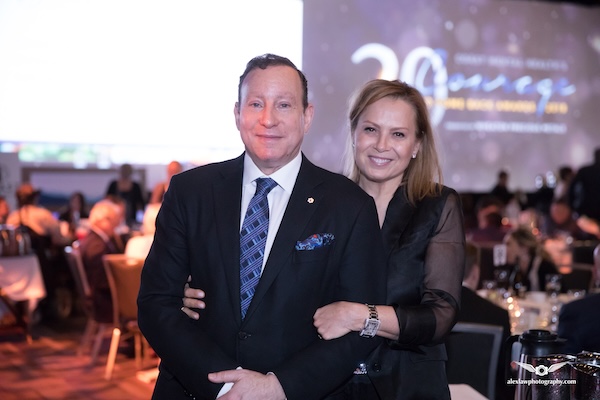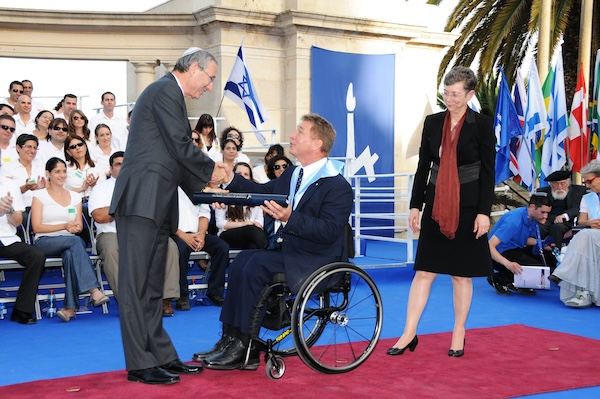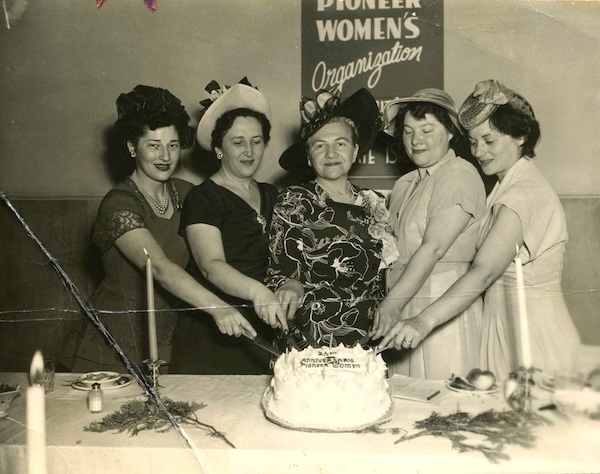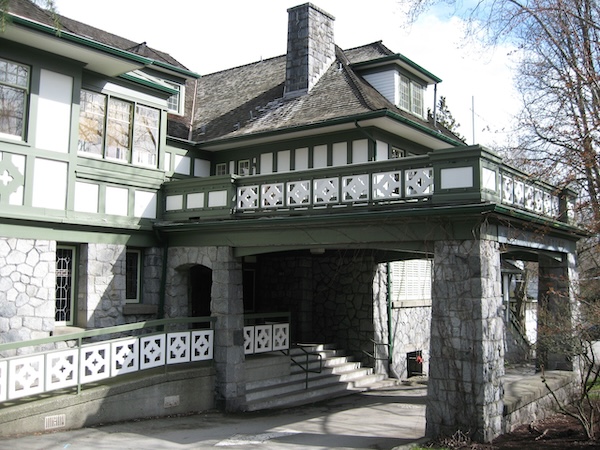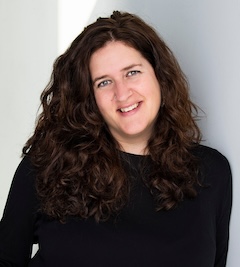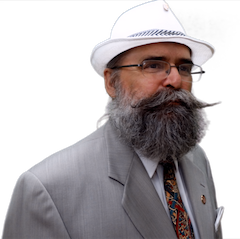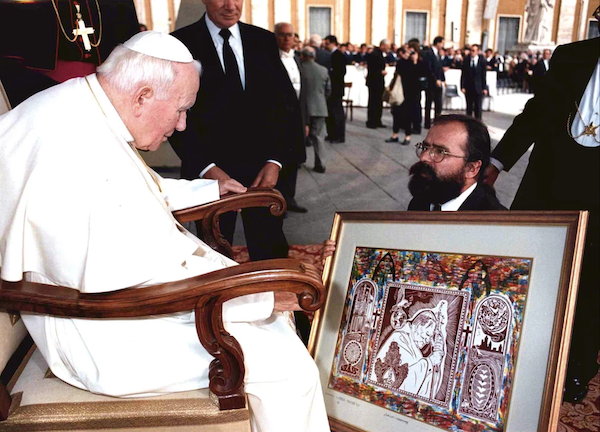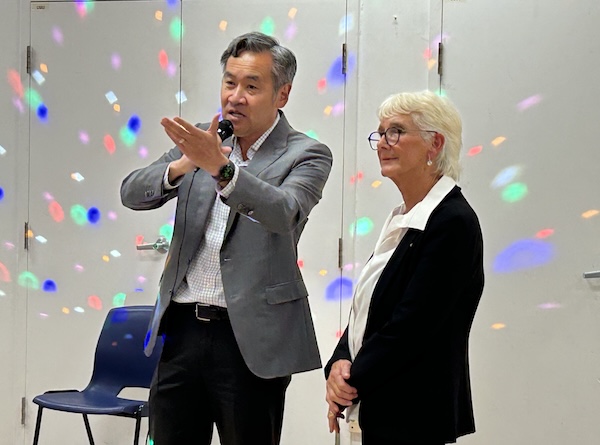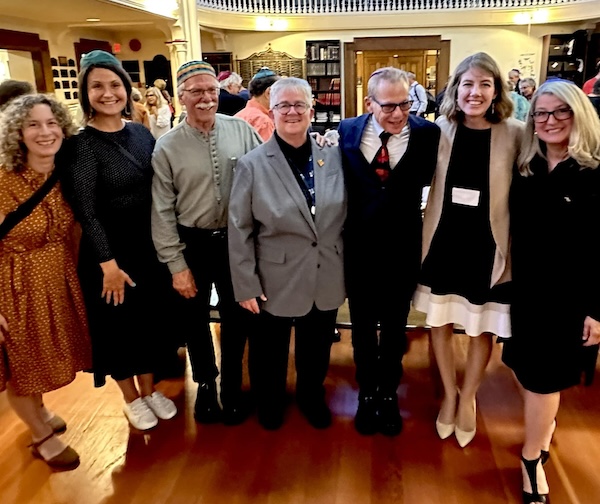
Michael Lee presented the King Charles III Coronation Medal to Grace Hahn at the Jewish Seniors Alliance peer support volunteer recognition celebration. (photo from JSA)
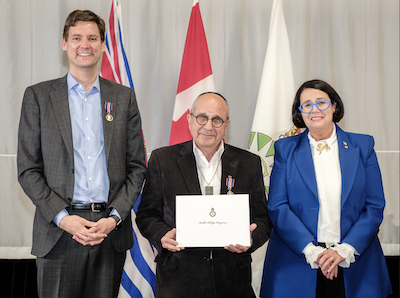
Premier David Eby, left, Rabbi Philip Bregman and BC Lieutenant Governor Janet Austin. (photo from Temple Sholom)
The King Charles III Coronation Medal was created to mark the coronation of King Charles III, which took place on May 6, 2023. It is the first Canadian commemorative medal to mark a coronation, and its recipients represent a diverse group of individuals who have made significant contributions to British Columbia or attained an outstanding achievement abroad that brings credit to the province.
Nominating partners included provincial lieutenant governors and territorial commissioners, provincial and territorial governments, members of Parliament, senators, the Canadian Armed Forces, the Royal Canadian Mounted Police and several other organizations. Across Canada, the medal will be awarded to 30,000 individuals. In British Columbia, 551 are being presented, and the honourees include several members of the Jewish community, some of whom were brought to the attention of the Jewish Independent.
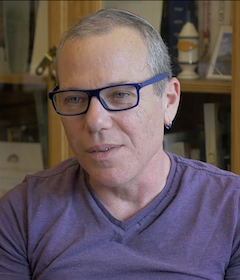
Rabbi Harry Brechner (screenshot from facebook.com/dustnbonesdoc)
Rabbi Harry Brechner, spiritual leader of Victoria’s Congregation Emanu-El, was nominated by former MLA Rob Fleming for championing community dialogue, interfaith connections and community service.
Rabbi Philip Bregman, rabbi emeritus of Temple Sholom and founder of the Other People, an intercultural group of individuals committed to breaking down the stereotypes that form the foundation of personal and societal bias, was nominated by BC Premier David Eby. Bregman was honoured for path-breaking interfaith work and his passionate fight against antisemitism and bigotry of all kinds throughout British Columbia.
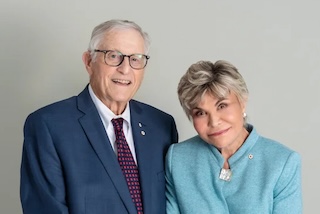
Gordon and Leslie Diamond (photo from kh-uia.org.il)
Gordon Diamond, who was also nominated by Eby, received the medal for unparallelled philanthropic work, making an indelible impact toward health and mental services in the province. Leslie Diamond, nominated by Eby, was recognized for exemplary philanthropic work, especially in the field of women’s health.
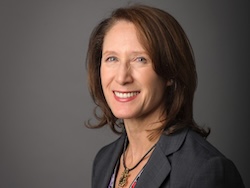
Karen James (photo from jewishvancouver.com)
Bernard Pinsky (photo from cwilson.com)
Eby nominated Karen James for leadership, philanthropy and dedication to the Jewish community at home and abroad, and Bernard Pinsky for a lifetime of dedication to the justice system and for strengthening and securing the stories and memories of the Jewish community.
Grace Hahn, senior peer support trainer and supervisor at Jewish Seniors Alliance, was nominated by former MLA Michael Lee. On Sept. 23, at the JSA peer support volunteer recognition celebration, Lee presented the medal to Hahn for her leadership, dedication and commitment to advancing the support for seniors living at home. Hahn has trained countless volunteers in JSA’s Peer Support and Friendly Visitor programs, and also provides additional training in support of reducing isolation and loneliness in the vulnerable seniors sector.
Left to right: Congregation Emanu-El president Ilana Stanger-Ross, MLA Grace Lore, Prof. Richard Kool, Victoria Mayor Marianne Alto, Emanu El’s Rabbi Harry Brechner, MP Laura Collins and MLA Lana Popham on Aug. 18 at the shul’s 160th birthday party. (photo posted on Facebook by Lana Popham)
Victoria’s Congregation Emanu-El, the oldest synagogue on the West Coast and the oldest synagogue still in continuous use in Canada, has been commemorating its 160th anniversary with various events this summer, including an evening concert and an afternoon of poetry, music and food.
On Aug. 15, Tehila Nini Goldstein, a soprano based in Berlin, performed Ladino, Yiddish, Spanish, Hebrew and Yemeni songs, accompanied by Robert Holliston of the Pacific Opera Victoria and the Victoria Conservatory of Music. Goldstein has won the Tel Aviv Music Academy Singing Competition, received a scholarship from the America Israel Cultural Foundation and taken home a prize in the Liederkranz Foundation Competition in New York.
On Aug. 18, municipal, provincial and federal politicians, as well as representatives from several religious groups, attended an anniversary ceremony, emceed by Richard Kool, a professor of environment and sustainability at Royal Roads University.
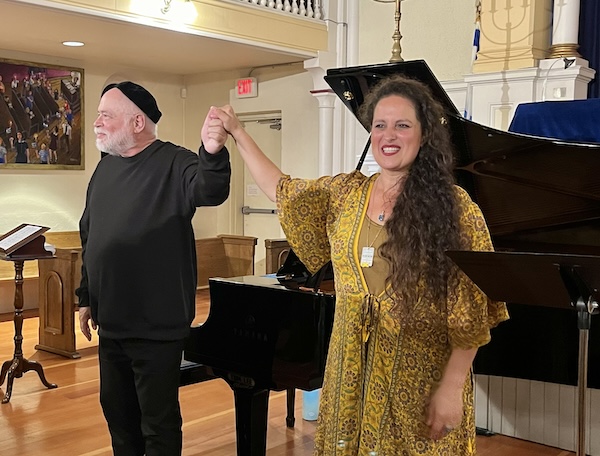
On Aug. 15, Tehila Nini Goldstein performed songs in multiple languages, accompanied by Robert Holliston. The event was part of Congregation Emanu-El’s 160th anniversary celebrations. (photo by Penny Tennenhouse)
The events coincided with a campaign, still underway, by the Conservative shul on the corner of Blanshard and Pandora “to restore, preserve and revitalize” the synagogue. The Romanesque Revival building, a National Historic site, is having work done on both its exterior and interior.
Restoration began this spring, with repairs to the brick outside of the building to ensure structural integrity. Interior restorations include repairing water damage and wall cracks; painting the sanctuary; replacing lighting, smoke detectors, sound and security systems; and refinishing flooring and external doors. Regarding security, Emanu-El plans to set up CCTV cameras, with other systems to improve preparedness.
In August, the congregation held a general meeting at which a motion to increase the complete restoration budget to $1.5 million easily passed, with no objections and one abstention. According to the shul, the meeting filled four Zoom screens, with some members tuning in from Nova Scotia, staying up well past midnight in the Atlantic time zone.
Scores of individuals and families have contributed to the architectural revitalization project. The synagogue offers the opportunity to “buy a brick” with a minimum donation of $54. The Ronald S. Roadburg Foundation, the Victoria City Heritage Trust and the Jewish Federation of Victoria & Vancouver Island are among the organizations supporting the project.
Jews first started arriving in Victoria in sizable numbers in the 1850s, with the majority traveling from San Francisco. During this era of prospectors, fur traders and steamships, those looking for gold needed to stop in Victoria, the provincial capital, for a mining licence, before moving onto the places where gold was discovered on the mainland.
The first Jews in town came with the prospectors, supplying mining camps with food, clothing, household goods and tools. By the end of the 1850s, roughly 200 Jews were living in Victoria and, by 1860, the Victoria Hebrew Benevolent Society, the first Jewish organization in Western Canada, purchased a burial site, which still serves the community to this day.
The congregation came into being in 1862, when community members purchased the synagogue’s present site, and a cornerstone-laying ceremony, attended by the many local luminaries of the time, took place on June 2, 1863. The building was designed by the first professional architect in Victoria, John Wright.
Over the course of Emanu-El’s existence, there have been some leaner times, particularly in the mid-part of the previous century, as Vancouver became the dominant provincial city. In the 1940s, with only a handful of paid-up families, the synagogue was in bad shape. To prevent the building from being condemned, its brick exterior was covered with stucco, its windows were blocked and a false ceiling was installed to help with heating.
In 1978, a group of volunteers decided to bring the synagogue back to its original condition, which cost, at that time, some $370,000, much of it coming from the Jewish community. Completed in 1982, the restoration was celebrated in a way similar to the original dedication in 1863, with people from many cultures coming together to honour the occasion.
In 2003, as the community continued to expand, Congregation Emanu-El added more space to host social and cultural activities. In 2013, the synagogue had its 150th birthday with musical and theatrical events, lectures, an auction, and a gala dinner at the Empress Hotel. There was also a reenactment of the original cornerstone-laying ceremony, including a parade. Today, the synagogue grows still, with hundreds of members of all ages.
On Sept. 15, at 2 p.m., Emanu-El will be the setting for a conversation between Eleanor Wachtel, the writer and broadcaster most known for hosting Writers & Company on CBC Radio One, and Gregor Craigie, who leads the On the Island morning show for CBC in Victoria.
Reflecting on the long history of the synagogue, this year’s b’nai mitzvah class at Congregation Emanu-El wrote: “When you come in the doors, you feel different from how you feel outside. There’s an ancient and respectful vibe here. That’s the sort of feeling we get in this building; we want to honour that age.”
Israeli writer Gil Zohar (standing, seventh from the left) with other 2024 Rockower Award winners in Nashville, Tenn., last month. (photo by Bill Motchan)
At the annual conference of the American Jewish Press Association, which took place in Nashville, Tenn., June 2-4, Israeli freelance writer and tour guide Gil Zohar was there in person to collect his Rockower Award for Excellence in Jewish Journalism. He won an honourable mention for the article “Identifying the victims,” published by the Jewish Independent Nov. 10, 2023. The Independent picked up four Rockowers this year, for work published in 2023.
Zohar’s article (jewishindependent.ca/identifying-the-victims) won in the Wild Card Category – Award for Excellence in Writing about the War in Israel: News and Feature Writing. It explains how staff at the Israel Defence Forces’ Shura base were working around the clock at the time to identify the remains of the 1,200 people murdered in Israel by Hamas terrorists on Oct. 7, 2023, a process made more grisly and difficult because of the extreme brutality of the attack.
Winning first place in the Wild Card Category for weekly and biweekly newspapers was “New era for world Jewry” by Chaim Goldberg, published by Intermountain Jewish News (Denver, Colo.). Taking second place was “A letter from Israel: It’s okay to start dreaming” by Chaim Steinmetz, published in the Jewish Journal of Greater LA (Los Angeles, Calif.).
The Jewish Independent won first place for weekly and biweekly newspapers in the category of Excellence in Single Commentary with Helen Mintz’s article “Opportunity for healing” (jewishindependent.ca/opportunity-for-healing). Originally presented as a d’var Torah at Or Shalom Synagogue, it was “intended as a beginning of a conversation about how we, as Canadian Jews, can heal our relationship with Ukrainians and Ukraine.” Of the article, the Rockower jury wrote: “A powerful reminder that there are many ways to view complex histories. The beautiful way the story is told is both intimately personal and ultimately universal.”
Taking second place in the Single Commentary category was “Wokeism and the Jews: A reckoning” by Monica Osborne (Jewish Journal of Greater LA), with “The inside story of how Palestinians took over the world” by Gary Wexler (also for the Jewish Journal of Greater LA) receiving an honourable mention.
Local musician, composer and bandleader Moshe Denburg earned the Jewish Independent second place for Excellence in Arts – Review/Criticism, weekly and biweekly newspapers, with his review “Erez’s new CD shows mastery” (jewishindependent.ca/erezs-new-cd-shows-mastery). The Rockower jury wrote: “Sounds like a great CD.”
Placing first Excellence in Arts – Review/Criticism was “Oppenheimer, and the lesson of brainy Jews” by Thane Rosenbaum (Jewish Journal of Greater LA) and Tabby Refael received an honourable mention for the article “For a deaf woman from Iran, freedom never sounded so good” (Jewish Journal of Greater LA).
Winnipeg freelance writer Joanne Seiff won the Independent its fourth award, placing second in the category of Excellence in Writing about Jewish Thought and Life. The JI submitted three of her articles for consideration: “Women’s rights evolve,” “Honouring others in death” and “A yearly reminder to return.” The first article (jewishindependent.ca/womens-rights-evolve) talks about parallels between modern events and talmudic discussions – in particular laws that limit women’s ability to control their own bodies. The second article (jewishindependent.ca/honouring-others-in-death) is about how Jewish tradition could inform the debate that ensued after the remains of four murdered Indigenous women were found in Winnipeg-area landfills, and the third piece (jewishindependent.ca/a-yearly-reminder-to-return) connects the renovation of Seiff’s home with the month of Elul and teshuvah, usually translated as repentance, but also meaning return. “Returning to our best selves might require us to listen, pay attention to our gut feelings, do some renovation,” she writes.
In summing up Seiff’s articles, a member of the Rockower jury commented: “I would love to live in Winnipeg, only to read Joanne Seiff regularly. She is an intelligent writer.”
First place in this category for weekly and biweekly newspapers went to “Ten measures of beauty, of fragility, of hope” by Tehilla Goldberg (Intermountain Jewish News) and Refael won another honourable mention, for the article “I’m an observant Jew, and I need Christmas music more than ever before.”
To read the writing of all the 2024 Rockower winners, visit ajpa.org.
Stand Up for Mental Health founder David Granirer. (photo from smhcomedysociety.org)
Stand Up for Mental Health (SMH), a program started in Vancouver that teaches stand-up comedy to people with mental health issues as a form of therapy and to destigmatize mental illness, celebrated its 20th anniversary this spring.
“It feels like such an accomplishment. Helping so many people has been the highlight of my life,” said David Granirer, the founder of SMH. “One thing I am really good at is making other people into stars, and I feel like I have done that a lot. Over the past 20 years, I have trained about 700 comics. So, that’s a lot of stars.
“I had no idea what I was doing when I started out, so I had no expectations about the program being successful or not. I could never have imagined this,” he said.
Granirer, a counselor by profession, as well as a stand-up comic, told the Independent that the two-decade journey has been unforgettable. “Everything stands out,” he said. “Every show, every comic I have ever trained, every laugh we have gotten.”
When considering some of the more memorable bits over the years, he recalled writing a mental health version of the Beatles song “While My Guitar Gently Weeps.” In Granirer’s rendition, the guitar has dizziness, dry mouth and is too depressed to get out of bed.
Granirer, who is open about his own struggles with mental illness, has trained groups in more than 50 cities, in Canada, the United States and Australia, in partnership with various mental health organizations. He plans to continue the program and run it in more cities in the coming years.
The idea for SMH originated from a course Granirer has been teaching at Langara College since 1998 called Stand-Up Comedy Clinic. Occasionally, he would see people have life-changing experiences by getting on stage and using comedy to tell a club full of people who they were.
“One woman had a fear of flying and told me that the day after our event she had to get on a plane and she said, ‘My fear was gone. I felt like once I’d done stand-up I could do anything,’” Granirer said. “And I thought, wouldn’t it be amazing to be able to give this experience to people who wanted to do comedy but who also wanted to change their lives? And since I work in mental health and I also have a mental illness, I thought that would be the perfect place to start.”
For Filomena Black, a graduate of the course, SMH has been a lifeline. An introvert by nature, she said she has been able to be more comfortable around people.
“I’ve lost my self-conscious focus and become more engaged in enjoying other people’s company. I’m now looking forward to successfully meeting challenges in all aspects of my life rather than avoiding them,” Black said.
Asked to tell one of the jokes in her repertoire, Black responded, “I used to run away from home a lot, but my kids always found me.”
Another SMH graduate, April Soon, also speaks highly of the program, lauding Granirer for shining a light on what people with mental health issues can do and not letting finances be a barrier to participation.
Soon, a veteran of public speaking through Toastmasters, did not find standing up before a crowd as intimidating as others might have and, these days, she not only performs at SMH gigs but at other venues around Vancouver.
“When bad things happen to me now, I wonder how I can use it as material,” said Soon. “SMH has helped reframe my thinking and provided good resilience training.”
On a lighter note, she added, “Being involved with SMH has exposed me to many other mental illnesses I want to try out.”
Kevin Scow similarly expresses his gratitude, saying the program has given him his voice and was vital to his recovery.
“This came to me at exactly the right time,” he said. “Instead of seeming strange … now they know I am strange … and they love me all the more for it. Thanks to David and my fellow alumni for nurturing my voice and helping with making it funny. My First Nations side says thanks.”
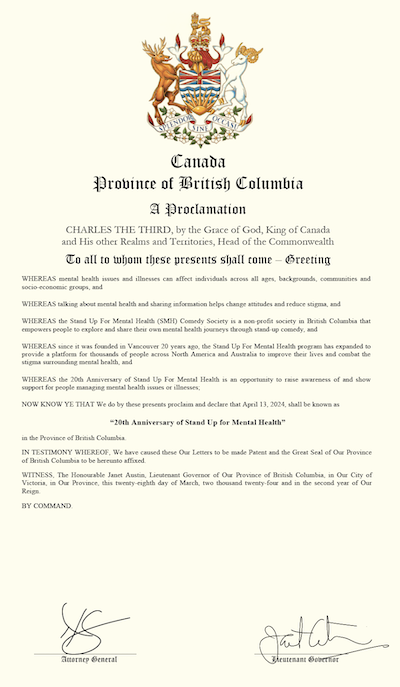
SMH’s 20th anniversary was recognized last month with a proclamation from the Province of British Columbia declaring April 13 as Stand-Up for Mental Health Day.
SMH’s 20th anniversary was recognized last month with a proclamation from the Province of British Columbia declaring April 13 as Stand-Up for Mental Health Day. The proclamation reads, in part, that SMH provides a program for thousands of people “to improve their lives and combat the stigma surrounding mental health and … is an opportunity to raise awareness of and show support for people managing mental health issues or illnesses.”
Since 2004, Granirer and his comics have performed more than 500 shows for mental health organizations, government departments, corporations, universities, correctional facilities and the military. Granirer also gives “laughter in the workplace presentations” to organizations across North America, helping them use humour to lower stress, improve wellness and cope with change. Granirer, too, is the author of The Happy Neurotic: How Fear and Angst Can Lead to Happiness and Success.
SMH’s classes in Vancouver last for six months and students step on stage for two shows, a debut and a graduating performance. As Granirer says, “The comics go from knowing nothing about stand-up to killing it.”
Stand Up for Mental Health is currently recruiting for its next class, which starts July 30. For more information, visit smhcomedysociety.org.
Sam Margolishas written for the Globe and Mail, the National Post, UPI and MSNBC.
By the time you read this, I’ll be working on the last days of preparation before my twins’ b’nai mitzvah. This, as many have said, is a big simcha (happy party), a once-in-a-lifetime event, a milestone and an achievement in our lives. It won’t surprise those who know me that this also puts a lot of pressure on us! Don’t get me wrong, my household is excited. We’re also nervous, apprehensive and stressed by all the details.
It helps to put this into context. We’re a family who has been going to services on Saturdays regularly since long before these children appeared on the scene. My kids are familiar with what’s expected of them and want to do a good job. We’re from a family with diverse approaches to Jewish life, so we’ve gone to all sorts of services, as well as different kinds of Shabbat dinners, family outings on Saturdays, and more. Our kids have experienced many more different ways of observing holidays and Jewish life than I did growing up. This was one of my goals for raising well-informed Jewish kids. For a small ethno-religion, we have so many varied traditions.
This came to mind when I chatted with some of my husband’s young cousins long ago. They told something to the effect that there was only one way to sing a particular part of the Shabbat service. When I explained that there were many melodies and ways to recite the same Shabbat prayers, they looked at me with disbelief. Their experiences with only one congregation in a specific ethnic group and religious movement meant they hadn’t been exposed to multiple melodies or the rich musical traditions of other Jewish communities.
Exploring these choices has made my kids’ lessons and preparations more difficult. If they only knew one tune, well, that’s the one they would sing. However, offering learners many choices means it can be harder to narrow down and practise one melody to make it shine.
Staying true to our family’s particular needs and choices when it comes to the celebration itself has been its own adventure. If one is used to a specific type of bar/bat mitzvah party, with loud music, dancing, catered “rubber chicken,” a photo slide show or a candlelighting ceremony, anything different can seem peculiar. At age 12, I attended one classmate’s bat mitzvah party that was (gasp) held at the family’s home rather than at the synagogue or at a party venue. Rather than graciously modeling that people are different, I thought this was weird. No one reprimanded me for saying this. In retrospect, it was a lovely, heimisch (homey) party held by a family who celebrated the way that they felt most comfortable. I wish I’d had the maturity to see that then.
Holding a Jewish event on a June Shabbat in Winnipeg means that it will be light until late at night, so we’re having a seudah shlishit (a third Shabbat meal or supper). Our congregation’s building is under renovation so the meal will be at home, without the loud music or DJ, to align with those who observe more traditionally. We’ve made numerous choices that my tween self would call “weird.” As an adult, I see it as providing the celebration that fits our family the best.
We’re mostly introverts. Three of the four of us don’t usually like noisy, crowded events. An entire weekend of socialization will be a lot of people time for us. Since many of our relatives are coming from far away, it may be more like a week of company. One of us jokingly said he would announce, “Hey! The party’s over! Please leave!” so he could go back to reading quietly in a corner. We’ve encouraged him not to voice this aloud to any of our relatives or guests.
Although some people hire event planners to manage this, for many households, the burden falls on the mom to arrange everything. This seems to be yet another gendered responsibility. I’ve been told that 50-some years ago, women in the community cooked all the food as well, and there was no catering on offer. I’ve had kind supportive offers from older women friends who remember those days. However, even if one wants to hire serving staff, it can be hard to do in these post-COVID days. There’s just nobody out there who seems to want to do it.
Making so many decisions, from catering to dishes to compost bins and yard games for kids, feels overwhelming. In some moments, I find myself excited about when it will be over and I can stop worrying. Yet, I know that, for many people, this event is a lifelong memory. I just want to make it a meaningful one for all of us. With twins, we only get one chance at it, too, so … no pressure?
Often, I have Jewish texts to lean on to help me understand and guide me. Although it’s not my family’s tradition to recite Eishet Chayil (Proverbs 31:10-31), the tribute to a “woman of valour,” it strikes me that the woman in this important narrative knew how to throw a perfect Jewish family event. I hope I can do something that is half as acceptable, where everyone feels welcome, comfortable and full of good food at the end.
In my head, I’m hearing phrases offered by the older people in my husband’s family at the end of every family party: “May we only meet at happy occasions,” for example. After such a difficult and sad time, I cannot forget those messages. While I worry over the details, please take the opportunity, when it is offered to you, to celebrate at these once-in-a-lifetime happenings. Bring your joy and light to make them special for everyone. “May we only meet at weddings (and not funerals). May we only meet at happy occasions,” these aunts would say as they hugged us. It’s about time to find space for some happy moments, too.
Joanne Seiff has written regularly for the Winnipeg Free Press and various Jewish publications. She is the author of three books, including From the Outside In: Jewish Post Columns 2015-2016, a collection of essays available for digital download or as a paperback from Amazon. Check her out on Instagram @yrnspinner or at joanneseiff.blogspot.com.
Left to right at Chabad of Vancouver Island’s 20th anniversary gala last November: Rabbi Meir Kaplan; Iddo Moed, Israel’s ambassador to Canada; Dr. Elior Kinarthy and Leah Kinarthy, founders of Kineret Tamim Academy of Victoria; and Rebbetzin Chani Kaplan. (photo from Chabad of Vancouver Island)
Chabad of Vancouver Island, led by Rabbi Meir and Rebbetzin Chani Kaplan, ended last year by marking a few milestones. The centre celebrated its 20th anniversary in November with a gala that included many dignitaries from across North America, including the Israeli ambassador to Canada. The centre – which is officially called the Verrier Family Chabad Centre for Jewish Life and Learning – marked eight years since the opening of its own building, which was the first new synagogue built on Vancouver Island in more than 150 years. And, Dec. 22-23, the centre hosted Cantor Yaacov Orzech and the Kol Simcha Singers for a community Shabbaton in solidarity with Israel, marking the first time a choir has ever sung at the Chabad synagogue.
My own connection with the Kaplans and Chabad of Victoria began several years ago, when the Kaplans hosted me at their home for Rosh Hashanah. At the time, services were being conducted in the annex of a nearby school. I was impressed at the dedication of the members of the synagogue in their little makeshift shul and even more impressed when I learned that a new Chabad Centre would be built.
At the 20th anniversary event, which I unfortunately couldn’t attend, a future milestone was announced – the establishment of a new Jewish elementary school in Victoria. Kineret Tamim Academy will be the first new Jewish day school on the island in 160 years. It will be part of the Tamim Academies network, which operates 15 schools across North America, including locations in Toronto, Portland, New York and Miami. Opening in September, it will complement the existing CTots Childhood Education Centre at the Chabad Centre, which has a preschool and kindergarten.
The Verrier Family Chabad Centre for Jewish Life and Learning first opened its doors eight years ago. (photo from Chabad of Vancouver Island)
A spontaneous day trip to Victoria several months ago led to the December milestone at Chabad of Vancouver Island. I called Rabbi Kaplan from the ferry, and he told me to drop by the synagogue and say hello. When I arrived, the rabbi gave me a tour of the two-storey building which houses the kindergarten, a mikvah, offices, a meeting/study room, a Judaica store and a social hall. The building was light and spacious, and the acoustics were impeccable. I mentioned to Rabbi Kaplan that the Kol Simcha Singers, with whom I sing, would appreciate the great sound in the shul. He was intrigued and suggested that perhaps the shul could host an evening for the choir. On a subsequent visit, I brought Cantor Orzech and, after that meeting with Rabbi Kaplan, the stage was set for the community Shabbaton.
The choir – which includes Matanya Orzech, Sydney Goldberg, Maurice Moses, Hirschel Wasserman, Geoffrey Goldman, Edward Lewin, Terry Barnett and me – made our way from Vancouver to Victoria to lead the Friday night and Shabbat morning services. We were joined for this special occasion by a Kol Simcha singer who grew up in Victoria, as well as a chorister who is originally from Manchester but is now a resident of Qualicum Beach. As we crowded around Cantor Orzech on the bima to chant, in harmony, ancient Shabbat melodies, the shul’s acoustics enhanced our voices and made for a heavenly sound. After services, we enjoyed a Shabbat dinner made by Chef Menajem. We ate downstairs in the bright and cheery social hall, which features paintings from local artists. It was a joyous evening, with Rabbi Kaplan leading some spirited singing interspersed with inspiring words of Torah.
Rabbi Meir Kaplan, far right, with Cantor Yaacov Orzech (back) and the Kol Simcha Singers at Chabad of Victoria prior to the Dec. 22-23 Shabbaton. (photo from Chabad of Vancouver Island)
Shabbat morning was more of the same, with the choir singing, under the cantor’s direction, songs to honour Shabbat and Israel. During the service, Rabbi Kaplan acknowledged several members of the congregation who have family members serving in the Israel Defence Forces. At lunch afterwards, the choir sang Shehecheyanu, a prayer that commemorates a milestone, because singing at the centre was a new experience for both the choir and Chabad of Vancouver Island.
At the lunch, Rabbi Kaplan shared that one of our choir members, Terry Barnett, was born in Victoria and had lived there until the 1980s. After the meal, I took a walk with Terry along Cook Road to Dallas Road for a view of the ocean and the Olympic Mountains. For Terry, it was nostalgic being back in Victoria. For me, it was a pleasure to be in the city, too – I had almost moved there several years ago. Terry and I got back to synagogue just in time for ma’ariv, the evening service, and then most of the choir returned to Vancouver.
I stayed over a few extra days and, on Sunday morning, attended services and watched a video of the Lubavitcher Rebbe, Rabbi Menachem Mendel Schneerson (1902-1994), who stressed the need for education in a Jewish community. There were several new programs announced for 2024, including a six-week series entitled Advice for Life, which offers the Rebbe’s guidance for leading a more purposeful life. Registration for the series, which is also held at other Chabad centres, can be made via chabadvi.org or myjli.com. The new program complements the Shabbat and Sunday morning services, weekly classes and adult education and holiday celebrations that the centre offers throughout the year.
Later that Sunday, I took a walk to some familiar places in Victoria and checked out the Fernwood General Store, which is in the neighbourhood I would have moved to. It’s a small grocery store that used to be owned by South African Jews and that still features a kosher section, with kosher chicken, blintzes, bourekas, gefilte fish, tuna, matzah and grape juice, among other things.
My visit to the island for the December Shabbaton reminded me of how much Jewish Victoria has to offer and brought back memories of another milestone I had the privilege of witnessing, the 150th anniversary commemoration of the Conservative Congregation Temple Emanu-El, the oldest synagogue in continuous use in Canada. Hopefully, I will be able to return to Victoria again to celebrate and perhaps write about another Jewish milestone in British Columbia’s beautiful capital city.
David J. Litvak is a prairie refugee from the North End of Winnipeg who is a freelance writer, former Voice of Peace and Co-op Radio broadcaster, “accidental publicist,” and “accidental mashgiach” at Louis Brier Home and Hospital. His articles have been published in the Forward, Globe and Mail and Seattle Post-Intelligencer. His website is cascadiapublicity.com.
Jewish Seniors Alliance honoured volunteers Merle Linde, left, and Gyda Chud for their many years of service. (photo by Rita Propp)
Jewish Seniors Alliance celebrated its 20th anniversary at its Oct. 26 annual general meeting, which took place at Congregation Beth Israel. The meeting was followed by a reception honouring two volunteers, Merle Linde and Gyda Chud, and entertainment was provided by Brock House Big Band, with party sandwiches and dessert by Nava Creative Kosher Cuisine.
The AGM was called to order by JSA president Tammi Belfer, who paid tribute to Serge Haber, who had passed away the previous week. Haber’s family urged JSA to carry on with the proceedings, which included paying respect to all the JSA members who had died in the last year.
The 2022 minutes and the agenda for this year were approved. The president’s report followed and Chud presented a summary of committee reports. Larry Shapiro spoke about the financial position of JSA as of May 31 on behalf of treasurer Alan Marchant, who was unable to attend the meeting. Jerry Bleet gave an update on fundraising plans and the election of directors was presented for the nominating committee by Ken Levitt.
Once the formal part of the afternoon was completed, the 62 members of JSA assembled in the reception area, where tables had been set up and the band was already playing. Brock House Big Band is an 18-piece ensemble whose repertoire comprises a variety of jazz and popular music. Rabbi Adam Stein, a JSA board member, said Hamotzi, so lunch could begin.
Brock House Big Band plays at Jewish Seniors Alliance’s annual general meeting Oct. 26, in celebration of JSA’s 20th anniversary. (photo by Miguel Mendez)
Levitt gave another tribute to Haber, emphasizing Haber’s work in creating JSA from scratch, his care and compassion for seniors, and his work with them. Levitt said Haber thrived on challenges. “How many people can say that they created an organization?” asked Levitt.
A video was shared in which Haber talked about the needs of seniors, the importance of dealing with loneliness and isolation, and the need for emotional support.
Michael Lee, MLA for Vancouver-Langara, said a few words. He had met Haber seven years ago at a seniors’ event and Lee praised the work Haber had done in Holocaust education and his efforts in building JSA to serve seniors in British Columbia. Lee thanked the board and staff for the work JSA has done.
Maurice Moses, a longtime personal friend of Haber’s, spoke about singing with Haber and with Saul “Pucky” Pellman and Arnold Selwyn at the Louis Brier Home and at Congregation Beth Israel for many years. He said Haber called him every Friday to say Shabbat Shalom. Moses made reference to “lech l’chah” – literally meaning “Go to yourself,” “go forth,” the essence of our lives and spiritually being within ourselves – and sang a song about it honouring Haber.
Then it was the time to honour the two volunteers.
Linde has been a peer support volunteer since 2005. She is inspired by the humanitarian ideals of tikkun olam(repairing the world) and chesed (acts of kindness) to ensure a safeguard for those who are at a disadvantage. This work is a natural progression for Linde, from her participation for many years in community organizations in both South Africa and Canada.
Charles Leibovitch, coordinator of peer support services, made the presentation to Linde, as Grace Hann, trainer and supervisor of peer support services, was away due to a death in her family. He presented Linde with a bouquet of flowers and a certificate, praising her for the many years of service to the seniors she has supported. Hann sent a note saying that Linde has been a role model for her.
Linde thanked Leibovitch and Hann. Apparently, all four of her clients had been artists and Linde used with them her own artistic skills and artwork. She said people eventually tell you their stories in such an environment and this enables her to offer emotional support.
Marilyn Berger made the presentation to Chud, calling Chud “our star.” She said Chud seems unable to say no and takes a lot on herself. Chud is a past co-president of JSA and presently chairs two committees – peer support, and programs. In her thanks to Berger and the committee, Chud spoke about the three Rs that are important in education and life: relationship, reflection, restorative practice. She ended with JSA’s motto: “Seniors Stronger Together.”
Ezra Shanken, chief executive officer of the Jewish Federation of Greater Vancouver, addressed the group briefly. He said the JSA is important to the community and thanked the organization for their crucial work with seniors.
Entertained by the band, a few people danced. Dessert was served and people chatted with one another and listened to the music. This was the first of several upcoming events that will celebrate JSA’s 20th anniversary.
On Nov. 19, JSA’s fall symposium will present “Serge Haber, A Visionary.” Everyone is welcome to join in a tribute to Haber, whose vision of a kinder future helped shape the Jewish community. For more information, visit jsalliance.org.
Shanie Levinis a life governor of Jewish Seniors Alliance and on the editorial board of Senior Line magazine.
Adina Horwich at the 42nd annual Rockowers Awards. She received an honourable mention for journalistic excellence in covering Zionism, aliyah and Israel. (photo from Adina Horwich)
The Jewish Independent won four Simon Rockower Awards for Excellence in Jewish Journalism this year. The awards, which are given out by the American Jewish Press Association, were for work done in 2022. The JI has had a few Rockower hat tricks in its history, but this is the first time the paper has garnered four honours in one year.
The awards were presented on July 11 at the Higgins Hotel and Conference Centre in New Orleans, La., where the AJPA’s annual conference was held. The JI mainly competed in the division of weekly and biweekly newspapers, but there were some categories for which the competition was between all types of media (print and online); awards were given for first and second place, and sometimes honourable mention.
Writer Adina Horwich traveled from her home in Israel to New Orleans to receive her award in person. She won the JI an honourable mention for journalistic excellence in covering Zionism, aliyah and Israel for her article “Immigration challenges” (jewishindependent.ca/immigration-challenges-2). The piece both reviews Adi Barokas’s Hebrew-language graphic novel, The Journey to the Best Place on Earth (and Back), about Barokas’s experience trying to immigrate to Vancouver from Israel, and shares Horwich’s experience making aliyah from Canada. The jury commented: “Extremely readable story, that skilfully explores from a personal perspective the nitty gritty of making aliyah.”
The JI’s Pat Johnson also received an honourable mention – his article “Oasis in the Caucasus” (jewishindependent.ca/oasis-in-the-caucasus) garnered recognition for excellence in writing about Jewish heritage and Jewish peoplehood in Europe. The jury said about his piece:
“A terrific look into the Jewish community of Azerbaijan that most of us, unfortunately, don’t have on our ‘Must-Go Places to Visit.’ Pat Johnson’s very nice story strongly suggests otherwise. Johnson paints a wonderful picture of this tucked-away ‘shtetl’ where the residents say they have never faced antisemitism. If only we could feel so lucky here in the United States! And while most of us do well playing ‘Jewish geography,’ actual world geography is often more of a challenge. Having Johnson admit having to Google Azerbaijan before traveling there to report this story added a nice touch that connects with readers who may also be unfamiliar with the country – but now more knowledgeable thanks to this feature.”
Johnson was recognized for another of his articles, “Maus not too graphic” (jewishindependent.ca/maus-not-too-graphic), which placed second for excellence in education reporting. Johnson sat in on Anna-Mae Wiesenthal’s Holocaust and Genocide Studies class at King David High School, and listened as students discussed the graphic memoir Maus by Art Spiegelman.
“Lots of people laughed when a Tennessee school board pulled Maus from the curriculum because of the drawing of a naked cat. That was too much for board members and they banished the Pulitzer Prize-winning graphic novel,” wrote the Rockower jury. “Viewing the book through the eyes of five students at a Jewish high school subtly portrays the board decision’s absurdity.”
Rounding out the JI wins was a first place for excellence in editorial writing – where all entries competed in the same division. The JI editorial board of Johnson, Basya Laye and me were honoured for the set of editorials that included “Every person has a voice” (about Elon Musk, hatred and misinformation online, and how people can counter such forces), “Extremism not helpful” (about New Democratic Party leader Jagmeet Singh’s views on the Israeli-Palestinian conflict) and “New era in U.S. politics” (about the U.S. Supreme Court’s rejection of a woman’s right to reproductive self-determination, as well as the Jewish perspective on abortion).
About these editorials the Rockower jury wrote: “These pieces are good examples of what editorials should be – thoughtful examination of pressing issues, using clear reasoning in looking at both sides, then coming to a well-reasoned conclusion. Local tie-ins strengthen opinions.”
All of us at the JI appreciate the AJPA’s recognition of the hard work that goes into producing an independent Jewish newspaper, magazine or website, and we congratulate all of our colleagues on their achievements. For the full list of Rockower winners, visit ajpa.org.
The JI couldn’t do what we do without our subscribers, donors and advertisers – thank you for all your support. For readers who are thinking about subscribing, donating or advertising, please consider doing so to help us continue producing a high-quality, independent Jewish newspaper that connects community members from across the religious and political spectrums; covers lifecycle events and local, national and international news; and documents our community history as it happens. Visit jewishindependent.ca/support-the-ji, email [email protected] or call 604-689-1520.
Rabbi Itzhak Marmorstein – a former spiritual leader of Vancouver’s Congregation Or Shalom – stands beside the ark in Beit HaRav Kook, where he is the gabbai (sexton). (photo by Gil Zohar)
Scores of congregants packed Beit HaRav in downtown Jerusalem June 2-3 to celebrate the centenary of the historic synagogue, yeshiva and home of Rabbi Abraham Isaac Kook (1865-1935), a seminal Zionist religious leader during the British Mandate who founded the Chief Rabbinate of Israel.
Born in Griva – then part of the Czarist Empire but today Daugavpils, Latvia – Kook arrived in Jaffa, Ottoman Palestine, on Iyar 28, 5665 (1904), where he became the city’s leading Jewish spiritual figure. The family’s private celebration became a national holiday during the 1967 Six Day War when Israel conquered the Old City of Jerusalem on the same date.
Exiled in Switzerland and then in Britain during the First World War, Kook – also known by the Hebrew acronym HaRaAYaH – played a key role in London in securing the 1917 Balfour Declaration by which Britain announced its support for the establishment of a “national home for the Jewish people” in Palestine.
Returning to the country then under British military occupation following the war, Kook served as the Ashkenazi chief rabbi of Jerusalem. Both the city’s Jewish religious leaders and Whitehall were anxious to replace the Ottoman office of hakham bashi, chief rabbi of the former Turkish empire. Thus, in 1921, Kook was appointed to the newly created position of Ashkenazi chief rabbi of the Land of Israel.
But where was a scholar of such stature to live, especially since the representatives of other religions in the holy city all had an appropriate residence?
The issue was brought up in a July 24, 1921, meeting at Government House on the Mount of Olives – today the Augusta Victoria Hospital – between Britain’s newly arrived high commissioner, Sir Herbert Samuel (1870-1963), and New York businessman Harry Fischel (1865-1948). Asked by Samuel to raise money for the project among his American peers, the philanthropist and his wife Shayna volunteered to fund the building themselves.
They identified Beit David, a one-storey kollel almshouse erected in 1873 by philanthropist David Reis. Owned by the Ashkenazi community’s Central Committee of Knesset Israel, the site was eminently suitable. The courtyard – opposite Rothschild Hospital (today Hadassah College) and near the residence of pioneering ophthalmologist Dr. Alfred Ticho and his wife, artist Anna – was located on Hadassah Street, which was renamed after Rabbi Kook following his death.
The yeshiva hall and beit midrash of Beit HaRav Kook. (photo by Gil Zohar)
A cornerstone for the second-floor addition was laid on Aug. 15 before the Fischels departed. Work began immediately. Fischel, an architect and real estate developer in Manhattan, ensured the structure included all the latest modern conveniences. The double-height ceilings were decorated with colourful stencil patterns. Built surrounding a central courtyard, one wing included a reception area, kitchen, bathroom and three bedrooms for the Kook family. The other side included the Central Universal Yeshiva, a synagogue and the scholar’s bureau – now restored to its appearance a century ago. At Kook’s insistence, the synagogue incorporated a moveable roof to permit a sizeable sukkah.
The Kooks moved in at Hanukkah 1922, though the synagogue and yeshiva were still under construction. That spring, the Fischels again crossed the Atlantic. Docking in Alexandria, they caught the train from Egypt across the Sinai Desert to Palestine. Arriving at Lydda (Lod) on May 9, they were greeted by a delegation of rabbis. The couple insisted on being immediately escorted to Beit HaRav.
The dedication began at 3:30 p.m. on Thursday, Sivan 12, 5683 (May 27, 1923). The program – which included 33 events and speakers with a tea break – augured well for cooperation between the country’s growing Jewish community and the new imperial regime.
The many dignitaries in attendance included leading rabbis and Zionist figures. The event was a quasi-national holiday. Jerusalem was decorated with bunting in the Zionist, British and American colours. Flags flew everywhere across the city.
The orchestra of the nearby Institute for the Blind played the Star-Spangled Banner, God Save the King and Hatikvah, while the Etz Chaim Talmud Torah’s choir performed for the guests.
Among the dozens of speakers was Fischel, who addressed the assembly in Hebrew and then English: “Words fail me at this moment to express my gratitude to the Almighty for granting me this privilege of building this Beth HaRav and synagogue…. While my heart always beats for Palestine, yet my home is in America. I have, therefore, had to travel nearly 6,000 miles to participate in this holy celebration….
“The building committee has just presented me with the key of this house certifying thereby that the building is now completed. In view of the fact that this residence and synagogue are to be used for the benefit of the people of Palestine, and that Your Excellency [Samuel], is the chief executive of the land, I therefore deem it fitting and proper to present you with the key, and designate you as custodian of this combined edifice. May I ask you, please, to accept this golden key and keep it as a souvenir and memento of this occasion? I want to take this means also of publicly thanking you for the honour you have bestowed upon us. May God grant you, your administration and the people of Palestine continued security and peace.”
Turning to Kook, sitting next to him on the dais, resplendent in his Sabbath and festival fur spodek (tall, black hat), Samuel declared:
“I congratulate the Chief Rabbinate, Mr. and Mrs. Fischel and the Jewish community at large on this auspicious day. Among the many problems with which the civil administration had to deal on its establishment was the adoption of measures to place the Jewish community both on its secular and on its ecclesiastical side, upon a permanent and regular basis. The question of the organization of the secular side was not yet fully settled. But the government has been able to establish, on an electoral basis, the Chief Rabbinate and, for the first time after an interval of many centuries, a Jewish ecclesiastical authority has been founded on a permanent footing, based upon the decisions of the community itself.”
The ornately carved chair that Samuel presented to Kook on behalf of King George V remains in its place of honour on the synagogue’s eastern wall next to the aron kodesh (Torah ark).
The Beit HaRav dedication ceremony a century ago. Rabbi Isaac Kook, fourth from the right in the photo, is wearing the fur spodek. To his left is Harry Fischel. Herbert Samuel and Sefardi Chief Rabbi Yaakov Meir. (photo from Rabbi Aaron I. Reichel, esq., administrator of the Harry and Jane Fischel Foundation)
Asked about the importance of Beit HaRav, the institution’s gabbai (sexton) Rabbi Itzhak Marmorstein – also known by his nom de plume rabbanique Evan-Shayish – cited Kook’s dedication address a century ago:
“We are engaged here in declaring an elevated ideal that must proceed higher and higher. This ideal must develop and grow its activity through the gathering together of our scattered powers so that together we can proceed in the rebuilding of the ruins of Jerusalem together. This involves strengthening the physical building of the land and the nation in the material realm as the basis for the higher, holy and spiritual building of the Torah and holiness. This will illuminate the living light for the entire national renewal in all its branches.”
Kook’s funeral in 1935 was attended by an estimated 20,000 mourners. Beit HaRav continued to function as the flagship for the dati leumi (national religious) community, but a larger yeshiva was erected in Kiryat Moshe in 1964, and the old building fell into disuse.
Since 2008, Marmorstein – a Canadian-Israeli who formerly served at Congregation Or Shalom in Vancouver – has been engaged in reviving the original building. The building today operates as a neighbourhood synagogue with Sabbath services, as well as a museum.
The centre offers a class every Thursday at 9 p.m. taught by noted kabbalist Rabbi Yohai Yemini on Kook’s commentary on Rabbi Isaac Luria’s teachings. Those insights, recorded and edited in Safed between 1570 and 1572 by his disciple Haim Vital, form the basis for Lurianic kabbalah (mysticism), a system of thought Kook helped spread under which the arrival the Messiah and the ingathering of the Jews to Israel is imminent.
Congregation Schara Tzedeck is celebrating 20 years since Rabbi Andrew Rosenblatt and Dr. Cirelle Rosenblatt arrived in Vancouver, and 115 years as the city’s flagship Orthodox congregation. (photo from Schara Tzedeck)
Members of Congregation Schara Tzedeck are celebrating 20 years since Rabbi Andrew Rosenblatt and Dr. Cirelle Rosenblatt arrived in Vancouver. And, while gala festivities are slated for June 14, the rabbi wants members of his congregation and the larger community to focus less on the individuals than on the role the synagogue has played in the past – and could play in the future.
Schara Tzedeck, which is marking 115 years as the city’s flagship Orthodox congregation, has been a central institution of the community, though Rosenblatt balks at the word “institution.”
“It’s more than a registered authority with CRA,” he said. “It is more than an organization with a letterhead. It’s even more than the sum of its membership because plenty of people who feel a connection with Schara Tzedeck may not currently be paying members but they may have a historical connection. They may live elsewhere now but feel very close to Schara Tzedeck.
“The thing that I want our community to appreciate and to value and perhaps give more attention to is that they are part of this very long story and, if they treat it well, it can play a very important role in their lives,” the rabbi said. “It can play a very significant role in their future and in the security of their family and the emotional health of their family.”
While Rabbi Rosenblatt has been tending to the spiritual and other needs of his congregants, Dr. Rosenblatt has been tending to the medical needs of individuals with brain injuries. As founder and director of Advance Concussion Clinic, she is a leader in the field of neuropsychology and has applied interdisciplinary expertise in concussion as a neuropsychologist and consultant to amateur and professional athletes and teams, including in the Olympics, the National Football League and the National Hockey League.
Reflecting back on two decades, Dr. Rosenblatt believes that it was no accident they landed in Vancouver.
“The primary feeling I have is one of gratitude,” Dr. Rosenblatt told the Independent. “I’m really grateful – I guess it’s appropriate for a rabbi’s wife – I’m really grateful that we were guided to Vancouver. I have a very strong sense of faith and belief that we were meant to be here and that there was a plan in place for us. [I’m] really grateful that God led us to this place but really also to the community and for the community and for the opportunities that Vancouver specifically provided for us and for our family.”
It is partly because of Dr. and Rabbi Rosenblatt’s scientific and theological intersections that the guest speaker for the gala, which is called Mosaic 2023, is Yeshiva University’s president, Rabbi Dr. Ari Berman.
“The reason that we thought it was such a good idea,” explained Rabbi Rosenblatt, “is that Yeshiva University’s motto is ‘Torah Ummada’ [‘Torah and Science,’ or secular knowledge]. The idea of sophisticated wisdom and intellectual disciplines coupled with Torah is going to be something that makes them both better on some level.”
Dr. Rosenblatt was educated in the Yeshiva University system from high school, through her undergraduate studies, to her doctoral work.
Rabbi Rosenblatt, a native of Baltimore, Md., received his smicha, rabbinic ordination, from Yeshiva University. He earlier completed an undergraduate degree in chemistry and English literature and a master’s in bioorganic chemistry at Columbia.
Rabbi Andrew Rosenblatt and Dr. Cirelle Rosenblatt (photo from Schara Tzedeck)
The gala will celebrate the two decades of the Rosenblatts’ service to the community but also the much longer history of Schara Tzedeck, which began as B’nai Yehuda, in 1907, and has been at the heart of Jewish Vancouver almost as long as there has been a Jewish Vancouver. But the rabbi worries that social changes are affecting his congregation and all religious assemblies, and community groups more broadly. Among these are declining engagement at religious services, the omnipresence of social media, the alienation from community connections and related phenomena that author Robert D. Putnam outlined in his 2000 book Bowling Alone: The Collapse and Revival of American Community.
“Those kinds of group spaces, those kinds of community living, are extremely powerful for the need of the individual in terms of their emotional health,” he said. “That, too, is under threat.”
For 115 years, under successive rabbis, Schara Tzedeck has been much more than the sum of its parts, said Rosenblatt.
“You have this network, this community, this thriving ability to provide help and resources and support in a rotating fashion,” he said. “The value of this community has lent emotional and financial and physical and every other kind of support you can possibly imagine. That’s severely threatened now in the 21st century.”
Being spiritual leader of Schara Tzedeck is to play a leadership role in maintaining the infrastructure of Jewish life in the city, including the mikvah (ritual bath) and the cemetery, as well as what is, in the context of those two community assets, a far more recent addition: the 32-kilometre eruv, the spiritual boundary that allows observant Jews to carry certain items outdoors on Shabbat, which Rabbi Avi Baumol created more than 20 years ago.
Taking wisdom that has been passed down for millennia and making it “speak in a modern voice” is what Rosenblatt calls his stock-in-trade, with the late chief rabbi of the United Kingdom, Rabbi Lord Jonathan Sachs, being a model he cites.
“We also try to do things that are a little bit on the creative side in terms of how people can access these mitzvot, but have very long-standing or deep roots in the Torah,” he said, citing a “sukkah-raising” that allowed people to get involved hands-on in the tradition.
“I guess that’s the Jewish equivalent of a barn-raising,” the rabbi said with a laugh. But the congregation also took the opportunity of the ancient tradition of constructing a temporary shelter to discuss the very modern reality of housing security.
Food security is another area that Rosenblatt has emphasized. For years, volunteers from the shul were involved in a vegetable garden at Yaffa House, Vancouver’s Jewish group home and centre for adults with mental illness. The rabbi would take bar mitzvah classes to the garden and talk about the importance of food and sustainability. He also takes great pride in the long presence of members of the Schara Tzedeck community as volunteers in groups like Yaffa House, Tikva Housing and other agencies.
Rosenblatt has trouble believing his family has been here for 20 years, but that passing of time has a very physical manifestation, in the form of the youngest of the Rosenblatts’ five children, the daughter the rabbi calls their “anchor baby,” who was born a few months after the family’s arrival.
“It’s hard for me to believe that her entire life is here,” he said, noting that all five (now adult) children love Vancouver. “They think it’s a really special place.”
As come-from-aways themselves, the Rosenblatts understand the long history of newcomers arriving, often from inhospitable places, to start a new life here. In the days of Schara Tzedeck’s Rabbi Nathan Pastinsky, who began his long service in 1918 and continued until his passing in 1948, the spiritual leader would meet migrants at the train and set them up with a cart from which to sell wares and begin a career.
“I’m not giving people carts anymore,” said Rosenblatt. But he is still very much involved in easing the way for newcomers to navigate the immigration system, find a job and housing and settle into the community.
Shelley Rivkin, vice-president of the Jewish Federation of Greater Vancouver, is just one person with accolades for the contributions the Rosenblatts have made to their chosen home.
“Rabbi Rosenblatt is a consummate bridge-builder,” Rivkin told the Independent. “He is always willing to reach out and have a conversation with anyone regardless of religious practice and beliefs. When you attend his Zoom classes, you see participants from across the Jewish community who are actively engaged in what he has to say.
“Cirelle (Dr. Rosenblatt) is a role model for modern Orthodox women,” Rivkin continued. “She is very learned. She is a highly respected professional and successful businesswoman and she is the mother of five children. When she gives a class, she is able to effectively weave together Torah study with contemporary issues.”
Rabbi Rosenblatt, though, deflects back to the longer history of the shul.
“I want people to understand that the anniversary of this milestone is a moment to appreciate how valuable this institution is,” he said.