Almost every year that the Jewish Independent has entered the American Jewish Press Association’s Simon Rockower Awards for Excellence in Jewish Journalism competition, the paper has been recognized for its editorials. We have won for other articles, too, in several different categories, but have taken away the most honours for our editorials. This year, for instance, we took first and second place! (See jewishindependent.ca/ji-editorials-win-twice.)
The JI’s editorial board, Pat Johnson, Basya Laye and I, don’t always agree initially on what the editorial’s stance will be. Our back-and-forths, exchanging our different views and coming to a consensus, is one of my favourite parts of running the paper. It’s a key reason, I believe, that the editorials have been so award-winning.
Another reason is that the three of us have read and worked on the Jewish Independent for so many years, and we’ve been part of this community for so many years. We are grateful for those on whose shoulders we stand. The wisdom of previous generations, and that of our own generation, inspires how we look at what’s happening here and elsewhere in the world.
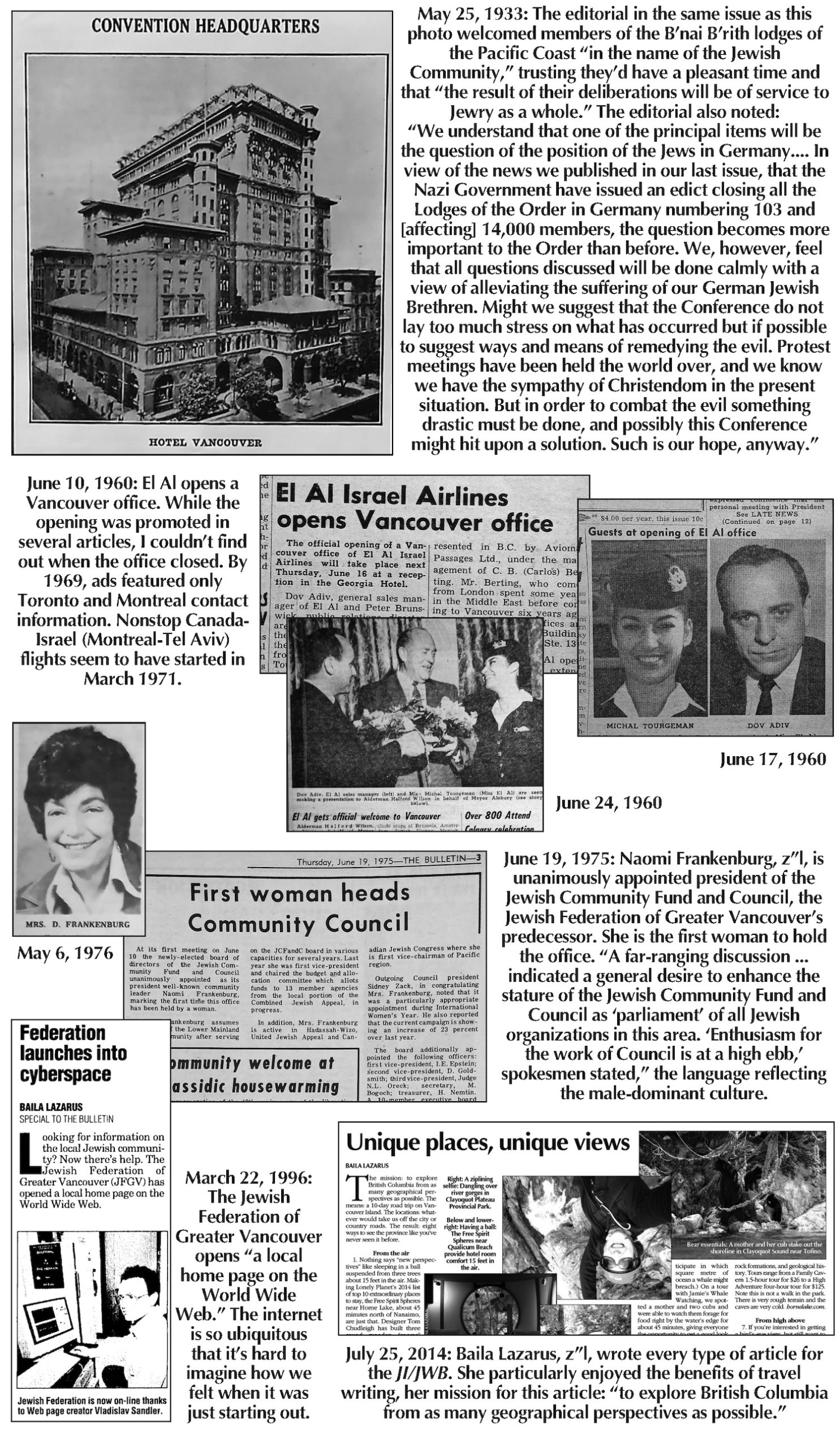
As I looked through the JI archives, I came across the first editorial I wrote for the paper, when it was still called the Jewish Western Bulletin, and before Pat, Basya and I became a team. I also clipped out just some of the thousands of editorials that have been written over the years. There are so many recurring themes, including communal and democratic responsibilities and the importance of free speech. The editorials variously try to calm, cajole, educate or empower readers.
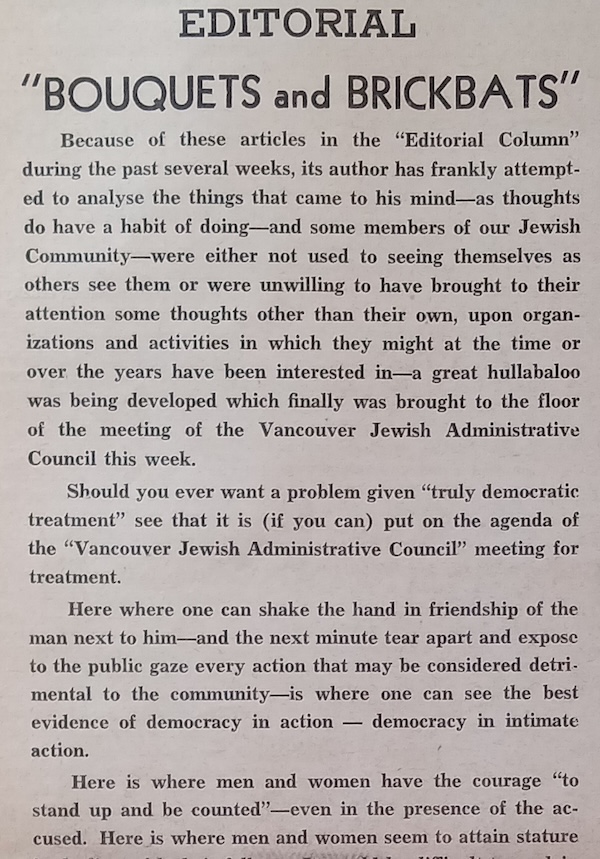
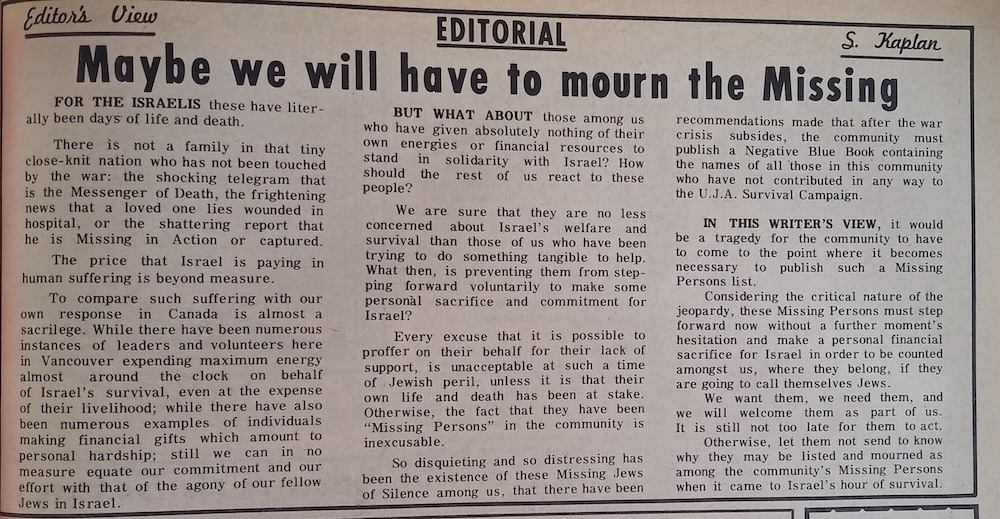
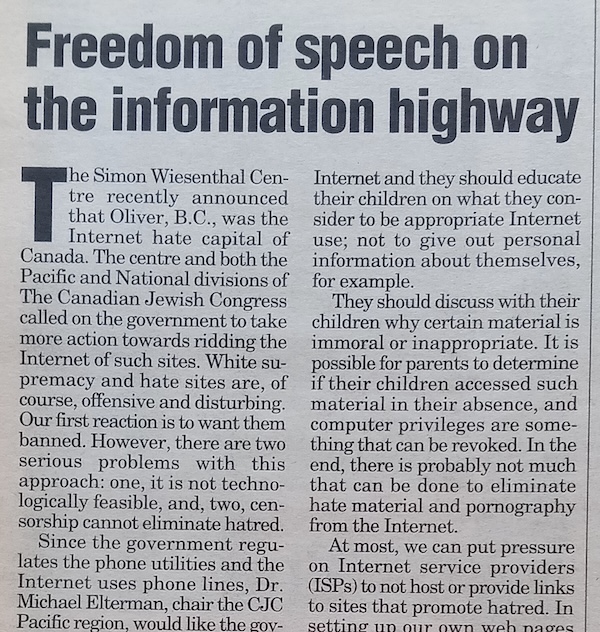
April 13, 1945: The paper’s editorials were brought under community review. Associate editor Goodman Florence describes the meeting that took place and comes to the conclusion that, “He who aspires to express himself must expect to receive both ‘bouquets and brick-bats’ – and if he is intelligent he will use them both.”Oct. 26, 1973: Jewish Western Bulletin editor Sam Kaplan calls out community members who’ve not contributed funds to Israel in the wake of the Yom Kippur War. The editorial floats the idea of publishing a list of these “Missing Jews of Silence.”Feb. 6, 1998: My first editorial for the paper argued for limited regulation of the internet, concluding that state censorship is more dangerous than free speech, including hate speech.
The JI editorial board’s first place Rockower Award winners from 2024 – and our many other missives – can be read at jewishindependent.ca.
“At a time when we are all wishing each other a Happy New Year we may well pause to consider what we mean by happiness and what we shall do to attain it. There is one thing that holds true of all of us: there is nothing that we think so much about, care so much for, aim so much at, as somehow to be happy. Yet happiness remains one of the most elusive objects in the world, and even when we stop chasing it long enough to think about it, we find ourselves confused as to what we mean by being happy, anyway.”
“Let us talk friendly with ourselves as we face the New Year,” continues Rabbi Samuel Cass, spiritual leader of Congregation Beth Israel from 1933 to 1941, writing in the Jewish Western Bulletin’s Sept. 26, 1935, Rosh Hashanah edition. “What is it that we’re trying to overcome? Why does that call of renewal of vitality come as a refreshing sound to our ears?”
Cass contends that “many of us” in that day and age were in a “state of boredom,” despite the “manyavenues of excitement that modern civilization has to offer to us for the enjoyment of our leisure hours.” Hours that “ancient man” – who, “when he did not toil, he slept” – did not have.
“Modern man, thanks to a machine civilization with its labor-saving device, enjoys a greater amount of leisure than man had ever enjoyed before, aside from the enforced leisure of unemployment. Yet our leisure hours are the most boring we enjoy. Just an endless round of movies, cards, games.”
Cass goes on to recount a display at the World’s Fair a couple of summers earlier: “the electric marvel of our age, Captain Televox, the mechanical man. This electrical mechanism, when addressed in the proper pitch, gives correct information, and executes various commands. It can start a vacuum cleaner, turn on the electric lights, sets the radio at the proper station.”
The engineer who created “Mr. Televox” predicted “the day when housewives will be able to be away from the house all day and manage the household duties in absentia, by merely calling up the mechanical man and giving it orders.”
Cass laments that life in the 1930s was “reduced to a mechanical existence” with alarm clocks, radios, cars – even newspapers! “Our music comes from the radio, our dramatic entertainment from the motion picture, our philosophy from newspapers,” he writes.
His solution for happiness?
“Find an ideal somewhere and let it life [sic] you above the mechanics of living, let it give you true freedom and stir within you new fountains of personality. We need not seek very far for it. We are living in a world teething with problems, teething with causes that demand to be taken up!”
He asks readers to “embrace some great human ideal in the New Year, and in it experience the blessedness of a Happy New Year.”
This Rosh Hashanah message – and most of those throughout the JWB/Jewish Independent’s 95-year history – hold up remarkably to the test of time. The language differs, of course, but the problems are variants on sadly consistent themes: war, economics, technology, assimilation, antisemitism, etc. And the “solutions” are also relatively consistent over the years: the need for Jewish education, a renewed embrace ofJudaism’s ideals, unity, engagement, financial and physical support of community institutions, self-reflection. This year’s missive contains some of these same ideas.
In addition to holiday-related articles and editorials, Rosh Hashanah papers over the years have featured local and Israel year roundups, games and puzzles for kids, crosswords, recipes, reflective pieces, and more. The front covers generally gave some indication that the New Year’s issue would be special in some way – another tradition we continue to uphold.
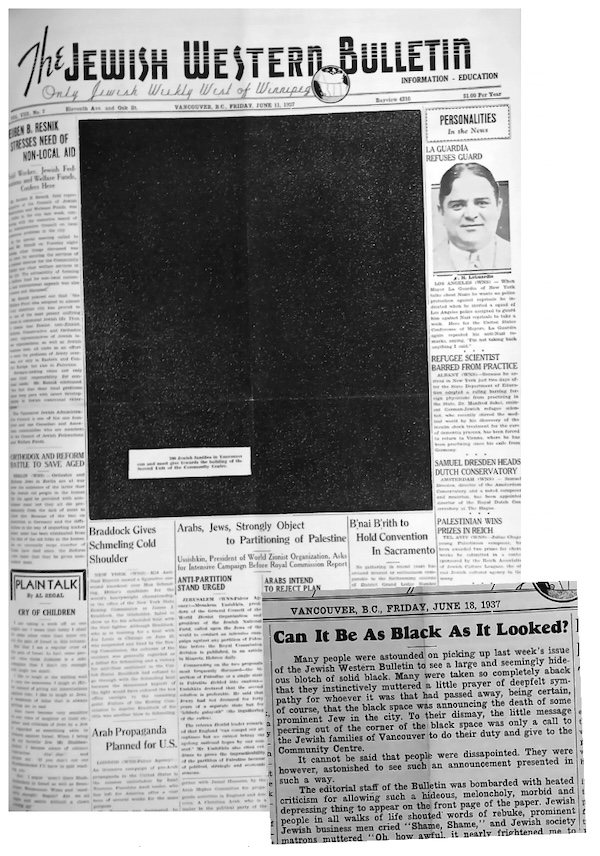
It was the big black square on the cover of the June 11, 1937, Jewish Western Bulletin that caught my attention initially. Then, as I flipped backwards and forwards through the archived papers, it was the weekly drama – that kind of left me hanging – and the sheer bluntness of tactics that drew me in to the JWB’s coverage of the 1937 campaign to raise funds for a second unit of the Jewish Community Centre, then located at Oak and 11th. (The building still exists, the home of the BC Lung Association for a long time now.)
The campaign action plan came out of a shareholders’ meeting in March of that year, at “which over one hundred men of the community were present,” according to the March 12, 1937, JWB, the JI ’s predecessor. I’ve no idea who the shareholders of the centre were. Nor if any women were at that planning meeting, but Lillian Freiman Hadassah, Council of Jewish Women and the Schara Tzedeck Auxiliary were among the organizations that helped solicit and collect pledges.
The appointed campaign committee set a quota of $12,500 (or $271,217 in today’s dollars) and collections were divided into three divisions: donors of $100-$250 (Group A), $25-$100 (Group B) and up to $25 (Group C). The “keynote” of the campaign was “that each give according to his ability,” and every organization on the committee committed “its intention of getting whole-heartedly behind the task ahead.” Meanwhile, “The proposal submitted to shareholders by Schara Tzedeck Congregation of taking over the building has been tabled for a period of three weeks.”
While that proposal obviously fizzled out, I couldn’t find any later mention of it. As I’ve often found when looking through the paper’s archives, it’s easy to find when things start, but harder to find out how they ended up. What is clear is that there was a hard push to raise the $12,500, and, while the March 12 article noted that, “possibly, for the first time in community history, there is no division of opinion concerning the necessity of and the urgent need for doing constructive work for [the] community Centre,” the JWB did feature some disparate views as soon as the next issue.
Rabbi J.L. Zlotnik summed up those concerns in a March 19 article: the quota was too much, given other community concerns and organizations that also needed financial support; and the quota was too little, given that actual building costs are almost always larger than planned, and the community would, therefore, become even more indebted as a result.
“After a period of ten years, twenty thousand dollars are still to be paid before this building can truly be called our own,” wrote Rabbi Samuel Cass in the March 31 issue, about the existing centre, while also pointing to the need for a second unit. He observed, “First, we must not repeat the mistakes of the past,” so the second unit should “be paid for in cash to the very last penny, before the first sod is turned. Second, the campaign must go beyond the amount necessary to erect the contemplated addition.” Lastly, he said, the whole community must agree that the debt on the first unit be paid off “even speedily, and at a near time.”
The advice seems to have gone unheeded. In the same March 31 paper as Cass’s article, the page 2 headline read, “All Organizations Endorse Second Unit Campaign.”
The next edition’s cover blared, “2ND UNIT CAMPAIGN IN FULL SWING,” with the news that more than $3,000 had come in on the campaign’s first day, “collected from twenty men.” The building plans were also outlined in the April 9 paper: a two-storey building with a balcony was envisioned. The lower floor would be a gymnasium and banquet room, with “kitchen, showers, wash room, steam rooms, cloak-room, etc.” The upper floor would house an “Auditorium and Ball Room, cloak-room and lounge.” The balcony would be divided into small meeting rooms. “This present building is 33 feet 11 inches on 11th Ave. The addition would be 47 feet 9 inches or more than 40% larger,” the article stated.
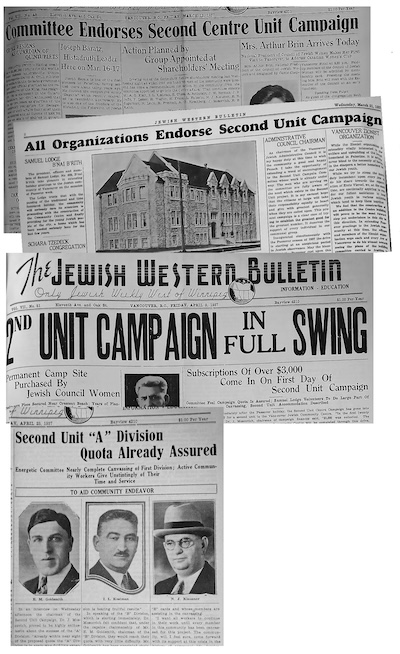
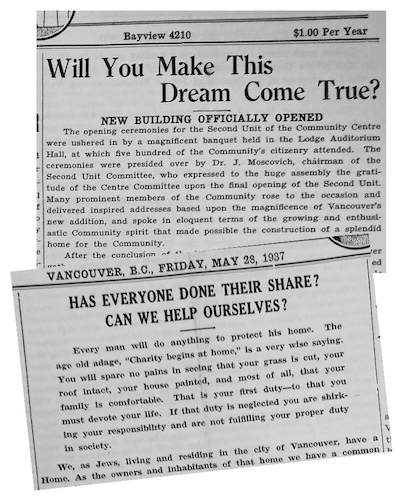
By the April 23 issue, the A Division quota was “already assured.” A couple of weeks later, in the May 7 paper, a completely fictional piece was published on the cover, titled “Will You Make This Dream Come True?” It was written as if the second unit of the centre had opened, with a banquet, a highlight of which was the announcement of a $5,000 gift from an anonymous donor to pay for all the unit’s furnishings and appliances. The article imagined what meetings and other banquets were already being held in the new building and the great number of athletics classes available now that “the use of the gymnasium was available to all persons in the Community.”
By the end of May, though, the JWB was asking whether everyone had “done their share.” By June, the optimism hit a wall.
The cover of the June 11 issue featured the large black square that caught my eye. The label-sized caption with a white background read: “700 Jewish families in Vancouver can and must give towards the building of the Second Unit of the Community Centre.”
The dramatic editorial choice was explained in the June 18 paper:
“The editorial staff of the Bulletin was bombarded with heated criticism for allowing such a hideous, melancholy, morbid and depressing thing to appear on the front page of the paper. Jewish people in all walks of life shouted words of rebuke, prominent Jewish business men cried ‘Shame, Shame,’ and Jewish society matrons muttered ‘Oh, how awful, it nearly frightened me to death.’
“No one, however, said ‘That little message in white, standing so pure, apart from that black hideousness was TRUE. Every body should give to the Centre – How we need that second unit – How essential it is to our Youth to have a proper meeting place.
“What our Community needs is more players, and less bench criticisizers. More workers, and less kickers.”
It concluded: “If you have a conscience, if you have the true community spirit – come through and show it. If you haven’t already given your contribution to the Second Unit – Mail it in to the Centre – tell them this article made you feel your responsibility. If you have given your donation, send in notification to the Centre to have it doubled. No matter what you give, make it as much as you can afford. Don’t let us be criticisers – LET’S BE BUILDERS.”
Over the summer, a couple of meetings were held about the centre. There was a large notice on the cover of the July 2 paper about a July 5 meeting, but I couldn’t find a report in the paper about what transpired. Nor could I find out how the Sept. 22 “mass meeting” on “the Future of Vancouver Jewry” went – its Sept. 14 front-page notice declaring that “By your attendance … YOU SHALL BE JUDGED!”
There are no August or October 1937 papers in the bound archival collection I have, and I don’t know if they were lost to history or never published. Until June 1937, the reporting had been detailed and consistent, but the next mention of a campaign, in the Nov. 12 paper, is “the Recent Centre Drive” – not the second unit drive. In this campaign, there were seven grades, ranging from Grade A ($500 and up) to Grade G ($1 to $49). The Grade A donors were listed by name in that paper, the Grade Bs in the next issue, the Cs in the next, through to the Gs in the Dec. 24 issue, wherein the committee was congratulated for its work and the community for its “whole-hearted support to the campaign.”
Since there is no useable digital archive of the paper, sadly, my time-limited flipping came across no more mention of a second unit. The editorial two years after that campaign, on June 23, 1939, started, “Much water has gone under the bridge since our Centre Building has been re-financed. Inside and outside improvements on the building, in addition to the Amortization Plan itself has gone forward.
“Never have local Jewish efforts been more active, and the response greater, nor has the attendance within the building itself been so large. Much of the success is due to the liberal atmosphere of the Centre itself, which means the use of this building for any and all worthy Jewish efforts with but one thought – helping others to help themselves. One shudders to think of what might have happened to Jewish efforts in our city had not our fellow-Jews responded to the call for funds when it was made.”
The editorial also noted: “Some, however, have through oversight or neglect failed to send their payments in as yet.” It was hoped that “the pledgors in arrears will … see that their respective remittances are made … upon receipt of the notices.”
As far as I know, the second unit of the Oak and 11th JCC never materialized. It would be more than two decades later that a new centre would be built, at Oak and 41st, opening in 1962.

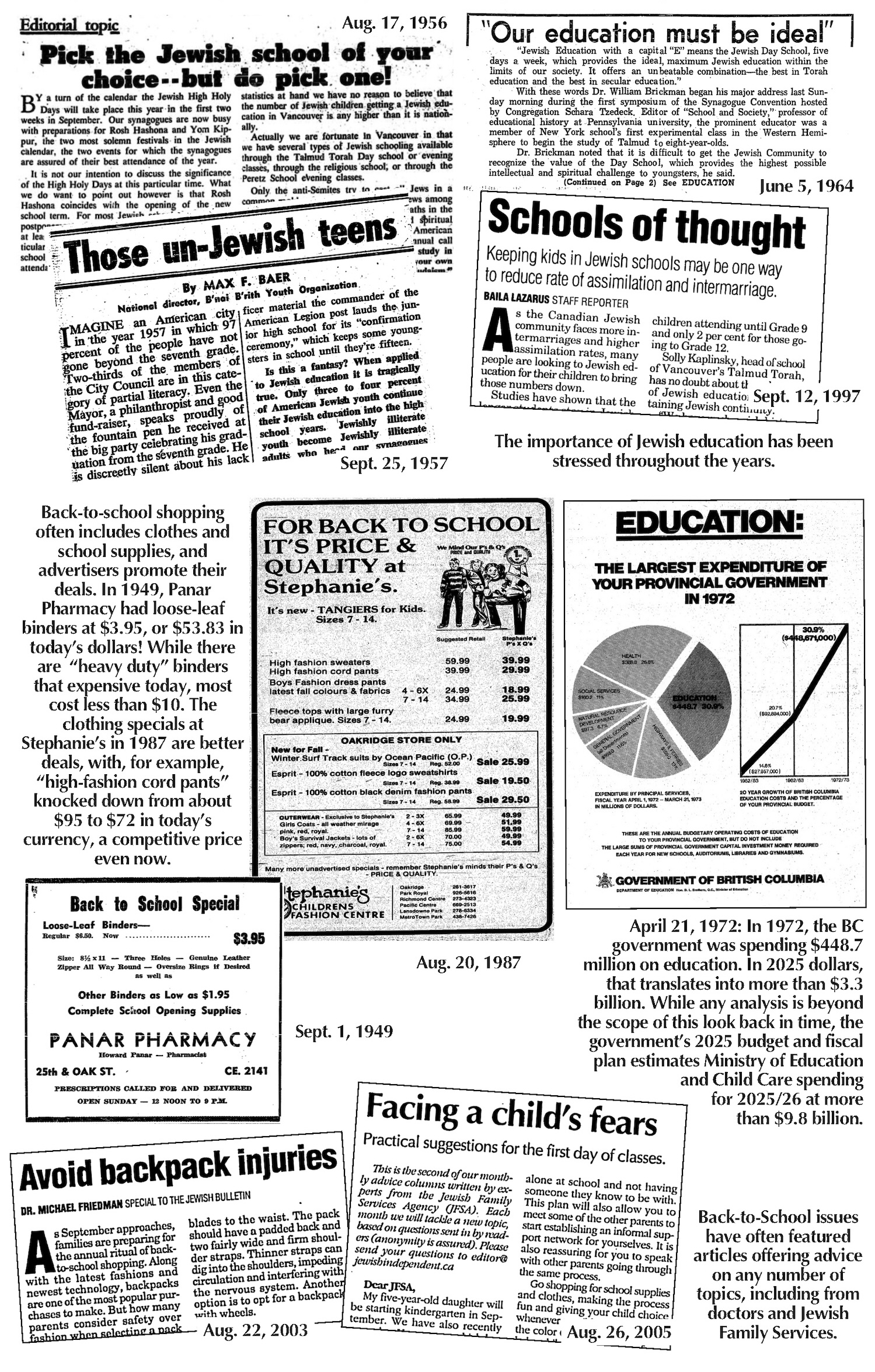
Not surprisingly – “People of the Book,” and all – education is an always-relevant topic that has been covered in the Jewish Independent / Jewish Western Bulletin. The paper seems to have steered clear of editorially supporting any particular Jewish school or type of Jewish schooling, but rather consistently stressed the need for Jewish education, especially for children, but also for youth and adults.
A 1956 editorial noted that “an estimated 50 percent of Jewish children in Canada do not get any Jewish education whatsoever.” While admitting that there were no data to suggest Vancouver fared better than other Canadian cities in this regard, it noted that there were several types of schooling available here, day school, evening classes, religious and secular options. “Only the anti-Semites try to cast all Jews in a common mold, a hateful mold,” it noted. “But the Jews among themselves have always followed diverse paths in the perpetuation of their history, ideals and spiritual heritage.” So, it concluded, “Register your child in the Jewish school of your choice. And, if your child is already enrolled, remind your friend or neighbor about enrolling his child.”
It is sometimes hard to look back over the pages of the Jewish Independent and its predecessor, the Jewish Western Bulletin, knowing what has happened since the articles were published. From the 1933 optimism that there was hope for German Jewry, to the enthusiastic welcome of a seemingly short-lived El Al office in Vancouver, to colleagues who have passed away.
King Charles was in Canada this week, delivering the Speech from the Throne. It was a monumental moment in many ways, not least because it was the first official visit by the monarch since he ascended to the throne. For those of us whose entire lives have been lived under the reign of Queen Elizabeth II, it remains a fascinating and jarring challenge to the tongue to hear the phrase “the King of Canada.”
Paging through back issues of the Jewish Western Bulletin, which preceded the Jewish Independent, one of many striking things is the efforts that Jewish individuals, businesses and other advertisers have taken, over the decades, to express loyalty to king (or queen, as the case more commonly has been) and country.
Knowing what we know of antisemitic tropes, we suspect that this had more than a little to do with the stereotype of “dual loyalty.” Throughout history, Jews have been accused of being more loyal to their “tribe” than to their countries of domicile. Since 1948, this antisemitic idea has been applied to Israel, whose interests Jews today are often accused of prioritizing above the interests of their own countries, like Canada.
The sort of hyper-patriotic and monarchist messages we saw in the pages of this paper in decades past have largely disappeared. The trope of dual loyalty is not the most prevalent or dangerous threat to Jewish security in Canada or most other Western countries at the moment. Put succinctly, those who want to take offence with Jewish Canadians are less likely to go the extra step and accuse us of dual loyalty. They just cut to the chase and contend that any support for Israel at all is evidence of ill-will or immorality.
As we have turned the pages of the past in preparing for this special anniversary issue, that is just one small example of social change reflected from issue to issue in 95 years as an institution in this community.
As much as things have changed, so a great deal has remained the same. It is amusing, heartening and sometimes frustrating to see the repetitive nature of (we suppose) humankind in general and Jewishkind in particular across 10 decades. So many of the same discussions and arguments that our people were engaged in locally and globally 60 or 70 years ago remain on our lips today. More encouragingly, the leaders, activists and influencers (we certainly didn’t use that latter word until far more recent issues) of our community have often shared the same surnames, from the 1930s through to today, and so many new surnames – Jews from myriad different backgrounds – have joined the list of community contributors. The continuity combined with the growth in number and diversity is reassuring.
So much has changed in 95 years, such that the originators of the newspaper you hold in your hands (or, by a previously unimaginable magic of futuristic wonder, are reading on some whirring space-age illuminated rectangle) could not have foreseen.
These are not easy days for print media or, really, legacy media of any variety. We believe, and we hope you share our certainty, that the product we put out, as the latest iteration of a 95-year commitment to informing and reflecting our community, has value today, as it has across most of the past century.
As attention spans have shortened and the media landscape has refracted, keeping eyes on these pages is a challenge. At times, we content ourselves with the belief that the stories we write today will only increase in value as, at some unimaginable future time, and perhaps using some heretofore unimagined technological phenomenon, researchers or people with an avocational curiosity about the past, will finger through what we have written to understand better who we were and, therefore, how the Jewish community of the future became what it is, just as a review of our archives helps us understand how we came to be who we are today.
That a small, plucky newspaper operating on a shoestring at the remote edges of the Jewish universe could survive, and occasionally thrive, across 95 years is, even in the context of the much longer, always extraordinary, history of the Jews, something of a miracle.
This is a moment for us to thank everyone who made this possible, many of whose names have appeared in these pages across the years and many who have not. As a reader and supporter of the Jewish Independent, you are now part of that long legacy of people who have made this moment happen. Thank you for making this milestone possible. More importantly, thank you for making possible our present and our future.
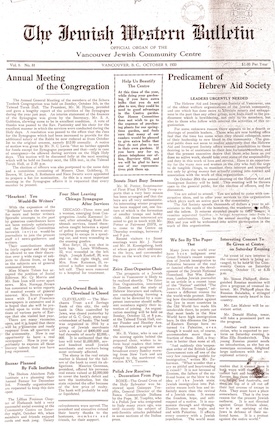
When does something begin? I’ve been thinking about that as I go through 95 years’ worth of Jewish Independents. Well, 20 years of JIs and 75 years of its predecessor, the Jewish Western Bulletin. The JWB also had its predecessors – mimeos and letter-sized versions. The paper’s founders started counting on Oct. 9, 1930, the official first tabloid edition, when they could have started July 15, 1925, “the natal issue of the Vancouver Jewish Bulletin.” Or maybe earlier. Who knows when the idea that brought into existence what would become, through thousands of issues, the paper you today hold in your hands or read on your computer.
Making the cover of this special issue, where six stories jump to the inside and the rest of the stories are blurbs that direct readers to pages on the inside, was an organizational challenge. There was no way I could replicate the brevity of the 1930s articles, but I could mimic the style.
I know I’ve mentioned this fact in previous anniversary issues, that the JI could be considered five years older than the age we have deemed it to be. In looking through so many beginnings – and endings – throughout the years, it struck me again. So many organizations have multiple possibilities for the equivalent of their first edition. For example, the Louis Brier Home and Hospital was organized in 1945, but the idea for it probably came even earlier and the home didn’t open until 1946.
I share this as a caveat because, as I went through the paper’s archives, looking for other community organizations that are celebrating a significant anniversary this year, I no doubt have missed some. But my intent was good – I wanted to share the JI’s “special day” with others.
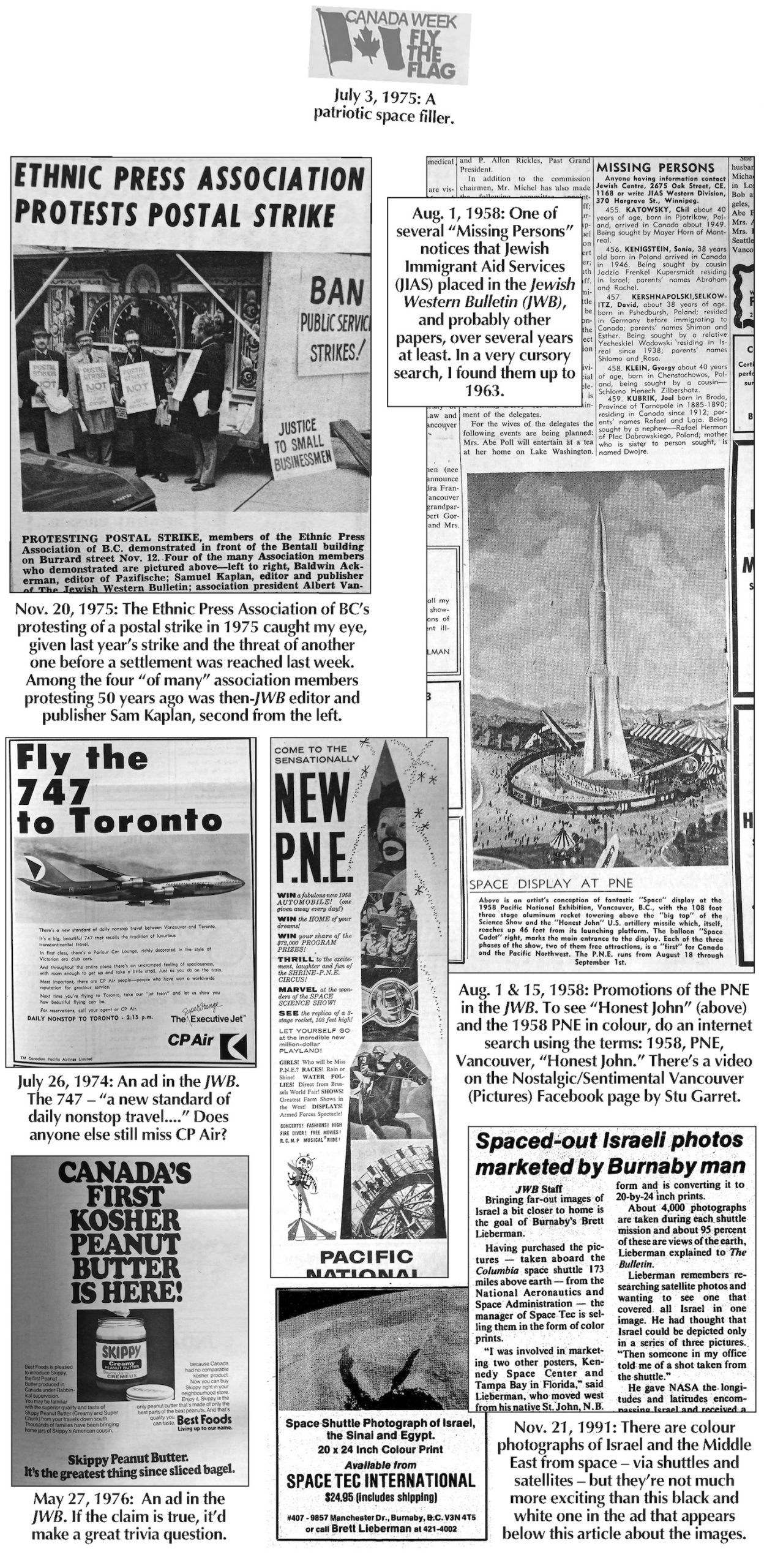
Unfortunately, I was hampered in my goal because the search function of the online Jewish Western Bulletin archives (newspapers.lib.sfu.ca/jwb-collection) is basically dysfunctional. If I had a 95th birthday wish, it would be to have the funding to have all the newspapers back to 1925 re-digitized and re-indexed, so that this priceless resource could be more accessible. In the meantime, I hope readers can embrace the random smattering of “clippings” that represent my attempt to show how the newspaper has grown with the community – our success being directly attributable to our collective success.
I continue to wish that the founders of the newspaper had started counting in 1925, when the “natal issue of the Vancouver Jewish Bulletin” was published.
Going through the pages of the newspaper over 95 years is both an inspiring experience and a sobering one. Countless people, organizations, businesses and events no longer exist, but there are always new people coming into the world, coming into the community; new groups being created, new businesses popping up, new ideas being discussed, new events being organized. If the size of the Community Calendar is any indication, there is more happening in the community today than there has ever been.
During my 26 years as publisher – or, one of my other beginnings, 27 years since I was hired by the paper – there have been recessions, wars, a global pandemic, and seemingly inexhaustible antisemitism, which has increased greatly since Hamas’s terror attacks on Israel on Oct. 7, 2023. I am still processing that massacre, the ensuing war and all the other violent conflicts happening in the world, the hate and the anger that threaten to overwhelm. It never ceases to amaze and sadden me, humanity’s ability to be as destructive and cruel as we can be creative and compassionate. I won’t dwell on the negative here.
In running the newspaper, I have tried to maintain a middle ground, to be inclusive but also respect my own boundaries. I think there are concerns that should be played out in public, and others that should be dealt with privately. The JI is not a gossip rag, it is not sensationalist or alarmist. That is a decision I have made, and that our editorial board (Pat Johnson, Basya Laye and me) considers every issue.
While not ignoring the hurtful, the divisions, the controversies in our community or the larger universe, we try to cover stories in a way that doesn’t depress and paralyze action, but rather opens the door for solutions or at least positive attempts at change. We don’t want readers to put down the newspaper in despair, but rather to think about what they can do to contribute to a better world, whatever that means to them. One ad in this paper heralds the JI for being the bearer of good news – it makes me happy that people think that, even as we report the news that’s not so good.
The Jewish Independent has survived so long because of one thing: community support.
In 95 years, there has been much to mourn, that is true, but there also has been so much to celebrate. Personally, during my tenure as publisher, I have benefited from many kindnesses, from generous landlords and donors to loyal subscribers and the people who support the paper through purchasing ads.
I have met, worked with and/or become friends with some truly amazing people. I consider myself lucky to have joined the paper early enough to have met in person several of the visionaries who built the organizational foundations of this community, not to mention those of the province, even of Canada, in some instances. There are afternoon teas, lunches and gala dinners I’ll remember forever, if the mind stays healthy.
The people I work with are smart, talented, dedicated and should be earning a lot more than they are. I might own the paper, but by no means do I run it alone. The people whose names you see on the masthead every issue are integral to publishing the paper. And all the people who have been on that masthead over the years – and the many more who have not been recognized in print – have helped keep the paper going, from its first days to today. I thank you all.
I am not a journalist per se, nor an entrepreneur. I’m trained as an economist, and still make myself chuckle when I think of the most uneconomical choice I have made in my life – to buy this newspaper. But it has kept me clothed and fed, with a roof above my head. It has taught me so many things and, though I’ve not always been a willing student, I am better for the lessons.
Most importantly, I am better for all the people I have encountered on this journey. I have made many friends and acquaintances. Not all my encounters have been pleasant or easy, but I have come to appreciate more as I’ve gotten older that, behind the organizations serving the community are simply people. Maybe people I don’t always agree with, but people who are undeniably committed. They are people who believe in community so much that they give of their time, either as volunteers or staff or both, working in one place, volunteering in others. Or they give of their financialresources, funding causes in which they believe, choosing to give away some of their money rather than letting it sit in the bank or using it for personal wants and needs.
It is a privilege to do what I do for a living. I am proud to be part of this extraordinary community. Kol hakavod to us all. May we go from strength to strength….
Now let’s party. Happy anniversary to all the other Jewish organizations celebrating a milestone this year!
Israeli writer Gil Zohar (standing, seventh from the left) with other 2024 Rockower Award winners in Nashville, Tenn., last month. (photo by Bill Motchan)
At the annual conference of the American Jewish Press Association, which took place in Nashville, Tenn., June 2-4, Israeli freelance writer and tour guide Gil Zohar was there in person to collect his Rockower Award for Excellence in Jewish Journalism. He won an honourable mention for the article “Identifying the victims,” published by the Jewish Independent Nov. 10, 2023. The Independent picked up four Rockowers this year, for work published in 2023.
Zohar’s article (jewishindependent.ca/identifying-the-victims) won in the Wild Card Category – Award for Excellence in Writing about the War in Israel: News and Feature Writing. It explains how staff at the Israel Defence Forces’ Shura base were working around the clock at the time to identify the remains of the 1,200 people murdered in Israel by Hamas terrorists on Oct. 7, 2023, a process made more grisly and difficult because of the extreme brutality of the attack.
Winning first place in the Wild Card Category for weekly and biweekly newspapers was “New era for world Jewry” by Chaim Goldberg, published by Intermountain Jewish News (Denver, Colo.). Taking second place was “A letter from Israel: It’s okay to start dreaming” by Chaim Steinmetz, published in the Jewish Journal of Greater LA (Los Angeles, Calif.).
The Jewish Independent won first place for weekly and biweekly newspapers in the category of Excellence in Single Commentary with Helen Mintz’s article “Opportunity for healing” (jewishindependent.ca/opportunity-for-healing). Originally presented as a d’var Torah at Or Shalom Synagogue, it was “intended as a beginning of a conversation about how we, as Canadian Jews, can heal our relationship with Ukrainians and Ukraine.” Of the article, the Rockower jury wrote: “A powerful reminder that there are many ways to view complex histories. The beautiful way the story is told is both intimately personal and ultimately universal.”
Taking second place in the Single Commentary category was “Wokeism and the Jews: A reckoning” by Monica Osborne (Jewish Journal of Greater LA), with “The inside story of how Palestinians took over the world” by Gary Wexler (also for the Jewish Journal of Greater LA) receiving an honourable mention.
Local musician, composer and bandleader Moshe Denburg earned the Jewish Independent second place for Excellence in Arts – Review/Criticism, weekly and biweekly newspapers, with his review “Erez’s new CD shows mastery” (jewishindependent.ca/erezs-new-cd-shows-mastery). The Rockower jury wrote: “Sounds like a great CD.”
Placing first Excellence in Arts – Review/Criticism was “Oppenheimer, and the lesson of brainy Jews” by Thane Rosenbaum (Jewish Journal of Greater LA) and Tabby Refael received an honourable mention for the article “For a deaf woman from Iran, freedom never sounded so good” (Jewish Journal of Greater LA).
Winnipeg freelance writer Joanne Seiff won the Independent its fourth award, placing second in the category of Excellence in Writing about Jewish Thought and Life. The JI submitted three of her articles for consideration: “Women’s rights evolve,” “Honouring others in death” and “A yearly reminder to return.” The first article (jewishindependent.ca/womens-rights-evolve) talks about parallels between modern events and talmudic discussions – in particular laws that limit women’s ability to control their own bodies. The second article (jewishindependent.ca/honouring-others-in-death) is about how Jewish tradition could inform the debate that ensued after the remains of four murdered Indigenous women were found in Winnipeg-area landfills, and the third piece (jewishindependent.ca/a-yearly-reminder-to-return) connects the renovation of Seiff’s home with the month of Elul and teshuvah, usually translated as repentance, but also meaning return. “Returning to our best selves might require us to listen, pay attention to our gut feelings, do some renovation,” she writes.
In summing up Seiff’s articles, a member of the Rockower jury commented: “I would love to live in Winnipeg, only to read Joanne Seiff regularly. She is an intelligent writer.”
First place in this category for weekly and biweekly newspapers went to “Ten measures of beauty, of fragility, of hope” by Tehilla Goldberg (Intermountain Jewish News) and Refael won another honourable mention, for the article “I’m an observant Jew, and I need Christmas music more than ever before.”
To read the writing of all the 2024 Rockower winners, visit ajpa.org.