Skip to content
  • Home
  • Subscribe / donate
  • Events calendar
  • News
    • Local
    • National
    • Israel
    • World
    • עניין בחדשות
      A roundup of news in Canada and further afield, in Hebrew.
  • Opinion
    • From the JI
    • Op-Ed
  • Arts & Culture
    • Performing Arts
    • Music
    • Books
    • Visual Arts
    • TV & Film
  • Life
    • Celebrating the Holidays
    • Travel
    • The Daily Snooze
      Cartoons by Jacob Samuel
    • Mystery Photo
      Help the JI and JMABC fill in the gaps in our archives.
  • Community Links
    • Organizations, Etc.
    • Other News Sources & Blogs
    • Business Directory
  • FAQ
  • JI Chai Celebration
  • JI@88! video

Recent Posts

  • המלחמות של נתניהו וטראמפ
  • Zionism wins big in Vegas
  • Different but connected
  • Survival not passive
  • Musical celebration of Israel
  • Shoppe celebrates 25 years
  • Human “book” event
  • Reclaiming Jewish stories
  • Bema presents Perseverance
  • CSS honours Bellas z”l
  • Sheba Promise here May 7
  • Reflections from Be’eri
  • New law a desecration
  • Resilient joy in tough times
  • Rescue dog brings joy
  • Art chosen for new museum
  • Reminder of hope, resilience
  • The national food of Israel?
  • Story of Israel’s north
  • Sheltering in train stations
  • Teach critical thinking
  • Learning to bridge divides
  • Supporting Iranian community
  • Art dismantles systems
  • Beth Tikvah celebrates 50th
  • What is Jewish music?
  • Celebrate joy of music
  • Women share experiences 
  • Raising funds for Survivors
  • Call for digital literacy
  • The hidden hand of hate
  • Tarot as spiritual ritual
  • Students create fancy meal
  • Encouraging young voices
  • Rose’s Angels delivers
  • Living life to its fullest

Archives

Follow @JewishIndie
image - The CJN - Visit Us Banner - 300x600 - 101625

Tag: JSABC

BC budget fails seniors

BC budget fails seniors

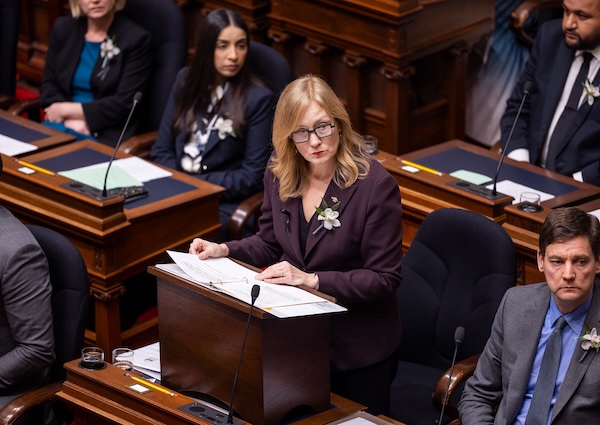
Brenda Bailey, BC minister of finance, delivers the government’s 2026 budget. (photo from flickr.com/photos/bcgovphotos)

British Columbia’s 2026 budget sends a message that should concern every family in this province: seniors can wait. Indefinitely.

Seven scheduled long-term care projects have been delayed. These designated projects were to be built in Abbotsford, Campbell River, Chilliwack, Kelowna, Delta, Fort St. John and Squamish. They now have no completion dates. Are these “delays” just another broken government promise? 

This is not a minor policy adjustment. It is a policy choice with real consequences. The reality is that this reinforces an all too familiar pattern: the fastest-growing demographic in the province continues to receive the slowest response. What is government waiting for?

When long-term care beds are delayed, the need does not disappear. It shifts. It shifts into overcrowded hospitals, onto exhausted family caregivers, and into the homes of seniors who are increasingly isolated and struggling to cope without adequate support.

Despite the fiscal challenges facing the province, delay of critical infrastructure for seniors leaves seniors living in isolation and without proper supports. Government knows this produces worse outcomes for seniors.

The province is aging faster than its systems are evolving. Every year of delay widens the gap between need and capacity. While governments talk about sustainability, the current approach is neither sustainable nor strategic. Even with the completion of these planned beds, demand for long-term care beds vastly outpaces availability. It always will.

Delaying long-term care without rapidly expanding home support is not a cost-saving measure. It not only shifts the burdens of care, but the costs. It shifts costs to emergency departments. It shifts costs to family caregivers who reduce work hours or leave the workforce. It shifts costs in its impact on seniors’ physical and mental health as isolation deepens. And, ultimately, it shifts even greater costs back onto the health system.

This is why the 2026 budget was a missed opportunity for bold solutions.

If capital projects must be delayed, then investment in home support should surge. Instead, innovation in home and community care remains an afterthought – despite overwhelming evidence that it is the most cost-effective way to support aging populations.

Jewish Seniors Alliance of British Columbia knows that most seniors want to age at home. Supporting them there is dramatically cheaper than institutional care. Preventing crises is cheaper than responding to them. Keeping people connected is cheaper than treating the consequences of isolation.

The math is not complicated. The policy response should not be either. This is why JSABC has long been a leading advocate for universal free access to home support for all BC seniors.

Across British Columbia, community organizations are already proving what works: volunteer-driven wellness checks, culturally appropriate outreach, transportation assistance, social programs and coordinated home-support initiatives that keep seniors healthier and independent longer. These are not luxury services. They are preventive health care in its most practical form. Yet they remain chronically underfunded, and our community organizations can’t keep pace to support our seniors’ needs province wide.

Home support is not a side program. It is the backbone of a modern seniors care strategy focused on providing alternative service delivery models and providing support for people to age well in place.

It is time for government to prioritize seniors. Ignoring the problem today won’t change the system for when we ourselves are looking for extra support not so far into the future. 

Jeff Moss is executive director of Jewish Seniors Alliance of British Columbia.

Format ImagePosted on March 13, 2026March 12, 2026Author Jeff MossCategories Op-EdTags British Columbia, Budget 2026, health care, home care, Jewish Seniors Alliance, JSABC, long-term care beds, seniors

Chronicle of a community

The past and future of Jewish journalism were on the agenda when Cynthia Ramsay addressed the Jewish Seniors Alliance of British Columbia, Jan. 27. 

In a Zoom presentation that was part of the alliance’s Empowerment Series, the publisher of the Jewish Independent spoke on the history of the newspaper and discussed the future of Jewish newspapers in general and the Independent in particular.

photo - Ramsay spoke about the history and future of the Jewish Independent at the Jewish Seniors Alliance of British Columbia Empowerment session Jan. 27
Ramsay spoke about the history and future of the Jewish Independent at the Jewish Seniors Alliance of British Columbia Empowerment session Jan. 27. (photo by Karen Ginsberg)

While the paper celebrated its 95th anniversary last year, Ramsay said it could be a century old, depending on how one begins the count. 

A Vancouver Jewish Bulletin was published in 1925, printed by Dr. J.I. Gorosh and this was succeeded by a mimeographed newsletter produced by the Jewish Community Centre and dubbed the Jewish Centre News. The name Jewish Western Bulletin dates to the 1930s.

Publishing transitioned to the Jewish Community Council of Greater Vancouver, a forerunner of today’s Jewish Federation, though it appears to have evolved a degree of independence under publisher Abraham Arnold, who took the helm in 1949, in conjunction with his wife Bertha.

The newspaper became formally separate from other institutions a decade or so after Sam and Mona Kaplan took over in 1960. 

The Kaplans were very much committed to advocacy journalism, Ramsay said, most notably advocating freedom for Soviet Jewry.

The Kaplans ran the paper for 35 years and, after a period when it was contracted to an American Jewish media chain, it was sold to Ramsay and two partners, Kyle Berger and Pat Johnson. The latter two later left the business but Ramsay says she is happy that they remain friends and that Johnson is on the editorial board and still writes for the paper (including this story).

The new leadership brought fresh policies, including accepting notices of interfaith and same-gender weddings, as well as coverage of a broader range of topics that were previously considered off limits. The paper opened up to a wider range of opinions, including on Israel.

In 2005, Ramsay renamed the paper the Jewish Independent.

“I changed it because I didn’t think Bulletin really said ‘newspaper,’” she explained. “We got rid of the word ‘western’ also. By that point we were online … and it wasn’t just people from BC who were reading it.” 

The paper walks a line between supporting the community and providing a critical eye where necessary, she said.

“I think there are concerns that should be played out in public, but then there’s others that really should be dealt with privately,” she said. “We’re not a gossip rag and we’re also not sensationalist or alarmist. 

“We don’t ignore the bad stuff that goes on in our community or in the world, but we do try to cover stories in a way that doesn’t depress or paralyze,” said Ramsay, quoting from an article she wrote in the paper’s anniversary issue last May. “We want, rather, to open the door for solutions and at least positive attempts at change. We don’t want you to put down the paper in despair, but rather [consider] what you can do to contribute to making the world a better place.” 

Above all, she said, the paper tries to provide a record of the community, a role it has played for most of a century. 

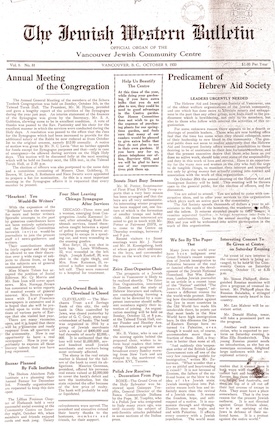
image - The first issue of the Jewish Western Bulletin, Oct. 9, 1930
The first issue of the Jewish Western Bulletin, Oct. 9, 1930.

“The Jewish Western Bulletin, the Jewish Independent, has been the only consistent historical record of the community since 1930,” she said. 

“Now, of course, we miss a lot of stuff,” she acknowledged. “We have a very small staff. We have a limited number of pages every issue, we’re not going to cover everything.”

She provided an insider view of how the paper operates in terms of the amount of advertising determining the size of each issue, and how decisions are made about what is covered in each issue and on what page things appear.

The pandemic was deeply challenging to the economic viability of the paper, said Ramsay, and it was at that time that the publishing schedule shifted to twice monthly from weekly. 

image - The Jan. 23, 2026, issue of the Jewish Independent
The Jan. 23, 2026, issue of the Jewish Independent.

The Independent has survived when other Jewish newspapers in Canada and across North America have not, she noted, even including Federation-owned publications that have gone under in some cities. She wants the paper to reach 100 and she also has her own retirement in mind, tentatively at age 60.

“I’m 56,” she said, noting that almost 30 of those years have been devoted to the paper.

“I’m already starting to think about succession plans,” she said. “I’ve kind of got a five-year window at this point where I’m looking and wanting to responsibly pass over [the paper].”

Innovation could make the publication more sustainable, perhaps a monthly format, she said. 

All in all, she takes pride in her achievements and the longer history of the paper’s contributions to the community.

“I think we’ve been a great success, not just because we’re 96 years old, but … [almost] every year we’ve won an American Jewish Press Association Rockower Award for Excellence in Jewish Journalism, mostly for our editorials, but occasionally for other articles,” she said.

The Jewish Seniors Alliance session was opened by Jeff Moss, the organization’s executive director. Fran Goldberg introduced Ramsay. 

Posted on February 13, 2026February 11, 2026Author Pat JohnsonCategories LocalTags history, Jewish Independent, Jewish journalism, Jewish Seniors Alliance, Jewish Western Bulletin, JSABC
What should governments do?

What should governments do?

Left to right at the Jewish Seniors Alliance of BC Fall Symposium Nov. 23: Jeff Moss, Joyce Murray, Anthony Kupferschmidt, Dan Levitt and Isobel Mackenzie. (photo by Alex Roque Photography)

The Jewish Seniors Alliance of British Columbia’s fall symposium featured a panel discussion on the responsibilities of governments for seniors. The panelists discussed housing, transportation and healthcare services. They explored challenges in funding, staffing and service delivery, while also touching on topics such as the potential for community involvement in shaping senior support systems.

The Nov. 23 gathering, which took place at the Jewish Community Centre of Greater Vancouver, opened with Jeff Moss, executive director of JSABC. He said provincial advocacy is “at the heart” of what JSA does, “and bringing together politicians in this space is really important, because the conversations that we have when we meet with the provincial government, or when we’re meeting with the opposition, [are] where we are advocating strongly for universal free home support for seniors in British Columbia.”

JSA’s partners in this campaign are Council of Senior Citizens’ Organization (COSCO), the BC Health Coalition, the Independent Long-Term Care Councils Association of BC, Family Caregivers of British Columbia and the BC Care Providers Association (BCCPA), whose chief executive officer, Mary Polak, addressed those gathered. 

Polak shared that her father, who’s 96 years old, is in long-term care. He has some dementia issues and needs to have some specialized care, she said. “But in the time that he was at home with us and we were trying to give him the best quality of life we could in our own home, it was a real challenge to try and support that with home health services. And we were in a better place than many because at least we had some of the financial capacity to do that, and we had the family around us. But, for an increasing number of people, that’s becoming impossible, and it shouldn’t be that way.”

Ezra Shanken, CEO of the Jewish Federation of Greater Vancouver, which also is a partner and supporter of JSABC, introduced Shay Keil, who sponsored the event with the BCCPA and JSA, along with Michael and Sally Geller, and the Zalkow Foundation.

“Seniors are the foundation of who we are,” said Keil. “You’ve built our families, our traditions and our values, and you deserve to be honoured, supported and celebrated. We often speak of m’dor l’dor, from generation to generation, and that idea is very close to my heart. I strongly believe in the connection between seniors and children and everyone in between. That belief is why I’m here today, and why I’m deeply committed to community through volunteering, supporting and staying actively involved in the organizations that strengthen the lives of those around us, including JSA.”

Keil introduced the emcee of the panel, Isobel Mackenzie, “who served as British Columbia’s seniors advocate from 2014 to 2024, and has spent her career championing the well-being, safety and dignity of our seniors.”

Mackenzie asked each panelist to come to the stage: Anthony Kupferschmidt, strategic lead for aging and older persons with the City of Vancouver, who has worked in similar capacities with other cities and groups, and is also a gerontologist; Joyce Murray, who has served both as a member of the Legislative Assembly and as a member of Parliament; and Dan Levitt, a gerontologist who has worked 30-plus years in seniors care, and is the current seniors advocate for the province.

Each panelist gave an overview of their opinions, starting with Kupferschmidt, who noted that much of what a municipality can do for the aging population requires financial support from other orders of government. However, a city can impact seniors in such areas as “zoning and related development charges, making sure that we have the right type of housing and the right mix of housing  across the city.”

Municipalities can work with the provincial government, for example, on where care homes are located and support their development. Transportation is another key area, as are sidewalks and other “elements of an age-friendly city.” Cities have a role with respect to public libraries and the accessible services they offer, community centres, senior centres, pools, arenas, etc. 

Levitt was the next to speak. “Currently, there are 5.5 million people living in our province, 1.1 million people are over 65,” he said. “Today, there’s one in five – 20% of all people are seniors. Fast forward just a decade from now and it’ll be one in four, 25%…. We have more people who are living longer and more people who are seniors, so 400,000 more seniors in the next decade.”

Levitt’s office monitors five areas: health care, transportation, housing, income and community services.

“The general trend,” he said, “is that there are more seniors and there are more investments, but there’s less available per senior.”

As an example, he said, a quarter of all seniors are living on $23,000 a year, or less than $2,000 a month. “And it’s not that hard to go find people living in the West End in affordable housing living on less than $1,000 a month, so they really need that income support from all levels of government, they need those subsidies.”

Levitt said there were 13,000 people on the waitlist for affordable housing last year. “How many of them got a space?” he asked. “Six percent, just under 800 people have got a space for affordable seniors housing in our province. We haven’t built enough, and there is a call right now to build more, but we’re not keeping pace with that demand.”

As well, he said, the province has been taking money away from long-term care homes, no longer funding overtime and agency nurses, for example, and this affects places like the Louis Brier Home and Hospital.

“It means that an already very thin margin is now almost impossible to operate without that government subsidy,” said Levitt. 

“We haven’t invested enough either in seniors care,” he added. “We did a report in July, and our July report identifies that over 16,000 people are going to be short long-term care because we’re not building enough beds. There are 7,200 people on the waitlist today.” The burden of care, he said, is being transferred to families.

Murray took the conversation in a different direction.

“I was looking at the budget numbers about this when I was thinking about what I would be saying,” she said, “and the total new spending on OAS [Old Age Security] and medical care for seniors alone in the 2023 budget was $110 billion of new money…. Now, that’s going to tie into some of the demographics, for sure, but, when you break that down, that’s $4,300 per retiree 65 and older in new money in the 2023 federal budget versus $755 for younger Canadian under 45 in new money.”

She wondered about how well younger people were being supported. She also spoke of environmental concerns.

“What does it mean to be a good ancestor?” she asked. “And what do we think our society, our province, our country needs to do so that we collectively are good ancestors?”

“To govern is to choose,” said Mackenzie, noting that governments must make decisions about how “to allocate our finite resources to our infinite demands.”

The panelists talked more about that, as well as the way in which different levels of government work with one another. Murray said governments make policies they hope will attract voters, and seniors tend to vote more than younger people, so, for example, “a family with two members can earn up to $180,000 a year and still get their full OAS,” she said, asking, “Is that a good allocation of money?”

Mackenzie asked a variant of Murray’s question, considering how maximum monthly payments for public long-term care work.

“The person whose income is $200,000 a year is going to pay the same for their publicly funded long-term care plan as the person whose income is $70,000 a year,” said Mackenzie. “And so, if, on the one hand, we say, well, the people who have more should get less, which is the OAS argument, to what extent should we flip that and say, well, the people who have more should pay more when it comes to publicly subsidized long-term care? That’s, I think, missing from the discussion…. I think there are very uncomfortable conversations … that governments are going to have to have with their electorate and, as elected officials, you don’t like to have those uncomfortable conversations, for obvious reasons.”

Levitt thought the situation could be improved if governments helped people understand how much money they need to save to age well, what supports there would be for them as they age, and what people could do to support themselves. 

Murray suggested, “Maybe what we need is like a citizens’ assembly, to start out by identifying what are the key things that are maybe broken or need improvement so that we can be good ancestors. And then have a citizens’ assembly that looks at what are the best solutions in other countries … and then create a proposal on that. I think we have to crowdsource the solutions here…. We need citizens to help us solve this.”

Kupferschmidt brought up Better at Home, a basket of non-medical services that seniors can access. “There has been public engagement into what those services should be…. However, there are examples of the service that is offered in one neighbourhood in the city is different than another,” he said, explaining that a “model with all the best intentions can sometimes create some disparities as well.”

Mackenzie stressed the complexities, both because everyone’s needs and everyone’s solutions are different. “And, in the end, in those environments, generally, we try to come up with solutions that meet the greatest good for the greatest number, but that certainly doesn’t meet the need for everybody all the time and that is, I think, the political challenge at all levels of government, whether they be the local, the provincial or the federal.”

Posted on December 19, 2025December 18, 2025Author Cynthia RamsayCategories LocalTags Anthony Kupferschmidt, Dan Levitt, eff Moss, Ezra Shanken, funding, governance, government, government funding, health care, Isobel Mackenzie, Jewish Seniors Aliance, Joyce Murray, JSABC, long-term care, Mary Polak, policy, seniors, Shay Keil
Seniors are being left behind

Seniors are being left behind

Investing in home care is not just compassionate, it’s economically sound, argues Jeff Moss, executive director of Jewish Seniors Alliance of British Columbia. (photo from yahhomecare.com)

Let’s stop pretending our seniors are a priority. The proof is out there to show they aren’t. Despite all the platitudes from politicians about “valuing elders” and “aging with dignity,” the truth is glaring. Successive British Columbia governments have been abandoning their commitment to seniors and punting the issue down the road for 30 years or more. We have long known of the coming bubble in seniors that might risk the Canada Pension Plan. How can we not have planned for the needs of seniors’ care and support when we all knew this crisis was coming? The cost to us all is financial, moral and systemic.

The crisis is no longer looming, it’s here. Right now, more than 3,000 seniors are languishing on waitlists for long-term care (LTC) beds. By 2040, that shortfall is projected to balloon to 30,000 beds. The government’s response? Studies and painfully slow progress. Since 2020, only 380 of the promised 3,300 new LTC beds have been built. This is critical, with ramifications we experience today.

The Jewish Seniors Alliance of British Columbia is actively lobbying the provincial government to make changes that would increase access to home support immediately. JSABC’s seniors-led committee has created short videos sent to politicians to further raise awareness of the issue. Using the videos as a platform, JSABC has met with more than 20 MLAs from across the political spectrum, including Minister of Health Josie Osborne and Parliamentary Secretary for Seniors’ Services and Long-Term Care Susie Chant. Meetings with the Conservative critics for health and seniors have also been successful.

These meetings have not amounted to change. Yet.

While the Ministry of Health is reviewing bed planning to ensure “value for public investment,” seniors are dying in hospital hallways and are also trapped in expensive alternate level of care (ALC) beds with nowhere to go. And seniors are dying at home, too, lonely, isolated and lacking the support they need. This is not a system that’s strained, it’s a system collapsing under the weight of political inertia. Well-meaning as they are, our elected officials are paralyzed by changing economics and the hope the systemic hurdles will just go away. 

It doesn’t take a policy expert to understand the math. Building LTC beds at $1 million each is unsustainable. The Office of the Seniors Advocate estimates it would take $17 billion over the next decade to catch up. This massive number reflects how far we’ve fallen behind – not because it’s an impossible investment, but because successive governments have delayed, deferred and deflected. Action needed to be taken at least 15 years ago, not five years in the future.

Our seniors are left behind facing a decision between paying for rent, food or home support – having all three is a luxury many can’t afford. But there is a solution staring us in the face: radically expand free home support services.

Most seniors want to age in their own homes. By providing essential services – housekeeping, meal preparation, personal care – free of charge, we can drastically reduce demand on LTC and hospital beds. This isn’t a pipe dream: Ontario and Alberta already provide an hour of daily home support to seniors at no cost.

In British Columbia, a senior earning $30,000 a year could be forced to pay up to one-third of their income just to receive basic home support. It’s a shameful policy that penalizes seniors for wanting to live independently and it crowds our LTC homes with people that can be better served at home. Moving to LTC is a personal choice that many families and individuals need to make, but it should not be a forced choice to save money because the cost of care at home is too high.

Investing in home care is not just compassionate, it’s economically sound. Home support reduces hospital readmissions, prevents premature institutionalization and frees up desperately needed acute care beds. British Columbia has the highest rate of overpopulation of LTC beds by those who could be cared for at home with just a couple of hours of care daily. Yet, every year, reports from the Seniors Advocate highlight the same issues and, every year, the gap between need and availability widens. We advocate that family doctors be able to prescribe home support for seniors to reduce the burden on our overworked social workers.

The Ministry of Health boasts of past “recommendations adopted” and new federal-provincial funding agreements, but where is the action plan? Where are the benchmarks, timelines and deliverables? Families are being forced to shoulder caregiving burdens they are ill-equipped for, quitting jobs, exhausting savings and compromising their own health because the government has downloaded its responsibilities onto them. The toll on family caregivers is an immense burden not accounted for in traditional studies.

The impact of these failures on family caregivers is felt cross-culturally, impacting families as they try to support aging loved ones. Family support leading to burnout is felt equally among the Jewish population as it is across multiple faith and cultural backgrounds.

The failure to invest in home support and community-based care isn’t a policy debate – it’s a moral failure. If we continue down this path, we will soon see wards filled with seniors waiting to die, while the promised LTC beds are perpetually “under review.” The backlog will grow, hospitals will become gridlocked, and the human cost will be immeasurable.

Additional study is meaningless when there is no sense of urgency, no detailed plan and no political will to make the bold decisions needed now. The ministry’s token investments – $354 million over three years and a $733 million federal agreement – are a drop in the ocean compared to what’s needed. Without a clear commitment and path to expanding home support now, every new bed built will still leave us desperately behind.

We cannot allow this crisis to deepen for another 15 years while seniors suffer as political collateral. The government must:

1. Immediately make home support services free and universally accessible.

2. Develop a transparent LTC expansion plan with real timelines beyond 2030.

3. Set measurable wait-time reduction targets for LTC placement.

4. Increase community-based respite and adult day programs to relieve families.

5. Provide public accountability with regular progress reports and public data.

British Columbians need better. Seniors deserve better. If we don’t act now, the future will be one of overcrowded hospitals, overwhelmed families and government scrambling to explain why it didn’t act sooner.

The time for reports is over. It’s time for action. 

Jeff Moss is executive director of Jewish Seniors Alliance of British Columbia.

Format ImagePosted on September 12, 2025September 11, 2025Author Jeff MossCategories Op-EdTags funding, healthcare system, home care, Jewish Seniors Alliance, JSABC, long-term care, seniors
Proudly powered by WordPress