

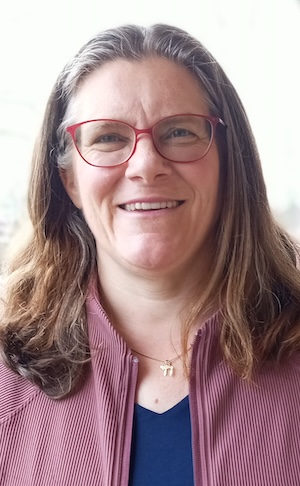
The past and future of Jewish journalism were on the agenda when Cynthia Ramsay addressed the Jewish Seniors Alliance of British Columbia, Jan. 27.
In a Zoom presentation that was part of the alliance’s Empowerment Series, the publisher of the Jewish Independent spoke on the history of the newspaper and discussed the future of Jewish newspapers in general and the Independent in particular.
While the paper celebrated its 95th anniversary last year, Ramsay said it could be a century old, depending on how one begins the count.
A Vancouver Jewish Bulletin was published in 1925, printed by Dr. J.I. Gorosh and this was succeeded by a mimeographed newsletter produced by the Jewish Community Centre and dubbed the Jewish Centre News. The name Jewish Western Bulletin dates to the 1930s.
Publishing transitioned to the Jewish Community Council of Greater Vancouver, a forerunner of today’s Jewish Federation, though it appears to have evolved a degree of independence under publisher Abraham Arnold, who took the helm in 1949, in conjunction with his wife Bertha.
The newspaper became formally separate from other institutions a decade or so after Sam and Mona Kaplan took over in 1960.
The Kaplans were very much committed to advocacy journalism, Ramsay said, most notably advocating freedom for Soviet Jewry.
The Kaplans ran the paper for 35 years and, after a period when it was contracted to an American Jewish media chain, it was sold to Ramsay and two partners, Kyle Berger and Pat Johnson. The latter two later left the business but Ramsay says she is happy that they remain friends and that Johnson is on the editorial board and still writes for the paper (including this story).
The new leadership brought fresh policies, including accepting notices of interfaith and same-gender weddings, as well as coverage of a broader range of topics that were previously considered off limits. The paper opened up to a wider range of opinions, including on Israel.
In 2005, Ramsay renamed the paper the Jewish Independent.
“I changed it because I didn’t think Bulletin really said ‘newspaper,’” she explained. “We got rid of the word ‘western’ also. By that point we were online … and it wasn’t just people from BC who were reading it.”
The paper walks a line between supporting the community and providing a critical eye where necessary, she said.
“I think there are concerns that should be played out in public, but then there’s others that really should be dealt with privately,” she said. “We’re not a gossip rag and we’re also not sensationalist or alarmist.
“We don’t ignore the bad stuff that goes on in our community or in the world, but we do try to cover stories in a way that doesn’t depress or paralyze,” said Ramsay, quoting from an article she wrote in the paper’s anniversary issue last May. “We want, rather, to open the door for solutions and at least positive attempts at change. We don’t want you to put down the paper in despair, but rather [consider] what you can do to contribute to making the world a better place.”
Above all, she said, the paper tries to provide a record of the community, a role it has played for most of a century.
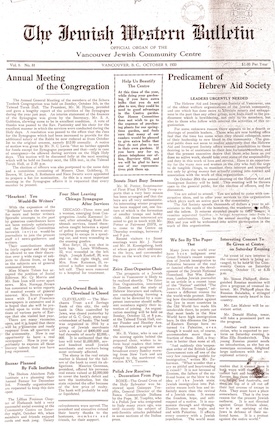
“The Jewish Western Bulletin, the Jewish Independent, has been the only consistent historical record of the community since 1930,” she said.
“Now, of course, we miss a lot of stuff,” she acknowledged. “We have a very small staff. We have a limited number of pages every issue, we’re not going to cover everything.”
She provided an insider view of how the paper operates in terms of the amount of advertising determining the size of each issue, and how decisions are made about what is covered in each issue and on what page things appear.
The pandemic was deeply challenging to the economic viability of the paper, said Ramsay, and it was at that time that the publishing schedule shifted to twice monthly from weekly.
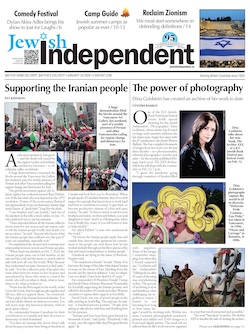
The Independent has survived when other Jewish newspapers in Canada and across North America have not, she noted, even including Federation-owned publications that have gone under in some cities. She wants the paper to reach 100 and she also has her own retirement in mind, tentatively at age 60.
“I’m 56,” she said, noting that almost 30 of those years have been devoted to the paper.
“I’m already starting to think about succession plans,” she said. “I’ve kind of got a five-year window at this point where I’m looking and wanting to responsibly pass over [the paper].”
Innovation could make the publication more sustainable, perhaps a monthly format, she said.
All in all, she takes pride in her achievements and the longer history of the paper’s contributions to the community.
“I think we’ve been a great success, not just because we’re 96 years old, but … [almost] every year we’ve won an American Jewish Press Association Rockower Award for Excellence in Jewish Journalism, mostly for our editorials, but occasionally for other articles,” she said.
The Jewish Seniors Alliance session was opened by Jeff Moss, the organization’s executive director. Fran Goldberg introduced Ramsay.



