Skip to content
  • Home
  • Subscribe / donate
  • Events calendar
  • News
    • Local
    • National
    • Israel
    • World
    • עניין בחדשות
      A roundup of news in Canada and further afield, in Hebrew.
  • Opinion
    • From the JI
    • Op-Ed
  • Arts & Culture
    • Performing Arts
    • Music
    • Books
    • Visual Arts
    • TV & Film
  • Life
    • Celebrating the Holidays
    • Travel
    • The Daily Snooze
      Cartoons by Jacob Samuel
    • Mystery Photo
      Help the JI and JMABC fill in the gaps in our archives.
  • Community Links
    • Organizations, Etc.
    • Other News Sources & Blogs
    • Business Directory
  • FAQ
  • JI Chai Celebration
  • JI@88! video

Recent Posts

  • המלחמות של נתניהו וטראמפ
  • Zionism wins big in Vegas
  • Different but connected
  • Survival not passive
  • Musical celebration of Israel
  • Shoppe celebrates 25 years
  • Human “book” event
  • Reclaiming Jewish stories
  • Bema presents Perseverance
  • CSS honours Bellas z”l
  • Sheba Promise here May 7
  • Reflections from Be’eri
  • New law a desecration
  • Resilient joy in tough times
  • Rescue dog brings joy
  • Art chosen for new museum
  • Reminder of hope, resilience
  • The national food of Israel?
  • Story of Israel’s north
  • Sheltering in train stations
  • Teach critical thinking
  • Learning to bridge divides
  • Supporting Iranian community
  • Art dismantles systems
  • Beth Tikvah celebrates 50th
  • What is Jewish music?
  • Celebrate joy of music
  • Women share experiences 
  • Raising funds for Survivors
  • Call for digital literacy
  • The hidden hand of hate
  • Tarot as spiritual ritual
  • Students create fancy meal
  • Encouraging young voices
  • Rose’s Angels delivers
  • Living life to its fullest

Archives

Follow @JewishIndie
image - The CJN - Visit Us Banner - 300x600 - 101625

Tag: government

The hidden hand of hate

Warren Kinsella has spent much of his career studying the darker corners of political life. A lawyer by training, author of about a dozen books and a longtime political strategist, he has written about Holocaust denial, far-right extremism and organized hate movements. 

In his just-released book, The Hidden Hand: The Information War and the Rise of Antisemitic Propaganda, he follows these threads down the unseemly rabbit hole that has perplexed many observers since Oct. 7, 2023: the sudden and superficially spontaneous eruption of anti-Israel activism across Western campuses and cities in the aftermath of the horrendous atrocities of that day.

Kinsella’s thesis is straightforward and, to most readers of these pages, probably neither controversial nor surprising. The worldwide surge in anti-Israel protests, he argues, is not organic. Rather, it reflects a long-developed propaganda infrastructure – the “hidden hand” – involving the Iranian regime, Hamas, Hezbollah and a constellation of worldwide activist organizations that have spent years building networks capable of shaping Western public opinion.

Hamas, Kinsella argues, fights two wars simultaneously. One is the familiar military campaign conducted with rockets, bullets and suicide attacks. The other is an information war, waged through imagery, messaging and propaganda. Israel may well win the first war, he suggests, but the second – the battle for global public opinion – is far less certain.

The book opens with the immediate aftermath of the Hamas attacks of Oct. 7. While Israelis were still grappling with the scale of the massacre, demonstrations against Israel began sweeping Western campuses and cities. In the United States, a “national student walkout” took place within days of Oct. 7. Activists insisted these events were spontaneous expressions of outrage over the war in Gaza – but many of them took place before there was even a war in Gaza.

Many of the protests, Kinsella writes, appeared to have been organized rapidly with shared messaging, identical slogans and coordinated materials. Student groups that claimed to be independent grassroots organizations were often connected to larger activist networks. Manuals, posters and protest toolkits circulated almost immediately.

image - The Hidden Hand book coverThis pattern is central to the book’s argument. What looks like decentralized activism, Kinsella contends, often reveals indisputable signs of coordination.

One of the more striking anecdotes in the book involves Gary Wexler, a California professor who worked with the Ford Foundation on programs in Israel and Palestine during the Oslo peace process. Wexler recalls being warned by a leading Palestinian civil society coordinator that pro-Palestinian networks would one day rival – and surpass – the vaunted Jewish advocacy organizations in their ability to mobilize globally. Funding, the activist reportedly told him, would come from European institutions, Arab governments and wealthy donors.

Years later, Wexler began to see the prediction materialize in movements such as the push for boycott, divestment and sanctions (BDS), Israel Apartheid Week and international flotillas challenging Israel’s blockade of Gaza.

Kinsella stops short of claiming a single command centre orchestrating these movements. Instead, he suggests a looser ecosystem in which state actors, activist organizations and sympathetic nongovernmental organizations amplify one another’s messaging.

If there is a common theme running through the book, it is the power of narrative.

According to Kinsella, Hamas and its allies have been remarkably successful at shaping the language through which the conflict is discussed in the West. Terms such as “colonialism,” “apartheid” and “genocide” now dominate activist discourse, particularly among younger audiences. These ideas circulate widely on social media platforms, where emotionally charged content spreads faster than verified information.

The book devotes considerable attention to misinformation and the speed at which it travels. One example Kinsella cites is the widely circulated claim that Israel had bombed the al-Ahli Arab Hospital in Gaza, killing hundreds of civilians. The allegation ricocheted around the world within hours, sparking protests and diplomatic condemnations from the highest levels. Later evidence indicated the explosion was caused by a misfired rocket from Palestinian Islamic Jihad – and that the casualty figures had been exaggerated exponentially. The correction, of course, traveled neither as far nor as fast as the original claim.

Social media algorithms amplify this dynamic, Kinsella argues, pushing users toward increasingly extreme content. The phenomenon is not unique to Middle East politics. The same mechanisms drive conspiracy theories about vaccines, elections and countless other subjects. But, in the case of Israel, he suggests, the misinformation taps into something older and deeper: an antisemitic proclivity to believe the worst and most fantastical allegations about Jews.

In the contemporary context, antisemitic narratives often blend with modern ideological frameworks. In activist discourse, Jews are sometimes recast as embodiments of colonialism or “whiteness,” placing them on the oppressor side of social justice frameworks. The result, Kinsella suggests, is a rhetorical environment in which hostility toward Israel can slide easily into hostility toward Jews.

Polling data cited in the book underscores the generational divide in attitudes toward the conflict. Surveys in North America and Europe have found large numbers of younger respondents expressing sympathy for Hamas or believing that the 10/7 attacks were justified. Other polls show significant numbers of young people convinced that Israel is committing genocide. Such findings shocked even the pollsters who conducted them.

Kinsella argues that universities have played a significant role in shaping these attitudes. For decades, he writes, academic discourse has increasingly framed Israel through the lens of “settler-colonialism.” At the same time, foreign governments – particularly that of Qatar – have donated billions of dollars to Western universities.

The media also come under scrutiny. Western news organizations, he argues, routinely rely on casualty figures supplied by the Hamas-controlled Gaza Health Ministry, numbers that critical analysis suggests are inflated, particularly in terms of non-combatant casualties. Journalists reporting on what’s happening in Gaza frequently depend on local stringers who operate either directly under Hamas authority or in a context where anything but pro-Hamas reporting is existentially dangerous. This situation effectively grants terrorist propaganda the imprimatur of legitimate media platforms.

Because Kinsella is Canadian, The Hidden Hand is rife with Canadian content. This will be interesting to Canadian readers – and a meaningful contribution to the sad litany of incidents in this country – but it is additionally relevant because Canada has been among the worst places for these sorts of offences. Last year, an Israeli government report analyzing the problem worldwide called Canada the “champion of antisemitism.” So, while Canada may not be a major player in many of the world’s foremost competitions or concerns, when it comes to anti-Jewish discrimination, we regrettably find ourselves owning the podium. That makes what happens here – and how (or whether) we confront it – especially relevant.

The thesis of Kinsella’s book, of course, is that these problems know no boundaries (figuratively or literally).

Much of the evidence he presents is circumstantial rather than definitive. He has found no single document or intercepted communication that proves the existence of a centralized propaganda command. The accumulation of connections, coincidences and patterns is what gives the book its force, but Kinsella does not provide the proverbial smoking gun. This is partly understandable because, if there were incontrovertible proof linking ostensibly legal, legitimate activist groups in Canada and around the world with known terrorist entities, surely Western governments would have acted by now.

Ah, but there’s the rub. The very fact that someone like Kinsella, without, say, top-level security clearance, could amass such a damning catalogue of evidence begs the question of just how much effort governments and security services are devoting to this problem. That so many deeply problematic and potentially illegal cases in Canada, including here in British Columbia, have not resulted in charges or even, seemingly, any serious investigation, makes Kinsella’s book especially valuable. If there is this much smoke, where are the governmental and security agencies that are supposed to be the firefighters?

Whether one accepts all of Kinsella’s conclusions or not, The Hidden Hand forces readers to confront the possibility that the global conversation about Israel is shaped by forces far more organized and odious than many seem willing to believe.

If Hamas fights both with bombs and with words, as Kinsella argues, then the information battlefield may prove just as consequential as the physical one. And, on that battlefield, the outcome is still very much in doubt. 

Posted on March 27, 2026March 26, 2026Author Pat JohnsonCategories BooksTags antisemitism, books, government, media, propaganda, protests, rallies, The Hidden Hand, Warren Kinsella
What should governments do?

What should governments do?

Left to right at the Jewish Seniors Alliance of BC Fall Symposium Nov. 23: Jeff Moss, Joyce Murray, Anthony Kupferschmidt, Dan Levitt and Isobel Mackenzie. (photo by Alex Roque Photography)

The Jewish Seniors Alliance of British Columbia’s fall symposium featured a panel discussion on the responsibilities of governments for seniors. The panelists discussed housing, transportation and healthcare services. They explored challenges in funding, staffing and service delivery, while also touching on topics such as the potential for community involvement in shaping senior support systems.

The Nov. 23 gathering, which took place at the Jewish Community Centre of Greater Vancouver, opened with Jeff Moss, executive director of JSABC. He said provincial advocacy is “at the heart” of what JSA does, “and bringing together politicians in this space is really important, because the conversations that we have when we meet with the provincial government, or when we’re meeting with the opposition, [are] where we are advocating strongly for universal free home support for seniors in British Columbia.”

JSA’s partners in this campaign are Council of Senior Citizens’ Organization (COSCO), the BC Health Coalition, the Independent Long-Term Care Councils Association of BC, Family Caregivers of British Columbia and the BC Care Providers Association (BCCPA), whose chief executive officer, Mary Polak, addressed those gathered. 

Polak shared that her father, who’s 96 years old, is in long-term care. He has some dementia issues and needs to have some specialized care, she said. “But in the time that he was at home with us and we were trying to give him the best quality of life we could in our own home, it was a real challenge to try and support that with home health services. And we were in a better place than many because at least we had some of the financial capacity to do that, and we had the family around us. But, for an increasing number of people, that’s becoming impossible, and it shouldn’t be that way.”

Ezra Shanken, CEO of the Jewish Federation of Greater Vancouver, which also is a partner and supporter of JSABC, introduced Shay Keil, who sponsored the event with the BCCPA and JSA, along with Michael and Sally Geller, and the Zalkow Foundation.

“Seniors are the foundation of who we are,” said Keil. “You’ve built our families, our traditions and our values, and you deserve to be honoured, supported and celebrated. We often speak of m’dor l’dor, from generation to generation, and that idea is very close to my heart. I strongly believe in the connection between seniors and children and everyone in between. That belief is why I’m here today, and why I’m deeply committed to community through volunteering, supporting and staying actively involved in the organizations that strengthen the lives of those around us, including JSA.”

Keil introduced the emcee of the panel, Isobel Mackenzie, “who served as British Columbia’s seniors advocate from 2014 to 2024, and has spent her career championing the well-being, safety and dignity of our seniors.”

Mackenzie asked each panelist to come to the stage: Anthony Kupferschmidt, strategic lead for aging and older persons with the City of Vancouver, who has worked in similar capacities with other cities and groups, and is also a gerontologist; Joyce Murray, who has served both as a member of the Legislative Assembly and as a member of Parliament; and Dan Levitt, a gerontologist who has worked 30-plus years in seniors care, and is the current seniors advocate for the province.

Each panelist gave an overview of their opinions, starting with Kupferschmidt, who noted that much of what a municipality can do for the aging population requires financial support from other orders of government. However, a city can impact seniors in such areas as “zoning and related development charges, making sure that we have the right type of housing and the right mix of housing  across the city.”

Municipalities can work with the provincial government, for example, on where care homes are located and support their development. Transportation is another key area, as are sidewalks and other “elements of an age-friendly city.” Cities have a role with respect to public libraries and the accessible services they offer, community centres, senior centres, pools, arenas, etc. 

Levitt was the next to speak. “Currently, there are 5.5 million people living in our province, 1.1 million people are over 65,” he said. “Today, there’s one in five – 20% of all people are seniors. Fast forward just a decade from now and it’ll be one in four, 25%…. We have more people who are living longer and more people who are seniors, so 400,000 more seniors in the next decade.”

Levitt’s office monitors five areas: health care, transportation, housing, income and community services.

“The general trend,” he said, “is that there are more seniors and there are more investments, but there’s less available per senior.”

As an example, he said, a quarter of all seniors are living on $23,000 a year, or less than $2,000 a month. “And it’s not that hard to go find people living in the West End in affordable housing living on less than $1,000 a month, so they really need that income support from all levels of government, they need those subsidies.”

Levitt said there were 13,000 people on the waitlist for affordable housing last year. “How many of them got a space?” he asked. “Six percent, just under 800 people have got a space for affordable seniors housing in our province. We haven’t built enough, and there is a call right now to build more, but we’re not keeping pace with that demand.”

As well, he said, the province has been taking money away from long-term care homes, no longer funding overtime and agency nurses, for example, and this affects places like the Louis Brier Home and Hospital.

“It means that an already very thin margin is now almost impossible to operate without that government subsidy,” said Levitt. 

“We haven’t invested enough either in seniors care,” he added. “We did a report in July, and our July report identifies that over 16,000 people are going to be short long-term care because we’re not building enough beds. There are 7,200 people on the waitlist today.” The burden of care, he said, is being transferred to families.

Murray took the conversation in a different direction.

“I was looking at the budget numbers about this when I was thinking about what I would be saying,” she said, “and the total new spending on OAS [Old Age Security] and medical care for seniors alone in the 2023 budget was $110 billion of new money…. Now, that’s going to tie into some of the demographics, for sure, but, when you break that down, that’s $4,300 per retiree 65 and older in new money in the 2023 federal budget versus $755 for younger Canadian under 45 in new money.”

She wondered about how well younger people were being supported. She also spoke of environmental concerns.

“What does it mean to be a good ancestor?” she asked. “And what do we think our society, our province, our country needs to do so that we collectively are good ancestors?”

“To govern is to choose,” said Mackenzie, noting that governments must make decisions about how “to allocate our finite resources to our infinite demands.”

The panelists talked more about that, as well as the way in which different levels of government work with one another. Murray said governments make policies they hope will attract voters, and seniors tend to vote more than younger people, so, for example, “a family with two members can earn up to $180,000 a year and still get their full OAS,” she said, asking, “Is that a good allocation of money?”

Mackenzie asked a variant of Murray’s question, considering how maximum monthly payments for public long-term care work.

“The person whose income is $200,000 a year is going to pay the same for their publicly funded long-term care plan as the person whose income is $70,000 a year,” said Mackenzie. “And so, if, on the one hand, we say, well, the people who have more should get less, which is the OAS argument, to what extent should we flip that and say, well, the people who have more should pay more when it comes to publicly subsidized long-term care? That’s, I think, missing from the discussion…. I think there are very uncomfortable conversations … that governments are going to have to have with their electorate and, as elected officials, you don’t like to have those uncomfortable conversations, for obvious reasons.”

Levitt thought the situation could be improved if governments helped people understand how much money they need to save to age well, what supports there would be for them as they age, and what people could do to support themselves. 

Murray suggested, “Maybe what we need is like a citizens’ assembly, to start out by identifying what are the key things that are maybe broken or need improvement so that we can be good ancestors. And then have a citizens’ assembly that looks at what are the best solutions in other countries … and then create a proposal on that. I think we have to crowdsource the solutions here…. We need citizens to help us solve this.”

Kupferschmidt brought up Better at Home, a basket of non-medical services that seniors can access. “There has been public engagement into what those services should be…. However, there are examples of the service that is offered in one neighbourhood in the city is different than another,” he said, explaining that a “model with all the best intentions can sometimes create some disparities as well.”

Mackenzie stressed the complexities, both because everyone’s needs and everyone’s solutions are different. “And, in the end, in those environments, generally, we try to come up with solutions that meet the greatest good for the greatest number, but that certainly doesn’t meet the need for everybody all the time and that is, I think, the political challenge at all levels of government, whether they be the local, the provincial or the federal.”

Posted on December 19, 2025December 18, 2025Author Cynthia RamsayCategories LocalTags Anthony Kupferschmidt, Dan Levitt, eff Moss, Ezra Shanken, funding, governance, government, government funding, health care, Isobel Mackenzie, Jewish Seniors Aliance, Joyce Murray, JSABC, long-term care, Mary Polak, policy, seniors, Shay Keil
A new voice for BC elders

A new voice for BC elders

Dan Levitt has been appointed to be British Columbia’s new seniors advocate (photo from Dan Levitt)

Dan Levitt is set to become British Columbia’s new seniors advocate. The appointment was announced last month by BC Health Minister Adrian Dix.

“Dan Levitt has championed the rights of seniors for 30 years and with his extensive experience he is an excellent choice for BC’s seniors advocate,” Dix said in announcing the appointment. The Office of the Seniors Advocate is an independent branch of the provincial government, which acts in the interest of seniors and their caregivers.

Levitt becomes only the second person to hold the role, replacing Isobel Mackenzie, who will retire April 5 from the position she initiated a decade ago.

Levitt spoke with the Independent over lunch in the community centre that is part of KinVillage, the Tsawwassen continuing care retirement community he has headed as chief executive officer since 2021. Over the din of an adjacent bingo game, Levitt spoke of his career, the footsteps of his father and his plans for the new job.

The role of seniors advocate is unusual, he explained. British Columbia’s was the first in Canada, being created by legislation in 2013. To date, only two provinces, New Brunswick and Newfoundland and Labrador, have followed suit, though others are considering it.

The purpose of the advocate’s office, which has a staff of 17, is to look at systemic issues that impact seniors and make recommendations to government. 

“The five areas that we look at are transportation, housing, health care, income supports and community services that are geared around older people,” said Levitt. While the office has no authority to force governments to take steps, Levitt said his predecessor, Mackenzie, has recommended many proposals that have found favour with those in power. Not all recommendations will be adopted, he said, but “it usually helps to move the needle in a direction.”

“There isn’t that power, if you will, to say, ‘This must happen.’ But, many times, the recommendations are ones that are introduced and taken forward because they are the right things to do,” said Levitt, noting that his predecessor initiated a great range of measures that the government has taken up. 

“Isobel and the office have been real pioneers in shedding lights on challenges and opportunities with an aging population,” he said. “That’s the purpose of these independent offices. They can reflect, in this case, what matters most to seniors, what are their concerns, and then move that agenda forward in helping to influence public policy.”

The position is nonpartisan and independent from government. 

“In the recruitment process, no political official was involved,” said Levitt. 

Levitt is not the first in his family to work in the senior care field. His father, Ken Levitt, was a longtime administrator of the Louis Brier Home and Hospital, during a time of significant expansion, including the development of the Weinberg Residence. The elder Levitt is now, among other things, past president of the Jewish Seniors Alliance of Greater Vancouver. 

“I am following in his footsteps, for sure,” said the son. “And I think I am honouring, as he did, our parents by ensuring the health and well-being of older adults.”

As his new position requires he hold no outside affiliations, Levitt recently resigned from roles on the boards of directors of CommonAge, which advances the interests of older adults in the 53 Commonwealth countries, and the International Federation on Ageing. He has also given up adjunct professorships in gerontology at Simon Fraser University and in the school of nursing at the University of British Columbia, and a sessional instructor position at the British Columbia Institute of Technology.

Levitt’s undergrad degree in psychology is from UBC and he graduated from the University of North Texas, Centre for Studies in Aging, with a master of science.

“I need to dedicate 110% of my working time to this role,” he said of giving up his other gigs, which included speaking engagements worldwide on topics of aging and extensive public commentary on related subjects. 

The vetting process for the seniors advocate position was a lengthy one – and Levitt compares getting the final word on his selection with the feeling of elation he gets when he places well in his avocation of competitive running.

“Probably like anybody else who’s been through a job search like this, when you get that nod, it feels pretty good,” he said. “I am a competitive runner in my age category and, when I place well in a race, you are elated. So, when I got the message, I was pinching myself, making sure I heard what I thought I heard. You feel this elation. Soon this wears off and you start realizing the responsibility, start realizing what this means now, and people are depending on you to make their lives better.”

Caring for seniors also means helping the people in their lives, he said.

“It’s not just the older people that we’re trying to support, who are directly impacted, but it’s their family members,” said Levitt. 

Although he is not yet in the job – he’ll have to move to Victoria, coming home to Vancouver on weekends – he already has the first few months scoped out.

“I’m going to be doing a tour around the province of BC [meeting with seniors],” he said. “I’ll be asking them questions around what are those policies that help or hinder them in those five areas of transportation, housing, health care, income supports and community supports. We’ll be looking at those issues, listening to them, then we’ll come back to the office, synthesize the information and then we will release a report on what we found. That report will give us a mandate of what the biggest concerns are that seniors have and we’ll make recommendations to the government on how we can improve different aspects of seniors’ lives.”

In the statement announcing Levitt’s appointment, his predecessor had kind words for him.

“It has been an honour and a privilege to serve as seniors advocate for the Province of BC,” said Mackenzie. “Our population is aging and seniors need the ability to live independently at home, knowing the programs and services to support them are easily accessible to everyone. As issues such as dementia, housing and elder care become more complex, it’s crucial to advocate for strengthened seniors services throughout the province. I know Dan is ready to continue the cause and his efforts will make a difference in the lives of seniors for years to come.”

“I have big shoes to fill,” said Levitt, “because Isobel Mackenzie has done a phenomenal job starting the Office of the Seniors Advocate and really setting a very high bar, really pushing forward the agenda of older people, shining a light on some of the inequities and some of the systemic issues that impact older people and making recommendations that have stuck and changed just about every aspect of life for seniors.”

Levitt has spoken out on issues in the past, weighing in, for example, on the controversy around Lisa LaFlamme, whose firing as CTV National News anchor was blamed on sexism and ageism, and in challenging the ageism of birthday cards. While he will be taking on systemic issues on the larger stage of provincial policy, he urges individuals to speak up against ageism in everyday life and to celebrate aging.

Be aware of even subtle language that debases older people and their experiences, he advises.

“Don’t use the language that demonizes or goes into the negative stereotypes we often will see,” he said. “For example, ‘I’m having a senior moment.’ No one who is young says they’re having a junior moment.”

He encourages everyone to reject negative connotations around aging.

“Embrace your own age,” he said. “Embrace who you are and enjoy those birthdays and celebrate them and celebrate getting older. Don’t hide your age.” 

Format ImagePosted on February 23, 2024February 22, 2024Author Pat JohnsonCategories LocalTags British Columbia, Dan Levitt, government, health care, Office of the Seniors Advocate, seniors
Government to target hate

Government to target hate

Irwin Cotler spoke Sunday at a virtual event convened by National Council of Jewish Women of Canada. (photo from raoulwallenbergcentre.org)

Canada is set to make a number of significant commitments to combat antisemitism, as are other countries that participated in a summit on the issue last week in the Swedish city of Malmö.

Irwin Cotler, Canada’s special envoy on preserving Holocaust remembrance and fighting antisemitism, spoke Oct. 17 at a virtual event convened by National Council of Jewish Women of Canada. The human rights lawyer and former federal justice minister, who is also international chair of the Raoul Wallenberg Centre for Human Rights, said that, in the aftermath of the conference, the Canadian government would announce a number of pledges.

These will include enhanced teaching and learning about the Holocaust across generational lines, combating the increasing Holocaust denial and distortion, and battling hatred on social media. Reducing an alarming rise in hate crimes will also be among the pledges Prime Minister Justin Trudeau is set to make, according to Cotler.

“Twenty-twenty was the year for the highest rise in hate crimes targeting Jews ever,” he said. “But, by May 2021, we had reached the level then of all the hate crimes in all of 2020.”

The government will recommit itself to protecting the security of Jewish institutions, he said.

“Here, the government recently made commitments in financial terms for this purpose,” said Cotler.

Zero tolerance for antisemitism in the political discourse is also an objective, he added.

“That means not just calling out antisemitism in the other’s political party but calling out antisemitism in our own,” Cotler said. “In other words, not weaponizing antisemitism or politicizing it, but holding each of us, respectively, our own political parties, accountable.”

In addition to Trudeau, Israeli President Isaac Herzog, French President Emmanuel Macron and U.S. Secretary of State Antony Blinken were among the leaders who addressed the conference. The Malmö International Forum on Holocaust Remembrance and Combating Antisemitism was hosted by Sweden’s Prime Minister Stefan Löfven. Trudeau announced at the conference that Cotler’s role of special envoy would be made permanent.

Cotler contextualized the Malmö forum in a two-decade era of what he calls “demonological antisemitism,” which began at the 2001 Durban conference against racism that devolved into an antisemitic carnival.

“What happened at Durban was truly Orwellian,” said Cotler. “A world conference against racism and hate turned into a conference of racism and hate against Israel and the Jewish people. A conference that was to commemorate the dismantling of apartheid in South Africa turned into a conference calling for the dismantling of the ‘apartheid state’ Israel.

“Those of us who personally witnessed this Durban festival of hate have been forever transformed by the pamphlets and posters of hatred and antisemitism, by the cartoons and the leaflets portraying not only the Jews as Nazis, but the classical antisemitic tropes of Jews with hooked noses, with fangs, with fingers dipped in blood from the killing of children. Where we were accosted with pamphlets of the Protocols of the Elders of Zion. Where we witnessed demonstrators with signs – incredibly for a human rights conference or for any conference – signs which said, ‘Too bad Hitler didn’t finish the job.’ Where we witnessed Jewish students – and I witnessed this personally – being physically assaulted and being told, ‘You don’t belong to the human race,’” said Cotler.

Durban was the first tipping point and the global surge of antisemitism during last spring’s conflict between Hamas and Israel was a second, he said.

“Jews were targeted and threatened in their own neighbourhoods and on their own streets,” said Cotler. During and after that conflict, Cotler said, Jewish memorials were defaced, synagogues were torched, cemeteries were vandalized, Jewish institutions found themselves under assault and incendiary hate speech – such as 17,000 tweets that “Hitler was right” – exploded.

The COVID-19 pandemic has exacerbated antisemitism, or at least has been exploited by antisemites, who have “instrumentalized one of the more ancient tropes of the Jews as the poisoners of wells,” said Cotler. The health crisis has also seen conspiracies of Jews profiting from vaccines and anti-vaxxers posing “as if they were victims of Nazi persecution,” he added.

Cotler lamented what he calls “the mainstreaming, the normalization – in effect, the legitimization of antisemitism in the political culture.” During the conflict last spring, convoys of vehicles in London, U.K., drove through Jewish neighbourhoods screaming, “F–k the Jews, rape their daughters!” This was a convoy and a message that was replicated in Toronto days later and which resulted in, Cotler said, an “utter absence of outrage.”

The legalist also spoke of the International Holocaust Remembrance Alliance Working Definition of Antisemitism.

“If you can’t define it, you can’t combat it,” he said. The IHRA definition was adopted after 15 years of discussion and debate by intergovernmental bodies, governments, parliaments, scholars and civil society leaders, he said.

The task of fighting antisemitism must not fall only to Jews, Cotler  stressed.

“As we’ve learned only too painfully, and have repeated too often, that, while it begins with Jews, it doesn’t end with Jews,” he said. “Therefore, we need this collective global constituency of conscience to combat it.”

Format ImagePosted on October 22, 2021October 21, 2021Author Pat JohnsonCategories NationalTags Academic Advisory Council, antisemitism, Canada, Durban, government, Holocaust, Irwin Cotler, Malmö International Forum, National Council of Jewish Women of Canada, politics

Taming online world

Two bills recently introduced by the federal government are aimed at reducing online hate and putting some controls on the anarchic world of online commentary. Some, like Jewish community organizations, have been calling for stronger rules to deal with rampant online vitriol. Others, like civil liberties groups, balk at any incursions into unfettered expression. It might not matter anyway.

Bill C-36 is intended to crack down on online hate, something Jewish community advocates and many others have been supporting since a similar section of the Canadian Human Rights Act was repealed in 2013 over concerns around free expression. Groups like the Canadian Civil Liberties Association have expressed apprehensions over the new bill, as they had over the repealed section.

The bill would make it an offence to make statements on the internet that are “likely to foment detestation or vilification of an individual or group of individuals on the basis of a prohibited ground of discrimination.” It would target commentary that is “motivated by bias, prejudice or hate based on race, national or ethnic origin, language, colour, religion, sex, age, mental or physical disability, sexual orientation, gender identity or expression, or any other similar factor.”

The bill defines hate as “the emotion that involves detestation or vilification and that is stronger than dislike or disdain,” and is not merely language that “discredits, humiliates, hurts or offends.”

A different piece of legislation, Bill C-10, is also aimed at online content. In this case, the government would require platforms, such as social media and video streaming sites, to enforce guidelines that extend Canadian content rules, which have long governed radio and TV, to the internet. Again, critics say this is an infringement on the freedom of expression.

Both bills attempt to walk a line between free speech and the government’s attempts to encourage particular outcomes. They are likely to please some and they are likely to offend many. Both are probably founded on the best intentions, but, as critics have pointed out, Canada already has hate-speech laws that apply online and off.

Given the chaotic efforts of social media companies themselves to enforce guidelines for conduct and to curtail hate speech, it is difficult to imagine how legislation would provide a clearer guide to online etiquette. More worrying is the possible chaos that human rights tribunals and courts might have thrust upon them if Canadians begin reporting thousands or millions of problematic online statements.

We should be wary of heavy-handedness not only because the proposed laws hand a lot of arbitrary decision-making power to government or judicial overseers, but also because it is unwise to bury hateful ideas. The best way to confront hate and extremism is to shine a light on it, not to force it onto emerging platforms created specifically to give shelter to the most extreme people and ideas.

However, this all might be moot because Parliament has recessed for the summer. If, as many speculate, a federal election is called before Parliament resumes, these pieces of legislation would die. If the Liberals were to be reelected, they could reintroduce the bills. Conservatives have charged that the two proposed laws are “virtue signaling,” as much about campaign fodder as substantive change. The NDP and Bloc voted in favour of Bill C-10, with the NDP asserting that the “modernization of the law is necessary for [the] cultural ecosystem.”

Whatever the fate of these two bills, the fight against hate (online and off) will continue. We have long contended that the most powerful response to hateful words is more words – words that heal and educate. The online world is a jungle of facts and fictions, wonder and woe, insights and insanity. It is, perhaps, like the larger world, only condensed onto a small screen that amplifies the most fringe and sensational voices. Criminalizing those voices may or may not bring the result most of us seek, which is a kinder world. That said, contesting the worst of the online world is a Sisyphean task that we cannot abandon.

The medium is the message, said Marshall McLuhan, who died long before ordinary people heard the word “internet.” The anonymity and unruliness of the internet has no doubt helped to create a toxicity in our culture. But, while we should take seriously dangerous ideas online, we should remember that these are symptoms of strains in society and not solely products of the technology. Addressing online hate demands returning to first things and addressing all forms of hatred and division in our society. Fixing the online dialogue demands changing minds – and that has been the challenge since long before the advent of the internet.

Posted on July 9, 2021July 7, 2021Author The Editorial BoardCategories From the JITags civil liberties, free speech, government, hate speech, internet, law, politics, regulation

Pushing for more oversight

Members of the Jewish community, as well as members of various professional organizations, are calling on the government of British Columbia to do more to regulate practising therapists and counselors in the province.

According to the Federation of Associations of Counseling Therapists in British Columbia (FACTBC), which is at the forefront of the campaign for this change, there is currently no regulatory body for counseling therapists in the province and, therefore, there are no regulatory standards for the work that counseling therapists do.

As it stands, they claim, someone can call themselves a mental health professional in British Columbia without having the checks that exist elsewhere in Canada. This, FACTBC points out, differs significantly from Ontario, Quebec and Alberta, which have all established regulatory bodies to oversee who can become a mental health professional. And, they add, the remaining provinces have done more than British Columbia when it comes to the consideration of implementing regulation.

A member of the Jewish community recently came to the Independent with her story. In her attempts to remove a social worker from her mother’s life, she encountered what she believes were numerous inadequacies within the present system regarding the protection of the public’s interest and confidence.

“When we seek the help of doctors and nurses, there is a protected title that tells us the person is qualified and safe and that there is a professional regulator to back up this promise,” she said. “Regulation protects people from harm. I cannot change the events of the past, but I can take from that experience and do what I can to ensure that all our citizens are protected, moving forward.

“I knew,” she added, “and had confirmed by other counselors and social workers that what this registrant was doing was in violation of their professional code. I saw my mother become further isolated from friends and family, while her health continued to decline both mentally and physically, while in this registrant’s care.”

The community member filed a complaint with the B.C. College of Social Workers (BCCSW). “Through this experience, I saw firsthand the lack of transparency in the complaint and discipline process that gives social workers the ability to enter negotiated complaint resolution agreements (CRAs) in exchange for keeping matters confidential. How can the public have confidence in regulators if the public is not aware of actions taken by regulators to protect them?” she wondered.

The community member then did what many who lack the financial means could not: she filed a civil claim against the social worker. She was not looking for money, she told the Independent; rather, she was looking for accountability and safety.

In the end, the woman and her family received an apology from the registrant and a promise to not repeat the following conduct: failing to differentiate between professional and personal boundaries; creating a situation of dependence with clients; and failing to limit their practice within the parameters of their competence.

“The college, in their inquiry decision, acknowledged that the time the registrant spent with my mother and the amount the registrant billed were not reasonable. I am not sure I will ever be able to fully reconcile with the events that occurred over a three-year span at the hands of a social worker, who was a friend at the time, and [that] I helped facilitate the introduction to my vulnerable, senior mother,” the woman said.

“To help with my own personal healing,” she added, “I elected to join FACTBC’s stakeholder table. I hope to lend my voice to ensure social workers, counseling therapists and emergency medical assistants who deal with our most vulnerable citizens are recognized as health professionals and regulated under the Health Professions Act.”

For Shelley Karrel of Jewish Addiction Community Services (JACS) Vancouver, the importance of regulation for counselors in British Columbia cannot be overstated. “For counselors working in the area of addiction and recovery, it is critical to know the importance of assessment, understanding the various stages of addiction, being able to identify the options available for treatment and recovery,” she said.

Karrel explained that understanding co-morbidity – i.e., the presence of one or more additional conditions – of mental health issues with addiction requires psychotherapists and counselors to have the proper training and education to know how to help clients deal with their various challenges.

“Having counseling fall under a regulated body will give clients the assurance they are dealing with qualified professionals who have to meet professional standards of practice, ongoing continuing education and clinical supervision,” she stated.

According to Glen Grigg, a Vancouver clinical counselor and the chair of FACTBC, “proper regulation will prevent consumers from harm. A consumer should not have to guess whether the therapist is equipped to deliver the services they promise. Moreover, when harm is done, it is important to know that a registrant’s college has the power to bring restoration and remediation when harm has occurred.”

FACTBC, which is comprised of 14 professional organizations that represent 6,000 mental health professionals in the province, is asking for safety and accountability. On professional title, it recommends one legislative authority and one coherent and fair process that prevents harm and has the power to act accordingly when harm has been done.

The B.C. government has said that it will first implement modernization of the health professions regulatory system – a step that FACTBC enthusiastically supports – and then give attention to the mental health system.

To Grigg, “this response comes down to saying, in effect, ‘despite the opioid crisis and mental health fallout from the pandemic, we can defer this issue.’ When pressed for what is intended after a new regulatory process is put into place, timeline unknown, the response is that government will ‘recommend’ that professions, such as counseling therapy and social work, become a ‘priority.’ A recommendation to a yet-to-be created bureaucracy falls far short of commitment and action.”

Grigg added, “FACTBC has been advocating for public protection where counseling therapy is concerned for more than 20 years and have heard, over and over, variations on the theme, ‘Yes, of course, we are going to protect the public, but later, at a time we’re not prepared to specify.’”

FACTBC does give the province credit for creating a Ministry of Mental Health and Addictions – a huge step forward, in their view, as was the $5 million the province put towards increasing mental health services. What the government needs to do to follow up on this momentum is to regulate counseling therapy, they assert.

At present there is no way of accurately ascertaining how many practising counselors there are in British Columbia. However, Grigg cites what Ontario discovered. In that province, in the time since they implemented statutory regulation on counseling therapists, they found that half the people providing services did not have any form of registration or certification.

“That’s dangerous,” said Grigg. “And we suspect that the situation in B.C. is similar but, because there is no central authority, even the scale of the problem is guesswork.”

He stressed, “It’s easy to see why this is so crucial. Suppose you were sick or injured and went to your local clinic or emergency department and discovered that it was up to you to figure out whether the people working there really were nurses and doctors, and whether they were qualified to provide care? That’s what people looking for counseling services are up against every day in B.C. There is no single title, like doctor or nurse or dentist or pharmacist, that identifies qualified and accountable counseling therapists.”

Sam Margolis has written for the Globe and Mail, the National Post, UPI and MSNBC.

Posted on May 28, 2021May 27, 2021Author Sam MargolisCategories LocalTags British Columbia, counseling, FACTBC, Glen Grigg, government, healthcare, JACS Vancouver, law, mental health, regulation, Shelley Karrel, therapy
B.C. puts $25 million to JCC

B.C. puts $25 million to JCC

One of the reasons the Jewish Community Centre of Greater Vancouver is being redeveloped is that its amenities, like the gymnasium and swimming pool, are aging. (photo from miss604.com)

The government of British Columbia has announced $25 million to support the redevelopment of the Jewish Community Centre of Greater Vancouver.

At a virtual event April 28, three cabinet ministers and Alvin Wasserman, president of the board of the JCC, publicly shared the major contribution to the $155 million project.

The first phase of the redevelopment, which is what the grant supports, will contribute to the construction of the new, 200,000-square-foot community centre. This will be built on the current JCC parking lot. The new facility will allow the JCC to expand childcare, seniors services, arts and cultural spaces and amenities for all. The centre, when opened, will also be home to about 15 not-for-profit organizations, with expanded space for the Vancouver Holocaust Education Centre, a new theatre, and other facilities. That component is anticipated to be completed in late 2024.

A second phase of the project, which is the largest capital project in the history of British Columbia’s Jewish community, will see the existing JCC replaced with mixed-use rental housing, including units at or below market value. In this phase, King David High School, which is currently located to the east of the JCC, across Willow Street, is expected to move to new, larger premises in the second phase to accommodate growing student enrolment. This phase, expected to be completed in 2027 or 2028, will cost about $272 million.

The redevelopment initiative includes the transfer of the property from the JCC into a community trust, with rent and other revenues being reinvested into the Jewish community in perpetuity.

Melanie Mark, B.C. minister of tourism, art, culture and sport, made the funding official in an enthusiastic announcement.

photo - JCC gymnasium
The JCC gymnasium (photo from miss604.com)

“The Jewish Community Centre of Greater Vancouver is an integral part of our social and cultural fabric, it’s a vibrant, intergenerational community centre,” she said. “But it was built more than 60 years ago and the facility is in desperate need of replacement. Its amenities, like the swimming pool and gymnasium, are aging. Meanwhile, the community of Oakridge has exploded around it.”

Mark added: “We hope this grant will assist the centre to secure other sources of funding for this project. The redevelopment of the centre is a massive undertaking, leaving a legacy for generations to come, which is why I’m encouraging other levels of government to join us in funding this important project. Specifically, I hope the federal government will step up and match our funding commitment. I hope they see the value in meeting the needs of this growing, diverse community.”

The new JCC’s capacity for increased childcare and the residential components of the second phase dovetail, Mark said, with the government’s commitments to affordable housing and childcare.

David Eby, the province’s minister responsible for housing, emceed the event. The JCC’s aim of 500 units of affordable housing is an example of how the province is “going to get to our very ambitious target of 114,000 units of affordable housing across the province,” Eby said.

Also on hand was George Heyman, minister of environment and climate change strategy, who recalled his teenage years hanging out at the centre. He echoed Mark’s call for the federal government to join the province in supporting the project.

“The Jewish Community Centre is a centre not just for Oakridge and the Cambie Corridor but for all of Metro Vancouver, and has been for years,” said Heyman. “Visitors come from all around the region and from a wide variety of ethnic, cultural and religious backgrounds.”

On behalf of the JCC, Wasserman thanked the provincial officials, all three of whom represent Vancouver ridings in the legislature.

“The centre is in desperate need of replacement,” said Wasserman. “Community needs have hugely outgrown it and, fortunately, we are blessed with options. The centre is in the heart of Vancouver, on land worth more than $325 million. Our community pioneers knew this land would be important for our future needs and that future is arriving…. Thanks to the funding from the province of B.C., we are able to move forward with the plan that will bring benefits to many for many generations to come.”

Format ImagePosted on May 7, 2021May 6, 2021Author Pat JohnsonCategories LocalTags Alvin Wasserman, British Columbia, David Eby, George Heyman, government, JCC, Jewish Community Centre, Oakridge, redevelopment

Summit on online hate

Martin Luther King III and Arndrea Waters King delivered the keynote address at the Action Summit to Combat Online Hate, April 14 and 15. The son and daughter-in-law of the late civil rights leader Martin Luther King Jr. have both been deeply involved for many years in fighting racism, antisemitism and all forms of discrimination.

The summit was organized by the Canadian Coalition to Combat Antisemitism, an initiative of the Centre for Israel and Jewish Affairs, and funded by the Government of Canada.

King reflected on the legacy of Black-Jewish alliances in the civil rights movement and quoted his late father’s words: “Rabbis of Jewish congregations took their places on the frontlines as the Old and New Testament ethic of social justice flamed with a fire that had once transformed the world.”

King has worked in Israel and Palestine, educating young people to advance nonviolent resolutions to conflict.

“It was a wonderful experience and everywhere I went I experienced great hospitality and kindness from the people of Israel,” he said. “My father and mother, Coretta Scott King, were very concerned about the spread of antisemitism, racism and all forms of hatred, prejudice and bigotry, particularly among young people. Both of my parents made a commitment to doing everything that they could to help educate people about their shared vision for greater interracial understanding, cooperation and goodwill. Long after my father was assassinated, my mother continued to speak out against antisemitism and remain active in building the Black-Jewish coalition of social justice and human rights in Atlanta and throughout the world.”

Waters King worked for years at the Centre for Democratic Renewal, an organization that monitors and reports on hate groups, also delivering a broad range of educational programs to combat hate groups in the spirit of nonviolence that empowered the American civil rights movement.

“I have learned that the proponents of hate never sleep and our struggle against racism, antisemitism and all forms of bigotry and prejudice must remain ever-vigilant. What we can and must do is declare war on the ignorance that fuels hatred and the only known and proven cure for ignorance is education.”

King spoke about the advent of technologies over the past decades that hate groups have used to disseminate their messages. “But let’s remember that this communications revolution we have all lived through also gives us powerful tools to combat online hate,” he said.

The summit also featured keynote presentations by Katharina von Schnurbein, European Commission coordinator on combatting antisemitism, and Steven Guilbeault, federal minister of Canadian Heritage. More than three dozen others participated in two days of sessions, lectures, workshops and panel discussions. The Kings’ presentation is available online at actionsummit.ca.

Posted on May 7, 2021May 7, 2021Author Pat JohnsonCategories NationalTags Action Summit, anti-racism, antisemitism, Arndrea Waters King, Centre for Israel and Jewish Affairs, CIJA, government, Martin Luther King III
Canadian refugee law study

Canadian refugee law study

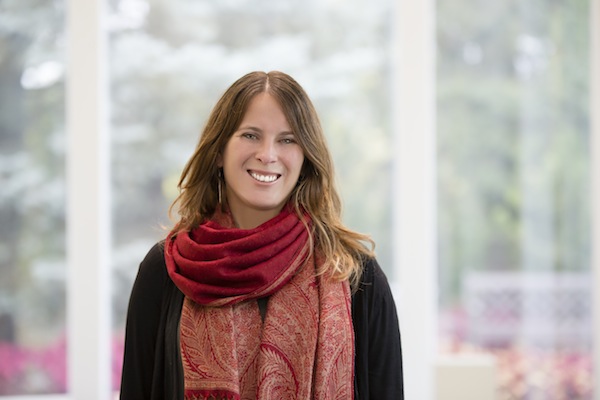
Shauna Labman (photo from Shauna Labman)

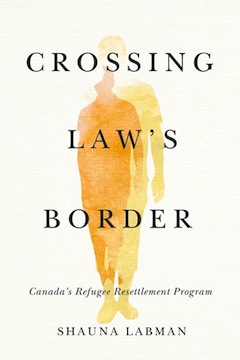
Amid the world’s largest refugee crisis since the Second World War, Winnipeg-based legal scholar Shauna Labman has come out with the book Crossing Law’s Border: Canada’s Refugee Resettlement Program, an in-depth look at how national and international law and policies have shaped Canada’s resettlement programs.

After growing up in Winnipeg, Labman did her undergraduate degree in English and religion at the University of British Columbia, then went into law school at the University of Victoria.

“At the end of law school, I was called to the bar in Ontario, and then I got a contract with the United Nations High Commissioner for Refugees in New Delhi, India,” said Labman. “I went to India, knowing about refugee laws that I’d studied in law school … which meant I knew about the Canadian context of refugees – how refugee claims are made in Canada, how the Immigration and Refugee Board works. I didn’t know anything about how refugees receive protection in a country like India, which has not signed the [United Nations] Refugee Convention or anything.”

After returning to Canada, Labman accepted a consultancy with the Canadian embassy in Beijing. Realizing that the life of a diplomat was not for her, she returned to UBC in 2007 for a master of laws, which was followed by a PhD. Her graduate supervisor was the current dean of the university’s Allard School of Law, Prof. Catherine Dauvergne.

Of her master’s thesis – “The Invisibles: An Examination of Refugee Resettlement” – Labman said, “It’s about the fact that refugees waiting for resettlement don’t get seen. We only see them when they are resettled … but the program is very ad hoc and there was very little attention given to it at the time.”

As Labman was starting her PhD, the ships Sun Sea and Ocean Lady arrived off the coast of British Columbia, carrying several hundred Tamil migrants seeking asylum from civil war in Sri Lanka. She recalled how resettlement was being discussed then. “The relationship between law and refugee protection and what I call ‘the layer legality of it all,’ how different laws work to position different refugees differently, became the basis of my doctoral work and this book,” she said.

After moving back to Winnipeg 10 years ago, she worked as a law professor at the University of Manitoba. Last July, she joined the University of Winnipeg and its Global College. As a human rights professor, she teaches courses on refugees, resilience, and concepts and conventions of human rights.

“I find this really rewarding work,” she told the Independent. “I sit on the board of the Immigrant and Refugee Community Organization of Manitoba and, in that program, I meet a lot of incredible people who spend a lot of time committed to creating a place of welcome for newcomers in our community.”

Labman’s book looks at Canada’s refugee resettlement program from the 1970s, when there were large numbers of people fleeing Vietnam, Cambodia and Laos, up to the Syrian resettlement that’s been happening in the past decade. It covers the different ways that Canada resettles refugees – the government’s resettlement program and the private sponsorship program, including the newly created Blended Visa Office-Referred program, which works with refugee referral organizations to screen refugees before connecting them with private sponsors.

“One way you can think of it is that resettlement itself is a complement to Canada’s inland refugee protection program,” she explained. “Because not that many refugees are able to come to Canada to claim protection, we have a resettlement program. Within that resettlement program, the government is doing resettlement, but the private sponsorship program allows the broader Canada population, individual citizens, to complement the government resettlement program by resettling refugees as well.

“We need only to look south at the U.S. to see how a change in government can affect refugee resettlement,” she said. “We have a legal obligation to asylum-seekers, but a lot of conversation about the border-crossers right now is about whether they are illegally entering the country and whether they are coming in violation of the law when they cross a border. I would say they’re not. I’d say that part of our recognition in the Refugee Convention is that they cannot be penalized for their entry and that, even within our Immigration and Refugee Protection Act, we recognize that refugees may need to cross in a different way or manner to make their claims of asylum.

“In the same way,” she added, “refugee resettlement isn’t a legal obligation, but law still plays out … in how these refugees are selected for resettlement before they enter our borders, which means that, when they are entering our borders, they are entering with a legal document permitting their entrance. They have a legally valid means of entering the country, even though they didn’t have a legal right to enter the country until they were selected for resettlement. So, the book looks at different ways the law operates within these two programs.”

image - Crossing Law’s Border book coverOne area in which the book does not delve, but that Labman said is important, is that the required forms are becoming more complicated to fill out, forcing applicants to seek help from lawyers. “It was too complicated for me to fill out when my family did a private sponsorship application,” she said.

While Labman’s book is academic, it is accessible to a broader readership. “It’s not going to be a page-turner if you’re not interested in refugee resettlement,” she said. “But, if you’ve, say, sponsored refugees and want to understand the program in more detail, it might be of interest. If you’ve worked with refugees, whether in a medical or educational context, in a settlement context … individuals working with refugees, there’s so much history and contextual details to the program. When I was writing this book, that information didn’t exist anywhere particularly clearly. So, if you want a comprehensive understanding of what resettlement in Canada is, this book has that.”

Also, for the main target audience – academics and graduate students in history, philosophy, political science, social work, sociology, law and others – Crossing Law’s Border provides a starting point for their own research on refugee resettlement and sponsorship.

“And, as Canada in the past few years has been promoting the expansion of private sponsorship to other countries, and other countries are taking up private sponsorship models, there’s lots of international interest by governments and policy makers and NGOs in those countries, in what Canada’s resettlement program is about,” said Labman.

The Winnipeg launch of her book took place on Jan. 16, and Labman is planning a launch at the Allard School of Law sometime in May.

Rebeca Kuropatwa is a Winnipeg freelance writer.

Format ImagePosted on February 14, 2020February 12, 2020Author Rebeca KuropatwaCategories BooksTags government, immigration, law, refugees, resettlement, Shauna Labman
Managing our potable water

Managing our potable water

Seth Siegel’s latest book is Troubled Water: What’s Wrong with What We Drink. (photo from Seth Siegel)

With approximately seven percent of the world’s renewable water resources within Canada’s borders, it would seem that we should have little to worry about when it comes to agriculture and potable needs. But our drinking water is at risk, said Seth Siegel, author of Troubled Water: What’s Wrong with What We Drink.

Siegel has spent the last half-decade studying the quality of drinking water. While his book focuses specifically on U.S. water sources, he said water quality is also a concern for Canadians and he worries that neither country is really prepared to address the threat of contaminants from our technological age: plastics, undetected chemicals and aging, inadequate infrastructure.

All of the issues that Siegel examines in his book regarding U.S. drinking water have been raised in recent years in Canada-based research. In many ways, Siegel’s exposé on the environmental impacts of toxic substances, chemicals and medication in the United States is a mirror into our own environmental dilemmas, as Canada is home to many of the same industries and technological challenges. It’s also home to its own significant problems with water purification in rural indigenous communities.

Lead in drinking water

The Flint, Mich., lead water crisis of 2014 may have faded from newspaper headlines, but researchers are still warning about the levels of lead in American and Canadian drinking water. While we are exposed to lead daily in minuscule amounts from the environment, both countries’ federal governments publish guidelines to stringently limit exposure – because lead is a neurotoxin. In Canada, old (pre-1970s or so) water pipes or solder were made with lead, while more recently made pipes do not contain the substance.

In March 2019, Health Canada tightened the guidelines for lead in potable water from a maximum of .01 micrograms (mcg) per litre to .0005 mcg/litre. The decision coincided with a yearlong investigation by Canadian journalists to determine how prevalent lead was in tap water. Some 300 homes in 11 cities were tested and, as expected, newer homes connected with updated water systems had acceptable readings but neighbourhoods with lead service lines or antiquated interior pipes had excessive lead in tap water. One older home in Whistler produced readings more than 12 times the maximum limit, and some 20 communities in Montreal were found to still have lead service lines.

What often makes things worse, Siegel told the Independent, is that updating service lines and interior water lines aren’t inexpensive undertakings and homeowners, who may not have the expertise to weigh the urgency of those changes, often have to bear the cost of upgrades.

Microplastics and more

Lead isn’t the only health risk homeowners face. Microplastic contamination, which has been traced, in part, to the use of plastic bottles, is a growing concern in Canada, home to a robust bottled water industry. Researchers at McGill University, the University of Toronto and several institutions in the United States are currently undertaking studies to determine the prevalence and effect of microplastics in the environment, including on local marine life.

While the World Health Organization states there isn’t enough evidence to confirm that ingesting microplastics is harmful to humans, Siegel and other researchers disagree. As he details in his book, there is now compelling research to suggest microplastics can actually “disrupt the human body’s hormone-related activity,” especially in children.

Becoming advocates

Still, Siegel cautions that his book isn’t an appeal to simply throw out the technology we use. “None of this is a call to ban plastic,” he said, noting that, “just more than 100 years since its first commercial use, plastic is the dominant material of our times. If one wanted to do so, it would be nearly impossible to go even a day without contact with it in some form.”

image - Troubled Water book coverThe answer, he said, is advocacy: educating ourselves and taking proactive approaches that steer both companies we invest in and the experts that oversee their products’ safety, so that materials are exhaustively tested and verified as safe for dependent, long-term use.

“Because your health and the health of your family rely upon your drinking water being of good quality, it’s important for you to get this right,” said Siegel, who said he hopes the data he has provided will help inspire a “citizen’s movement” to change the way drinking water is tested, approved and protected in the United States and elsewhere.

Troubled Water is Siegel’s second book on drinking water management. His New York Times bestseller, Let There Be Water: Israel’s Solution for a Water Starved World, published in 2015, delved deeply into Israel’s national water management system and the mechanisms that have made the country a sought-after resource on drought management in an era of climate change.

A graduate of the Hebrew University of Jerusalem and a successful entrepreneur and expert in patent law, Siegel said the book’s concept has been licensed in his name, but he is not charging royalties for its use. He said he wants to encourage other countries to use it as a template to inspire environmental change in their communities.

“[Every] country in the world is dealing with the same contaminants,” said Siegel. “They may have a different regulatory regime. Obviously, not everybody has the U.S. [Environmental Protection Agency] … but, whatever the local problems are, they are more similar than different.”

Both of Siegel’s books, as well as other resources, are available through his website, sethmsiegel.com.

Jan Lee’s articles and blog posts have been published in B’nai B’rith Magazine, Voices of Conservative and Masorti Judaism, Times of Israel, as well as a number of business, environmental and travel publications. Her blog can be found at multiculturaljew.polestarpassages.com.

Format ImagePosted on February 14, 2020February 12, 2020Author Jan LeeCategories BooksTags business, environment, government, health, policy, Seth Siegel, technology, water

Posts pagination

Page 1 Page 2 Next page
Proudly powered by WordPress