
Skip to content
  • Home
  • Subscribe / donate
  • Events calendar
  • News
    • Local
    • National
    • Israel
    • World
    • עניין בחדשות
      A roundup of news in Canada and further afield, in Hebrew.
  • Opinion
    • From the JI
    • Op-Ed
  • Arts & Culture
    • Performing Arts
    • Music
    • Books
    • Visual Arts
    • TV & Film
  • Life
    • Celebrating the Holidays
    • Travel
    • The Daily Snooze
      Cartoons by Jacob Samuel
    • Mystery Photo
      Help the JI and JMABC fill in the gaps in our archives.
  • Community Links
    • Organizations, Etc.
    • Other News Sources & Blogs
    • Business Directory
  • FAQ
  • JI Chai Celebration
  • JI@88! video

Recent Posts

  • Hateful messages intensify
  • Creating entrepreneurs
  • Wrong choice to host Piker
  • Attack on Jewish kids
  • Multiple benefits of a break
  • Dialing up the perfect thriller
  • Empowerment & more
  • Songs in war of peace
  • Successful trip to Cuba 
  • Tackling antizionism head on
  • Thinking of leaving Canada?
  • Kindness as a matter of fact
  • Personal stories, vital lessons
  • Connecting generations
  • Vancouver to Vienna
  • Recipes a form of resistance
  • Community milestones … February 2026
  • Generations … It’s all yours!
  • נתניהו לא מתבייש להאשים את ביידן באחריות להרג חיילים ברצועת עזה
  • Last hostage home
  • New bill targets hate crimes
  • Concerning actions
  • Recipes not always required
  • Survivor urges vigilance
  • Seniors profoundly affected
  • Farm transforms lives
  • Musical legacy re-found
  • A range of Jewish literature
  • A concert of premieres
  • Variety telethon on Feb. 22
  • Victoria club’s many benefits
  • Avodah dedicated to helping
  • Artists explore, soar, create
  • Life’s full range of emotions
  • Community needs survey closes March 29
  • Jerusalem marathon soon

Archives

Follow @JewishIndie
image - The CJN - Visit Us Banner - 300x600 - 101625

Tag: Dan Levitt

What should governments do?

What should governments do?

Left to right at the Jewish Seniors Alliance of BC Fall Symposium Nov. 23: Jeff Moss, Joyce Murray, Anthony Kupferschmidt, Dan Levitt and Isobel Mackenzie. (photo by Alex Roque Photography)

The Jewish Seniors Alliance of British Columbia’s fall symposium featured a panel discussion on the responsibilities of governments for seniors. The panelists discussed housing, transportation and healthcare services. They explored challenges in funding, staffing and service delivery, while also touching on topics such as the potential for community involvement in shaping senior support systems.

The Nov. 23 gathering, which took place at the Jewish Community Centre of Greater Vancouver, opened with Jeff Moss, executive director of JSABC. He said provincial advocacy is “at the heart” of what JSA does, “and bringing together politicians in this space is really important, because the conversations that we have when we meet with the provincial government, or when we’re meeting with the opposition, [are] where we are advocating strongly for universal free home support for seniors in British Columbia.”

JSA’s partners in this campaign are Council of Senior Citizens’ Organization (COSCO), the BC Health Coalition, the Independent Long-Term Care Councils Association of BC, Family Caregivers of British Columbia and the BC Care Providers Association (BCCPA), whose chief executive officer, Mary Polak, addressed those gathered. 

Polak shared that her father, who’s 96 years old, is in long-term care. He has some dementia issues and needs to have some specialized care, she said. “But in the time that he was at home with us and we were trying to give him the best quality of life we could in our own home, it was a real challenge to try and support that with home health services. And we were in a better place than many because at least we had some of the financial capacity to do that, and we had the family around us. But, for an increasing number of people, that’s becoming impossible, and it shouldn’t be that way.”

Ezra Shanken, CEO of the Jewish Federation of Greater Vancouver, which also is a partner and supporter of JSABC, introduced Shay Keil, who sponsored the event with the BCCPA and JSA, along with Michael and Sally Geller, and the Zalkow Foundation.

“Seniors are the foundation of who we are,” said Keil. “You’ve built our families, our traditions and our values, and you deserve to be honoured, supported and celebrated. We often speak of m’dor l’dor, from generation to generation, and that idea is very close to my heart. I strongly believe in the connection between seniors and children and everyone in between. That belief is why I’m here today, and why I’m deeply committed to community through volunteering, supporting and staying actively involved in the organizations that strengthen the lives of those around us, including JSA.”

Keil introduced the emcee of the panel, Isobel Mackenzie, “who served as British Columbia’s seniors advocate from 2014 to 2024, and has spent her career championing the well-being, safety and dignity of our seniors.”

Mackenzie asked each panelist to come to the stage: Anthony Kupferschmidt, strategic lead for aging and older persons with the City of Vancouver, who has worked in similar capacities with other cities and groups, and is also a gerontologist; Joyce Murray, who has served both as a member of the Legislative Assembly and as a member of Parliament; and Dan Levitt, a gerontologist who has worked 30-plus years in seniors care, and is the current seniors advocate for the province.

Each panelist gave an overview of their opinions, starting with Kupferschmidt, who noted that much of what a municipality can do for the aging population requires financial support from other orders of government. However, a city can impact seniors in such areas as “zoning and related development charges, making sure that we have the right type of housing and the right mix of housing  across the city.”

Municipalities can work with the provincial government, for example, on where care homes are located and support their development. Transportation is another key area, as are sidewalks and other “elements of an age-friendly city.” Cities have a role with respect to public libraries and the accessible services they offer, community centres, senior centres, pools, arenas, etc. 

Levitt was the next to speak. “Currently, there are 5.5 million people living in our province, 1.1 million people are over 65,” he said. “Today, there’s one in five – 20% of all people are seniors. Fast forward just a decade from now and it’ll be one in four, 25%…. We have more people who are living longer and more people who are seniors, so 400,000 more seniors in the next decade.”

Levitt’s office monitors five areas: health care, transportation, housing, income and community services.

“The general trend,” he said, “is that there are more seniors and there are more investments, but there’s less available per senior.”

As an example, he said, a quarter of all seniors are living on $23,000 a year, or less than $2,000 a month. “And it’s not that hard to go find people living in the West End in affordable housing living on less than $1,000 a month, so they really need that income support from all levels of government, they need those subsidies.”

Levitt said there were 13,000 people on the waitlist for affordable housing last year. “How many of them got a space?” he asked. “Six percent, just under 800 people have got a space for affordable seniors housing in our province. We haven’t built enough, and there is a call right now to build more, but we’re not keeping pace with that demand.”

As well, he said, the province has been taking money away from long-term care homes, no longer funding overtime and agency nurses, for example, and this affects places like the Louis Brier Home and Hospital.

“It means that an already very thin margin is now almost impossible to operate without that government subsidy,” said Levitt. 

“We haven’t invested enough either in seniors care,” he added. “We did a report in July, and our July report identifies that over 16,000 people are going to be short long-term care because we’re not building enough beds. There are 7,200 people on the waitlist today.” The burden of care, he said, is being transferred to families.

Murray took the conversation in a different direction.

“I was looking at the budget numbers about this when I was thinking about what I would be saying,” she said, “and the total new spending on OAS [Old Age Security] and medical care for seniors alone in the 2023 budget was $110 billion of new money…. Now, that’s going to tie into some of the demographics, for sure, but, when you break that down, that’s $4,300 per retiree 65 and older in new money in the 2023 federal budget versus $755 for younger Canadian under 45 in new money.”

She wondered about how well younger people were being supported. She also spoke of environmental concerns.

“What does it mean to be a good ancestor?” she asked. “And what do we think our society, our province, our country needs to do so that we collectively are good ancestors?”

“To govern is to choose,” said Mackenzie, noting that governments must make decisions about how “to allocate our finite resources to our infinite demands.”

The panelists talked more about that, as well as the way in which different levels of government work with one another. Murray said governments make policies they hope will attract voters, and seniors tend to vote more than younger people, so, for example, “a family with two members can earn up to $180,000 a year and still get their full OAS,” she said, asking, “Is that a good allocation of money?”

Mackenzie asked a variant of Murray’s question, considering how maximum monthly payments for public long-term care work.

“The person whose income is $200,000 a year is going to pay the same for their publicly funded long-term care plan as the person whose income is $70,000 a year,” said Mackenzie. “And so, if, on the one hand, we say, well, the people who have more should get less, which is the OAS argument, to what extent should we flip that and say, well, the people who have more should pay more when it comes to publicly subsidized long-term care? That’s, I think, missing from the discussion…. I think there are very uncomfortable conversations … that governments are going to have to have with their electorate and, as elected officials, you don’t like to have those uncomfortable conversations, for obvious reasons.”

Levitt thought the situation could be improved if governments helped people understand how much money they need to save to age well, what supports there would be for them as they age, and what people could do to support themselves. 

Murray suggested, “Maybe what we need is like a citizens’ assembly, to start out by identifying what are the key things that are maybe broken or need improvement so that we can be good ancestors. And then have a citizens’ assembly that looks at what are the best solutions in other countries … and then create a proposal on that. I think we have to crowdsource the solutions here…. We need citizens to help us solve this.”

Kupferschmidt brought up Better at Home, a basket of non-medical services that seniors can access. “There has been public engagement into what those services should be…. However, there are examples of the service that is offered in one neighbourhood in the city is different than another,” he said, explaining that a “model with all the best intentions can sometimes create some disparities as well.”

Mackenzie stressed the complexities, both because everyone’s needs and everyone’s solutions are different. “And, in the end, in those environments, generally, we try to come up with solutions that meet the greatest good for the greatest number, but that certainly doesn’t meet the need for everybody all the time and that is, I think, the political challenge at all levels of government, whether they be the local, the provincial or the federal.”

Posted on December 19, 2025December 18, 2025Author Cynthia RamsayCategories LocalTags Anthony Kupferschmidt, Dan Levitt, eff Moss, Ezra Shanken, funding, governance, government, government funding, health care, Isobel Mackenzie, Jewish Seniors Aliance, Joyce Murray, JSABC, long-term care, Mary Polak, policy, seniors, Shay Keil
Learning about aging

Learning about aging

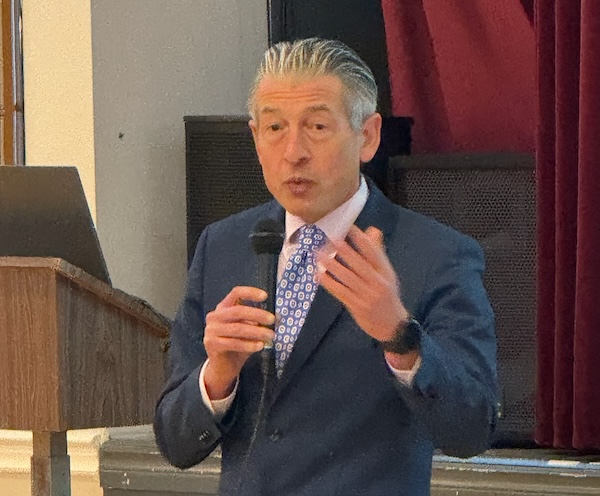
On Jan. 12, Dan Levitt, seniors advocate of British Columbia, spoke at the Jewish Seniors Alliance’s winter symposium. (photo from JSA)

On Jan. 12, Jewish Seniors Alliance, with Kehila Society of Richmond and the Peretz Centre for Secular Jewish Culture, presented the winter symposium titled The Future of Aging. The featured speaker was Dan Levitt, seniors advocate of British Columbia.

Jeff Moss, executive director of JSA, opened the afternoon event and Toby Rubin, co-executive director of Kehila Society, offered some remarks, including that Kehila is always happy to be a co-presenter with JSA.

Gyda Chud, representing the Peretz Centre, told a few stories about the Levitt and Gofsky families (Dan Levitt’s parents) and their history with the Centre. Levitt’s great-grandparents, Rose and Abe Smith, were among the founders of the Peretz. Chud spoke of her mother, Gallia, who is 100 years old – she lives by and instils the values of diversity, inclusion, social justice and advocacy. Chud also mentioned that she had been Dan Levitt’s preschool teacher at the Peretz Centre, where the symposium was held.

Tammi Belfer, chair of JSA, reminded everyone of the organization’s commitment to all the seniors of British Columbia, and thanked everyone for working to enhance the quality of life for all seniors.

Levitt, who is an honorary member of JSA, then educated the 125 attendees about the situation of seniors in this province. He began by giving an example from his time at a home in Mission. The story involves giving plants to seniors on one floor of the facility and telling them that they were responsible for the plants’ upkeep. Plants were also given to residents on another floor, but they were told that the staff was responsible for their care. The residents who were given the responsibility had plants that flourished, whereas the plants on the other floor died. Given purpose and responsibility, said Levitt, people will rise to the challenge.

Levitt continued with some statistics: there are presently 1.1 million seniors in British Columbia and, by 2036, there will be 1.6 million. More than 90% of seniors live independently, but the fastest growing segment of this cohort is over 85 years old, and one in three of them will need care. 

In his travels across the province, Levitt has heard from seniors about age discrimination in the workplace, often related to the regulations of employment, such as losing long-term disability and group insurance coverage after age 65. Many were concerned about the cost of driver’s licence renewal medical forms, which can vary from about $80 to $250, depending on the doctor’s discretion.

Levitt’s office is planning on holding a panel on transportation that will look at the needs of seniors. Some of the concerns are the distances between bus stops and the availability of HandyDART services.

There are many challenges ahead, said Levitt, noting that there are 6,500 people in British Columbia waiting for a publicly-subsidized long-term care bed. Home support, which would enable many seniors to “age in place,” is expensive here – these services are free to users in Ontario and Alberta. There is a need for more advocacy, he said. Support is also needed for caregivers, so they are not lost to other jobs. Combating ageism is also important.

Some other problems include the seismic upgrading needed in many care homes and digital access for seniors. The future must include help at home, with aid in reminders regarding medications, and help with technology. There needs to be age- and dementia-friendly places like they have in Bruges, Belgium.

Recommendations from Levitt and the Office of the Seniors Advocate include improving SAFER (a rental help program for seniors, the rates of which are inadequate); free home support; the funding of shingles, RSV and enhanced flu shots; and developing cross-ministry synergy for seniors’ issues.

After a lively Q & A session led by Chud, Ken Levitt, Dan’s father, who is a longtime board member of JSA, said a few words of appreciation. Larry Shapiro, JSA past chair, presented Dan Levitt with a gift and Moss thanked him. Refreshments followed, and the audience lingered and talked with Levitt before leaving with more knowledge and confidence than when they arrived. 

Shanie Levin is a Jewish Seniors Alliance Life Governor. She is also on the editorial committee of Senior Line magazine.

Format ImagePosted on February 14, 2025February 13, 2025Author Shanie LevinCategories LocalTags aging, BC seniors advocate, Dan Levitt, health care, JSA, policy, seniors
A new voice for BC elders

A new voice for BC elders

Dan Levitt has been appointed to be British Columbia’s new seniors advocate (photo from Dan Levitt)

Dan Levitt is set to become British Columbia’s new seniors advocate. The appointment was announced last month by BC Health Minister Adrian Dix.

“Dan Levitt has championed the rights of seniors for 30 years and with his extensive experience he is an excellent choice for BC’s seniors advocate,” Dix said in announcing the appointment. The Office of the Seniors Advocate is an independent branch of the provincial government, which acts in the interest of seniors and their caregivers.

Levitt becomes only the second person to hold the role, replacing Isobel Mackenzie, who will retire April 5 from the position she initiated a decade ago.

Levitt spoke with the Independent over lunch in the community centre that is part of KinVillage, the Tsawwassen continuing care retirement community he has headed as chief executive officer since 2021. Over the din of an adjacent bingo game, Levitt spoke of his career, the footsteps of his father and his plans for the new job.

The role of seniors advocate is unusual, he explained. British Columbia’s was the first in Canada, being created by legislation in 2013. To date, only two provinces, New Brunswick and Newfoundland and Labrador, have followed suit, though others are considering it.

The purpose of the advocate’s office, which has a staff of 17, is to look at systemic issues that impact seniors and make recommendations to government. 

“The five areas that we look at are transportation, housing, health care, income supports and community services that are geared around older people,” said Levitt. While the office has no authority to force governments to take steps, Levitt said his predecessor, Mackenzie, has recommended many proposals that have found favour with those in power. Not all recommendations will be adopted, he said, but “it usually helps to move the needle in a direction.”

“There isn’t that power, if you will, to say, ‘This must happen.’ But, many times, the recommendations are ones that are introduced and taken forward because they are the right things to do,” said Levitt, noting that his predecessor initiated a great range of measures that the government has taken up. 

“Isobel and the office have been real pioneers in shedding lights on challenges and opportunities with an aging population,” he said. “That’s the purpose of these independent offices. They can reflect, in this case, what matters most to seniors, what are their concerns, and then move that agenda forward in helping to influence public policy.”

The position is nonpartisan and independent from government. 

“In the recruitment process, no political official was involved,” said Levitt. 

Levitt is not the first in his family to work in the senior care field. His father, Ken Levitt, was a longtime administrator of the Louis Brier Home and Hospital, during a time of significant expansion, including the development of the Weinberg Residence. The elder Levitt is now, among other things, past president of the Jewish Seniors Alliance of Greater Vancouver. 

“I am following in his footsteps, for sure,” said the son. “And I think I am honouring, as he did, our parents by ensuring the health and well-being of older adults.”

As his new position requires he hold no outside affiliations, Levitt recently resigned from roles on the boards of directors of CommonAge, which advances the interests of older adults in the 53 Commonwealth countries, and the International Federation on Ageing. He has also given up adjunct professorships in gerontology at Simon Fraser University and in the school of nursing at the University of British Columbia, and a sessional instructor position at the British Columbia Institute of Technology.

Levitt’s undergrad degree in psychology is from UBC and he graduated from the University of North Texas, Centre for Studies in Aging, with a master of science.

“I need to dedicate 110% of my working time to this role,” he said of giving up his other gigs, which included speaking engagements worldwide on topics of aging and extensive public commentary on related subjects. 

The vetting process for the seniors advocate position was a lengthy one – and Levitt compares getting the final word on his selection with the feeling of elation he gets when he places well in his avocation of competitive running.

“Probably like anybody else who’s been through a job search like this, when you get that nod, it feels pretty good,” he said. “I am a competitive runner in my age category and, when I place well in a race, you are elated. So, when I got the message, I was pinching myself, making sure I heard what I thought I heard. You feel this elation. Soon this wears off and you start realizing the responsibility, start realizing what this means now, and people are depending on you to make their lives better.”

Caring for seniors also means helping the people in their lives, he said.

“It’s not just the older people that we’re trying to support, who are directly impacted, but it’s their family members,” said Levitt. 

Although he is not yet in the job – he’ll have to move to Victoria, coming home to Vancouver on weekends – he already has the first few months scoped out.

“I’m going to be doing a tour around the province of BC [meeting with seniors],” he said. “I’ll be asking them questions around what are those policies that help or hinder them in those five areas of transportation, housing, health care, income supports and community supports. We’ll be looking at those issues, listening to them, then we’ll come back to the office, synthesize the information and then we will release a report on what we found. That report will give us a mandate of what the biggest concerns are that seniors have and we’ll make recommendations to the government on how we can improve different aspects of seniors’ lives.”

In the statement announcing Levitt’s appointment, his predecessor had kind words for him.

“It has been an honour and a privilege to serve as seniors advocate for the Province of BC,” said Mackenzie. “Our population is aging and seniors need the ability to live independently at home, knowing the programs and services to support them are easily accessible to everyone. As issues such as dementia, housing and elder care become more complex, it’s crucial to advocate for strengthened seniors services throughout the province. I know Dan is ready to continue the cause and his efforts will make a difference in the lives of seniors for years to come.”

“I have big shoes to fill,” said Levitt, “because Isobel Mackenzie has done a phenomenal job starting the Office of the Seniors Advocate and really setting a very high bar, really pushing forward the agenda of older people, shining a light on some of the inequities and some of the systemic issues that impact older people and making recommendations that have stuck and changed just about every aspect of life for seniors.”

Levitt has spoken out on issues in the past, weighing in, for example, on the controversy around Lisa LaFlamme, whose firing as CTV National News anchor was blamed on sexism and ageism, and in challenging the ageism of birthday cards. While he will be taking on systemic issues on the larger stage of provincial policy, he urges individuals to speak up against ageism in everyday life and to celebrate aging.

Be aware of even subtle language that debases older people and their experiences, he advises.

“Don’t use the language that demonizes or goes into the negative stereotypes we often will see,” he said. “For example, ‘I’m having a senior moment.’ No one who is young says they’re having a junior moment.”

He encourages everyone to reject negative connotations around aging.

“Embrace your own age,” he said. “Embrace who you are and enjoy those birthdays and celebrate them and celebrate getting older. Don’t hide your age.” 

Format ImagePosted on February 23, 2024February 22, 2024Author Pat JohnsonCategories LocalTags British Columbia, Dan Levitt, government, health care, Office of the Seniors Advocate, seniors
Proudly powered by WordPress