Skip to content
  • Home
  • Subscribe / donate
  • Events calendar
  • News
    • Local
    • National
    • Israel
    • World
    • עניין בחדשות
      A roundup of news in Canada and further afield, in Hebrew.
  • Opinion
    • From the JI
    • Op-Ed
  • Arts & Culture
    • Performing Arts
    • Music
    • Books
    • Visual Arts
    • TV & Film
  • Life
    • Celebrating the Holidays
    • Travel
    • The Daily Snooze
      Cartoons by Jacob Samuel
    • Mystery Photo
      Help the JI and JMABC fill in the gaps in our archives.
  • Community Links
    • Organizations, Etc.
    • Other News Sources & Blogs
    • Business Directory
  • FAQ
  • JI Chai Celebration
  • JI@88! video

Recent Posts

  • המלחמות של נתניהו וטראמפ
  • Zionism wins big in Vegas
  • Different but connected
  • Survival not passive
  • Musical celebration of Israel
  • Shoppe celebrates 25 years
  • Human “book” event
  • Reclaiming Jewish stories
  • Bema presents Perseverance
  • CSS honours Bellas z”l
  • Sheba Promise here May 7
  • Reflections from Be’eri
  • New law a desecration
  • Resilient joy in tough times
  • Rescue dog brings joy
  • Art chosen for new museum
  • Reminder of hope, resilience
  • The national food of Israel?
  • Story of Israel’s north
  • Sheltering in train stations
  • Teach critical thinking
  • Learning to bridge divides
  • Supporting Iranian community
  • Art dismantles systems
  • Beth Tikvah celebrates 50th
  • What is Jewish music?
  • Celebrate joy of music
  • Women share experiences 
  • Raising funds for Survivors
  • Call for digital literacy
  • The hidden hand of hate
  • Tarot as spiritual ritual
  • Students create fancy meal
  • Encouraging young voices
  • Rose’s Angels delivers
  • Living life to its fullest

Archives

Follow @JewishIndie
image - The CJN - Visit Us Banner - 300x600 - 101625

Tag: Warren Kinsella

The hidden hand of hate

Warren Kinsella has spent much of his career studying the darker corners of political life. A lawyer by training, author of about a dozen books and a longtime political strategist, he has written about Holocaust denial, far-right extremism and organized hate movements. 

In his just-released book, The Hidden Hand: The Information War and the Rise of Antisemitic Propaganda, he follows these threads down the unseemly rabbit hole that has perplexed many observers since Oct. 7, 2023: the sudden and superficially spontaneous eruption of anti-Israel activism across Western campuses and cities in the aftermath of the horrendous atrocities of that day.

Kinsella’s thesis is straightforward and, to most readers of these pages, probably neither controversial nor surprising. The worldwide surge in anti-Israel protests, he argues, is not organic. Rather, it reflects a long-developed propaganda infrastructure – the “hidden hand” – involving the Iranian regime, Hamas, Hezbollah and a constellation of worldwide activist organizations that have spent years building networks capable of shaping Western public opinion.

Hamas, Kinsella argues, fights two wars simultaneously. One is the familiar military campaign conducted with rockets, bullets and suicide attacks. The other is an information war, waged through imagery, messaging and propaganda. Israel may well win the first war, he suggests, but the second – the battle for global public opinion – is far less certain.

The book opens with the immediate aftermath of the Hamas attacks of Oct. 7. While Israelis were still grappling with the scale of the massacre, demonstrations against Israel began sweeping Western campuses and cities. In the United States, a “national student walkout” took place within days of Oct. 7. Activists insisted these events were spontaneous expressions of outrage over the war in Gaza – but many of them took place before there was even a war in Gaza.

Many of the protests, Kinsella writes, appeared to have been organized rapidly with shared messaging, identical slogans and coordinated materials. Student groups that claimed to be independent grassroots organizations were often connected to larger activist networks. Manuals, posters and protest toolkits circulated almost immediately.
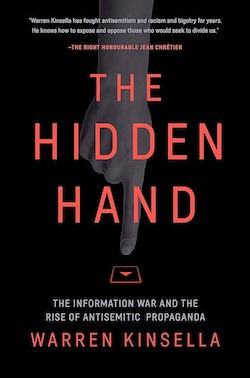
image - The Hidden Hand book coverThis pattern is central to the book’s argument. What looks like decentralized activism, Kinsella contends, often reveals indisputable signs of coordination.

One of the more striking anecdotes in the book involves Gary Wexler, a California professor who worked with the Ford Foundation on programs in Israel and Palestine during the Oslo peace process. Wexler recalls being warned by a leading Palestinian civil society coordinator that pro-Palestinian networks would one day rival – and surpass – the vaunted Jewish advocacy organizations in their ability to mobilize globally. Funding, the activist reportedly told him, would come from European institutions, Arab governments and wealthy donors.

Years later, Wexler began to see the prediction materialize in movements such as the push for boycott, divestment and sanctions (BDS), Israel Apartheid Week and international flotillas challenging Israel’s blockade of Gaza.

Kinsella stops short of claiming a single command centre orchestrating these movements. Instead, he suggests a looser ecosystem in which state actors, activist organizations and sympathetic nongovernmental organizations amplify one another’s messaging.

If there is a common theme running through the book, it is the power of narrative.

According to Kinsella, Hamas and its allies have been remarkably successful at shaping the language through which the conflict is discussed in the West. Terms such as “colonialism,” “apartheid” and “genocide” now dominate activist discourse, particularly among younger audiences. These ideas circulate widely on social media platforms, where emotionally charged content spreads faster than verified information.

The book devotes considerable attention to misinformation and the speed at which it travels. One example Kinsella cites is the widely circulated claim that Israel had bombed the al-Ahli Arab Hospital in Gaza, killing hundreds of civilians. The allegation ricocheted around the world within hours, sparking protests and diplomatic condemnations from the highest levels. Later evidence indicated the explosion was caused by a misfired rocket from Palestinian Islamic Jihad – and that the casualty figures had been exaggerated exponentially. The correction, of course, traveled neither as far nor as fast as the original claim.

Social media algorithms amplify this dynamic, Kinsella argues, pushing users toward increasingly extreme content. The phenomenon is not unique to Middle East politics. The same mechanisms drive conspiracy theories about vaccines, elections and countless other subjects. But, in the case of Israel, he suggests, the misinformation taps into something older and deeper: an antisemitic proclivity to believe the worst and most fantastical allegations about Jews.

In the contemporary context, antisemitic narratives often blend with modern ideological frameworks. In activist discourse, Jews are sometimes recast as embodiments of colonialism or “whiteness,” placing them on the oppressor side of social justice frameworks. The result, Kinsella suggests, is a rhetorical environment in which hostility toward Israel can slide easily into hostility toward Jews.

Polling data cited in the book underscores the generational divide in attitudes toward the conflict. Surveys in North America and Europe have found large numbers of younger respondents expressing sympathy for Hamas or believing that the 10/7 attacks were justified. Other polls show significant numbers of young people convinced that Israel is committing genocide. Such findings shocked even the pollsters who conducted them.

Kinsella argues that universities have played a significant role in shaping these attitudes. For decades, he writes, academic discourse has increasingly framed Israel through the lens of “settler-colonialism.” At the same time, foreign governments – particularly that of Qatar – have donated billions of dollars to Western universities.

The media also come under scrutiny. Western news organizations, he argues, routinely rely on casualty figures supplied by the Hamas-controlled Gaza Health Ministry, numbers that critical analysis suggests are inflated, particularly in terms of non-combatant casualties. Journalists reporting on what’s happening in Gaza frequently depend on local stringers who operate either directly under Hamas authority or in a context where anything but pro-Hamas reporting is existentially dangerous. This situation effectively grants terrorist propaganda the imprimatur of legitimate media platforms.

Because Kinsella is Canadian, The Hidden Hand is rife with Canadian content. This will be interesting to Canadian readers – and a meaningful contribution to the sad litany of incidents in this country – but it is additionally relevant because Canada has been among the worst places for these sorts of offences. Last year, an Israeli government report analyzing the problem worldwide called Canada the “champion of antisemitism.” So, while Canada may not be a major player in many of the world’s foremost competitions or concerns, when it comes to anti-Jewish discrimination, we regrettably find ourselves owning the podium. That makes what happens here – and how (or whether) we confront it – especially relevant.

The thesis of Kinsella’s book, of course, is that these problems know no boundaries (figuratively or literally).

Much of the evidence he presents is circumstantial rather than definitive. He has found no single document or intercepted communication that proves the existence of a centralized propaganda command. The accumulation of connections, coincidences and patterns is what gives the book its force, but Kinsella does not provide the proverbial smoking gun. This is partly understandable because, if there were incontrovertible proof linking ostensibly legal, legitimate activist groups in Canada and around the world with known terrorist entities, surely Western governments would have acted by now.

Ah, but there’s the rub. The very fact that someone like Kinsella, without, say, top-level security clearance, could amass such a damning catalogue of evidence begs the question of just how much effort governments and security services are devoting to this problem. That so many deeply problematic and potentially illegal cases in Canada, including here in British Columbia, have not resulted in charges or even, seemingly, any serious investigation, makes Kinsella’s book especially valuable. If there is this much smoke, where are the governmental and security agencies that are supposed to be the firefighters?

Whether one accepts all of Kinsella’s conclusions or not, The Hidden Hand forces readers to confront the possibility that the global conversation about Israel is shaped by forces far more organized and odious than many seem willing to believe.

If Hamas fights both with bombs and with words, as Kinsella argues, then the information battlefield may prove just as consequential as the physical one. And, on that battlefield, the outcome is still very much in doubt. 
Posted on March 27, 2026March 26, 2026Author Pat JohnsonCategories BooksTags antisemitism, books, government, media, propaganda, protests, rallies, The Hidden Hand, Warren Kinsella
Trying to counter hate

Trying to counter hate

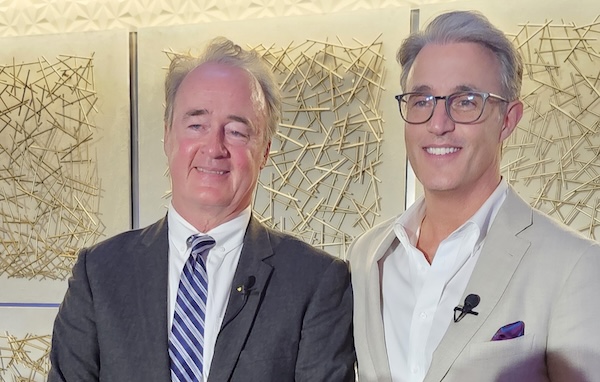
Warren Kinsella, left, and Ben Mulroney at Montreal’s Beth Israel Beth Aaron Synagogue June 19. (photo by Dave Gordon)

In 1980, when Warren Kinsella was in Calgary performing with his punk rock band, one of his friends tapped him on the shoulder to say some men in the crowd were giving a Nazi salute.

“I didn’t believe him. I didn’t think it was possible,” said Kinsella, now a Toronto Sun columnist, at a recent talk. “There, in fact, were three big guys, shaved heads, T-shirts, jeans, suspenders, Doc Martin boots, coloured laces, and they were making Nazi salutes.”

Kinsella confronted one of them, twice asking him to stop the salutes, and was greeted with an expletive and the word “Jew.” As the Irish-Catholic Kinsella tells it, a fist came his way, he hit back – a fight involving his buddies and the skinheads erupted. Eventually, the “skinheads retreated, battered or bruised,” said Kinsella. After the show, one of them pointed at Kinsella, saying, “We’ll be back.” 

“And the truth, my friends, is they never really left.” 

On June 19, at Montreal’s Beth Israel Beth Aaron Synagogue, Kinsella was joined by syndicated radio host Ben Mulroney, who acted as the moderator of the event called Weaponizing Genocide: Exposing Propaganda and Hate in the Age of Misinformation. It was a fundraiser for the Foundation for Genocide Education, which was founded in 2014 by Heidi Berger, a child of Holocaust survivors. The nonprofit aims to ensure that the subject of genocide is taught in North American high schools. 

Since that incident 45 years ago, Kinsella has battled Jew-hatred as a lawyer and as a journalist – at times with rifles jammed in his chest, police protection, bomb threats and death threats.

“I’ve seen lots of hate, but I have never seen it as bad as it is,” he said at the June event. What the Jewish people are fighting is not only a seven-front military war, but a propaganda war “we are losing,” he said.

Kinsella, the author of 10 books, will soon publish The Hidden Hand: The Information War and the Rise of Antisemitic Propaganda, along with an accompanying documentary.

Exactly 18 months before Oct. 7, 2023, social media profiles started popping up all around the Muslim world, Kinsella said. They had “very few followers” and were filled with “stuff about soccer matches and celebrities and pictures of kittens.” On the morning of the seventh, as Hamas and its allies were attacking Israel, thousands of these social media profiles came to life, he said, noting those that had just a few followers suddenly had half a million. 

“They pushed out lies,” he said, such as “there had been no murder, no rapes.” 

“It was an indication of how sophisticated and how effective these guys were, as they were able to get that word out into the stratosphere,” said Kinsella.

“Antisemites,” he added, “know that … this is the greatest political, cultural and economic revolution of our lifetimes,” with Generation Z’s primary source of information being TikTok, “one of the principal platforms for antisemitism on the planet.” 

After the event, Berger told the Jewish Independent that social media literacy for students is critical, to “learn when the term genocide is being used to manipulate their views and their emotions.”

In his remarks, Kinsella said some three million members of Gen Z in Canada believe Israel should be wiped off the map and that Hamas was justified in its actions. Weeks before Israel sent troops into Gaza, he said, young people across Western democracies were chanting the lies that they had seen online.

These were organized campaigns of protests, with professionally made signs, and the “disrupting and terrorizing of Jewish neighbourhoods with military precision,” said Kinsella. “They had talking points. They had food, drink, transportation. They even had legal representation for free….  And many of them were being paid to show up.” 

He said, “It was principally a campaign to seize the sympathies of our young. And it’s a campaign that’s winning.” 

Kinsella, president of Daisy Consulting Group, who has worked for various high-profile US and Canadian political campaigns, noticed that protesters used pithy phrases “very much like what political mainstream parties do,” such as “from the river to the sea” and “free Palestine.”

“Who’s against freedom?” he asked. “It’s nice.”

Media, government and nongovernmental organizations continue to take Hamas at its word, said Kinsella, citing an early example. On Oct. 17, 2023, when the Gazan Health Ministry declared that Al-Ahli Arab Hospital in Gaza City had been bombed by Israel and that 500 people were dead, it made headlines around the world. “The bombing was cited as evidence of Israel’s genocidal war,” yet evidence later showed it was a Palestinian Islamic Jihad rocket that hit the parking lot, and perhaps a few dozen were killed.

The day of the Montreal talk, Iran bombed Soroka Medical Centre in Beer Sheva, Israel – a war crime that almost no media reported on, said Kinsella.

“The line I always use with politicians: facts tell, but stories sell,” said Kinsella. “That’s why they try to overwhelm us, because they know if our story gets heard, if it gets seen, if it gets read, they will be defeated, because, at the end of the day, their story is a litany of hate.” 

Dave Gordon is a Toronto-based freelance writer whose work has appeared in more than 100 publications around the world. His website is davegordonwrites.com.

Format ImagePosted on July 11, 2025July 10, 2025Author Dave GordonCategories NationalTags anti-Israel protests, antisemitism, Ben Mulroney, education, Foundation for Genocide Education, journalism, mainstream media, PR, social media, speakers, university campuses, Warren Kinsella
Action must be taken

Action must be taken

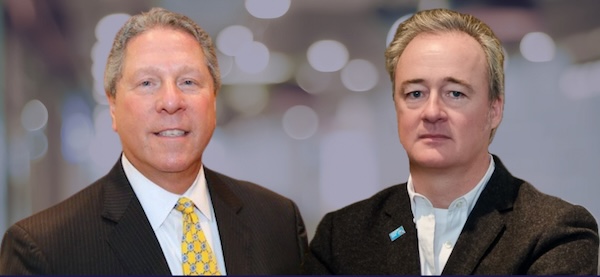
Richard Heideman, left, and Warren Kinsella participated in a B’nai Brith Canada virtual fireside chat on May 30. (photo from B’nai Brith Canada)

The League for Human Rights of B’nai Brith Canada hosted a virtual fireside chat with Canadian lawyer and author Warren Kinsella and American attorney Richard Heideman on May 30. The conversation largely focused on growing antisemitism and political passivity in North America in the wake of the Oct. 7 Hamas attacks on Israel.

Kinsella began by talking about his experiences over the past three decades, writing about neo-Nazism and antisemitism and how they never fully disappear, no matter what region of Canada one observes. However, he said, the present state of anti-Jewish feeling in the country is the worst he has witnessed.

“I never dreamed in my worst nightmare that we would actually have in a single week two schools in separate provinces shot at because they teach Jews. I never thought I would see the attacks on Jewish businesses, individuals and community centres,” he said.

Kinsella castigated elected representatives in Canada for their inaction and lack of leadership in the face of hate speech directed at Jews and the rising numbers of attacks, citing an abundance of laws to handle the problem effectively.

In the international arena, Heideman added, the silence from prime ministers, presidents and ambassadors after the Hamas attacks last fall has been “deafening.” No Western democracy, he said, would tolerate the atrocities committed during the Oct. 7 attacks on their own soil.

“The United Nations and its world courts must be held accountable for singling out Israel for multiple decades and playing into the biased hands of countries like Iran, which only months ago directed hundreds of drones and rockets at the sovereign state of Israel,” said Heideman.

Both men praised Israel for its commitment to human rights and agreed that the present demonization of the strongest democracy in the Middle East, and the concurrent calls for economic and academic boycotts, must come to an end. 

Heideman argued that the lessons of recent history, namely the banning of Jews from all facets of everyday life in Nazi Germany in the 1930s – which was followed by the Holocaust – have not been learned. What’s more, he said, there is presently a blame-the-victim mentality at the international diplomatic level which faults Israel for the present situation.

On the bright side, Kinsella noted that polling after Oct. 7 would suggest that the vast majority of North Americans are on Israel’s side and believe it has a right to defend itself. They also welcome Jewish people into their communities. The problem, according to Kinsella, is with the younger segment of the population, the group which has taken to the streets, created encampments, and said and done terrible things to Jews.

“Eighteen-to-40-year-olds in Canada, the United States and Europe are presently a lost generation. You will find no constituency or demographic that believes more in Holocaust denial, that thinks Hamas was right and that Israel should be wiped off the map,” Kinsella said.

“When we have millions of young people who have embraced hatred, division and terrorism, we have a big, big problem,” he continued. “I think we are looking at something that is going to take a decade or more to fix because it’s taken us more than a decade to get us to this dark place.”

To Kinsella, the internet – the primary medium through which people, particularly the young, obtain information – is largely at fault. Despite improving the world in many respects, he said, the World Wide Web has enabled those intent on propagating hate to do so immediately and at no expense. Further, both Kinsella and Heideman said bad state actors are determined to exploit the internet to spread misinformation and hate speech.

Heideman said there was no place for timidity in the present environment and advocated examining each situation and acting accordingly – in other words, not remaining silent.

“Being quiet does not do us any good,” he said. “Being quiet leads to Holocaust denial, distortion and people not caring. We have to take action in a way that is targeted, strategic and powerful – that means in federal courts, state courts and international courts.”

Kinsella is president of the Daisy Group and a former special assistant to former prime minister Jean Chrétien. He has advised numerous political campaigns and is the author of several books, in addition to being a newspaper columnist.

Heideman, senior counsel at Heideman, Nudelman and Kalik PC, and chair of the US Holocaust Memorial Museum Lawyers Committee, is a specialist in American and international litigation. 

Sam Margolis has written for the Globe and Mail, the National Post, UPI and MSNBC.

Format ImagePosted on June 14, 2024June 13, 2024Author Sam MargolisCategories NationalTags antisemitism, B’nai Brith Canada, Israel, Richard Heideman, United Nations, Warren Kinsella
Proudly powered by WordPress