Skip to content

  • Home
  • Subscribe / donate
  • Events calendar
  • News
    • Local
    • National
    • Israel
    • World
    • עניין בחדשות
      A roundup of news in Canada and further afield, in Hebrew.
  • Opinion
    • From the JI
    • Op-Ed
  • Arts & Culture
    • Performing Arts
    • Music
    • Books
    • Visual Arts
    • TV & Film
  • Life
    • Celebrating the Holidays
    • Travel
    • The Daily Snooze
      Cartoons by Jacob Samuel
    • Mystery Photo
      Help the JI and JMABC fill in the gaps in our archives.
  • Community Links
    • Organizations, Etc.
    • Other News Sources & Blogs
    • Business Directory
  • FAQ
  • JI Chai Celebration
  • JI@88! video
image - Weizmann Canada Physics Tournament 2025
image - The CJN - Visit Us Banner - 300x600 - 101625

Recent Posts

  • Vrba monument is unveiled
  • Music to build bridges
  • A better future possible
  • Anne Frank exhibit on now
  • Human rights in sport
  • Telling the story of an icon
  • Crawl bigger than ever
  • JCC Maccabi in Toronto
  • A way to meet fellow Jews
  • Time to include
  • Add Jewish joy to the mix
  • Reminder of humanity’s light
  • From the archives … editorials
  • Year-round holiday recipes
  • מדוע עזבתי את ישראל ואינני חושב לחזור ארצה
  • OJC hosts Oct. 7 memorial
  • A journey beyond self
  • Antisemitism a problem
  • Young man is missed
  • Orr action sparks complaint
  • Prison sentence for hate
  • Etgar Keret comes to Vancouver
  • New fall lecture series
  • Series explores music
  • Doc on Zapiro screens Nov. 6
  • Joy of shared existence
  • Community milestones … October 2025
  • MAID vs Jewish values
  • Cheshvan a great month, too
  • Bull, bear or bubble?
  • From the archives … a coin, etc.
  • מדוע האנטישמיות הולכת וגואה בעולם
  • New bio gives Vrba his due
  • Joy brighter than ever
  • When approaches differ
  • New leadership at the JCCV

Archives

Follow @JewishIndie

Tag: Kiryat Shmona

Community milestones … October 2025

photo - Anita and Arnold Silber
Anita and Arnold Silber (photo from Jewish Federation of Greater Vancouver)

Last month, the Jewish Federation of Greater Vancouver received the generous gift of $500,000 from the Arnold and Anita Silber Family Foundation toward the postwar renovations and expansion of Beit Vancouver in Kiryat Shmona. 

The Silber family are long-time supporters of Federation’s work in its partnership region of Etzba Hagalil. This recent gift will jumpstart the launch of the centre into the next era, advancing the upgrades the facility requires in its role as the central hub of growth and resilience for the youth and children of Kiryat Shmona. As part of the renovation, the new Silber Family Wing will provide spaces for small-to-medium-sized group programs and activities, helping meet the growing needs of the community as they return to the region and rebuild their lives. 

Established in 1980, Beit Vancouver has long been a centre of learning, creativity and community. More than 1,000 children and youth participate in weekly programs, including the Youth City Council, Krembo Wings (an inclusive youth movement), the Studio Program (a social-emotional therapeutic initiative) and a music centre. Since the mid-1990s, Jewish Federation and donors from the Vancouver community have invested funds to strengthen Etzba Hagalil, with Beit Vancouver at the heart of this work – supporting education, social welfare and regional development to help youth grow, lead and shape their futures. 

“I don’t come from a strong home at all … and my folks are always struggling. Beit Vancouver was the one place I could rely on after school and during vacations. My other option was to hang out for hours at the park,” shared Hodaya, who grew up in Kiryat Shmona. “My experiences at Beit Vancouver have made me connected to my community and city until today. Beit Vancouver changed my life.”

Throughout the Iron Swords war, Beit Vancouver stood empty, suffering damage from nearby rocket hits and neglect. Now, as families return to the region, the need to restore and renew this space is more urgent than ever. 

“Beit Vancouver represents the heart of the community in Kiryat Shmona. Our family believes in the power of youth to lead and heal, and we are honoured to help create a space where they can thrive. This gift is our way of standing with them as they rebuild their lives and their city,” said Arnold Silber.

• • • 

photo - “The Frigatebird and the Diamond Ring” by Liron Gertsman
“The Frigatebird and the Diamond Ring” by Liron Gertsman

Liron Gertsman’s “The Frigatebird and the Diamond Ring” has been awarded the Bird Photographer of the Year title, selected from more than 33,000 entries. His image also won Gold Award in the Birds in Flight category.

“I spent well over a year of planning to capture my dream of a bird in front of the total solar eclipse,” said Gertsman. “I enlisted the help of a boat to position myself near some islets off Mazatlán that were frequented by seabirds. As the moon uncovered the sun’s edge at the end of totality, I captured this image during the eclipse phase known as the ‘diamond ring’ – a moment that lasts mere seconds.”

Celebrating bird life from around the world, the Bird Photographer of the Year images comprise some of the most incredible bird photos in the world, while also raising funds for Bird Photographer of the Year’s partner charity, Birds on the Brink.

Check out the behind-the-scenes clip at birdpoty.com/2025-winners to see the moment that Gertsman took the photograph. To attend one of Gertsman’s workshops or tours, visit vancouverbirdingtours.com.

• • • 

The Jewish Federation of Greater Vancouver welcomes several new community connectors – local leaders who foster engagement, connection and belonging. 

Abbey Westbury is the community connector for the Okanagan. She has been a pillar of Jewish life in the region for more than a decade, serving as vice-president of the Okanagan Jewish Community Centre and as a board member of the Jewish Museum and Archives of British Columbia. 

On Salt Spring Island and the Gulf Islands, Ayala Reznik has already begun her work, and Elvira Molochkovetski and Anabel Wind are on the Victoria team, in partnership with the Jewish Federation of Victoria and Vancouver Island (JFVVI).

In Squamish, Sara Evans will support local Jewish engagement, strengthen connections between individuals and organizations, and work closely with both Federation and grassroots partners. 

In South Delta, Lizz Kelly has joined the team, bringing her experience in community engagement with the Chamber of Commerce to her new role. 

In the Comox Valley, Jessica Benoualid’s work over the past year to create welcoming spaces for the Jewish community made her the perfect fit for this position. 

To learn more or connect with a community connector near you, email [email protected].

Posted on October 24, 2025October 23, 2025Author Community members/organizationsCategories UncategorizedTags Beit Vancouver, Bird Photographer of the Year, community connectors, Jewish Federation of Greater Vancouver, Kiryat Shmona, Liron Gertsman, photography, Silber Family Foundation

Hope amid the conflict

We are still reeling from what happened in Israel on Oct. 7 and the war that has ensued.

Hamas carried out a brutal terror attack on Israel that targeted civilians, murdering 1,400 people and kidnapping more than 200 Israeli hostages. Jews worldwide are grief-stricken, angry and scared. It is hard to see the hope, as images of dead Israelis mix with images of dead Palestinians.

There is no doubt in our minds that Hamas needs to be incapacitated – its covenant explicitly states their intention to eliminate Israel and kill Jews. On Oct. 7, they reasserted their intention with a vengeance that cannot be ignored. Their unambiguous goal is genocide.

Posters we see around Vancouver that simultaneously accuse Israel of genocide for defending itself and call for the genocide of Israelis – “From the river to the sea, Palestine will be free!” – are abhorrent. People who support Hamas’s genocidal actions, implying, or outright stating, that Israelis deserve such cruelty do not care about humanity, do not believe in peace.

The people who are putting up the posters that ask, “Do you support indigenous rights? Then you support Palestine” are implying that Jews are colonizers and, therefore, deserve to be expelled, no matter how. But the Jewish connection to the land goes back thousands of years; we were dispossessed of it but never ceded it.

There are some two million Palestinians in Gaza, and they cannot be similarly dispossessed. More than half the population has been asked to leave their homes. Reports are that more than 4,500 have been killed from Israel’s bombing campaign.

Our hearts break at the type of war that fighting Hamas entails. The terror group uses civilians and civilian infrastructure as shields, ensuring that hundreds or thousands of innocent Palestinians die every time Israel defends itself militarily, even when it adheres to international law in its actions, including allowing humanitarian aid into Gaza.

One way or another, the people who live between the river and sea must find a way to coexist. That is quite literally the only way forward. As simplistic as this sounds, it is nevertheless true. That is impossible with Hamas as the controlling force in Gaza. But, when they are removed, what then? Replacing the figures at the top – whether in Gaza or in the Israeli government, the latter of which is something that will certainly be discussed in the aftermath of this horror – will not automatically negate deep mutual distrust among populations.

There are so many complexities and no end of theories as to how we have arrived at this point. What will happen next is less discussed, though there is the all-too-real possibility that the conflict will become regional – already the 22,000 residents of Kiryat Shmona, the largest community in the Vancouver Jewish community’s partnership region of the Upper Galilee, are being evacuated because of terrorist attacks from Hezbollah in Lebanon, which are expected to increase once Israel begins its ground offensive in the south. Some fear that the Hamas attack is less the main event than a distraction, a trap to lure Israel into an even more existential fight on multiple fronts.

Closer to home, there are security threats to Jews in the diaspora. Thankfully, Hamas’s call for a day of rage on Oct. 13 did not result in serious incidents. But the fear is real, and that is the purpose of terrorism. Jewish organizations and law enforcement agencies are working together to keep us safe. We must continue to live our lives as Jews, and not hide.

Some of our local community members have gone to Israel to fight. Other community members are rallying, marching and postering to make sure that the Israeli hostages being held captive in Gaza are returned home. More than $15 million was raised for Israel in just two weeks by the Jewish Federation of Greater Vancouver’s emergency campaign.

And, there are Israelis (Jewish, Muslim, Christian and others) and Palestinians who, despite the terrorist attacks and the war, continue against so many odds to work for peace. Groups such as Standing Together, Women Wage Peace, the Parents Circle, and others are working to shore up hope for peace, equality and coexistence. These groups deserve our support, moral and financial.

At the same time as we support our family and friends in Israel and one another here, as we call for the immediate return of the hostages and as we raise funds for aid, we must also support those activists and dreamers on the ground who advocate for a better postwar world.

Posted on October 27, 2023October 26, 2023Author The Editorial BoardCategories From the JITags evacuations, Gaza, genocide, Hamas, Israel, Kiryat Shmona, Palestinians, peace, terrorism, war
A tree-lined memorial

A tree-lined memorial

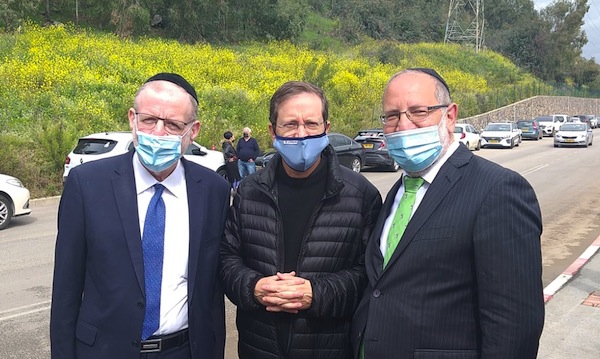
Left to right: Rabbi Dov Bakst, presidential advisor, Yitzhak (Buji) Herzog and Rabbi Shlomo Raanan at the March 4 launch of the Ayelet Hashachar initiative to create a promenade in Kiryat Shmona to commemorate Jewish COVID victims from around the world. (photo from IMP)

“What is the main defining characteristic of the COVID-19 era?” asks public activist Rabbi Shlomo Raanan. “The coronavirus brought about separation and disconnect. It separates between countries, divides communities and splits families. It’s about being lonely and alone. My goal is to foster connection. Every Jew has an intrinsic connection to Israel. Let’s help them develop that connection and make it grow.”

Raanan’s organization, Ayelet Hashachar, has recently launched an initiative to foster connection with Diaspora Jewry: a promenade in Kiryat Shmona to commemorate Jewish COVID victims from around the world. More than 100 olive trees will line the kilometre-long walkway. Each tree will represent a different Jewish community from across the globe, serving as a vehicle to commemorate members who passed away from the coronavirus. Visitors to the site can learn about the communities and members who succumbed to COVID by standing next to the tree and getting the story on a dedicated app via a QR code. Each community will have its own mini-site, featuring eulogies, historical anecdotes and any extra information the community wishes to include, for a bona fide living memorial.

“Throughout the years, Diaspora Jewry has always been there for Israel,” said Raanan, explaining what inspired him to reach out to Diaspora communities and provide this free service. “We felt that the time had come for us, here in Israel, to show them our solidarity and support during this very challenging time.”

The significance of the location of the commemorative promenade is not limited to the views of Mount Hermon that Kiryat Shmona affords. Israel’s northernmost city is no stranger to bereavement – its very name commemorates eight people, including hero Joseph Trumpeldor, who were killed, in 1920, while defending the area. More recently, the proximity of Kiryat Shmona to the Lebanese border has made it a frequent target for terror and rocket attacks.

Kiryat Shmona is a symbol of Jewish determination and tenacity. Off the beaten track, it needs to invest twice the effort to make itself relevant to the centre of the country. Despite the hardships associated with leading a border city, Mayor Avihay Shtern has been making strides to promote development and attract residents. The growing food-tech industry and the establishment of large academic institutions are examples of those efforts.

“I am proud and gratified to have this opportunity to reach out to Diaspora communities and commemorate their COVID victims,” said Shtern. “There are many memorials, but I’ve yet to see one honouring those who succumbed to the pandemic, even though we’re almost a year in, and it’s taken such a heavy toll globally.”

photo - Kiryat Shmona Mayor Avihay Shtern, left, with Rabbi Shlomo Raanan
Kiryat Shmona Mayor Avihay Shtern, left, with Rabbi Shlomo Raanan. (photo from IMP)

Shtern noted that the walkway, to be named “the Path of Life,” will serve as “a living history lesson” for local residents, as well as the many visitors and tourists who flock to the Upper Galilee. “I think it’s important for us to remember, and for the children of the future to know, what happened during this period. The coronavirus will soon disappear, but we must never forget those who were lost to the disease.”

A grand opening ceremony for the promenade was held on March 4, with the participation of the mayor, Raanan, senior public figures, as well as Jewish Agency chair Isaac (Bougie) Herzog.

Each tree, a story

Raanan sees special significance in planting trees as commemoration. “There is a beautiful verse in the book of Job: ‘For a tree has hope; if it is cut it will again renew itself and its bough will not cease.’ Trees signify revival, particularly olive trees,” he said. “They are a perfect metaphor for the Jewish people. Even when it looks lifeless, the olive tree still retains vitality deep inside. Olive trees are also very adaptive; they survive tough periods and can live for thousands of years. It’s certainly appropriate that the olive tree is the symbol of the state of Israel.”

Raanan welcomes community leaders and members who wish to have their community represented by a tree on the promenade. His staff of web developers will prepare the relevant text and visual material at no charge.

“The coronavirus separated people from their loved ones, often forcing victims to die alone,” he said. “This memorial accomplishes the opposite, bringing communities together and uniting people.”

Raanan has other plans to connect Diaspora Jewry with Israel, as well.

Parallel to the commemoration project in Kiryat Shmona, he is offering interested communities the opportunity to plant not just one tree but an entire olive orchard. “There are vast tracts of land across Israel that are neglected…. Communities can plant their own orchards in areas of national importance – the Galilee, the Negev, the Jordan Valley,” he said.

Of established projects, Raanan’s Chavrutah program was started more than two decades ago, with the aim of encouraging dialogue between secular and religious Israelis. The program now features close to 20,000 people studying in partnerships, in Israel and abroad.

Ayelet Hashachar’s goal in all its projects is to heal the divisiveness of Israeli society by working to eliminate mistrust between sectors, thereby breaking stereotypes and encouraging mutual respect.

For more information about how to have a community featured in the Path of Life commemoration project, email [email protected] or call 97-252-617-6222.

– Courtesy International Marketing and Promotion (IMP)


Format ImagePosted on March 19, 2021March 18, 2021Author Sharon Gelbach IMPCategories IsraelTags Avihay Shtern, Ayelet Hashachar, coronavirus, COVID-19, Diaspora, Israel, Kiryat Shmona, memorial, olive trees, Path of Life, Shlomo Raanan
Galilee as a food-tech hub

Galilee as a food-tech hub

Former chief scientist of Israel Avi Hasson, left, and MK Dr. Erel Margalit. (photo from Noa Yaar)

Having the Upper Galilee be the world’s food-tech hub is the dream of Israeli Member of Knesset Erel Margalit, who recently announced he will run for leadership of the Labour party. And the work has started in the form of Israel Initiative 2020 (ii2020).

Leading the establishment and development of the food-tech hub in Kiryat Shmona is Michal Drayman, a partner and chief financial officer of Jerusalem Venture Partners (JVP). She has 11 years of high-tech experience and 14 years’ experience in the agro-bio medical activity area of investment.

For Drayman, ii2020 is her volunteer job, and she describes her role as “vice-chairman.” The initiative started up nearly four years ago, focusing much of its work in Israel’s upper north and south.

“We decided to focus on agri-food development in the Eastern Galilee, which is made up of a group of 22 municipalities, from Tiberius in the south, up to Metula in the north and the Golan Heights in the east,” she told the Independent.

They began working with the region in January 2014, holding brainstorm sessions and doing about six months of research with 10 leaders from the region to pinpoint a focus, which became agriculture.

“Anything that can be grown on earth can be grown in the Eastern Galilee,” said Drayman. “Because of the difference in height, climate, water and land, it allows them to grow anything from tropical things to cherries, apples and everything in between.

“We also discovered that the area already has a lot of activity when it comes to agro-bio research – in particular, with Migal, a foundation founded in the early ’70s that has about 115 employees, 65 PhDs and about 50 laboratories developing food and agro-bio activity.”

With Tel-Hai College to develop the academic focus – most of its 5,000 students are studying agriculture, bio-technology, food and nutrition – the region is well-positioned in the field.

As Drayman and team sought an even more specific focus, they decided on medical food, which means any food promoting health and preventing illness. “With this, we’re taking into consideration modified food, functional food, macro-bio activities, and how it will affect us concerning nutrition going forward,” said Drayman.

While work in this field is being done on a large scale by the Volcani Centre, as well as by other institutions throughout Israel, it has rarely reached the market. It took Drayman only six months to get consensus from area municipalities that medical food would be their focus, after which she began on the year-long process of writing up a plan.

“Bio-technology and health, there’s so much to do that, with the right investment, we see the potential of growing something significant in that area,” she said. “In food tech, there’s a lot of innovation and research, but not a lot of invested money. Much of the work that is done is void of being able to monetize it. That’s true of the world, not just in Israel.”

Looking at how food companies impact health by what they put into the food they make – ingredients such as sugar and salt, for example – Drayman and team are working with the industry to change regulations, especially food labeling. The goal is to give customers clear information about the nutrition content in the product they are buying.

“The idea is that companies cannot just [add] sugar whenever they don’t have another ingredient and want to fill [the product] with something very cheap,” said Drayman. “We’re going to show … a red stop light on food. If it has too much salt or sugar, it will be identified on the wrapping.

“The food industry is going through significant change,” she added. “Regulations, GDP talks, and the fact that people are more educated and understanding about what we’re eating, will affect how we’ll be when we get older. If we’re going to make sure we’re eating proper nutrition, then probably we’re going to affect a lot of the illnesses and reduce the amount of obesity.”

Exactly three years from the initiation of the project, with the 22 municipalities participating, the government approved about 80% of Drayman and team’s submitted budget. Next, they will speak with various multinational companies to see if they will invest in research and development in the area.

“One of the things that’s already in process is the movement of the Volcani Centre that is currently in the Tel Aviv area to the Galilee,” said Drayman. “It was declared, but I’m less optimistic about how fast it will happen. But it was declared it will happen, which is huge, because we’re talking about 5,000 scientific people doing research. So, moving that kind of activity would be significant.”

The municipality of Kiryat Shmona has allocated a building to house the new food innovation centre and funds are being collected to allow for the renovations, with Jewish National Fund picking up half of the $6 million tab.

“Basically, we want it to be an iconic building in the centre of Kiryat Shmona, something that will be visible from the road,” said Drayman. “It will have an accelerator for food-tech activities and activities with kids and education – trying to have two percent of top-tier students working together with the accelerator, incubator and entrepreneurship … being part of a success story.

“We’re going to also have music, because we don’t want to have it only as a high-tech building. We want to make sure we have regular people being part of it, living the scene, and not isolating this kind of activity.”

To raise the remainder of the needed funds, Drayman is working to create a consortium of five multinational companies that would run the accelerator and, subsequently, create and run an incubator.

“The accelerator, as opposed to regular accelerators that only do mentoring and primarily help when you’ve started to build a theme … we want to do proof of concept with our accelerator,” said Drayman. “We’d like to invest money, not only time and support, from high-tech people. We want to actually invest money and run the project for four to 12 months to identify an actual R&D project or research and bring it to commercialization.

“Assuming it’s able to be commercialized, then we’d like to take it into the space of an incubator and invest larger amounts of money to be able to run the project until an actual company is created.”

As of press time, IBM was considering providing data analytics.

For more information or to get involved with ii2020, contact Noa Yaar at [email protected] or 1-781-530-8025.

Rebeca Kuropatwa is a Winnipeg freelance writer.

Format ImagePosted on July 14, 2017July 11, 2017Author Rebeca KuropatwaCategories IsraelTags food, high-tech, ii2020, Israel, Kiryat Shmona, technology
Helping youth at risk

Helping youth at risk

Beit Vancouver is a centre for youth at risk in Kiryat Shmona. (photo from Jewish Federation of Greater Vancouver)

The Etzbah HaGalil, or Galilee Panhandle, is the northernmost part of Israel, a “finger” of land extending into Syria and Lebanon, with its southeastern border also touching on Jordan. Militarily and geopolitically vulnerable, Etzbah HaGalil is also far removed from any urban centres, rendering it somewhat cut off from Israel’s economic and cultural heartlands, as well as its government infrastructures. For all of these reasons, young people growing up in Kiryat Shmona, one of the Etzbah’s major towns, face particular challenges.

Add to the above the fact that many immigrants are drawn to the Etzbah by cheaper housing. As in any other country, newcomers to Israel have a particular need for social services and community institutions to help them integrate into society and flourish. Yet those are the very things that have been hard to find in the Etzbah. Enter Beit Vancouver, a centre for youth at risk in Kiryat Shmona.

Originally built by the British Jewish community campaign (United Jewish Israel Appeal) in the early 1980s and held by the Israeli Housing Ministry, the youth centre that would eventually become Beit Vancouver was built near a major public high school in Kiryat Shmona. Inadequate operating support left it deserted for many years and the centre was in need of rescue in 2004 when the Partnership2Gether Coast-to-Coast steering committee identified it as a high-priority project in the region. P2G is a partnership between Jewish Federation of Greater Vancouver and five other Jewish communities across Canada, and the steering committee includes representatives from the Canadian and Israeli communities in the partnership.

In 2005, three Vancouver-based families (the Diamond, Heller and Libin families) visited the region and donated funds for the renovation and renewal of operations at the centre. Beit Vancouver was scheduled to open July 11, 2006, but that day turned out to be the first day of the Second Lebanon War, which delayed the centre’s opening until September 2006.

The initial operating years of Beit Vancouver were strong, with rapid growth. An infusion of funds from the Israel Emergency Campaign beyond the initial commitments from the core funders helped.

Juvenile delinquency dropped dramatically in the region and, in 2008, the centre was singled out for national recognition for excellence in providing services to youth.

Unfortunately, 2009 saw both a reduction in funding and changes in staff that led to a decline in the centre’s effectiveness. A visit by Vancouver Federation staff in 2009 inspired a strong intervention with the city administration to force attention to the state of the program and building. Three core partners – Vancouver Jewish Federation, Kiryat Shmona and the Rashi Foundation – each committed to a revitalization of Beit Vancouver, with ongoing operating funding at a sufficient level.

photo - At the launch of the Friends of Beit Vancouver recognition wall on a mission led by Anita and Arnold Silber, Arnold Silber addresses the audience. He is joined by, left to right, Nissim Malka, mayor of Kiryat Shmona, and Eran David from Jewish Federation of Greater Vancouver’s Israel office
At the launch of the Friends of Beit Vancouver recognition wall on a mission led by Anita and Arnold Silber, Arnold Silber addresses the audience. He is joined by, left to right, Nissim Malka, mayor of Kiryat Shmona, and Eran David from Jewish Federation of Greater Vancouver’s Israel office. (photo from Federation)

The centre reopened in March 2010 and the level and quality of programming has grown steadily. When a financial crisis in Kiryat Shmona caused the closure of all other community centres in the city, Beit Vancouver stayed open, providing full-scale services to hundreds of youth on a daily basis.

“This centre is really essential for the youth of Kiryat Shmona,” said Ezra Shanken, Vancouver Jewish Federation chief executive officer. “The community is lacking many things we take for granted. There is no movie theatre in Kiryat Shmona. It is incredibly important that the youth there have somewhere to go.”

And, not only that, but the Beit Vancouver building has been used for emergency housing and relief for Israeli children in communities under attack. For example, when under fire from Gaza, children from Sderot were bused to Beit Vancouver.

Federation currently funds three programs at Beit Vancouver: Net@, Merkaz Ma’ase and Youth Futures. Krembo’s Wings is under review to be funded for 2017.

Net@ is an education program that helps high school students achieve high-level computer skills. The program has produced 5,000 graduates and is the only one of its kind in the region that integrates Muslim, Jewish and Christian youth in joint activities.

Merkaz Ma’ase is a leadership program for young adults designed to deliver equal opportunities and social mobility. It engages at-risk youth in a year of volunteer service after they graduate high school and before they begin their army service.

Youth Futures is a community-based intervention that aims to help children in junior high who are notably at risk for failure or withdrawal. Children are referred to Youth Futures by teachers, social workers and others who observe their need for help, shown by poor attendance, failing grades and behavioral problems. The child is paired with a trustee who acts as a bridge between the child, the family, the school and the public system.

Lastly, Krembo’s Wings provides weekly social activities for young people living with any type of motor, cognitive or sensory disability. The program helps these children become part of community life.

Shanken encourages Vancouver Jews to make Beit Vancouver part of their Israel trip. “Having a place that bears our name creates a bridge that can connect our communities,” he said.

Vancouverites can designate donations for Beit Vancouver through the Federation’s annual campaign, which was launched last week. For more information, visit jewishvancouver.com.

Matthew Gindin is a Vancouver freelance writer and journalist. He blogs on spirituality and social justice at seeking her voice (hashkata.com) and has been published in the Forward, Tikkun, Elephant Journal and elsewhere.

Format ImagePosted on September 23, 2016September 21, 2016Author Matthew GindinCategories LocalTags annual campaign, at-risk youth, Beit Vancouver, Etzbah HaGalil, Federation, Israel, Kiryat Shmona, tikkun olam
Proudly powered by WordPress