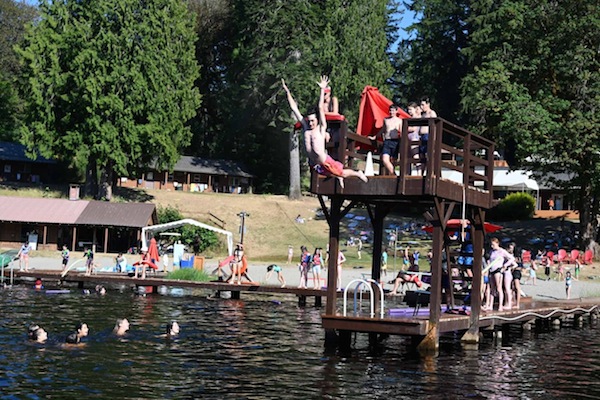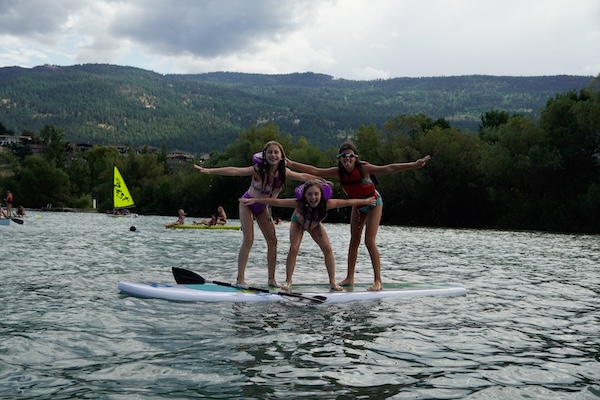
Summer camp experiences, which encompass a range of activities campers get to try, can be costly. (photo from Camp Hatikvah)
If you get sticker shock when you see the cost of Jewish summer camp, you’re not alone. Pay full fare and you could easily be spending $1,000 per week. But there’s a reason it’s so high, say camp directors. Running a Jewish camp is an expensive endeavour – and it’s not getting any cheaper.
For Camp Hatikvah, which welcomes 480 summer campers to the Okanagan each year and a staff of 90, the biggest chunk of its operating budget – just over $2 million in 2024 – is salaries and honorariums. Only two staff members have year-round employment and the rest serve only in seasonal roles, said Liza Rozen-Delman, executive director. Food is the next largest expense, followed by costs related to site operations. And the general program experiences, which encompass the range of activities campers get to try, don’t come cheap either. Hatikvah campers get to waterski and wakeboard, and have access to an inflatable thunderdome on the lake, among other experiences. Now add the cost of insurance to the equation.
“Camper fees cover the direct costs of care, supervision, food and other daily needs, but donors fund all capital projects, major equipment purchases and our financial assistance program,” she said. “Camp could never break even on fees alone. We rely on our donors to help offset operational costs by funding anything considered an investment that lasts beyond a single summer.”
The biggest challenge facing Jewish camps across North America is maintaining affordability for middle-income families, Rozen-Delman said. “All camps, including ours, have wonderful financial assistance programs for those in clear need. What is harder to manage is families who earn higher incomes but struggle to balance the high cost of living an engaged Jewish life.”
Hatikvah tries to manage this by setting its camp fees as low as possible and requesting donations from those who can donate. “We’re fortunate to have donors who understand the immense importance of a Jewish camping experience,” she said.
The same is true for other camps.
“Camp tuition doesn’t cover the cost of operating Camp Miriam and, as expenses continue to rise, that gap only widens,” said Leya Robinson, Miriam’s community director, who noted that no camper is turned away due to lack of funds and about 40% of campers receive a scholarship each summer.
“We rely heavily on donors and grants not only to uphold this commitment but also to cover essential camp operating costs,” said Robinson. “Operating costs include salaries, staff training and benefits, food services, facility maintenance, utilities, insurance, programming, transportation, property taxes, equipment, medical supplies, annual organizational dues and fees, and security.” She added that the camp, which is located on Gabriola Island, is in the midst of a capital campaign “to upgrade our physical facilities so we can continue delivering the ‘Miriam magic’ for generations to come.”
Camp Miriam has more than 350 campers each summer and 85 summer staff. Throughout the year, they have three full-time and three part-time staff.
In Washington State, Camp Solomon Schechter welcomes 630 campers over the course of a summer, and has a staff of 80 to 100.
“Tuition covers only 80% of our operating costs, so we rely on the community to help us with donations, and on our diversifying revenue stream, which includes an outdoor school and a retreat centre available for rent,” said Zach Duitch, executive director.
Schechter is a kosher camp, and kosher food, especially meat, chicken and cheese, are much more expensive than their non-kosher equivalents. The cost of taking care of 100 staff is high, and running high-quality programs infused with Jewish values and themes requires significant funds, too. Up to 30% of camp staff comes from Israel, South America and the United Kingdom. “We love that delegation and we can’t run the camp without them, but, between agency fees, flights and visas, the costs add up,” Duitch said.

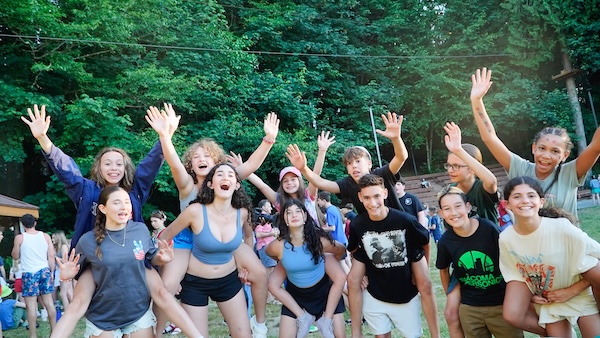
Programming fees are expensive, too. “Today’s parents want and expect their kids to develop new skills at camp, and that demands staff and supplies,” he said. “It’s not enough to play gaga or kick a soccer ball around for three weeks. They want a new toolkit and to know their kids are advancing their skills in terms of tefillah [prayer], sports, arts, cooking and everything we do at camp.”
Like Rozen-Delman, Duitch emphasized the quandary of camp fees for middle-class families. “Affluent families can afford to send their kids to camp. About 25% of our camper base requests some level of financial aid,” he said. “The trickiest part is for middle-class families that want to send their kids to camp. Maybe they need to put a new roof on their house, and that takes priority. How do we make sure all families can come to camp? We know how essential the camp experience is in terms of developing lifelong friendships, connecting to Israel and fomenting a strong Jewish identity.”
Schechter’s annual operating budget is $5.5 million and, while the camp has figured out how to stay financially solvent, it can get challenging when donors drop the size of their gift, or if the camp doesn’t meet its campership goals. “We’re creative and, if we have to pivot, we certainly do,” Duitch said. “We need to focus on endowment, life or legacy gifts, because those can add thousands of dollars into your operations without touching the principal. Our goal is to grow our endowment to secure our programs and infuse cash into our operating budget.”
Consider this, said Stacy Shaikin, executive director of Camp BB Riback in Alberta. “We open six weeks ahead of summer camp, to ‘turn the machine on’ before the kids can come out. There’s an insane number of requirements – health, safety, certifications, and all that stuff has increased in price. We don’t just pay the counselors, we house and feed them. And, remember, nothing in the Jewish community comes cheap. You’re dealing with a market that is small and has ethnocentric needs, such as kashrut and special skills required for teaching. We bring in Israelis to add those cultural pieces to the experiences, and that comes at a cost, too.”
Camp BB Riback welcomes around 250 campers and 70 staff each summer, and its prices run at the lower end of the Jewish camp fee spectrum Canada-wide, said Shaikin. However, there are costs of running a Jewish summer camp that can’t be avoided.
“I have 40-plus buildings that use electricity, a boat that requires maintenance and fuel, a ropes course that has to be certified every year, a horse program and a swimming pool. Anyone that runs a swimming pool will tell you it’s a money pit,” Shaikin said. “And, every year that goes by, you have to think about renovations and replacements.”
He stressed, “I’m not complaining – I’m just offering insight into the business. We’re not-for-profit and our goal is to not lose money, but also to put something back into keeping our campsite up.”
Most of the nearby Jewish summer camps were established more than 70 years ago and maintenance costs run high – keeping the property competitive and its facilities clean, safe and up to code, means putting money back in every year.
So, as you start to consider a Jewish camp experience for your child, keep in mind the value being offered, as well as the values being imparted.
“We’re not making money at our Jewish camp. We’re literally just trying to keep the business afloat and out of debt, which is a struggle for not-for-profits,” Shaikin said. “We’re a community entity and we’re not gouging families in any shape or form. We take our responsibility seriously: to encourage people to send their kids to Jewish summer camp. If they do, then we will continue to have a flourishing Jewish identity in our province, our country and in the world.”
Lauren Kramer, an award-winning writer and editor, lives in Richmond.