Indigeneity and Zionism

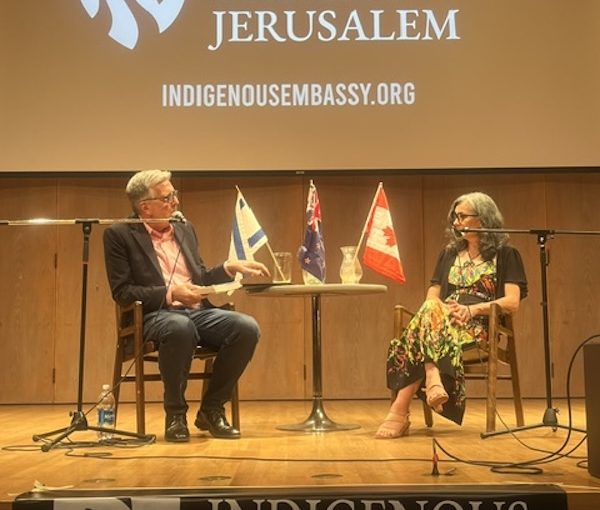
Pat Johnson and Dr. Sheree Trotter at the University of Victoria on June 14, hosted by the Jewish Federation of Victoria and Vancouver Island. (photo by Janet Dirks)

“What we’ve seen happen in New Zealand with our indigenous movement is that Palestine has been held up as a way to fight against what’s happening in our country with our indigenous people,” New Zealand writer and academic Dr. Sheree Trotter told those gathered at the University of Victoria on June 14. 

“So, what we do is that we identify with the Palestinians and we see them as brown, oppressed indigenous people; we see Israel as the Western foreign colonizers.” In this context, she said, the antizionist argument is reduced to one of settler colonialism, despite the differing histories of places like New Zealand, Canada and Palestine.

At the Victoria event, which was hosted by the Jewish Federation of Victoria and Vancouver Island, Trotter, who is of Te Arawa iwi origin, spoke on the topic Indigeneity and Zionism Versus Settler Colonialism. 

“Each of these topics could be a whole university course,” Trotter acknowledged at the outset. Before talking about Zionism, she explained its standard definition: the right of self-determination and statehood for Jews in their ancestral homeland, the land of Israel.

Trotter said there have been several streams of thought that have led to the current antizionist movement, including the views of the Nazis, who saw Jews as conspiratorial subversives, and Soviet antizionism, which depicted Zionism as a global and racist conspiracy. Added to the mix, Trotter said, are Arab nationalist and Islamic movements and, more recently, Western settler-colonial theory.

Settler colonialism, Trotter said, is an ideology that has developed within academia as a particular kind of colonialism. The key feature of it is an imperial power that has sent its people to a foreign land to settle permanently.

“In this way, you create this binary that you’ve got two classes of people. You may call it the oppressor and the oppressed, the colonizer or the colonized, these sorts of ideas. This binary erases complexity. It’s not accurate. It’s not true to history,” Trotter said.

Using the example of the Māori in New Zealand, Trotter explained some of the problems in the settler-colonialist argument.

“There’s no room for nuance or complexity, no room for indigenous agency – the fact that, in my case, Māori embraced many of the new things that came, new technologies, modernity, certainly literacy,” she said. “In embracing Christianity, Māori turned away from tribal warfare, from cannibalism, from slavery, because they adopted a new way of thinking. Under settler colonialism, you don’t get to hear any of the good things that might have happened. It’s all just labeled as oppression and bad.”

More broadly, she argued, the settler-colonialist theory does not fully consider that many of the people who arrived in places like Canada and New Zealand were poor immigrants who do not fit the settler-colonialist power paradigm.

Regarding Israel, the settler-colonial standpoint is a tremendous stretch, said Trotter, because Jews, with more than 3,500 years of continuous connection to the land, are not foreign to Israel.

“In Māori thinking, we have a concept called ahikā, which means keeping the fires burning. If a tribe wanted to keep their connection to a piece of land, it would keep a fire on that land. It’s symbolic of the idea that somebody stayed on the land, even in small numbers,” she said. “Now, we’re finding the fact that there’s always been a Jewish presence in the land. Even though very small at times, they’ve kept ahikā, they’ve kept the fires burning, they’ve kept a continuous connection.”

Trotter is the co-founder, with former member of New Zealand’s House of Representatives Alfred Ngaro, of the Indigenous Embassy Jerusalem and the Indigenous Coalition for Israel, nonprofits established to provide representation in Jerusalem for indigenous peoples from around the world. Her latest book, Zionism at the Ends of the Earth: A Story of Humanitarianism and Identity, chronicles the social history of the Zionist movements in New Zealand to 1948. 

Following her talk, Trotter sat down for an interview and to answer audience questions with journalist Pat Johnson, a member of the Jewish Independent editorial board and founder of Upstanders Canada, an organization working to encourage non-Jewish Canadians to take a stand against antisemitism and antizionism.

The event attracted some protest. According to organizers, the technician who was scheduled to work that evening walked off the job before the event started because of their objection to the subject matter. And, in the middle of Trotter’s talk, a few members of the Jewish Faculty Network of Vancouver Island held up signs rejecting claims of Jewish indigeneity in the Middle East and protesting Israel’s military actions; the group was escorted out of the auditorium without incident. 

Sam Margolis has written for the Globe and Mail, the National Post, UPI and MSNBC.

How Jews are indigenous

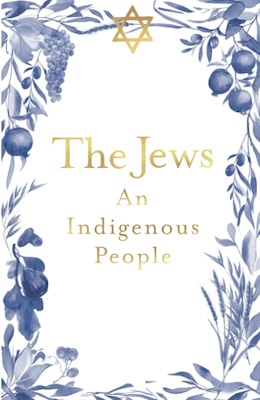
Last month, Ben M. Freeman spoke about his latest book, The Jews: An Indigenous People, as part of Kolot Mayim Reform Temple’s 2024/25 speaker series. (PR photo)

Ben M. Freeman, founder of the modern Jewish Pride movement, spoke from his home in London, England, about his work and ideas in a Zoom webinar on Jan. 12. Titled Building Jewish Pride and Recognizing Jewish Indigeneity, the virtual event was hosted by Victoria’s Kolot Mayim Reform Temple.

The author of Jewish Pride: Rebuilding a People and Reclaiming our Story: The Pursuit of Jewish Pride, Freeman’s latest, The Jews: An Indigenous People, will be released this month.  

Freeman began by calling into question the perception that indigeneity implies people who have lived on the land and are primitive or oppressed.

“I have great issue with that because the idea of those things being inherent is to destroy the great diversity of the indigenous experience,” he said.

The United Nations, he explained, set up seven criteria used to determine the indigeneity of a people to a particular land. Freeman, in his writings and talks, argues that Jews are indigenous to the land of Israel even by the UN’s criteria.

“[The UN] also created rights for indigenous people: the ability to have self-determination, the ability to practise your own religion, have your own language, all of these different things. But, again, many of them are still rooted in this idea that indigenous people are inherently oppressed,” he said.

“We’re not here to say that indigenous people have not experienced oppression. That would be ludicrous. Many indigenous groups do experience that, but we can’t necessarily say these things are inherent….”

To view certain groups as only victims, he contended, strips them of agency.  Freeman would define an indigenous people, rather, as a group whose collective identity begins in one specific land, and it is in that land they remain rooted either physically, spiritually or culturally.

“This is their home and is where they originated, developed and continue to be fixed through a connection to the environment and natural resources, living systems, culture and practice as a people, irrespective of their sovereignty in the land,” he said.

image - The Jews book coverThis definition, Freeman believes, not only applies to Jews in Israel but also refers to the experiences of the Maori in New Zealand and First Nations in Canada, and other peoples in other countries.

From his perspective, Jews were a small group of tribes that developed into a civilization over time. The Torah played a large part as it codified Jewish civilization by taking practices that already existed, reshaped some of them and retold some of the stories, creating a culture that contains religion.

“Almost all the practices were rooted in the land. Pesach was two different festivals: one was a matzah festival and one was a sacrifice festival. Rosh Hashanah, our new year, was the beginning of the agrarian year. Shavuot is an agricultural holiday,” Freeman said. 

“One of the odd experiences of being Jewish is that we exist in this cognitive dissonance almost because we will describe ourselves officially in many ways as a religion, but then we have so much of our practice rooted in land.”

Freeman also put forward that a distinguishing characteristic of Judaism is that, unlike Christianity, it can be a religion but not exclusively a faith or creed.

“Christianity has creed. My partner is a Christian and I sometimes ask him, ‘Could you be a Christian without believing in Jesus?’ And he’s like, ‘no.’ We don’t have that,” said Freeman. “That’s why you can have atheist, secular or agnostic Jews who are part of Am Yisrael. There is nothing we have to believe to be Jews.”

Freeman went on to discuss Jewish pride, which, for him, bears three central tenets. The first is to encourage and empower Jews to reject the shame of antisemitism – to wear one’s Jewishness as a badge of honour.

The second point is to repudiate non-Jewish definitions of Jewish identity.

“I just feel it’s so egregious to me that non-Jews think they have a right to tell us what it means to be Jewish or any aspect of that experience. This is my identity. I will tell you what it means to be a Jew,” he said.

The third tenet is for Jews to go on a journey to explore their identity through a Jewish perspective. “We have to be able to say this is who we are,” he said, “but we have to humbly accept that takes time. We need to be doing real work to investigate our Jewishness and then, most importantly, [do it] through a Jewish lens.”

Freeman is scheduled to travel to Canada in March to discuss The Jews: An Indigenous People, with appearances in Toronto, Windsor and Edmonton. His schedule may include stops in Ottawa and Vancouver, as well.

Next up in the Kolot Mayim 2024/25 lecture series, on March 2, 11 a.m., is Jonathan Bergwerk, author of the Audacious Jewish Lives books, who will speak about Jewish innovators who changed the world. Go to kolotmayimreformtemple.com to register. 

Sam Margolis has written for the Globe and Mail, the National Post, UPI and MSNBC.