TUTS season is set to begin

Left to right: Sheryl Wheaton as Rosie, Lori Ashton Zondag as Tanya and Caitriona Murphy as Donna in Mamma Mia! with Adam Charles as Jack, Caleb Lagayan as Race and Graeme Kitagawa as Mush in Disney’s Newsies. (photo by Lindsay Elliott)

Iconic Swedish pop music and a story that exemplifies America’s love of the underdog are coming to Stanley Park’s Malkin Bowl this summer. Theatre Under the Stars presents Mamma Mia! and Disney’s Newsies on alternate nights, starting with a preview of Mamma Mia! July 5.

Set in the Greek islands, Mamma Mia! features ABBA songs aplenty, as bride-to-be Sophie invites three of her mother’s former lovers to her wedding in order to figure out which one is her father. The TUTS production features two Jewish community members who are veterans of the stage: Wendy Bross Stuart as music director (and rock band pianist) and Stefan Winfield as Harry Bright, one of the possible fathers, a role that was played by Colin Firth in the film version of the musical.

About his preparation for the TUTS production, Winfield shared: “Main note to self: do not attempt to replicate Colin Firth’s performance! He is a great actor. His quintessentially understated, sensual and impossibly British charm that comes across so well on the screen is not something I’d ever be able to reproduce on the Malkin Bowl stage in a way that connects with anyone past the first row … so, I’m bringing what I can to the role, doing my best to fulfil the vision of the creative team.”

Winfield’s first TUTS show goes back to childhood. In 1976, he played Randolph in Bye Bye Birdie. “My next appearance on the Malkin Bowl stage was not until 1999,’ he said, “when I played an adult role (i.e., not a Jet or a Shark!) in West Side Story.”

Since then, he has been involved in several TUTS shows, including Jesus Christ Superstar, another mounting of Bye Bye Birdie and of West Side Story, and The Drowsy Chaperone. Among other things, he was also in Parfumerie at the Metro Theatre in 2014, directed by Disney’s Newsies musical director, Christopher King, and has been directed a few times by fellow Jewish community member Richard Berg, who is currently TUTS’s production manager.

photo - Stefan Winfield plays one of the prospective dads in Theatre Under the Star’s Mamma Mia!, which previews July 5
Stefan Winfield plays one of the prospective dads in Theatre Under the Star’s Mamma Mia!, which previews July 5. (photo from TUTS)

“It’s a pleasure to be working again with Shel Piercy,” Winfield added. “This is the fourth time I’ve performed under his direction on a theatre production, but the first time dates back to 1977! I played Kurt in a very local production of The Sound of Music for Marpole Community Theatre, directed by Shel, who, I believe, had only recently graduated from Eric Hamber. He’s a guy who’s been telling great stories for several decades, on stage and screen; I am very honoured to work with him.”

Another co-worker partially explains why Winfield likes being involved in TUTS. “The opportunity to work under the direction of and perform with outstanding theatre professionals, including my wife, choreographer Shelley Stewart Hunt – not to mention the crowd of extraordinarily talented and impressively trained up-and-coming young people who give themselves over to TUTS for the summer. And, for me personally, TUTS has really lived up to its mandate of creating a family atmosphere in allowing me to share the experience with my son Wesley, who was ‘en ventre sa mère’ during Bye Bye Birdie as Shelley was choreographing, then performed in featured bits in The Drowsy Chaperone at the age of 5, and is doing the same now in Mamma Mia! – this time actually executing choreography set by his mum! To watch it gives me joy … naches, if you will.”

And it’s a family scene that is among Winfield’s favourites in Mamma Mia!

“There are a lot of great moments,” he said, “but I’d say my favourite occurs during the scene when the dads meet Sophie for the first time. Harry is singing ‘Thank You for the Music,’ playing the guitar while lost in wistful reminiscence, when, to his surprise, in walks Sophie who joins in on the song. It’s a moment made all the more special by the lovely voice and energy of the young lady who’s playing Sophie in our production, Keira Jang.”

Also a TUTS veteran, Bross Stuart has worked with Piercy and Stewart Hunt before.

“Shel, Shelley and I have worked together on many shows; we go back a very long time,” said Stuart. “In fact, Shelley was actually my student when she was in Grade 8. And an excellent student at that! As a team, I have profound respect for Shel and Shelley. There is a wonderfully creative synergy between the two of them and between them and myself. They see possibilities which are almost magical.”

Bross Stuart’s first TUTS production was Fiddler on the Roof in 1997.

“In those days,” she said, “it had not occurred to people in Vancouver that it might be useful to have an actual Jewish person involved with a production of Fiddler on the Roof. TUTS was ahead of its time, realizing how important this would be! In those days, there was very little Jewish influence in this town, especially compared to where I had spent my childhood and young adult life – in New York City and Montreal.”
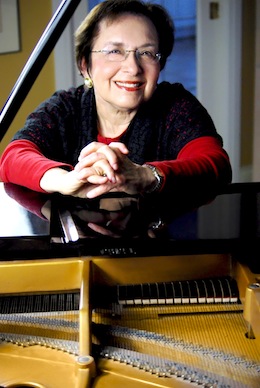
photo - With Mamma Mia! music director and pianist Wendy Bross Stuart has added ABBA’s music to her repertoire
With Mamma Mia! music director and pianist Wendy Bross Stuart has added ABBA’s music to her repertoire. (photo by Erin Palm)

Describing working at TUTS as “intoxicating,” Bross Stuart highlighted the beauty of Stanley Park and said about the feeling of “conducting/playing outdoors in front of a large, appreciative audience – absolutely second to none. A very special experience!”

As well, she noted that “each show has completely different demands because of the material we are using.” For Bross Stuart, ABBA’s music was a new challenge.

“ABBA was not in my repertoire at all,” she admitted. “During the ABBA period, I was busy living in Japan and studying traditional music for koto and shamisen, composed by Yatsuhashi Kengyo and Tsuruyama Kengyo. No pop music for me! However, I have learned so much about this style from working on Mamma Mia! Doing ABBA music has taken me to a new place in my musical life. Growing and learning is such an exciting venture.”

While music rehearsals officially started on April 24, Bross Stuart said she opened her home for early rehearsals to anyone who wanted a head start.

“The style of the music makes the approach much different from most shows,” she said. “Less on the micro details and more on the big picture. As a detail-oriented person, it is a great learning experience for me – and, I am playing keyboard in a rock ’n’ roll band (and conducting). Each of the four keyboards is hooked up to a computer with many sound patches. I love it!”

For tickets to Mamma Mia! and Disney’s Newsies – which may not have local Jewish community members in its creative team but has music by Alan Menken, lyrics by Jack Feldman and book by Harvey Fierstein – visit tuts.ca or call 604-631-2877.

Refugees 40 years on

Sui Khuu and her husband Dar, with their two children. (photo from Shirley Barnett)

In the last couple of years, Jewish congregations and groups in Vancouver have sponsored refugees from Syria, acts of humanitarianism that are inspired in part from ancient and recent history in which Jewish people were strangers in a new land. But this generosity is not new. Forty years ago, in 1979, a similar phenomenon occurred with Vietnamese refugees fleeing conflict in Southeast Asia.

The so-called “boat people” – about two million Vietnamese – fled their homeland in the years following the war there, which ended in 1975. Across Canada, churches, synagogues, service clubs and other groups came together to sponsor refugees. Among these were several B.C. Jewish groups.

Forty years later, one of the refugees sponsored by a group of Jewish friends reflected on the experience.

Sui Khuu was 5 years old when she arrived in Vancouver with her 4-year-old sister Ngoc Lien (informally called Ileen), her father Vinh and grandparents Namson Khuu and Kim Thi Kiu.

“My mom passed away in [a refugee camp in] Thailand,” Khuu told the Independent recently. “She was five months pregnant. She had malaria and she passed away.”

Khuu has no recollections of her life before Canada, but deeply embedded in her memory is the warm welcome she and her family received from the Jewish sponsors as soon as they arrived here.

Four couples joined together to guarantee to the government of Canada that they would ensure the sponsored family got a secure start in their new country: Peter and Shirley Barnett, Abe and Esther Nobleman, Buddy and Cherie Smith and Paul and Edwina Heller.

With the support of Canadian Jewish Congress and Jean Gerber, who worked there at the time, numerous groups banded together to sponsor Vietnamese immigrants, including Beth Israel, Temple Sholom, the Jewish Community Centre of Greater Vancouver and Emanu-El in Victoria, among others.

“Each group had a name and our group chose the name ‘Hope,’” Shirley Barnett recalled. She has kept in close touch with the family across the decades and remembers how Sui was just 7 or 8 years old when she served as translator for her father and grandparents at government meetings and with doctors, teachers and such.

“By the time she was 9, she was the head of the family, because the grandparents never learned to speak English,” Barnett said. The father worked for the Barnetts at their Elephant and Castle restaurant for years. He is now semi-retired. The grandparents have both passed away.

“They were incredibly resourceful, successful,” said Barnett about the family. The girls finished high school and Ileen became an accountant, while Sui is coming up on 29 years as a pharmacy assistant at London Drugs.

“How did they get the strength to turn out so great?” Barnett asked. “The answer came from their grandmother. I remember one day, as a little one, Sui forgot to take her lunch to school and Grandma packed her lunch and found her way to school without speaking English and Sui told me later she found her grandmother wandering in the hallway just trying to find out what classroom she was in to bring her lunch.”

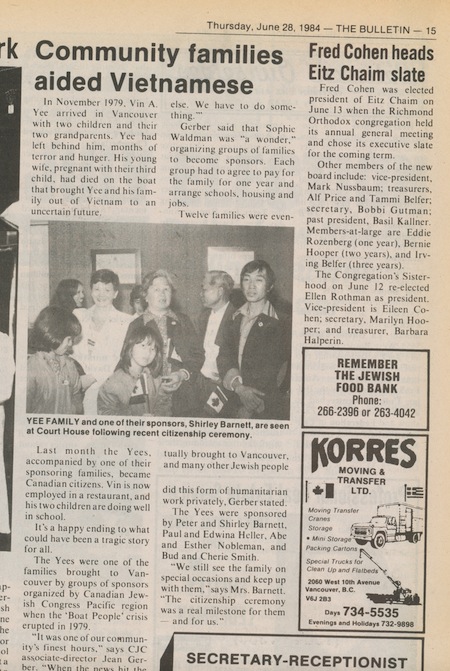
image - An article in the Jewish Independent’s predecessor about Sui Khuu and her family’s citizenship ceremony in 1984
An article in the Jewish Independent’s predecessor about Sui Khuu and her family’s citizenship ceremony in 1984.

While the grandparents never learned English, they found ways to communicate.

“In those years, my ex-husband, Peter, was still fluent in French and he was able to talk to Grandpa a bit in French,” said Barnett.

Khuu recalls something beyond verbal between her grandmother and Shirley Barnett.

“I can’t imagine how she and Shirley communicated at that time but they totally understood each other,” the daughter said. “That was a great memory. My grandmother was trying to tell Shirley [something] and Shirley totally understood what she wanted her to do.”

She also remembers the Barnetts and Nobelmans picking the family up to take them to dinner, delivering Christmas gifts and taking family members to doctors’ and dentists’ appointments.

“Cherie Smith was in charge of finding them clothes,” Barnett said. “I was in charge of getting them enrolled in a preschool.”

“Shirley got a house for us on East 12th Avenue in Vancouver,” Khuu said. Both girls, now in their 40s, are married and each has a son and a daughter of their own.

Seeing Syrians coming to Canada now evokes memories for Khuu.

“It’s hard when they have young families like what my grandparents and my dad went through,” she said. She is saddened when she hears comments that are unwelcoming toward new Canadians and sees the circle of life in the next generation of refugees finding a home here.

Barnett is effusive about how Sui and Ileen have turned out: “By luck or determination or resilience or whatever they had, they turned out really well. They are just lovely, responsible, charming, caring people.”

Exploring music, dance, self

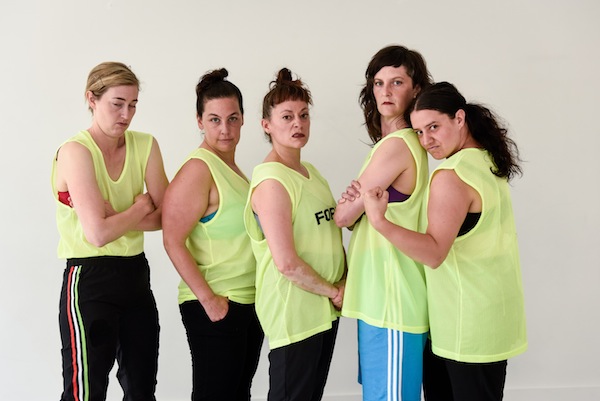
The cast of Tara Cheyenne Performance’s The Body Project. (photo by Wendy D. Photography)

Among the more than 20 choreographers and companies from across Canada, Brazil and Korea that are participating in this year’s Dancing on the Edge Festival are local Jewish community members Alexandra Clancy (Soleful Dance Company) and Tara Cheyenne Friedenberg (Tara Cheyenne Performance).

Soleful Dance Company’s Where the Music Begins will take place July 12, 8:15 p.m., in the Firehall Arts Centre courtyard, and Tara Cheyenne Performance’s The Body Project (working title) is part of Edge 5 July 11, 9 p.m., and July 13, 7 p.m., at the Firehall. DOTE runs July 4-13. Click here to watch the festival trailer on YouTube.

* * *

Where the Music Begins, created by Clancy and composer and musician Mike W.T. Allen, was commissioned by Dances for a Small Stage for its Summer Series.

“Mike and I had played music together but never officially constructed any works for stage,” Clancy told the Independent. “Throughout the rehearsal process, there would be a back and forth of ideas; sometimes I would have a rhythmical phrase of tap dance and Mike would then create a melody over top, and sometimes Mike would compose a phrase of the melody and I would choreograph specifically to that part of the tune. After some give and take between our prospective instruments and ideas, we solidified a melody and then decided upon the structure of the tune. Some of the tune is improvised, some is a conversation, and some is very set and predetermined. We both enjoyed the collaborative process and found a harmonious way to create music and dance together.”

Clancy grew up in Vancouver and has always been involved with the Jewish community. “I was raised Jewish; attending Hebrew school on Sundays, becoming bat mitzvah, and participating in holidays and traditions,” she said. “After going on Birthright a few summers ago, I was re-inspired by the beauty of the culture and have tried to stay more engaged in the community by attending Axis events and other social gatherings, as well as going to synagogue when I can. I am grateful for the support and familial kindness that I have received from the community, consistently reminding and encouraging me that I am capable of whatever I put my all into.”

And she has put her all into a lot, having trained in all genres of dance, studying at Danzmode and the Vancouver Tap Dance Society. She was a member of Tap Co., a pre-professional youth tap dance company, and has trained and performed across North America.

photo - Alexandra Clancy is one of the performers and choreographers whose work will be featured in this year’s Dancing on the Edge, which runs July 4-13
Alexandra Clancy is one of the performers and choreographers whose work will be featured in this year’s Dancing on the Edge, which runs July 4-13. (photo from DOTE)

“After graduating, I lived in Austin, Tex., and was a member of Tapestry Dance Company in its 25th season,” said Clancy. “I then moved back to Vancouver and have been performing and teaching ever since. This past year, I taught at the Arts Connection, Dance Co., and the Pulse, sharing my love and passion for tap dance and educating the next generation of talented dancers.

“As recital season comes to an end, I am currently in a creative residency with Dances for a Small Stage, where we are developing works for our Summer Series and exploring digital literacy in dance. As well as preparing for DOTE, I am also in the studio rehearsing and creating for our upcoming performance at Jacob’s Pillow later this summer. In the fall, I will be moving to Calgary to attend the training program at Decidedly Jazz Dance Company.

“My goal,” she said, “is to broaden my toolbox to assist in expressing myself and telling stories through dance. This upcoming year, I hope to continue to collaborate and create through Small Stage, develop more new works with Soleful Dance Co., film a concept video, and share dance through as much teaching and performing as possible.”

Jacob’s Pillow is located in western Massachusetts in the town of Becket. Clancy auditioned for and then attended the inaugural tap dance program at Jacob’s Pillow in 2010 and returned two years later (again with an audition) for a second summer of learning and dancing. “My time at the Pillow was the most influential training thus far in my life and it has always been a dream of mine to perform my own work at the Pillow,” she said.

That dream will become a reality this summer.

“Jeffrey Dawson and I co-choreographed a piece for an online competition Jacob’s Pillow was running this year, and we were lucky enough to be chosen as Top 6 and then voted Top 3, meaning we will get to perform our work live at the Inside/Out stage on Aug. 17,” said Clancy.

In addition to choreographing and teaching, Clancy established Soleful Dance last spring. She and some other dancers “felt we needed a name and a clear avenue to share the work we had started developing. Based in Vancouver, this company is a platform to express ourselves and tell stories through the music of tap and the movement of dance.

“Although under my direction,” she said, “Soleful Dance Company is rooted in collaboration. Our ultimate goal is to make audiences feel something. All of the members of the company’s primary focus is tap dance; however, everyone brings a versatile background to the creative process, spanning from contemporary dance, to acting, to playing music and more. We hope to continue to grow and create more works to share with audiences in the near future.”

Clancy described tap dance as “a magical art form that allows one to not only express through movement but connect and emote through sound.

“This traditional American art form has a rich and complex history that is intertwined deeply with jazz music and culture,” she explained. “There is a sense of community that I have always appreciated about tap dance, and I feel a great amount of respect and gratitude that I get to perform and participate in its culture. It just feels good to get to move your body and dance and then, on top of that, creating and connecting with music opens endless doors of expression.”

* * *

The Body Project is a new interdisciplinary performance created from interviews, symposiums and roundtables.

“I started research on and around the theme of ‘female body image’ about a year ago,” Friedenberg told the Independent. “Part of our research/creation process has been interviewing female-identifying and non-binary people (many dancers and actors). To date, 35 people have generously participated.

“In the studio, I have been mining my own complicated and unhealthy relationship with my body as a dancer in a female body with the help of my amazing collaborators/performers. The process so far has involved exploring how the forms of stand-up comedy and dance can express this difficult, and often absurd, story of struggling with body image that many of us share.”

The performers – Bevin Poole, Caroline Liffmann, Kate Franklin and Kim Stevenson – came into the process shortly after Friedenberg began her exploration of the topic.

“We are working very closely with intimate and difficult material so, although I am leading the process, it is essential that all the voices/bodies in the room are present in the work. For example, there is a section choreographed by Kim Stevenson – much of the gestural language has been created through our own gestures as we’ve spoken about our personal experiences with body image.”

About the creative process, Friedenberg said, “These are very busy people, so we have had times when we are all in the studio and other times when it’s just me and one collaborator. Making room for people’s lives and demands, including parenting and caring for parents, is an important part of our feminist practice.

“Justine A. Chambers is our dramaturge/outside eye and Michelle Olson will be involved in the project as a consultant and possibly a performer in the next phase of development.”

As professional dancers, the performers/creators have shared some common struggles and coping mechanisms regarding body image.

“The pressure to fit a very narrow ideal of the ‘dancer body’ has been difficult and complex for all of us,” said Friedenberg. “There’s the pressure to be very thin, small, more muscular, or less muscular. Pressure to fit an oppressive ideal of beauty. We each have found ways to navigate these limiting ideas. Sometimes we have had to remove ourselves from certain arenas in order to survive. Sometimes we have found power in defying the stereotypes of what a dancer should look like to the euro-centric patriarchal gaze. But I keep coming back to the effort and energy required to bare these expectations and what we can transform with that energy instead.”

She added, “It must be noted that the many voices, words, time and contributions from the people we have interviewed are alive in the work through our bodies and presence. Their names will be listed on our website. Although the work, at this early stage, is a version of my story, it is also very much a result of being together in conversation about body image, in a circle, speaking, listening, moving, supporting and sharing with many powerful female-identifying/non-binary people – ‘the personal is political.’”

* * *

The full DOTE schedule can be found at dancingontheedge.org. For tickets, call 604-689-0926 or visit tickets.firehallartscentre.ca.

Naming inhumanity

Concentration camps are in the news this week. The term, which was first used in the context of Jews in the Holocaust, is being invoked by opponents of the U.S. government’s detention of migrants from Latin America. Appallingly, those detained include hundreds of children who have been separated from their parents. These current child detainees are among the at least few thousand children who have been separated from their families over the last two years.

The use of “concentration camps” and phrases like “Never again” has been criticized by some high-profile Jewish activists and others as diminishing the meaning and seriousness of the Holocaust. Some see the use of these terms as a cheapening of the Jewish experience or a form of Jew-baiting. In contrast, it is not heartening that Republicans who sanctimoniously condemn the use of these terms have a crass political motivation for defending the sanctity of Jewish historical memory.

There is no question that the words are used for their shock value. And, at a time when short attention spans intersect with what is genuinely a grotesque affront to humanity, there is little wrong with shocking a complacent population.

Reports from the facilities tell of sickening conditions.

A group of lawyers who toured one of the facilities and spent days interviewing child-inmates said that the most basic standards demanded under international law around the treatment of children in custody are being ignored. Children are not supposed to be held for longer than 72 hours, but many have been incarcerated for weeks. They are crammed into windowless warehouses, unwashed for days, in mucous-stained clothing, without the most rudimentary necessities like soap or toothbrushes, sleeping on cold concrete floors, suffering lice-infestations and untreated influenza outbreaks. Guards bring diaperless 2- and 3-year-old children to the facility and ask older children to care for the younger ones. Teenagers serve as unofficial guards in exchange for extra food. Parents are being held separately in unknown locations and some experts have said it is likely some families will never be reunited.

The situation for adults is not to be ignored either. At one facility, about 900 migrants are incarcerated at a facility intended for 125. Cells intended for 35 people are jammed with more than 150.

In an unfathomable breach of what public relations folks call “optics,” there are plans to accommodate the ever-growing number of child detainees by repurposing Fort Sill, Okla., a site where Japanese-Americans were interned during the Second World War.

To be charitable, the argument over language reflects a struggle to find words for what is happening. The situation for these children (and adults) is intolerable in any country, least of all, perhaps, in the land that once welcomed the tired, the poor, the huddled masses yearning to be free.

Still, concerns over the desecration of the memory of the Holocaust are legitimate. We have witnessed too many instances where minor affronts are equated with Nazism and other massively inappropriate comparisons. But the Holocaust did not begin with crematoria. It began with dehumanization and othering and, as the will of the world to tolerate increasingly hostile acts against Jews was tested and found to be elastic, the perpetrators progressed into successive stages leading to genocide.

There is no way to predict the future and there is little point in making unnecessarily combustible assertions about impending genocide. But, when human beings are treated as they are in this circumstance and the trajectory is toward more of the same, people must militate against this inhumanity.

A consensus has developed among Holocaust educators and human rights activists that the term “Never again” does not apply solely to attempts to reprise anti-Jewish ideas and actions, but that the lesson of the Shoah is that we must be vigilant when any people are targeted.

It is unfortunate that the people who seem most inclined to use Holocaust-associated language in the context of current events are also people whose record on issues of concern to Jewish people are highly problematic, drawing reasonable suspicions to their motives. Terminology is important. But, the more we learn about what is happening to children and others in American detention facilities, the more hair-splitting over nomenclature seems to compound the inhumanity we are witnessing.

We are correct to be defensive about any perceived disrespect to the memory of the Holocaust and its victims. However, we might ask ourselves, when judging the appropriateness of such usage: If not now, when?

Inspired by a fellow activist

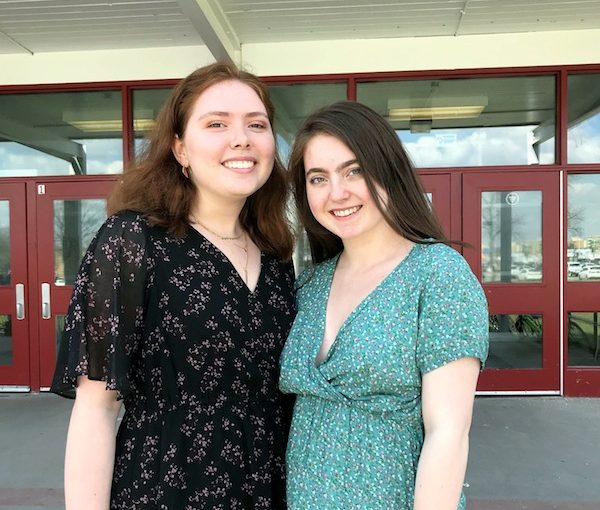
Katie Delay, left, and Sunny Enkin Lewis are co-presidents of Grant Park High School’s Students for Social Justice. (photo from Sunny Enkin Lewis)

Earlier this year, Winnipeg Grade 12 student Sunny Enkin Lewis won first prize for her age group in A&E network’s contest Lives That Make a Difference. The contest receives hundreds of submissions from all over Canada.

“The prompt [for the contest] is along the lines of, ‘Write an essay about someone who has made a significant contribution to Canada in 2018,’” Enkin Lewis told the Independent. “So, I wrote about Autumn Peltier, who – I believe she’s 15 now, around there – is an indigenous water keeper. She’s an activist for clean water in indigenous communities in Canada. She’s spoken at the UN, she’s spoken to Prime Minister Justin Trudeau. So, she’s done a lot of amazing activism.”

Peltier is Anishinaabe and is from the Wikwemikong First Nation on Manitoulin Island in northern Ontario.

“I chose her for a couple reasons,” said Enkin Lewis, who was born in Toronto, but has lived in Winnipeg for the past 10 years. “First of all, I think her cause is really important in Canada. I’ve always been really upset with Canadian society and government, because we tend to look at ourselves as pretty flawless in terms of human rights. And, it is true that the quality of life for Canadians, overall, is really good. Yet, there are people, a lot of people, who don’t have the most basic of their needs met – water and shelter … and I think she has brought more awareness to that.”

In her essay, Enkin Lewis points out that Peltier not only stands up fearlessly for this cause, but that she does so from a unique worldview as an Anishinaabe person.

“She thinks of water as deserving of rights,” said Enkin Lewis. “That’s not something we would generally think of and I think it’s a really strong statement – that someone can stand up and speak of things in a way that contrasts the common logic of general Western ideas. I think that helps validate indigenous worldviews in a Western context a little more. Also, I was just inspired by her, as a young woman. I think it’s so important that young people’s voices are heard and that’s how I believe change will happen the fastest – if young people are given a platform and are accepted and respected – and she really embodies that.”

As for as why Enkin Lewis’s essay may have been chosen, she said, “I think my choice of person was really relevant in Canada today, especially since, now, I think, there’s a big focus on indigenous rights, and I think it was maybe a bit refreshing to see someone like that. I haven’t read the other people’s essays, and they didn’t tell me why mine was specifically chosen … just that they thought it stood out.”

Growing up, Enkin Lewis learned that “a big thing in Judaism is valuing life over everything, and knowing the value of human life. And, I think a big part of Judaism is also just respect for people and … everyone should have a good quality of life.

“The fact that, here, in Canada, there are people who don’t have their basic needs met, I think that’s not OK in Judaism. I think it’s important for other cultures to listen to each other, just as I think it’s important for Christian people to listen to Jewish people. And, I think it’s important for Jewish people to listen to indigenous perspectives. As a European Jew, I’m not native to this land … and it’s important to respect the people who are the caretakers of this land and who have been for thousands of years.”

Last year, Enkin Lewis led the organizing of a social justice conference at Grant Park High School, which, in turn, led to the development of a student social justice club at Grant Park. Enkin Lewis and co-president Katie Delay created the club and, because they and the teacher involved in helping to form the group will have left the school by the start of the next school year, Enkin Lewis hopes the younger members will pick up the ball.

“I think our club is very student-centred, very much about what we care about right now, and it gives me and other people an opportunity to get involved in a safe and constructive way,” she said.

As Grant Park has many newcomer Yazidi students, events organized by the club have been focused on building community awareness of the Yazidi situation.

“We did a drive for school supplies for underprivileged students in Winnipeg, and the biggest thing we’ve done is organize a coffeehouse and a couple other events for Yazidis with the help of a local organization called Operation Ezra. We had a bake sale where we sold traditional Yazidi foods, a Yazidi dance class to educate people about the culture, etc. I find that people are not really aware of what’s happening to the Yazidi people.

“We had a coffeehouse in the evening and invited community members, students, parents, anyone to come. There were student performers and a speaker talking about what’s happening, and a Yazidi performer.”

Enkin Lewis’s essay win comes with a $3,000 cheque for her and a $1,000 cheque for her school. She plans to follow her family’s Jewish custom of donating a portion of everything they earn. “I haven’t narrowed it down to a specific organization yet,” she said, “but I’m going to donate it basically to her [Peltier’s] cause – water in indigenous communities. Other than that, I will probably put it toward my education.”

Rebeca Kuropatwa is a Winnipeg freelance writer.

The search for a friend

Finding Fukue follows Jessica Stuart’s journey to Japan to find her childhood friend.

screenshot - Finding Fukue follows Jessica Stuart’s journey to Japan to find her childhood friend
(screenshot)

To what lengths would you go to find a childhood friend whose letters stopped coming decades ago? When online searches proved fruitless, Vancouver-born, Toronto-based musician Jessica Stuart headed back to Japan, and her journey is recorded in the CBC Short Docs film Finding Fukue, which was produced with Real Stories. Since posted to YouTube last November, the charming and moving documentary has been viewed more than 3.6 million times to date.

“When I was 9 years old, my parents got English teaching jobs and moved us all to Japan for a year,” shares Stuart as the film starts. Among the images we see are clips of home movies from that year, 1988. “I was a blond kid, and that made me of interest to all the Japanese people because they had never really seen a blond-hair person before,” she says. “They would point at me or my sister, touch my hair, talk at me; I didn’t understand anything yet. The day after we arrived, I went to school for the first time and then that was crazy. I didn’t feel that anyone was interested in getting to know me, except for one person, and her name was Fukue, and we became best of friends.”

The Stuarts – Wendy, Ron and daughters Fiona and Jessica – settled in Saku, then a small rural village with no foreigners. Now, however, Stuart has to start looking for her friend Fukue in a city of 100,000 people. She visits the elementary school they attended and gets a yearbook, where she gets Fukue’s father’s name and an address from the year 2000, but this leads her to a new development, where she and her translator (for the more complex encounters) meet some women who remember her family but can’t help with finding Fukue.

At Saku City Hall, a press contingent meets Stuart and she gets the word out on television and in print. Finally, a clerk at City Hall manages to find a phone number for Fukue’s sister, who connects the two friends. The reunions – first by phone and then in person – are quite emotional. The two fall into a familiar comfort and get reacquainted. They have kept in touch since.

The approximately 21-minute film can be found at youtu.be/ZVlZMOB-Sq0.

Aiming for carbon neutrality

Jeff Golfman’s Raw Office helps “businesses save money and be more eco-friendly in their supplies.” (photo from Raw Office)

Jeff Golfman has been working on ways to preserve nature since he was a boy. “I can trace it back to my time going to camps in the summertime and just really connecting with nature and with the human impact we have on the planet,” said Golfman, who went to B’nai Brith Camp in Kenora, Ont., and also spent one summer at Camp BB in Pine Lake, Alta., in addition to spending time at family cottages.

“Initially, it was just seeing people leaving garbage at campsites and leaving garbage in the wilderness. That really bothered me as a kid. It really stuck with me. That’s where it started, really. For me, wanting to be concerned about the legacy and what we leave behind, in terms of … how we show up on the planet and what we leave when we’re gone.”

Born in Vancouver, Golfman grew up in Winnipeg and is now living in Toronto. He started Winnipeg’s blue box recycling program in 1990 and then began researching how to make paper without trees, eventually getting patents to make tree-free paper, which is now available in big box stores like Staples, Office Depot and Office Max. About five years ago, he turned his attention to developing and sourcing product for his recently launched online office supply store, the Raw Office (rawoffice.ca).

“We help businesses save money and be more eco-friendly in their supplies,” he told the Independent. “It just made sense to do business with purpose…. It wasn’t so much that my passion was to save the world. It was more like I asked myself, ‘What is logical?’ And, to me, it’s logical that we’d want to do good while making commerce at the same time.”

While Raw Office’s current client base is 80% American, the company does business all across Canada, including in Vancouver, Calgary, Winnipeg, Toronto and Montreal.

“We’re using artificial intelligence and data to come into businesses and make recommendations for them on how they can make better informed decisions,” said Golfman. “Most people, when they go shopping, basically just browse and shop, and add to their cart and check out. It’s a lot of manual work to do that. What we do is put together a custom-made, curated program for each and every business that we come into. So, we’re really a one-of-a-kind program for each and every client we work with.”

Golfman’s company helps clients increase their use of recycled material for starters. Leading by example, Raw Office is currently the only office supply company that is 100% carbon neutral.

“What we practise and help businesses to do is to make an improvement from where they are today,” said Golfman. “It’s not about 100% or nothing. It’s about making an improvement. On average, the companies that have chosen to work with us are saving 30% financially and are getting 200% eco-improvement.

“I can’t speak to the tax benefit just yet, because everything is so new and is a moving target. We’re doing this outside of the political system, to help business be carbon neutral at no extra cost, which I think is the ideal scenario.”

While many companies are working toward going carbon neutral, no other large international player has cracked the office supply sphere. “There are other companies doing eco-friendly office supplies, but the ones we’ve found are not national and international in scope like we are,” said Golfman. “They are usually regional players and niche players.”

Raw Office has teamed up with the Bonneville Environmental Foundation and are buying carbon offsets to support landfill-to-gas projects, with 83,000 products on their website that show their individual environmental footprint.

“They are basically going into the landfill and pulling methane out of the landfill, and repurposing that for power and energy, and helping us reduce our emissions,” explained Golfman. “So, in a nutshell, we’re buying offsets and not charging our customers … banking that into the cost of working with us.”

By eliminating the bricks-and-mortar storefront of a conventional business, Raw Office is able to pass on the savings and offer carbon-offset products that cost 20-30% less.

“We are a technology-based company,” said Golfman. “We don’t hold inventory. We do drop shipping. It’s very similar to other tech companies that have been able to disrupt industries and reduce costs.”

Anyone can buy from Raw Office, but the bigger the company, the bigger the savings and planet impact. “We add a whole bunch of value to larger businesses that have multiple locations,” said Golfman. “A lot of the companies we work with are larger, with dozens or hundreds of locations. Most of our customers are like that, but we add value to all companies.

“One thing we do that is really uniquely for larger companies is the curated program and, also, we have these really great approval processes that allow managers and owners to approve of items and orders. And, we have these really cool features that allow the bookkeepers to integrate into their accounting software more easily.”

Meanwhile, Golfman is also working to create enhanced environmental and financial reports for his customers.

With products made all over the world, Raw Office offers complete transparency, with each product showing the country of manufacture and an eco-score.

“The eco-scoring system we created takes into account the country of manufacturing, eco-certifications and things like that,” said Golfman. “So, you’ll know, with transparency, if you’re buying something that’s made in Canada or overseas…. We make that really clear. If you had a preference for local manufacturing, you can do that on our website using filters … or, if you had a preference for some other country, we can do that, too. It’s all part of the search functionality.”

In his free time, Golfman volunteers with the nonprofit Green Kids, which he founded and of which he is board president.

“It’s an environmental theatre,” he said. “We do live theatre for children. We tour schools across Canada, all the way from Victoria, B.C., throughout Vancouver, Manitoba and Ontario. To date, 1,400,000 Canadian children have seen the Green Kids show.”

Golfman also runs a health blog, called, “The Cool Vegetarian,” where he interviews people about healthy eating and lifestyles.

Rebeca Kuropatwa is a Winnipeg freelance writer.

Meet Barry at Havana

Did you know without goats, the coffee bean may have never been discovered? Are you able to recognize if the vinyl you hear coming from your neighbor’s apartment is a 78, 45 or 33? Do you type your university essays out on a typewriter? Barry knows, Barry can, Barry does, Barry will and Barry did. Introducing the next wave in AI customer service. Barry is the perfect fit for all your too-cool-for-school business needs.

In Jewish community member Ira Cooper’s Artisanal Intelligence, fellow community member Hannah Everett plays Jane, the entrepreneur and creative genius responsible for developing Barry, a fast-learning, curious and fashion-wise artificial intelligence customer service robot, played by Drew Carlson. Cooper describes his play as “not simply a form of absurdist, comedic, low-brow escapism as it may come across. It’s a conversation about identity, as most things are, and its tumultuous relationship with self versus societal box-fitting…. There are other dialogues, too; questions raised about creation versus intent versus audience response and who gets to create meaning. It’s also an affirmation of what love can be.” Artisanal Intelligence is at Havana Theatre July 5 and 7, 9:30 p.m. Tickets ($15) can be purchased at showpass.com.

Mature content (14+)

Kehila celebrates 20th

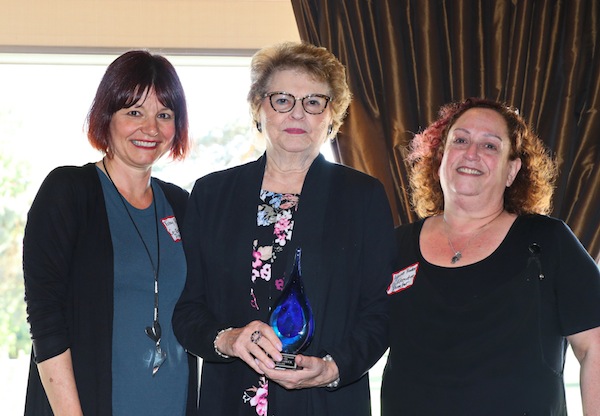
Left to right are Toby Rubin, Marie Doduck and Lynne Fader. (photo by Lianne Cohen)

On May 5, the Kehila Society of Richmond celebrated its 20th anniversary. The society honoured Marie and Sid (z”l) Doduck for the support and guidance they have given to the society since its inception, and celebrated members of its first board of directors. The special annual general meeting, which took place at the Richmond Country Club, also saw the initiation of Kehila’s current board and the event featured speaker Dr. Sherri Wise, who shared her story of surviving a terrorist attack in Israel. More than 90 people attended the AGM.

“The difference that Kehila has made for our Jewish community in Richmond … for the quality of living for those residing here – we continue to be an integral part of the Richmond community at large and are partners within it, making a difference every day,” said Lynne Fader, co-executive director with Toby Rubin.

“Kehila’s weekly seniors program on Mondays is an essential service for most of our attendees,” said Rubin. “We are meeting so many of their needs: from free ESL programming to food sustainability and socialization and education. We are very proud of our program and its vitality.”

photo - The Kehila Society of Richmond’s 2019/2020 board of directors
The Kehila Society of Richmond’s 2019/2020 board of directors. (photo by Lianne Cohen)

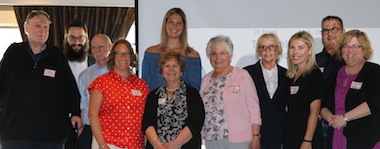
The 2019/2020 Kehila Society of Richmond board of directors is Sherri Barkoff (co-president and treasurer), Mark Babins (co-president), Keziah Selles (secretary), Ruth Singer (seniors’ representative), Shauna Osten (community outreach), Shelley Morris (human resources), Courtney Cohen (community outreach) and Harley Godfrey (finance committee), with directors Rabbi Levi Varnai (the Bayit representative), Lu Winters (Richmond Jewish Day School), Jeff Rothberg (Beth Tikvah) and Sanford Cohen (Chabad Richmond).

“I am proud of the collaboration that we do with all the organizations in Richmond to help those in need, seniors, families and youth,” said Barkoff.

Kehila’s partnerships include the Multifaith Richmond Food Aid Delivery Program, a faith-based group of organizations working to feed the homeless, isolated, low-income and frail in the general population. Kehila assists with deliveries, cooking and, when viable, food vouchers and items of warm clothing. Kehila has facilitated a partnership with the Richmond SPCA and Tysol Pets to assist with these community members’ animal companions.

Kehila also participates in Light of Shabbat, with Chabad of Richmond. This biweekly, by-donation program has volunteers of all ages doing the cooking, packaging and delivering of kosher Shabbat meals to 30-plus individuals.

The Len Babins Nutritional Subsidy Program is a donor-sponsored initiative focused on RJDS but not exclusively. It provides hot lunches twice a week for children in need at the school; children are screened discreetly through the school counselor. Approximately 254 meals per term per student are provided, with a total of 17 children from 12 families accessing the service. But the number of children served is higher than this because, additionally, Kehila funds a healthy lunch for these same children who, on days of no hot lunch program, do not have lunches.

Chabad of Richmond and Kehila also partner in the Richmond Community Seder, an annual, by-donation event that has been held for numerous years. Generally, about 70 people attend the seder and many take food home for a second seder or out of need. This year, for the first time, a full seder meal and supplies were delivered to those who were unable to attend.

Lastly, Kehila spearheads Rose’s Angels, an annual outreach program that provides warm clothing, hygiene products, children’s books and more to local community agencies whose clients are in need of assistance. This year, more than 1,100 individuals benefitted from the program, which is run through donations of many kinds.

Cory Bretz has made a video of Kehila Society’s work and Lianne Cohen photographed the 20th anniversary event – the video and photos can be found on Kehila’s Facebook page (facebook.com/113139405408718).


Community milestones – Silber Theatre, RJDS-Pawer tzedakah, Rudolph wedding, Pawer and Baitelman grads

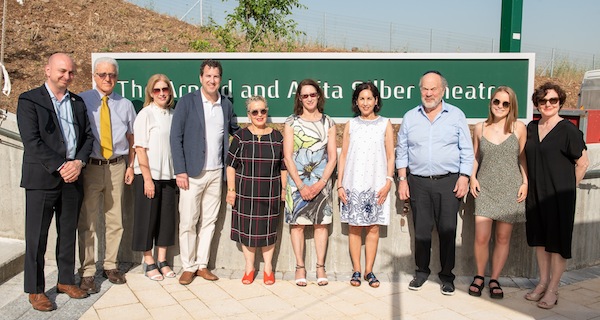
The Arnold and Anita Silber Theatre at Tel-Hai College officially opened last month. (photo from Jewish Federation of Greater Vancouver)

Last month, Jewish Federation of Greater Vancouver chief executive officer Ezra Shanken, as well as board members Karen James, Alex Cristall and Candace Kwinter, and Jewish Community Foundation executive director Marcie Flom were in Israel for the official opening of the Arnold and Anita Silber Theatre at Tel-Hai College. This new 1,200-seat outdoor theatre will be a hub of activity for the university and surrounding area. The theatre is located at the centre of the Tel-Hai campus, and is a key component in the college’s long-term development plan.

The Silbers have long supported Federation’s partnership region of the Galilee Panhandle, and its work there. They have supported a number of projects and established the Friends of Beit Vancouver, a donor-recognition program for supporters of Beit Vancouver. Anita Silber serves on Federation’s Israel and overseas affairs committee, and has for several years. Recognizing that Tel-Hai is a significant economic driver in the region led the Silbers to fund this legacy project and lend their name to it.

The official opening of the theatre began with a welcome reception with Tel-Hai’s board of trustees, followed by a ribbon cutting. The Silbers were joined by their granddaughter, Samantha Addison, and family members from Israel. In reply to the address honouring them that was delivered by Tel-Hai’s president, Prof. Yossi Mekori, Arnold Silber stressed that the students were the primary motivation for this investment. They are the ones to whom the future of the region is entrusted, and it is they who will take it to the next level.

A number of families and individuals from our community agree, and they are funding scholarships, which were awarded to students at the ceremony by James and Cristall: the Coleman Family Scholarships, the Krell Family Scholarships, the Evelynne Loomer z”l Scholarships, the Bernard Lotzkar Scholarships and the Zalkow Family Scholarships.

* * *

photo - Left to right are Lola Pawer, RJDS students Maya Bernal and Penina Berger, and Leslie Diamond
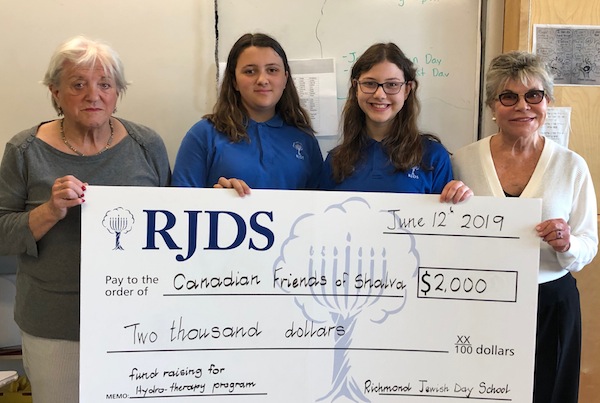
Left to right are Lola Pawer, RJDS students Maya Bernal and Penina Berger, and Leslie Diamond.

Over the course of the 2018/2019 school year, the Student Council Committee of Richmond Jewish Day School took it upon themselves to raise money for the Shalva Centre Hydrotherapy Program in Israel.

With the support of families, the school raised $1,000, which was generously matched by Lola Pawer. Pawer and Leslie Diamond, who is a board member of the Shalva Centre, came to RJDS to teach students about the work Shalva provides for children with disabilities.

The students presented a cheque to Diamond in the amount of $2,000. For anyone wanting to learn more about Shalva or make a donation, visit shalva.org.

* * *

photo - Brett and Caro Rudolph
Brett and Caro Rudolph

Brett and Caro Rudolph have fun at their wedding in Syracuse, Sicily. Brett is the son of Les and Anita Rudolph of Vancouver (previously from South Africa) and Caro is the daughter of André and Svetli Wanne of Vienna. The wedding was officiated by Rabbi Paul Chaim Eisenberg of Vienna and was thoroughly enjoyed by family and friends. Brett and Caro live in Israel.

* * *

photo - Samantha Pawer
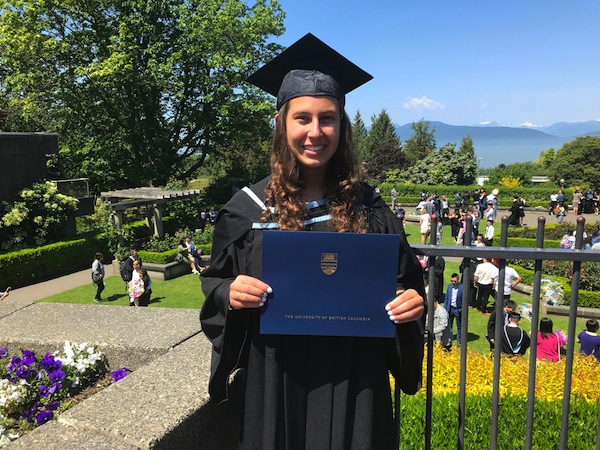
Samantha Pawer

On May 25, 2019, Samantha Pawer was conferred the degree of bachelor of science honours in integrated sciences with distinction from the University of British Columbia. Samantha is an alumna of Richmond Jewish Day School and Hugh Boyd Secondary School. Proud are parents Jeff Pawer and Beverly Pawer and big brother Brayden Pawer.

* * *

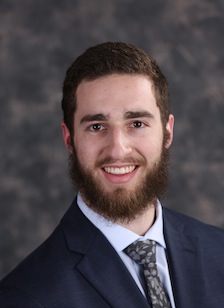
Moshe Baitelman decided to become a doctor when he took his first biology class in high school. On May 26, 2019, the Vancouverite graduated as valedictorian at Touro’s Lander College of Arts and Sciences in Flatbush, Brooklyn, N.Y. He will begin medical school in the fall.

photo - Moshe Baitelman
Moshe Baitelman

Baitelman chose Touro because it offered a strong Jewish environment as well as academic rigour. He majored in honours biology and minored in computer science. Along the way, he built strong relationships with his professors. “They all pushed me to be my best,” he said.

Living in Brooklyn, Baitelman found support for his career goals via the Gedaliah Society, a local network of Chabad men and women in the healthcare profession who offered advice and shared their own experiences in preparing for medical school. He also served as executive editor of Touro’s science journal and president of the Touro Science Society.

“Moshe has distinguished himself as a gifted, multitalented student with outstanding leadership skills. We are confident that he will become a respected physician, who will create a Kiddush Hashem in all his patient and professional interactions,” said Dr. Robert Goldschmidt, vice-president and executive dean of the Lander College.

Prior to Touro, Baitelman attended Vancouver Hebrew Academy for elementary and then the Pacific Torah Institute. Both schools imparted a strong Torah education with Jewish morals and values, and a first-class education. Baitelman’s education in Vancouver was the solid foundation for a life of strong Jewish identity and commitment to Jewish observance and learning, as well as enabling him to pursue further career education.

Baitelman credits his parents for his drive; they instilled a strong work ethic and have continued to encourage him. He offers similar advice to students getting ready to start college: “Be proactive. It will be the difference between just passing through and actually gaining from college. Find activities that will be conducive to your professional and educational growth – use your network of professors, advisors and other students.”