לאור אירועי המלחמה בין ישראל לחמאס בעזה נרשם גידול משמעותי באנטישמיות בקנדה, נגד יהודים וישראלים. זאת, בדומה לגידול באנטישמיות בארצות הברית הסמוכה ומדינות אירופה השונות. בקנדה יש לזכור קיים הריכוז של היהודים מהגדולים בעולם (מחוץ לישראל)
בשכונת פורסט היל בטורונטו שבה חיה הקהילה היהודית הגדולה בקנדה, רוססו כתובות נאצה על סניף של ענקית הקפה סטארבקס. מייקל לויט, מנכ”ל ידידי מרכז השואה על שם שמעון ויזנטל, פרסם תמונות של האירוע ברשתות החברתיות. זאת למקרה שמישהו מתקשה לקרוא את גרפיטי השנאה. כתוב שם ספל קפה ובעצם אתם מתכוונים לספל דם. תפסיקו להרוג תינוקות ודם על ידיכם. זו המציאות היומיומית של יהודי קנדה
השחתת הסניף על רקע הטענה כי סטארבקס תומכת בישראל היא רק דוגמה אחת לאירועים הקשים שהפכו מנת חלקם של יהודי טורונטו וערים אחרות. באירוע אחר ריססו פעילים פרו־פלסטינים צבע אדום על חנות ספרים בטורונטו, ותלו עליה כרזות עם תמונת המנכ”לית הת’ר רייזמן בצירוף הכיתוב אתם מממנים רצח עם. באירועים במונטריאול אלמונים ירו לעבר בית כנסת ושני בתי ספר. את האירועים גינה בחריפות ראש ממשלת קנדה, ג’סטין טרודו. לדבריו אירועי האנטישמיות הנוראים במונטריאול חייבים להיפסק. אף הורה לא צריך להידרש לספר לילדו כי ירו על בית ספר. אף רב לא צריך להסביר לקהילה שבית הכנסת שלה הותקף. במונטריאול מתגוררת הקהילה היהודית השנייה בגודלה במדינה
בטורונטו דיווח גם על תלישת מזוזות, ריסוס גרפיטי של מגיני דוד טבולים בדם על בתים של יהודים ובבית ספר. בכיר במשטרת טורונטו אומר, כי הממוצע היומי של פשעי שנאה נגד יהודים קפץ בכמאה שלושים אחוז מאז פרוץ המלחמה. לפי גורמים רשמיים, אף שדווחו גם אירועים אסלאמופוביים, מספרם זעום בהשוואה לאלימות הגואה נגד יהודים. שיעור המוסלמים בקנדה הוא קרוב לחמישה אחוזים ומהגדולים במערב, לעומת כאחוז ליהודים
באוניברסיטת קונקורדיה מונטריאול מתגבשת תביעה ייצוגית נגד המוסד האקדמי ואגודת הסטודנטים בטענה כי טיפחו מרחב מוגן לאנטישמיות לאורך השנים, וגרמו בכך לפגיעה רגשית בקרב סטודנטים ומרצים. התביעה מבקשת פיצויים בסכום של חמישה עשר מיליון דולר (קנדי) עבור התובעים, שעמם נמנים סטודנטים, אנשי צוות ומרצים יהודים שהשתייכו למוסד האקדמי בשלוש השנים האחרונות. אוניברסיטת קונקורדיה כשלה בחקירה ובתגובה לאירועים אנטישמיים בתחומה, דבר שאיפשר לאנטישמיות לשגשג ברחבי הקמפוס, טענו העותרים. בבקשה תוארה תקרית אלימה בין סטודנטים פרו־ישראלים לפרו־פלסטינים שהסתיימה במעצר של סטודנט ופציעתם של סטודנט נוסף ואנשי ביטחון. התביעה נגד קונקורדיה מתגבשת ברקע מאבקן של אוניברסיטאות ברחבי קנדה להתמודד עם המציאות הנפיצה בקמפוסים, מאז פרוץ המלחמה ומצטרפת לתביעה שהגישו בשבוע שעבר סטודנטים באוניברסיטת ניו יורק שבה הושמעו טענות דומות
ההסלמה באירועים האלימים נגד יהודי קנדה מאז מתקפת חמאס איננה מאפיינת רק את הערים הגדולות ביותר. במיסיסאוגה במחוז אונטריו, העיר השביעית בגודלה בקנדה, רופא יהודי קיבל איומים על חייו. ביישוב קטן יותר באונטריו, בריונים תלו מכתב איום על בית משפחה יהודית. אין ספק שאנחנו עדים להסלמה חדה באנטישמיות בעיר שלנו, בערים ברחבי קנדה וברחבי העולם מאז מתקפת חמאס, מציין נח שאק, סגן נשיא למלחמה בפשעי שנאה ואנטישמיות, במרכז בטורונטו. בין שמדובר באירועי בריונות נגד הילדים שלנו בבתי ספר משום שהם יהודים ובין שנגד סטודנטים באוניברסיטאות, או אפילו נגד אנשים שעוצרים לקפה בדרך לעבודה ונחשפים לוונדליזם אנטישמי וכתובות שטנה. מדובר במציאות מטרידה מאוד, הוא ציין עוד
Weekly vigils calling for the release of hostages held in Gaza continue weekly at the Vancouver Art Gallery.
On Nov. 26, the vigil spotlighted female victims of the atrocities and emphasized the hypocrisy of many groups, including UN Women, an entity ostensibly dedicated to gender equality and the empowerment of women, which took 50 days to express any concern about Israeli women.
The vigil took place a day after the United Nations International Day for the Elimination of Violence Against Women.
Rebeka Breder, a lawyer in Vancouver who specializes in animal law, addressed the assembled crowd. She reflected on how, as a child, she looked up to the United Nations as a humanitarian organization.
“Laughable, I know,” she said. “As I have come to learn, and as many of the people standing here have come to learn … the UN is a humanitarian organization – but not for Jewish people.”
The world seemingly cares about women’s rights, she said, except for Jewish women.
“Since Oct. 7, UN Women issued 26 statements about Palestinian women and children versus only three statements about Palestinian and Israelis together,” said Breder. “There is not one statement by UN Women that specifically condemns the brutal rape and mutilation of women’s bodies that was committed by Hamas. Not one. When we look at the photos that are posted by UN Women, most if not all of the pictures are about Palestinian women and children. I’m not saying we shouldn’t care. We should care about all life. But when you see UN Women that is an agency, that is supposed to be standing up and essentially representing women around the world, not post even one — not even one — picture of Oct. 7’s brutal attacks on women and [what] other Jewish people have gone through, it speaks volumes.”
Women’s rights groups and officials in Israel have been working to compile information and evidence about the brutality, rapes, mutilation and other atrocities committed by Hamas, Breder said.
“My understanding is that they have tried a number of times to send this information to UN Women so they can review it and, up until yesterday, there was silence, there was absolutely nothing coming from them,” she said.
Temple Sholom member Shirley Hyman, a board member of ARZA Canada, the voice of Reform Zionism in Canada, paid tribute to Vivian Silver, the Canadian-Israeli woman who was murdered Oct. 7 but who was not confirmed dead until Nov. 14.
“Vivian Silver was a proud Zionist,” said Hyman. “Vivian Silver spent the last four decades working to end the Israeli-Palestinian conflict while advocating for coexistence and harmony between both peoples. She was born in Winnipeg and, after a stint at Hebrew University in Jerusalem, in 1974, she moved to Israel and so began her life as an activist.”
Silver was a founder of Kibbutz Be’eri and oversaw construction projects, while shuttling back and forth to Gaza advancing coexistence.
“When Hamas took over the control of Gaza in 2007, everything changed,” Hyman said. “The closest she got to Gaza was the border, where she picked up sick Palestinians in order to take them to hospitals in Jerusalem.”
Disenchanted with the political left’s inability to end the conflict, Hyman said, Silver “turned to woman power.” She helped found the organization Women Wage Peace (Nashim Osot Shalom, in Hebrew).
“It has today grown to be the largest grassroots organization in Israel composed of both Israelis and Palestinians, numbering over 45,000 and located in 95 different areas,” Hyman said. “Every Monday, they protest at the Knesset, wearing white and turquoise so government officials can identify them. They host peace-building webinars, protests and marches around the country and conduct peace-building activities.”
On Oct. 4, days before she was murdered, Silver was with a group in Bethlehem, protesting at the security barrier in Bethlehem, many wearing T-shirts declaring “Peace is possible.”
Toby Rubin, president of CHW Vancouver, the local branch of the national organization founded as Canadian Hadassah-WIZO, stated, “Violence against women is never resistance.”
“It’s our duty to continue to speak for those who cannot,” she said. “But the silence has been deafening from the international women’s groups. Jewish women, Israeli women, our sisters, deserve the same respect, the same rights, and the same voice as women everywhere. Shame on the global community for deliberately ignoring them. Even if the UN came out yesterday, that was 50 days too late.”
The Canadian branch of the worldwide women’s Zionist organization has raised $2.5 million in emergency relief since Oct. 7, she said.
Rubin paid tribute to Daphna Kedem and others who have organized the weekly vigils since the terror attacks. Kedem read the names of all the child hostages. “Your dedication and your Zionism in helping this community never forget the faces,” she said. “We must never forget and we must continue to fight [until] every single one of the hostages is back.”
The previous week’s vigil, on Nov. 19, occurred a day before UN World Children’s Day. Volunteers stood on the steps of the Vancouver Art Gallery holding posters featuring the children murdered or being held hostage by Hamas.
Noemi Gal-Or, professor emerita of politics and international relations, said international law declares that a child should not be separated from their parents against their will. She called on Canada to redouble efforts to press Hamas to release all hostages.
Rabbi Shmulik Yeshayahu of the Ohel Ya’akov Community Kollel said the world should not accept that 40 children – including an infant born in captivity – are being held hostage.
“And the world is silent,” he said. “This is not acceptable. This is not the world that we envisioned. This is not a world that should be. We’ll do anything within their power to bring them home.”
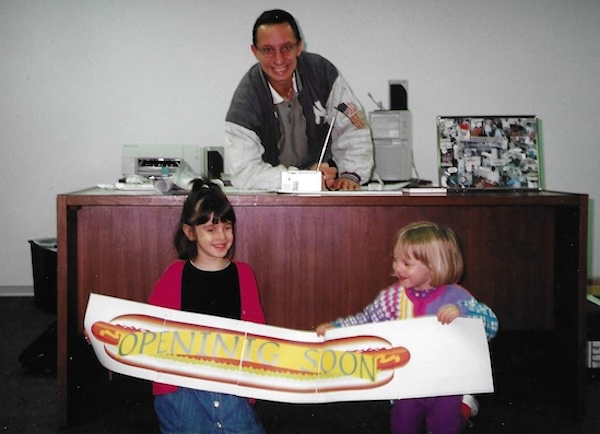
Eppy Rappaport with daughters Aviva, left, and Lauren before the opening of Omnitsky’s. (photo from Eppy Rappaport)
Omnitsky Kosher Delicatessen, which, since 1910, has fed generations – first in Winnipeg and, from 1995, in Vancouver – is entering the next phase of its storied existence. Efrem “Eppy” Rappaport, the owner of the landmark establishment for the past 40 years, is preparing for a well-earned retirement as he passes the apron over to the new proprietor, Richard Wood.
Rappaport’s last day at the Omnitsky helm was on Dec. 8 and there is a strong chance that, when this article goes to print, he may be lining up a putt on a Florida golf course.
When the Independent caught up with Rappaport earlier in the month, he was in tremendous spirits as he was getting set for life after Omnitsky’s.
“I feel fortunate, I feel good, I feel exhilarated. I feel blessed to have had all this mazel,” he said, reflecting on his four decades of running the business.
The story of Rappaport’s involvement with Omnitsky’s begins in Winnipeg in the fall of 1979, when he was pursuing a master’s degree in sociology at the University of Manitoba but had decided to take a year off from his studies.
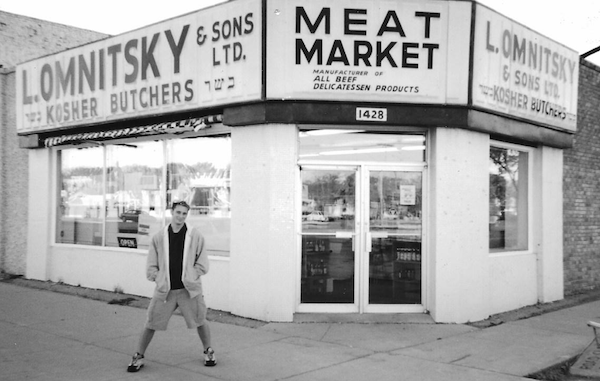
Omnitsky’s was established in Winnipeg, where Eppy Rappaport ran it for 12 years. Former Vancouver staff member Danny Simons is pictured in the photo. (photo from Eppy Rappaport)
Rappaport’s father, Sidney (Shalom) Rappaport, the rabbi at Winnipeg’s Rosh Pina Congregation, was asked by William Omnitsky, the then-owner of the deli, if he might know of someone who could take over the business. At the time, Omnitsky, whose father Louis founded the deli in 1910, was preparing for his own retirement.
The rabbi suggested his son. Soon afterwards, the young Rappaport met Omnitsky in the store’s small office, and they spoke about the business’s potential and the responsibilities that ownership would entail.
“The story of this place, and keeping the original Winnipeg name, comes from the respect I had for Bill Omnitsky. When I started, I did not have the money to buy a business. He took back the purchase price as long as I trained with him. Four years later, I was able to take it over,” Rappaport said.
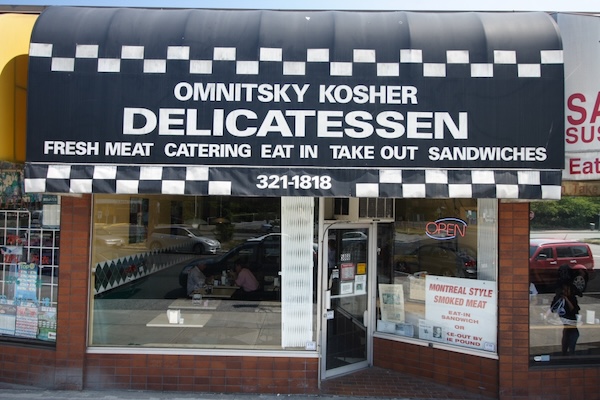
In 1995, after operating Omnitsky’s in Winnipeg for 12 years, Rappaport decided that the Jewish community in Greater Vancouver would present a better fit for his family – wife Ellen Rappaport (née Lowe) and daughters Aviva and Lauren. The deli initially settled on Cambie Street, near West 41 Avenue, before moving to Oak Street in 2014.
During his tenure, Rappaport expanded Omnitsky’s at both the retail and wholesale level. As the only full-service kosher store this side of Toronto, Omnitsky’s has a clientele that comes from numerous points on the western North American map. Regular patrons often drop in from Calgary, Edmonton, Victoria and Seattle.
Besides the kosher grocery store, Rappaport added a restaurant with a soup and sandwich bar. As a result, a loyal customer base was established for those fond of soups made from scratch and sandwiches the size one finds in New York and Montreal.
The deli, open Monday to Thursday, 10 a.m. to 6 p.m., and Friday, 9 a.m. to 3 p.m., features a wide selection of favourites, from pastrami sandwiches to knishes, matzah ball soup to a chopped liver “appy.”
With his wholesale operation, Rappaport began making gluten-free hot dogs with no MSG. Several of his products, such as wieners, jumbos and salami, can be found in grocery stores throughout the Lower Mainland, as well as Vancouver Island, under the Eppy’s Kosher label.
Rappaport’s products are also sold to cruise ships, airlines, hospitals, nursing homes and prisons. They have even found their way to possibly his most famous customer, Bette Midler.
From the time he first took over the business from the Omnitsky family, Rappaport has worked long hours, getting in at 6 a.m. and frequently staying until 6 p.m., sometimes even longer into the night, six days a week.
One story that jumps out at him is when the deli had to move from its Cambie Street location to its current location, in 2014. It was in the period leading up to Rosh Hashanah.
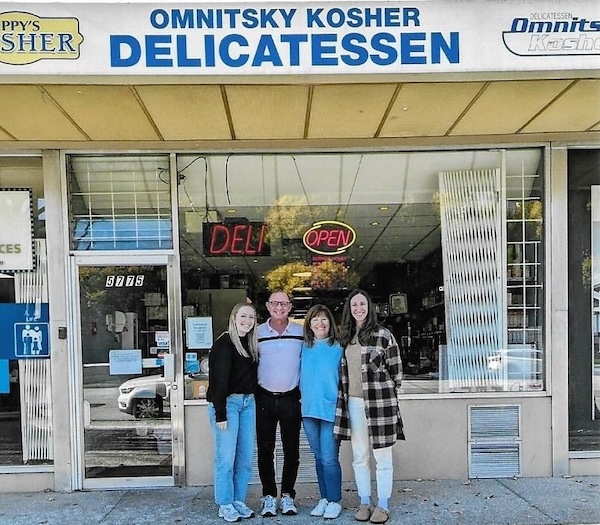
“Just as Rabbi [Yechiel] Baitelman was about to place the mezuzah on the doorpost, he looked up and noticed the number 5755 [Oak St.] outside the building, the same year, 5755, which was about to be marked on the Hebrew calendar,” said Rappaport.
In 1995, Eppy Rappaport moved to Vancouver and opened the deli on Cambie Street, where it was located until 2014. (photo from Eppy Rappaport)
In its 113 years of operation, Omnitsky’s has managed to last through the Great Depression, foreign wars, recessions, inflation, challenges from large grocery stores and, of course, changes in ownership.
In late 2022, Rappaport, who was turning 65, felt it was the right time for him to retire. He placed an advertisement in the Canadian Jewish News to find a buyer for the store, factory, name and delivery trucks.Had a buyer not come forward, Rappaport would have shut the business down.
In an interview last year, Rappaport told a reporter that potentially shuttering Omnitsky’s weighed heavily on him.
“There are a lot of people sitting on the fence of whether they want to keep kosher or not. If they lose the ability to just pop in on their way home from work in order to have something for dinner, then that falls by the wayside,” he said. “The only people who are left are the ones who care and truly want kosher food because it becomes a conscious effort to order it. It becomes more difficult, and a lot of people may use this as an excuse.”
However, a new owner did come along in the form of Wood, the business director at BC Kosher. Rappaport expressed hope that the community would continue to support Omnitsky’s.
“Richard’s passion and commitment to kashrut will continue to strengthen and fulfil the community’s needs,” Rappaport said.
In November, Rappaport wrote a thank you letter to the Vancouver community, published in the Jewish Independent, in which he said it was “impossible to convey the incredible 40-year journey this has been.I truly believe that this labour of love was what I was destined to do in life.”
In that letter, Rappaport said he would treasure the relationships formed with customers and the community over the years, the depths of which exceeded his “wildest dreams.”
Eppy Rappaport with his wife Ellen and daughters Lauren, left, and Aviva after the sale. (photo from Eppy Rappaport)
“The warmth of so many customers filled my heart on a daily basis,” he said. “I want to thank each and every person who always made me feel that my life’s work was important to them, myself and the community at large. This will stay with me forever.”
Besides golfing, Rappaport said he plans to do some food and time management consulting in retirement. But, he stressed, family time is presently top of his list. And, he adds, he will continue to be a presence in the community.
As is the case with their father, Rappaport’s daughters are both involved with food. Aviva works in dietetics at Fraser Health, while Lauren is a senior scientist for Starbucks in Seattle.
There is no doubt Rappaport will be missed by customers who have long frequented Omnitsky’s. As one transplanted Winnipegger noted nostalgically, “Thanks to Eppy, we had a slice of Jewish Winnipeg in Vancouver. Every time I step into Omnitsky’s, I am transported back to Winnipeg’s North End.”
Sam Margolishas written for the Globe and Mail, the National Post, UPI and MSNBC.
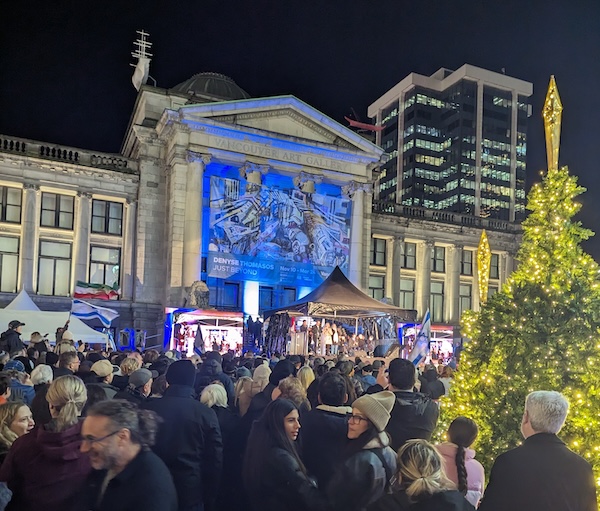
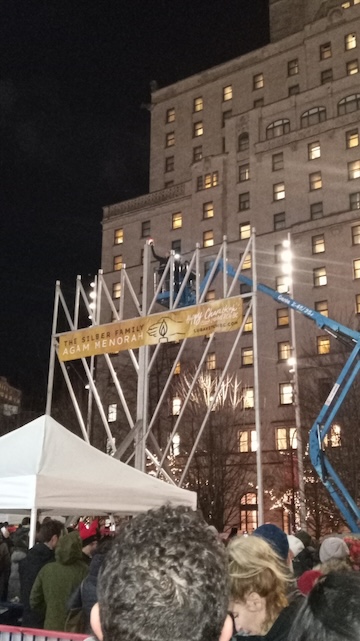
Hundreds attended the lighting of the Silber Family Agam Menorah on the first night of Hanukkah Dec. 7, where politicians from all levels of government offered holiday greetings and support. (photo by Pat Johnson)
Hundreds gathered outside the Vancouver Art Gallery on the first night of Hanukkah, Dec. 7, to kindle light in the darkness. The decades-old annual event led by Chabad Lubavitch BC had even more than the usual sense of familiarity, as the Jewish community has been gathering weekly on the same site since the Oct. 7 pogrom, and Hanukkah’s messages of hope amid tragedy reinforced the words that have been shared from the podium over recent weeks.
The art gallery event, as well as a community menorah lighting Sunday in Richmond, was attended by many elected officials – including the premier of British Columbia and the provincial opposition leader at both ceremonies. Ezra Shanken, chief executive officer of the Jewish Federation of Greater Vancouver, reiterated his gratitude for the support shown to the community in times of trouble.
The first night event was co-hosted by Karen James and Howard Blank and was produced by Richard Lowy, who sang and played guitar. Children from Jewish schools and public schools sang Hanukkah songs. Spoken word artist Vanessa Hadari performed.
The first candle on the Silber Family Agam Menorah was lit by Etsik Mizrachi and Dan Mizrachi, father and brother, respectively, of Ben Mizrachi, the Vancouver man who was killed Oct. 7 while attempting to save others under attack at the music festival in Israel, where more than 360 people were murdered by Hamas terrorists.
The first candle on the Silber Family Agam Menorah was lit by Etsik Mizrachi and Dan Mizrachi, father and brother, respectively, of Ben Mizrachi, z”l. (photo by Cynthia Ramsay)
“This is a time of darkness in the world,” said B.C. Premier David Eby. “British Columbia is a place of tolerance and we need to be like the light on the menorah – we need to be a light against hatred.”
Speaking on behalf of the provincial government, Eby promised to do “all we can to push back against the tide of rising hate around the world.”
He spoke of meeting Dikla Mizrachi, mother of Ben, before addressing the assembly.
“It’s moving to meet the mother of a hero, a man from Vancouver who didn’t run away from danger. He ran back to help a friend,” said the premier, “and it cost him his life.”
In a message he repeated in Richmond a few days later, Eby said he prays for the release of the hostages and for peace.
Kevin Falcon, British Columbia’s leader of the opposition, also spoke both in Vancouver and in Richmond.
“I cannot think of a time in my lifetime that the message of Hanukkah, the triumph of good over evil, light over darkness, has resonated and been so meaningful to all of us,” he said on the first night of Hanukkah. “In the wake of that horrific tragedy, we’ve seen unfortunately some really vile antisemitism in the weeks that followed. Sadly, we’ve seen some of that even here in British Columbia and in Canada.”
Falcon received a resounding ovation on both occasions when he acknowledged Israel’s right to defend itself.
“Something must be made really crystal clear, and that is that Israel has a right to exist, Israel has a right to defend itself and the Jewish community here in British Columbia has the right to feel safe and secure,” said Falcon.
Vancouver Mayor Ken Sim, flanked by many Vancouver city councilors, said, “It’s a really tough time.”
“While we can’t unwind what’s going on, I can tell you that … we love you and we will always be here for you,” said the mayor. “You are our family, you are our friends, you are our neighbours. We have your back. We are not going to stand for any acts of hatred.”
Messages of support from Prime Minister Justin Trudeau and federal opposition leader Pierre Poilievre were read aloud.
“In a country built by immigrants, the contribution that Jewish Canadians have made and continue to make every day to our shared nation are indeed invaluable,” Trudeau wrote.
“For generations,” Poilievre wrote, “the menorah has been a symbol of strength and comfort to the Jewish people. In times of darkness, it has carried a message of hope. In times of oppression, it has been an emblem of freedom. Today, it continues to bring encouragement to Jewish people in Israel, here in Canada and around the globe. Unfortunately, this message of hope is needed now more than ever.”
Jim DeHart, consul general of the United States to British Columbia and Yukon, also spoke, promising that the United States will not stand by in the aftermath of such attacks.
“We won’t be silent in the face of antisemitism and we will continue to work to defeat hate and prejudice in all of its forms,” he said.
Rabbi Dovid Rosenfeld compared current events with the Hanukkah story.
“In the glow of these menorah lights, we find inspiration and the triumph of light over darkness, hope over despair and freedom over oppression,” he said. “Even in the face of challenges that may seem insurmountable, the human spirit can prevail and miracles can unfold.… In the face of darkness, we choose to be the light.”
Herb Silber, son of the late Fred Silber, who donated the menorah that is lit annually at the Vancouver Art Gallery, spoke of the vision of his father and his father’s contemporaries, who built British Columbia’s Jewish community.
“It would be with a heavy heart if those pioneers like my father were here today to witness a rise in antisemitism that, while bubbling on the surface these last few years, has now burst into the open and become mainstream,” he said. “So, I come back to the holiday of Hanukkah because it reminds us that the story of antisemitism is not a new phenomenon. It is 3,500 years old, and the attempt to separate the Jewish people from their indigenous land of Israel is also not a new phenomenon. But what history has shown us is that Jews like my father and his contemporaries and those that came before him, and indeed the story of the Jewish people, is that we are a resilient people.
“One disappointment that marks these historic outbreaks of antisemitism,” he continued, “has been the silence of the non-Jewish community and, regrettably, we have seen evidence of that in events of the past two months. But, gathering here tonight reminds us that we have friends on the stage and elsewhere. And we know that the silent majority of our Canadian neighbours and our friends cherishes each one of us as Canadians, as we do them.”
Lana Marks Pulver, chair of the board of the Jewish Federation of Greater Vancouver, thanked the Vancouver police for ensuring the safety of the community, and noted that antisemitic hate incidents reported in October were up 350% over the same month a year earlier.
Members of the Rabbinical Association of Vancouver stood on stage, days before most of them left Sunday for a three-day mission to Israel.
Rabbi Dan Moskovitz, flanked by seven other rabbis who are on the mission, said he will carry the light of the Vancouver community to the people of Israel.
“We are going because of your light, which shines so brightly in this dark time,” said Moskovitz, senior rabbi at Temple Sholom. “We are going to bring that light, the message of Hanukkah, of resilience, of dedication, of rededication, of religious freedom, of the few fighting to preserve freedom against the many who seek to destroy it, and us in its process. We are going to assure Israelis that they are not alone, that the people of Vancouver stand with them.”
The rabbis, according to Moskovitz, will meet with Israeli thought leaders, Oct. 7 survivors, the wounded, Jewish and Arab Israelis, and others, “to hear with our own ears what people experienced on Oct. 7 and what it has been like in the months since.”
They will also bring cold weather gear to soldiers, especially in the north, who have not been able to leave their posts to replenish supplies.
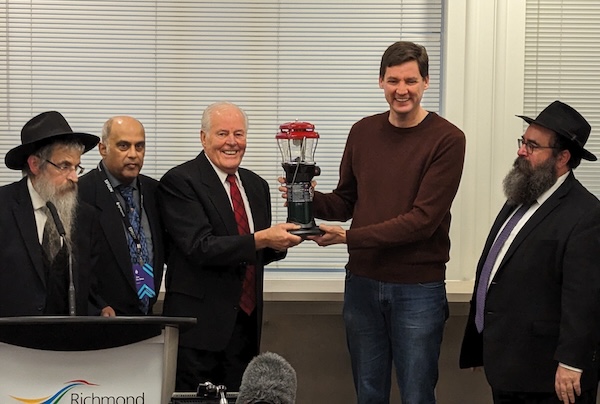
On Sunday, Dec. 10, almost every one of Richmond’s elected officials at the federal, provincial and municipal level was present to hear rabbis speak and to see the premier and Richmond Mayor Malcolm Brodie light the shamash and the first candle. Community leaders Jody and Harvey Dales lit the successive candles.
The Richmond event began 35 years ago and joining Eby on Sunday was Bill Vander Zalm, who was premier at the time and lit the menorah on the first year a public lighting was held.
The Dec. 10 candlelighting was a chance to celebrate the 35th year that there has been a community menorah lighting in Richmond. Among those in attendance were, left to right, Rabbi Avraham Feigelstock, lighting organizer Joe Dasilva, former BC premier Bill Vander Zalm, BC Premier David Eby and Rabbi Yechiel Baitelman. (photo by Pat Johnson)
Rabbi Levi Varnai of the Bayit emceed the Richmond event and said it was the Lubavitcher Rebbe who revived the ancient tradition of public menorah lightings, which, over the centuries, had fallen out of favour for fear of persecution. Richmond was among the first communities to institute the celebration, he said, thanks to Rabbi Avraham Feigelstock, who also spoke Sunday.
In addition to the rabbi and the former premier, numerous people who were at the first menorah lighting 35 years ago were also in attendance Dec. 10, including Joe Dasilva, who has organized every annual menorah lighting. He retired from the Ebco Group of Companies, whose founders, Helmut and Hugo Eppich, donated the Arthur Erickson-designed menorah. Richard Eppich, now president of the family business, attended Sunday.
Light amid darkness is a common theme in the winter festivals of many wisdom traditions. As befitting a Jewish holiday, the meanings of Hanukkah are many and varied, among these the resilience of the Jewish people and the imminence of miracles. These are welcome themes this year.
At vigil after rally after menorah lighting after social media post after dinner table conversations during Hanukkah, the theme has been reprised endlessly over the past days: in a world of darkness, we are called upon to generate light, even to be the light.
Finding the light – let alone being the light – is not easy. It is understandable to respond to events in the world today with hopelessness. A dramatic spike in antisemitic incidents locally and internationally is only an iceberg’s tip. It does not require a physical assault or desecrated property to be victimized by the tsunami of hatred sweeping over the world.
In the face of this conflict and the ensuing uptick in hatred, what have Canadian Jews done? In British Columbia and across the country, we have joined with Jews around the world to volunteer, donate and do whatever is necessary to repair, as much as it can be, the brokenness that happened on Oct. 7 and since.
This is the light we are called upon to be. This is the resilience that is not just a word, but an actualized embodiment of Jewish values.
It is worth remembering that the greatest period of growth and expansion of our own local community occurred in the late 1940s and early 1950s. Even as the magnitude of the unprecedented historic trauma was just beginning to be understood, new synagogues were constructed, new day schools opened, social service agencies launched, refugee aid groups mobilized. Hillel welcomed students for the first time at the University of British Columbia mere months after the end of the Second World War.
In the shadow of unfathomable darkness, Jews in Vancouver redoubled their commitment to nationhood. Similar epochs of regeneration took place worldwide, not least being the fulfilment of the ancient dream of Jewish self-determination as a free people in our own land.
This extraordinary burst of collective local regeneration was, of course, due in part to the influx of refugees, as well as the greatest period of sustained economic growth in human history. But, it was, first and foremost, an expression of the determination of the surviving remnant to plant for the future generations even while mourning those who had planted for them.
The chalutzim, the pioneers, who built the foundations of the community we live in today remain with us – some only in spirit, some very much still with us at advanced ages. Likewise, the founders who built the state of Israel are present, some in body but all in spirit, as we rededicate ourselves to girding the defence, strength and future of that country. Together, the examples of these forces of resilience are models for us to emulate as we struggle in these dark times.
We do not need to search hard for inspiration to get us through and embolden our commitment to carry on, to be the light. It is in the example of our families, our community and millennia of being a people that the poet Yehuda Amichai called “infected with hope.” May we merit to grow in hope, compassion, resilience and light in the coming days and weeks.
I’m that grown-up who jumps to catch a kid who is about to fall off a playground slide, even if the kid isn’t mine. I’m saying, “Hey, be careful!You don’t want to hurt your bum,” or whatever concern is applicable. Some feel I’m overprotective. Rather than using unkind words like “hovering,” I prefer “proactive worrier.”
I felt isolated with this habit. Then I got to know the contractors for our home renovation better. The brothers who worked for us were also parents. They did everything possible to keep kids, dog and parents safe as they worked on the house with us living in it. The older brother, the electrician, would spell out exactly which hazards he was trying to avoid. He would close a door, put up a sign saying “Please stay out” or another proactive way to avoid problems. The day they installed a big new bathtub was a good example. After caulking it, the tub was filled with water to weigh it down and create a good seal. We knew the kids and dog would be very tempted to check it out – we imagined kids falling in in their clothing, playing with rubber duckies, a dog jumping in and flooding the room. We strategized how to keep everyone away from the tub until the caulk hardened.
I was surprised when I started studying Bava Kamma, a Babylonian talmudic tractate dedicated to civil law, particularly the law of damages and compensation owed. In “fancy” legal vocabulary, this is tort law, which “provides damages to victims in compensation for their losses.” The rabbis of the Talmud thought through these issues. They used examples from their day. They talked about oxen that gored, camels that fell (and caused a stumbling block) and other unpredictable situations. I’d heard sermons where people laughed about this level of detail, but my brain returned to those playground moments. Perhaps others don’t take these examples seriously because they’ve never interacted with large, stubborn livestock or a fussy, heavy toddler or two.
Here’s an example of a question posed in a baraita in Bava Kamma 29: “If one’s jug broke and he did not remove its shards, or if his camel fell and he did not stand it up, Rabbi Meir deems him liable to pay for any damage they cause. The rabbis say that he is exempt according to human laws, but liable according to the laws of Heaven.” So, the understanding is, if you create a dangerous situation, you’re obligated to clean it up. If you don’t clean it up, you’re still responsible for it. You’re guilty even if you don’t owe money as compensation.
Examples like these keep popping up. This tractate is a Jewish rabbinic lesson in taking responsibility for our actions. How might something we do harm someone? What if it’s an accident, like dropped pottery? What if you purposely left broken glass or pottery that could harm others?
This ancient rabbinic text can seem dry, as law texts might be, but also relevant. In the last few days, many communities have started to use law as an excuse to exclude public acknowledgement or celebration of Hanukkah. Moncton, N.B., made a name for itself in this way. A Hanukkah candlelighting has been customary there for 20 years. Suddenly, this year, the mayor and council felt it interfered with the separation of church and state. They canceled the event, although Moncton City Hall decorates with angels, a Christmas tree and wreaths. A last-minute petition with many opposing voices succeeded in forcing a new vote that overturned this decision, so the menorah and candlelighting were reinstated.
Other communities wrestling with this include Williamsburg, in my home state of Virginia. Organizers there suggested that a menorah lighting couldn’t be allowed unless it was under a “ceasefire now” banner. In Britain, a London town council reversed their decision to cancel a public menorah lighting after an outcry. Back in Canada, in Calgary, Alta., the mayor canceled her attendance at the city’s public menorah lighting.
Suddenly, the rabbis’ detailed discussions in Bava Kamma make more sense. Their debates explore when someone is wronged by accident, and if they owed compensation. However, they also include the question of responsibility when someone is wronged “on purpose.” For example, when a government uses the law to suppress a minority religious observance, like Hanukkah. When this kind of action takes place, it does harm. It does harm beyond whether Jews are legally allowed to light a hanukkiyah in a public place. The message it sends causes bigger damage and fear.
After all, if Jews in Canada or the United States aren’t allowed to publicly celebrate their religious rituals, it feels unsafe to be Jewish in these places. Where is it safe? Most Jews would then think about Israel as being the place where it’s truly safe to be Jewish. The people who want to withdraw public observance of Jewish traditions due to the Israel/Hamas war send a message to Jews living in North America – it’s not OK with them to have a Jewish homeland in Israel. It’s also not OK with them for Jews to observe their religion openly here. They probably missed the irony, as their message is that it’s especially not OK when the Jewish holiday is about religious freedom.
Laws about compensation for damages can sound uninteresting. It becomes more intriguing when imagining an unsafe play structure, a broken piece of pottery or a camel that won’t budge. It gets even more pertinent – and uncomfortable – when the law is used to keep us from celebrating our religious traditions freely, in public, without fear, in a democracy.
While Hanukkah is ending, it’s still the time of year when many indulge in more sweets and tortes than we’d planned. Sadly, it’s a different kind of tort this year, one where we consider how to compensate for the potential loss of religious freedom.
Joanne Seiffhas written regularly for CBC Manitoba and various Jewish publications. She is the author of three books, including From the Outside In: Jewish Post Columns 2015-2016, a collection of essays available for digital download or as a paperback from Amazon. Check her out on Instagram @yrnspinner or at joanneseiff.blogspot.com.
Inbal Ben Haim in Pli, which will be at the Vancouver Playhouse Feb. 2-3. (photo by Loic Nys)
Imagine flying through the air on … paper?! That’s just what the circus artists do in Pli, which is being co-presented by the PuSh and Chutzpah! festivals Feb. 2-3 at the Vancouver Playhouse.
The show’s concept came from Israeli French circus artist Inbal Ben Haim, who performs the work with Domitille Martin and Alvaro Valdes. Ben Haim has always been attracted to working with various materials. In her first show, Racine(s), which means “root(s)” in French, soil was used as “poetic matter to talk about the connection of human beings with the earth and [their] homeland,” Ben Haim told the Independent. Racine(s) premièred in 2018.
“But my story of paper started from a workshop I had while I was in CNAC [Centre national des arts du cirque], with the artist Johann Le Guillem. In the point of view of Johann, circus is a ‘minor practice’ – a practice that has never been made, that no one’s practising anymore, or that it is very rare. He asked us to prepare a small presentation … and I wanted to work with paper, to create a huge bird of paper and to fly on it. Well, I didn’t manage to do it, but I started sculpting the paper and made a paper puppet, which I suspended in the air and climbed on it.”
“A little bit later,” she continued, “I met Alexis Mérat, who is a paper artist [and who used to perform in Pli], and we figured out we do the same gesture with our hand – he is crumpling, and I am hanging from my rope. So, we wanted to try to do the two actions at the same time – to crumple and suspend. We were sure that the paper would break, but when we discovered that hanging from paper was possible, it inspired us a lot in the poetical point of view of this image – putting your body, your weight, your life, on something so fragile as paper. In a way, it’s a human action that we all do sometimes. It seemed to us that we absolutely needed to continue this research.”
As they did, Ben Haim said it became clear that they had to involve Martin, who she knew from Racine(s). Martin is not only a performer but a scenographer and one of Martin’s specialties is creating a set that is also circus apparatus, said Ben Haim. “This is how we started to work together.”
Ben Haim studied both visual arts and physical practice, and the visual circuses she creates are a melding of those two passions.
“I was always a hyperactive child,” she said. “I did sports, athletics and martial arts since [I was] very young. But, when I discovered circus practice, and especially aerial acrobatics, I found a space of quiet, of high intensity in a calm place. I found a different relation to gravity and to the body, and also a practice that was very physical but at the same time poetic and interior. It touched me deeply.”
Ben Haim said she wasn’t scared the first time she climbed a rope or was suspended from a trapeze. “I was used to climbing on very high places – trees, mountains, and so on,” she explained. “My parents tell that when I was 1 year old, they found me one day up on a ladder – which means I learned how to climb before I knew how to walk.”
It’s only as she has worked longer in the profession that she has felt more fear. “I get to be more aware of all the risks we take, not only in the acrobatic act but in the hanging and rigging – this is where most of the accidents happened,” she said. “I get to be more and more careful with age and with experience.”
Ben Haim moved to France in 2011 to pursue her art and training, first at Piste d’Azur: Centre régional des arts du cirque PACA, then the CNAC de Châlons-en-Champagne, from which she graduated in 2017. Her bio also notes that “she developed a teaching method for therapeutic circus and worked in various contexts in Israel and France. By blending circus, dance, theatre, improvisation and visual arts, Ben Haim has created her own form of poetic expression. Largely inspired by the human bond made possible by the stage, the ring and the street, she aims to create strong connections between the audience and the artist, the intimate and the spectacular, the earth and air, and the here and there.”
This interplay of connections is evident in Pli and how Ben Haim, Martin and Mérat worked together.
“In the moment we discovered that hanging and climbing on paper was possible, we dove into this research, and we wanted to discover and understand all the possible ways to do that,” said Ben Haim. “We did a lot of experiments which are visual and physical, but also mechanical. Alexis is an engineer, so he held all this point of view that finally makes all that we do quite safe.
“We were creating nine apparatus of hanging on paper in different ways, and we observed how the body changed the paper,” she continued. “We created also many scenographies from paper in which I entered to transform them, getting in a different relationship with the matter…. I metamorphose it, and then it holds me differently – it becomes a duet with lots of listening and care.
“In parallel, we were creating costumes from paper, we made lots of sound work, [registering] the different sonorities of paper to compose the music and doing … research on the possibilities of lighting paper on stage. We can say that the paper guided us in this journey.”
Jessica Mann Gutteridge, artistic managing director of the Chutzpah! Festival, was drawn to Pli right away when she was introduced to it by the PuSh Festival, whose director of programming is Gabrielle Martin.
“Chutzpah! and the PuSh Festival share many common interests in terms of the kind of work we present and have been looking for opportunities to work together,” said Gutteridge. “PuSh knows that Chutzpah! has a particular interest in presenting Israeli artists, as well as audiences who are interested in dance and innovative performance, so this project was an excellent opportunity for us to join forces and co-present.”
The 2023 Chutzpah! Festival, which took place just last month, “included a project that centred on long sheets of paper used to create visual artworks on scrolls, with professional and community artists exploring the centuries-old art form of crankies,” said Gutteridge. “This resonance with Inbal’s work creates a lovely bridge to our winter Chutzpah! PLUS collaboration with the PuSh Festival.” (Crankies are a centuries-old artform in which an illustrated scroll is wound on two spools set in a viewing window.)
Chutzpah! took place as the Israel-Hamas war continued, and the probability is that the war will still be going on when PuSh begins Jan. 18.
“We can say that art is not saving anyone’s life in times of war, so what is its power in front of violence?” responded Ben Haim when asked the role of the arts, even in times of conflict.
“I believe that art has the power to bypass the mind and touch beyond it – the heart, the emotions, the curiosity, our sense of humanity,” she said. “Art has the chance to connect us – above the definitions and identities, as nationality, history and politics. And can connect us into something bigger than what we think we are, something which is common.”
She said, “As someone who searches more for solutions than accusations in any conflict (personal or geopolitical), I search the space of connection moreover than the reasons of separation. I believe that that’s the only way we can find peaceful and respectful solutions for all sides. I feel the need of being able to deeply see each other, human beings, beyond the grief, the fear, the sadness. I think art offers us this kind of space, where we can feel all humans, and experience ourselves as a connected grid. It is not the ‘solution,’ but I think it’s a good starting point, especially in our days.”
Having lived for many years in Israel, in a region of recurring conflict, Ben Haim said, “I know how persistent experiences of fear, pain, loss and distress make us become less and less sensitive, and more into defensive and violence. It happens in order to protect ourselves from those difficult experiences, and it is common for all sides. But, in the long run, it is devastating, for ourselves and for our partners.
“Even in the middle of a storm of violence, I think art helps us keep a space of sensibility in this crazy world,” she said. “An untouched place where we can simply be, observe, experience, feel. To marvel in front of some piece of beauty, beside the destruction. Having, for short moments, a sense of hope. To feel the strength in the subtlety, in vulnerability, the power in the creative act, in being alive. And this sensibility can be a window of connection. A thread to follow slowly and gently.”
Pli is 60 minutes with no intermission and the teaser can be viewed on YouTube or Vimeo. It is recommended for ages 11+. For tickets to the Feb. 2-3 shows at the Playhouse (in-person and livestream), visit pushfestival.ca.
I was driving home from work the other day. Left the office early to reduce driving time in the evening hours. Hamas likes their 6 p.m. missile barrage and I’m honing my missile-avoidance routine.
I was listening to talk-radio, but have kind of had enough of the news. Too much war talk and it’s getting a bit overwhelming. So, I switched to Spotify and up popped Supertramp, “The Logical Song.” How “wonderful, beautiful, magical” life once felt. Before Oct. 7. Before Hamas.
Then, as if on cue. I gazed towards the sky and saw missiles flying overhead. At first, it didn’t really click. And then, yikes! I quickly switched back to the news where, in a very calming voice, they were announcing areas under missile attack, which is another reason to listen to the radio while driving during war – real-time information. Lesson learned.
Suddenly, my smartphone’s flashlight started flashing, which was pretty darn cool! And there I was, on Star Trek, standing on the bridge. I even recalled the vessel number, NCC-1701. I was with Captain Kirk. No! I was Captain Kirk, Dr. McCoy by my side, Sulu and Chekov at the controls. The Klingons were attacking and Mr. Spock, standing to the side, was calmly advising the attack coordinates. No, wait! That was the radio announcer. Seriously, this all took place within a split second in my over-active imagination.
The flashing continued. I realized my cellphone was communicating with me, warning of danger. I have the Home Front Command application, which sounds an amazingly loud alarm during a missile attack in my area, but changing between the radio and Spotify prevented the siren from going off. So, instead, the phone activated my flashlight, sending out an SOS. Now how neat is that?! In a geeky sort of way. Like for someone who imagines himself on Star Trek during a real-life missile attack.
Reality set in. There were Home Front Command instructions to follow.
Momentary panic set in. Where was my wife, to tell me what to do? Like she always does … but that’s another story. This time, I wanted her there, instructing me.
All these thoughts raced through my mind in milliseconds. As I calmly slowed the car and veered to the shoulder, like other cars around me, I put on the blinkers. More flashing lights, but the bridge of the USS Enterprise was now a distant thought. Looking both ways, I left the car and hopped over the road barrier, moving away from the car, although probably not far enough, because there was a steep decline just below. It was getting dark and, suffering from poor night vision, I didn’t want to trip and hurt myself. I heard my son laughing at me. “Nerd!” he called out. But that was just my imagination.
I should have laid flat, prostrating myself for maximum protection. But it had rained earlier that day, the ground was wet and I didn’t want to get muddy. “Nerd!” This time, it was my daughter in my mind’s eye. “OK,” I said to no one in particular, “I’ll squat.” Good enough, but not really.
The family in the car ahead were huddling together but too close to their vehicle. I shouted for them to move further away, but they didn’t react. Maybe they didn’t understand me, given my still heavily accented Canadian Hebrew. This time, I heard both my kids teasing me – 30 years and still talking like an immigrant! “Hey, they just don’t hear me,” I said to the darkness.
It was very moving seeing the father crouching down on top of his brood, in a protective sort of way. “Isn’t that touching,” I said to my wife in my imaginings. “For sure,” she responded, somewhat sarcastically, in the back of my mind. “I know you’d do the same.”
Then it was over. The sky went quiet. People returned to their cars. The nestled family broke apart and entered theirs. We should have stayed in place several more minutes. Ten minutes is the recommended time. But it was dark, getting late, also a bit cold. I just wanted to get home, back to the real chiding of my kids and to my wife, somehow longing for her ordering me about.
A few minutes later, my wife called, to make sure I was safe. And then routine set in. “Don’t forget to pick up some milk and bread from the corner store,” she instructed me.
Am Israel chai.
Bruce Brown, a Canadian-Israeli, made aliyah 25 years ago. He works in high-tech and is happily married, with two kids. He is the winner of a 2019 American Jewish Press Association Simon Rockower Award for excellence in Jewish writing.
A resident doctor in Vancouver was confronted by a fellow medical student demanding to know why Israel is exchanging three or more Palestinians for each Israeli hostage kidnapped by Hamas and held in the Gaza Strip. Is an individual Palestinian life of less value than a Jewish life? the student demanded.
This is one of many anecdotes making the rounds among Jewish doctors in British Columbia. These experiences, as well as an inflammatory anti-Israel letter signed by a sizeable number of University of British Columbia medical students, caused more than 100 doctors to assemble to discuss the issues Dec. 5.
“If the university doesn’t take these things seriously, I’m prepared to give up my UBC appointments,” said a Vancouver neurosurgeon who asked that their name not be used because they suspect activists would target them with vexatious complaints to professional governing bodies or harass them online or otherwise. “I don’t need to be associated with a university that does not speak out against antisemitism.”
Medical students in the province are trained in Indigenous awareness among other culturally relevant education, said the neurosurgeon.
“I consider myself to be part of the indigenous people of the land of Israel, and a minority,” the doctor said. “We’ve been labeled as settler-colonialists by a quarter of the medical students and our history has been completely ignored. I think those people should be forced to have some education about the indigenous people of Israel.”
The meeting, held at the Jewish Community Centre of Greater Vancouver, brought together about 50 doctors in person, with another 60 attending virtually. The neurosurgeon left uplifted after hearing from community leaders about strategies and actions being taken.
Addressing the meeting were Ezra Shanken, chief executive officer of the Jewish Federation of Greater Vancouver, Nico Slobinsky, Pacific region vice-president for the Centre for Israel and Jewish Affairs, and Ohad Gavrieli, assistant executive director of Hillel BC. The event was convened by Larry Barzelai, a recently retired family doctor, and Marla Gordon, a physician working in elder care and medical director for long-term care in Vancouver.
The gathering was a reunion of sorts, including some doctors who had been part of an informal cadre of Jews in the field who would get together informally a couple of times a year in recent decades. However, the turnout far exceeded expectations.
Gordon contacted Barzelai, thinking 10 or 20 doctors might want to get together over coffee. As of last week, 240 Jewish doctors, most of them in British Columbia, were part of a WhatsApp group of professionals concerned about antisemitism in their discipline, especially affecting younger doctors. About half attended last week’s event.
The letter that precipitated much of the meeting’s concern was signed by more than 300 UBC medical students – an estimated 20 to 25% of the total student body. The letter called on UBC’s new president, Benoit-
Antoine Bacon, to call for a ceasefire between Israel and Hamas, but also called Israel a “settler state” that is “dispossessing Palestinians of their homes” and stated that Palestinian people “have been continually abused, traumatized, and killed by the settler state of Israel and its Western allies for over 75 years” through “colonialism and imperialism.”
Gordon said the doctors are asking for the medical school’s diversity, equity and inclusion education modules to address antisemitism.
“Just knowing that we are teaching these students who signed this letter, there is discomfort,” Gordon said. “We feel that everyone should be safe in their workplace. If you are a patient, you should feel safe getting care. What if one of your care providers had signed that letter and knows you’re Jewish?”
As much as the meeting had an agenda of fighting antisemitism and biased approaches to international affairs in the medical sector, Gordon said, it is also important for people to gather in mutual support when the community is feeling isolated.
Barzelai echoed Gordon, noting that several doctors told him that any future meetings should continue to be in person, or hybrid, rather than exclusively virtual, because the camaraderie was crucial.
“People are hurt,” said Barzelai. “They are having all sorts of negative experiences in their workplace, with the faculty, with other professors. They want to do something about it.”
Right now, the letter signed by hundreds of medical students is the foremost concern, he said.
“The fact that that many students would sign a letter I think shows the ignorance of the situation, or their lack of knowledge of what’s going on,” he said. “It just pointed to us that we need to educate these people, that it’s too easy to sign a letter and take sides. But the situation itself is a complex situation. To blithely sign a letter like that is kind of distressing. For us, as doctors, we think that people who get into medical school should have done some critical thinking to get there and would be a bit more nuanced about their opinions about the Middle East.”
A lawyer at the meeting stressed the importance of documenting each and every incident on campus, in the workplace or elsewhere. Pro bono legal assistance is available for students and an antisemitism hotline is likely to be operational in the new year.
An alternative letter, signed by Jewish and non-Jewish doctors and medical students, may be drafted and presented to university administrators. Successive meetings will determine next steps.
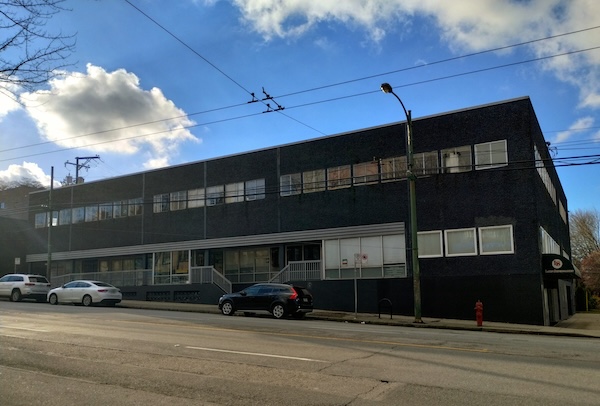
Jewish Family Services of Vancouver has purchased a building at 2929 Commercial Dr. (photo from JFS)
Jewish Family Services (JFS) of Vancouver has purchased a commercial building at 2929 Commercial Dr. to serve as its headquarters and services hub.
“After renovations are completed, the 20,000-square-foot building will offer the necessary space and infrastructure for our social service offerings,” said Tanja Demajo, JFS’s chief executive officer. “Moreover, with ownership, we will finally have a sense of stability after 87 years of frequent moves from one leased premise to another.”
The building, to be named in honour of the Roadburg family, will replace two Vancouver locations that are currently being leased: JFS’s head office at 2285 Clark Dr. and the JFS Kitchen at 54 East 3rd Ave. The new location, just three blocks from the Commercial-Broadway Skytrain station, provides ready access to public transit, which is essential for most JFS clients.
The purchase and a portion of the planned renovations have been financed by generous donations from Harvey and Jody Dales; the Ben and Esther Dayson Charitable Foundation; the Diamond Foundation; the Al Roadburg Foundation; and the Ronald S. Roadburg Foundation.
“We are pleased to support the development of the new facility for Jewish Family Services of Vancouver to carry the Roadburg family name,” said Stephen Gaerber, a director of the Ronald S. Roadburg Foundation and past board chair of JFS. “This provides a long-term solution for JFS, locating JFS’s critical services and administration in a central location near transit and helping ensure more people can get access.”
Services to be offered from the new location will include case management, housing advocacy, clinical counseling, meals from a commercial kosher-certified pareve kitchen, care for Holocaust survivors and a Ukrainian settlement program.
The renovation plans call for, among other things, a multipurpose room that can act as a dining area for meals, event space for programming, and drop-in space for the community. The building will also have a play area for young children, meeting rooms, wheelchair-accessible washrooms, a Jewish Foodbank warehouse, and a truck loading dock.